Conference

Subsidizing Fossil Fuels in Times of High Energy Prices: Fossil fuel subsidy reform in trade and climate discussions

May 16, 2022 1:30 pm - 3:00 pm CEST

In-person at International Environment House II, Geneva and online via Webex

(Open to public)

Effectively addressing fossil fuel subsidies is key to reducing greenhouse gas emissions and limiting climate change, thus allowing member states to achieve global goals. Fossil fuel subsidy reform (FFSR) will deliver trade, economic, social, and environmental benefits and release government funds to support green and climate-resilient investments. This event was co-organized by the Friends of Fossil Fuel Subsidy Reform (FFFSR), the International Institute for Sustainable Development (IISD), and the Geneva Environment Network (GEN) ahead of pivotal Stockholm+50, United Nations Framework Convention on Climate Change (UNFCCC), and World Trade Organization (WTO) meetings this June.

About Fossil Fuel Subsidy Reform

Formed in June 2010, the FFFSR is an informal group of non-G20 countries aiming to build political consensus on the importance of fossil fuel subsidy reform. Current members of the “Friends” group are Costa Rica, Denmark, Ethiopia, Finland, New Zealand, Norway, Sweden, Switzerland, and Uruguay.

At the WTO Eleventh Ministerial Conference (MC11) in 2017, a coalition of 12 WTO members signed the FFFSR’s first Ministerial Statement, calling on the WTO to “achieve ambitious and effective disciplines on inefficient fossil fuel subsidies that encourage wasteful consumption including through enhanced WTO transparency and reporting that will enable the evaluation of the trade and resource effects of fossil fuel subsidies programmes.” The Ministerial Statement also noted that any efforts to phase out fossil fuels must consider the needs of the poor.

Building on that effort, the initiative renewed its statement in December 2021 and is now supported by 45 WTO members. The renewed statement seeks the rationalization and phase-out, along a clear timeline, of inefficient fossil fuel subsidies that encourage wasteful consumption and calls on WTO members to join those efforts. The statement recognizes that reforming fossil fuel subsidies must consider the specific needs and circumstances of developing countries and minimize the possible adverse impacts it may have on their development. The statement also identifies the WTO as a forum to advance discussions for ambitious and effective disciplines on fossil fuel subsidies, in part by using enhanced transparency and reporting to enable the evaluation of the trade and resource effects of fossil fuel subsidy programs.

About this Session

With strong momentum on FFSR in both climate and trade negotiations in 2021, negotiators looked ahead to 2022 with a lot of promise for progress. This included expectations of progress within the WTO after delays of in-person meetings due to COVID-19 in 2020 and 2021. Additionally, the inclusion of fossil fuel subsidy reform as a key part of the Glasgow Climate Pact symbolized a turning point where countries could use FFSR with increased focus as a tool to assist in achieving the Paris Agreement goals.

This was, of course, turned on its head in February with the invasion of Ukraine and the associated crises and instability in global energy markets. Within their energy sectors, many countries are facing pressure to diversify their energy supply. In the short and medium terms, this includes increasing the production and consumption of clean energy sources while also managing immediate pressure to mitigate the impacts of high energy prices on consumers. The pressure and allure of subsidizing fuel prices has been very high; in some cases, we have already seen governments agreeing to price relief, for example, instating "holidays" for the collection of motor vehicle fuel taxes while oil prices are high.

In 1972, the United Nations Conference on the Human Environment made the link between environment and poverty and placed it at the forefront of the international agenda. Now, five decades later, with the international community gathering for the “Stockholm+50: A healthy planet for the prosperity of all – our responsibility, our opportunity” conference, and pivotal meetings of both the UNFCCC and WTO also looming in June, this hybrid in-person and virtual event comes at a timely moment. The event brings together trade and climate experts to outline how they look to address the energy pricing crisis strategically through various forums and collectively work to avoid the pressure to subsidize fossil fuels in the immediate term, while still maintaining momentum on FFSR and the clean energy transition in the longer term.

Speakers

Clare Kelly, Permanent Representative to the World Trade Organization, New Zealand Ministry of Foreign Affairs and Trade

Joy Kim, Senior Economic Affairs Officer, United Nations Environment Programme

Aik Hoe Lim, Director, Trade and Environment Division, World Trade Organization

Ana Laura Lizano, Counsellor, Permanent Mission of Costa Rica to the World Trade Organization

Laurie van der Burg, Global Public Finance Campaign Co-Manager, Oil Change International

Peter Wooders, Senior Director, Energy, IISD
Conference

Moving Beyond GDP: The Case for Wealth as a Core Measure of National Progress

This regional seminar, with a focus on Africa, will explore the case for wealth as a core measure of national progress with discussions on the shortcomings of GDP, the benefits of using expanded wealth measures to guide decision-making, and the steps necessary for countries to embrace this new approach to ensure the sustainability of development. 

April 26, 2022 7:00 am - 8:15 am EDT

(Open to public)

For more than 70 years, GDP has been the most frequently cited and influential indicator of national progress. Yet GDP narrowly focuses on short-term economic growth while ignoring the costs of this growth, including environmental degradation, loss of societal trust, mounting debt, and growing inequality. Decision-making focused on GDP is biased toward short-term economic benefits, overly concerned about what happens in the market economy, and not concerned enough about the consequences of economic growth on other determinants of well-being—especially the environment and community.

But measuring wealth in the broad sense—considering human, natural, social, produced, and financial capital—would give countries new and important insights into the sustainability of their policies.

This seminar will explore the case for wealth as a core measure of national progress. Discussion will focus on the shortcomings of GDP, the benefits of using expanded wealth measures to guide decision-making, and the steps necessary for countries to embrace this new approach to ensure the sustainability of development.

Moderator: Dominique Charron, Vice-President, Programs and Partnerships (International Development Research Centre, IDRC)

Speakers

  • Njuguna Ndung’u, Executive Director, African Economic Research Consortium (AERC)
  • Jim Cust, Senior Economist, Office of the Chief Economist (Africa Region) - World Bank
  • Kevin Urama, Acting Chief Economist and Vice President for the Economic Governance and Knowledge Management Complex, African Development Bank
  • Jane Mariara, Executive Director, Partnership for Economic Policy
  • Lebohang Liepollo Pheko, Senior Research Fellow at Trade Collective & Wellbeing Economy Alliance (WEAll) Ambassador
Moving Beyond GDP Seminar
Conference

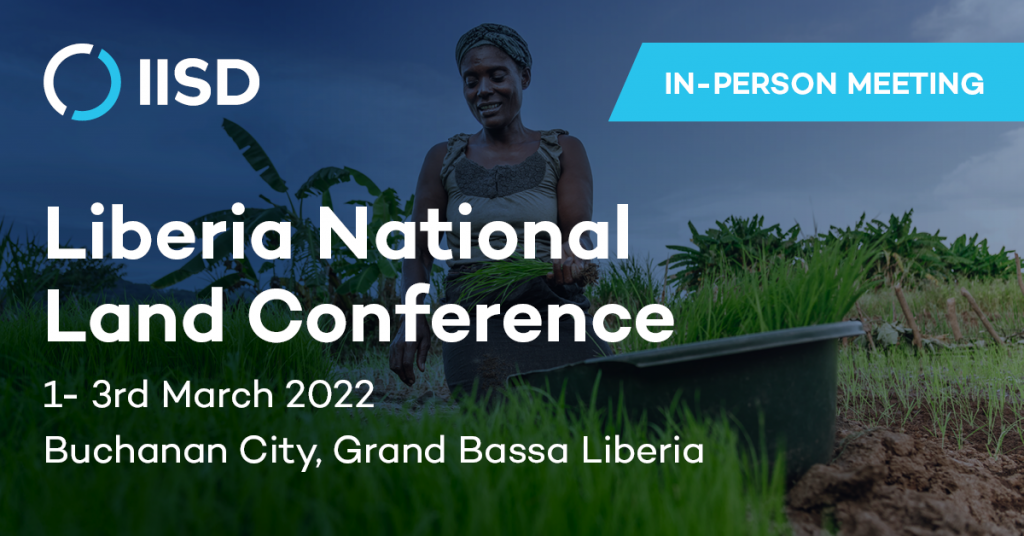
Liberia National Land Conference

March 1, 2022 3:00 am - March 3, 2022 11:00 am

Buchanan City, Grand Bassa, Liberia

(Open to public)

Event card

To help address some of the historical injustices of Liberia, a set of reforms was instituted by the post-war government of H.E. Ellen Johnson Sirleaf, who served as the 24th President of Liberia from 2006 to 2018. Among these reforms was the reform of the land sector. After a 5-year land reform process, in 2013, a policy framework called the Land Rights Policy (LRP) was adopted; 5 years later, the hailed Land Rights Act (LRA) was enacted in 2018. Within the context of inherited widespread food and land tenure insecurity, the historic passing of the LRA is the first step in a long and complex process ahead. Against this background, the National Land Conference will take stock of successes achieved so far, analyze and highlight challenges, identify opportunities, and generate recommendations and commitments for the way forward.  

IISD and the FAO will co-present a Policy Brief on Linkage of Tenure Rights to Responsible Agricultural Investment (RAI) and Food Security during this event.

Conference

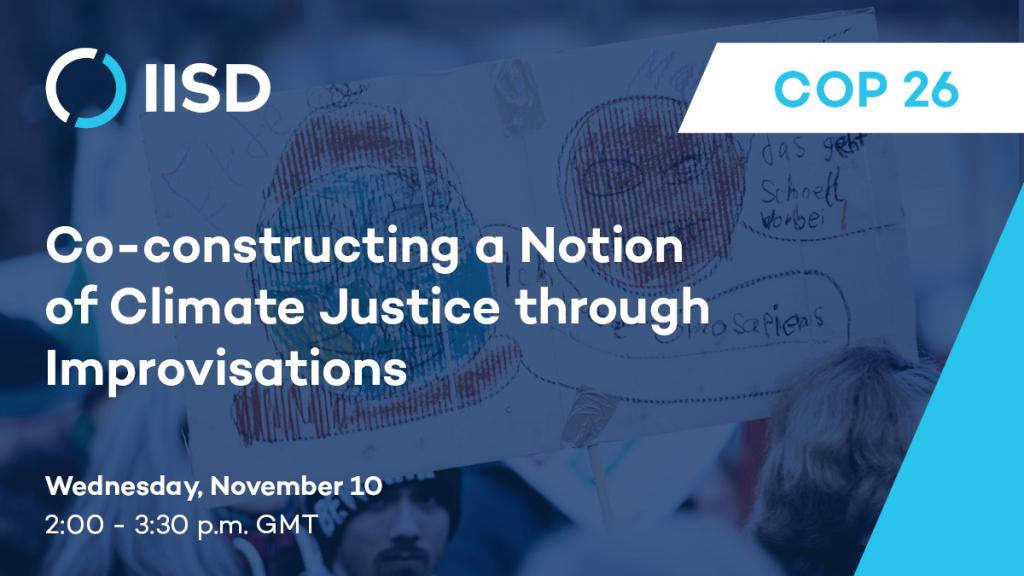
COP26 Side Event | Co-constructing a notion of climate justice through improvisations

November 10, 2021 2:00 pm - 3:30 pm GMT

(Open to public)

Social Media Card | Co-constructing a Notion of Climate Justice through Improvisations

Deconstructing our own notions of 'climate’ and ‘justice’, as well as connecting with the visions of others, will help us shape the action needed on this fundamental aspect of climate efforts.

Everyone has their own ideas about what climate justice is, but there are many gaps in our own constructs. Through improvisation, we aim to generate ideas to help us individually and collectively better understand what makes climate action just. And maybe even come up with some insights into how to get there.

Conference details

Conference

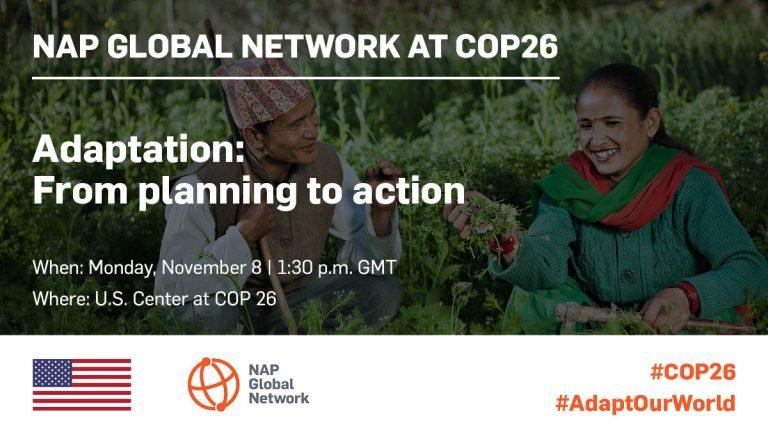
COP 26 | Adaptation: From planning to action

November 8, 2021 1:30 pm - 2:30 pm GMT

(Open to public)

Social Media Card - COP26, Adaptation: From Planning to action

This event will highlight the importance of National Adaptation Plans in building climate resilience at scale. It brings together donors and developing countries to discuss progress and needs, as well as announcements of new funding for the NAP Global Network to increase support for developing countries in achieving their adaptation goals.

Conference

COP 26 | Engaging Citizens in Climate Adaptation through Creative Communications

November 5, 2021 3:30 pm - 4:30 pm GMT

(Open to public)

NAP-at-COP26-twitter-creative-communications

In this session, our experts will showcase the outcomes of two projects that IISD and the NAP Global Network supported to foster innovative and creative ways to communicate the climate crisis through images: the Next Season project, which brought together scientists and contemporary artists to create artwork depicting the climate crisis in Costa Rica; and the collaboration with Lensational, which enabled women in Ghana and Kenya to share their experiences on climate change adaptation through participatory photography.

Watch this event via Facebook Live!

Conference

COP 26 Side Event | Accelerating Adaptation Through Valuation of Nature-Based Infrastructure

On Friday, November 5, 2021, visit the Global Environment Facility (GEF) pavilion at COP 26 to learn more about an exciting new initiative on valuing nature-based infrastructure to support climate adaptation.

November 5, 2021 3:15 pm - 5:00 pm GMT

(Open to public)

Infrastructure provides essential services worldwide that communities rely on. But how do we ensure that new infrastructure is cost effective, environmentally friendly, and resilient to changing climates? The answer lies in nature.

Building with nature offers us a more sustainable alternative to engineered or “grey” infrastructure. Its regenerative characteristics make it more efficient and less expensive to manage and maintain—it is much less carbon intensive, it can help communities adapt to climate change, and it provides a wide range of additional benefits, from job creation to improved well-being for citizens.

In sum, nature-based infrastructure (NBI) can provide valuable ecosystem services and adaptation benefits, all while supplying public services that generate sustainable patterns of development. It offers long-term value for money—so why is the value of forests, mangroves, wetlands, grasslands, agricultural lands, trees, and green spaces so often overlooked?

The reason NBI is not being scaled up enough to fulfill its potential is that our knowledge of its performance, predictability, and financial viability has—until now—been limited.

The NBI Global Resource Centre, led by IISD in partnership with the Global Environment Facility, the MAVA Foundation, and the United Nations Industrial Development Organization, aims to overcome the evidence gap that investors, project developers, and other key stakeholders face when they evaluate whether to invest in nature.

This event will discuss the role of NBI at COP 26; the challenges to design, implement, and finance NBI; and the solutions to scaling NBI. The event will also launch a call for projects from different stakeholders to work with the NBI Resource Centre on the economic and financial valuation of NBI projects.

Learn more about the event on the GEF website.

Conference

COP 26 Side Event | The Subsidy Swap: Reform and reallocate subsidies from fossil fuels to deliver a fair energy transition

November 11, 2021 2:00 pm - 3:00 pm GMT

SEC Centre, Hall 4, Exhibition Way, Glasgow, United Kingdom G3 8YW

(Open to public)

Nordic countries have been trailblazers in implementing environmental fiscal policies including reforming fossil fuel subsidies, pricing carbon, and supporting renewable energy. Hosted by IISD, this hybrid COP 26 side event at the COP 26 Nordic Pavilion will explore how the Nordic experience can inform fiscal policy in the Global South and make the case for subsidy reform and reallocation to clean energy across the globe. Particular focus will be given to experience from South Africa where a coal dominated energy sector coupled with severe energy access challenges presents a number of key challenges for reform.

This event will include presentations of the latest research in this area and a Q&A session, answering:

  • What difference would it make to the climate if fossil fuel subsidies could be reformed and reallocated?
  • Which countries have managed to transform their fiscal systems to enable a clean energy transition and how did they manage this?
  • How can Nordic experience be applied elsewhere?  

For those attending COP 26 in person, please join us in Hall 4 of the SEC Centre in Glasgow. The event will also be livestreamed on multiple platforms. We invite all to tune in virtually via the Nordic Council Facebook page or the We Don’t Have Time online COP 26 platform.

Agenda

Welcome and introduction from the Moderator
Richard Bridle, Senior Policy Advisor, IISD

Opening remarks
Mary Gestrin, Head of Communications Nordic Council of Ministers

Transforming energy, transforming the fiscal system: Clean energy and environmental fiscal reform in Sweden
Sebastian Carbonari, Head of Section Ministry of the Environment Climate Division

Global trends in fossil fuel subsidy reform
Nathalie Girouard, Head of Division for Environmental Performance and Information, OECD Environment Directorate

Reform and reallocate: Swapping subsidies for a fair energy transition 
Chido Muzondo, Policy Advisor, IISD

Response: A youth perspective on subsidies and tax
Nadia Gullestrup Christensen, Danish Climate Youth Ambassador

Q&A session

Conference

IGF 17th Annual General Meeting

The leading international forum on mining policy and sustainable development will once again bring together mining sector experts and stakeholders from government, academia, industry, civil society, non-governmental, and international organizations. The theme for 2021 is Building Tomorrow Together: Mining for a Responsible and Inclusive Future

October 19, 2021 8:30 am - October 20, 2021 11:00 am EDT (GMT -4)

(Open to public)

event poster


The Intergovernmental Forum on Mining, Minerals, Metals and Sustainable Development’s (IGF) 17th Annual General Meeting (AGM) will be held on October 19–20, 2021. The event will be hosted virtually. All interested parties are invited to register and attend.

The theme for the 2021 AGM is Building Tomorrow Together: Mining for a Responsible and Inclusive Future.

Governments, companies, and mining communities face a variety of fluid challenges today. Amid the need for pandemic response and recovery, calls are growing for a transition towards metals-intensive, clean energy sources to combat climate change. New technologies are disrupting operations and posing new challenges for community engagement and local content policy-makers. In addition, assessing and managing the environmental and social impacts from mining—throughout the mining life cycle and for operations of all sizes—remains critical to maintaining trust in the sector.

As such, 2021 AGM sessions will focus on a variety of timely topics surrounding mining sector governance, including: artisanal and small-scale mining (ASM), community engagement, critical minerals, environmental management, environmental and social impact assessments (ESIA), gender equality, local content, partnerships, taxation, and technology.

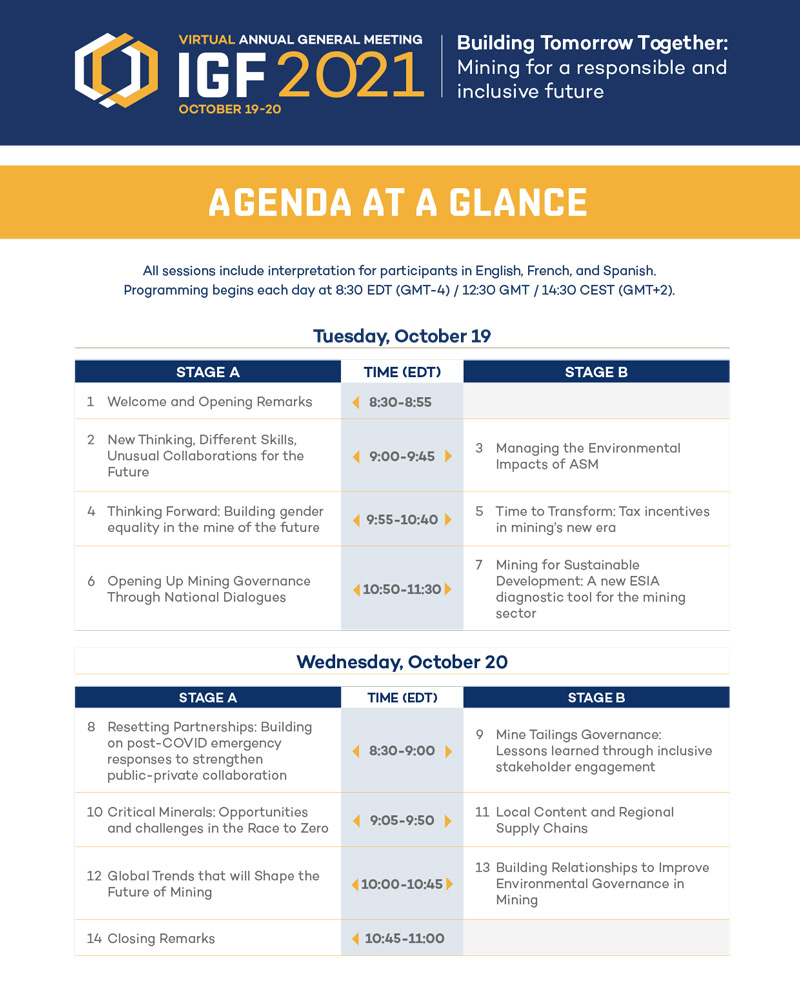
AGM sessions will include interpretation for participants in English, French, and Spanish.

Brief Agenda

Full Agenda and Speakers
(As of October 15, 2021)

AGM brief agenda


Conference

IISD at the WTO Public Forum 2021

The International Institute for Sustainable Development (IISD) continued its tradition of participating in the World Trade Organization’s (WTO's) largest outreach event, the Public Forum, in September 2021.

September 28, 2021 9:00 am - October 1, 2021 4:00 pm CEST

(Open to public)

The 2021 edition of the WTO Public Forum had “Trade Beyond COVID-19: Building Resilience” as its theme and was held in hybrid mode from September 28 to October 1, 2021. All sessions were streamed live online with virtual and on-site participation.

IISD was involved in organizing the following two events and reported on the discussions through the SDG Knowledge Hub.

Building Bridges: Border carbon adjustment and the multilateral trading system

This session was organized by IISD and brought together leading policy experts to look at border carbon adjustments (BCAs), otherwise known as carbon border adjustment mechanisms (CBAMs). This climate policy tool, which has a profound impact on international trade, has increasingly drawn public attention in recent months. This session sought to look beyond the headlines to examine the possibility of building common ground and best practices in the design and implementation of BCAs. Panellists considered what elements are good candidates for common ground, asked where discussions might take place, and considered what prospects there are for this common ground to act as a bridge between the objectives and principles of climate change action and the multilateral trading system, with particular attention to the principles of special and differential treatment and common but differentiated responsibilities and respective capabilities.

Panellists:

  • Aaron Cosbey, Senior Associate, IISD
  • Susanne Dröge, Senior Fellow, Stiftung Wissenschaft und Politik
  • Arunabha Ghosh, Founder/CEO, Council on Energy, Environment and Water
  • Professor Xiankun Lu, Founder and Managing Director, LEDECO Centre Swiss

Moderator:

  • Alice Tipping, Lead, Sustainable Trade and Fisheries Subsidies, IISD

Date and Time: 

  • Tuesday September 28, 2021, at 3:05 PM CEST.

A WTO Fisheries Subsidies Deal: What it means and why it matters

This session was organized by the Pew Charitable Trusts and IISD. Panellists looked at how a successful WTO agreement on curbing subsidies for overfishing could pave the way for a stronger multilateral trade and environment agenda. The event provided expert views and a forum for discussion on what the new agreement means and why it matters for the ocean and the multilateral trading system. Panellists also considered how the agreement’s implementation will be a catalyst for sustainable trade and a sustainable future.

Panellists:

  • Chris Costello, Co-director of the Sustainable Fisheries Group, University of California, Santa Barbara
  • Richard Damania, Chief Economist of the Sustainable Development Practice Group, The World Bank Group
  • Sebastian Mathew, Executive Director, International Collective in Support of Fishworkers (ICSF)
  • Alexandre Parola, Ambassador and Permanent Representative to the WTO, Permanent Mission of Brazil to the WTO

Moderator:

  • Alice Tipping, Lead, Sustainable Trade and Fisheries Subsidies, IISD

Date and Time:

  • Wednesday September 29, 2021, at 3 PM CEST.