Deep Dive

United We Leave or Divided We Stay? Why it’s time for the EU to speak with one voice regarding the Energy Charter Treaty

The European Commission's recommendation for the European Union, its member states, and Euratom to leave the embattled Energy Charter Treaty in a "coordinated withdrawal" is a potential watershed moment, following years of debate over how to address an accord that has complicated efforts toward ambitious climate action.

July 20, 2023

After a written procedure that was finalized on Friday, July 7, the European Commission (EC) formally recommended a coordinated European Union (EU) withdrawal from the Energy Charter Treaty (ECT). This is a landmark move for the embattled accord, which fossil fuel companies have regularly used to challenge and hinder states' climate action. 

The move contrasts with the "compromise proposal" that EU member states have discussed in recent months, which intended to facilitate an uncoordinated exit, with the EU, Euratom, and some EU member states withdrawing individually while allowing others to stay in a modernized ECT. 

The news from the EU's executive arm comes as more ECT contracting parties indicate their own plans to leave. On the same day that the EC made its recommendation, Ireland announced its intention to withdraw, followed by Portugal on July 18, making these countries the ninth and tenth EU member states to do so. On June 28, the United Kingdom Climate Change Committee also recommended that the United Kingdom announce such an intention. 

A coordinated withdrawal from the ECT, now supported by the EC, would have the EU, Euratom, and all EU member states leave the treaty—an accord that also counts more than 20 states outside the EU among its contracting parties. The EC’s recommendation, if it becomes a reality, will allow the EU and its member states to speak with one voice and remove a major obstacle to achieving the bloc's climate ambitions. 

IISD research shows, for instance, that the ECT is the treaty most used by fossil fuel investors to challenge climate-related regulations. The treaty is also well known in the investment law community for the hefty arbitral awards against governments in claims filed by foreign investors using the ECT's investor–state dispute settlement (ISDS) mechanism.

Over the past years, IISD has analyzed the approach of a coordinated withdrawal and found that it is both legally viable and effective for safeguarding ambitious climate action. Moving forward, the Council of the EU, consisting of EU member state representatives, will now undertake complex talks to reach a final position. We therefore outline below why a coordinated withdrawal is the most viable option from a legal and policy standpoint—while describing some of the legal complexities involved—and show why an uncoordinated withdrawal that leaves some EU member states in the treaty could lead to damaging consequences.

Tackling the ECT’s famed "sunset clause"

The Commission's recommendation for a coordinated withdrawal is a major step forward when it comes to providing legal clarity for the EU and its member states on what happens after leaving the ECT, especially for investments made by EU investors in other EU member states prior to withdrawal.

Notably, the recommendation would allow the EU to address the risk of continued intra-EU arbitration after the withdrawal takes effect—a risk stemming from the ECT's so-called "sunset clause." This clause provides that investments involving a withdrawing state would continue to be protected under the ECT for a period of 20 years post-withdrawal. A coordinated EU withdrawal could be accompanied by an internal—also known as an "inter se" —agreement, in which the EU would clarify that the treaty, including its sunset clause, does not and never did apply within the EU and its member states.

This is a view that the EU has already expressed in past and ongoing arbitrations. Such a clarifying inter se agreement would address the remaining legal risks of EU investors suing other EU member states for taking climate action throughout that 20-year period. A coordinated withdrawal would furthermore contribute to a harmonized timeline for the EU and its member states to leave the treaty, providing even greater legal certainty for governments wishing to advance the energy transition.

From failed reform to coordinated withdrawal

The EC's announcement comes after many years of debate, within and outside the bloc, as to the options for reforming the treaty. Explaining their recommendation, EC officials made clear that the ECT is counterproductive when it comes to achieving an essential goal of the bloc: ambitious and effective action toward climate mitigation. 

Executive Vice-President for the European Green Deal Frans Timmermans highlighted, in the EC's strongest statement yet, that climate policy was the main reason for the decision:

"With the European Green Deal, we are reshaping our energy and investment policies for a sustainable future. The outdated Energy Charter Treaty is not aligned with our EU Climate Law and our commitments under the Paris Agreement. It’s time for Europe to withdraw from this Treaty and to put all of our focus on building an efficient and competitive energy system that promotes and protects renewable energy investments."

The EC's groundbreaking shift in strategy is the latest development in a years-long process. The ECT's contracting parties had initially sought to "modernize" the treaty in a bid to make it more supportive of climate action and address other problems that have emerged over the years. The result was a draft text negotiated among ECT contracting parties across 15 rounds from 2020 to 2022.

However, several EU member states did not support this "modernized" draft text, finding it inadequate for achieving their climate goals —a finding backed by IISD's legal research. They instead announced their respective intentions to withdraw unilaterally from the treaty. In light of these announcements and following a European Parliament resolution advocating for a coordinated exit rather than adherence to the "modernized" draft ECT text, a pre-scheduled vote in the Council to support the draft text was called off. The EC was facing a new reality.

The eventual result was a major shift of strategy: support for a coordinated withdrawal of the EU, Euratom, and all EU member states from the treaty (Euratom refers to the European Atomic Energy Community, established over 60 years ago.) An internal non-paper by the EC leaked to news outlets in February had already called such a step "unavoidable," and the Commission had started to negotiate an inter se agreement with EU member states. In its new recommended Council decision, the EC confirms that these efforts toward clinching an inter se agreement remain underway. The EC has also formally withdrawn its earlier proposals for Council decisions that would have supported the vote by the EU and Euratom in favour of adhering to the draft reform text.

Making a coordinated EU withdrawal a reality

In its new proposal, the EC unequivocally states that the ECT, in its current form, is incompatible with EU law, the EU's energy and climate goals, and the EU's approach to investment protection. Therefore, the EC proposes a coordinated withdrawal.

The ECT text itself sets out a procedure for withdrawal in Article 47. Under this article, a contracting party can withdraw by notifying the depositary of the treaty of its intention. Withdrawal will take effect 1 year after the receipt of this notification. As noted above, withdrawal will trigger the treaty's sunset clause, set out in paragraph 3 of that same article, according to which investments made prior to withdrawal will continue to be covered by the treaty for a period of 20 years from the date of withdrawal taking effect. This would generally allow investors of such investments to bring arbitration claims against withdrawing contracting parties for the full duration of this 20-year period. 

The EC's proposal clarifies, however, that this clause will not affect investments between EU member states, noting that the ECT, in its entirety, does not, never did, and never will apply among EU member states.

To solidify the clarification that the ECT, including the sunset clause, does not apply among EU member states, the EC is negotiating an inter se agreement with EU member states based on Article 31(3)(a) of the Vienna Convention on the Law of Treaties. This convention provides a general rule on how treaties should be interpreted and states that any subsequent agreement between the parties regarding the interpretation of the treaty or the application of its provisions should be taken into account.

In addition to addressing issues arising under the ECT, the EU also needs to ensure that a withdrawal from the ECT aligns with the EU's own body of law. Because the two principal EU treaties, the Treaty for the European Union and the Treaty on the Functioning of the European Union, do not expressly provide for a process to withdraw from an international agreement like the ECT, the EC has proposed to use Article 218(6)(a)(v) of the Treaty on the Functioning of the European Union as the procedural legal basis for leaving the ECT. Rather than withdrawal, this article describes the procedure for the EU to conclude international agreements. The EC now clarifies that the same procedure must be followed for withdrawal.

Similar to the approval of a new treaty, withdrawal of the EU from the ECT would, as a result, require a qualified majority of the Council, which usually means the support of 55% of the bloc’s member states—in other words, 15 member states—representing at least 65% of the EU population. The move will also require the consent of the European Parliament, which has already signalled such support. The EU can withdraw from the ECT under EU law if these conditions are met.

Uncoordinated withdrawal: Creating new legal complexities and uncertainty

A coordinated withdrawal provides far more legal and political clarity than an uncoordinated one. Under EU law, the ECT covers a range of areas, only some of which fall under the exclusive competence of the EU, such as foreign direct investment. For other areas, the competence is shared between the EU and its member states, such as portfolio investment. Other areas, such as the ECT's ISDS mechanism, require the consent of EU member states. Meanwhile, some areas, like tax policy, largely fall under the exclusive competence of EU member states.

Because the ECT was negotiated before the distribution of competences around investment were clarified at the EU level, the treaty is largely silent about how to deal with this issue. While Article 1(3) of the ECT provides some clarification, this remains limited.

This ECT article defines the term "Regional Economic Integration Organization" (REIO) as an "organization constituted by states to which they have transferred competence over certain matters a number of which are governed by this Treaty, including the authority to take decisions binding on them in respect of those matters." While the EU qualifies as an REIO, and the article seems to recognize that the EU has competence over "certain matters" covered by the ECT, the article does not clarify what this language implies if the EU but not all its member states withdraw.

This raises the more specific question of whether those EU member states remaining in the ECT would bear international responsibility for implementing normative acts taken by the EU, even if the subject matter of these acts falls within an area of EU competence, and even after the EU has withdrawn from the treaty. A recent legal analysis finds that this is very likely. Contrary to that finding, the EC has repeatedly stated that in international agreements where both the EU and its member states are parties, member states only bear international responsibility regarding areas within their competence under EU law. To date, however, ISDS tribunals have largely rejected this view.

If some member states remain in the ECT, the legal implications will continue to be unpredictable. It would also imply a violation of EU law, since ISDS cases could potentially continue to arise within the EU, where either a home or host state, or both, are still parties to the ECT. A coordinated withdrawal of the EU, Euratom, and all EU member states, accompanied by an inter se agreement, would resolve many of these questions related to member states' international responsibility, relative to that of the EU itself.

By contrast, a decision by some EU member states to remain in the ECT might require express authorization from the EU, since they would likely act in ways that concern areas of exclusive EU competence. The EU may also have to issue such authorizations on a rolling basis, since these states could be compelled to vote on or abstain from subsequent decisions taken under the Energy Charter Conference—the decision-making body of the ECT contracting parties—when it comes to areas that fall under exclusive EU competence in EU law.

Conclusion

A coordinated exit mitigates many of these potential legal problems while avoiding a situation that would place undue stress on the EU division of competences. For instance, a coordinated withdrawal would not require complex and politically strenuous procedures for individual authorizations for those EU member states wishing to remain party to the agreement. New formal mechanisms for the post-withdrawal coordination of positions among remaining and withdrawing EU member states would thus be avoided. This could also free up much-needed capacity in energy ministries across the EU.

Finally, a coordinated EU withdrawal would also prevent a situation in which some member states could indefinitely bear international responsibility for the implementation of normative acts of the EU. A coordinated withdrawal would thereby safeguard the bloc’s internal market—and the EU’s climate policies—from adverse external influence in the long term.

The EC's decision to recommend a coordinated EU withdrawal is an important step for creating more legal and political certainty in an already muddled area of law. Reflecting an "all EU" approach, it paves the way for creating a clean slate for the EU to develop a coherent, novel approach to international energy investment law that advances climate goals and supports the energy transition.

Member states representing more than 75% of the EU population have announced their intention to withdraw unilaterally from the treaty or have already withdrawn. This includes Spain, currently presiding over the Council. These member states should seize the chance offered by the EC to make coordinated exit a reality and publicly support this option.

Given this new momentum, reluctant EU member states may wish to reassess their strategy. Endorsing a coordinated exit would not only allow the EU to maintain unity and cohesion, but it would also reduce significant legal risks they could incur in the future. With the uncertain fate of reform, they may indefinitely remain party to an agreement that is in violation of EU law. Supporting a coordinated exit would instead send a strong signal for joint climate action. 

July is set to become the hottest month the world has experienced in 120,000 years, with the emission of greenhouse gases from fossil fuels and other sources being the main driver of the climate crisis. The EC's proposal is a chance for the EU to speak with one voice, adapt to the current geopolitical context, and cooperate more constructively and creatively on energy policy within the EU and other ECT contracting parties, including in its neighbourhood. 

The authors would like to thank Sofia Baliño and Isaak Bowers for their comments. 

Deep Dive

Gender Equality at the Heart of Recovery: Advocating for Gender-Responsive Procurement in Ukraine

As Russia’s war on Ukraine continues, the plan for recovery and reconstruction is already in the making. The most recent rapid damage and needs assessments estimate the cost of reconstruction and recovery at now USD 411 billion, with the process estimated to take at least 10 years. As these plans begin to come together, government agencies and international donors are considering how Ukraine’s public procurement policies can be used strategically as a means of economic recovery.


June 28, 2023

Procuring goods, services, and infrastructure creates local jobs, promotes transparency and prevents corruption, all while contributing to the reconstruction of infrastructure necessary for the livelihoods of millions in a post-war context. But for procurement to also help empower women and other groups disproportionately affected by the war, public procurement policies must be gender-responsive. The integration of gender considerations into procurement processes has the potential to generate greater inclusivity and benefits for different gender groups in planning and executing publicly funded projects.

This article looks at what doing so would mean for Ukraine’s recovery and reconstructions, including for advancing gender equality in a post-war context, and examine what lessons other countries can provide on using public procurement as a means of promoting inclusion after conflict.

War’s gendered impacts: the state of play in Ukraine

In Ukraine, the war has had gendered impacts on women and men. While many combatants and civilians continue to lose their lives or suffer severe physical and psychological harm, women, children and the elderly lack access to essential services, resources, and humanitarian aid. Women and girls also face an increased care burden and have to look for alternative livelihoods, while they are also at risk of gender-based violence, including sexual violence and trafficking. Displacement can heighten these security risks and place women in even more precarious and dangerous situations.

Reconstruction will mobilize billions of USD from both public and private funds. The Ukrainian government will work alongside donors and investors to rebuild and repair its infrastructure. This will include energy infrastructure; roads and public transport; services such as healthcare, schooling, and childcare; industry; agriculture; housing; markets; parks; and other public spaces. In short: all of this infrastructure is expected to respond to the needs and support the livelihoods of all genders and socioeconomic groups.

Some groups affected by the war, like women and internally displaced groups, will likely face significant barriers to participating in the economy in the aftermath of conflict. The destruction of infrastructure such as educational institutions, safe transportation, and childcare can make it difficult for women, and especially women heads-of-households, to fully participate in the post-war economy due to increased caregiving responsibilities.

Why gender-responsive procurement matters

In recent years, gender-responsive procurement has emerged as a strategy for addressing a range of structural gender inequalities which pervade many sectors, including the overwhelming allocation of public spending to businesses owned or managed by men. This approach to procurement also aims to address persistent institutionalized discrimination affecting women, such as the prevalence of the gender pay gap, unsafe working conditions, sexual harassment, and gender-based violence in the workplace.

UN Women defines gender-responsive procurement as “the sustainable selection of services, goods or civil works that considers the impact on gender equality and women’s empowerment.” In other words, gender-responsive procurement encourages buyers and suppliers to examine the impact of their activities on women and men and deliver contracts in a way that addresses their different needs and interests.

Gender-responsive procurement supports the allocation of public resources to benefit all gender groups while serving to improve the working conditions and participation of women and women-owned businesses (WOBs) in supply chains

Gender-responsive procurement supports the allocation of public resources to benefit all gender groups while serving to improve the working conditions and participation of women and women-owned businesses (WOBs) in supply chains. The EU legal and policy framework around procurement mentions the “strategic use of procurement, including for the advancement of social objectives.” The European Commission’s 2020-2025 gender strategy also states the importance of socially responsible procurement to fight discrimination between gender groups and promote equality.

When it comes to planning for conflict recovery, gender-responsive procurement is also showing promising results.

Social inclusion in public procurement: lessons from South Africa

In other countries, governments have used public procurement policies to facilitate more equal and inclusive economies following times of crises and political turmoil. One such example is South Africa, whose 1996 Constitution—adopted after apartheid—provides for “categories of preference in the allocation of contracts, and the protection or advancement of persons or categories of persons, disadvantaged by unfair discrimination.”

In 2000, South Africa’s Preferential Procurement Policy Framework Act (PPPFA) was then established to enact preferential treatment to historically discriminated individuals and groups who suffered discrimination under apartheid. Later, in 2003, the Broad-Based Black Economic Empowerment Act (B-BBEE) was adopted to establish a framework for the promotion of black economic empowerment and advancing the participation of Black People, as defined in the Act, in the economy. Both acts aim to enhance the participation of historically disadvantaged groups in the economy through the allocation of contracts to South African-owned enterprises, the creation of new jobs at the local level, and by supporting micro, small, and medium-sized enterprises (MSMEs)owned by Black people.

The PPPFA and the B-BBEE also contain provisions for supporting Black women’s empowerment by prioritizing bids from women-owned businesses (WOBs) and developing WOB supplier databases. South Africa’s Preferential Procurement Regulations specifically aim to use public procurement as a strategic lever for social and economic transformation, including targets and quotas for WOBs.

Various other bills, provisions, government initiatives and funds have also since been launched to promote the participation of women, specifically Black women, in the South Africa economy. They include the Women’s Empowerment and Gender Equality Bill and government-funded initiatives like the Isivande Women’s Fund and the NEF Women Empowerment Fund, which supported more than 1,000 businesses owned by Black women .

The adoption of a socially inclusive public procurement policy worked as an amplifier, fostering targeted action toward disadvantaged groups and individuals historically excluded from participating in the economy

Following the devastating impacts of the COVID-19 pandemic, South African President Cyril Ramaphosa announced a commitment to dedicate 40% of government procurement spending to WOBs as part of the national recovery plan. UN Women has been supporting the development of a technical task team across government departments to help with the implementation of those procurement processes. While there are still several legislative, institutional, and cultural barriers to elevating WOBs in South Africa, the adoption of a socially inclusive public procurement policy worked as an amplifier, fostering targeted action toward disadvantaged groups and individuals historically excluded from participating in the economy.   

Public procurement as a response to crisis: the Colombian case

Colombia stands out as an example of a country which continues to work towards gender-responsive public procurement in response to the inequalities between groups after decades of conflict.  Colombia’s rural ethnic groups were especially impacted, with their access to land and livelihoods severely curtailed, and women and girls affected by sexual and gender-based violence.

In 2016, after the official peace accord, estimates showed that women created 40% of Colombia’s microenterprises. However, women faced obstacles that made it difficult for them to sustain or expand them, including informal work, the double burden of care, lack of access to credit, and difficulty to access and understand procurement procedure, among others.

Colombia also struggled with low levels of competition in public procurement. In response, the national procurement agency began working to improve competition by adopting new laws and introducing other institutional changes. Among those was the creation of a guide specifying standard social clauses, to support socially responsible public purchasing in the procurement value chain. This could be used to prioritize WOBs, as  exemplified by the Municipality of Cali, which defined a socially responsible public supplier as one which had at least 10% female employees, specifically women heads-of-households.

The COVID-19 pandemic disproportionately affected women’s employment in Colombia. The President, Iván Duque Márquez, issued a directive to generate employment, identifying women, especially those in rural areas who had been doubly impacted because of armed conflict, as having suffered most economically through the pandemic. This directive mentioned specifically the creation of measures to boost the participation of WOBs in the public procurement system, as a response to the employment crisis.

The National Procurement Agency and the Office of the Presidential Advisor for Women’s Equity subsequently partnered with UN Women and the Open Contracting Partnership to devise a roadmap for implementing the 2020 Entrepreneurial Law. The law aims to establish a regulatory framework to promote entrepreneurship in Colombia in order to increase social welfare and generate greater equity.

This law specifically mentions the inclusion of policies and programs which adopt a different criterion for women-led MSMEs, including women heads-of-households, victims of armed conflicts, and reintegrated people. It includes a tie-breaking directive, stating that in a situation where two or more bidders submit identical or closely ranked proposals, female heads-of-households are preferred. A similar tie-breaking factor is also included for Indigenous, Black, and Afro-Colombians. The framework also created the Fondo Mujer Emprende: a government fund to support women starting businesses.

The law resulted in the establishment of several pilot programs, the creation of gender-responsive indicators to measure the participation of WOBs and their progress, and the development of e-procurement platforms, workshops, and other dissemination techniques to increase the familiarity of WOBs with the public procurement process. While it may still be too early to assess the impact of these measures on women and WOBs nationally, pilot projects do indicate that gender-responsive procurement strategies yield economic returns for women and small agricultural businesses, while increasing competitiveness and transparency.

Looking Ahead: what these cases mean for Ukraine

Ukraine’s public procurement system had already undergone an impressive transformation prior to Russia’s full scale-invasion. The introduction of electronic procurement, Ukraine’s Association Agreement with the EU, and the accession to the plurilateral World Trade Organization (WTO) Agreement on Government Procurement drove major shifts in Ukraine’s public procurement policy toward more transparency, tackling a legacy of corruption.

In 2016, all government agencies began using the e-procurement system ProZorro, due to an initiative led by Transparency International Ukraine. Both government officials and civil society are stressing the importance of retaining this effective and transparent procurement system post-war. Fraud, corruption, and collusion threaten the allocation of public spending, which could lead to losses of precious time and funding during recovery.  Ukraine’s government and several other stakeholders have expressed a willingness to implement transparent, modern, and progressive digital infrastructure, including procurement infrastructure, but little is currently known on whether future public procurement policy would also target greater social inclusion and equality.  

These countries’ experiences could serve as potential roadmaps for Ukraine’s post-war recovery planning, building on systems that Ukraine already has in place

As the examples of South Africa and Colombia show, public procurement has been successfully used to respond to social inequalities and economic crisis. These countries’ experiences could serve as potential roadmaps for Ukraine’s post-war recovery planning, building on systems that Ukraine already has in place.

By adopting a gender-responsive approach to public procurement, the Ukrainian government can maximize the creation of jobs and economic benefits for groups most at risk of poverty and marginalization, establish criteria that supports safer and more inclusive workplaces, and adopt standards that reduce the negative impacts of reconstruction on women and girls. Public procurement policies can therefore be leveraged to support the reintegration and inclusion of a variety of groups impacted by the war: women, survivors of sexual and gender-based violence, internally displaced persons (IDP), former combatants, and people with disabilities, to name a few.

Ukraine already has strong policies and legislative frameworks which could foster and support the adoption of a gender-responsive public procurement system. Ukraine’s current laws on public procurement allow for the consideration of environmental and social aspects in the evaluation of bids, while the National Action Plan on Women, Peace and Security already defines a space for women’s active participation at the forefront of recovery efforts. Alongside those crucial frameworks and with an understanding that public procurement in post-war Ukraine can catalyze social inclusion and recovery for all, stakeholders should treat gender responsiveness as an essential part of any public procurement policies.

Procurement cannot single-handedly ensure the full inclusion of different groups in post-war Ukraine, but paired with gender-responsive budgeting and project planning, the government, donors, and other stakeholders can use it strategically as a tool to contribute further to inclusive recovery. Many guidance documents for developing gender-responsive public procurement policies and criteria already exist, but the adoption of gender-responsive public procurement policy by Ukraine’s leadership is vital. This way, the billions of USD that will flow into reconstructing Ukraine will help create a more inclusive economy where people of all genders thrive.

The author would like to thank Ronja Bechauf and Liesbeth Casier for their feedback and help with this article. 


Deep Dive

Nigeria Must Ensure its Fuel Subsidy Reform Sticks for the Long Term

Q&A with Dr. Neil McCulloch, Director of The Policy Practice

Nigeria's new president, Bola Tinubu, removed gasoline subsidies right after he was sworn in on May 29. To find out what this means for Nigeria and how the country can make this reform a success, IISD's Energy Communications expert Aia Brnic talked with fossil fuel subsidy expert Dr. Neil McCulloch, author of the book Ending Fossil Fuel Subsidies: The Politics of Saving the Planet. Neil is Director of The Policy Practice, a network of experienced development professionals, and has co-authored several IISD reports. The interview has been edited and condensed for clarity.

June 20, 2023

Aia Brnic: What's happening in Nigeria with fuel subsidies right now?

Neil McCulloch: Nigeria has just elected a new President, Bola Tinubu, who announced the end of fuel subsidies in his inauguration speech. Nigeria has been subsidizing fuel for more than 40 years, and the one major fuel subsidy left is for gasoline. While this is a very bold thing to do, it is also long overdue. But the inevitable happened—the petrol stations shut up shop because they didn't want to sell fuel until the prices rose, and so suddenly, there were long queues and gasoline shortages. Shortly after, Tinubu announced a new fuel price, which had more than doubled, from about NGN 185 (USD 0.40) to NGN 537 (USD 1.15), due to the removal of fuel subsidies.

Aia Brnic: What is the plan now? Is this it, or is the government planning to go further?

Neil McCulloch: That's a really important question. The problem with Nigerian fuel subsidies has been that the cycle has repeated itself for more than a decade: a new president comes in, realizes that the burden of subsidies on the budget is far too high—Nigeria was spending almost USD 10 billion (NGN 4.39 trillion) last year just on subsidizing gasoline, which is more than four times the health budget (NGN 827 billion)—and takes a bold move to bump up the price. The previous president, Muhammadu Buhari, did the same thing; [former president Goodluck Ebele] Jonathan also tried reform in 2012 with disastrous results.

After the price increase, for a little while, there are no subsidies, but then subsidies always re-emerge because the domestic currency slides relative to the dollar. And as that happens, the cost of fuel goes up—but since the domestic price is fixed, that gap is filled by the budget. Usually, once you've had your one shot at removing subsidies, you don't get another political shot at doing it, so subsidies accumulate, and then they leave it to the next president to do the same thing again. One of the things we will wait to see is whether President Tinubu is going to change the system or just bump up the price as previous presidents did.

Aia Brnic: What has been announced so far?

Neil McCulloch: The regulator announced prices for all the different regions, which was a bit disappointing. I was hoping that he might say to oil marketing companies: "You choose the price; it's a competitive market out there." That would have liberalized the sector. The prices would have been volatile, and they would have jumped around a little bit, but then they would have settled down and continued to evolve depending on the cost of fuel. 

But because the regulator now has set prices for different states, it looks like a rerun of the previous arrangements whereby they've just fixed prices, and it'll be quite difficult for them to adjust. The real telltale sign of whether this is a serious reform or not will come in the course of the next month. If they say, "We're going to have a template and we’re going to adjust prices every month according to that template," then they are serious.

Aia Brnic: What blocked fuel subsidy reforms in the past?

Neil McCulloch: Two things have really affected reform. First, it is politically incredibly unpopular to bump up prices in this way. In 2012, when President Jonathan was in power, he did a sudden fuel subsidy reform where he increased prices by roughly three times. And the country erupted. There was a 10-day national strike, everybody was out on the streets, and people got killed. It was a disaster, and eventually, the government had to back down and reduce the price significantly, which meant that by the end of the Jonathan regime, there were still huge subsidies being paid. Everybody in Nigeria has that experience seared into them, and they want to avoid that. 

The other reason is that there are vested interests in keeping the subsidy regime. There's a very healthy business to be made smuggling fuel out of Nigeria to the neighbouring countries where, prior to the price bump, it was much, much cheaper. Police and customs officials make a lot of money collaborating with people who wish to smuggle fuel over borders.

Aia Brnic: Given how unpopular and difficult it is to remove fuel subsidies, why is it important to do it? How can regular citizens—who may struggle to pay their bills—accept it?

Neil McCulloch: The standard reason most Westerners would give is that we must stop subsidizing fossil fuels because of climate change. Honestly, that argument doesn’t resonate very well in Nigeria and, indeed, in many poor countries. While it's not that people don’t care about climate change—in fact, many of them are more impacted by climate change than people in wealthier countries—they have more pressing concerns like feeding their families and being able to get to work. So, they appreciate the subsidy and don’t want it removed. And you can totally understand why. 

At the same time, spending billions of dollars of the government budget subsidizing gasoline is one of the worst possible ways of spending your money if you care about development and the poor. That's because most of that benefit goes to the better off—people who have cars and motorbikes—rather than ordinary working people who might be on foot or taking buses. These subsidies are very unequal, but they're also not contributing to anything that's useful in the long term, like health services, roads, education systems, and social protection. It's just subsidizing the price, and it makes people burn more gasoline—which, of course, causes all sorts of environmental damage. Unfortunately, reforming subsidies also hurts the poor—not directly because the gasoline price went up, but rather because of the knock-on impact on food prices. And that's an area where the government really has to look out and do something to help people.

Aia Brnic: What is the solution to this?

Neil McCulloch: The standard solution—which the World Bank always pushed—is that there should be cash transfers. In many countries, the World Bank has supported the implementation of cash transfer schemes for the poor and the near-poor. Sometimes these systems are targeted at the bottom 40% of the population. Indonesia has done it, and it turned out that the cash given to the poorest 20% of the population more than compensated them for the petrol price rise. So, they were better off as a result. Having cash transfers, I think, is part of the solution, and the World Bank in Nigeria has been trying to support the government in introducing a similar cash transfer mechanism. If you don't have some sort of compensatory mechanism, then people will be very upset, and rightly so. 

However, it's not the only thing. You have got to have mechanisms that reach out to the bulk of the urban working class and the people who aren’t necessarily the poorest of the poor, but who do have to get on a bus, who do have to get to work, who live in Lagos or Abuja and are going to be very severely affected by these kinds of reforms because they buy gasoline. One mechanism, for instance, is for the government to provide explicit temporary subsidies to public transportation, ensuring the bus fares don’t go through the roof when the gasoline price rises. That way, you are enabling people to continue their livelihood.

There are other things, though, that can be done. In countries with successful reforms, we've often found that politicians turn it from a bad thing into a good thing. They have a political offer, and they say, "I'm sorry about this reform, it is very painful, and we'll do everything possible to protect you. But now that we've saved these resources, I'm going to give you something in return." And the thing that they offer is deliberately something that is very politically popular. For example, in the Indonesian case, that was a health card and an education card. Zambia recently made a major reform in 2021, and they said, "We're going to give you free secondary school education." This offer was very popular because secondary school education is expensive, but the cost of the subsidies was way more than the cost of secondary school education. So, the idea is to redirect funds toward something that is very popular. Having a political offer moves the story away from being a negative one to being, "This government is giving us something that’s very important." The Nigerian government needs quickly to come up with a politically credible offer so that it can say to Nigerians, "We’re going to make things better, and here’s how."

Aia Brnic: How important is clear communication about the reform?

Neil McCulloch: One of the points I make in my book Ending Fossil Fuel Subsidies is: communication, communication, communication. The presidents and prime ministers who have been successful in making fossil fuel subsidy reforms have generally been the ones who haven’t just suddenly launched it on people but who have talked about it and explained, "This is why it has to be done; this is how we got into this mess, how we’re going to get out of it, and why it’s going to make you better off in the longer run." Building that credibility and explaining to the population diffuses a lot of the anger against reform. If you don’t communicate and you launch it on people suddenly, then they are understandably angry and then they take to the streets. Who wouldn't? We saw this not just in developing countries but also in France with the gilets jaunes [(yellow vests) movement in 2018]. It’s really important that the government communicates these things in advance and makes sure that people understand why the reform is being done, even if it is unpopular.

Aia Brnic: The world is still in the middle of a cost-of-living crisis. Is this good or bad timing for such reform?

Neil McCulloch: It's a terrible time for the reform, but I think that President Tinubu has no real choice but to take these difficult steps now. Nigeria's finances are in a terrible state, partly because of the perpetuation of this subsidy. He must take bold measures—and the only time he can realistically take them is within the first 6 months of his presidency. But that's why it's so important that he and his government also provide measures to protect the people. I believe they are thinking seriously about that. The question is how they go about it. The inauguration speech mentioned several measures about jobs and prosperity. I think President Tinubu is right to focus on getting the economics and macroeconomics right, and fixing fossil fuel subsidies is one of the most important things he can do. But that’s not going to make it easy in the short term, particularly because prices are already rising.

Aia Brnic: How can Nigeria do things right this time?

Neil McCulloch: The number one thing, in my view, is to change the system. This is my big concern and my big hope as well. President Tinubu is a very smart man. He was very successful as Governor of Lagos, and he understands the depth and nature of the problems that Nigeria faces. So I hope that he will really grasp the nettle and recognize that gasoline is a commodity, just like every other commodity, and that its price needs to vary with the price in the world market in order to ensure that subsidies never re-emerge—because there are much better things for the Nigerian government to spend its subsidies on. It could spend them on promoting jobs, having an industrial development strategy or an agricultural development strategy that supports farmers, helping the poor ,and building a health service. But it will only have the resources to do that if it stops wasting so much money on subsidizing petrol. I hope that Tinubu doesn't simply bump up the price and that he also changes the system—by either liberalizing it entirely or setting up a template that shifts that price every month, as is done in South Africa, Zambia, Tanzania, and many other African countries. It's really important that he makes sure that this reform sticks for the long term rather than just as a one-off shift.

Aia Brnic: What are the next three things that Nigeria should do, in your opinion, to get this reform done?

Neil McCulloch: Number one, there's got to be a mechanism for compensating Nigerians who will be badly impacted by the current price rise. That is essential because, otherwise, people will be negatively impacted. Number two: make sure it's clear this is not just a bump in price, it's a change in the system, then announce what the new system will be, how the petrol price will be calculated, and how it will change. And make sure it changes at least every month to deal with exchange rate movements and movements in the international market so that subsidies never re-emerge. That is critical. And number three—and this is where it aligns very well with the inauguration speech and all the positive measures that the president is pushing—align the reform with politically popular offers to the population about how jobs will be created and how the services will be delivered. Those three things are vital for making the reform stick.

Aia Brnic: What is the renewable energy sector's potential in Nigeria? Could this reform contribute to building a more sustainable energy sector?

Neil McCulloch: The challenge has always been that the Nigerian electricity system is broken. The distribution companies don't collect enough money for the electricity they sell. They therefore don't pass enough money back to the bulk supplier, then the bulk supplier doesn't pay the generators, and the generators don't generate. Nigeria has 13 gigawatts of [installed] power, but it only actually generates around about 4–5 gigawatts every day. Despair over the power system has meant that a lot of people have just opted out completely—large businesses and households as well—and just built themselves solar panels. Mini-grids and solar are a fantastic solution for a lot of Nigerians, particularly in more remote locations where the grid can't reach, but getting the grid to function effectively for most of the urban areas is the answer—and that's another difficult long-term and very political reform.

Meanwhile, the government has been refusing to supply a sovereign guarantee—which ensures the government will pay the electricity provider if the utility fails to do so—for independent renewable power developers, who, as a result, find it very hard to get financed. So there are all sorts of problems with getting the renewable sector going in Nigeria, and that's one of the reasons why a lot of people are looking at the off-grid rather than the on-grid sector.

Aia Brnic: How can Nigeria build a cleaner and more sustainable energy system?

Neil McCulloch: Number one, I think that fossil fuel subsidy reform is a very important part of that because it stops wasting vast resources on fossil fuels and makes [these fuels] reflect their true cost. People will, over time, shift to more efficient vehicles, which reduces fuel usage. And the second thing is to continue to pursue the reforms in the power sector. A lot of good work has been done already, but there really needs to be a way of ensuring that independent power producers can produce and inject their electricity into the system and get paid for it. That could be done either by bilateral contracts between generators and consumers, without necessarily having to go through a central buyer, or by improving the market system of the central buyer. This is going to be one of the central industrial policy challenges of the new government—and if they get that right, the benefits will be enormous. Nigeria is a country of over 200 million people with a 13-gigawatt grid—this is nothing, and it should have a grid 10 times that size. But to get there, it must have a grid that is profitable and self-sustaining so that it can expand. If you get that, suddenly all the solar, wind, and biogas become viable, and investors will be more than willing to invest in them.

Deep Dive details

Deep Dive

Canada’s Energy Future Must Be Guided by Credible 1.5°C Scenarios

The Canada Energy Regulator (CER) has been directed to model the country's energy transition in a way that aligns with the Paris Agreement goal of keeping global warming within 1.5°C. This is a first, and it's a key opportunity to help decision-makers prepare for radically different global energy markets.

June 7, 2023

Need to know:

  • The CER 1.5°C scenarios will be particularly valuable to decision-makers planning for the impact of dwindling global fossil fuel demand as growth of renewable energy capacity in Canada accelerates.
  • The Canadian oil and gas industry needs realistic scenarios that fully integrate both short- and medium-term demand outlook and the transition risks associated with climate policies in line with limiting warming to 1.5°C.
  • Credible global 1.5°C scenarios need to be comprehensive, transparent, and granular in terms of reporting greenhouse gas emissions, as well as integrate equity considerations into their modelling assumptions.
  • Based on the International Energy Agency's (IEA's) Net Zero Emissions scenario and other major scenarios analyzed by IISD, there is no room for new oil and gas fields to be developed in Canada to align with the 1.5°C target.

Mandated by the Ministry of Natural Resources (NRCAN), CER is expected to publish a new set of scenarios this month, modelling Canada’s path to net-zero emissions. This follows a commitment to reach net-zero greenhouse gas (GHG) emissions by 2050, enshrined in law in 2021 and supported by the 2030 Emissions Reduction Plan.

The new NRCAN mandate directs the CER to model Canada’s energy transition in a way thatfor the first timereflects the global context in which the Paris Agreement goal of limiting warming to 1.5°C is achieved. This mandate marks a significant departure from previous Energy Future reports and will ensure the new CER scenarios inform a Paris-aligned energy transition for years to come.

Previous CER modelling focused on projecting energy supply and demand based on economic and energy outlooks. This year, the CER’s task is significantly more complex as it needs to model energy transition scenarios with an explicit climate target. Considering that the embodied carbon dioxide of Canadian oil and gas exports is larger than what the entire country emits domestically in a year, the CER’s 1.5°C scenarios need to grapple with the full range of impacts of the Canadian oil and gas industry.

This is a significant opportunity to provide Canadian decision-makers with a credible tool informed by the best available science as they assess the implications of a 1.5°C-aligned energy transition for Canada and prepare for radically different global energy markets.

The United Nations Environment Programme Emissions Gap Report 2022 clearly shows that the world is not on track to limit warming to 1.5°C. Even if all nationally determined contributions pledges are fully implemented by 2030, the world will still be heading for a 2.4°C–2.6°C temperature rise if countries don’t raise their ambition.

Hence, the CER modelling exercise provides the ideal platform to develop a credible roadmap to a 1.5°C world. This exercise will be particularly valuable for decision-makers who are planning for the impact of dwindling global fossil fuel demand and for accelerating the growth of renewable energy capacity in Canada, considering that Canada is the 4th and 6th largest oil and gas producer, respectively.

A pumpjack on the prairie. Alberta, Canada. Rocky Mountains in the distance.

Essential Components of Energy and Climate Scenarios

Energy and climate models give insight into how the future may unfold, based on various technical, economic, societal, and policy assumptions. They are generally built as integrated assessment models (IAMs), which bring together simplified versions of the energy, economy, and climate systems. They are the main tool used by academic research groups, intergovernmental organizations, and policy-makers to understand how different energy and technology choices affect our ability to achieve climate goals and impact other elements of the energy transition.

For climate and energy models to provide robust and credible pathways to 1.5°C, they must consider several key elements. Accordingly, the CER should ensure its new scenarios include the criteria below to deliver on its mandate.

Disclose Consistently on All Types of Greenhouse Gas Emissions

Consistent, clear, and accurate reporting of all GHGs is essential for a comprehensive understanding of how to limit warming to 1.5°C. While carbon dioxide emissions from burning fossil fuels are the main cause of global warming, other shorter-lived climate pollutants such as methane, nitrous oxide, and fluorinated gases have higher warming potential. The relative contribution of these GHGs to global temperature rise must be carefully modelled to design effective short- and long-term mitigation strategies.

The Canadian Net-Zero Emissions Accountability Act enshrines in legislation Canada’s commitment to achieve net-zero GHG emissions by 2050. Hence, accounting for all GHG emissions will not only be important to assess the global impact on Canadian emissions for the global climate target but also to plan policies to achieve Canada’s own domestic emissions reduction target.

Report Transparently on Emissions Reductions Versus Carbon Dioxide Sequestration

Knowing the relative contribution of emissions reduction versus carbon dioxide removal (CDR) and offsets is essential to assess whether a climate model can realistically reach its target. The Intergovernmental Panel on Climate Change (IPCC) Special Report on 1.5°C explicitly warned that “CDR deployed at scale is unproven, and reliance on [CDR] is a major risk in the ability to limit warming to 1.5°C.” The assumptions a model makes about CDR as well as the expected reductions from carbon capture and storage (CCS) in the fossil fuel sector (fossil-CCS) have a major impact on the relative mitigation efforts required to limit temperature rise to 1.5°C. Credible and feasible assumptions about the use of CDR and CCS are especially critical to reliably estimating the rate at which oil and gas must be phased out. Moreover, relying on forest carbon offsets is also problematic: well-documented issues over additionality, performance, double counting, and leakage generally prevent accurate assessments of these offsets’ sequestration potential.

Considering these technologies’ risks, high costs, and limited mitigation potential, the CER should limit the reliance of their 1.5°C scenarios on fossil-CCS and CDR to the IPCC feasibility and sustainability thresholds to remain realistically implementable. Rapid and deep GHG emission reductions are essential in all credible 1.5°C scenarios. While CCS technologies are a crucial component of all climate models, their deployment is slow and has limited scale, and application should be restricted mainly to hard-to-abate sectors, such as cement and steel. To assess the sensitivity of their mitigation pathways to these assumptions, the CER should also create one scenario with zero CDR and CCS.

Include Granular Sectoral Emissions Reduction Pathways

Limiting warming to 1.5°C will require different emissions reduction solutions in each sector, which will necessarily occur at different paces. However, immutable constraints on the 1.5°C carbon budgetthe maximum amount of CO2 that can be emitted over a period of time to limit global temperature to 1.5°Cmean that slower mitigation efforts in one sector will need to be compensated for by faster reductions in other sectors. In other words, giving one sector a bigger carbon budget leaves a smaller carbon budget for other sectors. Hence, governments need sector-level data to rationally distribute effort across sectors and track overall progress toward the Paris Agreement goal.

Accordingly, CER scenarios should feature sectoral mitigation pathways to provide useful guidance for Canadian policy-makers, energy producers, providers, and financial actors. Not only does the CER scenario need to show the trajectory of emissions reductions in each sector, it should also describe how electricity generation will be ramped up to accommodate the necessary declines in fossil fuel use in other sectors, such as transportation and buildings.

Integrate Equity Considerations

Modelling assumptions must also reflect a fair distribution of mitigation efforts across countries in line with the United Nations Framework Convention on Climate Change's principle of Common but Differentiated Responsibilities and Respective Capabilities. While most IAMs are based on least-cost assumptionsallocating a large share of mitigation efforts where they are the cheapestthis tends to put a higher burden on developing countries. Equitable and fair pathways must consider that fossil fuel production from large historical emitters with highly diversified economies, relatively low dependence on fossil fuel production, and high GDP per capita need to cut their emissions faster than the global baseline.

Canada, together with Australia, the United Kingdom, the United States, and Norway, belongs to this category of countries and has a responsibility and the capability to mitigate its emissions faster than the average emissions reduction trajectories in global 1.5°C scenarios. Moreover, global oil and gas production needs to decline rapidly by 2030 to allow emerging economies adequate time to phase out their coal dependence while meeting their social and economic goals.

Rapid and deep GHG emission reductions are essential in all credible 1.5°C scenarios. While carbon capture and storage technologies are a crucial component of all climate models, their deployment is slow and limited at scale.

Olivier Bois von Kursk

Common Features of Paris-Aligned 1.5°C Scenarios

Analyzing a wide set of global scenarios is useful for exploring the implications of different policy and technology choices on the required mitigation efforts in different sectors and countries. This can also help assess the sensitivity of certain features of the energy transition to various model assumptions. IISD’s analysis of hundreds of 1.5°C scenarios shows that, despite a wide variety of assumptions and model outputs, all major 1.5°C scenarios share certain key features.

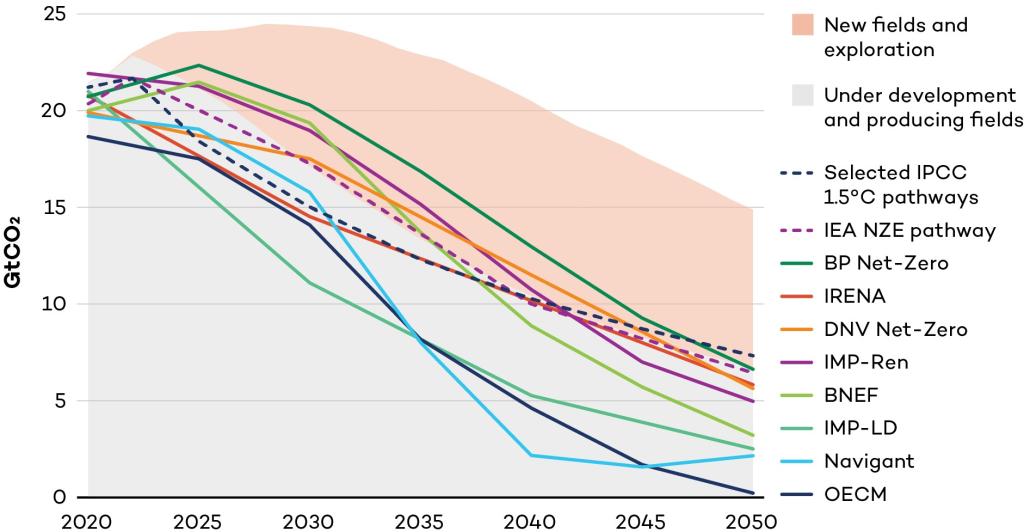
As shown in Figure 1, IISD’s analysis of all 1.5°C scenarios considered by the latest IPCC report finds that global oil and gas production needs to decrease 30% by 2030 when using feasible and sustainable amounts of CCS and CDR. Moreover, assessment of the IPCC Illustrative Mitigation Pathways, other 1.5°C scenarios from intergovernmental organizations including the IEA, the International Renewable Energy Agency, and various energy consultancies, all showed that oil and gas production needs to decrease at least 65% by 2050.

Graph showing energy pathways to 1.5C. The results find that developing any new oil and gas fields will prevent the world from limiting warming to 1.5C.
Figure 1. Global oil and gas production according to major 1.5°C scenarios.​​​​​

Analyzing these scenarios confirms the IEA’s conclusion that there is no room for any new oil and gas development globally. There is more than enough oil and gas stored in fields already in operation or under development to meet global demand in 1.5°C scenarios, and we must avoid developing or exploring for any new oil and gas fields.

This context underscores the need for the upcoming CER 1.5°C scenarios to show the implication of global models for the Canadian energy transition. They need to enable Canadian decision-makers to consider the impact of reducing domestic emissions in line with limiting warming to 1.5°C whichas all major scenarios indicateimplies a rapid decline in oil and gas production and consumption.

Currently, Canada’s net-zero targets, including targets for the oil and gas sector, only cover Scope 1 and 2 emissions. For the oil and gas sector, this accounts for emissions from extraction and production, which constitute only about 20% of the sector’s total emissions. Conversely, so-called Scope 3 emissions represent about 80% of the Canadian oil and gas sector's emissions. These emissions associated with the combustion of fuels exported to third parties are typically excluded from domestic net-zero calculations, and don’t feature in Canada’s 2030 Emissions Reduction Plan. However, they cannot be ignored when modelling global 1.5°C scenariosto limit warming, all emissions sources must be included regardless of where they are emitted. Accordingly, all global 1.5°C scenarios necessarily show declining oil and gas production in the coming decades since most Scope 3 emissions, for instance tailpipe emissions, cannot be sequestered through CCS.

In 2019, emissions from the combustion of Canadian oil and gas exported internationally, Scope 3 emissions, accounted for more than 954 MtCO2greater than Canada’s entire domestic emissions. Hence, in a world where warming is limited, decision-makers will require tools to assess the impact of a dwindling demand for oil and gas exports and to plan for the scaling of renewable energy sources to meet Canadian energy demand.

Canada Energy Regulator Current and Evolving Policies Scenarios

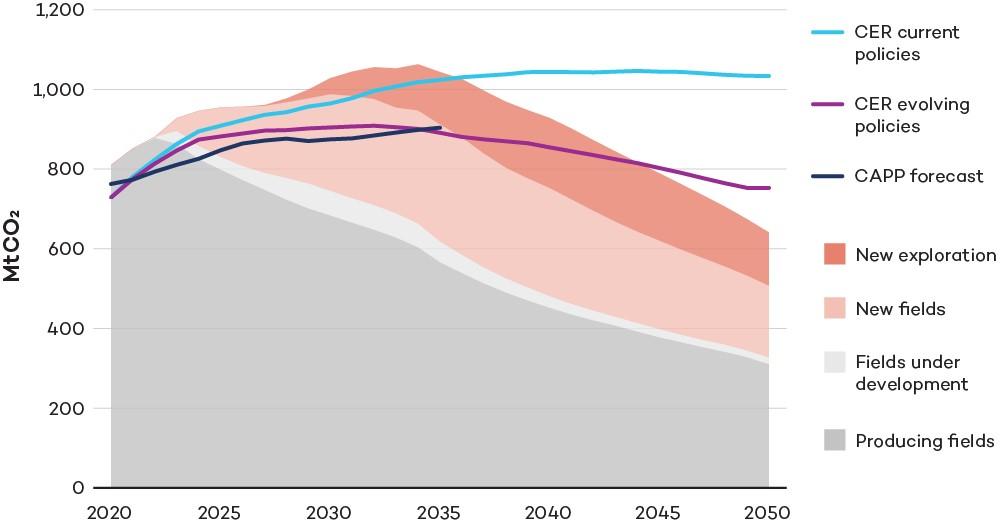
The CER’s most recent modelling shows that if Canada were to only maintain policies already in place, oil and gas production would continue to increase until the 2040s. The CER evolving policy scenariowhich models a future with increasingly ambitious climate policiesestimates that production would still increase until the 2030s before beginning to decline slowly thereafter, which is roughly consistent with the Canadian Association of Petroleum Producers’ forecast for the oil and gas sector. These scenarios were not designed to consider the global context and on their own are insufficient to understand the impacts of declining fossil fuel demand in 1.5°C-consistent scenarios.

As shown in Figure 2, both CER scenarios imply that opening new oil and gas fields and undergoing new exploration would be necessary to support the forecast increase in production levels. This is largely because these scenarios relied on much higher oil and gas price and demand assumptions than what energy analysts are now forecasting. Energy markets were tumultuous in 2022, significantly impacting the longer-term outlook for global demand.

Graph showing Canada Energy Regulator scenarios for oil and gas production.
Figure 2. Canada Energy Regulator oil and gas production scenarios.

Canada’s biggest export market, the United States, has implemented the Inflation Reduction Act which is enforcing policies and channelling hundreds of billions of dollars to accelerate the energy transition. Combined with a ramping up of U.S. gas production and export capacity, these developments are expected to reduce U.S. demand for fossil fuels. There has been considerable volatility in energy markets over the past 3 years. However, in general, the result is a faster transition away from fossil fuels.

Accordingly, it is becoming increasingly clear that the global demand for Canadian oil and gas is expected to decline and that exports will be less competitive. Canada's carbon-intensive oil and gas industry needs more realistic scenarios that fully integrate both short- and medium-term demand outlook and the transition risks associated with climate policies in line with limiting warming to 1.5°C.

If Canadian oil and gas production were 1.5°C-aligned, based on the IEA NZE scenario and other major scenarios analyzed by IISD (see Figure 1), no new reserves would be developed and, at a minimum, production would follow the natural decline rates of the fields already in production or under development. Extraction levels that exclude any new oil and gas fields indicate that production would peak at about 60 billion barrels of oil and gas in 2023 before decreasing by about 20% by 2030 and 70% by 2050.

Accordingly, Canada urgently needs to start planning for a Paris-aligned oil and gas production decline. Such an energy transition requires a rapid scale up of renewable energy production together with electricity grids and storage infrastructure. A 1.5°C-consistent CER scenario should help plan this accelerated energy transition while exploring the implications and opportunities of aligning with the Paris Agreement.

A Canada flag flies with the parliament buildings set in the background.

Canada Needs a Credible 1.5°C Scenario to Inform a Managed Phase-out of Oil and Gas Production

As one of the largest oil and gas producers globally, Canada has a significant role to play in limiting global warming to 1.5°C through its energy transition. CER scenarios will be critical to assessing its impact on the Canadian energy sector and economy. A pathway to net-zero emissions in Canada that simultaneously contributes to the world meeting the Paris Agreement goals can also be a roadmap for other high-income fossil fuel producers with highly diversified economies.

For CER scenarios to fulfill the NRCAN mandate and play these roles successfully, a few key elements cannot be ignored. The scenarios need to:

  1. Disclose consistently on all types of GHG emissions
  2. Report transparently on the relative contributions of emissions reductions versus removals and offsets
  3. Include granular sectoral emissions reduction pathways
  4. Integrate equity considerations into the modelling assumptions

Modelling from leading energy institutions around the world consistently demonstrates that it’s possible to implement a just energy transition while boosting the economy and supporting communities. An ambitious CER 1.5°C scenario is crucial in providing essential guidance to navigate an accelerating energy transition and declining oil and gas demand and production in a way that serves Canada’s best interests. It will influence the expectations of energy producers, energy consumers, investors, and policy-makers on the global energy supply outlook for years to come.

The CER has the potential to provide a roadmap to steer energy producers’ investment decisions and enable financial actors to adopt Paris-aligned strategies that can support Canada’s transition to a bright clean energy future. Now’s the time to take advantage of it.

Deep Dive details

Topic
Climate Change Mitigation
Energy
Region
Canada
Impact area
Climate
Deep Dive

The Road to Sustainable Transport Infrastructure: Why cost-benefit analyses need to integrate gender

Cost-benefit analyses (CBAs) are often the guiding principle for making decisions and investments in transport infrastructure. However, this approach rarely considers the fact that people of different genders use and experience transportation in a variety of ways. Illustrated using a case study in Coimbatore, India, this article explores why gender considerations should be included in transport infrastructure decisions and how they could be integrated into the CBA process.

May 22, 2023

Why Considering Gender Matters

Improved transport systems are key for advancing gender equality. Transport allows people to juggle busy lives, allowing them to move safely and efficiently from their homes to places of education, care, work, retail, health care, and community. Consequently, transport use is gendered: all genders use and experience transportation differently, owing to gender roles, biases, and discrimination, as well as cultural contexts.

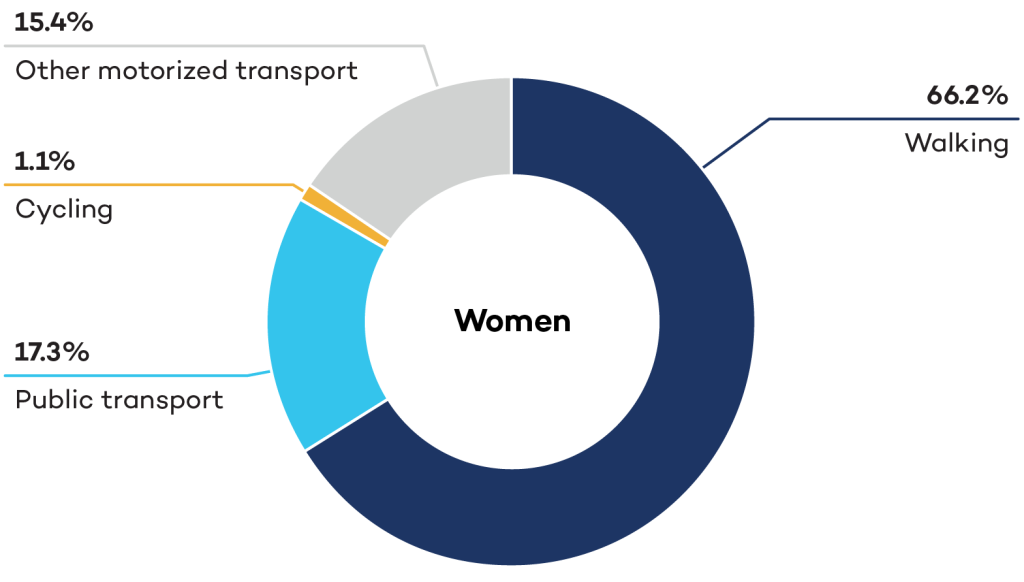
Researchers have long documented how women use transportation differently. For example, women tend to have more complex mobility patterns than men, as women often undertake care work and household chores due to the gendered division of labour. Women are also more likely to walk and use public transport and have less access to resources for travel, such as time, private vehicles, or money. Additionally, women face concerns about personal safety and gender-based violence that influence their travel choices, often avoiding public transport or journeys after nightfall.

Despite the fact that women make up about half of the world’s population, their perspectives as transport users and workers, as well as transport infrastructure’s gendered impacts, are often overlooked in transport planning. While some cities have begun implementing gender-responsive transportation plans, this is not the mainstream approach, partly because women lack sufficient opportunities to weigh in on transport-related decisions.

The same applies when considering transport infrastructure investments. Investment choices for large infrastructure projects are usually made based on CBAs—a methodology that rarely accounts for the outcomes for people of different genders. Transport decisions often remain gender-blind, missing the opportunity for advancing gender equality or potential threats to groups already facing structural discrimination and marginalization.

Access to safe and efficient transport is crucial for sustainable development and advancing gender equality. As former United Nations Secretary-General Ban Ki-moon states in the Mobilizing Sustainable Transport for Development report:

Sustainable transport is fundamental to progress […] in achieving the 17 Sustainable Development Goals. Sustainable transport supports inclusive growth, job creation, poverty reduction, access to markets, the empowerment of women, and the well-being of persons with disabilities and other vulnerable groups.

- Analysis and Policy Recommendations from the United Nations Secretary-General's High-Level Advisory Group on Sustainable Transport

Currently, only half of the world’s population living in cities has good access to public transport options, and over 1 billion people are unable to reach an all-weather road from where they live. Providing people around the world with the transport they need to thrive will require massive investments over the coming years. The Global Infrastructure Hub estimates that USD 45 trillion will be needed by 2040 for roads and railways alone. For transport investment to fulfil its promise, gender must be better considered in the decision-making process.

Cost-Benefit Analyses and Gender: The early evidence

CBAs are commonly used to inform decisions about transport investments. They can help decision-makers identify the most cost-effective and beneficial transport options and are often legally mandated for large infrastructure projects. To conduct a CBA, transport planners start by defining the project’s scope, costs such as construction and maintenance, and benefits such as reduced travel time and increased safety. Planners then assign each cost and benefit a monetary value, compare the totals to determine whether a project is viable, and then recommend to decision-makers the most effective and efficient investment option.

Integrating gender considerations can help assess gender-specific benefits and adverse effects, providing a more accurate picture of how transport investments affect the diverse needs of all genders.

CBAs are one of many entry points for gender-responsive transport planning. Integrating gender considerations into CBAs can help assess gender-specific benefits and adverse effects while providing a more accurate picture of how transport investments affect the diverse needs of all genders.

Currently, CBAs for transport projects are mostly gender-blind and do not include gender considerations. Specific guidance is scarce, as most resources either discuss transportation’s gender considerations without explaining how project assessments can incorporate them, or these resources may propose improvements to the CBA methodology without paying specific attention to gender.

Work has begun in developing tools and guidance for better integrating gender in these assessments. The Global Infrastructure Hub has developed a free tool to conduct an integrated CBA of bus transport projects that specifically assesses gender impacts. It estimates the environmental, social, and economic outcomes of bus projects, helping stakeholders make more informed decisions in the early planning stages. Crucially, the tool can provide gender- and income-disaggregated results for transit time savings, auto travel time savings, and active transportation benefits from walking and cycling.

The main barrier to mainstreaming genders in CBAs is a prevailing lack of knowledge and evidence on how to do so, making it difficult for planners to make informed assumptions on gender impacts and their monetary values. A 2017 report from the United States Agency for International Development calls on organizations to provide learning resources for modellers, improve the data collection on the topic, and grant flexibility in how analyses capture gendered impacts.

However, it may not always be possible, at first, to integrate gender aspects into quantitative models and CBAs. Experts convened by the International Transport Forum underlined that CBAs are most useful for transport decision making when they deliver the information sought by decision-makers, draw on the best available local evidence, and transparently explain uncertainties and gaps in the analysis. When high-quality data on gendered impacts is lacking and cannot be accurately integrated into a CBA, presenting decision-makers with additional qualitative information on gender considerations is a better approach.

In Practice: Non-motorized transport in Coimbatore, India

Coimbatore has a population of 1.6 million people, making it the second-largest city in Tamil Nadu, India. It faces pressing transport challenges such as traffic congestion, long commutes, safety concerns, and air pollution. Walking and cycling comprise a small proportion of the transport mode shares, while most people use public transport and private vehicles. To address the challenges, the Coimbatore City Municipal Corporation has developed a 15-year Non-Motorized Transport (NMT) plan, which includes 300 km of walking and cycling routes across the city and aims to benefit one million people, especially women, the elderly, and low-income communities, and reduce CO2 emissions. The total investment costs of the NMT network amount to INR 9,895 million (about USD 121 million).

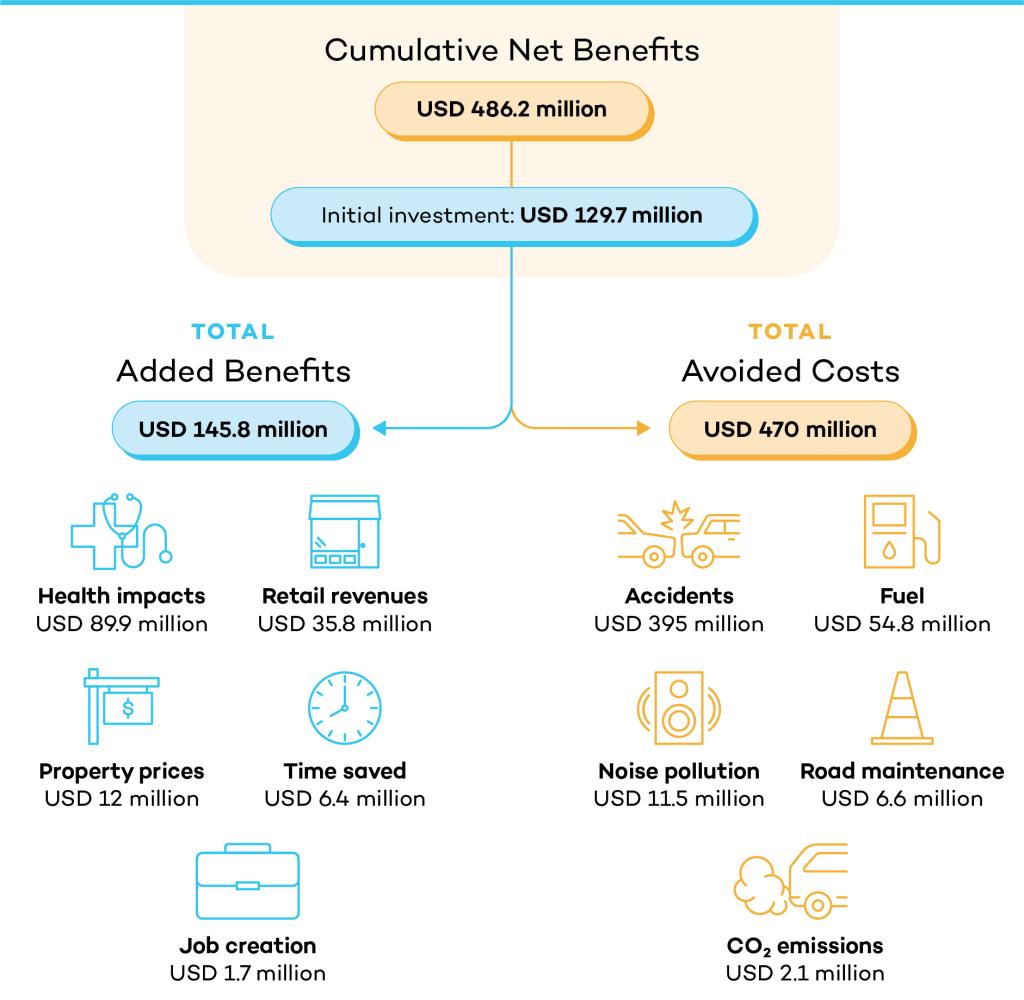
Using our Sustainable Asset Valuation (SAVi) methodology, we analyzed the NMT plan’s potential economic, social, and environmental outcomes. This integrated CBA shows that the NMT network in Coimbatore will provide efficient, safe, affordable, and convenient transport, and improve the last-mile connectivity to public transport. The greatest impact for the city will be the increased road safety, saving USD 395 million in costs from road accidents over the 23-year project period.

Figure 1 shows the net benefits, avoided costs, and added benefits of the NMT network.

Breakdown of NMT added benefits

Considering all added benefits and avoided costs, every dollar invested in this NMT network generates between USD 4.75 and USD 4.93 for society. This analysis, however, like most others, did not disaggregate the added benefits and avoided costs by gender.

Gender as Qualitative Dynamics in Systems Mapping

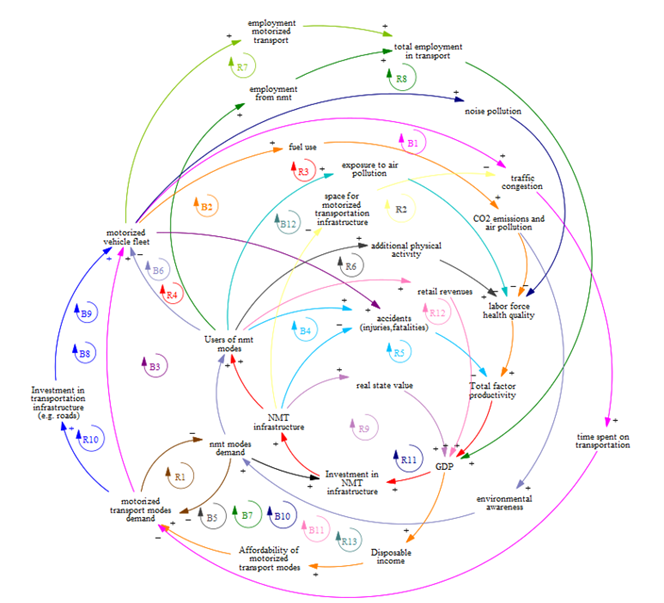
For the analysis, we first developed a causal loop diagram (CLD), which helps visualize the connections between the proposed NMT network and its effects on economic activity, as well as the social and environmental impacts. It is made up of many interconnected factors in the form of loops, and each loop visualizes cause-and-effect relationships that have either a positive (amplifying) effect or a negative (balancing) effect on the other, creating a feedback loop. A CLD enables us to identify the significance of each indicator and provides the basis for quantifying these with mathematical models, assigning them monetary values for an integrated cost-benefit analysis.

Figure 2 shows the CLD that was developed for the Coimbatore NMT network.

The CLD produced for the NMT network in Coimbatore

The CLD developed for the Coimbatore NMT case study, similar to many such systems maps, did not explicitly consider gender-specific indicators, though the project does have gender-specific dynamics. Incorporating these dynamics into systems mapping, such as a CLD, for transport infrastructure projects can serve as an initial and effective step to ensure that CBAs account for gender impacts.

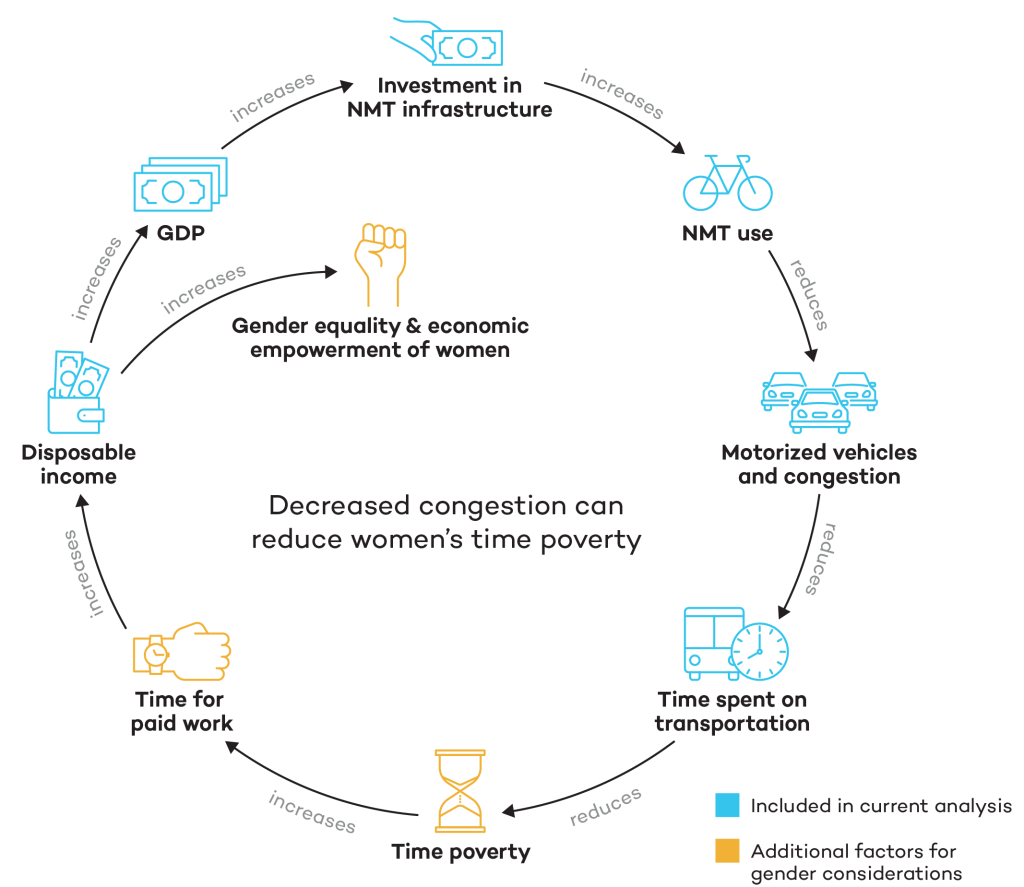
Decreased Congestion Can Reduce Women’s Time Poverty

In Indian cities, women comprise only 18.5% of the formal labour force and spend about 10 times more time on unpaid domestic work than men. They often juggle multiple roles and responsibilities, leaving little time to pursue education, paid work, or personal development. In many cases, women forego job opportunities and favour home-based work due to inefficient transport options preventing them from combining work with caregiving responsibilities World Bank, 2022).

We can adjust the CLD to better reflect the link between congestion, women’s time poverty, and income. Investing in walking and cycling infrastructure increases the use of non-motorized transport modes, reducing the number of motorized vehicles and congestion. Less congestion lowers the time spent on transportation, helping address time poverty, and in turn enabling women to take up paid work and increase their income. This contributes to gender equality and women’s economic empowerment, while boosting GDP and unlocking additional funds for NMT investments.

Increased walking and cycling also helps revitalize local economies. In our CBA of the NMT network, we estimate that retail revenues could be boosted by USD 36 million and property values by USD 12 million. This could help foster mixed-use neighbourhoods that contain a variety of residential, commercial, cultural, institutional, or entertainment areas, allowing women to address all their needs locally, reducing time spent on transportation and thus opening up greater opportunities for pursuing paid work or education.

Figure 3 shows the causal loop for reducing women's time poverty.

Causal loop for decreasing women's time poverty

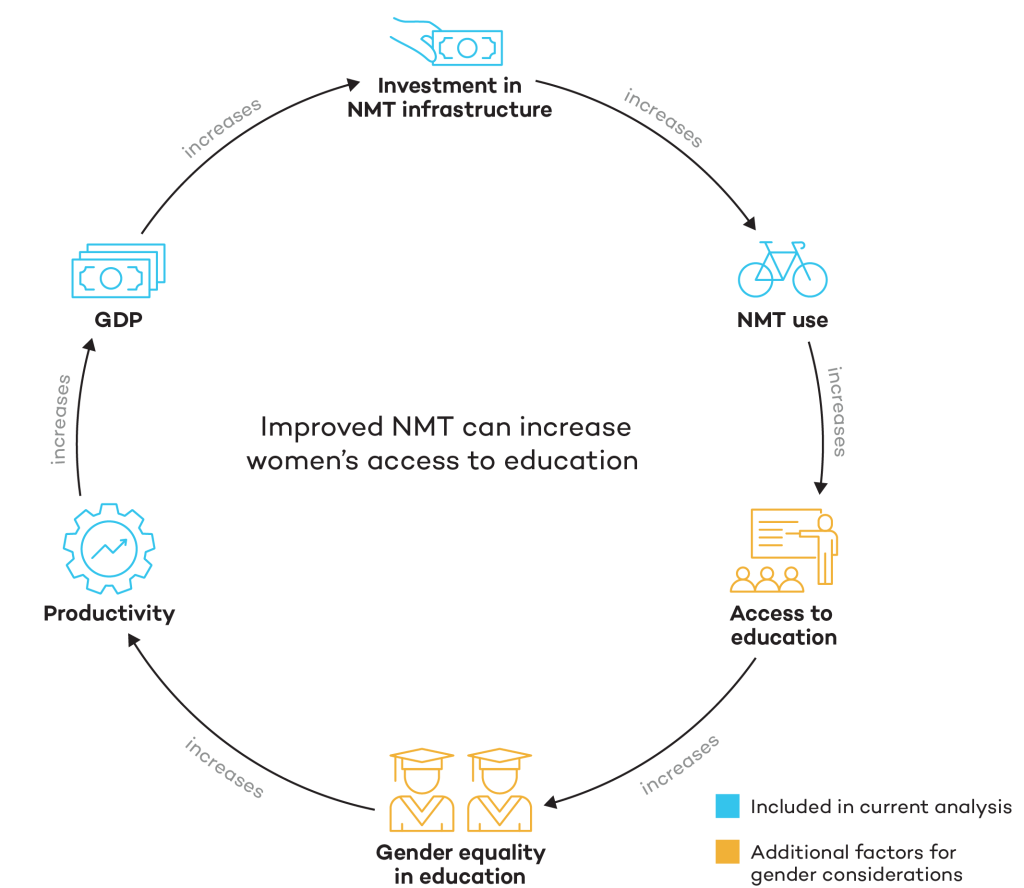
Improved NMT Can Increase Women’s Access to Education

Many low-income women in India struggle to afford fares for public transport and do not have access to private vehicles. Cultural norms also discourage women from cycling and walking in environments that are perceived as unsafe. Together, these factors considerably limit women’s mobility and access to education and economic opportunities. For example, female students in Delhi chose lower-ranked colleges than men to avoid unsafe travel routes, and 52% of women turned down education and work opportunities because of safety concerns.

For Coimbatore, a CLD feedback loop can be refined to consider how the NMT improves access to education, gender equality, and productivity. Investment in the project will increase the use of NMT modes (walking and cycling), boosting access to and participation in education, and resulting in increased productivity and GDP. This GDP growth, in turn, allows for further investment in NMT.  

Figure 4 shows the causal loop for improving women's access to education.

Causal loop for increasing women's access to education

Mobility Is Also Affected by Cultural and Societal Contexts for Women

Women use and experience transport differently based on their socio-economic status, ethnicity, caste, education, and age, as well as cultural and societal contexts. Therefore, transport projects should account for these varied contexts to address these diverse needs.

For example, one widespread threat to women in India is the high risk of gender-based violence and harassment in public spaces, with 56% of women reporting that they have been sexually harassed while using public transport. This violence and the fear of violence can lead women to avoid walking, cycling, and public transportation, especially after dark and in crowded situations.

The City of Coimbatore hopes that by investing in the new NMT network, walking and cycling will increase, transportation’s environmental impact will decrease, and women will have greater access to opportunities. However, the risks of gender-based violence and other societal and cultural factors could undermine the NMT network’s potential for improving women’s access to opportunities. To reap the full benefits of the new NMT infrastructure, it needs to be safe and culturally acceptable for women to use the new walking and cycling routes.

To a limited extent, gender-sensitive design and safety policies could increase women’s safety in public spaces and facilitate their access to the new NMT infrastructure. Some measures which have been taken in Indian cities and beyond to increase safety include improved lighting of paths and public transport, emergency response systems, and training for transport employees. However, systemic action is needed from policy-makers and society to tackle gender-based violence, change restrictive cultural norms, and ensure women’s fundamental human right of accessing public spaces.

To capture this gender-specific dynamic in the Coimbatore CLD, we can add a specific indicator about gender-based violence. The below figure shows that safety policies and gender-sensitive infrastructure design could reduce the risks of gender-based violence and improve women’s safety in public spaces, thus supporting women’s access to NMT.

Figure 5 shows how safety policies and gender-sensitive design can increase NMT use.

Causal loop for NMT use

Using Gender-Disaggregated Data in Quantitative Models

To assess the NMT network’s societal outcomes, we developed a mathematical systems model, building from the qualitative CLD. The Excel-based model quantifies and monetizes key indicators for the CBA—such as income creation, health impacts, and emissions—and, as with the CLD, can be refined further to reflect gender-disaggregated impacts.

This is important because the causal relationships for men and women may be the same, but the size of the impacts can differ by gender. For example, income influences the affordability of and demand for motorized transport modes for both men and women, but women in India often have less income and more complex journeys. This makes motorized transport less affordable for women, meaning that they rely more heavily on NMT and can benefit disproportionally from the improved infrastructure for NMT and public transport—a lesson that can be learned from other cities, such as Delhi.

Figure 6 shows the transport mode shares for all trips by gender in Delhi, based on Goel et al., 2022.

Pie chart showing the transport modes for men in New Delhi


Pie chart showing the transport modes for women in New Delhi

Gender-disaggregated data is still scarce in the transport sector, limiting the level of detail that mathematical models can achieve. Nonetheless, there are ways to refine the existing mathematical model to better capture gendered impacts related to employment, traffic safety, and health in Coimbatore.

Employment in the Transport Sector

Constructing and operating the NMT network in Coimbatore will create additional jobs and income of USD 1.7 million over 23 years. This value is small relative to the NMT plan’s other benefits, yet the mathematical model could use disaggregated data to capture the transport sector’s large gender gap in employment.

Even within the European Union, with relatively strong norms and guidance on gender equality, women make up just 22% of the transport workforce. The rate of female employment in construction in Asia is only 8%. The vast gender pay gap in India also means that women working in the informal construction sector earn 30% to 40% less than their male colleagues. Integrating such data into the mathematical models and CBA can demonstrate how, unless measures are taken to address these gender gaps, the employment benefits of investing in the NMT will disproportionately benefit men and fail to contribute to gender equality.

Traffic Safety

Avoided traffic accidents are the largest benefit from investing in Coimbatore’s NMT network, saving costs of USD 368 million over the project timeline according to our CBA. Men and women are affected differently by these accidents, which is why the mathematical model should use gender-disaggregated data. Men in India are about six times more likely to be killed or injured in road accidents, while women disproportionately bear the burden after accidents that affect family members, often taking up extra work and care for the injured. The model should aim to consider these gender-specific impacts on productivity and disposable income.

Health Benefits From Additional Physical Activity and Reduced Air Pollution

In India, 44% of women do not engage in sufficient physical activity to maintain their health, as compared to 25% of men. Potential reasons could be that women have fewer work-related trips, cycle less, and do less sports for leisure due to social norms, caste, gender, and socio-economic status.  

Improved conditions for NMT can enable greater mobility for women in Coimbatore, promoting increased walking and cycling, particularly for women who previously had limited exercise opportunities. To consider this impact, the mathematical model could use gender-disaggregated data for NMT users, additional physical activity, and impacts on health quality. This would allow for estimating the increased physical activity for men and women and the value of the related health benefits by gender.

Conclusion

Upcoming investments in transport infrastructure present an opportunity for decision-makers and stakeholders to advance gender equality. By focusing on enhancing safety, saving time, and improving women’s access to services and professional opportunities, these investments can have a transformative impact. Leveraging this opportunity requires careful consideration of gender contexts when making decisions about infrastructure investments. One effective approach is to develop more holistic CBAs that capture a systemic understanding of local gender dynamics.

In sum, transport planners and decision-makers can take three actions to better integrate gender in their CBAs. These recommendations are inspired by related research by the United States Agency for International Development that looked at CBAs more broadly.

  • Identify additional gender-specific aspects of transport projects. These dynamics can be mapped in a qualitative way in a CLD. For example, better conditions for walking and cycling can improve women's access to education, which benefits the entire economy.

  • Improve the collection of gender-disaggregated transport data and use it to refine the CBAs. For example, valuations should consider gender differences in transportation modes and travel patterns, disposable income, and employment by sector. Beyond CBAs, collecting gender-disaggregated data also enables evidence-based decisions on improving women's access to safe and secure transport.

  • Quantify and monetize the outcomes of transport investments on people of different genders. For example, job creation in male-dominated sectors such as transport can benefit men more than women and fail to advance gender equality unless additional policies encourage women’s employment. Conversely, reducing congestion can lead to increased income-generation potential for women by reducing time lost in traffic and improving access to job opportunities. Improving traffic safety can generate avoided costs, such as preventing damage to vehicles and infrastructure, and avoided health costs, resulting in greater income generation for women. Furthermore, promoting physical activity can generate specific health benefits for women, resulting in avoided health costs and potentially higher labour productivity and income.

Transportation is a complex topic, and CBAs are just one way to capture women's transportation experiences and needs. Transport planners and decision-makers should actively consider the gendered impacts of transport infrastructure, placing women’s needs as transport users at the core of planning decisions. Empowering women's active participation in the transport decision-making process is crucial. By adopting a gender-sensitive approach to transport planning, it is possible to advance gender equality, creating knock-on effects that benefit the economy, society, and the environment as a whole.


The author would like to thank Liesbeth Casier, Michail Kapetanakis, Benjamin Simmons, Marion Provencher Langlois, Ege TekinbasBecca Challis and Sofia Baliño for their work and advice on this article. 

Read the full SAVi Assessment of the NMT network in Coimbatore, India here.

Further reading: 


Deep Dive

The Investment Facilitation for Development Agreement

Where do negotiations stand ahead of the July 2023 deadline?

With over 100 World Trade Organization (WTO) members pushing to wrap up negotiations for an Investment Facilitation for Development Agreement, what would the actual accord mean for investment governance and sustainable development, and what thorny issues remain before a mid-year deadline?

March 3, 2023

Since September 2020, a group of WTO members has been negotiating a new agreement on investment facilitation disciplines, following nearly 3 years of preparatory work. The negotiations for this Investment Facilitation for Development Agreement (IFDA) have since advanced at a rapid pace, so much so that the co-coordinators of the process—South Korea and Chile—have announced that they expect the legal text of the Agreement to be finalized at the latest by mid-2023.

The rapid pace at which members are reaching consensus on some of the main elements of the Agreement has come as a surprise to some trade watchers, and whether the current July 2023 deadline is met remains to be seen. Historically, WTO members have long struggled to advance negotiations for new agreements, especially at the multilateral level—in trade jargon, those talks involving the organization’s entire membership. The IFDA, however, may prove to be an exception, with this progress potentially due to the so-called plurilateral nature of the negotiations. Rather than having all 164 WTO members engaging in discussions, the IFDA is only negotiated by a coalition of the willing, which currently includes more than 110 members of the WTO. This is more than two-thirds of the membership. The coalition includes developed economies, as well as a significant number of developing country and least-developed country (LDC) members.

The co-coordinators of the process—South Korea and Chile—have announced that they expect the legal text of the Agreement to be finalized at the latest by mid-2023.

The high participation of developing country and LDC members has been due to the initiative’s focus on promising that the IFDA will have a strong development dimension. The Agreement’s objective is to promote the implementation of investment facilitation measures, in the form of transparency, administration streamlining, international cooperation, and other types of efforts to facilitate the flow of foreign direct investments among members. The idea is that these investment facilitation measures will be useful for creating a more investment- and business-friendly environment, one which facilitates the entry and operation of foreign direct investment (FDI) in a country. There is also an expectation that these disciplines will be especially useful for developing country and LDC members in their efforts to attract foreign investment and may result in their increased participation in global investment flows.

What’s Been Agreed So Far

There are seven key sections in the draft negotiating text, each consisting of both clean and bracketed text. Brackets around a provision mean that the provision, or certain words within it, is still under negotiation. When language is not bracketed, it is referred to as “clean text,” which means WTO members have agreed—in principle—to the language of the article, and no more changes are expected. Beyond the brackets, WTO members also need to agree on select proposals that remain within the Agreement’s Annex. These are articles that have yet to gain broader support among participating WTO members so that these provisions can be moved to the main text.

Given that the negotiations have advanced rapidly, this means that members have produced a substantial number of “clean text” articles. By comparison, very few brackets and proposals remain subject to further negotiation. With that being said, the negotiations follow the long-standing WTO negotiating principle that “nothing is agreed until everything is agreed,” so even if many articles are “clean,” members can still revisit them later on.

The IFDA’s Objective and Scope

Section I of the Agreement outlines the IFDA’s objective and scope. In addition to the objective of increasing foreign investment in developing countries, this section includes important clarifications on how the Agreement will relate to other international investment agreements, to what type of government measures these disciplines would apply to, as well as what measures would fall outside the scope of application. For example, the section clarifies that the agreement cannot be construed as applying to matters relating to market access, investment protection, investorstate dispute settlement (ISDS), nor to government procurement and subsidies/grants unavailable to foreign investors, nor to government procurement and subsidies/grants unavailable to foreign investors.

These provisions are meant to help clarify the positioning of the IFDA within a larger landscape of international investment governance, among other purposes. For example, according to the United Nations Conference on Trade and Development (UNCTAD), there are currently 2,856 bilateral investment treaties, of which 2,244 are in force, in addition to 439 treaties with investment provisions, of which 360 are in force. The latter type of treaty often includes regional trade agreements, many of which have investment chapters. There are also active UN processes focused specifically on international investment governance, such as at the United Nations Commission on International Trade Law, and intergovernmental agencies that undertake extensive work in this area with governments, such as UNCTAD and the Organisation for Economic Co-operation and Development.

The exceptions outlined in the IFDA’s Section I, meanwhile, reflect concerns and necessary clarifications promised by the initiative’s proponents since plans for a possible investment facilitation agreement were first announced by 70 WTO members during the organization’s Eleventh Ministerial Conference in Buenos Aires, Argentina, in 2017.

Section I has benefitted from intense discussions in 2022 and still includes a number of details where members in the IFDA talks are working to achieve consensus. One of the core issues that remains unclear is the extent to which the IFDA’s obligations would apply to portfolio investments or whether the application of the disciplines will be constrained more clearly to matters relating to FDI only. Another set of particularly important brackets that members still need to agree on is whether the agreement should apply to measures that “affect” foreign direct investments or, more narrowly, to measures “related to” investments. Some members prefer a clearer and narrower approach, under which measures would have to be explicitly related to investments to be covered. Others prefer a wider approach, under which any measure that might have a direct or indirect impact on investments would be covered and subject to the IFDA’s obligations.

Transparency of Investment Measures

Section II is a core pillar of the Agreement, featuring disciplines that improve the transparency of investment measures. This is mainly done through the implementation of various publication-related disciplines. For example, members have agreed to publish information on all of their enacted government measures that have an impact on the investment activities undertaken by foreign investors in the host state’s territory. The Agreement clarifies that a government measure includes laws, regulations, rules, procedures, decisions, administrative actions, and possibly other forms undertaken by government authorities at the local, regional, and central levels, as well as by non-governmental bodies with delegated authority.

Members also agree to publish information on laws and regulations that are in the process of being developed. Beyond publishing information, members also agree to certain good regulatory practice provisions, which involve the implementation of certain “best practice” processes for developing and implementing regulations. Most notably, members agree to facilitate comments from interested stakeholders, including from foreign investors, during their regulatory development process. While members are required to facilitate such inputs, they are not obliged to implement the comments.

Streamlining and Speeding Up Administrative Procedures

Another key pillar of the Agreement is Section III on “streamlining and speeding up administrative procedures.” For instances when an authorization is required for a foreign investment to enter and operate within a country, this section clarifies how governments should develop measures for such an authorization, and, more specifically, provides guidance on how competent authorities should treat applications that may be submitted as a part of authorization procedures. By implementing such disciplines, the expectation is that the authorization procedures will become more efficient, namely by reducing “red tape,” and also will be implemented in a more transparent and reliable manner.

Members also agree to implement a range of disciplines aimed at improving governments’ collaboration with foreign investors. These fall under Section IV on focal points, domestic regulatory coherence, and cross-border cooperation. Examples of these disciplines include establishing a contact point that responds to enquiries from investors on matters pertaining to the IFDA, as well as creating a database that makes it easier for these investors to find information on local suppliers. In addition, the IFDA would encourage members to implement programs that would improve the capacity of local suppliers so that they can better respond to the needs to foreign investors.

Cooperation, Sustainable Investment-Focused Efforts

Not only are cooperation efforts expected in relation to investors, but the IFDA also targets improving cooperation among participating WTO members themselves. Members would be required to set up an enquiry point to respond to questions that other members submit on any measures covered by the Agreement, as well as to facilitate the exchange of best practices and experiences on their efforts to implement the Agreement. These points are set out in Section IV and Section VII on Institutional Arrangements and Final Provisions, respectively.

While all of these measures are expected to facilitate FDI, participating WTO members recognize that there is also a need for more specific disciplines that focus on promoting the flow of sustainable investments. These are also referred to as higher-quality investments that are more effective in achieving development related outcomes. Members have therefore agreed to include two articles for such efforts through Section VII on Sustainable Investments. Under these provisions, a member would be required to encourage foreign investors and businesses entering or operating in its territory to voluntarily incorporate international standards, guidelines, or principles focused on responsible business conduct (RBC) into their own business practices and policies. Members would also be required to develop government measures aimed at tackling corruption and possibly money laundering.

Proponents of these articles argue that including such disciplines is important for the IFDA to incorporate sustainable development priorities.

While participating members generally agree that such articles are valuable, sources familiar with the talks note that some members have voiced their disappointment that the article would not extend the RBC requirement to home states, but rather to limit its application only to host states. They argue that home states, which are mainly capital-exporting countries, typically tend to be wealthier, and therefore are in a better position to both encourage their investors to incorporate RBC practices, while also monitoring and sharing information of their businesses’ efforts in this area. While negotiators had initially considered including more robust home state measures, they ultimately did not attain consensus among the full group, as some members argued the scope of the agreement should primarily focus on host state requirements.

The final section of the Agreement includes a range of articles, from detailing the functions of the Investment Facilitation Committee that would be set up at the WTO, to providing clarity on how the participants of the Agreement would have access to WTO’s statestate dispute settlement mechanism to resolve any disputes that may arise under the Agreement.

The Development Dimension

Section V is a very important section from a development perspective, as it focuses on the particular flexibilities that developing country and LDC members can access. What this section recognizes is that developing country and LDC members are often not in a position to implement the various obligations of the Agreement right away. Instead, these members may need more time, as well as targeted capacity-building support, in order to be able to implement the agreement. In WTO jargon, this is known as special and differential treatment (S&DT).

At the WTO, any member can self-designate themselves as a developing country for a given WTO agreement and avail themselves of these inherent flexibilities. LDCs often have access to additional flexibilities, and the WTO in this instance uses the UN classification for whether a given economy is an LDC.

The IFDA’s section on S&DT is based on the model used under the WTO’s Trade Facilitation Agreement (TFA), a multilateral accord aimed at streamlining customs and border procedures for trade in goods, which has been in force for just over 6 years. The TFA’s approach to S&DT was considered as ground-breaking for having moved beyond the usual approach of implementing uniform exemptions or standard implementation periods. Under the TFA, developing country and LDC members can determine for themselves which of the obligations of the Agreement they can implement immediately—or after 1 year, in the case of LDCs—upon the TFA’s entry into force. They would then schedule these provisions under Category A. They can also designate which provisions they would need some time to implement under a so-called Category B, as well as which obligations they can only implement upon having attained capacity-building support and/or additional time. This last classification is known as Category C.

To determine this scheduling under the IFDA, developing country and LDC members need to do a needs assessment analysis, also referred to as a regulatory gap analysis. This exercise will allow them to analyze to what extent their domestic framework is already aligned with the provisions set out through the IFDA framework, so they can then determine which provisions should be placed under what category.

The guide that will help WTO members undertake this analysis is currently in the process of being finalized by the WTO Secretariat in partnership with six other international organizations and will likely be circulated in April 2023. There is some uncertainty among developing country and LDC members about whether they will have enough time, and more importantly the necessary financing, to carry out the analysis needed to schedule their commitments by the deadlines that would be set out in the Agreement. This difference in opinion over the timelines by which members will schedule their S&DT flexibilities is one of the main outstanding issues left for WTO members to finalize.

Setting up [an Investment Facilitation] Facility for the IFDA is also complicated by the plurilateral nature of the initiative

Another important issue from a development perspective where negotiations are still ongoing involves whether the IFDA should include the establishment of a dedicated Investment Facilitation Facility, which would manage donor contributions for helping developing country members implement the Agreement. The TFA and the recently concluded Agreement on Fisheries Subsidies set up similar funding mechanisms, but some members are wary of implementing a similar mechanism under the IFDA. Members who argue in favour of this facility say that it can help ensure the necessary support for developing country members as they undertake their needs assessments, while serving as a valuable body for coordinating funds. Some other members are concerned that funding coordination efforts are activities that do not belong within the mandate of the WTO and should instead be carried out by other, more relevant, international organizations, such as the World Bank.

Setting up such a facility for the IFDA is also complicated by the plurilateral nature of the initiative. Should the IFDA set up this facility, it is likely to need resources from the WTO Secretariat, which is funded by all WTO members, including those not involved in the IFDA. This, in turn, raises budget allocation questions. Given that the Joint Statement Initiative (JSI) has not received the backing of all WTO members, and some members remain vocal critics of the process, it is not yet clear how and where a facility might be housed.

The Way Ahead

As mentioned, the co-coordinators of the process have targeted July 2023 as the deadline for finalizing the negotiating text. Although the text has a substantial number of clean articles at this stage, it has yet to be seen whether members can agree on the outstanding brackets and proposals under this timeframe. Many of these brackets are especially relevant from a development perspective.

Members will also need to gain clarity on the legal architecture of the agreement, more specifically on whether it will be legally feasible to incorporate the IFDA within the WTO’s existing treaty architecture. At present, members are exploring three options and, as part of such efforts, are exploring the technical and political feasibility of each option.

The first option involves integrating the IFDA as a multilateral agreement, in which case all 164 members will have to sign on to be bound by the disciplines of the agreement.

The second option is to integrate the agreement as a plurilateral agreement, in which case the disciplines and benefits of the agreements would only apply to the parties of the agreement, and not to the non-participants, similar to other plurilaterals such as the WTO Agreement on Government Procurement. The signatories, however, may choose to extend the benefits voluntarily to non-participants, and it seems this extension of rights is being promoted through the treaty text itself. This option, however, will still require consensus approval from all 164 members so that the IFDA can be added to the WTO rulebook as a plurilateral accord under Annex 4 of the Marrakesh Agreement.

The success of either of these two options essentially depends on the buy-in of the broader WTO membership, including non-signatories, as well as members who have been very vocal opponents to plurilateral initiatives so far. India and South Africa are two such members who have long questioned the legal status of these kinds of Joint Statement Initiatives, including but not limited to the IFDA. Among their concerns is the potential lack of a legal basis for discussing these initiatives at the WTO, given the absence of consensus across the membership to even begin these processes. These members argue the initiatives have been a distraction, taking members’ focus away from negotiations that have an existing multilateral mandate, namely those under the Doha Development Agenda, which remain urgent and have significant development implications.

The success of either of these two options essentially depends on the buy-in of the broader WTO membership, including non-signatories, as well as members who have been very vocal opponents to plurilateral initiatives so far.

It has yet to be seen whether the proponents of the investment facilitation negotiations can convince non-signatories to either join the IFDA, or if that fails, to approve its addition to the Marrakesh Agreement’s Annex 4. Should neither option work, proponents may have to consider the third option. Rather than including the framework as a stand-alone agreement, they would need to separate the articles and schedule them within the existing WTO agreements, notably the General Agreement on Tariffs and Trade and the General Agreement on Trade in Services instead.

This third option would involve a process of coordinated scheduling and has parallels to how the outcome of a separate JSI on domestic regulation in services is now being worked into the WTO rulebook, though this too has proven to be controversial.  Some members have voiced concerns regarding this option for the IFDA, pointing out that it would be far too difficult to coordinate and implement. They have also asked whether incorporating the IFDA articles within existing WTO agreements would weaken the scope and application of these articles.

Only five more meeting rounds remain until the current July deadline. As participating WTO members push to clinch a deal within that timeframe, they will need to clear the hurdles that remain for achieving consensus among themselves on outstanding articles and proposals, as well as clarify how they will approach these questions of legal architecture. Lastly, they will need to address any concerns that may persist on how this agreement will slot into the wider sphere of international investment governance.

The author would like to thank Sofia Baliño and Alice Tipping for their feedback and edits on earlier drafts of this article, and the World Trade Organization for the permission to use the cover photo for this article.

For an in-depth analysis of the present draft of the IFDA negotiating text, please see our latest negotiating brief, which was produced with funding by UK aid from the British Government. The Umbrella Grant is a project of the Trade and Investment Advocacy Fund (TAF2+) and is implemented by the International Institute for Sustainable Development and CUTS International, Geneva. Views expressed in the publication are the author's own and do not necessarily reflect HM Government’s official positions or those of TAF2+.

Deep Dive

GTAGA: The Global Trade and Gender Arrangement, decoded

The Global Trade and Gender Arrangement, founded by Canada, Chile, and New Zealand, encourages action toward mutually supportive trade and gender policies. Since it was announced in 2020, Mexico, Colombia, and Peru have also joined the Arrangement, whose text addresses key domains of gender inequality. In practice, however, its focus so far has been on increasing the number of women entrepreneurs in trade.

March 1, 2023

In 2022, the Global Trade and Gender Arrangement (GTAGA) welcomed two new participants: Colombia and Peru. The news did not make headlines: the signing ceremony coincided with the World Trade Organization (WTO) Ministerial Conference in June, which attracted most of the trade-focused media attention.

The GTAGA has been heralded by many as "ground-breaking," a "landmark," and an innovative and comprehensive initiative. But is it really? What does it add to trade and gender provisions in existing agreements and how far can it go to redress gender inequalities in participating countries?

This article unpacks what GTAGA entails in practice, what officials from participating countries say about its potential, and what responses have emerged from the wider trade and gender community.

GTAGA's origins and objectives

The idea of a GTAGA originated in the Asia–Pacific Economic Cooperation (APEC) Inclusive Trade Action Group (ITAG) and came into being in 2020, with Canada, Chile, and New Zealand as its first three participants. The non-binding arrangement, commonly known as GTAGA (pronounced "gee-TA-gah"), aims to promote "mutually supportive trade and gender policies to improve women’s participation in trade and investment and in furtherance of women’s economic empowerment and sustainable development." It is a stand-alone text, not linked to a specific trade agreement. Current GTAGA participants are Canada, Chile, Colombia, Mexico, New Zealand, and Peru.

Alicia Frohmann, a trade policy specialist who delivers technical assistance on gender and trade in the Latin American region, told IISD that "Canada, Chile, and New Zealand agreed on GTGA in the aftermath of the Comprehensive and Progressive Agreement for Trans-Pacific Partnership (CPTPP), which did not include gender specific provisions."

GTAGA's content

GTAGA is a cooperation-focused initiative, strongly geared toward improving women's access to trading opportunities. While none of its provisions impose legally binding obligations on its participants, it does provide a framework that they can build on for the future.

In its five pages, the Arrangement acknowledges that “women's enhanced participation in the labour market, the growth of women-owned enterprises and entrepreneurship, women’s economic autonomy and access to, and ownership of, economic resources contribute to prosperity, competitiveness, and the well-being of society.” GTAGA further notes “the importance of adopting, maintaining, and implementing gender equality laws, regulations, policies, and best practices” and recognizes the need for evidence-based trade interventions to respond to barriers limiting women’s opportunities in the economy. 

GTAGA participants undertake to enforce their laws and regulations promoting gender equality and improving women’s access to economic opportunities. They reaffirm their obligations under other international agreements addressing women's rights or gender equality and recognize that it is “inappropriate” to weaken or reduce the protection provided in domestic gender equality laws with a view to encouraging trade or investment. 

GTAGA participants agree to encourage enterprises to incorporate gender equality standards, guidelines, and principles and to support the goal of promoting gender equality in the workplace. The Arrangement notes that temporary special measures relating to licensing and qualification requirements and procedures “aimed at accelerating de facto gender equality” are not to be considered discriminatory by GTAGA participating countries. 

Similar to gender chapters in recent bilateral trade agreements between Brazil, Canada, Chile, and other economies, GTAGA sets out detailed possibilities for cooperation among its participants through dialogues, technical assistance, exchange of experts, and the sharing of information and best practice. Articles 8 and 9 set out a non-exhaustive list of activities, including capacity-building; access to education, including digital skills development; measures to foster leadership and entrepreneurship; business development; access to networks; trade missions; and government procurement. 

The Arrangement establishes a working group to identify, coordinate, implement, and report on activities, as well as to interact with stakeholders. GTAGA further calls for the identification of a Contact Point for Trade and Gender in each participating country. A first periodic review of the Arrangement is scheduled for 2023, at which time participants are also due to look afresh at GTAGA's legal form and consider whether to undertake negotiations for a treaty-level instrument on trade and gender.

What does GTAGA add to existing gender provisions?

GTAGA's provisions show several parallels to gender chapters of other trade agreements, and its participants are all parties to trade agreements with provisions that explicitly refer to gender equality. This begs the question of what the Arrangement adds to what already exists. 

Former Chilean Foreign Minister Andrés Allamand—who served under the Chilean administration that helped develop the Arrangement—noted the benefits of developing a multi-country arrangement like GTAGA compared to negotiating bilaterally. The Arrangement “takes inspiration from trade and gender chapters,” he told participants at an OECD-organized meeting in June 2021. 

GTAGA therefore "represents a second step, reinforcing and complementing countries’ commitment to gender issues and encouraging them to work together. Also, it allows us to go global, as the G in its name suggests," Allamand said. Chilean officials serving under the current government concur with his comments, pointing out that they cannot always achieve as much as they would like with regard to gender equality in the country’s trade agreements. "Not all our trading partners are as committed to gender equality as we are," a Chilean trade official told IISD in Geneva recently, explaining that "we can go further with an Arrangement such as this." 

An important feature, a Peruvian trade official affirmed, is that the Arrangement “is open to more interested countries to join, thus increasing the learning space and the number of cooperation activities that can be proposed among participants.” The official further highlighted the arrangement’s focus on cooperation, which “allows Peru to advance in the area of trade and gender in a manner that is in line with the circumstances that apply in the country, and to benefit directly from training activities and the exchange of experiences with leading countries on issues related to the empowerment of women through trade.” 

Writing for TradeExperettes, an international network of women who are experts in trade and trade policy, former New Zealand trade negotiator Stephanie Honey noted that GTAGA "builds on what has gone before in terms of best-endeavours approaches to knowledge-sharing," highlighting the arrangement’s working group as an example of how GTAGA also “adds new elements and a more solid platform for cooperation.” 

A unique and potentially significant feature of GTAGA is its provision that participants will share experiences relating to policies and programs that encourage women’s participation in the economy through their reports to the World Trade Organization’s (WTO) Trade Policy Review (TPR) mechanism

TPRs are monitoring exercises that every WTO member undergoes periodically. The WTO secretariat and the member under review each prepare a report on the country’s trading policies and macroeconomic environment. These inform the TPR meeting, during which the reviewed member undergoes a discussion with fellow WTO members, who can submit questions both in advance and during the meeting itself.

What has happened so far?

Trade Policy Reviews

Mexico and New Zealand have come before the WTO’s TPR Mechanism since joining GTAGA. New Zealand's 2022 TPR report pays considerable attention to women's economic participation and women's rights, referring to developments in international trade forums and domestically. The domestic developments described include New Zealand's world-leading equal pay legislation: the 2020 Equal Pay Amendment Act. Canada, Chinese Taipei, and Iceland picked up on the topic in the discussion during New Zealand's TPR meeting in June, and no members stated that it was inappropriate to do so. The UK delegate commented that "we should all be thankful to New Zealand for highlighting the disproportionate impact of the COVID-19 pandemic on women and girls," adding that "it is right and proper to draw attention to these important areas."

Mexico's TPR report devotes an entire section to policies and actions the country is implementing to improve the integration of small and medium-sized enterprises (SMEs) and women into the economy. At the meeting for Mexico's TPR in November 2022, several WTO members, including Costa Rica, Saudi Arabia, and Turkey, commended Mexico for promoting women's empowerment. Argentina and Chile welcomed Mexico's TPR reference to measures in favour of women. The Nigerian delegate referred to "the steps taken by Mexico on the inclusion and participation of women and SMEs in Mexico's economy and international trade." Sri Lanka, for its part, noted that Mexico promotes women's empowerment and the development of transport and logistics infrastructure as part of its trade strategy, but cited data indicating "that the use of trade as a tool to reduce poverty and socio-economic inequalities has not achieved the expected outcome in Mexico."

TPR reporting on steps taken to favour women’s participation in trade is not, however, a new phenomenon. A 2019 WTO working paper found that over 75 WTO members had reported at least one trade policy targeting women's economic empowerment in their TPRs between 2014 and 2018.

Seminars

GTAGA participants have organized three events since the Arrangement was signed. These include a 2021 session that Chile hosted on Unlocking Opportunities for Women Entrepreneurs. Last November, New Zealand hosted an event titled Women in STEM—Fixing the leaky pipeline. This brought together speakers and presenters from Canada, Chile, Colombia, Mexico, New Zealand, and Peru with an audience of around 120 people from more than 20 countries. Events planned for 2023/24 include a panel discussion on making the shift to digital, as well as a webinar on how to ensure gender equality, diversity, and inclusion in the private sector as part of a Responsible Business Conduct strategy.

Participation in GTAGA

Growing country membership…

One of the objectives of current GTAGA participants is to draw in new participating countries, with Argentina and Ecuador already poised to join. As the Arrangement is not linked to a specific trade agreement, it is open to other interested economies, a point that current participants emphasize. In the words of former Minister Allamand of Chile, "We want to increase GTAGA’s influence and scope." At the June ceremony that welcomed Colombia and Peru into the GTAGA fold, ITAG Ministers invited fellow WTO members to "demonstrate their commitment to advancing inclusive trade" by joining  GTAGA. New Zealand Minister for Trade and Export Growth Damian O’Connor has stated his country’s commitment "to assist anyone who wants to come on board."

Officials of participating countries say that consultations within their countries on GTAGA’s content and on whether they should join were broad. Peru, for instance, consulted internally with different parts of its Ministry of Foreign Trade and Tourism, as well as with the ministry responsible for gender issues, the Ministry of Women and Vulnerable Populations (MIMP), a Peruvian official told IISD.

…but mostly private sector participation

Yet emphasis in the consultations appears to have been on private sector participation, with businesses involved in designing the content of the arrangement. Vicky Saunders, a Canadian entrepreneur, has described how in Canada, GTAGA built on broad consultations and an ecosystem-based approach to supporting women and non-binary people. 

Rooted more in trade than gender equality

The Arrangement is rooted more in the trade than in the gender equality field. This, along with GTAGA’s currently small number of participants and that it does not seek to secure access to other countries’ markets, appear to confine knowledge of it to true “trade and gender” aficionados. IISD reached out to a wide range of women’s groups and networks, as well as others working for gender equality and women’s rights, and was unable to locate much knowledge of GTAGA among them or women’s affairs ministries, other than women’s business associations.

"I work on gender issues in Chile and have not heard of the GTAGA," said a gender economist based there. A quest for information about GTAGA's impacts among feminist groups in participating countries elicited many similar responses. "I was an advisor in the women’s ministry of at the time of the country’s signing it but didn’t know about the Arrangement," one Peruvian official told IISD.

Trade and gender experts note that this lack of awareness may also be due to the limited interactions between different policy communities, as well as the result of scarce resources. "Ministries charged with women’s affairs may have limited interest in trade but also they usually are faced with pressing issues that attract their priority attention, such as violence against women and reproductive health, and are often less well-resourced than trade ministries," explained Frohmann. "It is hard to get them to engage on trade issues, partly because the trade community and the gender equality communities don’t talk to each other much."

Dr. Suzy Morrissey, a gender practitioner from New Zealand, suggested that this situation also stems from questions in the gender equality community about the pertinence of trade-based initiatives claiming to promote gender equality. "To the extent that I am connected (reasonably well I would say), I am not aware that the GTAGA is a subject about which feminists/the gender equality community are enthused. I would posit that is because it is not an inequality-reducing agenda." Indeed, many women's rights advocates consider that to focus on women entrepreneurs capable of entering export markets is to prioritize a small minority of already privileged women.

Assessment

It is too early to measure the impact of the Arrangement, but based on its current trajectory, GTAGA's effects may be limited. The work undertaken under the Arrangement’s cooperation provisions so far confirms that it is mainly oriented toward those women who wish to engage in international trade. 

Work under GTAGA has the potential to go further, as the Arrangement itself indicates. Its text states that cooperation can extend to key areas for gender equality, such as valuing care work or women's skills enhancement, which research consistently finds are essential for women's empowerment. But these words have not been followed up by action. To effect real change, countries participating in the Arrangement must pursue these objectives with as much vigour as they dedicate to supporting women entrepreneurs. Inserting women-friendly references or measures into trade agreements can only do so much if they are unaccompanied by measures to address the range of domains in which gender inequalities play out. 

Furthermore, no one appears to be paying heed to a logical end result of facilitating the access of more women-run or women-led companies from different countries around the world to international markets. Fernanda Vicente is based in Chile and is Chief Executive of Mujeres del Pacífico, Latin America’s largest community of women entrepreneurs. She has described GTAGA as a “silk thread that joins women businesses from its different member countries together.” But ultimately, these businesses will be competing against each other for foreign markets in the same way as other companies do. Ultimately, then, the perception that the Arrangement promotes a “more equitable system” and a “values-driven way of doing business” may be short-lived.

More broadly, to ensure that trade and trade rules enhance and do not undermine gender equality and women’s rights, participating countries must consider the impacts of trade on all women, including those who may be indirectly affected by trade rules. Participants have so far hardly considered this aspect. With rare exceptions, there is little indication that participating countries are considering how future trade agreements need to adapt if they are to contribute to broader gender-responsive and inclusivity objectives and support domestic efforts in favour of equality.

These criticisms aside, GTAGA does embody an interesting approach to cooperation on trade and gender. Being purely cooperative and unattached to a specific trade agreement insulates GTAGA from the horse-trading, each-for-its own nature of trade deals. The forum it provides for cooperation, mutual assistance, and experience-sharing may offer a way to ask the harder questions about the relationship between trade and gender, including the objectives and impacts of gender-responsive trade policies.

Describing GTAGA as ground-breaking and comprehensive may be overstating its case. But its existence has the merit of signalling the importance its participants attach to the matters at stake, and it could still be a positive vehicle for more significant engagement with the issues that sit at the nexus of trade and gender equality.

Deep Dive details

Deep Dive

Why Carbon Capture and Storage Is Not a Net-Zero Solution for Canada’s Oil and Gas Sector

The Bottom Line: Unpacking the future of Canada's oil & gas

Re-Energizing Canada is a multi-year IISD research project envisioning Canada's future beyond oil and gas. This policy brief is part six of The Bottom Line series, which digs into the complex questions that will shape Canada's place in future energy markets. (Download PDF)

February 9, 2023

Summary 

  • Reducing emissions from Canada’s oil and gas production is a priority, yet it presents unique challenges. Industry representatives consider carbon capture and storage (CCS) to be the sector’s primary emission reduction solution, but there is a lack of evidence on the efficacy of this approach and its consistency with Canada’s net-zero commitment. 
  • There are seven CCS projects currently operating in Canada, mostly in the oil and gas sector, capturing about 0.5% of national emissions. CCS in oil and gas production does not address emissions from downstream uses of those fuels. Captured carbon is used predominantly for enhanced oil recovery to facilitate additional oil extraction. 
  • CCS in the oil and gas sector is expensive—as much as CAD 200 per tonne for currently operating projects—as well as energy intensive, slow to implement, and unproven at scale, making it a poor strategy for decarbonizing oil and gas production, as evidenced by the track record of the technology in Canada and globally. 
  • Despite this, the federal government provides substantial support for CCS, having committed at least CAD 9.1 billion public dollars to date, alongside CAD 3.8 billion from the governments of Alberta and Saskatchewan. Industry is seeking further public funding. The U.S. Inflation Reduction Act (IRA), by comparison, offers much less financial support for CCS than what is already on the table in Canada: by 2030, Canada’s CCS Investment Tax Credit is estimated to provide double the subsidy amount offered via the IRA to CCS. 
  • Investing in CCS is a risky investment for taxpayers and comes with a significant opportunity cost for near-term, more cost-effective solutions. 

Banner Image Credit: Alberta Newsroom


As Canada seeks to lower its emissions by 2030 and reach net-zero by mid-century, the oil and gas sector—the country’s largest and fastest-growing source of emissions—faces the challenge of decarbonizing production. CCS is one of the main tools proposed by industry and government to meet this challenge. 

In this sector, CCS is the process by which emissions created during oil and gas production, refining, and upgrading are sequestered underground or used in further industrial processes (the latter is known as carbon capture, utilization, and storage [CCUS])—this report uses CCS as a shorthand that includes CCUS. Both industry and government have emphasized the important role they believe CCS will play in reducing oil and gas sector emissions, with the aim of reaching net-zero production by mid-century. Given the emphasis placed on CCS as an emissions-reduction solution and the scale of public investment directed toward it, the costs and benefits of this approach must be closely evaluated. 

The application of CCS to oil and gas production merits individual assessment given the unique challenges facing this industry in the transition to net-zero and is therefore the sole focus of this brief. 

Carbon Capture and Storage in Canada’s Oil and Gas Sector 

CCS in the oil and gas sector is used to lower emissions from production, and therefore covers only one side of the equation, representing about 15% of those fuels’ total life-cycle emissions. Production-side CCS does not reduce emissions from the end uses of oil and gas, which represent the largest share of life-cycle oil and gas emissions. Furthermore, most commercial-scale CCS projects in Canada use the captured carbon to boost the production of oil and gas through a process called enhanced oil recovery (EOR), injecting carbon dioxide (CO2) into declining oil fields to increase production, thereby creating new emissions (see Table 1).  

Refueling Car image

There are currently seven operational CCS projects in Canada, five of which are related to the oil and gas sector (Table 1). A recent example is the Alberta Carbon Trunk Line, a major network of pipelines for transporting CO2 captured from a refinery and an ammonia plant to declining oil fields in Alberta, where it is used to enhance oil recovery by “revitalizing” old oil fields and “extending the life of mature fields by several decades”. The CCS project at the North West Sturgeon Refinery had a similar goal. Another example is Shell’s Quest project, which has been operating since 2015 and produces blue hydrogen (hydrogen produced from natural gas with CCS) that is then used to upgrade bitumen into synthetic crude. Additional blue hydrogen projects are in the works, such as Suncor and ATCO’s joint venture to build a CAD 4 billion plant to produce blue hydrogen—65% of which would be used in Suncor’s Edmonton refinery.  

The primary potential application of CCS in Canada’s oilsands would be capturing emissions from natural gas combustion (used to generate steam to facilitate bitumen extraction or upgrading). Yet this form of emissions capture is very nascent. While about 65%–70% of CCS projects globally capture emissions from natural gas processing, in August 2022, Entropy’s Glacier Gas Plant in Alberta may have become the first commercial project in the world to capture gas combustion emissions.  

One noteworthy downstream CCS project is Boundary Dam, the first commercial-scale CCS project in the country. Operating since 2014, Boundary Dam captures CO2 from a coal-fired power station in Saskatchewan and redirects it to increase production through EOR in the Weyburn oil fields. It had an original target of capturing 90% of the coal plant’s total emissions; however, it has never achieved this rate, and a spokesperson for the project has called the target unrealistic. On average, the project captures approximately 50% of the plant’s emissions.  

Publicly available data on capture rates is limited due to the lack of industry transparency and independent monitoring. There are seven CCS projects currently operating in Canada, mostly in the oil and gas sector, capturing about 0.5% of national emissions. Based on available data, projects operating in the oil and gas sector in Canada capture approximately 2.7 million tonnes of CO2 equivalent per year (Mtpa). This is approximately 1.3% of the sector’s pre-pandemic emissions and 2.6% of the reductions needed for the sector to contribute a fair share to the national 2030 target of a 40%–45% reduction below 2005 levels.  

Further, approximately 70% of the carbon captured in existing CCS facilities in Canada is used to increase the production of aging oil fields through EOR. CCS is, therefore, facilitating continued Canadian oil and gas production—which the industry expects to grow by nearly 30% above 2020 levels by the end of the decade. 

The poor track record of CCS in Canada is part of a broader trend. According to the Global CCS Institute (2022), the global growth of carbon captured by commercially operating CCS facilities has been much slower than anticipated. As of September 2022, only 30 commercial CCS projects are operating across all sectors around the world, capturing 42.5 Mtpa. This falls far short of the IEA’s (2009) previous target of 300 Mtpa by 2020. Most proposed projects have been withdrawn: of the 149 CCS projects anticipated to be storing carbon by 2020, over 100 were cancelled or placed on indefinite hold. In the United States, despite significant industry and government investment in the technology, more than 80% of proposed CCS projects have failed to become operational due to high costs, low technological readiness, the lack of a credible financial return, and dependence on government incentives that are withdrawn. Of those projects that are operating globally, 73% of the carbon captured is used for EOR.

Table 1. Current commercial-scale CCS projects in Canada
Project (and operator) Sector Application Year operational Estimated total cost (CAD) Government support (CAD) Capture rates (Mtpa) Utilization (EOR) or storage?
Quest CCS  (Shell) Oil and gas Hydrogen production at bitumen upgrader 2015 1.31 billion 120 million (fed); 745 million (AB) (66% government funded) 0.823  Geological storage
Alberta Carbon Trunk Line (Enhance Energy & Wolf Midstream) Oil and gas and agriculture Transport from Sturgeon Refinery and Redwater facility 2020 1.2 billion 63 million (fed); 495 million (AB); 305 million (CPP Investment Board) NA Transport to EOR
Glacier Gas Plant CCS Phase 1 (Entropy Inc.) Oil and gas Natural gas combustion 2022 31 million TBD – anticipated support through federal CCS investment tax credit 0.047 (2022, partial year) Geological storage
Horizon CO2 capture and utilization project (CNRL or Canadian Natural) Oil and gas Hydrogen production in refineries At least since 2011 unknown unknown 0.4 (2020) EOR and storage in tailings ponds
North West Sturgeon Refinery (CNRL or Canadian Natural)  Oil and gas Hydrogen production in refineries 2020 unknown Public–private partnership of APMC Crown corporation; public funding amounts unknown 1.3  EOR
Boundary Dam (SaskPower)  Electricity Coal-fired power generation 2014 1.44 billion 240 million (fed); 1.2 billion (SK) (100% gov funded) 0.62 (avg) 90% EOR; 10% storage (as of 2016)
Redwater fertilizer facility (Nutrien) Agriculture Ammonia production for nitrogen fertilizer from natural gas 2020 12.6 million  3.28 million (AB) 0.3–0.6 EOR

Source: See PDF.

Put simply, proponents of CCS have repeatedly over-promised on the technology’s ability to reduce emissions, and CCS projects have under-delivered. As depicted in Figure 1, the IEA projects that CCS capacity in the oil and gas sector specifically will grow from 30 Mtpa in 2020 to 170 Mtpa by 2030 and that overall global CCS capacity across sectors will increase by 400% in this period. Yet so far—despite significant investment and application since the early 1970s—CCS has fallen far short of its anticipated progress. 

Figure 1. Global CCS capacity historically and projected under the IEA net-zero scenario  

CCS Capacity historically and as projected by IEA
Source: 2010 and 2020 data from Global CCS Institute, 2021; 2020 and 2030 projections from IEA, 2009, 2021.  

Despite the disappointing performance of CCS to date in Canada and internationally, Canadian oil and gas companies continue to propose new CCS projects as the primary measure of reducing their emissions. The Pathways Alliance—an organization of six companies that operate 95% of oilsands production—has budgeted two thirds of its recent emissions reduction investment for CCS. The companies propose to spend CAD 16.5 billion by 2030 on the first phase of a CCS project that aims to collect an estimated 10 MT annually of CO2 from 20 oilsands facilities and transport it to be stored underground near Cold Lake, Alberta. Over CAD 7 billion of the cost would be covered by taxpayers through a federal tax credit for CCS investment, and the Alliance has indicated their investment is contingent on even more government support.  

Yet even if this project were to proceed and successfully achieve the target capture rate, it would represent only a small fraction of the emissions reductions required by the oil and gas sector to align with national commitments. 


Energy and Capital Intensity of Carbon Capture and Storage 

CCS is both energy and capital intensive. The greatest amount of energy is required for the capture and compression of carbon, with additional amounts needed for transportation and storage. Capture and compression alone require 330–420 kWh per tonne of CO2 captured. CCS projects increase the energy demand of the facility they capture carbon from by 15%–25% on average, which stands to increase emissions given that the energy used to capture CO2 is often natural gas-powered electricity. In general, the technology is highly energy inefficient and generates its own emissions.  

Due to the high energy needs of the process and the significant infrastructure buildout required, CCS is one of the most expensive emissions reduction measures (IPCC, 2022). The cost of CCS projects varies depending on a range of factors, such as the concentration of CO2 in the emissions, the scale of the facility and transportation infrastructure, energy costs, and capital costs. The cost of CCS for oil and gas production could be as low as CAD 50 per tonne of carbon captured in the case of natural gas processing or much higher: the cost of the Quest project up to 2021 was about CAD 200 per tonne. Meanwhile, the lowest cost of capturing CO2 from the Boundary Dam project is estimated at CAD 100–120 per tonne.  

Thus, most CCS projects in Canada and globally have required heavy government subsidies and support to be economically viable. At the same time, companies are spending very little of their own money on CCS—or on renewable energy: oil and gas companies globally spent less than 1% of their capital expenditures on clean energy investment in 2020.  

CCS is an expensive approach to decarbonization compared to other measures, such as methane reduction, which is estimated to cost CAD 17 per tonne of greenhouse gas emissions under Canada’s current regulations. As shown in Figure 2, relative to other options for emission reduction options, CCS costs more and is much less effective in lowering emissions.  

Figure 2. Cost and potential efficacy of emissions reductions by CCS, methane (CH4) reduction, and renewable energies 

Emissions reduction capacity of different options
Source: Based on data from Babiker et al., 2022. 

Whether the costs of CCS in the oil and gas sector will decline dramatically is a pressing question. The cost of renewable energy technologies (e.g., solar photovoltaic, electric vehicles, and wind turbines) is declining rapidly. In contrast, CCS for gas processing and EOR is a mature technology that has been in development for five decades and is still not delivering comparable cost reductions. Indeed, the costs of CCS may increase as the technology is applied in more complex ways.  

CCS projects in the oil and gas industry have benefited from significant financial support from governments in Canada. Most recently, in 2022 the federal government announced a CCS investment tax credit (ITC). While this credit is available for projects in all sectors, it was developed after vocal requests from oil and gas sector representatives. Via the ITC, companies will receive a tax credit at a rate of 50% for carbon capture projects, 60% for direct air capture projects, and 37.5% for carbon transportation, use, and storage projects from 2022 to 2030, with each rate halved from 2031 to 2040. CCS projects eligible for the ITC must plan to operate for at least 20 years. The government estimates the ITC will cost CAD 8.6 billion over the first 8 years and is intended to reduce emissions by 15 MT annually by the end of the decade, for a cost to the public of CAD 100 per tonne of CO2e in 2030. However, the ultimate cost of the ITC will be dictated by industry investment. Considerably more taxpayer dollars could be directed toward CCS if companies scale up commitments. 

From 2000 until the establishment of the ITC, government support amounted to at least CAD 5.8 billion: CAD 2 billion from the federal government, CAD 2.6 billion from the Government of Alberta, and CAD 1.2 billion from the Government of Saskatchewan. 

Notably, the Boundary Dam project was fully government funded, while the Quest project was 66% covered by public funds. Public funds were also put into projects that never made it to completion, such as the Project Pioneer coal-fired power plant CCS retrofit, which received a total of CAD 779 million from the governments of Alberta and Canada. Oil and gas companies can also receive support for CCS via the Federal Clean Fuel Standard, which provides eligible firms federal tax credits for installing CCS systems that they can then sell, as well as through Crown corporations such as the Business Development Bank of Canada and Export Development Canada.  

There is additional potential for further government support for CCS in current funds aimed at reducing industrial emissions, such as the Net Zero Accelerator, the Strategic Innovation Fund to the Clean Resource Innovation Network, the new Green Bond Framework, and the Canada Growth Fund.  

The federal government and industry representatives have cited the recent U.S. Inflation Reduction Act (IRA) as a justification for Canada to provide more support to CCS to remain competitive internationally. However, of the USD 369 billion (CAD 499 billion) allocated through the IRA, just USD 3.2 billion (CAD 4.3 billion) was earmarked for the CCS tax credit over the next 10 years. In comparison, Canada’s ITC will provide double that amount (CAD 8.6 billion) by 2030—a significant sum, given the smaller size of the Canadian economy and government spending.  

The federal government is prioritizing support for CCS above other decarbonization measures in the oil and gas sector (Table 2). It has provided more resources for CCS than other solutions, such as methane reduction, despite evidence that the latter is one of the most cost-effective ways to cut emissions in the near term and given the government’s own target to cut methane emissions 75% from 2012 levels by 2030. While the government should end all financial support for oil and gas in line with its international commitments, the disproportionate public investment in CCS is particularly inefficient and uneconomical.


At a minimum, the oil and gas sector should be expected to reduce emissions in line with Canada’s national target of 40%–45% below 2005 levels by 2030. But CCS projects are slow to come online, requiring significant infrastructure buildout, including pipelines.

Carbon Capture and Storage Project Timelines and Net-Zero Pathways 

Given that CCS is the centrepiece of industry net-zero plans, it is prudent for its credibility to be assessed against Canada’s climate commitments and international criteria for net-zero ambitions.  

The United Nations High-Level Expert Group on the Net-Zero Emissions Commitments of Non-State Entities (2022) recently produced a report outlining recommendations for credible net-zero commitments, which include:  

  • A commitment to no longer invest in new fossil fuel supply  
  • A focus on reducing absolute emissions rather than emissions intensity  
  • The inclusion of emissions from all parts of the value chain (scopes 1, 2, and 3)  
  • Near-term targets for every 5 years  
  • Alignment with IPCC or IEA net-zero emissions pathways for limiting warming to 1.5°C.  

Canada has committed to aiming to limit global warming to 1.5°C, and all credible 1.5°C scenarios show demand for oil and gas peaking in the near term and then declining to mid-century. 

In this light, the timelines and efficacy of CCS development are not aligned with credible net-zero pathways and near-term emissions reduction targets. At a minimum, the oil and gas sector should be expected to reduce emissions in line with Canada’s national target of 40%–45% below 2005 levels by 2030. But CCS projects are slow to come online, requiring significant infrastructure buildout, including pipelines. Commercial CCS projects in Canada have taken at least 5 years to move from the project announcement to storing carbon. For example, the Boundary Dam CCS project was approved in 2008 but did not come online until 2014. For this reason, the IPCC finds that CCS will not play a significant role in reducing global emissions by 2030 and warns that overreliance on it represents a major risk to climate safety. Similarly, the Canadian Climate Institute (2021) found that it is “highly uncertain” that applying CCS in the fossil fuel sector will reduce emissions significantly before 2030, as it is neither cost-effective nor scalable.  

Whether or not CCS is a solution for oil and gas post-2030 needs to be considered in the context of full life-cycle emissions and 1.5°C-compatibility. The rapid decline in global use of oil and gas needed to reach 1.5°C raises serious questions for the long-term compatibility of the sector with these pathways. The IPCC includes 97 pathways to limit warming to 1.5°C that make use of what they determine to be “feasible and sustainable” levels of CCS and CO2 removal, which include very limited reliance on these technologies. Pathways to decarbonize the oil and gas sector should instead prioritize near-term, proven measures and technologies such as energy efficiency, electrification, and methane reduction while planning for an eventual decline in production. If the sector sees a long-term opportunity in decarbonizing production via CCS, they will shift their business models to facilitate this with or without government support, but to date, this has not been the case.  

oil-production-sunset

Conclusion: Carbon Capture and Storage is not an effective net-zero solution for Canada’s oil and gas sector  

CCS in the oil and gas sector is expensive, energy intensive, unproven at scale, and has no impact on the 80% of oil and gas emissions that result from downstream use. The application of CCS does not align with the time scale or ambition necessary for limiting global warming to 1.5°C—especially given that CCS often facilitates further oil and gas production and use. The scientific consensus and best practices are clear: reducing oil and gas production and use is necessary to limit climate change.  

Given the urgency of reducing emissions, instead of supporting CCS, public and private investment should prioritize cost-effective, near-term, and proven solutions to reduce emissions in the oil and gas sector and across the economy. Government should encourage near-term emissions cuts through regulations—such as the methane regulations currently under development—rather than providing further financial support to the oil and gas sector, including for CCS.   

The opportunity cost of investing in CCS and the risk of stranded assets for Canada’s oil and gas sector will intensify as global climate ambition ratchets up and demand for oil and gas declines. Ultimately, addressing emissions in the oil and gas sector will be critical in the short term, but scaling up alternative energy systems to allow a smooth shift away from oil and gas production will be essential for long-term, economy-wide decarbonization. 

A full list of references can be found here.

Re-Energizing Canada is a multi-year IISD research project envisioning Canada's future beyond oil and gas. This publication is part six of The Bottom Line policy brief series, which digs into the complex questions that will shape Canada's place in future energy markets.

Deep Dive details

Deep Dive

Why Canada Is Unlikely to Sell the Last Barrel of Oil

The Bottom Line: Unpacking the future of Canada's oil & gas

Re-Energizing Canada is a multi-year IISD research project envisioning Canada's future beyond oil and gas. This policy brief is part five of The Bottom Line series, which digs into the complex questions that will shape Canada's place in future energy markets. (Download PDF)

December 14, 2022

Summary 

  • Canadian producers are vulnerable to two foreseeable threats: declining global demand for oil and falling oil prices. 
  • Almost all Canadian exports go to U.S. refineries. This reliance on captive buyers will initially shield Canada from the worst of the decline in demand, but this buffer will not last. 
  • Nothing will shield Canada from global oil price drops and volatility. Pressure on Organization of Petroleum Exporting Countries-plus discipline as members rush to increase oil production in the face of declining demand will result in prices that are low and even more volatile than normal. 
  • Canadian oil producers’ environmental, social, and governance performance will not help preserve Canada’s market share, since it does not matter to the refineries buying the product. 
  • Marginal producers will not survive in the post-peak market, and efficient producers will see low profits, remitting low royalties and taxes. In line with history, large numbers of workers will lose their jobs in the sector. 
  • Canada cannot afford to delay support for diversifying into sectors that can replace oil as an engine of economic prosperity. 

Oil demand and oil prices are currently booming, spurred by under-investment in exploration and an unexpected demand surge as COVID-19 restrictions were lifted, and greatly exacerbated by the Russian invasion of Ukraine. Nonetheless, almost all analysts see global demand for oil peaking around 2030 (Rystad Energy, 2022). Recent International Institute for Sustainable Development (IISD) analysis predicts falling demand by 2030 and significant declines thereafter as new technologies and ambitious climate policies eat into all of oil’s major end uses. 

It is not obvious, though, what that means for Canadian oil producers. Will they thrive even as the global market shrinks? Will Canadian environmental, social, and governance (ESG) credentials help grow or maintain the country’s market share? Will they, as suggested by former Premier of Alberta Jason Kenney, help Canada buck global circumstances and sell the proverbial last barrel of oil

This policy brief explores four factors that define the answers to those questions: 

  • The destination of Canada’s crude oil exports 
  • Whether Canada can win markets with its ESG credentials 
  • Whether Canada can win markets on price 
  • What to expect from Canada’s global competitors 
fossil-fuel-transportation

Almost All of Canada’s Oil Exports Go to U.S. Refiners

In 2021, Canada exported 3.3 million barrels per day (bpd) of crude oil, or 80% of domestic production. Over 94% of those exports went to the United States, and 80% were in the form of heavy crude of the type produced in Western Canada’s oil sands

Figure 1 shows where those exports went: overwhelmingly to Midwest refiners in Illinois and Minnesota (primarily through the Enbridge and Keystone pipeline systems), but increasingly also to Gulf Coast refiners as U.S. pipeline reversals and transport by rail have increased Canadian producers’ ability to reach them.  

Figure 1. U.S. refining district destinations for Canadian crude exports 

Graphs showing where Canadian exports went
Source: Canada Energy Regulator, 2022. 

Several major Midwest refineries and some Gulf Coast refineries are deliberately set up to refine oil sands-type heavy crude. Many in the Midwest have made recent multibillion-dollar investments in capacity specifically designed to do so. For the Midwest refineries, Canada is the only viable source of crude feedstock; they do not have tidewater access to import crude from other suppliers (or to export their final product). Gulf Coast refiners can import crude by tanker, but other global sources of heavy crude—primarily in Mexico and Venezuela—have dropped to almost negligible levels of production, so Canada is a critically important source. 

What will those export patterns mean for Canada when global demand drops? Canadian oil exporters are potentially vulnerable to two forces: lower demand and lower price. On demand, Canada is partially insulated from global trends because it mostly sells to Midwest U.S. refiners whose output is consumed in the United States. But Canada is not completely insulated from drops in global demand for three reasons:

  • U.S. demand itself will be dropping. The U.S. Inflation Reduction Act is projected to shave 2.1 million bpd off U.S. demand for petroleum products by 2030 and 4.1 million bpd by 2035, relative to 2021 U.S. consumption of 18.6 million bpd of crude. Those numbers are likely underestimates since they do not factor in the ban on the sale of conventional light cars and trucks in California by 2035 or the follow-on announcements that will come from 15 other states with linked regulatory regimes. 
  • Though U.S. demand decreases won’t necessarily translate directly into reduced Canadian imports (the complex modern refineries to which Canada sells would not likely be the first to cut production), the pressure for such cuts will be significant. U.S. refiners exported 46% of their production in 2021, and they will be selling into a declining global market. 
  • A small but increasing amount of Canadian crude finds its way to markets beyond the United States through the Gulf Coast in flows that reached almost 300,000 bpd in 2021. The expansion of the Transmountain pipeline to the Canadian West Coast would, if completed, add another 600,000 bpd of non-U.S. export capacity. Combined, that would amount to 27% of total 2021 exports. 
Hazard-fuel-transportation

The conclusion is that Canada’s U.S. export patterns provide a buffer but do not shield it much from lower demand for its exported crude oil as global demand drops.  

Canada is also directly vulnerable to the price impacts of a global decrease in demand, and its U.S. export markets do little to shield it from those impacts. Prices are, to a large extent, set in a global market. Those prices are set both by demand and supply, however, so it matters what Canada’s global competitors will do as demand falls—a topic that is explored below. 

ESG Credentials Will Not Preserve Canadian Oil’s Market Share

If Canada were vying to sell the proverbial last barrel of oil, would it matter how its oil was produced? Would greenhouse gas (GHG) intensity matter, for example, or would it matter whether it was considered “ethical” or produced to high ESG standards? The short answer is: probably not. 

For some products, production methods impact marketability. At comparable price and quality, final consumers will favour “green” and ethically produced products. For goods like food, clothing, and electronics, a variety of labelling schemes allow consumers to choose, even to pay a premium for labelled products. But for commodities like oil, the situation is different. When refined Canadian oil is finally sold at the pumps, it is indistinguishable from other gasoline, and tracking the source at the retail level would be daunting. The original customers are mostly U.S. refiners dependent on the supply of heavy Canadian crude, as detailed above, who focus on quantity, quality, and price—not ESG. ESG considerations clearly matter a great deal to oil sector investors, but they do not preoccupy most customers. While investors influence companies’ ability to finance expansion, new projects, and infrastructure, they don’t buy the final product, and therefore their opinions don’t directly affect a company’s market share. This will be especially true in the context of a shrinking market in which Canadian producers will not need to expand operations to compete for the few remaining buyers. Canadian crude oil’s emissions intensity would matter if the United States implemented a clean fuel standard governing the life-cycle carbon content of transportation fuels such as gasoline. By design, such a standard would reduce the market share of crude oil produced at high emissions intensity, including most of Canada’s U.S. exports (see Box 1). California, Oregon, and Washington have clean fuel standards in place. But, while such a policy has been suggested by legislators, it would face strong opposition from the domestic refining sector and raise the price of gasoline for American drivers, making it unlikely to pass in the foreseeable future. 

Box 1. How does Canadian crude oil measure up on GHG emissions intensity?

Beyond the question of whether ESG matters for Canadian oil’s market share is the more basic matter of whether Canada’s producers are, in fact, world leaders on ESG criteria, as claimed by some industry groups and pundits. 

On environmental performance, the section above makes it clear that Canada’s overall GHG intensity of production is not world class. Beyond emissions, Canada’s oil sands operations have been dogged for years by a record of serious water and air pollution impacts. Those impacts were singled out as disproportionately affecting Indigenous peoples by the United Nations Special Rapporteur on the implications for human rights of the environmentally sound management and disposal of hazardous substances and wastes. 

Oil sands development has been responsible for extensive impacts on the traditional territories of many First Nations in Alberta, in violation of treaty rights and without proper consultation or respect for basic principles such as cumulative effects management. In many instances, the industry’s consultations and impact assessments with respect to Cree, Dene, and Métis rights have been designed in a manner to expedite oil sands development. Members of many Nations in the region, such as Athabasca Chipewyan First Nation and Fort McKay First Nation, have denounced these impacts for decades. Additionally, the Beaver Lake Cree Nation has an ongoing lawsuit against the governments of Alberta and Canada on the basis that the cumulative impacts of this industrial development violate their Treaty 6 rights. 

While ESG matters to investors and to builders of pipelines seeking social license, it does not matter to the refineries that buy Canada’s oil.

Canadian producers’ mismanagement of the end of the oil and gas project life cycle should also be considered. In Alberta, as of September 2022, 3,309 oil and gas sites are considered orphaned, meaning the original owners failed to fulfill their responsibility for costly end-of-life decommissioning and restoration. Many of those sites were strategically sold to insolvent operators. Responsibility for them now falls to the industry-funded Orphan Well Association, but current industry contributions are grossly inadequate. The Association has CAD 169 million in assets against orphaned sites that it estimates will cost almost CAD 700 million to clean up. Liability estimates for all existing sites are much higher, reaching up to CAD 260 billion. The difference has partly been borne by taxpayers through government loans and bailouts to treat inactive and orphaned wells, violating the polluter-pays principle. But most orphan wells remain unremediated, and a large proportion of “active” wells are, in fact, inactive but not declared as such, meaning the farmers and ranchers on whose land they sit suffer the environmental and economic consequences

Similarly, it is arguably an ESG issue that some Alberta oil and gas companies owe hundreds of millions of dollars in unpaid municipal taxes and tens of millions of dollars in unpaid lease payments to landowners. 

Some insist the last barrel of oil should be sold by a country like Canada that respects democracy and human rights. However, this is largely beside the point: while Canada as a country may have better ESG institutions than many of the world’s top oil-producing countries, ESG criteria traditionally centre on the behaviour of the firm in question, not the government policies where they happen to operate. Some Canadian oil producers score well on ESG criteria, and others score poorly.  

Ultimately, however, whether Canada’s producers’ ESG rating should preserve its market share is irrelevant. As argued above, it won’t; buyers of Canadian oil don’t discriminate on ESG grounds. 

oil-production-sunset

Canada Is Far From the Lowest-Cost Producer

If ESG status won’t save Canadian oil’s market share, could Canada compete on price? Most of Canada’s crude oil exports do not compete directly on global markets, though there are increasing exports from the U.S. Gulf Coast that do, and there will be substantially more with the completion of the TMX pipeline. And Canadian crude does not compete directly with the lighter, sweeter crude produced in most other countries. But Canada’s costs of production relative to its major competitors still matter in the long run, especially in a shrinking post-peak global market. 

Figure 2 shows how those costs measure up among the top 10 oil-producing nations, expressed here as the weighted average Brent crude U.S. dollar per barrel breakeven price in each country. While costs of production have come down dramatically in Canada over the last 20 years, Canada is still not a low-cost oil producer, especially compared to its Middle Eastern competitors.  

Figure 2. Global costs and reserves 

figure-2-last-barrel
Sources: Rystad UCube data; BP (2021).  
Note: Horizontal axis is the weighted average breakeven oil price for all existing producers. Bubble size indicates 2020 production levels. 

As of November 2022, the price of Brent crude is in the mid-eighties (USD), so prices could fall significantly before most Canadian producers, with a weighted average breakeven oil price of USD 35.21, became unprofitable. But in a future global market with falling demand and prices, there would be significant reserves and production in countries that would continue to be profitable long after Canadian production is not.  

The Post-Peak Market for Oil Will Be Savage

Despite Canada not currently participating directly in global markets, global supply and demand trends—and the prices that result from them—directly affect the price Canadian oil producers receive. It is, therefore, important to forecast the strategic behaviour of non-Canadian producers in response to what we know is coming: a peak of global demand by around 2030, followed by a marked decline. 

In the face of lower returns driven by climate policy, some have predicted a dynamic known as the green paradox, where producers predict their reserves will be worth less in the future, and rush to extract and sell more of them in the present. This would mean lower prices for all (and more consumption of cheap oil, hence the paradox). Others have criticized this theory, noting that significantly ramping up production is not a simple matter for most producers, particularly in the short term.  

In today’s circumstances, however, the green paradox would not necessitate a difficult ramp-up—it could simply amount to deliberately following existing plans in the face of declining demand. A survey of production plans for 12 major oil-producing countries shows projected increases by 2030 amounting to more than 10% of 2020 global production. By contrast, under plausible assumptions, global demand for oil could decline 22% by 2030 and more steeply thereafter.  

International (private) oil companies might change expansion plans in response to obvious decline trends; some shareholders would likely demand it. In the same vein, Cairns (2014) also criticizes the green paradox model on the grounds that it would be economically irrational for major producers to increase production and tank prices. But more than half of global oil supply comes from national oil companies. These companies are not strictly profit motivated, and are usually mandated by national governments to contribute to broader policy objectives, such as creating employment. Some national governments will very likely demand a ramping-up of production in the face of declining demand and prices. 

For decades, global oil markets have been protected from oversupply by the discipline of the Organization of the Petroleum Exporting Countries (OPEC) and, more recently, OPEC-plus. But the organization has always been subject to tensions, with heavily oil-dependent members seeking to increase production to address their urgent development needs. Declining oil prices with no long-term prospect for price recovery would ratchet those tensions up to new levels, risking a loss of collective discipline and resulting oversupply and volatility. 

All things considered, it is straightforward to predict whether Canada will sell the last barrel of oil; it will not.

Conclusions

How will the coming peak and drop in global demand affect Canadian producers?  

They will face low and volatile prices for oil. There is a mismatch between planned increases in production and potential decreases in consumption, which indicates prices will also go down. The weakening of OPEC discipline in a post-peak-oil world may also create increased price volatility, which has outsized impacts on investment, royalties, and other elements of the Alberta economy in particular. 

And they will face declining demand for their products. Canada’s focus on the United States as a destination market means it will be partly sheltered from global demand effects—U.S. refiners will buy Canadian crude even as global demand falls. But they will face increasing pressure as export markets are curtailed and domestic consumption falls. The refineries that buy Canada’s oil are large, complex, and low cost and are likely to maintain markets for some time even as demand shrinks, but at some point, even they will curtail production. 

Meanwhile, Canada cannot count on its producers’ (often questionable) ESG credentials to preserve market share. While ESG matters to investors and to builders of pipelines seeking social licence, it does not matter to the refineries that buy Canada’s oil; they are largely locked into Canadian heavy crude by massive investments in the capacity to use it as a feedstock. 

Neither can Canada rely on a low cost of production to help its position. While Canadian producers have reduced costs significantly since 2014, their oil is, on average, still much more costly than that of all the major Middle Eastern producers, which have huge reserves and capacity. In a battle to sell the last barrel, Canadian oil producers face a cost disadvantage. 

All things considered, it is straightforward to predict whether Canada will sell the last barrel of oil; it will not. But the more immediate and fundamental question is this: how will Canada fare in the savage post-2030 market of declining demand—a market characterized by low prices and even more volatility than the historical norm? Canada’s marginal producers will not survive; its more efficient producers will reap low profits, remitting low royalties and taxes. New investments will be almost unthinkable, other than incremental extensions of existing operations. Based on past experience, between cost-cutting and lack of new investment, the sector will shed large numbers of workers. 

The coming peak and drop in global demand matters for Canadian producers—in the long run, it presents an existential threat. In the near-to-medium term it promises to take the vitality out of a sector that has historically contributed enormously to the Canadian and provincial economies.  

These realities are acutely important for Canadian government policy. Canada cannot afford to delay support for diversifying into sectors that can replace oil as an engine of economic prosperity while simultaneously building a cleaner, healthier world. 

A full list of references can be found here.

Re-Energizing Canada is a multi-year IISD research project envisioning Canada's future beyond oil and gas. This publication is part three of The Bottom Line policy brief series, which digs into the complex questions that will shape Canada's place in future energy markets.

Deep Dive details

Deep Dive

From Sharm el-Sheikh to Montreal: Seizing the moment for the biodiversity–climate nexus at COP 15

The Post-2020 Global Biodiversity Framework negotiations at the UN Biodiversity Conference in Montreal represent a once-in-a-decade moment to set an ambitious agenda for biodiversity conservation. Building on the momentum of COP 27, enhancing synergies between the biodiversity and climate agendas is more important than ever.

December 9, 2022

With the once-bustling conference halls in Sharm el-Sheikh now quiet after an eventful 2-week UN Climate Change Conference (COP) 27, many familiar faces are now meeting again in Montreal from December 3 to 19, 2022, for the UN Biodiversity Conference COP 15. During these talks, Parties to the Convention on Biological Diversity (CBD) are seeking to finalize global biodiversity goals for 2050 as well as the intermediary targets for 2030, which will form part of the Post-2020 Global Biodiversity Framework (GBF).

The GBF is envisioned to be a blueprint both within and outside the UN system for catalyzing, enabling, and accelerating urgent and transformative actions to protect biodiversity, reduce threats, and meet people’s needs through the sustainable use of wild speciesa "Paris Agreement" for nature, as some call it. At COP 27 last month, key UN officials already raised the point that protecting biodiversity is protecting the Paris Agreement, as climate change and biodiversity loss are inherently intertwined, as are the human responses to combat the twin crises. 

The GBF’s predecessor, the Strategic Plan for Biodiversity 20112020 and its associated Aichi Targets, drew an essential linkage between ecosystem health and climate change, including a target of restoring at least 15% of degraded ecosystems to contribute to climate mitigation and adaptation (Aichi Target 15). At COP 15, the world will once again look to negotiators, civil society observers, and stakeholders for a set of ambitious targets that would facilitate urgent actions to address biodiversity loss, ecosystem degradation, and climate change.

One of the key integrated approaches to address the twin crises involves nature-based solutions (NbS). Much has happened in the climate and biodiversity landscapes since our article on how to get NBS right. One year later, we review why the two crises are interlinked, what progress has been made in reaching a common definition for NbS, how COP 27 has helped set the stage for CBD COP 15, and what this all means for the GBF negotiations in Montreal.

How COP 27 and COP 15 Are Paving the Way for Joint Action on Climate and Nature

Although scientists agree that the biodiversity loss and climate crises are intertwined, these issues have been treated separately in the policy world ever since the 1992 Rio Earth Summit. That conference saw the emergence of the United Nations Framework Convention on Climate Change (UNFCCC) and the CBD, along with calls from governments to negotiate a third UN convention that would address land degradation, which later became the United Nations Convention to Combat Desertification (UNCCD). These are known collectively as the Rio Conventions. 

View of the dais on November 6, 2022, at COP 27
View of the dais during the opening plenary of the UNFCCC COP 27. Photo by IISD/ENB | Mike Muzurakis.

A great opportunity emerged in having COP 27 precede this year’s biodiversity COP 15, given that the former event has already signalled the urgent need to form stronger synergistic actions between these policy areas as countries aim to finalize and adopt a post-2020 GBF in Montreal. Here are four recent advancements that are paving the way for more joint action on climate and nature:

1. Science Is Telling Us We Cannot Address Climate Change Without Biodiversity Conservation—and Vice Versa.

Climate change is one of the key drivers of biodiversity loss. It increases the severity and frequency of hazards such as droughts and floods, changes the ranges in which species can thrive, alters food webs, and affects times and patterns of reproduction. Degradation of natural ecosystemsparticularly deforestationboth releases enormous volumes of greenhouse gases and reduces the ability of natural systems to continue to absorb carbon from the atmosphere and protect us from disasters.

Two rows of vertical stripes showing global warming and biodiversity loss from 1970-2018
The variety and abundance of species are declining, represented from the green stripes to grey, as global warming has intensified over the last half century.

Image from biodiversitystripes.info. Biodiversity stripes created by Miles Richardson (findingnature.org.uk) based on the warming stripes developed by Ed Hawkins. Data from LPI 2022 (Living Planet Index database, 2022).

A joint analysis by global climate change and biodiversity experts of the Intergovernmental Panel on Climate Change (IPCC) and the Intergovernmental Science-Policy Platform on Biodiversity and Ecosystem Services (IPBES) delivers one central message: It is essential for countries to focus on integrated approaches such as NbS. 

We cannot achieve the goals of the Paris Agreement without drastically reducing the threat to biodiversity. Equally, we cannot meet the proposed targets and goals of the Post-2020 Global Biodiversity Framework without more ambitious emission reduction targets and more urgent adaptation action.

2. A New Common Understanding for NbS Offers New Opportunities for Linkages

NbS have faced criticism in the past, which largely stems from a lack of a globally agreed upon definition, standards, and principles guiding the implementation of these solutions. This vacuum opened NbS up for harmful interpretations and misguided applications.

However, in March 2022, at the resumed Fifth United Nations Environment Assembly (UNEA 5.2), governments formally agreed on a definition of NbS and recognized the important role these solutions can play in the global response to climate change and biodiversity loss. 

The UNEA 5.2 resolution formally adopted the definition of nature-based solution as "actions to protect, conserve, restore, sustainably use and manage natural or modified terrestrial, freshwater, coastal and marine ecosystems, which address social, economic and environmental challenges effectively and adaptively, while simultaneously providing human well-being, ecosystem services and resilience and biodiversity benefits."

The decision by countries to adopt a multilaterally agreed definition of NbS is a big step forward for climate and biodiversity. It underscores the value of NbS as effective tools to jointly address climate change and biodiversity loss. It also presents a monumental step forward in developing a common understanding of what NbS are and the social and environmental safeguards that must be adhered to in their implementation.

3. Momentum Gained at COP 27 Creates Ripples for COP 15

The biodiversity COP has big ambitions, with a vision that "by 2050 biodiversity is valued, conserved, restored and wisely used, maintaining ecosystem services, sustaining a healthy planet and delivering benefits essential for all people."

View of the dais during the COP 15 plenary on December 5, 2022
View of the dais during the COP 15 plenary on December 5, 2022. Photo by IISD/ENB | Mike Muzurakis.

COP 27 spurred this momentum for COP 15 by underlining "the urgent need to address, in a comprehensive and synergetic manner, the interlinked global crises of climate change and biodiversity loss." For the first time, negotiators included dedicated sections on oceans, forests, and agriculture in the COP 27 cover decision—known as the Sharm el-Sheikh Implementation Plan. Specifically, the cover decision includes the term NbS within the forest section, emphasizing the importance of ensuring social and environmental safeguards, something IISD has advocated for as a crucial factor in delivering effective and sustainable NbS. Cover decisions provide a high-level political mandate to countries and signal the importance of an issue—meaning that NbS could be a regular element as part of future climate negotiations.

COP 27 also saw the launch of several new multi-country initiatives for tackling deforestation and restoring carbon-rich and biodiverse ecosystems, as well as the convening of the Finance Forum on NbS to close the NbS finance gap. These developments will also help accelerate the GBF’s major goal of protecting 30% of the planet’s land and sea areas by 2030 through area-based conservation.

4. Promoting Coherence Between National Climate and Biodiversity Strategies

Both conventions have created instruments to give countries the flexibility to develop their own national strategies to achieve the commitments they have made in these international forums. For the Paris Agreement, these are called Nationally Determined Contributions (NDCs) and National Adaptation Plans (NAPs) to address climate change mitigation and adaptation. Similarly, for the CBD, National Biodiversity Strategy and Action Plans (NBSAPs) allow countries to formulate and outline their strategies for protecting biodiversity and ecosystems.

Although national instruments and policies have been developed separately under these two conventions to make progress in tackling the issues, this does not impede governments from creating greater coherence and alignment between national commitments.

Given the current emphasis on NbS and the importance of protecting and restoring nature to address climate change, overlaps between the measures included under NDCs, NAPs, and NBSAPs are inevitable. For instance, commitments to protect and restore hectares of forests are not only a climate measure to sequester carbon and buffer against the impacts of extreme weather events, but also a conservation measure to protect biodiversity.

Recent international efforts such as the Leaders Pledge for Nature to build better bridges between the climate and nature are playing a key role in propelling and harmonizing these more coordinated climate-biodiversity responses at the national level.

CBD COP 15 Is a Once-in-a-Decade Moment to Set an Ambitious and Synergistic Agenda

As CBD parties iron out the details of the GBF in Montreal, negotiators must keep in mind the intricate linkages between biodiversity and climate change and design the GBF in a way that encourages joint actions. Below, IISD experts have assembled a list of key recommendations on setting the targets of the GBF that would build on the momentum of COP 27 and pave the way for a nature-positive, resilient future.

Recognize the right to a safe, clean, healthy, and sustainable environment. At COP 27, people’s right to a clean, healthy, and sustainable environment was recognized explicitly in the Sharm el-Sheikh Implementation Plan. This recognition was in line with the recently adopted UN General Assembly resolution (A/76/L.75) and UN Human Rights Council resolution (48/13). Negotiators at COP 15 should build on this momentum and explicitly include “the fulfilment of the right to a safe, clean, healthy and sustainable environment” as one of the key objectives of conserving and sustainably managing biodiversity in Section B and the proposed Goal B of the GBF.

Build in ambitious climate mitigation and adaptation targets for the biodiversityclimate nexus. The proposed Target 8 of the GBF should include clear and measurable commitments relating to climate mitigation and adaptation and disaster risk reduction. It should also recognize the importance of integrated approaches to addressing biodiversity degradation and climate change, including NbS and other ecosystem-based approaches. However, it is equally crucial to recognize that NbS cannot be a substitute for rapid, deep, and sustained emissions reduction measures. Without ambitious commitments to fossil fuel phase-out or the elimination of environmentally harmful subsidies (including fossil fuel subsidies), NbS alone cannot successfully address the twin crises.

Establishing robust social safeguards for NbS is key. Throughout the GBF, references to integrating human rights-based and gender-responsive approaches and social inclusion considerations in the planning and implementation of biodiversity actions are central to the legitimacy and integrity of the Framework. Robust social safeguards should be at the heart of NbS planning and implementation to protect people’s rights, especially those of Indigenous Peoples and local communities, and ensure equitable benefit-sharing, leaving no one behind. These safeguards are especially critical in the context of the proposed "30x30" target for ecosystem conservation.

Encourage synergistic implementation of biodiversityclimate actions. Amplifying and promoting the joint financing and implementation of projects that deliver multiple goals under the GBF and the Paris Agreement will further enhance synergies between the two conventions. This includes encouraging the joint planning and implementation of the NBSAPs and NAPs, as well as mobilizing public and private sector finance for NbS to fulfill the estimated USD 384 billion per year of investment needed for NbS by 2025. These considerations should be reflected in the GBF Targets 1422.

Enhance cooperation and joint programming between the Rio Conventions. The UNEA’s definition of NbS represents a leap forward in reaching a legally binding definition for NbS within international law. With this newfound momentum, it is time for the three Rio Conventions—the CBD, UNFCCC, and the UNCCD—to create a shared understanding of the values, impacts, and limitations of NbS, as well as a set of common guiding principles and safeguards needed during their planning and implementation. It is also time for enhanced cooperation to assess the complementarity and compatibility between the goals and targets of each convention’s legal instruments and financing facilities, including the GBF, the Paris Agreement, the Global Environment Facility, and other entities of the financial mechanism, and the UNCCD’s Global Mechanism.

*The image of the dais from the COP 15 plenary used for the top banner of this article is by IISD/ENB | Mike Muzurakis.