Insight

Last Call for the Global Stocktake

What you need to know on adaptation before the technical dialogue process ends at SB58 in Bonn

May 24, 2023

This article was originally published via the National Adaptation Plan (NAP) Global Network and is reprinted in its entirety below.

A year ago at the 2022 Bonn Climate Change Conference (SB56), countries kickstarted the technical dialogue (TD) process, a critical part of the global stocktake (GST) under the Paris Agreement. During the GST process, country representatives and non-party stakeholders, including scientific experts, practitioners, and observers, have been sharing their insights, experiences, and expertise on mitigation, adaptation, and loss and damage, and means of implementation, as well as their assessments on whether we are on track to meet the long-term goals of the Paris Agreement.  

Building on the first TD (TD1.1) held at SB56 and the second TD (TD1.2) held at COP 27, the upcoming 2023 Bonn Climate Change Conference (SB58) will see the third and last installment of the Technical Dialogue (TD1.3) take place before the political consideration of outputs phase commences. This phase will start at the United Nations Framework Convention on Climate Change (UNFCCC) Twenty-Eighth Conference of the Parties (COP 28) in Dubai, United Arab Emirates. (SBs, in climate parlance, refer to the meetings of the UNFCCC’s subsidiary bodies.) 

In this article, we revisit the first two Technical Dialogues to take stock of what key messages on climate change adaptation have been captured thus far, what TD1.3 participants could emphasize on adaptation, and the next steps for the GST process. 

Climate Change Adaptation and the GST

Taking place every five years, the GST acts as an assessment and learning mechanism for the Paris Agreement, serving as a main part of the Agreement’s ratcheting mechanism to increase ambition for climate action. Article 7 of the Paris Agreement specifically tasked the GST with recognizing developing countries’ adaptation efforts and reviewing the overall progress made in adaptation and resilience-building actions (see the right-hand side of the below figure for the mandates from the Paris Agreement on adaptation for the GST).  

To this end, the GST seeks to collect information and reflections on the following elements, in line with the Paris Agreement’s mandates (see the left-hand side of the below figure): 

  1. The state of global adaptation progress. 
  2. Challenges and gaps identified by countries and relevant stakeholders. 
  3. Opportunities and solutions to bridge gaps and address challenges. 
  4. Good practices and tools to enhance global adaptation actions. 
  5. Enabling factors supporting effective and transformative adaptation. 
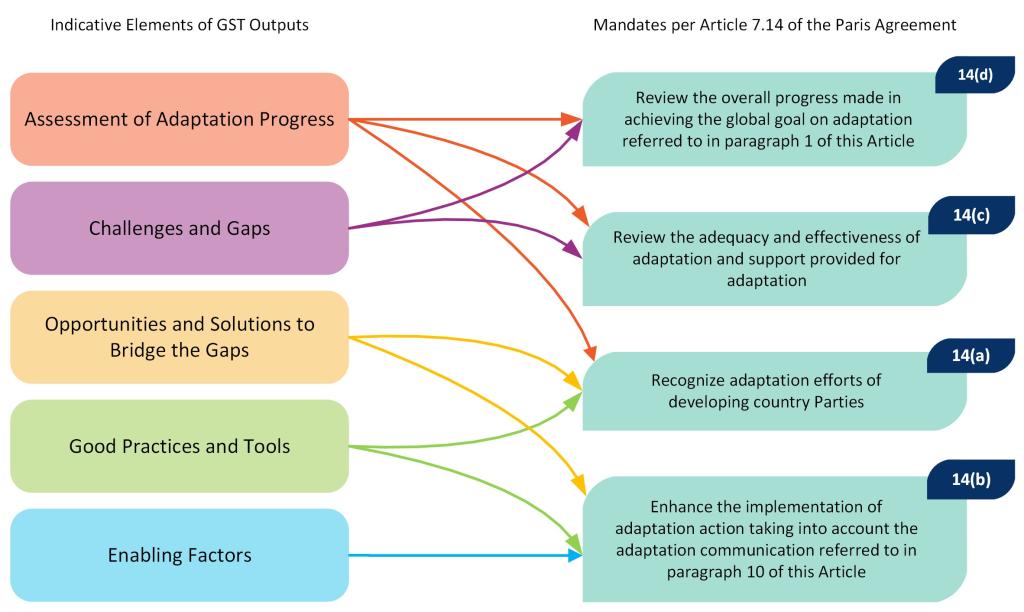
A figure showing the Paris Agreement mandates on adaptation
Mapping of the indicative elements of GST outputs with Paris Agreement Article 7.14 mandates (Source: NAP Global Network)

TD Key Messages: Increasing adaptation ambition, but with uneven progress

The TD on adaptation provides a forum for exchange and discussion on adaptation planning and implementation. This information will then be captured as part of the GST’s outputs. Based on the TD co-facilitators’ summary reports from the past year, we highlight three key messages shared to date.

1) While adaptation progress has been significant, it is still inadequate, and many challenges and gaps exist. 

From the latest Intergovernmental Panel on Climate Change (IPCC) reports and reflections shared by participants, it is clear that the impacts of climate change can be felt across the globe. Countries are stepping up their adaptation ambition, amongst others, through the formulation and implementation of their National Adaptation Plans (NAPs) and related strategies. At the time of the second TD, 139 of the 154 developing countries had NAP processes underway, while 45 countries had already developed and communicated their NAP documents to the UNFCCC. In addition, 57 countries have submitted adaptation communications (AdComs) that outline their experiences and efforts to build resilience. However, despite significant collective progress on adaptation, the transition from planning to implementation remains slow, uneven, and incremental.

"Collectively, there is increasing ambition in plans and commitments for adaptation, but there also remains an implementation gap, in that plans are implemented inadequately, unevenly, and incrementally."

- Summary Report of the second Technical Dialogue

Country representatives highlighted key challenges they face, such as a lack of capacity to analyze and use climate information, trouble accessing downscaled data, and insufficient support for establishing functioning and sustainable monitoring, evaluation, and learning (MEL) systems for adaptation. 

Experts and country representatives agreed that the provision of support and adaptation finance flows are not aligned with the level of climate impacts experienced by the most vulnerable countries.  

At the upcoming TD1.3, participants should continue to highlight the essential role of the NAP process and the importance of continued support toward helping countries formulate and implement their adaptation actions. Emphasizing these points is invaluable for these critical reflections are captured in the final output. 

2) More information on opportunities, solutions, good practices, and tools are needed to help countries enhance adaptation actions. 

Participants agreed that adaptation planning and implementation is a continuous and iterative process building on previous actions and drawing from a robust MEL system. Adaptation should be driven by local priorities and circumstances, while ensuring financial flows are realigned so these do not contribute to maladaptation, but instead go toward robust, inclusive, equitable, and participatory adaptation. 

Vertical integration, ecosystem-based adaptation, inclusive and gender-responsive adaptation planning processes, effective private sector engagement, and the application of the rights and knowledge of local communities and Indigenous peoples have also been identified as essential practices for fair and effective adaptation.

At TD1.3, participants should focus on compiling actionable solutions. This forward-looking perspective can most usefully highlight next steps to bridge the gaps identified in the previous TDs and facilitate the transition from planning to implementation. It will be equally important for the participants to stress the crucial role a functioning MEL system for adaptation plays in countries’ adaptation policy cycles, as well as connecting the GST process to the ongoing discussions under the Glasgow-Sharm el-Sheikh (GlaSS) work programme on the Global Goal on Adaptation (GGA)

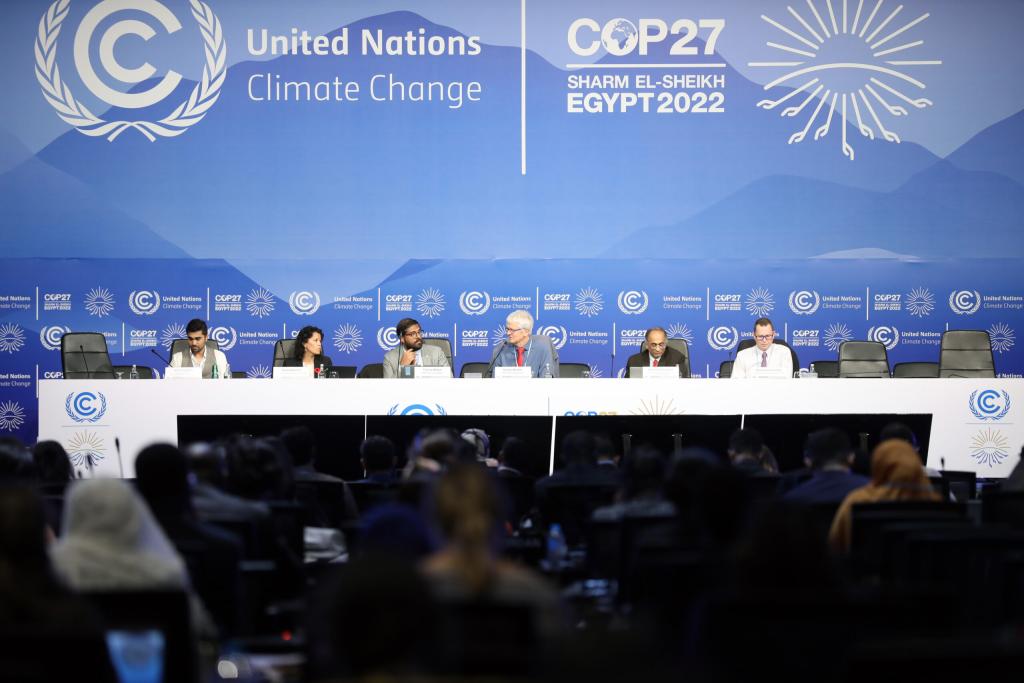
View of the dais at the Global Stocktake on adaptation at COP 27
TD Co-facilitators and expert moderators for the adaptation roundtables at TD1.2 at COP 27 (Photo by IISD/ENB | Mike Muzurakis)​​​

3) Countries are using a set of enabling factors to coordinate adaptation across sectors and scales of governance and to enable iterative planning and implementation, continuous learning, and transformational adaptation.

Participants have identified the following key enabling factors that underpin countries’ national adaptation planning processes: 

  • High-level political buy-in and support towards adaptation: Only when high-level political buy-in is available can adaptation be mainstreamed and prioritized. 
  • Adequate financing and capacity: Sustainable adaptation financing, as well as investments in capacity-building, enable effective adaptation planning and implementation. 
  • Synergistic institutional arrangements for mainstreaming and policy coherence: Overcoming the often fragmented, segmented, and siloed approaches to adaptation is key to mainstreaming adaptation and building resilience across sectors. 
  • Multilevel governance: Vertical integration and alignment between national, subnational, and local adaptation planning and implementation is essential for addressing the differential impacts of climate change and the various contexts and factors contributing to vulnerabilities. 
  • Participatory approaches and inclusion: A strong focus on cross-cutting and intersectional issues like gender, social inclusion, Indigenous peoples’ rights, and the integration of local and traditional knowledge and knowledge systems enables the co-creation of adaptation actions. The role of non-state actors in national adaptation planning and implementation also cannot be overlooked. 

 At TD1.3, participants will have the opportunity to formally organize these enabling factors and share tools and best practices associated with each.   

The Road to COP 28

TD1.3 at the upcoming SB58 will be the last opportunity for countries and other stakeholders to provide technical inputs before the political part of the GST starts. To ensure their messages are included in the Consideration of Outputs (CO) phase at COP 28, participants need to first make sure their inputs are captured in the Factual Synthesis Report (SYR), which is the compilation of all emerging messages and discussion outcomes across the three TDs.
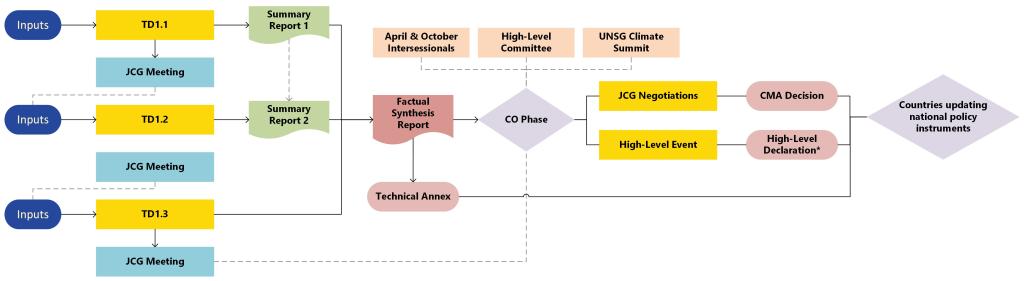
Process map of the Global Stocktake under the Paris Agreement
Process map for GST-1 (Source: NAP Global Network)

At SB58, country negotiators will start discussing how the CO phase will be carried out and how the GST process will communicate its outputs. The COP 28 presidency, along with the Chairs of the UNFCCC Subsidiary Bodies, will host a high-level event in Dubai to send a political signal that acknowledges the outputs of the GST and commits to increasing climate ambition. A decision or a declaration under the Conference of the Parties serving as the meeting of the Parties to the Paris Agreement (CMA) at COP 28 will also be negotiated by countries to highlight key messages and assessment results from the TDs and provide follow-up instructions as appropriate. 

However, much of the CO phase is still up in the air and pending countries’ negotiation. TD1.3 and SB58 will be the last window for countries and relevant stakeholders to highlight what they feel is the most important evidence to help shape the next generation of policies on adaptation and ensure the Paris Agreement’s first GST delivers on its mandate. 
Insight

Uncovering the Value of Sustainable Transport Investments

A Case Study in Coimbatore, India

Using a case study in Coimbatore, India, IISD demonstrates the importance of recognizing, valuing, and reflecting the full economic, social and environmental benefits and costs of a transport project in infrastructure decision-making.

May 22, 2023

Coimbatore, like many other rapidly expanding cities in India, faces numerous transport challenges. With a growing population of 1.6 million residents, the city’s infrastructure has struggled to keep up and is almost completely reliant on motorized transport. This had led to high traffic volumes, congestion, long commuting times, road safety issues, and air pollution.

To address this, the Coimbatore City Municipal Corporation has developed an ambitious Non-Motorized Transport (NMT) plan: a 300 km network of bicycle and pedestrian lanes, constructed over a 15-year period. The citywide network is expected to sustain existing and future NMT demand while meeting sustainable, low-carbon mobility targets, encouraging the shift from private motorized transport to active modes such as walking and cycling.

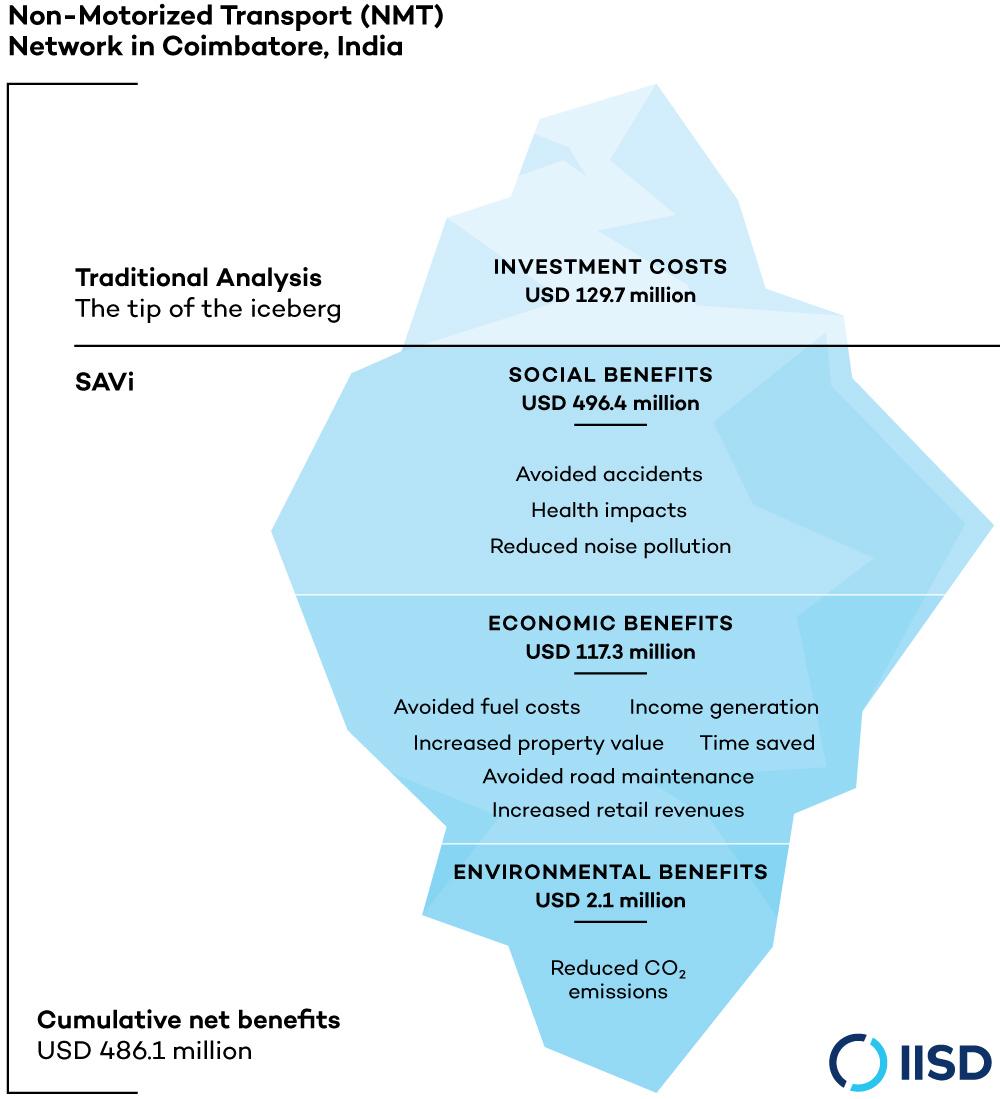
As part of a new series of sustainable transport case studies, the International Institute for Sustainable Development (IISD) has prepared a comprehensive economic analysis of the NMT plan in Coimbatore over the next 23 years. We found that the project was not economically viable if valued using only conventional metrics, such as cash flows and revenue streams. Yet, when a wider range of economic, social, and environmental benefits and costs are factored in, the NMT project becomes clearly investment worthy, both from an economic and a societal perspective.

When a wider range of economic, social, and environmental benefits and costs are factored in, the NMT project becomes clearly investment worthy, both from an economic and a societal perspective

To undertake these broader integrated assessments, IISD has developed a Sustainable Asset Valuation (SAVi) methodology based on system dynamics modelling. This methodology allows us to evaluate projects more holistically, forecasting how different transportation infrastructure options can affect or be affected by economic, social, and environmental factors and assigning monetary and financial values to these impacts. Through these analyses, we aim to raise awareness about the impacts of a project over its life cycle, with the hope of transforming decision-making to support long-term, sustainable solutions. This is not an off-the-shelf assessment tool. Rather, the SAVi methodology invests in a transparent, co-developed and customized approach that actively engages key stakeholders, including policy makers, investors and planners, providing a fuller picture of transport projects and their knock-on effects for the community and landscape.

In our assessment of the Coimbatore NMT plan, we found that it would result in the community experiencing significant health benefits from increased physical activity and lower levels of air pollution. Moreover, it would lead to higher retail and property prices, and significantly reduced costs from road accidents. Other benefits from the NMT plan include decreased CO2 emissions, diminishing road maintenance costs, and reduced noise pollution. Notably, the largest benefits from the NMT were found to be socio-economic rather than environmental. In terms of size, the greatest positive impact from the shift to non-motorized transport is the avoided costs of traffic accidents, amounting to USD 395 million cumulatively over the twenty-three-year period. This is followed by the health benefits (USD 89.9 million) and the avoided costs of fuel use (USD 54.8 million).

Iceberg graphic of added benefits and avoided costs for NMT in Coimbatore

It is not only NMT projects where we see this play out. Assessments of other sustainable transportation projects around the world yield similar results. For instance, IISD is currently undertaking SAVi assessments of a Bus Rapid Transit (BRT) project in Bandung, Indonesia, and a Mass Rapid Transit (MRT) project in Bogotá, Colombia. Both projects produce a wide range of economic, social, and environmental benefits typically overlooked in a traditional cost-benefit analysis. In these cases, like in the Coimbatore NMT plan, the inclusion of the full range of benefits and costs yields a much higher return on investment, roughly 20 times higher for the BRT and four times higher for the MRT, and provides therefore a stronger rationale for greenlighting the projects.

These examples underscore the importance of recognizing, valuing, and reflecting the economic, social and environmental benefits and costs in economic and financial decision-making. Moreover, by considering the full range of benefits and costs in sustainable transportation projects, infrastructure decision makers can transcend the important but inherently narrow questions around economic viability and instead rightfully place the focus on the overall value to society and sustainable development.

Infrastructure decision makers can transcend the important but inherently narrow questions around economic viability and instead rightfully place the focus on the overall value to society


The SAVi report on the NMT network in Coimbatore, India, is available to read here. This article was originally created for the SLOCAT's blog series Towards a Gold Standard for Transport Investment.

Insight details

Insight

A focus on water can lessen climate change’s burn

Canadians need water infrastructure to protect us in the face of mounting risks of flooding, drought, extreme heat, and wildfires.

May 18, 2023

This article is republished with permission from The Hill Times' website. The original article was published on May 17, 2023.

Here in Alberta, the wildfires that have engulfed my province and displaced close to 30,000 people are devastating—forcing farmers from their ranches, families from their homes, and children from their schools.  

The early wildfire season unfortunately serves as a sobering reminder that the intensifying impacts of climate change are affecting local communities, livelihoods, and ecosystems. 

How might we fight the fires of climate change – both the real ones burning actively in Alberta and the broader risks facing communities across Canada?  

Well, we fight fires with water.  

Firefighters on the frontlines know this, but we need all Canadians to understand—with renewed urgency—just how critical water is to our wellbeing and prosperity in the face of climate change.  

This week, we learned the range of water challenges facing prairie communities. Among them, perennial underfunding of water infrastructure, including stormwater, wastewater, and potable water assets, has caused their depreciation to outpace investment by $3 billion in just four years. 

By water infrastructure, we mean what you might understand as traditional infrastructure—think pipes, dams, and water treatment facilities.  

Canadians need water infrastructure to provide clean drinking water, manage stormwater and wastewater, ensure reliable water supplies for key economic sectors, and to protect us in the face of mounting risks of flooding, drought, extreme heat, and wildfires.

But it is growing more challenging for traditional—or “grey”—infrastructure to keep pace with the needs of communities, especially as rising costs and climate change add pressure.  

Thankfully, evidence from around the world and here in Canada, shows that nature can help to bridge the gap, in the form of natural infrastructure.  

Natural infrastructure is a way to plan and work with nature to meet infrastructure needs. It can be a conserved ecosystem, a restored ecosystem, or even a nature-based engineered feature. Examples range from conserving and restoring wetlands to reduce flood risk and retain soil moisture to installing green roofs on top of public buildings for reduced stormwater volumes.  

And natural infrastructure works—proving to be reliable and cost-effective, easing the burden on traditional water infrastructure systems. It also provides extra benefits – for example, wetlands can protect against flooding, while also storing carbon, supporting biodiversity, and even property values.  

There are exciting examples peppered across the prairies. A tertiary treatment wetland in La Broquerie, Manitoba uses the power of plants to ensure phosphorus levels meet regulatory requirements before discharging to the Seine River. A bioretention bed in Okotoks, Alberta collects, stores, and cleans stormwater used in a local irrigation system. But these projects are far from the norm; we need a more coordinated approach to scale up natural infrastructure across the country and in the prairies.

And soon. 

And while Canada’s federal government is supportive of building more natural infrastructure solutions to complement traditional infrastructure—evident by funding through the Natural Infrastructure Fund and plans to include natural infrastructure in the first ever National Infrastructure Assessment—we need to ensure that key investments and programs reach prairie communities in Alberta, Saskatchewan, and Manitoba; and beyond.

We can build on recent momentum—including the draft National Adaptation Strategy—to ensure the right supports are in place to help prairie communities make their water infrastructure more resilient.  

But how?  

First, we need to ensure adequate and more accessible funding for those, across all sectors, who want to implement natural infrastructure. Accessibility is key – while “shovel ready” projects are great, more support for the upfront development of projects can increase local uptake, particularly in rural or underserved communities who may lack capacity or expertise.  

We also need to make a stronger business case for local projects, to show where natural infrastructure is a cost-effective and impactful option that provides a clear return on investment. 

And, to facilitate all of this, we need to enable policies at all levels of government to make it easier for those who want to implement natural infrastructure — smaller municipalities, rural counties, Indigenous communities, agricultural producers, industry, and investors. 

Natural infrastructure can be an extra firewall against the worst impacts of climate change. Let’s focus on water to lessen the burn.  

Insight

"Green Lemons" Need to be Squeezed out From the ESG Market

April 18, 2023

Investments in climate change mitigation continue to grow, driving the energy transition and rapid growth in net-zero technologies. At the same time, a lack of reliable data and a loose regulatory environment have led to declining investments in environmental, social, and governance (ESG) funds, while some nervous managers are shifting assets away from ESG funds to avoid future claims of greenwashing.

The stubborn problems with ESG governance have triggered calls to either scrap ESG or reporting or replace the current framework with a narrower focus on greenhouse gas emissions. While a single indicator like carbon emissions would make reporting and governance easier, these proposals are deeply flawed, as they would ignore the need to also tackle real-world issues such as nature stewardship, pollution abatement, and climate change adaptation. More promisingly, new ESG regulations and disclosing standards proposed in the United States, the European Union, and elsewhere offer hope for curbing greenwashing and countering the credibility deficit in ESG markets.

Moreover, proposed sustainability, climate risk, and opportunities disclosure standards from the International Financial Reporting Standards (IFRS) Foundation, developed by the International Sustainability Standards Board (ISSB), could be the most important development in company reporting in a generation. The new standards are expected to be released in June 2023.

“Aggregate confusion” in sustainability reporting

Despite global financial and energy security concerns, investments in climate change mitigation and the energy transition continue to grow. Preliminary estimates show global climate finance volumes of between USD 850 billion and USD 940 billion in 2021, a 40% increase from the previous year, with the lion's share of the total going to climate change mitigation. Similarly, global investments in energy transition technologies like renewable energy and energy efficiency reached USD 1.3 trillion in 2022. Now the global community needs to turbocharge this emerging trend and quadruple annual investments in the energy transition to over USD 5 trillion to limit global warming to 1.5°C, the International Renewable Energy Agency warns.

However, climate finance is also part of the wider ESG investment space, and within the ESG space, worryingly, there is no discernible positive trend to begin with. Instead, investments in ESG funds are showing the opposite. S&P Global estimates that investment assets held by firms that factor ESG into their decisions dropped from USD 17 trillion in 2020 to USD 8.4 trillion in the United States at the beginning of 2022.

For nearly two decades, companies have made sustainability claims that were sometimes untrue, often untested, and nearly always non-comparable. The Harvard Business Review has noted that the “data underlying ESG ratings are incomplete, mostly unaudited, and often dated.” A recent report from the Massachusetts Institute of Technology (MIT), fittingly called “Aggregate Confusion,” has identified wide divergences across sustainability reporting, making it nearly impossible for investors to compare company performance and, in turn, reward higher ESG performance. Several state legislatures in the United States have called for ESG criteria to be scrubbed from markets and have even banned companies that use them.

In a less draconian proposal, The Economist has suggested jettisoning ESG frameworks altogether, instead requiring companies to report a single climate indicator: greenhouse gas emissions. While a simplified climate metric would allow financial markets to track net zero pledges against actions, it is a bad idea. A single greenhouse gas indicator would provide a static snapshot of current emissions but little information about future steps or longer-term risk scenarios. More broadly, investments are critical not only to curb emissions but also for climate change adaptation, nature conservation, nature-based infrastructure, and pollution abatement. In addition, ESG assumes these efforts must simultaneously integrate social, labour, human rights, and other standards to be truly sustainable.

Regulators looking to squeeze out the “green lemons”

The current issues with corporate sustainability disclosure standards pose a familiar problem for markets: How do we overcome information failures and allow prices to reflect the proxy value of assets?

More than half a century ago, Nobel Prize-winning economist George Akerlof identified the problem of asymmetric information stifling efficient market outcomes. Akerlof used the example of used car markets to illustrate asymmetric information: these were markets where few potential buyers possessed sufficient information to spot a defective used car, which he famously called lemons. He argued that, ultimately, regulations are needed to address information failures.

With the combination of expanding green markets and insufficient ESG data quality, the risk of “green lemons” has been growing for years, from phantom carbon offset credits to companies mismatching green pledges with daily practices.

Regulators across the world are making moves to address this. In the United States, the Securities Exchange Commission has proposed new rules setting out clear sustainability risk disclosure and reporting standards while the U.S. Federal Trade Commission has proposed new guidelines to ensure that green claims—including claims related to carbon offsets—are truthful.

In the EU, the next stage of the Sustainable Framework for Disclosure Regulations (SFDRs) entered into force at the start of this year, requiring greater transparency on how investments are classified under three categories–including “Light Green” funds, intended to promote environmental or social characteristics, and “Dark Green” funds, intended to deliver positive environmental or social impacts.

The EU is also expected to introduce new regulations to counter greenwashing in bond markets, building on the EU Taxonomy for Sustainable Activities.

In response, fund managers in Europe have moved nearly 40% of asset funds classified as “Dark Green” under the SFDRs to the lower “Light Green” level–a move representing roughly USD 100 billion. Shuffling from nervous asset managers is part of the reason ESG funds have been decreasing, and Bloomberg expects the shuffling to continue throughout 2023 as investors opt to reclassify asset funds now to avoid being accused of greenwashing when the new regulation kicks in.

Game-changing ESG and climate risk disclosure standards expected mid-year

There are promising signs that the remarkable regulatory convergence on climate finance metrics and measurement standards, which provides clarity and consistency for companies, will be replicated in the larger ESG market.

By mid-2023, the IFRS Foundation is expected to finalize its new rules on how companies disclose ESG and climate risk. These new standards, developed by the ISSB, mark the most important development in reporting in a generation.

China is among the markets to watch as the ISSB standards roll out. With climate disclosure standards already in place, China may adopt its own version of ESG standards somewhat distinct from ISSB’s. The good news is a widespread recognition among Chinese decision-makers of the importance of standards that are comparable and interoperable with other jurisdictions. Senior Chinese experts have played key roles in both the G20 Sustainable Finance Working Group and the United Nations (UN) High-Level Expert Group on the Net Zero Emissions Commitments of Non-State Entities, both of which underscore the importance of standards convergence.

Of course, with new standards forthcoming, the real test is whether better information will strengthen the business case for sustainability investments. Tim Buckley, the CEO of Vanguard, the world’s largest asset management group, recently said that they “cannot state that ESG investing is better performance-wise than broad index-based investing” as the group exited the Net Zero Asset Owner Alliance.

However, the conclusion of a recent analysis by researchers at MIT and Peking University School of Mathematical Sciences offers a vital counterpoint for sustainability investment. Based on evidence from over 200 ESG funds, the report concluded that there is a “significant positive relationship” between ESG investments and performance and that ESG funds outperformed their grey counterparts.

The new standards from the ISSB and different regulatory initiatives will allow investors to spot and crowd out “green lemons” in the critical years ahead–enabling the scaling up of investments not only for cutting emissions but also for enabling nature-positive outcomes, improving climate change adaptation, and strengthening social conditions.

Insight

Four Ways the G7 Can Show Leadership on Fossil Fuel Phase-Out

April 13, 2023

The G7 Ministers’ Meeting on Climate, Energy, and Environment is fast approaching, with ministers due to gather in Sapporo, Japan, at the end of this week, ahead of a leaders-level gathering next month in Hiroshima. At these meetings and throughout the rest of the year, G7 ministers and leaders have a key opportunity to make concrete progress on fossil fuel phase-out, which could in turn encourage other economies to follow suit.

The need for fossil fuel phase-out has never been clearer. Last month’s Intergovernmental Panel on Climate Change (IPCC) Sixth Assessment Synthesis Report highlighted the need for a rapid, global phase-out of unabated fossil fuels and a near-term peak in their consumption if the 1.5°C temperature guardrail under the Paris Agreement is to remain in reach. The G7 meetings, coming so soon after this authoritative statement from the scientific community, need to make political progress on this issue. Meanwhile, the ongoing Russian war in Ukraine continues to underscore how fossil fuel dependence leaves countries vulnerable to geopolitical risk and market volatility.

Bringing together several of the world’s advanced economies—namely, Canada, France, Germany, Italy, Japan, the United Kingdom, and the United States, as well as the European Union—the G7 meetings are a chance to set the tone for the rest of the political year. Preparations are already well underway for this year’s G20 leaders’ summit under India’s presidency, taking place in early September. UN Secretary-General António Guterres will hold a Climate Ambition Summit that same month. And all eyes will be on COP 28 in Dubai as the first Global Stocktake under the Paris Agreement reaches a political conclusion—and pressure will intensify on world leaders to make a strong statement about fossil fuel phase-out. By securing a robust agreement in the coming weeks on fossil fuel phase-out, the G7 could set the bar high for other political processes to follow. 

There are four ways the G7 can step up and demonstrate leadership in this crucial year.

Set a Date for Coal Phase-Out

In 2022, G7 leaders took a real step forward by committing to decarbonizing their electricity systems by 2035. Although the G7 leaders did not specify how this goal was to be achieved, the ministers’ communique contained more detail. Ministers stated that the G7 would prioritize “concrete and timely steps towards the goal of an eventual phase-out of domestic unabated coal power generation.” Coal phase-out is key, in other words.

What remains missing is a phase-out date. The Powering Past Coal declaration, which the United Kingdom, Italy, Germany, and Canada have already signed, reaffirms the need to phase out coal by 2030 among the Organisation for Economic Co-operation and Development (OECD)’s 38 member economies, as well as the European Union, and by 2040 in the rest of the world. The International Energy Agency’s Net Zero Emissions by 2050 Scenario (NZE), the agency’s core 1.5°C pathway, backs this up, envisaging that by 2030 advanced economies would end all power generation by unabated coal-fired power plants. With this in mind, the G7 should commit this year to phasing out coal by 2030 at the latest. As it stands, the European Union, the United States, and Japan reportedly still oppose such a pledge.

Make Real Progress on Ending Fossil Fuel Subsidies

The G7 has pledged to phase out “inefficient” fossil fuel subsidies every year since 2009. In 2016, they specified a timeline, committing to phase out subsidies by 2025. What has been missing so far is implementation. Indeed, globally, subsidies today are not lower than they were in 2009, but have rather reached an all-time high of more than USD 1 trillion in 2022, in the face of high energy prices.

In 2022, G7 ministers took a small step forward, committing to make a progress report in 2023 and further stating that they would consider options for developing joint public inventories of fossil fuel subsidies.

In 2023 the G7 needs to show leadership on urgently implementing their commitment to phase out subsidies. At a minimum, they should deliver the promised progress reports and inventories, which should demonstrate the delivery of their pledge. The G7 should submit their inventories annually through the formal reporting process for Sustainable Development Goal (SDG) indicator 12.c.1 (fossil fuel subsidies)—a process that hardly any countries have completed so far. Consistent and comprehensive compliance from the G7 can encourage improved data transparency from all parties to the SDGs.

Moreover, the G7 should drop the qualifier “inefficient,” which only creates uncertainty about which subsidies need reform. Rather, exceptional cases should be specifically named, and alternative reform pathways identifiedfor example, in the case of subsidies that are essential for energy access, targeting subsidies in the short term while developing clean alternative technologies. They should also support global commitments to fossil fuel subsidy reform, particularly in least developed countries, by committing to align relevant official development assistance flows with the need for technical and financial assistance in this area.

Implement the End of International Public Finance for Fossil Fuels

In recent years, the G7 has made progressive steps forward on ending international public finance for fossil fuels. In 2022, following a commitment to end direct government support for unabated international thermal coal power generation in 2021, G7 leaders extended this to the entire international unabated fossil fuel energy sector, except in “limited circumstances clearly defined by each country consistent with a 1.5°C warming limit and the goals of the Paris Agreement.”

The first thing G7 ministers and leaders should do is reiterate this commitment. But, more importantly, they should ensure that this commitment is fulfilled. Doing so could potentially shift USD 24.3 billion per year from fossil fuels to clean energy, and influence even bigger volumes of private finance. While the United Kingdom, France, and Canada have implemented policies ending international public finance for fossil fuels, Germany, Italy, the United States, and Japan have yet to publish such policies. Fulfilling this commitment this year is key to ensuring the G7’s credibility.

Moreover, the G7 can ensure that their policies on multilateral development banks (MDBs) match the ambition of their commitment. The 2022 G7 ministers’ communique stated that the commitment to end new direct public support for the international unabated fossil fuel energy sector would also “guide [their] approach” on the boards of MDBs. Yet only the United States has published official guidance for voting at MDBs. Other G7 countries should step up.

End New Oil and Gas Development

Finally, ministers and leaders should not open the door to international public finance for gas. Last year’s leaders’ statement left room for public investment in the gas sector as a temporary response, in the “exceptional circumstances” of the Russian war in Ukraine. Despite assurances on avoiding “lock-in effects,” this move was worrying. Far from being an appropriate response to the energy crisis, new investment in gas cannot contribute to resolving the crisis in the short term, while in the long term perpetuating price volatility, exacerbating the climate crisis, and risking stranded assets.

This year, Japan has proposed that G7 ministers recognize the need for upstream investments in liquefied natural gas (LNG) and natural gas. The G7 should oppose this language and confirm G7 economies’ domestic efforts to reduce gas demand as a key step toward more energy security.

Going beyond this, the G7 should make a positive statement about the need to end new oil and gas production. The International Energy Agency’s NZE found that, in a 1.5°C world, there is no room for new oil and gas fields. IISD research confirms that all major 1.5°C scenarios agree: there can be no more new oil and gas production if the world is to limit global warming to 1.5°C, and indeed production must decrease by at least 65% by 2050. The G7 must follow the science and affirm the need to stop new production.

In conclusion, the G7 has a key opportunity to step up on fossil fuel phase-out this year. At this time of ever-escalating climate impacts, ever-clearer science, and an ongoing energy crisis, the G7 must take this opportunity. Now is the time for action.

Insight

A Quest for Legal Clarity: What the International Court of Justice's upcoming advisory opinion means for climate action

April 6, 2023

On March 28, the United Nations General Assembly (UNGA) adopted a historic resolution asking the International Court of Justice (ICJ)—the UN's principal judicial organ—to provide an advisory opinion clarifying what governments' obligations are under international law when it comes to tackling climate change.

The resolution—sponsored by the small island state of Vanuatu—was adopted by consensus and has drawn praise by media outlets, international law and environment experts, and environmental advocates for its potential to provide much-needed legal clarity in this field.

"Climate justice is both a moral imperative and a prerequisite for effective global climate action," said UN Secretary-General António Guterres, praising UN member states for adopting the resolution. "The climate crisis can only be overcome through cooperationbetween peoples, cultures, nations, generations. But festering climate injustice feeds divisions and threatens to paralyze global climate action."

The UNGA resolution notes the disparity thus far between the measures governments have outlined in their nationally determined contributions under the Paris Agreement and the actual cuts to greenhouse gas emissions required to stay within that agreement's temperature limits. It also refers to the need for greater efforts on climate change adaptation. 

Under the resolution's terms, the ICJ has been asked to consider not only what states are legally required to do, under international law, to avert further climate change both now and in the future, but also to assess the "legal consequences under these obligations" when governments, both through what they do and fail to do, "have caused significant harm to the climate system and other parts of the environment."

This latter request asks specifically that the court consider what this harm has meant for both current and future generations, as well as for those countries who, by virtue of their "geographical circumstances and level of development, are injured or specially affected by or are particularly vulnerable to the adverse effects of climate change."

The UNGA resolution comes at a pivotal moment for the international climate community, as governments, civil society, academia, and private actors all prepare for the UN Framework Convention on Climate Change's 28th Conference of the Parties (COP 28) this November. This climate COP will seek the culmination of the first Global Stocktake under the Paris Agreement, showing how close the world is to achieving that Agreement's objectives and how much work remains. 

The Intergovernmental Panel on Climate Change (IPCC), which recently wrapped up its Sixth Assessment Cycle, has already confirmed that the world is far too close to the 1.5°C limit under the Paris Agreement—while indicating that there are proven options available for averting the worst impacts of climate change, so long as governments and other stakeholders act now.

While ICJ advisory opinions are not directly binding on states, they provide an authoritative interpretation of international law, which is binding upon states via custom and treaties. While an exact timeline for the advisory opinion is not yet known, experts indicate that they expect an outcome within a year.

International Law and Sustainable Development

The request for an ICJ advisory opinion follows a series of developments in recent years to advance the achievement of sustainable development objectives and to enable governments to take more ambitious steps on climate change mitigation, adaptation, and finance.

At the normative level, recent examples include the 2030 Agenda for Sustainable Development and its 17 Sustainable Development Goals, adopted by UN member states in 2015, and the more recent UN General Assembly resolution adopted by member states last year on the right to a clean, healthy, and sustainable environment. Although these instruments are not legally binding, they evidence global consensus on the necessity of climate action and importance of sustainable development.

This conversation on states’ environmental obligations under international law has also made its way to other courts and tribunals. For instance, last year, the Commission of Small Island States on Climate Change and International Law made a request for an advisory opinion from the International Tribunal for the Law of the Sea regarding states' obligations to protect and preserve the marine environment. There are also various climate change cases before the European Court of Human Rights seeking clarity on human rights obligations in the context of climate change.

The ICJ opinion is likely to have a significant impact in boosting countries' efforts to implement sustainable development policies. For instance, the ICJ opinion could provide greater detail, texture, and clarity to the benchmarks used for judging states' sustainable development policies, such as the implementation of the Paris Agreement's goals. The Court's opinion could also inspire greater ambition—and action—under international processes that aim to tackle different facets of the climate challenge.

While the outcome of the ICJ process remains to be seen, a crucial step that governments must already be ready for is making sure they can take the advisory opinion and put it into practice in their national policies and regulatory frameworks. This means understanding how governments' international climate change obligations implicate different sectors, such as energy, investment, mining, infrastructure, agriculture, and fisheries, to name a few examples. It also means analyzing what it means for governments' subsidy policies and other fiscal measures, as well as reconsidering how international agreements on issues such as trade and investment align with these climate change obligations.

IISD welcomes the UNGA resolution and will monitor the ICJ proceedings closely, with the hopes that the opinion will help in mobilizing efforts to promote sustainable development globally. Since its inception, IISD has worked with developing countries and international organizations to implement international climate change law through various regulatory frameworks, policy advice and nature-based solutions, and provided capacity-building services that have helped developing countries to adopt appropriate climate adaptation and mitigation measures.

Insight

IPCC Research Shows Need for Ramping Up Mitigation Ambition, Tackling Adaptation Gaps

March 22, 2023

The Intergovernmental Panel on Climate Change’s (IPCC) Synthesis Report of its sixth assessment cycle confirms that the world is already dangerously close to the 1.5°C temperature limit under the Paris Agreement—but also affirms that there are proven options available to avert the most catastrophic warming and improve adaptation planning and action, IISD experts say.

The science shows that preventing the global average temperature increase from exceeding the Paris Agreement target of 1.5°C above pre-industrial levels by the end of the century is still possible—but only if governments take immediate, ambitious action. 

IISD analysis of IPCC 1.5°C scenarios shows that no new oil and gas development is possible if the world is to stay with the Paris Agreement temperature limits. Any new oil and gas fields will push the world beyond 1.5°C or generate stranded assets unless relying on levels of carbon dioxide removal that exceed IPCC feasibility thresholds. Governments should stop awarding licences and permits to explore for or develop new oil and gas fields or coal mines, or other long-term infrastructure to produce, transport, or consume fossil fuels. They should set an end date with clear interim targets for fossil fuel production and consumption in their countries based on science and equity.

“The IPCC Synthesis Report gives clear evidence of governments’ failure to address the root cause of climate change. To change course, progress on renewable energy scale-up must be accompanied by a global decline in fossil fuel production and consumption,” said Olivier Bois von Kursk, Policy Analyst for IISD’s Energy program.

The science also makes clear that carbon capture and storage (CCS) in the fossil fuel sector cannot adequately compensate for delaying oil and gas production decline, and these technologies do not bear out their promise in practice. The IPCC has shown that CCS is one of the most expensive and least effective measures to cut emissions—while wind and solar energies have the biggest mitigation potential at the lowest cost. After more than 50 years of investment, only 30 large-scale CCS projects are operating worldwide, capturing only 0.1% of emissions.

“The IPCC warns that relying too much on carbon capture technology represents a major risk to climate safety. The growing consensus is that CCS for oil and gas won’t be enough and costs too much. IPCC research supports that view,” said Angela Carter, Specialist, Energy Transitions at IISD.

To align global energy supply with the 1.5°C limit, the focus must instead be on boosting wind and solar energy capacities while supporting vulnerable communities. The IPCC Synthesis Report shows that we have the global financial capital needed to close the investment gaps on both climate change mitigation and adaptation, but this capital must be redirected. 

Governments can immediately kick-start change by shifting public financial flows which they directly control—but despite numerous commitments to do so dating back as far as 2009, little progress has been made. An IISD submission to the Global Stocktake (GST) shows that fossil fuel subsidies were estimated at USD 543 billion in 2015, the year of the Paris Agreement, but instead of going down, they exceeded USD 1 trillion for the first time in 2022. IISD analysis also shows that planned investments for new oil and gas to 2030 could fully finance the scale-up of wind and solar energy needed to align with 1.5°C. 

Global temperature has already increased by 1.1°C above pre-industrial levels and is expected to exceed 1.5°C during this century, pushing the world past critical thresholds. Climate change risks and impacts will intensify as our planet gets warmer. Alongside the urgent need to reduce our greenhouse gas emissions, the IPCC calls on countries to accelerate their efforts to adapt to climate change.

While there has been important progress in adaptation around the world, it is not keeping pace with climate impacts. In fact, the gap between what is happening on the ground and what is needed is only growingan alarming trend, given that more than 3 billion people are already living in areas highly vulnerable to climate change. The IPCC has concluded that most adaptation responses to date have been fragmented, incremental, and unequally distributed across regions. They have also flagged important barriers to adaptation action, such as:

  • Limited resources 
  • Lack of private sector and citizen engagement 
  • Insufficient mobilization of finance (including for research) 
  • Low climate literacy 
  • Lack of political commitment 
  • Limited research and/or slow and low uptake of adaptation science 
  • Low sense of urgency 

Overcoming these barriers and coordinating the range and scale of efforts needed to secure a livable future requires planning and resources. While more and more jurisdictions are developing adaptation plans, they need to be implementable—meaning that they must articulate clear priorities, targets, responsibilities, and associated costs and sources of funding. As the IPCC clearly states, finance for adaptation is insufficient and must increase greatly. 

"The IPCC highlights major gaps in adaptation. It also points to ongoing progress and the benefits of inclusive, equitable, and long-term adaptation planning. Including adaptation in every area of government decision making is now crucial," said Anne Hammill, Associate Vice President, Resilience, at IISD. IISD is the host of the secretariat of the National Adaptation Plan Global Network.

By committing to a National Adaptation Plan process, countries can address these gaps, mobilize financial and other resources, and accelerate the implementation of equitable solutions with lasting impacts–especially for people living in poverty and experiencing discrimination. We must do what we can to close these adaptation gaps that leave our most vulnerable at risk. 

The first Global Stocktake under the Paris Agreement concludes this November at the UN Framework Convention on Climate Change’s 28th Conference of the Parties. With the IPCC’s Synthesis Report serving as a direct input into the GST, this new synthesis report is an invaluable reminder of the need to ratchet up efforts and ambition on mitigation, adaptation, and finance, both in the months leading up to COP 28 and the years to come.

The photo used for the banner image of this article is by IISD/ENB's Anastasia Rodopoulou.

Insight

Source to Sea: Integrating the water agenda in 2023

March 22, 2023

As the first months of the new year give way to the full-fledged pace of international meetings, projects, and conferences, it is increasingly apparent that 2023 could prove to be a definitive year for facilitating an integrative perspective on water issues, from fresh water to the marine environment.

Issues related to water are featured throughout the 2030 Agenda for Sustainable Development—reflected both in specific goals, such as SDG 6 on water and sanitation and SDG 14 on life below water, as well as in dedicated targets within other goals. The biodiversity that is an essential part of the water cycle, and that is fed by this cycle, brings many additional SDGs and targets into view. 

Work on these SDGs and targets happens in a range of forums—including intergovernmental organizations with mandates on environment or trade policy, environment ministries, and scientific research facilities—and in separate, distinct communities, operating under very different timetables.

This year is bringing high-level attention to several related targets, with a new high seas treaty concluded in early March, a once-in-a-generation UN freshwater conference this week, and active talks among UN and World Trade Organization (WTO) negotiators on new treaties and policies that will affect the marine environment. 

Set against a backdrop of the ever-intensifying impacts of climate change playing havoc with weather patterns and introducing new threats to our water supplies, it is looking like 2023 could and should be a critical year for water and the marine environment.

UN 2023 Water Conference: Eyeing a Water Action Agenda

Governments, civil society organizations, scientists, and a host of other actors working on water and water governance will come together from March 22 to 24 in New York for the UN 2023 Water Conference, an event that arrives nearly 50 years after the last such United Nations Water Conference, held in Mar del Plata, Argentina, in 1977.

This year’s event comes at the midway point of the Water Action Decade, aimed at tackling challenges ranging from sanitation to water scarcity. It also comes at the mid-point of the 2030 Agenda and immediately prior to the High-Level Political Forum on Sustainable Development’s focus on SDG 6 progress. The deliberations will also continue in September, when heads of state and government will participate in the SDG Summit. 

Participants at this month’s talks in New York have been encouraged to announce commitments that will be compiled in a Water Action Agenda that will seek to reinvigorate efforts at making the Water Action Decade a success. UN Secretary-General António Guterres has called for the Agenda to be bold and ambitious, one that can "[give] our world's lifeblood the commitment it deserves." The discussion forums for this meeting will focus on cross-cutting issues, bringing a focus to interlinkages between water and health, sustainable development, and climate change.

"Across the globe, we seem to be experiencing fresh water’s endlessly evolving vicissitudes firsthand, from unprecedented flooding to old and new pollutants in lakes and rivers across the world. And thanks to the ever-intensifying impacts of climate change, it doesn't seem like our fraught relationship with that which sustains us will be improving any time soon. That’s why this conference matters," said Dimple Roy, Director, Water Management at IISD, writing in the South China Morning Post

Crucial within those conversations, she added, is natural infrastructure, which can help provide crucial services like flood mitigation or wastewater treatment. "When it comes to working with governments, we need to encourage all levels—at events just like the UN 2023 Water Conference—to appreciate the benefits of and thus adopt more natural infrastructure projects."

WTO Fisheries Subsidies Deal: Governments set sights on ratification, new wave of talks

Follow up on a key decision in June 2022 that affects the marine environment could also bring a focus to interlinkages on the global agenda. In that decision, the World Trade Organization’s 164 members struck a deal that had eluded them for over 20 years: a new treaty setting binding, enforceable disciplines on harmful fisheries subsidies. 

The agreement is only the second WTO-wide treaty since the organization first opened its doors in 1995, and it is the first WTO agreement that is focused specifically on achieving an environmental objective. The treaty includes disciplines on subsidies that contribute to illegal, unreported, and unregulated (IUU) fishing, disciplines on subsidies to the fishing of overfished stocks, and subsidies to fishing activities that occur on the high seasin other words outside the national jurisdiction of any memberand do not fall within the mandate of any regional fisheries management bodies.

Delivering on this deal’s potential means ambitious implementation, and soon. For that to happen, a minimum of 109 WTO members need to submit formal acceptance of the deal, allowing the treaty to enter into force—though members can also start implementation at the domestic level beforehand. Since the start of 2023, Seychelles, Singapore, and Switzerland have submitted their acceptances, with 106 WTO members still to go at the time of this writing. 

This treaty is not the end of the line for the WTO fisheries talks. WTO members are now in a so-called "second wave" of negotiations, aiming to address topics that had proven too politically contentious for the deal reached last June—namely, those subsidies that contribute to overcapacity and overfishing.

Negotiators are pushing to wrap up these talks in time for the WTO's Thirteenth Ministerial Conference in February 2024 in Abu Dhabi, United Arab Emirates. If that deadline proves unfeasible, they have until 4 years from the current agreement’s entry into force to reach a deal or see the existing treaty lapse unless they decide otherwise.

"The Fisheries Subsidies Agreement was a necessary step in the right direction, but the work does not stop there. WTO members must now ensure that current disciplines are complemented by broader rules on subsidies that incentivize the overcapitalization of fleets and excessive fishing pressure," said Tristan Irschlinger, IISD Policy Advisor, Fisheries Subsidies.

New Treaty for the High Seas: A long-awaited deal crosses the negotiating finish line

March opened with big news for ocean and biodiversity governance: after 20 years of talks, UN member states have clinched a new deal for the conservation and sustainable use of marine biodiversity of areas beyond national jurisdiction (BBNJ).

This new high seas treaty builds on the UN Convention on the Law of the Sea and revolves around four major areas.

The treaty establishes provisions for “fair and equitable” benefit sharing for marine genetic resources, eyeing concerns involving the overexploitation of these resources and the fear that their benefits might otherwise be limited to those with the greatest ability to make use of them. These provisions are crucial as governments, businesses, and scientists alike explore the potential that these resources have for both commercial applications, like pharmaceutical products, and for achieving environmental goals, like enabling climate change adaptation.

The treaty sets out how governments can establish area-based management tools, including marine protected areas, in the high seas, which will help make it possible for governments to achieve the “30x30” target of protecting 30% of ecosystems, including inland water and marine ecosystems, under the new Kunming-Montreal Global Biodiversity Framework. That framework was adopted by governments at last year’s 15th meeting of the Conference of the Parties to the Convention on Biological Diversity (CBD COP 15).

The BBNJ agreement also establishes when environmental impact assessments would be required before governments can undertake certain activities on the high seas—and the steps they should take to mitigate and report on any harm that these activities may cause, should the project involved continue after the assessment. The BBNJ accord also features a section on capacity building and marine technology, as well as outlining plans for a financial mechanism to support the treaty’s implementation.

Looking ahead, the treaty will need to be formally adopted by delegations when the Intergovernmental Conference (IGC) tasked with the talks reconvenes. After that, the treaty requires ratification by a minimum of 60 UN member states before it can enter into force.

Tackling Plastic Pollution: Next steps for UN, trade talks

One year ago, UN member states at the resumed fifth session of the UN Environment Assembly adopted a resolution agreeing to begin negotiations for a legally binding treaty tackling plastic pollution—including pollution affecting the marine environment.

Talks for this new treaty are now underway in an Intergovernmental Negotiating Committee (INC). The first INC meeting took place in late 2022 in Punta del Este, Uruguay, to weigh questions over the treaty’s scope, along with how it will be put into practice, with the next INC, known as INC-2, taking place in late May and early June. Negotiators are currently aiming to clinch a deal next year.

"Just as for water governance, 2023 is a big year for chemicals and wastes. We’re closely watching the talks towards a new plastics treaty, as well as parallel negotiations on a possible post-2020 platform for chemicals and waste management. A new science-policy panel on chemicals is also under development," said Elena Kosolapova, Senior Policy Advisor for IISD's Tracking Progress team.

Meanwhile, in Geneva, Switzerland, over 75 WTO members are looking at how trade and the trading system can also serve to tackle plastic pollution and encourage a move towards more sustainable plastics trade. This process is known as the Informal Dialogue on Plastic Pollution and Environmentally Sustainable Plastics Trade. 

Guided by a December 2021 ministerial statement, this group is looking at crafting outcomes they can share in time for next year’s MC13, with ideas so far falling under the categories of "cross-cutting issues," "reduction and circularity to tackle plastic pollution," and "promoting trade to tackle plastic pollution."

Charting a course forward

These are just a few examples of the myriad efforts underway to help bring SDGs 6 and 14, as well as the other water-related targets across the 2030 Agenda for Sustainable Development, to fruition. They are efforts involving people ranging from scientists to policy-makers, Indigenous leaders to international lawyers, and many more. The level of activity underway across these forums is a testament to the value placed on water-related issues—and a reminder of the important work that still lies ahead.

The international community is now approaching the midway point of the 2030 Agenda for Sustainable Development, with the above-mentioned SDG Summit this upcoming September marking a valuable opportunity to take stock of the work thus far and the road ahead for the SDGs, especially at a time of converging crises. Now is the time to look across the different forums and conversations that affect fresh water and the marine environment and consider what an integrative perspective on these issues could look like.

The author would like to thank Lynn Wagner, Vanessa Farquharson, and Sumeep Bath for their invaluable editorial suggestions and feedback, as well as the experts quoted in this article for their thoughtful contributions.


Insight

Including Women in Sustainable Reconstruction in Ukraine

While Russia's aggression continues, planning for recovery in Ukraine has already begun. To ensure that this reconstruction is sustainable, inclusive efforts should be made to ensure women's full participation in the post-war recovery.

March 8, 2023

One year after Russia’s full-scale invasion of Ukraine, the country’s infrastructure has sustained extensive damage. Thousands of schools and health care facilities have been destroyed, the energy infrastructure has suffered severe harm, and the total value of infrastructure loss reached an estimated USD 138 billion as of December 2022. In September 2022, the World Bank estimated the cost of reconstruction and recovery at a minimum of USD 349 billion—a number that is slated to rise as the war continues.

The total value of infrastructure loss has reached an estimated USD 138 billion.

Kyiv School of Economics, December 2022

While no large reconstruction projects are planned until the end of the war, planning for recovery has already begun. To ensure that this recovery is sustainable, many stakeholders are now starting to underscore the importance of foregrounding gender equality and women’s empowerment in these efforts. This means recognizing that the damage caused by war is impacting women and girls differently than men and boys, and it means acknowledging and reflecting their differing needs and priorities from the outset of reconstruction planning and implementation.

The Gendered Impacts of War and Infrastructure Loss

Research to date across different international settings shows that in conflict and post-conflict situations, women often make up the majority of the population. They are also frequently the primary earners and caretakers for their families. In Ukraine, several reports have already confirmed the strain of the ongoing war on women, many of whom are having to care for children, the elderly, and other family members with disabilities or reduced mobility. This effort is further complicated by the difficulty they face in accessing food, water, drugs, diapers, formula, and other hygiene items. 

The double burden of care work is real: with the destruction and closing of infrastructure such as health care facilities, schools, childcare, and eldercare centres, women’s care burden is increasing. Simultaneously, women are also facing growing unemployment, especially in occupations often dominated by women, such as nursing and teaching. The lack of access to stable electricity supplies also has gendered implications, including having a severe impact on household activities, thus further increasing the strain of care work on women.

Women face the additional risk to their safety and the threat of gender-based violence to access those items necessary for their household’s survival or for trying to secure earnings to afford them. This comes in addition to women’s active role as agents of resistance in a conflict, where they may be participating directly in the defense of their country through military operations. Women may also be taking part indirectly by providing support to military forces, engaging in humanitarian assistance, or fundraising for aid.

Of the 5.4 million internally displaced persons from the war in Ukraine, 55% were women and girls.

International Organization for Migration, January 2023

As of January 2023, the International Organization for Migration (IOM) estimated that of the 5.4 million internally displaced persons (IDPs) from the war in Ukraine, 55% were women and girls. The biggest group of IDPs were adult women aged 19 to 59, representing one third of all IDPs. In the same IOM displacement report, 47% of IDP respondents indicated that they were caring for a child, 41% indicated that they were caring for an older person, and 36% indicated that they were caring for a chronically ill person. Additionally, IDP women and girls are known to be at a greater risk of suffering sexual and gender-based violence including trafficking, sexual exploitation and abuse, sexual assault, and domestic violence, due to their displacement and socio-economic status.

Involving Women at All Levels of Reconstruction

The use of infrastructure is also gendered. As stated above, women and girls of different socio-economic groups will likely have varying security needs and livelihood priorities. They will also use infrastructure in different ways depending on their own economic priorities, mobility, and social roles. Their infrastructure needs will further be contingent on their involvement in peacebuilding and security efforts both during and after the war.

These infrastructure needs will also vary within these groups. Such needs will change, for instance, as a result of a person’s sociocultural background, age, economic class, sexuality, education, and disability, to name a few factors. Sustainable reconstruction should therefore be based on thorough gender-based analyses of the needs, priorities, and knowledge of different gender and age groups. These analyses must also consider women’s capacity and desire to take action for themselves as they enact a vision for an inclusive post-war society in Ukraine.

The infrastructure life cycle must adopt gender-responsive decision making.

For gender considerations to be integrated into all aspects of project design, appraisal, and budgeting in the reconstruction efforts, the different stages of the infrastructure life cycle must adopt gender-responsive decision making. This requires recognizing that men often dominate decision-making processes when it comes to infrastructure and construction. The many stakeholders involved in reconstruction need to ensure women’s participation in decision making at all levels, from the subnational to the international, so that their needs and priorities are represented and reflected appropriately in each instance.

Reconstruction will mobilize different sectors, some of which are also historically male-dominated, such as the energy sector or the construction sector. For instance, estimates indicate that women only account for 9% of the construction workforce worldwide and approximately 27% of the energy workforce in Ukraine.

Women only account for 9% of the construction workforce worldwide and approximately 27% of the energy workforce in Ukraine.

UN Women, December 2022

Involving women at all levels and in all economic sectors that will be implicated in the reconstruction effort means considering them as an active part of the labour force. For example, ensuring favourable working conditions and environments will be essential so that women can benefit from employment in the planning, construction, and operation of new energy infrastructure. Specific skills-building programs, on-the-job training, or projects targeting the recruitment of women from communities where energy and other infrastructure projects will be developed could have a transformative impact, helping break down some of the barriers preventing women's access to employment.

Involving women at all levels and in all economic sectors that will be implicated in the reconstruction effort means considering them as an active part of the labour force.

Procurement is another key area that fosters socio-economic benefits for women and men. Equality and inclusion criteria can support more inclusive procurement systems and practices that can contribute to gender equality. Likewise, decision-makers can rethink procurement processes to include, in a meaningful way, Ukrainian women business owners, suppliers, and contractors in recovery plans. This is important to help ensure that women are given equal opportunity to access and benefit from the procurement of those goods and services needed for the country’s economic recovery.

Sustainable Reconstruction as a Driver for Equality

Equal access to and use of infrastructure in the short and long terms rely on taking into account several key factors. These include the different livelihoods of women and men, their differing mobility and use of infrastructure, and the environmental and social impacts of infrastructure projects on varying social groups.

Given that a large proportion of women spend more time managing a household’s well-being, they will likely have specific views on household needs. This could include the design and placement of the home as well as concerns over affordability, accessibility, and physical safety. Women might also prioritize access to safe transportation, affordable energy, quality childcare, and health facilities and schools, which can lead to greater socio-economic opportunities for the household.

For Ukraine’s reconstruction, it is therefore crucial that decision-makers factor in the needs of different groups of women, such as women-headed households, women IDPs, and women with disabilities. Doing so will ensure that decision-makers can develop a complete portrait of the variety of ways reconstruction can support women’s safety and livelihoods. Examples of how decision-makers might incorporate these considerations include designing accessible public transportation for people with disabilities or setting up appropriate education facilities and livelihood programmes for IDP women and girls during their return, resettlement, and reintegration.

It is therefore crucial that decision-makers factor in the needs of different groups of women.

These are all indications of what could be prioritized based on existing guidance, case studies, and previous recovery and reconstruction programs from other contexts. Only Ukrainian women and girls can determine what is of greatest priority to them in the reconstruction effort, what measures and projects would respond best to their most urgent needs, and where they see the most opportunity for active participation and transformation.

Conclusion

To ensure that post-war reconstruction is truly sustainable, it must consider and address the needs of all Ukrainians, with specific attention to those disproportionately affected by the war. This means incorporating the gendered dimensions of recovery and reconstruction in relevant frameworks, programs, projects, and funding platforms that are developed or revised, and for this to take place across all sectors concerned.

This is the only way reconstruction can be sustainable, just, and equitable. It also has the potential to become a driver for greater inclusion and equality for all Ukrainians in post-war recovery. 

Insight details

Insight

Organic Transitions Need Some Push and Pull to Bear Fruit

January 11, 2023

Farmers across the globe have been deeply affected by external shocks, including the pandemic, the war in Ukraine, and inflating input costs. Smallholders are especially vulnerable to these challenges because they tend to lack the resources to cope with labour shortages, supply chain disruptions, cancelled contracts, and price volatility, which can reduce their crop sales and income. With many of these pressures slated to persist for the short to medium term, governments should take steps to reduce these vulnerabilities and mitigate risks—and do so in a way that supports smallholders, communities, and the environment.

Complying with organic and other voluntary sustainability standards can help farmers build resilience to shocks. For instance, these standards can help farmers access new markets while providing them with the chance to undertake training on how to enhance soil fertility and preserve water. Adopting these more sustainable production practices, in turn, can improve crop yields while also leading to higher-quality crops that get better prices and premiums in local and international markets. Developing an organic system presents a great opportunity for some developing countries, but success requires a careful approach.

The best way to ensure a smooth transition to organic agriculture involves adopting measures that support both organic supply (push) and demand (pull).

Sri Lanka’s recent experience is illustrative. In 2021, the country’s president announced a nationwide transition to organic agriculture and a simultaneous import ban for synthetic fertilizers and agrochemicals. In theory, these plans had the potential to lead to positive environmental outcomes and improvements in agricultural productivity. Yet significant problems emerged when putting this transition into practice. Conventional farmers, notably producers of rice and tea, were largely unprepared for this change, and many were unable to adapt in time to achieve a good harvest. According to a survey circulated 2 months into the ban, 63% of responding farmers said they did not receive guidance on cultivating their crops without the banned fertilizers and pesticides. Sri Lanka lacked both the domestic capacity to produce the amount of organic fertilizer needed to support crop growth and a plan to import such fertilizers from abroad.

While organic standards are built on the principles of health, ecology, fairness, and care, the Sri Lankan case shows why these transitions need to incorporate the right support for farmers, should be rolled out over time, and should involve farmers themselves in the transition’s design and implementation. Otherwise, governments risk adopting measures that can hurt farmers’ livelihoods and food security, and thereby jeopardize the organic transition and its potential environmental, social, and economic benefits.

The benefits of organic systems are becoming increasingly clear across the globe, including in many developing countries.

As outlined by IFOAM – Organics International, the global organic umbrella organization, the best way to ensure a smooth transition to organic agriculture involves adopting measures that support both organic supply (push) and demand (pull). And since every jurisdiction has unique constraints and particularities, these measures must be adapted to the local context rather than being rolled out in a generic, one-size-fits-all style.

So how can national and sub-national decision-makers build a successful organic system that strengthens farmers’ resilience, improves food security, and enables greater access to local markets?

Support Decentralized, Inclusive, and Direct Advisory Services (push)

Peer-to-peer learning and advisory programs are valuable tools for supporting the organic sector and can be easily adapted to local needs and traditional social structures. In some countries, government-supported local farming organizations offer agricultural producers effective training, education, and other services.

For instance, in 2022, the United States launched the Organic Partnership Program, which funded more than 50 farming organizations so they could provide agricultural producers with technical assistance, paid mentorships, and other support as they adopted organic production practices. Demonstration farms are another excellent tool, allowing local producers to test and model sustainable practices for their farming communities. For instance, Teitei Taveuni, a non-profit farm organization in the Fijian island of Taveuni, has a network of diverse smallholder demonstration farms that undertake research and adapt organic production systems to improve soil health while enabling farmer-to-farmer learning.

Develop Local Organic Markets for Smallholder Farmers (pull)

Governments can play a key role in developing reliable local markets through policies and programs that support demand. For instance, public procurement policies in Brazil favour local organic producers and have created a guaranteed market for at least 120,000 farmer families across the country. And in 2012, the city of New Taipei introduced a food procurement program to offer students at least one organic lunch each week. As a result, the number of organic farms surrounding the city grew by 292% and the cultivated organic area grew by 186% from 2011 to 2020.

Extend Long-Term Funding for the Organic Sector (push and pull)

Developing a thriving community including organic farmers, processors, and researchers can take many years. Reliable long-term funding to support and build this community is therefore crucial. A good example is Costa Rica, where a fuel tax directly finances farmers’ forest conservation efforts (push) and consumer awareness activities (pull). Direct support to farmers can take many forms, such as extending payments for adopting agri-environmental practices, as seen in Mexico; providing subsidies for farmers to purchase or produce organic inputs, such as in South Korea; or covering the cost of attaining certification under a sustainability standard, as seen in Costa Rica. In any case, such measures must be implemented over a multi-year timeline to produce lasting results.

Take a Territorial Approach (push and pull)

Over the last 20 years, several rural areas have adopted an integrated approach to territorial development where the promotion of organic production is closely linked to that territory’s broader economic development. This concept was first developed in Italy’s Cilento Bio-District and France’s BioVallée in the early 2000s, and it has since been adopted in other countries, including India and Tunisia.

In these areas, also called eco-regions, local actors—including farmers, civil society, tourism operators, hotels, retailers, and governments—work together to promote economic development alongside the sustainable management of local resources. The latter is based on organic principles. As a result of these combined efforts, the growth of organic production and consumption becomes a shared responsibility among diverse local actors.

As shown by these examples, the benefits of organic systems are becoming increasingly clear across the globe. Many developing countries—including Madagascar, Pakistan, and Uganda—are working to support domestic organic production. And for those countries where decision-makers are still weighing the best way forward, there is a growing body of evidence from countries making the organic transition on what works well and what needs to improve. A careful approach, tailored to the local context and complemented by supportive push and pull measures, can lead to the development of successful organic systems that strengthen farmers’ resilience to shocks, support their livelihoods, and help ensure local food security.

This article builds upon the IISD’s State of Sustainability Initiatives' advisory work for the Government of Madagascar.