Insight

Advancing Biodiversity-Positive Nature-Based Climate Solutions

August 23, 2023

Climate change serves as a threat multiplier, amplifying biodiversity loss and ecosystem degradation globally. As a result, advancing climate solutions that preserve and restore ecosystems is critical. Actively conserving our forests, wetlands, oceans, and coasts will help communities become more resilient to the impacts of climate change. Nature-based solutions (NbS) for climate change adaptation can be a cost-effective way to increase resilience while generating multiple benefits (or co-benefits) for nature and society. But achieving measurable gains for biodiversity functioning that also deliver wins for society and adaptation often proves to be challenging.

The International Institute for Sustainable Development’s (IISD’s) recent report, Enhancing Biodiversity Co-Benefits From Nature-Based Solutions, provides recommendations to help plan, design, and implement NbS for adaptation that enhance biodiversity and ecosystem integrity. These recommendations range from incorporating Traditional Knowledge of biodiversity and ecosystem services and using cost-effective indicators for monitoring, evaluation, and learning to integrating local values that will help ensure that benefits address the needs of local community members.

Concrete examples of biodiversity co-benefits achieved through the implementation of NbS exist. From India to Ethiopia to Canada, we explored some of them at a recent event hosted by the Aga Khan Foundation Canada, IISD (under the Nature for Climate Adaptation Initiative), and Global Affairs Canada. These three case studies provide valuable examples of NbS’ potential while showing the versatility of NbS for different contexts.

Enhancing the Resilience of Coastal Communities in India

In recent years, natural hazards on the Saurashtra coast of Gujarat in India have become increasingly frequent. Exacerbated by climate change, phenomena such as cyclones, storms, coastal erosion, sea level rise, heat waves, floods, and extreme rains have been intensifying. To adapt to these changes, 20 coastal villages in the Porbandar district have partnered with the Aga Khan Agency for Habitat and technology company Ericsson to enhance their resilience through an ecosystem-based and community-centred approach.

Community members are planting 100,000 mangroves and other plant species to restore the coastal ecosystem and protect against coastal erosion adjacent to villages and nearby areas. Mangroves have proven efficient in mitigating the effects of storm surges, soil erosion, and salinity, as well as soaking up the carbon dioxide that contributes to climate change. Furthermore, cloud-based artificial intelligence monitoring sensors used in the project generate real-time data on the mangroves and coastal restoration efforts. With this project, new climate-resilient livelihood opportunities will arise for local communities—for example, they will plant 20,000 fruit-bearing trees across 10 villages to help increase biodiversity and reduce local heat waves.

Anita Miya, Head, Knowledge Management and Partnership, Aga Khan Agency for Habitat, provides more information in her presentation.

Improving the Health, Profitability, and Adaptability of Ethiopian Coffee Farmers

Ethiopia is one of the most climate-vulnerable countries in the world due to its strong reliance on rain-fed agriculture and natural resources and its limited ability to adapt to the changing climate. As explained by Anil Gupta, Senior Environment Specialist at Global Affairs Canada, a quarter of the population (mostly small-scale female farmers) derive their livelihoods from the production, processing, and marketing of coffee. However, with increasing temperatures and high inter-annual and intra-seasonal rainfall variability, areas suitable for wild coffee production could shrink by 40% to 90% by 2040.

Another issue, specific to the Sidamo region in southern Ethiopia, is how to deal with coffee processing wastewater. According to an early case study presented by Gupta and Paul Stewart, TechnoServe, 2 billion litres of hazardous wastewater is produced annually, overflowing into rivers and impacting human and animal health. The Sidamo project took different NbS measures to tackle this problem, including

  • composting the waste pulp from coffee processing,
  • installing over 100 vetiver grass restoration initiatives around wetlands, and
  • planting over 1 million indigenous shade trees on 28,000 smallholder coffee farms (to protect the soils and the coffee trees from heat and retain soil moisture).

(Through the project) I learned that coffee trees have a shorter lifespan when grown under full sun and reduce the coffee yields. That is why I loved to plant trees on my farm, as it, in turn, leads me to live a comfortable life.

Birtikuan Debeko, beneficiary of the program in Aleta Wondo (Sidamo, Ethiopia)

As a result, both the river water quality and the climate resilience of small-scale coffee farmers in the Sidamo region have improved over the past 10 years.

Restoring, Protecting, and Connecting Natural Landscapes Across Southern Canada

Southern Ontario contains the highest diversity and density of species in Canada, explained Janet Sumner, Executive Director, Wildlands League. The region is home to approximately 200 endangered species—out of a total of 500 endangered species in the country—and 80% of the species at risk in the province. To address both the extinction crisis and the climate emergency, the Nature Connectivity Project brings together protected area initiatives on both public and private lands under the Southern Ontario Nature Coalition and aims to integrate these parcels of land into the Rouge National Urban Park, enlarging it by 30%.

An important piece of the connectivity puzzle is the Ontario Greenbelt, which is composed of 800,000 hectares of farmland and natural areas around the Greater Toronto Area that are currently protected from urban sprawl. It provides multiple benefits, such as offering spaces for outdoor activities, alleviating the impacts of climate change, and countering biodiversity loss. But a rapidly growing population and their housing and transportation needs are threatening the integrity of this space. It will only endure if we find ways to recognize and preserve viable ecological connections among a web of green spaces—namely for fauna to safely migrate to and from larger protected areas.

lake and trees in Algonquin Park, Ontario

The Nature Connectivity Project enables just that as it aims to achieve an interconnected network of protection and ecological corridors across Southern Ontario, with positive mitigation and adaptation benefits for 12 million people. Among the multiple benefits, the project will create jobs, protect communities from flooding, and deliver on biodiversity co-benefits, including protecting a rare Carolinian forest that hosts over 1,700 species of plants and animals—23 of which are at risk.

Working Together to Scale Up NbS for Adaptation

If our communities and ecosystems are going to work together to survive these modern crises, we will need to increase evidence-based, inclusive, impactful, and gender-inclusive NbS for adaptation and biodiversity worldwide. This is what the Nature-Based Solutions (NbS) for Climate and Biodiversity Community of Practice aims to do by allowing organizations across the world to share their insights, expertise, and networks—as seen with the case studies above that were presented in the same meeting to cover a variety of perspectives and NbS practices.

Furthermore, Stefan Ruge and Michael Opitz from the German foundation Hanns R. Neumann Stiftung along with Kevin West from popular coffee chain Tim Hortons shared findings from a collaborative project on coffee and climate change adaptation. In addition, Jerry Nwigwe from the youth-led association Debate and Development Resource Centre–Nigeria discussed the integration of an NbS approach applied to a cassava value chain.

Nicholas Macfarlane, International Union for Conservation of Nature, also introduced to the Community of Practice the Species Threat Abatement and Recovery (STAR) metric, which measures the potential of “particular actions at specific locations to contribute to global sustainability targets, supporting science-based targets for species biodiversity.” It is a spatially explicit and standardized way of measuring biodiversity that allows a range of stakeholders, from policy-makers to NbS project teams, to compare the potential biodiversity impacts of specific actions.


Any organizations interested in NbS for adaptation and biodiversity are welcome to join the Community of Practice and can email [email protected] for more information.

The initial work plan of the NbS for Climate and Biodiversity Community of Practice was co-developed by Global Affairs Canada, members of the Canadian Coalition on Climate Change and Development, and other organizations in Canada.

The event From Knowledge to Practice: Advancing Biodiversity-Positive Nature-Based Climate Solutions was organized as part of the Aga Khan Foundation Canada’s Speaker Series on Climate Resilience and Adaptation. All presentations from the event can be found here. Don't miss our upcoming event, From Knowledge to Practice: Mainstreaming Gender Equality and Social Inclusion in Nature-Based Solutions for Adaptation, on 19 October 2023.

Relevant resources are also available on the Nature-based Infrastructure Global Resource Centre.

Insight

Imagining an Ethical Place for AI in Environmental Governance: Lessons from water management in Guyana

August 11, 2023

The topic of artificial intelligence (AI) has been ubiquitous following the release of Open AI's ChatGPT language processing model in November 2022. The fast uptake of ChatGPT and other new AI tools since then has prompted governments to weigh their options and seek expert input, even as many questions remain over the tools' benefits and risks.

Early steps by policy-makers to answer the questions posed by AI include the Government of Canada's proposed Bill C-27, the proposed AI Act under consideration in the EU, and the April release by the U.S. Department of Commerce's National Institute of Standards and Technology of a voluntary AI Risk Management Framework.

While laws, regulations, and government-crafted guidance have a role to play in mitigating risks and promoting public benefits, AI is already widely available. As AI uptake increases and new tools emerge, AI users will need to decide how this technology can be responsibly applied in each context, including in the field of environmental governance.

In this piece, I will explore some of the considerations that dominate the current debate around AI, focusing on implications for environmental governance and policy. I will then draw on my knowledge of water management in Guyana to illustrate some of the impacts that previous technologies have had on environmental governance, while outlining some of the questions that remain.

AI: Its promise and pitfalls

The continued development of AI and of the Big Data systems it relies on present some clear benefits to policy-makers and the general public. At IISD, our team working on freshwater science and policy has been exploring the benefits of technologies like AI, Big Data, the Internet of Things, and blockchain in environmental impact monitoring and decision making. For instance, AI, coupled with Big Data, might be used to paint a clearer picture of watershed health and to weigh different solutions, all while engaging the public. In another example, AI is already being used to track progress toward reducing global methane emissions. These benefits are not trivial, and more robust AI systems could make a decisive difference in innumerable environmental issues in coming decades.

At the same time, AI models are often opaque, and it can be difficult for users to evaluate the validity of their findings. For instance, data biases are of special concern for environmental and social justice, with AI potentially compounding other forms of systemic discrimination. Additionally, generative AI like ChatGPT can often muddy the waters by generating its own "source data" (such as fake references or data sources), which can further complicate the task of verifying and validating AI outputs. The opacity of AI can also present challenges for assigning accountability and ensuring that principles surrounding privacy, transparency, and due diligence are met (as was the case in a recent airline lawsuit).  Finally, AI is likely to disrupt environmental industries—such as farming, forestry, and fishing—due to biases, risks of cascading failures, and unequal access. However, these risks are not entirely new or unique to AI, and there are lessons to be drawn from yesterday's innovative technologies in imagining a path forward for tomorrow.

Looking Back: The impact of recent innovations on water management

To illustrate, I will draw on my own knowledge of the issue of water management in Guyana. The Rupununi savannah of Guyana is home to many Indigenous Peoples who live off the land through farming, fishing, hunting, and gathering practices. Recent droughts brought on by climate change are threatening this way of life, and Guyanese policy-makers have been working with international organizations to build new infrastructure, such as wells and dams, and improve year-round water access. Between 2017 and 2019, digital models of water systems, based on satellite imagery, economic datasets and climate science, allowed for infrastructure solutions to be designed remotely and deployed rapidly across dozens of communities.

However, upon speaking with many of those involved, it became clear to me that technology often exacerbated barriers to effective decision making and ultimately to water access. In many cases, the technologies used allowed for data to be collected and decisions to be made without the communities' knowledge or consent. One major infrastructure project faced strong opposition from surrounding communities and was cancelled mere weeks before construction. In another case, a dam flooded a crucial wetland area, impacting local hunting, gathering, and herding practices.

These failures lay, at least partly, in the use of technology as a substitute for other necessary governance practices, such as community consultation and information sovereignty, a problem which Tania Murray Li calls "rendering technical" in her book The Will to Improve. If applied in this way, technologies can impair, rather than improve, environmental governance.

Charting a Path Forward

Yet there is also room for cautious optimism. Many organizations and AI users are combining technologies with a return to basic principles to imagine an ethical place for AI. These include knowledge mapping and human-centred design for collaborative governance, as well as data traceability and blockchain to ensure privacy, transparency, and accountability

I asked OpenAI's ChatGPT to write me policy recommendations for climate change adaptation in the Rupununi and in seconds it suggested numerous solutions like sustainable land management and strengthening water resource management. These results were highly relevant to the subject, yet the process used to generate them is completely opaque. There is no clear way for me to decipher what information specific to Guyana and the Rupununi (if any) was used to generate these proposals. There were also omissions of topics, such as fisheries, fire management, and Indigenous subsistence practices, which I know from experience to be of high importance. Despite its polished language, this sort of AI-generated result is better understood as an initial foray into a policy topic rather than a conclusive analysis.

While it remains a useful and impressive technology, generative AI cannot replace years of in-person experience and research, including active engagement with and consultation of the communities impacted by environmental issues. Like other technologies before it, the net impact of AI will depend on our ability to optimize its use, to account for its limitations, and to retain space for the core principles of sound environmental governance.

Insight

As Canada Promotes Climate Change Adaptation, Agricultural Industry Is Poised to Lead or Be Left Behind

August 1, 2023

Recent federal actions in Canada, like the National Adaptation Strategy and the upcoming Sustainable Agriculture Strategy, signal that climate change adaptation efforts in the Canadian agriculture sector are increasingly becoming a priority. While these policies are well intended to increase the adaptability, profitability, and viability of Canadian farms, most Canadian farmers are not yet implementing deliberate actions that will increase their resilience to climate change.

The momentum to build climate resilience at the farm level has stagnated, but solutions do exist. Below, we outline a few policy options that will encourage producers to consider adaptation actions.

Canadian producers are used to planning and decision making around the variability of day-to-day weather because of its effects on crops, livestock, transportation, and, ultimately, the economic viability of their farms. However, the climate that producers are used to is changing, and the decisions of the past may no longer be appropriate for the changes already experienced and those yet to come.

Unfortunately, many producers remain skeptical about the concept and impacts of climate change, adaptation actions, and the link to greenhouse gas emissions. As Canadian producers are currently experiencing the negative impacts of climate change, why is there reluctance to implement deliberate actions that will increase their resilience to climate change?

The reasons for this skepticism are wide ranging but include a lack of easy-to-understand information about regional climate change projections and adaptation actions tailored to the needs of agricultural producers and shared through trusted sources, like commodity groups and fellow producers. Producers also do not feel included or understood in regulatory decisions and programs, which is why they, along with other agricultural experts, want to engage in these decision-making processes, applying their knowledge and experience to policy research, development, and implementation.

It is crucial for collaborative dialogue to occur between agricultural policy-makers and producers to help the latter recognize how climate change will impact their farms and begin to take action to increase their resilience.

Making sure farmers have a seat at the table

Producers need to lead the conversation on climate adaptation to ensure that agreed-upon decisions make sense, can be implemented, and have measurable impacts. Their active participation will also increase the likelihood that decisions will be well received by the wider farming community, as well as foster a more positive message about Canadian agriculture and the good work already going on.

Some positive examples already exist to support momentum at the farm level and across the industry. Farmers for Climate Solutions is a national coalition that advocates for agriculture as part of a solution to climate change, facilitating conversations between producers, the public, and decision-makers that lead to practical climate solutions. They also fund the Farm Resilience Mentorship Program (FaRM), a free, farmer-to-farmer learning hub, in partnership with regional farm organizations across Canada. Living Labs, an Agriculture and Agri-Food Canada research initiative in which the International Institute for Sustainable Development is a partner, makes participating farmers a key partner throughout the program, valuing, recognizing, and applying their input and hands-on expertise from the start.      

Unleashing the potential of EFPs

Environmental Farm Plans (EFPs) are voluntary processes through which farmers identify areas of environmental assets and risks and set realistic action plans to improve environmental conditions on their farms. As of 2021, 45% of Canadian farms had completed or were in the process of completing an EFP, although participation varies across production types and regions. While already successful, EFPs have untapped potential. They could be used to evaluate environmental efforts at the farm level, helping to demonstrate alignment with commodity-based sustainability efforts (e.g., Dairy Farmers of Canada’s proAction program requires an up-to-date EFP) or international export standards (e.g., Farm Sustainability Assessment equivalency in Alberta’s EFP).

Quebec and British Columbia already include a climate change adaptation and mitigation lens in their existing programs. Quebec’s equivalent of the EFP is the Agri-Environmental Support Plan (Plan d’accompagnement agroenvironnemental), delivered one-on-one with an agronomist through agri-environmental clubs. The adaptation component of British Columbia’s EFP contains a 5-step On-Farm Adaptation Planning Process and identifies a list of BMPs for adaptation specific to farm production, resource protection, and environmental concepts.

There remains a critical need to mainstream similar content in EFP programs across the rest of Canada, helping to increase producers’ knowledge and to normalize climate change and adaptation within the agricultural community. To keep the EFP manageable and approachable, the climate change lens should be incorporated into existing content, simplifying new concepts and helping to identify actions they can take or may already be taking to enhance resilience.

Quebec and British Columbia have both developed regional agriculture adaptation strategies, providing locally relevant information regarding the anticipated impacts of climate change and potential adaptation planning, a key tool that supports producers during the completion of their EFPs. Regionally relevant strategies and actions are needed across the rest of Canada, providing producers, agricultural extension specialists, commodity organizations, and farm policy groups with the tools to understand and take adaptation action. Producers in the United States already have access to a tool that can support their capacity to adapt to climate change, giving them a head start compared to Canadian producers. Adaptation Resources for Agriculture is a useful tool designed for the Midwest and Northeastern United States that provides a structured yet self-guided process to identify and assess climate change impacts, challenges, opportunities, and farm-level adaptation actions. A similar resource would be useful to support Canadian producers.  

Looking to the private sector for inspiration

While Quebec and British Columbia provide excellent examples of provincial-level leadership in adaptation, commodity groups are also showing initiative. The Egg Farmers of Alberta, for example, recently completed a climate risk assessment and identified adaptation actions with All One Sky, an Alberta-based non-profit organization.

To ensure egg producers were a part of the process, All One Sky hosted a webinar with an overview and summary of climate projections, undertook an online survey, hosted a risk assessment workshop, and conducted ongoing engagement to identify adaptation actions. The climate risk assessment identified six climate change impacts that were used to determine adaptation actions that egg producers can take, as well as the Egg Farmers of Alberta, to enhance resilience. In the coming year, the Egg Farmers of Alberta will begin to implement some of the suggested adaptation actions by first developing informational resources for egg producers, such as how to manage heat stress in birds. The Egg Farmers of Alberta recognize different perspectives on climate change but respect that egg farmers are supportive of the concept of resiliency.

Framing the conversation appropriately

Adaptation to climate change can be a frustrating concept, with the existing heavy workload, tight profit margins, and public scrutiny that are a reality on many Canadian farms. Framing the conversation appropriately is important to avoid alienating some producers. Risk management tends to resonate, as producers have always been risk managers—be it of weather, markets, consumer demands, or other factors—but now that risk is changing. The conversation should also be realistic and practical, recognizing that adaptation actions can increase resilience and may even improve efficiency and productivity, but many are costly or have restricted accessibility, such as irrigation with expensive infrastructure and limited water licences.

There is no time to waste as farmers increasingly face reduced yields, failed crops, feed shortages, and loss of livestock—which, in turn, has implications for food security in Canada and internationally. The agricultural industry is on the frontlines of climate change but also has an opportunity to be at the forefront of building climate resiliency into their operations and futures. Coordinated and collaborative efforts are necessary at federal and provincial levels to build trust with the farming community, provide relevant and contextual information about climate change and adaptation, embed climate change and adaptation initiatives into EFPs and regional agricultural adaptation strategies, and allow producers to show Canadians the great work they are already doing. Canada’s climate is changing, and we need our agricultural industry to adapt, or we risk leaving producers—and our food security—behind.

Insight

Envisioning Resilience: Women's Voices on Climate Change in Ghana and Kenya

As countries advance their National Adaptation Plan (NAP) processes, the need for meaningful participation by people on the frontlines of climate change becomes increasingly clear. This need is particularly important for women, who remain underrepresented in adaptation decision making due to discriminatory power structures and social norms. Inclusive dialogue is essential for effective, gender-responsive adaptation processes; however, it can be challenging to bring people with differing backgrounds and perspectives together to develop a common understanding of climate risks and vulnerabilities and identify locally led solutions.

July 18, 2023

Insight details

Insight

From the UN 2023 Water Conference to the HLPF: Time for a radical shift in perspective on water

July 11, 2023

Water issues are taking centre stage at the High-Level Political Forum on Sustainable Development (HLPF) this week in New York, as the international community takes stock of the progress made toward five of the 17 Sustainable Development Goals (SDGs)—including SDG 6 on clean water and sanitation. Coming on the heels of a landmark UN 2023 Water Conference held in March, what should governments, practitioners, scientists, and civil society keep in mind as we use the HLPF to review where we are on SDG 6 and where we are heading?

In this article, I look back on what the UN 2023 Water Conference showed us about the state of our water challenges and needs, as well as our perspective on water. As we approach the halfway mark of the 2030 Agenda for Sustainable Development, I propose that now is the moment for radical change.

The UN 2023 Water Conference: Taking stock of a half-century in water

The UN 2023 Water Conference, held March 22 to 24, 2023, was the first conference at the United Nations centred on water issues since 1977. The conference produced the Water Action Agenda—a compilation of more than 700 voluntary commitments by UN member states and stakeholders to accelerate progress toward SDG 6. 

The world has changed dramatically over the past 46 years: the global population has doubled, cities have grown, new technologies have emerged, and new contaminants are being found in our water.

These are physical changes. But have our mindsets changed as well? Water is vital to our lives. We cannot survive without water longer than a few days. Yet instead of valuing it accordingly, we continue to exploit it well beyond sustainable levels. It is used in the production of everything we use and consume, from food to clothing to technology. The more we want to produce and disseminate, the more water we extract. The public discourse around water is extremely important because it shapes our attitudes and forms our understanding of water challenges and solutions. 

At the 1977 conference in Mar del Plata, Argentina, governments discussed water as a resource vital to social and economic development and placed a strong emphasis on "the conservation and rational use of water resources." At the 2023 conference in New York City, the "sound management of water resources" was again an important subject for governments. However, the context of these conversations has changed as the impacts of climate change are increasingly being felt. Last year alone, human-caused climate change was linked to major droughts in Europe, the United States, and China, sparking concerns over impending water scarcity; meanwhile, Pakistan experienced devastating floods. 

After 46 years, it is clear that we can no longer continue with a status quo approach to economic development. The tougher our environmental challenges become, the more radical our actions need to be to address them. This includes, first and foremost, a radical change in mindset around water and economic development.

Making sure all voices are heard in valuing water

One of the main messages expressed during the March conference was that "the world must radically change the way it understands, values, and manages water." A crucial part of that change is ensuring all voices are heard in the decision-making processes. The UN 2023 Water Conference took the positive step of featuring voices of youth and Indigenous Peoples—an approach that could help trigger a radical perspective shift in valuing water—and one that subsequent conversations must build on.

For example, the official event "Indigenous-led Conservation for the Health of Water Ecosystems in Canada and the World"—co-organized by IISD—shone a light on Indigenous leadership in conservation and the importance of Indigenous knowledge and values in water stewardship. 

The event highlighted the examples of the Seal River Watershed and the Magpie River while touching on the role of partnerships and embracing diverse worldviews to protect nature and adapt to our changing water cycle. The Seal River Watershed is a pristine watershed spanning over 50,000 square kilometres in northern Manitoba, Canada, that the Indigenous traditional land stewards want to conserve permanently. The Magpie River in Québec was the first river to be granted legal personhood status in Canada

Lawyers from the International Observatory on Nature's Rights, which was one of the event partners, are working to attribute legal personalities to natural areas and shift our mindsets. Under this approach, nature can no longer to be treated as an "object" or a "resource" to be exploited but must instead be treated as a "subject of rights" that requires respect and protection for future generations.

Another event organized by the UN Educational, Scientific and Cultural Organization (UNESCO) and partners focused on Indigenous knowledge and water governance. Indigenous stewards from Australia, Canada, Chad, and Latin America spoke about Indigenous knowledge as a driver for water solutions. In a packed room of passionate Indigenous speakers, we heard from Hindou Oumarou Ibrahim, an Indigenous activist from Chad.

"We have four decades: decade of water, decade of ecosystem restoration, decade of language, decade of ocean," Ibrahim said. "Let us have all of [these decades] together in collaboration and let us have a mechanism where Indigenous people can participate across all [of] these decades." This intervention and others reinforced how an Indigenous holistic perspective and focus on nature can guide us to change our understanding, valuation, and management of water, as well as all interconnected systems.

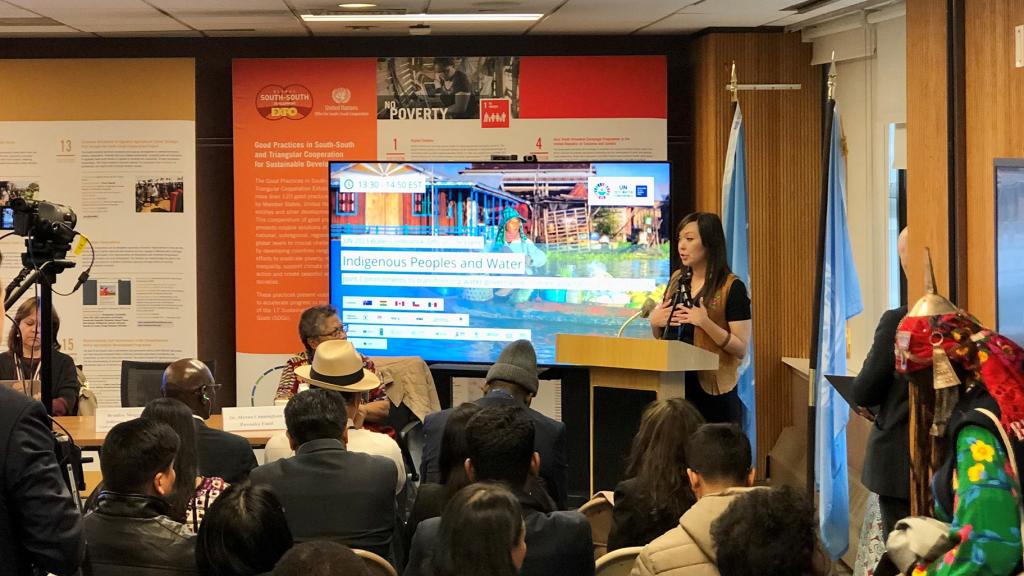
Stephanie Thorassie, member of Sayisi Dene First Nation, Canada, and executive director of the Seal River Watershed Alliance speaking on March 23, 2023, at the official UN 2023 Water Conference event “Indigenous Peoples and Water: Joint Commitments to transforming water governance, climate adaptation, and biodiversity.”
Figure 1. Stephanie Thorassie, member of Sayisi Dene First Nation, Canada, and executive director of the Seal River Watershed Alliance, speaking on March 23, 2023, at the official UN 2023 Water Conference event "Indigenous Peoples and Water: Joint Commitments to transforming water governance, climate adaptation, and biodiversity." Photo by Marina Puzyreva, IISD.

The finance challenge and definition of the "water sector"

To understand water challenges and solutions from a different perspective, I made my way to Times Square for the event "The New Age of Water Investing in a Time of Water Scarcity" at the NASDAQ office.

The event brought to the fore another crucial aspect of the water conversation, one that hinged on experiences of water scarcity and the challenges in finding, financing, and executing solutions. 

Jay Heller, the Head of Capital Markets at NASDAQ, pointed to the significant underfinancing seen in the water sector. For instance, when considering the exchange traded funds (ETFs) industry as an indicator of the capital raised for businesses, there are approximately 9,000 ETFs listed and formatted worldwide with USD 20 trillion in assets under management. Out of those, there are only seven ETFs earmarked for water, with only USD 4 billion in assets under management. 

Beyond the limited number of ETFs for water, we need to consider our definition of the water sector. Does this encompass only dams, pumps, and pipelines, or does it require a broader definition, one that goes beyond our understanding from nearly 5 decades ago?

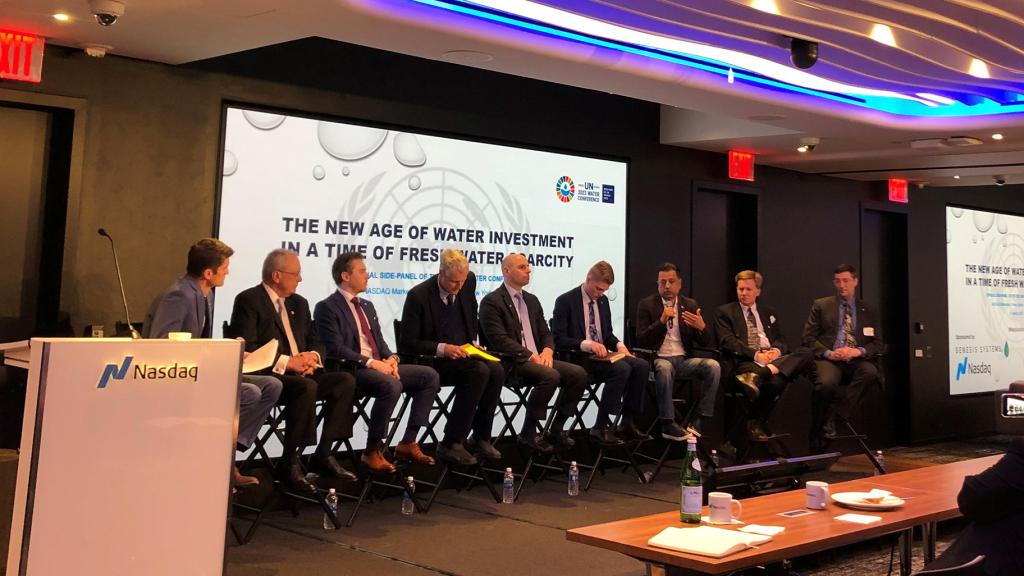
Expert panel at the official UN 2023 Water Conference event “The New Age of Water Investing in a Time of Water Scarcity” on March 24, 2023.
Figure 2. Expert panel at the official UN 2023 Water Conference event "The New Age of Water Investing in a Time of Water Scarcity" on March 24, 2023. Photo by Marina Puzyreva, IISD.

The conversation included a call to broaden our perspective. Zac Goldsmith, the United Kingdom's then Minister for Overseas Territories, Commonwealth, Energy, Climate and Environment at the Foreign, Commonwealth & Development Office, emphasized the crucial role of nature, especially in light of how environmental governance treats different issue areas. 

"In the ideal world, you would not have created a climate COP, a biodiversity COP, a desertification COP, and all these different things—and treat water as if it is something entirely separate because all these things are absolutely inextricably linked," he said, referring to the different Conferences of the Parties held under various multilateral environmental agreements. "My proposal is we focus as much as possible on nature… When you back nature, you get a whole range of benefits beyond what you initially were trying to achieve," Goldsmith emphasized. 

For water, nature-based solutions can help stabilize shores, recharge aquifers, and slow water runoff. These solutions can also support biodiversity, clean the air, and mitigate climate change, to give a few examples.

Looking ahead: New perspectives on water and foregrounding the role of nature

Throughout the conversations I heard in New York, the recurring theme was that nature needs to be at the centre of solutions. This message resonated across stakeholder groups—from those stewarding traditional lands to those fighting for legal rights of nature to those working on mainstreaming nature in British policy. 

Heading into the in-depth review of SDG 6 this July at the HLPF in New York, these reflections indicate there is a need to radically redefine our understanding of the value of water and water investments and to reconcile the way we live with nature. 

Now it is the time for the global community to tune into this new mindset, elevate the work of Indigenous land stewards, educate the broader public on these issues, and, particularly, advance nature's rights. This will be a stepping stone to transformative water action.

A tree in front of the United Nations headquarters in New York City
Figure 3. Tree against the background of the United Nations headquarters building in New York. Photo taken on March 21, 2023. Photo by Marina Puzyreva, IISD.

Insight details

Insight

Three Ways Standards Can Help Deliver on the Sustainable Development Goals

How can sustainability standards help deliver results on Sustainable Development Goals 2, 6, and 17 and support governments to track their progress ahead of the 2023 High-Level Political Forum for Sustainable Development?

June 26, 2023

Preparations for the 2023 High-Level Political Forum on Sustainable Development (HLPF) next month are in full swing. This annual event marks a key moment in the sustainable development calendar—a moment for countries to pause, take stock of their progress, and discuss how to make the 2030 Agenda for Sustainable Development a reality.

The July 2023 session of the HLPF will serve as an opportunity to prepare for a comprehensive review of progress on all 17 Sustainable Development Goals (SDGs) at the SDG Summit in September. This HLPF will focus on five SDGs, including SDG 6 on clean water and sanitation and SDG 17 on partnerships for the goals. 

At the International Institute for Sustainable Development (IISD), we have developed a set of recommendations on how countries could leverage the power of partnerships and work with voluntary sustainability standards (VSSs) to report on SDG progress.

VSSs set requirements for producing, selling, and purchasing products responsibly. Recent research has shown that VSS and SDG targets often overlap, particularly for SDGs 2, 6, and 17—all of which will be in the HLPF’s spotlight this year or next. Here are some examples of how standards can help deliver results on these three SDGs and help governments track their progress ahead of the HLPF.

Supporting SDG 2: Zero hunger

The Fairtrade International standard has been working in Uganda to improve agricultural productivity and smallholder incomes (SDG target 2.3) by delivering business and leadership skills training and support to the Gumutindo Coffee Cooperative. 

The training of more than 1,200 women has informed farmers about the importance of diversifying sources of income beyond coffee—the main source of earning in the community—into other crops or enterprises. Women farmers now earn extra income by selling vegetables, kerosene, and other products. 

Another positive outcome of the training has been informing women about the land tenure system, including how they could obtain the legal title for their land. As a result, more women are becoming aware that they can own land alongside their husbands, more joint legal titles are being issued, and more women are receiving land holdings in their own names. 

This example illustrates how VSS-supported educational efforts can promote access to land titles and deliver income improvements under SDG 2 while also supporting gender equality (SDG 5). 

Supporting SDG 6: Clean water and sanitation

The Alliance for Water Stewardship (AWS) Standard is collaborating with producers in Tanzania to increase water-use efficiency and address water scarcity (SDG target 6.4).

A coffee plantation owned by Olam International Ltd. in southern Tanzania’s upper Ruvuma basin became certified in 2015 under the AWS Standard, in collaboration with Water Witness International, which was responsible for tracking and monitoring the costs and benefits of implementing the standard. 

By complying with the AWS Standard, the coffee plantation—which irrigates more than 2,000 hectares and employs some 2,350 people, including more than 1,000 outgrowers—improved its water-use efficiency. It started a water-use monitoring system onsite, set efficiency targets, and ensured its water use corresponded with its permit of allowable water volume so as not to jeopardize environmental flows. 

In addition, a review of Olam’s water permit led to negotiations for the plantation to use less water than allowed under its 2015 permit. This reduction in water use could help prevent conflicts with other users and build local water security for nearly 300,000 people. 

This case illustrates how the AWS Standard, in partnership with Olam and Water Witness International, contributes to advancing SDG target 6.4 by enabling water monitoring, use, and consumption; planning water extraction and irrigation; and preventing water scarcity in neighbouring communities.

Supporting SDG 17: Partnerships for the goals

VSSs can also deliver sustainability benefits beyond certification. They play an important role in facilitating dialogue and fostering public-private partnerships between governments, VSS bodies, and multiple stakeholders—including farmers, buyers, producers, investors, and local authorities. This communication can help build trust, support policy coherence, and lead to improved coordination, strategies, and partnerships to tackle key sustainability issues. 

Countries could leverage those partnerships to report on SDG progress when preparing their Voluntary National Reviews (VNRs) for the HLPF. By capturing the results of the work VSSs are doing in their jurisdictions, as the case studies from Uganda and Tanzania demonstrate, governments could strengthen their VNR reporting by filling data gaps and providing evidence of SDG implementation on the ground. 

Detailed recommendations can be found in IISD’s new report, titled Standards and the Sustainable Development Goals: Leveraging sustainability standards for reporting on SDG progress. Launched ahead of HLPF 2023, the publication formulates guidelines to help interested governments lean into multi-stakeholder partnerships to bolster their VNR preparation and reporting efforts.
 

Insight

Five Ways the Global Goal on Adaptation can Help Build a Global Monitoring, Evaluation, and Learning System for Adaptation by COP 28


June 2, 2023

This article was originally published by the National Adaptation Plan (NAP) Global Network and is reprinted with permission.

With the 58th meeting of the United Nations Framework Convention on Climate Change’s (UNFCCC) Subsidiary Bodies (SBs) due to kick off in Bonn, Germany, on June 5, one of the key issues to watch in the realm of climate change adaptation are the talks on the Global Goal on Adaptation (GGA), given the need to move towards designing a Monitoring, Evaluation, and Learning (MEL) system for adaptation by COP 28.  

In 2015, the Paris Agreement (in Article 7.1) established the Global Goal on Adaptation (GGA) with the aim to “enhance adaptive capacity, strengthen resilience and reduce vulnerability to climate change.” Demonstrating the relevance and urgency of the GGA, its framework has been at the center of many subsequent negotiations to establish its scope and main elements.

During COP 26 in Glasgow, United Kingdom, the Glasgow-Sharm el-Sheikh work program on the GGA was established, including eight workshops for UNFCCC countries and observers to operationalize the GGA and create a framework that would allow better implementation of the above-mentioned Article 7.1. A year later at COP 27, parties further agreed to work on the framework with the aim of adopting it by COP28. The Bonn talks this June will include the sixth workshop of the Glasgow-Sharm el-Sheikh work program on the GGA.

Among its functions, the GGA framework needs to establish key elements, or dimensions, that can help capture and categorize evidence on progress towards the GGA. This information, in turn, will provide the basis for the design of a global monitoring, evaluation, and learning (MEL) system for adaptation under the GGA framework.

Based on a recently published IISD report, this article explains why and how the GGA framework should clarify the elements of a global MEL system for adaptation by COP 28.

What links the GGA with a global MEL system for adaptation?

As a counterpart to the Paris Agreement goal of limiting global temperatures to “well below 2°C and to 1.5°C,” the GGA represents the conceptual and methodological foundation through which parties and the UNFCCC will conduct the MEL of adaptation under the Paris Agreement. As such, a key component of the GGA framework is the definition of the MEL system that will provide evidence for the world to enhance adaptive capacity, strengthen resilience, and reduce vulnerabilities associated with climate change.

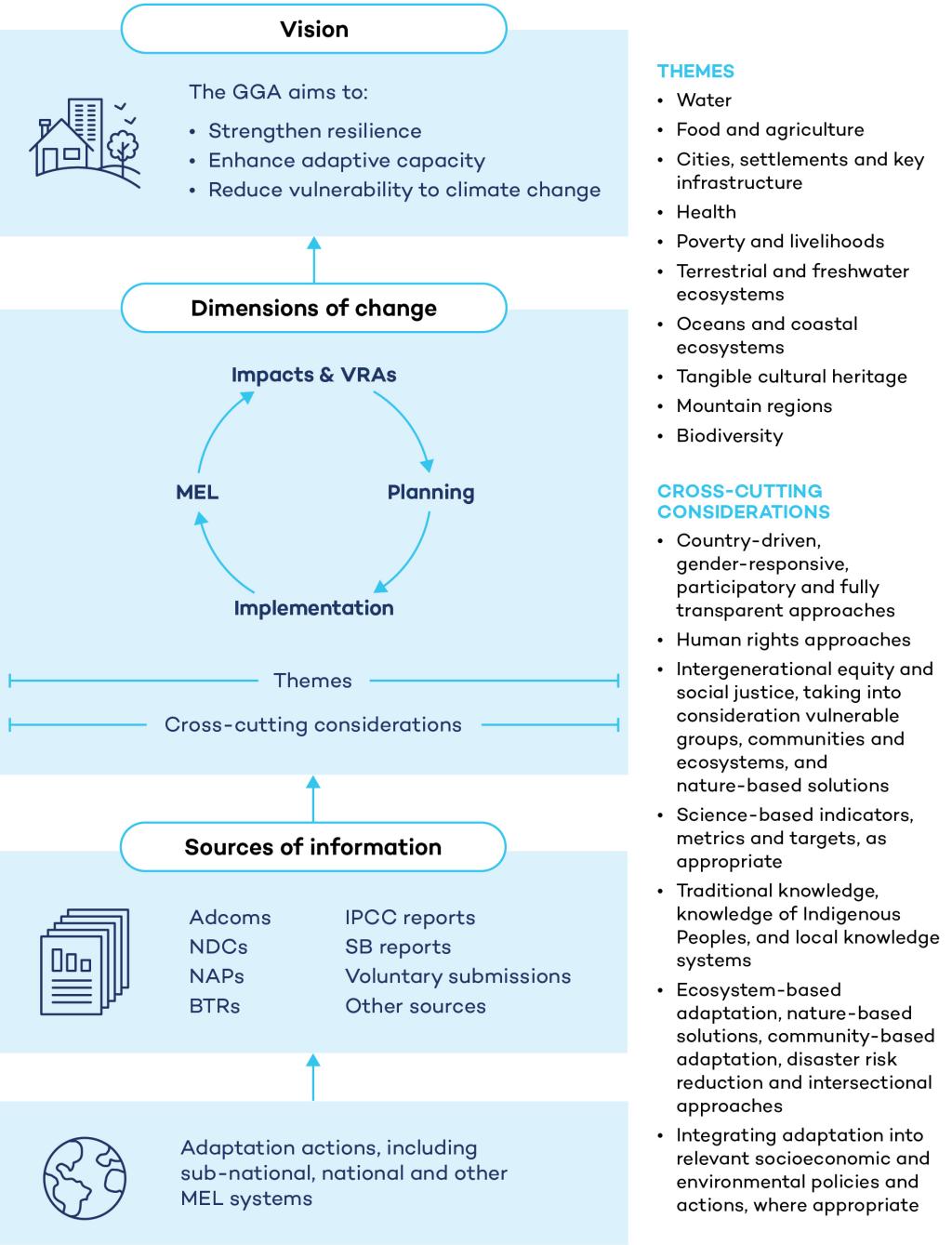
A figure outlining monitoring, evaluation, and learning in the context of the Global Goal on Adaptation
A conceptualization of the current elements of the GGA discussions that can be used as a basis for a global MEL system for adaptation. (Source: International Institute for Sustainable Development)

A MEL system refers to the tools, responsibilities, and processes used to monitor, evaluate, and learn from a specific climate change adaptation intervention. It is both a distinct phase in the adaptation policy cycle and an ongoing process throughout the entire policy.

There is already information available to guide the assessment of progress on the GGA. In fact, both the Paris Agreement and elements considered in Decision 3/CMA.4 from COP 27 highlight key components of the GGA that can shape a global MEL system for adaptation, including:

  • A vision for the GGA based on its definition in the Paris Agreement’s Article 7.1;
  • Dimensions of change through which evidence on progress can be captured; categorized, and assessed, which are based on the four dimensions of the iterative adaptation cycle: impact and vulnerability and risk assessments, planning; implementation, and MEL, along with key themes, and cross-cutting considerations; and
  • Sources of information that channel data from local, national, regional, and global sources.

How can the GGA framework finalize a global MEL system for adaptation at COP 28?

Developing the GGA framework is an opportunity for decision makers to learn from the lessons of existing MEL systems under global agreements and frameworks, such as the Sustainable Development Goals (SDGs) or the Sendai Framework for Disaster Risk Reduction. Those frameworks have followed a top-down approach and include long lists of templated indicators that countries contextualize to match their national and sub-national realities. For example, the SDGs’ global indicator framework includes 248 indicators that can be picked and contextualized by countries.

While in theory such top-down approaches can help generate political buy-in, facilitate global analysis, and support policy development, globally defined indicators often do not reflect local context or priorities and ignore existing systems, which are crucial for adaptation.  Building on existing MEL system is important to avoid reporting burden, considering almost half (48%) of NAP documents submitted to the UNFCCC already include MEL systems as part of their NAP processes, with 55% of these referencing specific indicators. Ahead of COP 28, the new proposed GGA framework should consider drawing lessons from previous exercises by designing a MEL system for the GGA that combines a minimal top-down approach with a bottom-up, country-driven approach that incentivizes national MEL systems.

The GGA framework needs to focus on its overarching goal of enhancing adaptation action rather than becoming a long-lasting methodological exercise. During discussions this year, countries must advance elements of both a global MEL system and the GGA framework that will make them implementable after COP 28. The MEL system under the GGA framework would therefore benefit from using a mix of top-down and bottom-up approaches. For this purpose, the GGA framework should prioritize:

1. Defining indicators based on existing systems

The choice of which indicators can inform progress on the GGA can be based on already existing sub-national, national, and other MEL systems in order not to overburden countries. The MEL of NAP processes, for example, can provide one way forward. This mixed approach can be used to identify a limited number of global targets that can drive political support for adaptation, yet that recognizes current sub-national and national MEL systems and does not add reporting burden on countries.

2. Designing an iterative and boldly pragmatic MEL system

The GGA framework should set realistic expectations of what countries can achieve rather than adopting overambitious targets that would exceed their capacities. The GGA framework and its MEL system must be an iterative process that continuously evolves, ratcheting up ambition while reflecting new realities brought on by the increasing climate crisis.

3. Strengthening country-driven and participatory processes

A non-prescriptive framework for the first GGA can guide countries to reinforce their national MEL systems to gather and communicate data, helping them articulate their adaptation story. This would strengthen country-driven and participatory processes, ensure a fair representation of varied voices and views that integrate the most marginalized groups, and account for local realities.

4. Establishing pathways for informing policy and practice

The GGA framework must focus on establishing processes, not just methods, to enable learning throughout the adaptation cycle to inform policy and practice. Learning pathways and exercises should be set at different stages of implementing the GGA, building from good practices in other countries and sharing evidence between different UNFCCC and external processes, including the Global Stocktake and the Intergovernmental Panel on Climate Change reports.

5. Defining roles for implementing the GGA framework and global MEL system for adaptation

This means determining modalities, timelines, and roles for the global community to support countries as they inform the GGA, as well as analyzing the evidence, and providing recommendations to share insights with regional, national, and sub-national stakeholders.

*   *   *
The GGA presents an opportunity to incentivize and strengthen MEL systems in countries. However, having a well-designed MEL system is not a substitute for the political will and financial support necessary for implementing sustainable national MEL systems, building lasting capacities, and financing adaptation actions themselves.

Insight details

Topic
Climate Change Adaptation
Region
Global
Project
NAP Global Network
Impact area
Climate
Insight

Paris Talks a Clear Chance for Canada to Lead on Plastics Pollution

May 29, 2023

Today, ministers and policymakers from across the globe are congregating in Paris and, under the auspices of the United Nations, rolling up their sleeves to negotiate “an international legally binding instrument on plastic pollution, including in the marine environment.”

Canada has the chance to play a leadership role on the world stage. The question is, will we seize the opportunity, or sit back as other countries shape global policies that will affect us for decades to come?

Global outrage at photos depicting a floating garbage patch of plastic in the ocean proved to be a significant impetus for these negotiations, but the issue is much broader than just needing to change the way we clean up after ourselves.

The solution needs to tackle everything from how we produce, use and dispose of plastics. The growing challenges related to human health, as well as its links to gender and the lives and livelihoods of Indigenous Peoples, should also be taken into account.  

Canada has already established itself as a vocal supporter of addressing plastic pollution for years. During its G7 presidency, the country developed and signed onto the 2018 Ocean Plastics Charter as well as a “High Ambition Coalition” for the current negotiations.

The real proof of its commitment, however, will come during the coming weeks as it engages in the second round of negotiations on this treaty.

Canada has already laid out some commendable priorities for these talks. It has said the future treaty should seek to clean up, mitigate—and ultimately end—plastic pollution to protect human health and the environment, as well as a focus on the elimination of unnecessary and problematic plastics and chemical additives, resource efficiency and a stronger ‘circular economy’ approach.

Canada also backs the creation of a financial mechanism to support the implementation and the inclusion of capacity building, and addressing just transition, gender, and human rights considerations.

But, if Canada is really serious about tackling plastics pollution, it needs to get bolder.

First, the government should explicitly advocate for provisions to reduce the production of primary plastic polymers and eliminate and restrict specific plastic polymers, chemicals and plastic products of concern. This would ensure that Canada is fully addressing the entire lifecycle of plastic – including the precursors of plastic pollution – from production and manufacture to disposal and circularity.

"A global solution is necessary, and Canada should seize this chance to be a global leader to ensure the treaty is fit for purpose—and ready for impact."

Second, Canada should strengthen its position on pollution and human health. Now that we know more about the sources of plastic pollution throughout the supply chain, Canada could expand global policy to address health impacts throughout the life cycle of plastics including from the toxic constituents of plastic as a material.

Third, links between plastic and plastic pollution with other areas should be addressed. Climate change and plastics, for example, are both driven by the extraction of oil and gas. And let’s also not forget that plastic pollution often has detrimental effects on freshwater systems—to which Canada is home to 20% of the world’s supply—as well as biodiversity, in particular seabirds and ocean creatures. An advisory panel, drawing on diverse scientific voices and perspectives—like that which informs the IPCC—would be a critical tool here to determine potential threats and to formulate clear and proven solutions.

Fourth, Canada could spearhead the talks on means of implementation - including adequate technical assistance, capacity building and the mobilisation of predictable, meaningful and sustainable funding for the implementation of the future treaty.

Finally, it will be important for the government to emphasize global measures and standards, over national measures. This will ensure a level playing field and that global standards set the path towards ending plastic pollution with clear timelines and targets.

Those startling images of plastics floating in the ocean have shown us that plastics pay no regard to national borders. A global solution is necessary, and Canada should seize this chance to be a global leader to ensure the treaty is fit for purpose—and ready for impact.

Insight

The Final Countdown: How Canada can end fossil fuel subsidies this year

May 29, 2023

The conversation on ending fossil fuel subsidies in Canada has been hanging like a dark cloud over the country, with years of pledges failing to lead to concrete action. But the skies may finally clear in the coming months with the release of Canada's long-awaited subsidies framework and policy.

The government first promised to scrap fossil fuel subsidies nearly 15 years ago, and the federal Minister of Environment and Climate Change has been instructed to act on this commitment in the 2015, 2019, and 2021 mandate letters. Meanwhile, ambition to curb greenhouse gas emissions—and thus the country's reliance on fossil fuels—has been escalating in Canada as its global peers make moves to rapidly scale up renewable energy.

However, the reality is that Canada still gives billions in tax breaks, grants, financing, and other supports to the oil and gas industry every year—totalling over CAD 20 billion in 2022—and a significant portion of these are subsidies.

More recently, the government set a deadline for this year, 2023, to finally end fossil fuel subsidies for good, with Steven Guilbeault, the current Minister of Environment and Climate Change, confirming that “not delivering is simply not an option.” Guilbeault then reinforced this pledge in December, saying that his government would move on this in the first half of the year.

But nearly 6 months into 2023, we are still waiting for action. The government must move quickly and decisively to make good on this long-standing promise to keep pace with Canada’s international peers and give Canadians something to be proud of.

What exactly will that look like? There are two elements the government must get right to keep its promise: clearly defining fossil fuel subsidies and developing policy for phasing them out.

What Are (Inefficient) Fossil Fuel Subsidies?

Canada's original commitment, alongside its G20 partners in 2009, was to end “inefficient fossil fuel subsidies.” The Canadian government is looking at this definition in two pieces: (1) what is a fossil fuel subsidy and (2) what is considered “inefficient.”

The World Trade Organization's (WTO's) definition of subsidies, which is part of international trade law, is widely used around the world, including in the recommendations to measure fossil fuel subsidies by the United Nations Environment Programme. This encompasses financial contributions that yield benefits to businesses or industries (in this case, fossil fuel companies)—including, but not limited to, direct transfers, foregone revenue, transfer of risk, and provision of goods and services. If established definitions are sidestepped without strong attempts to maximize ambition and capture all relevant measures, key subsidies might be missedwhich would defeat the very purpose of the government's commitment and risk our credibility internationally.

On the matter of inefficiency, the government should adopt strong criteria that do not leave any loopholes for fossil fuel support to slip through. IISD has proposed four criteria that all energy subsidies should align with to be considered efficient: supporting a sustainable economy, creating good long-term jobs, aligning with Canada's climate commitments, and getting the best value for public dollars spent. Subsidies that do not align with these criteria should be labelled “inefficient” and phased out under the forthcoming policy.

If the government adopts robust criteria like these, it would be very unlikely that any fossil fuel subsidy would be considered efficient. In fact, the government of Italy and the United Kingdom's Climate Change Committee have already noted that all fossil fuel subsidies are inefficient, while the United States, China, and Indonesia have indicated intentions to end fossil fuel production subsidies because they can lead to wasteful consumption.

What Should Canada's Policy to Stop Fossil Fuel Subsidies Look Like?

To its credit, last year Canada set a strong precedent by issuing policy guidelines to stop providing public financing for fossil fuel projects internationally, thus helping Canada follow through with its COP 26 promise to end such public support by the end of 2022. 

This policy can serve as a good model for Canada's work on fossil fuel subsidies at home. To be eligible for public financing, the policy guidelines require international projects to be aligned with 1.5°C scenarios, include a robust assessment of the risk of stranded assets, and prove a lack of renewable energy alternatives. This leaves very little room to continue financial support for fossil fuel projects. However, the policy guidelines still allow support for natural gas-fired power plants and “abated” fossil fuel production that relies on carbon capture and storage, a technology that has not proven effective at reducing emissions in the oil and gas sector and remains prohibitively expensive. 

Canada's approach to ending domestic fossil fuel subsidies should mirror the strengths of its international public finance policy, while making sure to close the loopholes. It should also require greater transparency and reporting so that implementation can be tracked and accounted for. 

Which Fossil Fuel Subsidies Does Canada Need to End?

The criteria and policies government develops should both end existing support for fossil fuel production and make sure that no new subsidies are created. This includes ending long-standing tax breaks for oil and gas companies, like the Canadian Development Expense, as well as non-tax subsidies. Lists of these measures have been gathered through subsidy inventories, though some are not even known to the public due to a lack of reporting.

A strong policy would also ensure that public funds like the Net Zero Accelerator Initiative and the Canada Growth Fund, as well as the recently announced investment tax credits for electricity and carbon capture, exclude fossil fuel support and prioritize investments in renewables, energy efficiency, and decarbonizing hard-to-abate industries. If the money in these funds flows to oil and gas companies, Canada risks breaking its long-standing international subsidies commitment and missing out on opportunities from fully embracing the shift to a cleaner economy.

Next Up: Tackling domestic public finance for fossil fuels

In addition to tax breaks and grants, the government also supports fossil fuels by financing projects on Canadian soil, such as pipelines and liquefied natural gas export facilities, taking on the risk of these projects and often offering better terms of financing than those available commercially. The federal government has promised to end this support, just as it did with projects abroad, but has not yet offered any specifics. It is critical that the government follows through on its pledge, given that even more public finance is directed to fossil fuels domestically than internationally—at least CAD 4.3 billion annually between 20192021.

The best course of action would be for the government to tackle domestic public financing for fossil fuels hand-in-hand with subsidies, eliminating both this year. This is especially important since domestic finance and subsidies have elements in common. In a year of high inflation and restricted government spending, this would free up funds in future budgets for investments in strategic, low-carbon sectors to power the transition, diversify the economy, and provide good green jobs for Canadians.

If Canada were to bring a strong policy for ending domestic fossil fuel subsidies and public financing to the G20 Summit this year, it would send an important signal to its peers and international forums like the WTO, that Canada is serious about aligning public spending with its climate commitments. After having demonstrated leadership by recently ratifying the WTO's Fisheries Subsidies Agreement, Canada has another opportunity to prove its sustainability credentials by aligning its financial support with sustainability goals and eliminating its support to fossil fuels.