Report

Rethinking Investment Treaties

A roadmap

International investment treaties and their investor–state dispute settlement (ISDS) system are facing growing scrutiny of how they threaten climate action, environmental protection, and social justice. But what would an alternative system—one fit for the challenges of the 21st century—look like?

May 15, 2024
  • EU voted to leave #ECT and Ecuador's citizens rejected #ISDS. The need to reform investment treaties to support #climate action and #socialjustice is more urgent than ever. In @IISD_news new paper @JOstransky and @JBonnitcha rethink whether/how treaties instead can accelerate #sustdev.

  • @SREnvironment found that our international investment treaties and #ISDS are "catastrophic" for #envi and #humanrights. But how can treaties be redesigned to support #sustdev? Must-read paper from @IISD_news @JOstransky & @JBonnitcha sets out a roadmap for policy-makers!

  • Investment treaties of the future need to strengthen international cooperation, make sure host states benefit from inv projects, and align with #ParisAgreement. How to get there? Join as experts unpack @IISD_news' new paper! Register https://www.iisd.org/events/rethinking-investment-treaties

If we were building the investment treaty regime from scratch today, what policy problems should the regime seek to solve, and how should it contribute to solving them?

The answer to this core question points to existing problems of international investment governance; issues where cooperation between states is both desirable and necessary.

This report divides investment governance policy problems into three categories: (a) issues related to the encouragement and support of sustainable investment, (b) issues related to the impacts of investment projects, and (c) issues of investment governance, institutions, and international cooperation. For each category, the paper assesses whether a treaty could play a useful role and highlights questions that require further consideration, investigation, and clarification.

Rethinking Investment Treaties is a step toward designing future investment treaties and a must-read for policy-makers responding to the most pressing economic, environmental, and social policy problems of the 21st century.

The report authors and leading experts from international institutions and academia unpacked the report's key findings and policy guidance in a webinar on May 30, 2024. Since then, IISD has advanced the conversation through bespoke sessions at the 2024 Investment Policy Forum and government workshops.

In June 2025, we launched a public consultation on the rethinking of investment treaties, seeking input on policy priorities and design from policy-makers, investors, experts, academics, and other members of the investment community.

We published the findings from the consultation in a summary report in March 2026. The consultation suggests that investment treaties should be redesigned to focus more on ensuring investments deliver genuine public goods—which is not the case with the current model focused on shielding foreign investors—and to better interact with national laws for settling disputes between investors and states.

Report

Transitioning Away From Oil and Gas

A production phase-out primer

At the COP 28 climate summit in Dubai, 198 governments agreed to transition away from fossil fuels. That means phasing out oil and gas, as well as coal. Yet most oil and gas producers plan to drill more, not less. Some countries are dependent on revenues from oil and gas, or politically entangled with the industry. An unmanaged transition could get ugly. So how do we deliver a fast, fair, and orderly phase-out?

May 14, 2024
  • Most oil & gas producing countries plan to expand production. To limit global warming to 1.5°C, there is no room for new oil & gas infrastructure. Oil & gas production must fall at least 65% by 2050.

  • With a new round of #NDCs due in 2025, governments face a critical moment to raise #climate ambition. Plans must account for an equitable global phase-out of oil and gas production.

  • More than 2,500 investment treaties allow oil & gas companies to sue governments over climate policies. Governments must work together to reform these treaties & uphold the right to regulate.

In this report, our experts explore why and how to phase out oil and gas. The primer covers scientific scenarios, equity principles, economic risks, supply-side policies, legal barriers, and discussions in international forums. It recommends next steps for governments, international processes, and other stakeholders.

Recommendations include:

  1. Stop issuing oil and gas licences. There is no room for new oil and gas fields under a 1.5°C warming limit. New production will either drive dangerous levels of warming or crash in value when climate action destroys demand.
  2. End public finance and subsidies to oil and gas production. Use valuable public resources to scale up clean energy and support people, not fossil fuels. Transform national oil companies’ business models from barrels to electrons.
  3. Make national phaseout plans as part of the next round of nationally determined contributions (NDCs) to the Paris Agreement due in 2025. Global oil and gas production falls at least 65% from 2020 to 2050 in credible 1.5°C-aligned pathways. An equitable distribution of effort takes into account human rights, historic responsibility, and social and economic capacity.
  4. Remove legal barriers to phase-out, like the thousands of investment treaties that allow oil and gas companies to privately sue governments for implementing climate policies.
  5. Mobilize support for vulnerable oil and gas producers in the Global South to restore degraded environments, reskill workers, and seize the opportunities of sustainable growth industries.

Report details

Topic
Climate Change Mitigation
Energy
Just Transition
Project
Advancing the Transition Away from Fossil Fuels
Impact area
Climate
Publisher
IISD
Copyright
IISD, 2024
Report

World Trade Organization Talks on Subsidies that Contribute to Overcapacity and Overfishing: What's on the table?

After the historic adoption of the Agreement on Fisheries Subsidies in 2022, Members of the World Trade Organization (WTO) are now negotiating new global disciplines to address more broadly the role of subsidies as a driver of overfishing. This update provides a clear overview of the draft additional rules that are currently on the table. It also highlights key considerations that WTO members should keep in mind from a sustainable development perspective.

May 14, 2024

In June 2022, world governments adopted the Agreement on Fisheries Subsidies at the World Trade Organization’s 12th Ministerial Conference. The treaty prohibits subsidies in the specific situations where they are the most unequivocally dangerous for the sustainability of fishing. Today, WTO members are looking to strengthen this historic agreement with new, broader rules on subsidies that contribute to overfishing and overcapacity more generally.

These disciplines aim to ensure that the financial support provided by governments to their fishing sector does not lead to excessive fishing pressure. As such, they have the potential to make an essential contribution to the protection of marine resources, as well as the livelihoods, food security, and development prospects of populations who depend on healthy fish stocks. While these additional rules could not be agreed at the WTO’s 13th Ministerial Conference earlier in 2024, WTO members came closer than ever to reaching consensus and landing a deal on this crucial sustainable development priority.

As WTO members reflect on the way forward in these negotiations, this update provides an overview of the draft text that constitutes the basis of current talks, which was circulated to WTO members by the chair of the Rules Negotiating Group, Ambassador Gunnarsson of Iceland, on April 12, 2024. After providing some background on the recent history of negotiations and the current state of play, the update describes and explains succinctly the new rules that are envisaged, and it provides contextual information to help readers understand the dynamics that have led to particular provisions in the draft text. For each main component of the proposed new rules, a summary box is provided to outline the key elements of the disciplines. Finally, the update concludes by highlighting a few key considerations about the draft text from a sustainable development perspective.

Report details

Topic
Subsidies
Sustainable Development Goals
Trade
Project
Fisheries Subsidies
Impact area
Nature
Sustainable Economies
Initiatives
Global Subsidies Initiative
Publisher
IISD
Copyright
IISD, 2024
Report

Modernizing Artisanal and Small-Scale Mining

Harnessing new technologies for sustainable development

How will emerging technologies affect the artisanal and small-scale mining sector?

May 14, 2024

The report provides a comprehensive analysis of ASM’s current state, including tools, techniques, and technologies across the mining life cycle, along with addressing crosscutting issues like monitoring and enforcement, occupational health and safety, access to finance, and access to information.

Distinguishing between artisanal and small-scale mining, the study then examines newly developed, phase-specific technologies. It assesses the benefits, opportunities, and policy options linked to emerging technologies in ASM. It provides insights regarding worker safety, reducing mercury use, improving traceability, and establishing robust mineral value chains. Additionally, the research includes a gap analysis of new technologies that identifies crucial areas for advancement to drive sustainable development within the industry.

Report

Toolkit for Monitoring, Evaluation, and Learning for National Adaptation Plan Processes

May 8, 2024
  • Continuously learning from MEL allow countries to adjust their NAP processes and strategies as changes occur, providing the evidence to ensure effectiveness of adaptation and avoiding negative unintended effects.

  • The Toolkit for MEL for NAP Processes from NAP Global Network and the Adaptation Committee brings together over 30 practical examples from countries and key resources to help guide adaptation teams through MEL systems.

  • Having a robust system for MEL that deepens understanding of what is working, how and for whom, provide a critical basis for building equitable NAP processes and outcomes. This toolkit guides adaptation teams in government to build this foundation.

As the impacts of climate change and climate-related shocks become more unpredictable and severe, countries are increasingly using NAP processes to design and build resilient strategies – and learn from them. Monitoring, evaluation, and learning (MEL) systems are critical to enable countries to understand if NAP processes work, how they work and for whom, and how to improve actions based on the insights gained. Continuously learning from NAP processes actions and adjusting strategies accordingly is crucial to improve the effectiveness of adaptation and to avoid negative unintended effects from policies and interventions.

MEL systems for NAP processes are also an important source of information for processes under the Paris Agreement – including assessing collective progress on the global goal on adaptation through the UAE Framework for Global Climate Resilience, and relatedly the adaptation section of Biennial Transparency Reports.

This toolkit for MEL for NAP processes provides practical guidance for the development and continuous improvement of MEL systems for national adaptation processes. It is designed for government actors coordinating NAP processes, along with stakeholders and development partners supporting adaptation planning and implementation. This toolkit provides flexible yet concrete guidance on the planning, implementation, and revision of MEL systems, regardless of what stage countries are at in their NAP processes or the development and implementation of their MEL system.

The toolkit has been developed in collaboration with the Adaptation Committee.

Report details

Report

ASGM Tailings Management and Reprocessing Governance

Global trends

An IGF report outlining technical aspects of artisanal and small-scale gold mining (ASGM), examining existing governance frameworks and providing recommendations for policy-makers to improve awareness, education, safety, and regulation of ASGM tailings. 

May 6, 2024

Artisanal and small-scale gold mining (ASGM) is a significant economic sector, employing 20 million people across 80 countries and producing up to 20% of the world's gold supply. The report underscores the urgent need for governments to prioritize responsible ASGM tailings management, particularly the disposal of hazardous materials like mercury that pose significant risks to human health and the environment.

This report first outlines important technical aspects of ASGM, including ore extraction, processing, tailings generation, management, and reprocessing. It also addresses mercury recovery, management, and disposal. Then, the authors examine existing governance frameworks, including guidelines from the United Nations Environment Program. This is followed by recommendations for policy-makers to improve awareness, education, safety, and regulation of ASGM tailings.

Key findings include the need for comprehensive international, regional, and national frameworks for ASGM to promote tailings management and reprocessing. Additionally, it highlights the potential benefits of collaboration between ASGM and large-scale mining sectors, formalization schemes aligned with Sustainable Development Goals, taxation and fiscal incentives, strategic environmental assessments, mercury-free alternatives, and mainstreaming gender-related concerns in tailings management and reprocessing approaches.

Report

A Scan of Natural Infrastructure Approaches

Bright spots from the City of Nelson, Halifax Region Municipality, and EPCOR

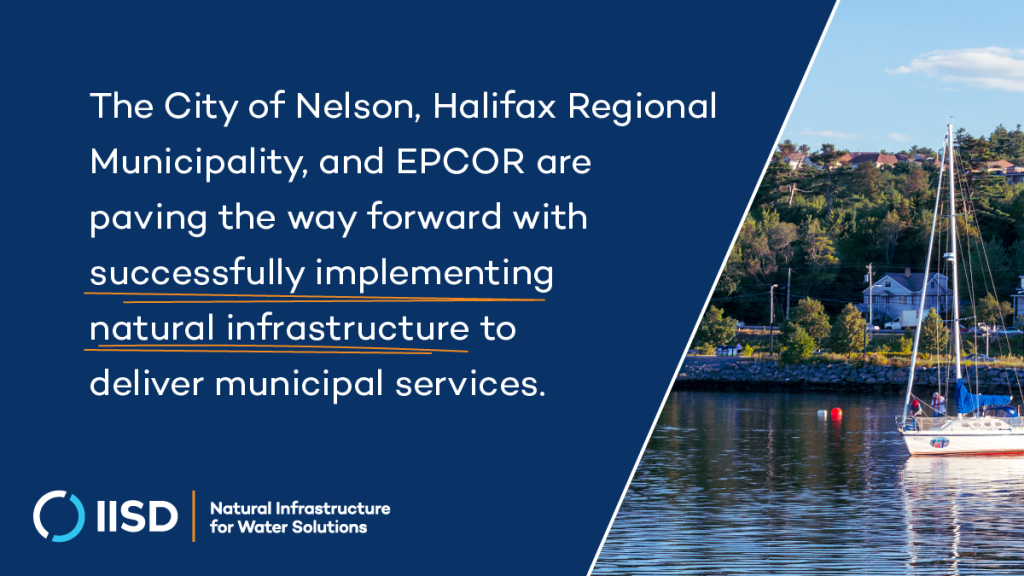
This report looks at successful natural infrastructure implementation to deliver municipal services in Canadian municipalities, Identifying how Edmonton, Alberta; Nelson, British Columbia; and the Halifax Regional Municipality, Nova Scotia are paving the way.

May 2, 2024
  • Natural infrastructure, like wetlands, can complement existing grey infrastructure to enhance the delivery of municipal services.

  • Regardless of size, jurisdictions in Canada are successfully implementing natural infrastructure—through policy and planning changes, collaborating across departments and with partner organizations, and more.

  • Each jurisdiction is different and needs to develop solutions that align with its own municipal processes.

Local governments play a crucial role in providing essential services to residents, such as drinking water, wastewater treatment, stormwater management, flood protection, and rural drainage. Traditionally, these services rely on grey infrastructure, like dams, pipes, and treatment facilities. However, there is a growing interest in using natural infrastructure to complement these services, especially in response to the increasing challenges posed by climate change.

Several jurisdictions in Canada, including the City of Nelson, Halifax Regional Municipality, and EPCOR, based in Edmonton, Alberta, are taking the lead on successful natural infrastructure implementation. These cases serve as models for others, showcasing effective policy changes in different administrative, jurisdictional, and geographic settings.

White text on a blue background that reads: "The City of Nelson, Halifax Regional Municipality, and EPCOR are paving the way forward with successfully implementing natural infrastructure to deliver municipal services"

Participating experts

Report details

Report

Strategic Environmental Assessment for the Mining Sector

Lessons from country case studies

An essential tool for policy-makers working to develop a sector-wide vision for responsible mining. 

April 17, 2024

This report provides analysis and case studies that highlight how strategic environmental assessment (SEA) can improve mining sector governance.

Not to be confused with environmental and social impact assessments (ESIA), which apply to individual projects, SEA applies more broadly and is defined by the OECD as a range of analytical and participatory approaches that aim to integrate environmental considerations into policies, plans, and programs, and evaluate the interlinkages with economic and social considerations.

SEA can improve mining governance by

  • providing better insight into environmental, economic, and social trade-offs, increasing the likelihood of positive outcomes;
  • raising awareness about unsustainable development options to prevent costly mistakes and conflicts;
  • increasing understanding of the cumulative impacts of multiple smaller developments and the opportunity to improve the coherence between projects;
  • enhancing credibility of government decisions, leading to more public trust in the planning process and more support for plan implementation.

Report details

Report

Blackouts and Backsliding: Energy subsidies in South Africa 2023

Blackouts and Backsliding presents the latest energy subsidy data for South Africa. South Africa's fossil fuel subsidies tripled between FY 2018 and FY 2023, from ZAR 39 billion (USD 2.9 billion) in FY 2018 to ZAR 118 billion (USD 7.5 billion) in FY 2023. The largest share of fossil fuel subsidies in South Africa in FY 2023 went to oil and gas consumption, carbon tax exemptions, and the electricity sector.

April 9, 2024
  • #Breaking | #SouthAfrica's fossil fuel subsidies hit a record ZAR 118bn in FY 2023. A new @IISD_Energy report finds that: Fossil fuel subsidies have tripled in 5 years. State support for #CleanEnergy remains minimal Learn more: https://www.iisd.org/story/south-african-energy-subsidies

  • Despite rising energy subsidies, loadshedding in #SouthAfrica hit record highs in 2023, occurring 335 days of the year. How can South Africa improve its energy security and hit #CleanEnergy targets? A new @IISD_energy report outlines a way forward: https://www.iisd.org/story/south-african-energy-subsidies

  • Oil & gas subsidies in #SouthAfrica reached ZAR 52bn in FY 2023 as the gov't looked to shield consumers during the #EnergyCrisis. IISD research finds shifting to renewables would support long term #EnergySecurity & affordability. Read the @IISD_Energy report: https://www.iisd.org/story/south-african-energy-subsidies

Participating experts

Report

Sustainable Asset Valuation of Parques del Río Norte in Medellín, Colombia

Known as the "City of Eternal Spring" due to its temperate climate, the City of Medellín has been looking for solutions to help restore its green space. Climate change and rapid urbanization has resulted in a negatively impacted ecosystem. The expansion of the Parques del Río Norte is a project that aims to restore green urban green space alongside the river in order to address and mitigate these issues.

April 8, 2024

This report is an economic valuation of the expansion of the Parques del Río Norte in Medellín, Colombia. The project, spearheaded by the Secretariat of Physical Infrastructure (SIF) of Medellín and the C40 Cities Finance Facility (CFF), seeks to mitigate issues such as river erosion, water pollution, flooding, and urban heat islands.

Through an integrated cost-benefit analysis, it was found that over 30 years, the park would generate significant benefits for Medellín, with a return of USD 1.67 for every dollar invested. These benefits include reduced flood risk, improved environmental quality, economic gains from increased retail revenue and property values, and enhanced human health and well-being from increased physical activity and better air quality.

The report highlights key recommendations, including investing in nature-based infrastructure (NBI) along the river to mitigate flood damages, ensuring continuous maintenance of the park for optimal benefits, and implementing further measures to protect the city from climate change impacts, as well as utilizing Medellín as a scalable example for combatting urban challenges through NBI.