Webinar

Africa Launch | The Role of Parliamentarians in Enhancing Responsible Investments in Agriculture for the Transition Toward More Sustainable Food Systems in Africa

December 15, 2020 2:00 pm CET

(Open to public)

* Un version française de cette page est disponible. Veuillez cliquez sur French en haut de la page au dessus de la photo.

The Food and Agriculture Organization of the United Nations (FAO), International Institute For Sustainable Development (IISD), the Pan-African Parliament, East African Legislative Assembly (EALA) and the Economic Community of West African States (ECOWAS) Parliament jointly organized an event on the role of parliamentarians in enhancing responsible investments in agriculture for the transition toward more sustainable food systems in Africa on Tuesday, December 15, 2020.

Because of the agricultural sector’s influence on people and development, investment in the sector and in food systems is critical to supporting economic growth and reducing poverty and food insecurity. At the same time, it contributes to rural development and creating job opportunities, especially for young people, women, and other vulnerable social groups. In the context of the current COVID-19 pandemic, additional investment in agriculture is required to reduce its consequences and support recovery efforts toward the achievement of the UN’s Sustainable Development Goals (SDGs).

In order to generate sustainable benefits for all, it is essential to ensure not only more, but above all, better investments that prioritize people’s food security and nutrition, uphold decent work, secure land rights and resources, recognize participation in consultation, and protect the most vulnerable.

Parliamentarians’ strategic position is fundamental to promoting enhanced public investments in the agricultural sector, such as the provision of public goods and services, including infrastructure, energy, research and development, especially in rural areas. These investments can also contribute to the emergence of the conditions to increase private investments, made by smallholders, by youth-led and women-led small and medium-sized enterprises (SMEs), and by larger-scale agribusiness investors, while ensuring well-defined safeguards are in place to protect legitimate interests and prevent damages to the environment and communities. Finally, they can act to facilitate complementarity between different kinds of investments. Members of parliament and parliamentary advisors also play a central role in building public awareness about the challenges and opportunities related to responsible investment in agriculture and food systems while ensuring that investments do not jeopardize vulnerable groups. 

Based on their experience working with parliamentarians, in 2020, FAO and the IISD joined forces to develop a practical handbook that provides a comprehensive and systematic overview of the role that parliamentarians can play in the creation of “enabling environments” in several areas related to investment in agriculture and food systems. It includes guidance notes alongside examples of legislation and good practices.

This event aimed to 
•    Raise awareness of the importance of responsible investment in agriculture and food systems for the achievement of the SDGs.  
•    Bring together parliamentarians from different parties and catalyze discussions on their concrete role in the enhancement of responsible agricultural investment (RAI) within Africa.  
•    Launch Responsible Investments in Agriculture and Food Systems. A Practical Handbook for Parliamentarians and Parliamentary advisors.


Watch the full recording of the event 

Download the Handbook here


The E-Book version of the report is now available at the following links


Check out a related story written by Francine Picard, Emma Jessie McGhie and Carin Smaller: More and Better Investments Are Needed in Agriculture and Food Systems - What can parliamentarians do about it?
Webinar

Food and Agricultural Trade in the New Policy Environment: How Can WTO members Support Economic Recovery and Resilience?

November 17, 2020 2:30 pm - 3:30 pm GMT

(Open to public)

twiiter card

Trade in food and farm goods has been hit hard by both the COVID-19 crisis and tensions between major economies, adversely affecting the food security of vulnerable populations. On November 17, 2020, the International Food Policy Research Institute (IFPRI), International Institute For Sustainable Development (IISD), and Akademiya2063 hosted a virtual regional dialogue for francophone Africa to look at the issues facing the continent in this area in the run-up to the World Trade Organization’s (WTO’s) 12th ministerial conference (MC12).

Panellists included senior government officials from Benin and Niger, experts from IFPRI and the WTO, and a speaker from the Alliance for a Green Revolution in Africa (AGRA).

COVID-19: Staples largely spared as falling demand hits other exports
Event moderator Francine Picard, policy advisor with IISD, began the discussion by asking participants how COVID-19 has affected markets for food and agriculture—the first of four themes addressed by the panellists.

As in other world regions, African countries had benefited from the robust stocks that existed prior to the outbreak of the pandemic, said David Laborde, senior research fellow at IFPRI.

Laborde said trade in staples had been hit less hard than other sectors such as fruit and vegetables or cut flowers, where falling demand and a sharp decline in air travel had disproportionately affected air-freighted goods and other perishable non-essential items.

But the COVID-19 pandemic has also exacerbated other challenges faced by countries in the region, emphasized Francoise Assogba Komlan, the Secretary-General of Benin’s Ministry of Agriculture, Livestock and Fisheries, pointing to the decision to close Nigeria’s border as one example.
Mounkaila Hassane, Director-General of Niger’s Trade Ministry, pointed to the impact of floods on rice cultivation in West Africa as another such case.

Coping Mechanisms in Place

At the same time, panellists emphasized that governments had implemented coping mechanisms that have so far helped people to weather the storm. Food trade was often exempted from border closure measures, Hassane pointed out, and Assogba explained how producers in Benin had benefited from storage aid from surplus production. 


Doaa Abdel-Motaal, senior counsellor in the WTO’s Agriculture and Commodities Division, recalled that many governments had collaborated to issue high-level declarations calling for trade in food and farm goods to remain open during the crisis and for measures to be taken that keep supply chains functioning normally.
Nonetheless, public health measures limiting the movement of people had also constrained trade in food and farm goods, Hassane said, while alternatives such as e-commerce remain poorly developed in many parts of Africa.

“This is not the last such crisis,”

Ousmane Badiane, Chair of Akademiya2063

“This is not the last such crisis,” said Ousmane Badiane, Chair of Akademiya2063, as he underscored the importance of being prepared for further shocks in the future.

Trade Rules to Protect the Weakest

Picard also asked participants to explain how Africa had been affected by tensions between major economies—such as the trade war between the United States and China that has dominated headlines during the Trump Administration.

Antoine Bouët, senior research fellow at IFPRI, said African countries have had to navigate their way through a tide of rising protectionism—although he also said this might now change following the U.S. election.


In particular, falling economic growth in countries like China could mean a decline in Africa’s exports of certain goods to these markets, warned Fadel Ndiame, deputy president of AGRA. He emphasized that African economies are often poorly diversified, with a heavy reliance on a handful of unprocessed commodities such as cotton and coffee.

At the same time, Assogba highlighted the potential for Africa to step in and fill the gap left by the decline in farm exports from other world regions. Tariffs and retaliatory measures on farm trade have seen China seek out new suppliers for key farm goods such as soybeans, a product widely used as animal feed.
Bouët cautioned that African countries have made little use of the WTO’s dispute settlement function, which is designed to defuse trade tensions and provide a peaceful route to settling disagreements over trade when these do occur. 

However, Laborde emphasized that rules were needed to prevent global trade from being governed by the “law of the jungle.”

“The rules protect the weakest countries,”

David Laborde, Senior Research Fellow, IFPRI

“The rules protect the weakest countries,” he told participants.

Diversifying and Adding Value
Abdel-Motaal recalled the importance of the African Continental Free Trade Agreement (AfCFTA), which aims to build on the regional integration that has taken place to date under Africa’s Regional Economic Communities and improve value addition on the continent.

Ndiame underscored the importance of improving the competitiveness of farming in Africa, and suggested that strengthening regional trade could represent a stepping stone toward greater integration on global markets. Assogba also highlighted the potential for geographical indications to ensure recognition for the quality of Benin’s food and agricultural exports within the region.

Alongside Ndiame, Laborde and Assogba also emphasized the importance of the diversification of products and export markets as part of a broader strategy to improve the resilience of African trade to shocks and unexpected events, and increase the extent to which value is added within supply chains on the continent.
“The keyword is ‘invest in agriculture,’” said Picard.

Laborde concurred, saying that governments needed to ensure adequate provision of “public goods” such as infrastructure and information while also creating the conditions for fair competition.

WTO and the Road to MC12
“International trade is a source of income, of opportunity—but also sometimes a source of worries,” Laborde said.

Better rules are needed so that “the actions of some don’t lead to damage to others,” he added, underscoring the importance of trade rules in improving the predictability of the trading system for economic actors.

On issues like cotton production subsidies—where African countries have long called for an update of WTO farm subsidy rules—Laborde argued that compensation should be paid to producing countries in Africa if subsidies proved impossible to reform for domestic political reasons. 

Abdel-Motaal reminded participants that COVID-19 and the election process for the next WTO Director-General continue to overshadow preparations for MC12, the date of which remains uncertain.

However, she emphasized that WTO members don’t need to wait for ministerial conferences in order to make decisions. “Nothing prevents WTO members from producing results immediately,” she said.

Abdel-Motaal pointed to a number of “low-hanging fruits” where negotiating outcomes might be more easily attainable than in other areas, including on topics of importance to Africa. These included issues around improved transparency, rules around tariffs on in-transit shipments, or export restrictions on food—with the last topic being particularly important to net food-importing nations, such as many of those in Africa.

More complex and controversial questions might need to be addressed as part of a work program that WTO members agree to pursue after MC12, she said, with domestic agricultural support and improved market access among the issues that would be addressed in this longer time frame.
 

The video recording for this event is available here.

This was the first of a series of events on the same topic, each with a regional perspective. The events will cover Africa, Asia, and Latin America. For more information on the Regional Series of Dialogues check out this page

The Nature-Based Infrastructure Global Resource Centre

Nature-based infrastructure (NBI) lies at the heart of climate change action. It underpins the implementation of the UN Sustainable Development Goals, the Paris Climate Accord, and the new international commitments on nature and biodiversity. Despite its wide-ranging benefits, NBI is not being scaled up enough to fulfill its potential. This is because our knowledge of the performance, predictability, and financial viability of NBI has—until now—been limited.

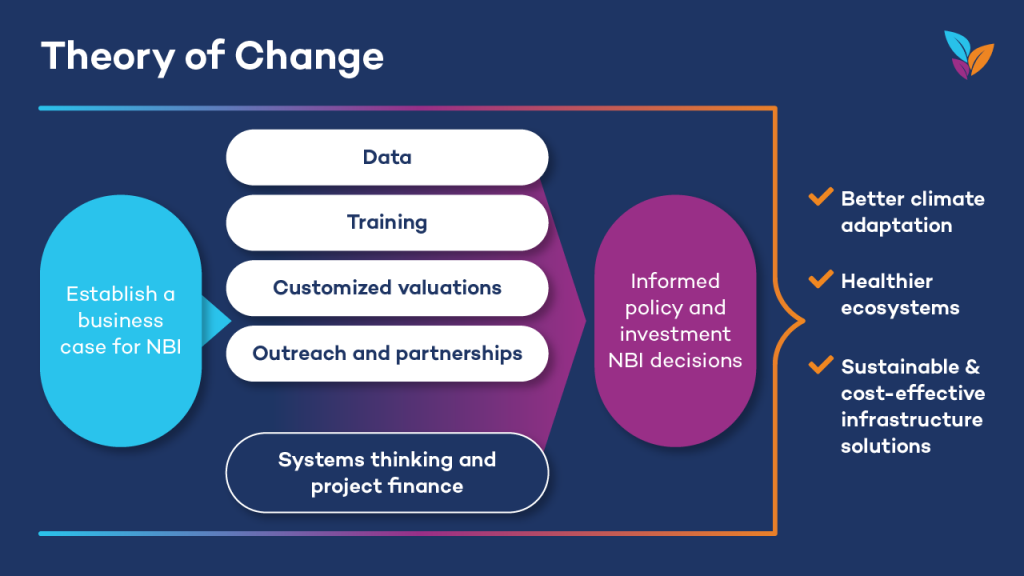
Together with the Global Environment Facility (GEF), the MAVA Foundation, and the United Nations Industrial Development Organization (UNIDO), IISD has established the Nature-Based Infrastructure Global Resource Centre. The NBI Global Resource Centre aims to bring together key partners to establish a business case for nature-based infrastructure. We will provide data, training, and sector-specific valuations based on the latest innovations in systems thinking and financial modelling.

We will work together with infrastructure planners, policy-makers, decision-makers, and financiers to improve the track record of NBI in delivering infrastructure services and supporting climate change adaptation while providing other environmental, social, and economic benefits.

Discover the NBI Global Resource Centre and visit the website.

Our Approach

The complexity of NBI requires taking a systemic approach when we plan, value, and implement infrastructure projects. It also requires knowledge integration and collaboration with partners in the field. Our work quantifies the positive impact of stewardship activities on ecosystems and demonstrates the cost efficiency of NBI. 

theory of change

Objectives

The NBI Global Resource Centre will seek to:

  • Improve the predictability and certainty of performance of NBI through more than 40 customized valuations of NBI projects globally.
  • Provide access to the data on the NBI performance through a new online database.
  • Strengthen the capacity of key stakeholders to understand and value NBI through a Massive Open Online Course (MOOC) and customized training.
  • Connect and build partnerships in the NBI field.

If you want to submit a proposal for assessment and collaborate with us to develop customized valuations of your projects, please contact our teams.

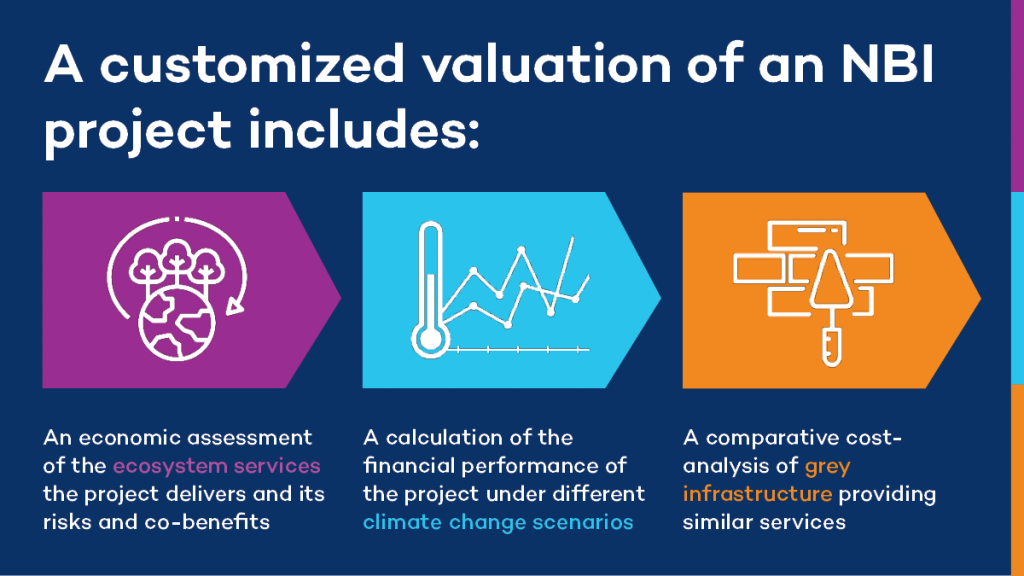
The valuations include:

  • The creation of a qualitative assessment of the impacts of the NBI project.
  • An economic assessment of the ecosystem services delivered by a given project.
  • A financial assessment of the project’s performance under different climate change scenarios, with climate data derived from the EU’s Copernicus Climate Data Store.
  • A comparison with the cost of grey-built infrastructure that provides the same level of services.
Description of what a customized valuation of an NBI project includes

Through the Sustainable Asset Valuation (SAVi) assessments, we have built a wealth of experience on how to value the costs of risks and externalities, as well as the risks that can emerge from externalities over a project life cycle. We have established partnerships with active NBI stakeholders in various geographies and sectors.

Find out more on the SAVi website and the NBI Global Resource Centre website.

Our track record on planning, valuing, and implementing nature-based solutions spans across various programs.

For a full overview of IISD’s work on nature-based solutions, see this page.

The GEF–MAVA project will be executed by IISD, while UNIDO will be the GEF implementing agency. GEF support comes from its Special Climate Change Fund. This work is also a key input into the work of the Global Commission on Adaptation.

funder banner for nbi includes Mava, GEF and UNIDO
Insight

Deep Dive Into Fisheries Subsidies, Part 1: Senegal and the suffering sardinella

Overfishing has reached alarming proportions in West Africa, affecting the local economy, culture and people's daily lives. How can a WTO agreement on fisheries subsidies help?

December 6, 2019

Members of the World Trade Organization are currently negotiating an agreement on fisheries subsidies that will determine the future of our oceans. The need to reach this multilateral deal is embodied in Sustainable Development Goal 14.6, which calls to prohibit harmful subsidies that contribute to overfishing. In this three-part series, IISD looks at the impact of fisheries subsidies on the day-to-day lives of people living in different regions across the globe.


We begin in West Africa with questions for Dr. Dyhia Belhabib, a researcher and author of the paper Une exploration des impacts potentiels des règles de l'OMC sur les subventions à la pêche: Le cas de la pêcherie de sardinelles en Afrique de l'Ouest. She explains how the WTO negotiations in Geneva could impact the fishing industry in Senegal, particularly for those working in local fishing communities, many of whom risk their lives every day to catch ever fewer fish.

Just how severe, in your opinion, is the problem of overfishing in West Africa?

Overfishing has reached alarming proportions in this region. At the moment, the majority of the region’s important fish stocks are overexploited. Growing competition between artisanal fishers and foreign vessels has exacerbated the issue.

How does this problem affect average citizens in the coastal communities?

A Senegalese fisher once said to me: “I risk my life for fewer and fewer fish every day.” Over 250 fishers lose their lives every year in West African waters. Fishing is one of the most dangerous jobs in the world, yet this doesn’t stop them from going out to sea and doing their job.

Fisheries have always played a pivotal role in the social and economic identity of these coastal communities. It’s an integral part of their lives and their culture. They significantly contribute to the region’s food security and gender-balanced employment.

How does fishing empower women in West Africa?

Traditionally, the fishers themselves have been mostly men, but the processors have almost always been women. In this region, they are perceived as the experts in fish processing—women are often the ones supporting fisheries operations, the entrepreneurs. If fisheries collapse, the whole system, including the gender balance, will collapse.

What kind of fish do they rely on here?

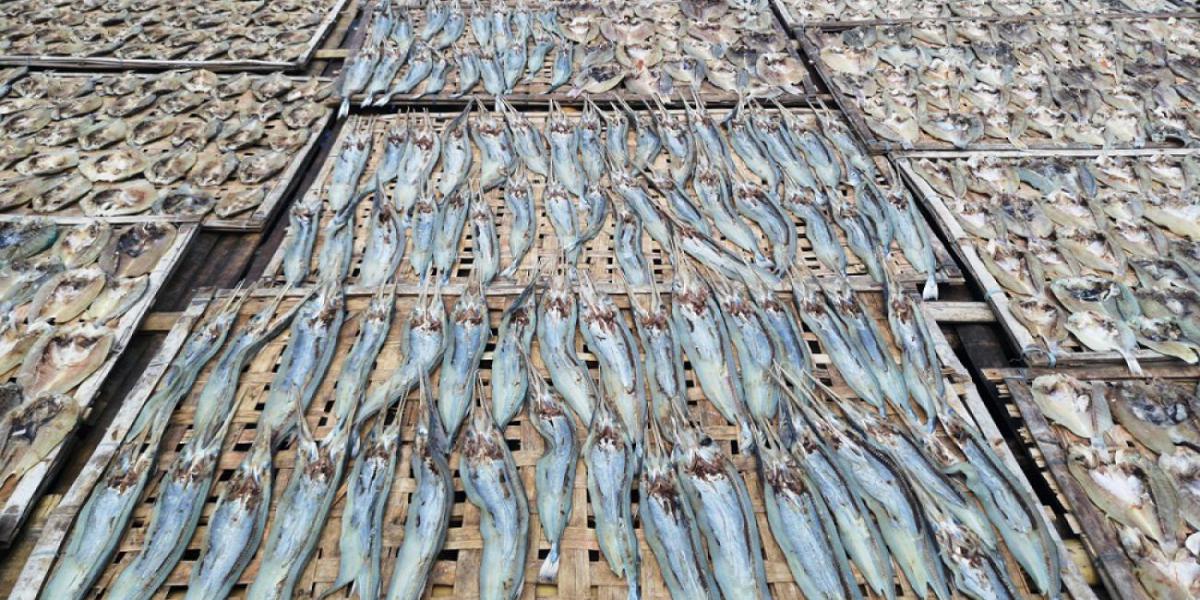
Many fishers in West Africa look for sardinella when they deploy their nets. In Senegal, small pelagic fish like sardinella account for 75 per cent of the population’s fish consumption. Our recent study estimates that in The Gambia, Guinea-Bissau, Mauritania and Senegal fishing for small pelagic fish, including sardinella, generates nearly 200,000 jobs, so it’s not only of cultural importance, it also has implications for food security and the local economy.

Why is sardinella so popular?

Sardinella is an essential source of animal protein in many West African countries. Most of the people in these regions can’t afford beef, lamb or poultry, so tiny sardinella distributed by local fishers and markets are often the most available choice.

Can sardinella be replaced by other fish?

The problem is that sardinella is at the bottom of the food chain. Forty years ago, the most popular fish in Senegal was thiof (white grouper). When the stocks of thiof collapsed, the sardinella population started growing and replaced thiof. But if sardinella stocks are depleted, there won’t be much else to fish.

How can a WTO agreement on fisheries subsidies help solve this problem?

WTO negotiations to discipline harmful fisheries subsidies constitute an opportunity to help put the region’s fisheries on a more sustainable footing.

Our research on sardinella shows clearly that unchecked fisheries subsidies are one of the key factors that have allowed this situation to develop and allow it to persist. The data presented in the study suggests that most of the fleets active in the sardinella fisheries benefit from subsidies, in particular, to cover the costs of fuel and access to other countries’ waters, and that these subsidies appear to play an important role in their profitability.

In other words, most fishing activities targeting sardinella, whether by artisanal or commercial fleets, may not be economically viable without subsidies?

Correct. So if we phase out the subsidies, while allowing for transition, the unsustainable fishing can be controlled.

What will happen next? How will this affect the industry?

It seems likely that the stocks would start to recover. This would, in the long run, increase catch opportunities and revenues for pirogues and vessels remaining in the local industry, who in turn may no longer need subsidies to be economically sustainable. It is, however, important to design a proper transition strategy to protect the most vulnerable.

How can we be sure that reducing subsidies will benefit local fleets, in particular, small-scale fishers?

There is a risk that this solution could have adverse effects on more vulnerable fishers in the short-term, in particular for the small-scale sector. To address this concern, one useful approach could be to apply a subsidy prohibition first to the industrial fleets, which are overwhelmingly foreign-owned and do not bring development benefits to West African societies the same way the small-scale sector does. Such a transition period could allow small-scale fishers to benefit from improved economic conditions as a result of stocks rebuilding, making subsequent reform of subsidies easier.

Is there anything West African countries can do today to prepare for these potential changes to regulations?

They should start assessing how the necessary reforms could be designed and supported in their countries. It’s a good time for improving the monitoring and surveillance of fishing activities. Finding effective control means will be key, but equally important will be supporting fishers through the transition. Governments should start preparing reforms to reorient public funds toward broader forms of support that promote rural development and strengthen basic public services.

Report

Une exploration des impacts potentiels des règles de l'OMC sur les subventions à la pêche : Le cas de la pêcherie de sardinelles en Afrique de l'Ouest

Cette étude de cas examine la manière dont de nouvelles règles de l’Organisation mondiale du commerce sur les subventions à la pêche pourraient concrètement affecter la pêcherie de sardinelles au large des côtes ouest-africaines.

December 3, 2019
  • The West African sardinella fishery suffers from excessive fishing capacity and #overfishing. These challenges negatively affect communities whose livelihoods and food security rely on this resource.

  • A @wto #fisheries subsidies agreement could help improve the environmental and economic situation of the sardinella fishery in West Africa, but should be accompanied by a transition period for small-scale fishers.

Éléments principaux

(English below)

  • La pêcherie de sardinelles dans les eaux de la Gambie, de la Guinée-Bissau, de la Mauritanie et du Sénégal fait face à une situation de surcapacité et les stocks de sardinelles sont surexploités. Ces défis ont un effet négatif sur les communautés ouest-africaines pour qui ces ressources halieutiques constituent un important moyen de subsistance et contribuent à la sécurité alimentaire.
  • Les subventions à la pêche sont l’un des facteurs qui ont contribué à cette situation et lui permettent de perdurer. Cette étude suggère que les flottes artisanales et industrielles actives dans la pêcherie de sardinelles bénéficient pour la plupart de subventions qui ont pour effet d’augmenter leur capacité de pêche, en particulier en diminuant les coûts du carburant et de l’accès aux eaux d’autres pays. Ces subventions semblent jouer un rôle important du point de vue de leur rentabilité.
  • De nouvelles règles de l'OMC sur les subventions à la pêche, associées à une meilleure gestion de la pêche, pourraient contribuer à améliorer la situation environnementale et économique dans cette pêcherie et d’autres pêcheries ouest-africaines. Elles devraient néanmoins s’accompagner d’une période de transition convenable pour la pêche artisanale, afin de se prémunir des impacts sociaux potentiellement négatifs qu’une réforme des subventions pourrait avoir à court terme.
  • Une telle amélioration de la durabilité des activités de pêche revêt une importance fondamentale dans l’optique de la réalisation des Objectifs de développement durable en Afrique de l’Ouest, en particulier dans certaines régions côtières.

Le programme de développement durable à l’horizon 2030 des Nations Unies inclut une cible spécifique concernant la conclusion, d’ici 2020, des négociations de l’OMC en vue de discipliner les subventions à la pêche qui ont des impacts néfastes sur l’environnement. Dans le cadre de ces négociations, de nouvelles règles sont actuellement envisagées dans trois domaines particuliers : (1) les subventions qui contribuent à la pêche illicite, non déclarée et non réglementée, (2) les subventions pour la pêche de stocks de poissons surexploités et (3) les subventions qui contribuent à la surpêche et la surcapacité de manière plus large. Afin de faciliter une meilleure compréhension de la manière dont de nouvelles règles de l’OMC s’appliqueraient en pratique, l’Institut international du développement durable a produit trois études de cas qui explorent les impacts potentiels de telles disciplines dans trois pêcheries se situant dans trois régions différentes.

Cette étude de cas se penche sur la pêcherie de sardinelles dans les eaux de quatre pays ouest-africains (Gambie, Guinée-Bissau, Mauritanie, Sénégal). Elle offre un aperçu de la pêcherie et de sa gestion, examine les subventions dont bénéficient les flottes qui ciblent les sardinelles et évalue de manière qualitative les impacts que différentes règles de l’OMC pourraient avoir sur cette pêcherie. Elle évoque également certaines pistes pour la réforme des subventions à la pêche.


Exploring the Potential Impacts of WTO Fisheries Subsidies Rules: The case of Sardinella in West Africa

Key Messages

  • The sardinella fishery in the waters of the Gambia, Guinea-Bissau, Mauritania and Senegal suffers from a situation of excessive fishing capacity, and sardinella stocks are considered to be overfished. These challenges have adverse consequences for West African communities, whose livelihoods and food security rely on this resource.
  • Fisheries subsidies are one of the key factors that have allowed this situation to develop and still allow it to persist. This study suggests that most of the artisanal and industrial fleets active in the sardinella fishery benefit from capacity-enhancing fisheries subsidies, in particular to cover the costs of fuel and access to other countries’ waters. These subsidies appear to play an important role in their profitability.
  • Meaningful World Trade Organization subsidy prohibitions, alongside better fisheries management, could help to improve the overall environmental and economic situation of the sardinella fishery and other West African fisheries. They should, however, be accompanied by an appropriate transition period for small-scale fishers, in order to mitigate the negative social impacts subsidy reform could have in the short term.
  • Such enhanced sustainability of fishing activities is of fundamental importance for the realization of the UN Sustainable Development Goals in West Africa, especially in certain coastal regions.

The United Nations 2030 Agenda for Sustainable Development includes a specific target (Sustainable Development Goal 14.6) of completing, by 2020, negotiations at the World Trade Organization (WTO) to discipline harmful fisheries subsidies. In the context of these negotiations, new rules are discussed in three specific areas: (1) subsidies that contribute to illegal, unreported and unregulated fishing, (2) subsidies to the fishing of stocks that are already overfished and (3) subsidies that more broadly contribute to overfishing and overcapacity. To help build understanding of how possible subsidy rules might apply in practice, the International Institute for Sustainable Development has produced three case studies to explore the possible impact of such WTO subsidy disciplines in three fisheries in distinct geographical areas.

This case study looks at the sardinella fishery in the waters of four West African countries (The Gambia, Guinea-Bissau, Mauritania and Senegal). It provides an overview of the fishery and its governance, examines the subsidy patterns of fleets targeting sardinella and gives a qualitative assessment of the impact that different possible WTO rules on fisheries subsidies could have in this fishery. It also provides insights about potential pathways for the reform of harmful fisheries subsidies.

Insight

Overfishing Calls for Concrete Actions

Our oceans and fish stocks—and the populations that depend on them—all suffer from the consequences of overfishing. We share a glimpse of the current WTO push to end harmful fisheries subsidies by 2020.

May 29, 2019

Our oceans and fish stocks—and the populations that depend on them—all suffer from the consequences of overfishing.

According to the Food and Agriculture Organization of the United Nations, 33 per cent of the world's assessed fish stocks are considered overexploited, while 60 per cent are exploited at their maximum sustainable level. Perhaps even more worrying, despite a growing global awareness of the problem, the trend is not improving. The share of overexploited stocks is steadily increasing: it has tripled since the 1970s.

Overfishing
The share of overexploited fish stocks has tripled since the 1970s.

In addition to serious environmental impacts, there are social, economic and even cultural costs to this alarming trend. Of course, many fisheries are also well-managed, but as we witness this general decline of the health of fish stocks, the time has come for concrete actions.

Fisheries subsidies are a major contributing factor. By artificially reducing the costs of fishing, capacity- and effort-enhancing fisheries subsidies allow vessels to take ever more fish on longer trips, ever further from land. Unfortunately, the amount of fish in the ocean does not extend in the same way. That is why the International Institute for Sustainable Development (IISD) has chosen to support the current World Trade Organization (WTO) negotiations to effectively discipline harmful fisheries subsidies, in support of Sustainable Development Goal target 14.6. Along with the Pew Charitable Trusts, IISD is delivering analysis and convening support to WTO members to help them reach their goal of an agreement on fisheries subsidies by December 2019.

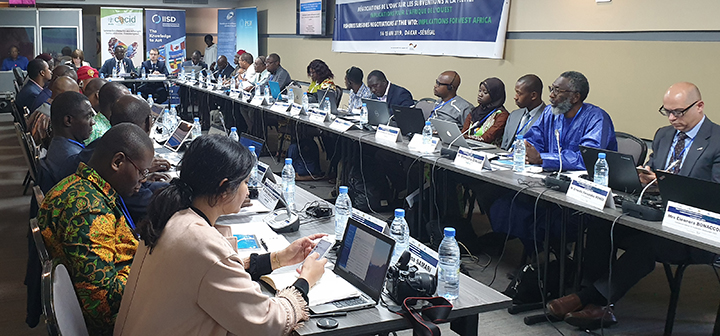
In parallel with activities in Geneva to support and inform the negotiating process more directly, a series of workshops have taken the conversation to the negotiators’ home regions. In a non-negotiating setting, we have brought together policy-makers, experts and stakeholders from academia, the fisheries sector and civil society for an in-depth discussion of WTO fisheries subsidies negotiations. Like the Caribbean and Latin American workshops, our recent session in Senegal on West African issues offered invaluable insights, illustrating the spectrum of concerns these negotiations raise for the region.

Senegal workshop
Policy makers, academics, and fisheries sector and civil society experts gathered in Dakar, Senegal for an in-depth discussion of WTO fisheries subsidies negotiations and their implications for West Africa.

Illegal, unreported and unregulated fishing, overfished stocks, as well as overfishing and overcapacity more broadly all pose real challenges in West Africa. The magnitude of fishing by foreign fleets in West African waters and the fundamental importance of artisanal fishing for people in the region (with a special nuance for women active in the processing sector) highlight both the relevance of WTO negotiations and the variety of issues at play. The event also offered stakeholders two new tools for considering subsidy reform: a draft case study commissioned by IISD on the Sardinella fishery off the coast of West Africa gave participants a real-world model of the possible impacts of new WTO rules, while an interactive toolkit developed by Pew let attendees consider the larger biological and economic implications of prohibitions being negotiated at the WTO.

Throughout the workshop, the message crystalized that something must change because the current situation is not tenable over the long term. The WTO negotiations are a real opportunity to not only rethink industrial and artisanal fisheries subsidies, but to take meaningful action that renews the health of our oceans and supports the livelihoods of the fishing communities and populations who depend on them.

Insight details

NAP Global Network

The National Adaptation Plan (NAP) Global Network supports developing countries to advance their NAP processes to help accelerate climate change adaptation efforts around the world.

The Network was established in 2014 at the 20th session of the Conference of the Parties (COP 20) in Lima, Peru, initiated by adaptation practitioners from 11 developing and developed countries. Today, the NAP Global Network connects over 1,400 participants from more than 150 countries working on national adaptation planning and action, and has delivered direct support to more than 40 countries. Financial support for the Network has been provided by Austria, Canada, Germany, and the United States. IISD hosts the Network's Secretariat.


Our vision is a world where communities and countries—particularly the poorest and most vulnerable—are able to articulate, work toward, and realize their development aspirations in a changing climate. This is possible by having robust adaptation planning processes that are:

  • Aligned with development priorities and plans. 
  • Effective in channelling resources to the people, places and systems that need them most. 


Our mission is to harness the collective knowledge and resources of governments, practitioners, donors, and civil society to build capacities and accelerate the formulation and implementation of NAP processes.