
Mapping the Green Transition in Recent Economic Agreements: The Trade & Climate Tracker
Trade deals are no longer only about tariffs. This article draws data from the IISD Trade & Climate Tracker to show how governments are using trade agreements to cooperate on energy, climate, and critical minerals.
Key Messages
Governments are increasingly using economic agreements to cooperate on the green transition and enhance economic security and growth, as revealed by IISD’s new Trade & Climate Tracker, which analyzed 71 trade and economic deals signed between January 2025 and June 2026.
Of the 46 agreements with published texts:
- 37% of the agreements analyzed, involving 23 parties, include renewable energy provisions—the connective tissue of recent trade deals. This category is not dominated by any single government, but rather the one picked up so consistently by governments that it’s clear renewable energy cooperation is one of the priorities of the global trade agenda.
- Critical minerals cooperation is a strong focus of recent trade deals. Overall, 54% of the deals tracked cover critical minerals (such as lithium, cobalt, copper, and rare earths), which are rapidly becoming a strategic priority for many countries. Most of these agreements are dedicated exclusively to critical minerals, with provisions focused on building value chains in producer countries and on supply chain security partnerships among allies.
- In addition, 59% include broader climate-related provisions, with cooperation on deforestation the single most common climate-related issue, appearing in 24 agreements.
- The United States has been the most active government overall, negotiating 32 out of 71 agreements in the last 18 months, and the majority of its agreements contain critical minerals provisions (17 out of 25 agreements with provisions on Critical Raw Materials (CRMs) in the period analyzed. It has also been most active on energy cooperation (12 out of 31 agreements) and deforestation issues (9 out of 24 agreements).
- The European Union’s (EU’s) agreements have the most provisions linked to emissions reduction (7 out of 19 agreements with available texts), heavy industry decarbonization and circularity (4 out of 5 in each sub-category), while leading on renewable energy cooperation (6 out of 17).
- India is second only to the European Union on renewable energy cooperation (five agreements to the EU’s six) and features prominently as the first country to have EU Carbon Border Adjustment Mechanism-related provisions in its flagship EU–India free trade agreement (FTA).
Why Look for Climate Cooperation in Trade Agreements?
Trade deals are no longer only about tariffs. Despite—or perhaps because of—the fragile state of multilateral climate governance, countries are turning to economic cooperation agreements to strengthen and deepen partnerships that go beyond pure trade cooperation to tackle climate change issues. These deals increasingly incorporate support for each other's green energy transition by securing value chains and enhancing energy cooperation, as well as building the green markets of the future. Governments’ economic priorities increasingly align with the fight against climate change.
This brief presents the first findings from the IISD’s Trade & Climate Tracker (see Figure 1), a new resource that codes recent economic agreements for their green transition content, to show what these deals add up to when read together. IISD’s analysis currently covers 71 binding and non-binding instruments (referred to here collectively as “agreements”) signed between January 2025 and June 2026, and the publicly available texts for 46 of those agreements.
Figure 1. The IISD Trade & Climate Tracker
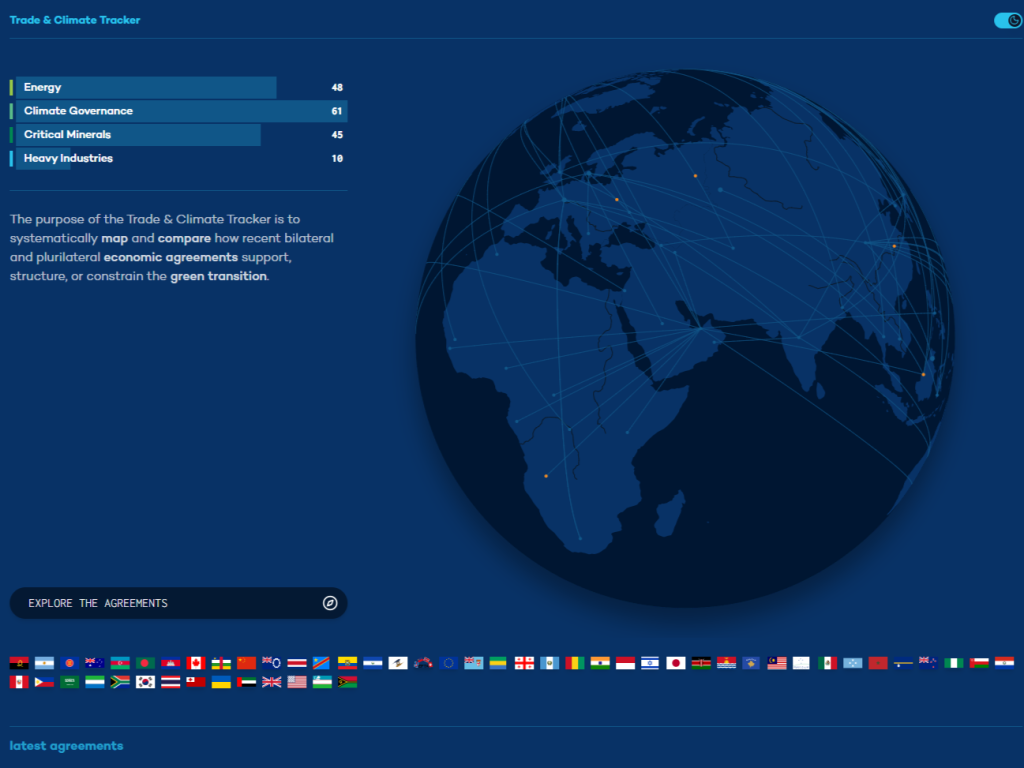
The trade agreements analyzed by the tool were concluded in 2025 and 2026 and include provisions on access to critical minerals, renewable energy cooperation, combating deforestation, and securing supply chains.
A Busy Space in Trade Diplomacy
2025 and 2026 marked a fast-moving period for trade diplomacy, with a total of 71 agreements signed between 66 governments (Figure 2). The spurt was led by the United States, whose negotiators concluded 32 agreements, followed by the United Arab Emirates (14) and the European Union (9).
FTAs have long been the most prominent form of trade partnership between countries and typically include wide-ranging trade liberalization commitments. However, FTAs increasingly feature ambitious provisions on other aspects of economic cooperation. They are taking on a new role as vehicles for cooperation on climate change issues, spanning energy security, deforestation, and critical minerals.
At the same time, newer forms of cooperation, such as CRM memorandums of understanding (MoUs) (16 tracked agreements) and reciprocal trade agreements (8), are emerging. This trend is strongly led by the United States, which is involved in 95% of the CRM-centric agreements tracked. The rise of high-level issue-specific MoUs alongside more traditional FTAs reflects governments’ desire to move quickly to secure access to raw materials or other key inputs, even if at the expense of legally binding commitments; FTAs are, by design, wide-ranging, legally binding treaties, but take years (sometimes decades) to negotiate.
Figure 2. Signatory network in the Trade and Climate Tracker
India-Australia Partnership on Cyber, Critical Technologies and Supply Chains
On July 9, 2026, India and Australia signed a cooperation pact that, among other things, provides for collaboration on the development of secure critical minerals supply chains. Although the pact falls outside the Tracker’s current data set, the fact that critical minerals can be used in both renewable energy and digital technologies suggest governments may be using different kinds of economic agreements to cooperate on the green transition while enhancing economic security.
Green transition provisions are common but unevenly distributed. Energy is the most frequent topic, appearing in 32 texts of the analyzed agreements. Climate-related provisions appear in 27 agreements, CRM provisions in 25, and heavy industry provisions in 8 agreements (Table 1). Notably, CRM provisions are nearly as prevalent as energy and climate cooperation provisions, suggesting that mineral sourcing and security are as important to trade negotiations as energy security and climate cooperation. CRM (critical minerals in particular) are used in both renewable energy technologies and digital products more generally, which means that whatever the motivation for securing their supply, doing so can provide benefits to a country’s renewable energy industry.
Agreements are not necessarily entirely or even prominently presented as being about climate cooperation, even when it features extensively. They might also incorporate provisions on fossil fuels as part of energy security. The trend, however, is that national priorities, whether national security or economic resilience, appear to be pragmatically converging with cooperation over climate and green industrial policies.
Table 1. Green transition provisions in economic agreements
Energy security and cooperation provisions appear in 31 agreements, roughly twice as many as contain renewable energy provisions (17). This is a clear reflection of the period of high energy insecurity that began with COVID-19, continued with the Russian invasion of Ukraine, and has recently escalated due to the conflict between the United States and Iran. This trend suggests that governments are actively using economic agreements to address energy security concerns, with some prioritizing renewable energy within this. The United States signed the most agreements containing energy provisions (12), followed by the European Union (7) and India (5); while on renewable energy specifically, the European Union led with six agreements, followed by India with five (Table 1).
Through climate provisions in their trade agreements, governments often reaffirmed their Paris Agreement commitments, strengthening cooperation on emissions reduction and other joint climate objectives. Among the 27 agreements with climate content, deforestation provisions appear in 24 texts, emissions-related provisions in 19, and other climate cooperation (references to Paris Agreement processes, adaptation, and climate finance) in 18 (Table 1). The United States (9) and the European Union (7) signed the most agreements with climate provisions, and the European Free Trade Association (comprising of Iceland, Liechtenstein, Norway, and Switzerland), are parties to five agreements containing climate provisions.
Agreements on CRM cooperation have focused on strengthening supply chain security (25 agreements) and developing the value chain further downstream (20 agreements) (Table 1). The United States dominates this category of agreements, being a party to 17 of the 25 agreements with CRM provisions, followed by the European Union (7) and Japan (3). The United States’ reciprocal trade agreements, for example, require partners such as Indonesia, Cambodia, and Ecuador to allow and facilitate U.S. investment across the full CRM value chain from exploration to refining and export. At the same time, the European Union’s minerals partnerships with the United States and South Africa cover the whole life cycle, including recycling and local value addition in producer countries.
Heavy industry-related cooperation remains a less developed aspect of economic and trade agreements, but one to watch. So far, governments have focused on joint work on decarbonization and circularity. The European Union stands out as the government prioritizing this agenda, including provisions on decarbonization (four agreements) and circularity (four agreements) across the EU–Mercosur agreement, the EU–India FTA, the EU-Australia FTA, and the EU–South Africa Clean Trade and Investment Partnership, while India is party to two agreements containing heavy industry-related provisions.
Emerging Trends
The value of the Trade & Climate Tracker is not only in aggregate counts. It also makes visible concrete stories about how governments are using economic agreements to cooperate on the green transition.
Why This Matters
As trade and economic agreements are becoming an active part of the governance infrastructure of the green transition, tracking such agreements reveals where governments’ priorities lie. It also enables external scrutiny of what has been agreed, and whether what happens on the ground after the ink has dried matches the negotiators’ carefully crafted language of cooperation.
The Trade & Climate Tracker currently covers 71 agreements on trade and economic cooperation, including 46 agreements with publicly available text, signed between January 1, 2025, and June 30, 2026.
For each agreement, the Tracker records the agreement type, text availability, source, signature date, and signatories. It also includes coded summaries and references for provisions on energy, climate, CRMs, heavy industry, and notable tariff or market access treatment.
The Tracker is a mapping tool. It records what agreements provide for, not whether governments implement those provisions or whether they produce measurable environmental outcomes.
The Tracker is available at https://www.iisd.org/trade-climate-tracker/, and the methodology note is available at https://www.iisd.org/trade-climate-tracker/about.

You might also be interested in
Major trade deals signed since 2025 are actively advancing climate cooperation, new tracker shows
Governments are actively leveraging economic agreements to drive the green transition: climate cooperation is explicitly mentioned in 59% of recent trade agreements whose texts are public. These are among the first findings of the Trade & Climate Tracker, launched today, which maps over 71 trade deals signed since 2025.
The Use of Voluntary Sustainability Standards in Trade Policy
This explainer provides an overview of how voluntary sustainability standards (VSSs) are used in trade policy instruments.
International Trade and Investment Agreements and Sustainable Critical Minerals Supply
This report seeks to assess the current state of play by examining the body of trade and investment agreements.
COP 30: Key issues on trade and climate agenda
Ahead of the UN Climate Change Conference (COP30) in Belém, IISD trade experts explain why trade is at the heart of the climate conversation—and what’s at stake as trade issues land on the COP 30 agenda.