Press release

Canadian Youth Head to Bali for World's Largest Water Forum

May 9, 2024

Government officials, heads of state, scholars, and international organizations are gathering in Bali this month for the 10th annual World Water Forum—and will be joined by two Canadian youths.

These young academics will convene with global water experts to share ideas and research on how water resources can be made available to everyone.

Emily Kroft is an award-winning Youth Engagement and Water Policy Officer. She runs the IISD Next program, which includes a campus workshop series on sustainability that is attended virtually by hundreds of students all over the world. Emily will share research from the IISD Experimental Lakes Area in two separate presentations at the event.

“Water sustainability and freshwater policy are pressing global issues right now,” says Emily. “With the impacts of climate change, water policy work and research are more important than ever. We need to think both regionally and internationally when it comes to solutions.”

One of the IISD Next students, Alyssa D’Addio, is joining Emily at the World Water Forum, where she will be attending the World Youth Parliament for Water General Assembly. Travelling this weekend to Bali from Mississauga, she's excited to join other youth from around the world to discuss water policy and protecting freshwater resources.

“I’m hoping to learn more about community-driven solutions being mobilized to address issues like water scarcity, pollution, and conservation,” says Alyssa. “I’m especially eager to deepen my understanding of complex issues prevalent in different socio-political contexts, such as how water challenges give rise to and intensify conflicts and insecurity.”

Alyssa credits the IISD Next workshop series for helping her learn more about global issues surrounding water and how science can form a basis for policy-level decision making about freshwater resources. IISD Next is made possible in part thanks to Wawanesa Insurance, who is also sponsoring this student’s attendance at the forum.

Media Contact

Brittney Le Blanc, Communications Officer, Water, IISD: [email protected]

More about IISD Next

IISD Next is an initiative that works with hundreds of students and youth advocates all over the world to ensure the next generation of leaders has an in-depth understanding of policy topics related to sustainable development, along with the tools they need to engage with various levels of governance. The workshop series provides training and insight into how youth can more effectively engage with government policy and work toward concrete change, as well as deep dives into the United Nations 2030 Agenda for Sustainable Development and its 17 Sustainable Development Goals, among other crucial climate issues.
Press release details

Topic
Water
Region
Canada
Press release

Innovative Approaches to Canadian Municipal Infrastructure Celebrated by International Think Tank

May 8, 2024

Three municipalities within Canada are being recognized as leaders when it comes to innovative approaches to natural infrastructure benefiting the municipality, the environment, and providing many economic advantages.

A new report released by the International Institute for Sustainable Development (IISD), a think tank headquartered in Winnipeg, MB, recognizes that the City of Nelson, British Columbia; the Halifax Regional Municipality, and EPCOR in the City of Edmonton, are taking the lead on working with nature to help meet infrastructure needs. The three are highlighted in the report as models for other cities, showcasing effective policy changes in different administrative, jurisdictional, and geographic settings.

Climate change will strain existing municipal infrastructure that provides the services we all need—flood and drought protection, drinking water, and wastewater treatment. Typically, these services rely on grey infrastructure such as dams, pipes, and treatment facilities. However, some municipalities are leading the way forward by complementing the above with natural infrastructure such as wetlands, trees, grasslands, and rain gardens to enhance service delivery.

When compared to large urban centres that tend to have greater staff capacity, the City of Nelson is successfully implementing natural infrastructure, regardless of limitations. With strategic bylaws, such as The Subdivision and Development Servicing Bylaw, the city is promoting the use of natural infrastructure approaches—including rain gardens, bioretention swales, and constructed wetlands—for improved stormwater management.

The Halifax Regional Municipality embeds natural infrastructure across its suite of policy and planning mechanisms, trickling into lower-level plans like HalifACT. This climate change plan specifies the need to “protect, restore, maintain, and expand natural areas and green infrastructure assets.”

Guided by HalifACT and with funding for the Natural Infrastructure Fund, 555 metres of cobble beach will be restored with native vegetation, a breakwater, and a raised permeable waterfront trail along Shore Road. With the use of natural infrastructure, the area will be more resilient to extreme weather, reducing severe erosion, road washouts, and closures.

EPCOR, based in the City of Edmonton, takes an integrated approach to stormwater management, with approximately 59% of a CAD 1.6 billion investment going toward natural infrastructure over 30 years. That’s a huge savings for the City of Edmonton when compared to exclusively using grey infrastructure. The previous plan, which relied on grey infrastructure, was estimated to cost between CAD 2.2 billion and CAD 4.6 billion over 80 years and was less effective at reducing flood risk.

By partnering with the City of Edmonton to share the cost, operation, and maintenance of natural infrastructure, EPCOR is leading the way in normalizing natural infrastructure by increasing knowledge, on-the-ground projects, and skilled professionals.

Natural infrastructure can help provide essential water infrastructure services at a fraction of the cost of grey infrastructure, helping municipalities meet important water-related needs while working alongside nature.

“The featured jurisdictions in our report show that regardless of size, municipalities can develop solutions and successfully work with nature to meet infrastructure needs,” says Ashley Rawluk, co-author of the report and policy advisor with IISD’s Water Program and Natural Infrastructure for Water Solutions (NIWS) initiative. “These solutions infrastructure benefits, but also can benefit communities in other social, economic, and environmental ways. These are three bright spots in Canada which we hope will inspire others.”

The full report, as well as a summary, can be found here.

More on the Natural Infrastructure for Water Solutions Initiative

IISD has launched the NIWS initiative to better support the implementation of natural infrastructure on Canada’s Prairies—for cleaner water and more resilient communities. Natural infrastructure allows us to plan and work with nature to help meet infrastructure needs. NIWS hopes to take the idea of natural infrastructure from novel to normal, championing water infrastructure solutions in rural communities, cities, and government planning processes.

Press release details

Press release

CSDDD: EU's due diligence law vote should drive supply chain sustainability efforts

April 24, 2024

April 24 – The European Parliament has today voted to adopt the Corporate Sustainability Due Diligence Directive (CSDDD), following months of negotiations between the European Union (EU) institutions and member states.

“Ensuring that corporations take responsibility for preventing and managing the environmental, labour, and human rights impacts of their supply chains is key to global sustainable development efforts. The adoption of the CSDDD is a step in the right direction”, Suzy H. Nikièma, Director of Investment at the International Institute for Sustainable Development (IISD) said.

“However, the watered-down nature of the final directive compared to the original proposal is concerning. Now, only companies with more than 1,000 employees and a net turnover of over EUR 450 million EUR annually are within the scope of the rules, compared to 250 employees and a net turnover of EUR 40 million as the threshold for high-impact sectors in the original text.

Due diligence initiatives, such as the CSDDD, will only truly deliver their promised sustainability benefits if they address the unique needs of the suppliers in the countries where most of these requirements will be applied. If we get the implementation right, due diligence regulations should help generate genuine responsible investment in developing countries.

European policy-makers must now focus on providing the technical support and resources necessary for local suppliers in developing countries to comply, which includes making sure that the large international companies in scope of the CSDDD take their share of the responsibility for this crucial work.”

Media Contacts

Suzy H. Nikièma, Director of Investment, IISD: [email protected]
Isaak Bowers, Communications Officer, Investment, IISD: [email protected]
 

Press release

IISD: EU’s historic Energy Charter Treaty vote will boost energy transition

April 24, 2024

April 24 – The European Parliament has today voted for a historic withdrawal of the European Union (EU) from the Energy Charter Treaty (ECT).

The vote follows almost 10 months of negotiations after the European Commission’s original proposal for an EU departure from the ECT, during which Germany, France, and Poland have formally left the treaty and a growing number of EU member states, as well as the United Kingdom, have announced their future exits.

“This is a historic vote from the European Parliament. It delivers a boost for Europe’s green energy transition and a reminder for policymakers that all international investment treaties must align with the Paris Agreement,” Lukas Schaugg, international law analyst at the International Institute for Sustainable Development (IISD) said.

“Fossil fuel investors have used the ECT to challenge government climate measures through investorstate dispute settlement (ISDS) more frequently than any other investment treaty. With its vote for the EU to leave the ECT, the European Parliament underlines that granting fossil fuel companies privileged access to ISDS is fundamentally incompatible with climate mitigation.

With this step, the EU follows a broader trend away from the old model of unlimited and unsustainable investor privileges, as states are moving away from outdated investment treaties more frequently than ever before.

In line with their ambition to lead the global green transition, the EU and its member states now have a unique opportunity to use the momentum of this progress to show the same level of climate ambition with all of their international investment agreements. The EU must work to remove ISDS privileges still granted to thousands of fossil fuel investors worldwide in more than 800 outdated investment treaties between EU member states and other countries.”

Media Contacts

Lukas Schaugg, International Law Analyst, IISD: [email protected] 
Isaak Bowers, Communications Officer, Investment, IISD: [email protected]

Press release

Ecuador Referendum Rules Out ISDS Return, Underlining Public Support for a Sustainable Path

April 22, 2024

In a referendum on Sunday, April 21, the citizens of Ecuador emphatically voted to keep Article 422 of the country’s 2008 constitution, which prevents Ecuador from using international arbitration to settle disputes between Ecuador and foreign investors or private individuals in international treaties or instruments.

The result of the referendum underscores Ecuador’s strategy, which was developed in response to its negative experience with investment arbitration and investor–state dispute settlement (ISDS). This increasingly criticized mechanism, which allows foreign investors to sue states in international arbitration, has repeatedly been found to hinder states’ climate policies, social justice action, and right to regulate.

Ecuador has been on the receiving end of several costly compensation awards by ISDS tribunals in favour of investors. For example, in 2012, a tribunal ordered Ecuador to pay the U.S. oil company Occidental over USD 1.5 billion, one of the largest amounts a state had ever been ordered to pay. Ecuador argued that the amount of the award represented almost 9% of Ecuador’s 2012 annual budget, 59% of its annual education budget, and 135% of the country’s annual healthcare budget.

This settlement led Ecuador to exit the International Centre for Settlement of Investment Disputes Convention—the world’s primary institution managing disputes between states and foreign investors—and terminate its bilateral investment treaties with other states.

The risks that led Ecuador to turn away from ISDS over a decade ago have only become more acute, with damage awards reaching multiple billions of USD. These risks are especially acute in mining, oil, and gas, as these sectors have been frequent users of ISDS and involved in exorbitant awards. These sectors remain important sectors in Ecuador and receive significant foreign investment. The issue of inflated compensation in ISDS tribunals is yet to be solved—it is part of the ongoing discussions at the United Nations Commission on International Trade Law on ISDS reform.

The outcome of the referendum clearly demonstrates strong public support for Ecuador’s cautious and balanced approach to ISDS, grounded in its own painful history with this deeply flawed and outdated tool.

The citizens of Ecuador have signaled to policy-makers in the country and the region that ISDS is not a necessity and that if the country chooses to conclude bilateral investment treaties or investment chapters within free trade agreements, they will have to provide adequate protection for the environment, local communities, and climate action.

Media Contact

Suzy H. Nikièma, Director of Investment, IISD: [email protected] 

Florencia Sarmiento, Policy Advisor, IISD: [email protected]

Isaak Bowers, Communications Officer, IISD: [email protected]
 

Press release

G20 Finance Ministerials and World Bank/IMF Spring Meetings: Expert comment

High on the agenda is the need to mobilize trillions of dollars of investment in the transition to clean energy.

April 17, 2024

April 16, 2024 — Finance ministers and central bank governors of the G20 major economies are meeting in Washington on Thursday on the sidelines of World Bank and IMF spring meetings. High on the agenda for these events is the need to mobilize trillions of dollars of investment in the transition to clean energy.

“Following the historic outcome at COP 28 to transition away from fossil fuels, triple renewables, and double energy efficiency, we need investment to match,” says Farooq Ullah, senior policy advisor at the International Institute for Sustainable Development. “G20 finance ministers need to show leadership and lay the groundwork for an ambitious new climate finance package.”

IISD experts are available to comment on how fiscal reform, reform of multilateral development banks, and engagement with national oil companies can move the needle.

Fiscal reform

In 2009, the G20 governments agreed "to phase out and rationalize over the medium term inefficient fossil fuel subsidies while providing targeted support for the poorest." They have not done so. Indeed, the latest complete data set shows public financial support for fossil fuels at a record high, both in the G20 and globally.

"We’re seeing hundreds of billions of dollars still being poured every year into fossil fuel subsidies, financing, and investments by state-owned energy companies," says Tara Laan, senior associate at IISD. "Instead, these funds could be used to support vulnerable consumers and businesses in other ways and to bridge the funding gap for tripling renewable energy."

Removing fossil fuel subsidies and increasing environmental taxation can raise revenues for poverty alleviation, development, and the energy transition, IISD experts say. Countries urgently need to re-align their fiscal policies with a low-carbon and equitable future. Initiatives such as the taskforce for international taxation for climate action and sustainable development can guide countries on how best to raise funds while sending signals to consumers and investors to change their behaviour.

Multilateral development bank reform

At the last G20 summit, leaders agreed to triple global renewable energy capacity by 2030 and achieve global net-zero emissions by mid-century. Achieving these goals will require a substantial scaling up of investment and climate finance, IISD experts warn. Multilateral development banks (MDBs) like the World Bank have a key role to play in closing the finance gap.

"G20 countries, as major shareholders in the MDBs, can accelerate the investment in clean energy the world needs," says Paola Yanguas-Parra, policy advisor at IISD. "There is no time to lose."

They can start by redirecting finance away from all fossil fuels. While the major MDBs have stopped funding coal projects, most still back gas as a 'transition' fuel, or finance oil and gas through intermediaries. There is no room for any new fossil fuels under a 1.5°C warming limit.

There is an urgent need for investment in clean energy systems in developing economies, particularly in Africa. Initiatives like the Clean Energy Transition Partnership can help to target support where it has the most impact.

National oil companies

At the last UN climate summit, COP 28, governments agreed to transition away from burning coal, oil, and gas for energy. Yet many national oil companies (NOCs), including in the G20, are planning to expand production. NOCs have control over two thirds of global hydrocarbon reserves.

"Support for oil producing countries taking bold steps to transform their economies is a blind spot of discussions around climate finance," says Yanguas-Parra. "But this will be key to enable a global transition away from fossil fuels."

MDBs should engage with NOCs and their host governments to align their plans with the Paris Agreement. They can provide fiscal and regulatory assistance to plan and implement the transition. For those countries leading the way in reducing their economic dependence on oil and gas production, MDBs need to create targeted finance lines. MDBs can also help with strategies to keep countries creditworthy while they cut oil and gas production.

Notes to editors:

  1. Leaders’ Statement at the 2009 Pittsburgh summit
  2. Fanning the Flames: G20 provides record financial support for fossil fuels
  3. Burning Billions: Global government support for fossil fuels topped $1.7bn in 2022
  4. European Climate Foundation press release on launch of taxation task force
  5. G20 New Delhi Leaders’ Declaration
  6. Navigating Energy Transitions: Mapping the road to 1.5°C
  7. Assessing National Oil Companies' Transition Plans: An essential tool for banks, investors, and regulators

For more information or to request an interview, contact:

Megan Darby, Senior Communications Officer, IISD (London): [email protected]
Tara Laan, Senior Associate, IISD (Melbourne): [email protected] 

Press release

Experts Call on G7 to Get Serious on Fossil Fuel Subsidy Reform

Rich countries are wasting billions of dollars on coal, oil, and gas industries, as G7 deadline looms.

April 16, 2024

April 16, 2024 — At a press conference in Rome on Tuesday, Italian Minister of the Environment and Energy Security Gilberto Pichetto Fratin set out the agenda for G7 climate, energy, and environment ministerial meetings April 28-30.

"In continuity with the commitments undertaken in the G7 and G20 spheres, the Italian Presidency will be consolidating the initiatives already underway and focusing on targeted, joint actions geared to concreteness," said Minister Pichetto Fratin. "We want to give a strong push to the development of renewables and broaden our horizons to all sources that, with scientific support, can guarantee us energy security, contributing to the achievement of environmental objectives."

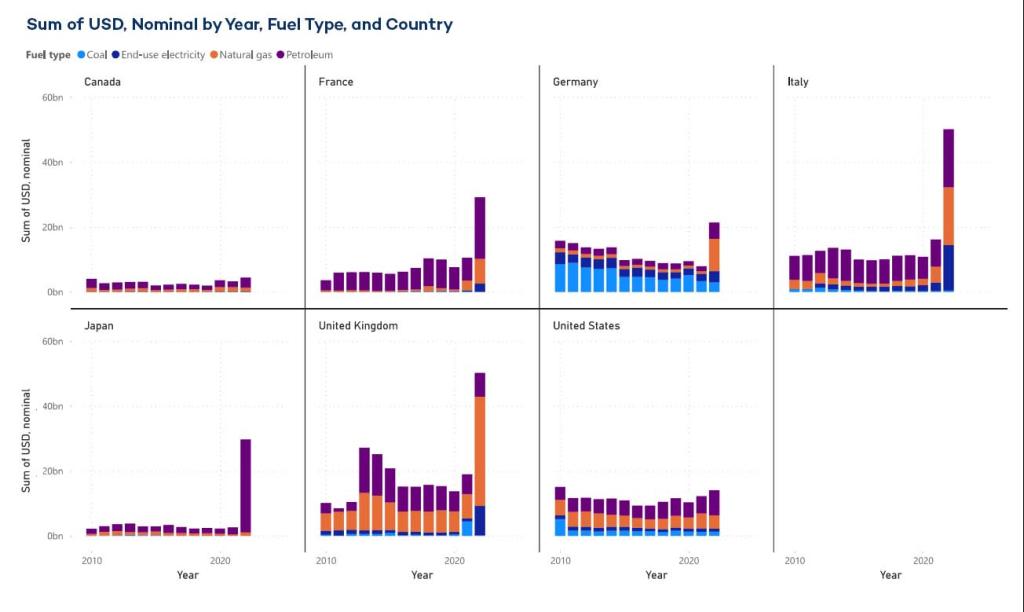
This must include action to tackle persistent public financial support to coal, oil, and gas, say experts at the International Institute for Sustainable Development. G7 countries have committed every year since 2009 to eliminate “inefficient” fossil fuel subsidies. In 2016, they added a deadline: by 2025. Yet, without a serious focus on fossil fuel subsidy reform at G7 ministerial meetings on April 28–30, the bloc will miss this target. For the latest year full data are available, 2022, fossil fuel subsidies across G7 countries hit an all-time high of USD 199.1 billion. This followed a global trend, as oil and gas prices spiked after Russia invaded Ukraine, and governments moved to shield consumers from bill hikes.

Graph showing sum of USD, nominal by year, fuel type, and country
Source: Fossil Fuel Subsidy Tracker

Support for clean energy must, therefore, be coupled with moving away from coal, oil, and gas, IISD experts say. Countries agreed at COP 28 in Dubai in December to transition away from fossil fuels. Scenario analysis shows there is no room for new coal, oil, or gas under a 1.5°C global warming limit.

“The surest path to energy security is to reduce exposure to volatile fossil fuel markets,” says Farooq Ullah, senior policy advisor at IISD. “G7 governments need to stop throwing money at climate-polluting sectors and mobilize investment to scale up clean energy systems.”

G7 communiques to date include the caveat that governments need only eliminate “inefficient” fossil fuel subsidies. This has never been defined. The ambiguity allows governments to claim they are complying with the commitment while continuing to put money into the pockets of the coal, oil, and gas industries. IISD is calling on the G7 to tighten up the language and change the defaults.

“At this month’s G7 meetings, ministers need to close the loopholes and show they are serious about tackling fossil fuel subsidies,” says Jonas Kuehl, policy analyst at IISD. “Any exceptions to the rule need to be clearly justified and temporary while alternative non-fossil subsidy solutions are developed.”

Notes to editors:

  1. Webcast of press conference
  2. Burning Billions: Record public money for fossil fuels impeding climate action
  3. Navigating Energy Transitions

Media Contact

Megan Darby, senior communications officer, IISD: [email protected]

Press release

South African Fossil Fuel Subsidies Hit Record Highs as Country's Energy Crisis Deepens

April 10, 2024

April 10 2024, Cape Town—South Africa's fossil fuel subsidies tripled between 2018 and 2023, hitting ZAR 118 billion (USD 7.5 billion), up from ZAR 39 billion (USD 2.9 billion) 5 years earlier, a new report by the International Institute for Sustainable Development (IISD) reveals. 

The increase was largely driven by the global energy crisis, with consumer subsidies rising to reflect higher prices for oil, gas, and coal following Russia's invasion of Ukraine, according to the report Blackouts and Backsliding: Energy Subsidies in South Africa 2023. 

The increases came as global fossil fuel subsidies hit a record high of USD 1.5 trillion in 2022, with governments around the world scrambling to respond to the energy crisis. 

The largest share of fossil fuel subsidies in South Africa in 2023 went to oil and gas consumption, carbon tax exemptions, and the electricity sector. 

Fossil fuels provided 91% of South Africa’s total energy supply in 2021, compared to 80% globally. Coal dominates the electricity sector, accounting for 86% of all generation, while wind and solar make up just 6%. This is despite the fact that the average cost of renewable energy installation bids in South Africa has decreased by more than 77% since 2011.

But while fossil fuel subsidies have increased, the country's creaking electricity system is deteriorating rapidly, with rolling blackouts (known as load shedding) reaching record levels in 2023. The country experienced outages on 335 of 365 days of the year, taking a significant toll on the economy.

Core issues include a lack of investment in new generation and in the grid by the government and Eskom, the heavily indebted state-owned utility, the report said. 

"Soaring fossil fuel subsidies in South Africa mean the country is still locked into dependence on economically volatile fuels, with ill-targeted consumer subsidies failing to protect the poorest families," said Anna Geddes, co-author of the report and associate consultant at IISD.

She added: "Carbon tax exemptions for big emitters like Eskom, as well as current plans to expand gas-generated power, are undermining South Africa’s commitments to shift away from fossil fuels. Government support should send a clear signal to investors and the market, and therefore be consistent with climate targets and social priorities, such as ending load shedding and ensuring access to energy for all.”

South Africa committed to phasing out inefficient fossil fuel subsidies as a member of the G20 in 2009 and, more recently, as part of the COP 28 agreement, to tripling the world’s installed renewable capacity to 11,000 GW by 2030 and to transitioning “away from fossil fuels in energy systems in a just, orderly and equitable manner…to achieve net zero by 2050.”

Despite these commitments, the South African government’s latest draft Integrated Resource Plan 2023 outlines a future energy system increasingly dependent on gas, potentially at the expense of renewables.

Geddes added: “Worsening blackouts are taking a heavy social and economic toll on South Africa. Expanding subsidies for economically volatile fossil fuels will ultimately increase the risks South Africans face and fail to address long-term energy security concerns.

“In a world increasingly united in bringing an end to fossil fuel dependency, South Africa must set its sights higher or risk being left in the dark.” 

Media Contacts:

Anna Geddes, Associate Consultant: Energy—[email protected]
Harry Cockburn, Communications Consultant: Energy—[email protected]
 

Press release

Copenhagen Climate Ministerial: Expert comment

Leaders need to halt fossil fuel development and plan for an equitable phase-out, IISD experts say.

March 19, 2024

March 19, 2024—Around 40 climate leaders and ministers are meeting in Copenhagen from March 21 to 22 to discuss priorities for this year’s UN Climate Change Conference (COP 29). The president of COP 28, Sultan Al Jaber, will co-chair the meeting with COP 29 president-designate Mukhtar Babayev and Danish host Dan Jørgensen. International Institute for Sustainable Development (IISD) energy experts are following this event and are available to comment.

Fossil fuel phase-out

At COP 28 last December, governments agreed to transition away from burning coal, oil, and gas for energy.

“The first step in transitioning away from fossil fuels is to stop opening new oilfields, gas fields, coal mines, fossil power plants, or other infrastructure,” says Greg Muttitt, Senior Associate at IISD. “The science is clear that limiting warming to 1.5°C leaves no room for new fossil fuel projects to be built. When you are in a hole, stop digging.”

Governments are due to deliver a new round of national climate plans (nationally determined contributions) in 2025. This is an opportunity to build on emissions targets with measures to curb fossil fuel production.

“This ministerial is a moment to explore what a fair and orderly transition away from fossil fuels looks like in practice for each country and its climate targets,” says Paola Yanguas, Policy Advisor at IISD. “Setting transition milestones such as peak and phase-out dates, for example, will give workers, companies, and communities the security to plan. A goal without a plan is just a dream.”

The International Energy Agency forecasts that demand for all fossil fuels will peak by 2030, even with no new climate policies.

Vance Culbert, Senior Policy Advisor at IISD, advises: “Curbing oil and gas production is not just the right thing to do, it’s the smart thing to do. Leaders need to mobilize investment in the industries of the future, not the past.”

The 2023 report The Production Gap found that governments are collectively planning to produce more than twice as much oil and gas in 2030 as the 1.5°C carbon budget allows. IISD analysis shows there is no room for new fossil fuel development under a 1.5°C global warming limit. Oil and gas production falls by at least 65% globally from 2020 to 2050 in credible 1.5°C-aligned scenarios. The Civil Society Equity Review calls on wealthy countries with low economic dependence on fossil fuels to phase out fastest and provide support to poorer countries for their transition.

Scaling up clean energy

In another groundbreaking agreement at COP 28, countries agreed to triple global renewable energy capacity and double energy efficiency this decade. While many clean technologies are competitive without subsidies, targeted government support is needed to accelerate deployment.

According to Tara Laan, Senior Associate at IISD, “Public financial support is critical to ensure that the energy transition is fast and equitable: we need to crowd in private investment, particularly in lower-income countries and for technologies that are not yet commercially viable.”

Delivering finance

Looking ahead to COP 29, governments are set to negotiate a New Quantified Collective Goal for climate finance. Developing countries are calling for USD 1 trillion a year to support their climate plans. Rich countries were late to deliver on their previous USD 100 billion commitment from overseas development aid. Other sources of finance, such as taxation and fossil fuel subsidy reform, are on the table to bridge the gap. In 2022, public financial support for fossil fuels hit a record high of USD 1.7 trillion globally, according to IISD research.

“The finance battle looms large ahead of COP 29,” says Farooq Ullah, Senior Policy Advisor at IISD. “To meet this challenge, governments must now look at all forms of resource mobilization, including the domestic reform of public finances and leveraging private finance, as well as redirecting all harmful finance in line with the Paris Agreement.”

Notes to editors:

  1. Press release about the ministerial from the Danish government
  2. IEA World Energy Outlook 2023
  3. The Production Gap 2023
  4. Navigating Energy Transitions report on 1.5°C scenarios
  5. An Equitable Phase Out of Fossil Fuel Extraction
  6. Burning Billions report on fossil fuel subsidies

Media Contacts

Greg Muttitt, Senior Associate, IISD: [email protected]
Paola Yanguas, Policy Advisor, IISD: [email protected]
Vance Culbert, Senior Policy Advisor, IISD: [email protected]
Tara Laan, Senior Associate, IISD: [email protected]
Farooq Ullah, Senior Policy Advisor, IISD: [email protected] 
Megan Darby, Senior Communications Officer, IISD: [email protected]

Press release

India Faces Clean Energy Challenges as Energy Demand Soars and Global Fossil Fuel Subsidies Rise

March 11, 2024

March 12, 2024, New Delhi—The 2022 global energy crisis, together with India’s growing energy demand, has led the country to adopt a hybrid approach, expanding all forms of supply in 2023. This approach has pushed India’s total energy subsidies to a 9-year high of INR 3.2 lakh crore (USD 39.3 billion) for the fiscal year ending 2023 (FY 2023), new research suggests.

In recent years, India has positioned itself as an international climate leader, steering the G20 under its presidency to call for global renewable energy capacity to triple by 2030 while also funding decarbonization measures to decouple the fast-growing economy from greenhouse gas emissions and reach net-zero targets.

However, clean energy subsidies accounted for less than 10% of total energy subsidies in FY 2023, while coal, oil, and gas subsidies contributed around 40%. The majority of the remaining subsidies were for electricity consumption, particularly in agriculture.

In 2023, like many countries, rising energy demands and the impact of the international energy price crisis following Russia’s invasion of Ukraine led India to put several measures in place that significantly increased support for fossil fuels. With an aim to protect low-income households, India responded to peaking fossil fuel prices in 2022/2023 by capping retail prices of petrol, diesel, and domestic liquefied petroleum gas; cutting taxes; providing direct budgetary transfers to businesses and consumers; and supporting existing energy supplies. As a result, oil and gas subsidies rose by 63% in FY 2023 compared to FY 2022, according to a report by the International Institute for Sustainable Development (IISD).

The report, titled Mapping India's Energy Policy: A Decade in Action, reveals that subsidies for coal also rose by 17% over the same period. The latest figures from the International Energy Agency also show that coal accounts for 45% of India’s total primary energy supply in 2022, up from 43% in 2020. Altogether, fossil fuel subsidies were five times greater than clean energy subsidies.

Rapid economic growth, on course to drive India to become a USD 5 trillion economy by 2027, means that the government is investing in all forms of energy supply. In FY 2023, both clean energy and fossil fuel subsidies grew by around 40%.
“While fossil fuel subsidies have reduced by 59% since their peak in 2013/2014, without further targeting and a return to a market-based pricing regime, they could mount again, resulting in budgetary impacts. This is undesirable, as untargeted fossil fuel subsidies are an inefficient way of supporting low-income households, and they shrink the fiscal space available for supporting clean energy technologies," said co-author of the report Swasti Raizada, Policy Advisor at IISD.

“The current approach not only perpetuates dependence on price-volatile and geopolitically risky fossil fuels but also delays India’s own clean energy goals for 2030. Clean energy solutions can instead deliver sustainable economic growth and reinstate India’s global climate leadership as an agenda-setting country with a practical vision for eliminating pollution and meeting essential climate goals.”

The report also recommends that the government could consider earmarking a portion of its fossil fuel tax revenues to support its emerging just transition needs.

Deepak Sharma, Policy Analyst at the IISD, said: “Previous studies show that India will require significant investment to make its energy transition just, sustainable, and inclusive. India’s state-owned enterprises will be a critical part of this shift. As their majority shareholder, the government should ensure that all fresh capital going to these entities is linked to India’s net zero commitments.”

Media Contacts:

Swasti Raizada (IISD) – [email protected]
Harry Cockburn (IISD)– [email protected]

Press release details