
A Scan of Natural Infrastructure Approaches
Bright spots from the City of Nelson, Halifax Region Municipality, and EPCOR
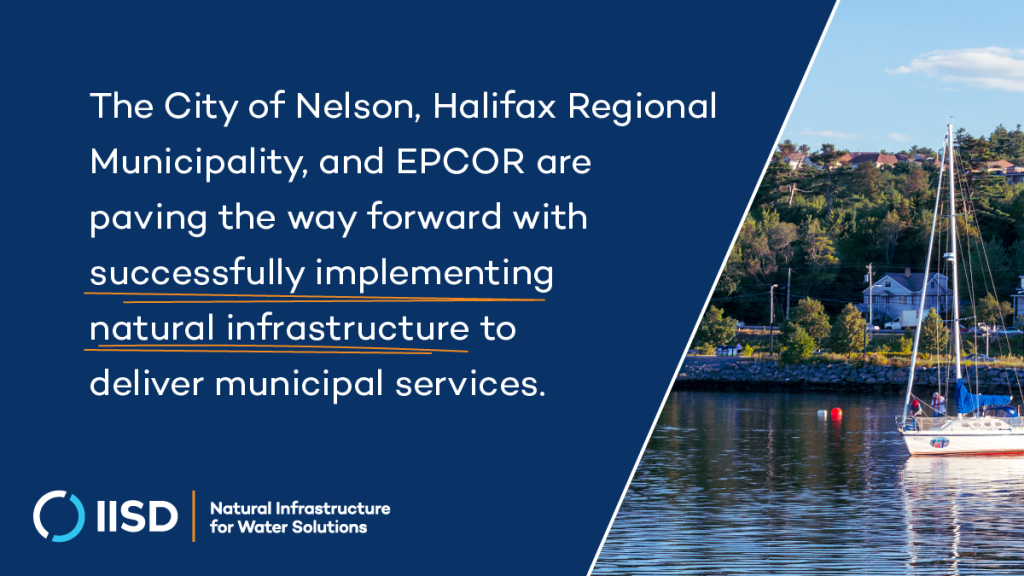
This report looks at successful natural infrastructure implementation to deliver municipal services in Canadian municipalities, Identifying how Edmonton, Alberta; Nelson, British Columbia; and the Halifax Regional Municipality, Nova Scotia are paving the way.
-
Natural infrastructure, like wetlands, can complement existing grey infrastructure to enhance the delivery of municipal services.
-
Regardless of size, jurisdictions in Canada are successfully implementing natural infrastructure—through policy and planning changes, collaborating across departments and with partner organizations, and more.
-
Each jurisdiction is different and needs to develop solutions that align with its own municipal processes.
Local governments play a crucial role in providing essential services to residents, such as drinking water, wastewater treatment, stormwater management, flood protection, and rural drainage. Traditionally, these services rely on grey infrastructure, like dams, pipes, and treatment facilities. However, there is a growing interest in using natural infrastructure to complement these services, especially in response to the increasing challenges posed by climate change.
Several jurisdictions in Canada, including the City of Nelson, Halifax Regional Municipality, and EPCOR, based in Edmonton, Alberta, are taking the lead on successful natural infrastructure implementation. These cases serve as models for others, showcasing effective policy changes in different administrative, jurisdictional, and geographic settings.
Participating experts
Funded by
You might also be interested in
Summary Report | Natural Solutions for Water Security: Canada’s policy path forward
Summary of Natural Solutions for Water Security: Canada’s Policy Path Forward, highlighting key opportunities and an emerging action agenda to scale natural infrastructure.
Optimizing Water Retention to Reduce Algal Blooms in Canadian Lakes
Five years of monitoring and modelling data are used to show how water retention projects can be better designed to improve phosphorus reduction.
From Theory to Practice
This briefing note presents two practical ways that conservation practitioners and managers of implementing nature-based solutions interventions can strengthen their monitoring, evaluation, and learning systems, with a focus on qualitative data to measure social outcomes.
Climate Risk Profile: Greater Virunga Landscape
A climate risk profile for the Greater Virunga Landscape examining the observed and projected climate hazards, impacts on ecosystems, biodiversity, and livelihoods, and potential nature-based solutions for adaptation.