Insight

In Adapting to Climate Change in Canada, We Overlook Governance at Our Peril

As the weather cools, media attention on the need to prepare for climate change in Canada is waning as well. However, the federal government must remain committed to ensuring climate change adaptation actions and investments are taken forward.

September 29, 2025

Once again, many Canadians spent this summer seeking relief from excessive heat and humidity, being displaced by wildfires, or worrying about the risk of flash flooding and hail. As the impacts of climate change increasingly intrude into our daily lives, taking steps to reduce near- and long-term climate risks becomes more urgent. 

Canada does have a strategy to help us anticipate and manage the consequences of climate change. Canada’s National Adaptation Strategy (NAS), released in 2023, outlines a whole-of-society approach to safeguarding communities and preparing our economies to cope with worsening climate risks. Its release was a significant milestone in Canada’s efforts to prepare for climate change. It brought Canada in line with other Organisation for Economic Co-operation and Development countries (at last), and we demonstrated global leadership by including concrete targets and putting equity and environmental justice at the strategy’s core. 

Unfortunately, as highlighted in a report by the Commissioner of the Environment and Sustainable Development (CESD) released in June, the design and implementation of the strategy have significant weaknesses. 

In his report, Commissioner Jerry DeMarco drew attention to a disconnect between the most critical climate risks facing the country, such as the health impacts of wildfire smoke, and the objectives and targets of the NAS, pointing out that there is no formal system to regularly (re)assess these risks and update the strategy. 

The report also highlighted gaps for measuring progress, monitoring effectiveness, and reporting on outcomes, and cited challenges with the federal action plan supporting implementation of the strategy. In short, the report pointed to shortcomings within the governance system for climate change adaptation in Canada. 

But as Canadian summers are increasingly marked by oppressive heat and unhealthy air quality, with wildfires displacing thousands and impacting the health of millions, why should we be concerned by these weaknesses? 

Simply put, inclusive governance enables us to manage climate risk more effectively. While not always visible, strong governance arrangements play a vital role in changing systems and building resilience at scale. 


Climate impacts are pervasive, cutting across different sectors like health, infrastructure, and agriculture. Adapting to climate change is also context-specific, and the long timeframes and uncertainty can strain political will and accountability systems that are focused on short-term results. The absence of an effective governance system can therefore lead to a patchwork of disconnected programs and initiatives that may duplicate efforts, not target the areas of greatest need, and potentially even contradict one another. 

In contrast, according to the Intergovernmental Panel on Climate Change, policies and instruments that clearly articulate goals, assign roles and responsibilities, and are implemented in a coordinated and inclusive manner result in better adaptation outcomes. 

This is something we can achieve here in Canada. 

For one, we need to enhance the NAS’s system for tracking and assessing progress toward its objectives. We need a framework that includes timely progress reporting and indicators that are strategy-specific, SMART (Specific, Measurable, Achievable, Relevant, and Time-bound), and represent all of society. 

Greater clarity on roles and responsibilities among the five leading departments, Environment and Climate Change Canada, Natural Resources Canada, Health Canada, Public Safety Canada, and Housing, Infrastructure and Communities Canada, along with improved coordination of actions, would also advance progress. These actions need to be backed by strong senior-level leadership and commitment. 

Communities across Canada are calling for increased investment in much-needed adaptation actions like improved emergency management and the promised Resilient Home Retrofit program. At the same time, we also need to invest in the governance systems that will enhance the efficiency and effectiveness of these and other investments, ensuring they target the greatest risks and the most vulnerable communities. 

In its response to the CESD’s report, Environment and Climate Change Canada committed to improving coordination across ministries by the end of January 2026, tracking interim progress and developing a plan for resourcing a climate risk assessment that draws on existing analysis. 

In the coming months, as the weather continues to cool, so too will media attention on the need to prepare for climate change. But the federal government must remain committed to ensuring these actions and investments are taken forward. As our past failures to curb greenhouse gas emissions have locked us into changes in our climate that cannot be reversed, it is critical that we work together to put governance systems in place that will allow us to adapt more effectively.

This article was originally published in the Hill Times.

Press release

Canada Set to Provide CAD 3.93 Billion in LNG Support by The End of 2030

As LNG Canada Phase 2 tops major projects list, new research finds extensive, opaque subsidies to Phase 1

September 17, 2025

The governments of Canada and British Columbia are set to provide more than CAD 3.93 billion in support to the liquefied natural gas (LNG) industry by the end of 2030, according to a new study by the International Institute for Sustainable Development.

This support means the Canadian public, not the project proponents, are bearing much of the increasing costs and risks of LNG expansion.

But it’s not too late: policy-makers can still prevent this outcome by redirecting resources away from fossil fuels and toward the priorities of taxpayers.  

Released today, IISD’s report Launching a Loss: An inventory of government support for BC LNG offers the most recent and comprehensive estimate of government financial support for BC’s LNG export industry to date, with projections to the end of 2030. The estimate does not account for potential support for the LNG Canada Phase 2 project.  

The findings include:

  • CAD 1.62 billion in public finance and CAD 151.95 million in infrastructure funding from the federal government.
  • CAD 2.16 billion by the end of 2030 from the BC government through foregone revenue, reduced electricity rates, and investment in enabling infrastructure.  

The combined support of CAD 3.93 billion is likely a low estimate, as it does not factor in non-quantifiable benefits such as the 2019 waiver on steel tariffs.  

“LNG projects come with a high price tag and much of that cost is being carried by the public,” says Danielle LaBrash, policy advisor at IISD and co-author of the report. “These subsidies slow down the energy transition, embed emissions in the Canadian economy, and tie up resources that could otherwise support workers, communities, and cleaner energy sources.”

The report finds that LNG Canada Phase 1 project is the single greatest beneficiary of public support, with about CAD 1.36 billion committed by the end of 2030, while the Coastal Gaslink Pipeline has also received about CAD 700 million in public finance.

And although market forecasts predict a glut of LNG supply in the coming years and a peak in global gas demand in the early 2030s, the government has signaled further public support for LNG projects. Prime Minister Mark Carney on September 11 announced LNG Canada Phase 2 as a priority for review. Phase 1, which came online this summer, was delayed and ran 29% over budget. Phase 2 risks similar setbacks and is also expected to enter an already oversupplied market—raising the likelihood that additional public support will be required to see it through. 

For a secure nation-building strategy, the report recommends:

  • The Canadian and BC governments should ensure the costs and risks of LNG expansion are borne by project proponents—not the public.
  • The federal government should end all domestic financing for new fossil fuel projects.
  • The provincial government should make approval of any new project conditional on credible alignment with climate plans, without reliance on subsidies.

“Understanding the scale and impact of public support for LNG is the first step to reforming it. It’s not too late for governments to redirect these resources toward projects that deliver tangible benefits for communities, workers, and the climate,” LaBrash says.  

Join co-author Danielle LaBrash in our September 18 webinar covering the report’s findings.

Media Contact

Nick Pearce

[email protected] 

Press release details

Webinar

Canada's LNG Subsidies: Why Europe and Asia don't need Canadian LNG for energy security

This webinar, the first in a two-part series, outlines the extent of public subsidies for Canadian liquefied natural gas (LNG), as well as the economic and energy security risks for importers.

September 18, 2025 12:00 pm - 1:00 pm EST

(Open to public)

On June 30, Canada shipped its first LNG exports from the coast of British Columbia. While LNG is intended to diversify Canada’s exports and boost energy security abroad, it has been consistently linked to energy insecurity in some of Canada’s closest partners in East and South Asia and Western Europe.

Despite these risks, the governments of Canada and British Columbia have contributed billions of dollars to support LNG exports. These subsidies come as the world is still recovering from a wave of inflation, triggered in part by a gas supply shock in Europe that highlighted the risk of overreliance on fossil fuel imports. More recently, United Sates-led tariffs have disrupted international trade and investor confidence, adding further risk for LNG buyers and sellers alike. Governments in Europe and Asia are now considering how to insulate themselves from similar geopolitical and economic shocks going forward. Long-term demand for Canadian LNG is in question, undermining the rationale for governments to fund expansion.

This webinar, the first in a two-part series, spotlights the IISD report Launching a Loss, with author Danielle LaBrash outlining the extent of public subsidies for Canadian LNG and the economic risks in the case of weakening demand. Experts on European and Asian LNG markets will then outline regional demand trends and explain why doubling down on LNG would likely undermine energy security and decarbonization goals.

Agenda

Welcome

Steven Haig, Policy Advisor, International Institute for Sustainable Development

Presentations 

Danielle LaBrash, Policy Analyst, International Institute for Sustainable Development

Christopher Doleman, LNG/Gas Specialist, Asia, Institute for Energy Economics and Financial Analysis

Julian Schwartzkopff, Team Lead, Gas Phase-Out, Deutsche Umwelthilfe

Q&A

Conclusion

Steven Haig, Policy Advisor, International Institute for Sustainable Development

Deep Dive

Upgrading Canada's Homes: A path to net-zero

This publication is a part of IISD's Clean Energy Insights policy brief series, which outlines the benefits of a net-zero economy for Canadians across the country. (Download PDF)

August 21, 2025


The Economics of Energy Efficiency in Buildings

Buildings account for 18% of Canada's GHG emissions, making it the third-largest emitting sector after the oil and gas and transportation sectors. The majority of energy use in residential buildings goes toward space heating (63%), with lights and appliances (19%), water heating (15%), and cooling (3%) representing the remainder of energy use.


The emissions profile from the buildings sector varies across provinces due to differences in the energy sources used for heating and the share of electricity that is produced from low- or non-emitting sources.  

  • In Manitoba, 55% of buildings rely on natural gas for heating compared to 45% that use electricity.
  • In Ontario, natural gas is the primary heating source for 75% of buildings.
  • In British Columbia, natural gas represents about 60% of household energy consumption, while electricity covers about 40%.
  • In the Atlantic provinces and Quebec, heating oil is more commonly used in the Atlantic provinces and Quebec, with about 25% of households in Atlantic Canada relying on it for heating, compared to just 6% in the rest of the country.

British Columbia, Manitoba, Newfoundland and Labrador, and Quebec all benefit from grids based on hydroelectricity that reduce the electricity-related emissions in buildings. Conversely, Saskatchewan and Alberta, which rely more heavily on fossil fuels for electricity generation, have higher emissions from their buildings.

Clean and Efficient Homes for Canadians

The approach to retrofitting buildings depends on the type of building. The vast majority (approximately 11 million) of buildings in Canada are residential, with single-family detached homes making up the largest share (see figure below). In contrast, there are approximately 556,000 commercial and institutional buildings across Canada.

Virtually all homes in Canada will require some form of building retrofit to achieve net-zero targets, with older homes typically representing a much larger decarbonization challenge compared with newer ones. Deep energy retrofits (DERs), which involve comprehensive upgrades such as improved insulation, advanced air sealing, and upgraded heating systems (e.g., HVAC systems or heat pumps), offer a significant reduction in energy consumption. Unlike standard energy-efficiency measures, which focus on specific components like windows or doors, DERs aim to overhaul the entire building envelope for maximum energy efficiency. The federal government defines a DER as achieving a minimum of a 50% reduction in energy consumption relative to previous standards.
 

Homeowners now have options to expand their use of renewable energy, including installing solar panels on homes and increasing access to clean electricity from the grid. Reducing overall energy demand also decreases the electricity needs of homes, making rooftop solar a more viable and effective solution. 

Advances in heat pump technology, including both ground-source and air-source systems, provide an opportunity to substantially increase efficiency and switch from fossil fuels to electric heating. 

Modern heat pumps, if sized appropriately, are highly efficient even in cold climates, providing both heating and cooling using a fraction of the energy required by fossil fuel-based heating systems or stand-alone one-way air conditioners.

Ground-source heat pumps, while requiring more upfront infrastructure, are highly efficient even in extreme cold, making them well-suited to the harsh winters of the Prairie provinces. Additionally, emerging technologies like smart thermostats and energy recovery ventilators further optimize energy use, making buildings more resilient to climate change while contributing to emission reduction goals. 

Measures like installing a heat pump—even without upgrading the building envelope—can still be considered a DER if they reduce the building's energy use by at least 50%. This illustrates how efficiency upgrades and fuel-switching may not be independent of each other. Some upgrades reduce overall energy use and eliminate fossil fuel use. Reducing the building's heating and cooling load before installing a heat pump would minimize energy use and operating costs for homeowners. However, the decision to upgrade the building envelope would depend on other factors, such as the age of the building and the owner’s ability to pay the upfront costs. 

Achieving net-zero emissions in Canada's building sector requires finding a cost-effective balance between energy retrofits, fuel-switching, and expanding clean electricity generation. Electrifying the building energy system without accompanying efficiency upgrades may place a strain on the grid. For example, reducing natural gas space-heating usage by half in Manitoba would require at least double the province's current electricity generation. Similarly, making extensive efficiency upgrades to every building is challenging due to the high costs.

Also important to consider is the impact of embodied carbon, which includes emissions from the extraction, production, and installation of building materials. The federal government has developed a standard for embodied carbon in construction materials which could be expanded to include additional high-impact materials. 

In March 2025, the federal Liberal government announced a new policy to support the construction of prefabricated housing to address Canada's housing crisis. The policy does not specify what energy-efficiency standards these prefabricated homes must meet, meaning they will likely be built to the energy-efficiency requirements set out in provincial building codes. This could result in uneven energy performance standards across the country. While the federal government has already committed to high-efficiency requirements for its own buildings under the Greening Government Strategy, it remains unclear whether prefabricated homes built under this new initiative would qualify as federal buildings.

Economic Opportunities

Investment in Canada's building energy efficiency is not just a climate imperative but also represents a significant economic opportunity. Investing in green buildings would serve as a powerful economic driver by creating jobs, increasing demand for goods and services, reducing household energy costs, and boosting GDP. Some research suggests that the green building industry could contribute as much as CAD 150 billion to Canada's economy by 2030. While energy-efficiency upgrades offer long-term cost savings and environmental benefits, the high upfront costs remain a barrier to adoption. Targeted government funding for low-income households and incentives for landlords are essential to ensuring that these benefits are widely accessible. 

Prioritizing energy efficiency can be understood as an investment with positive spillover effects, rather than a cost, as it reduces overall energy use and provides many years of energy savings. Government support for upfront efficiency investments can secure longer-term energy affordability for homeowners while providing clear market signals to make energy efficiency feasible and attractive for builders. 

An estimated CAD 10 billion–CAD 15 billion in annual funding is required each year until 2040 to decarbonize buildings, which is expected to yield significant economic benefits, including lower energy bills for Canadians. Estimates suggest that energy retrofitting can lead to CAD 10.8 billion in annual energy bill savings. At the same time, building retrofits are projected to create thousands of jobs, supporting workforce development and providing long-term employment opportunities across Canada’s low-carbon economy.


Day-to-Day Benefits for Canadians

High-efficiency energy systems in buildings lead to lower utility bills, directly impacting affordability and reducing rates of energy poverty. Research suggests that upfront investments in energy efficiency often pay for themselves over time by reducing long-term utility costs and the total cost of building ownership. Because up to 90% of a building's lifetime costs come after construction, investing in energy-efficiency design upfront is one of the most effective ways to reduce operating expenses and overall ownership costs. Targeted programs can support low-income households with upfront capital costs, ensuring that benefits flow to all Canadians, not just those who can afford energy retrofits. 

Highly efficient homes can help reduce the overall cost of building and maintaining electricity grids by lowering energy demand. A highly efficient building envelope is one of the most effective ways to reduce energy demand, lower peak energy loads, and enhance climate resilience. Peak demand can also be reduced by lowering overall energy use and using smart appliances and thermostats that can be set to cycle off during peak electricity demand periods. Rooftop solar panels can also reduce the demand for electricity from the grid and support overall grid resilience. This decreased strain on the grid can minimize the need for costly infrastructure expansions. For example, the Government of Ontario has estimated that achieving net-zero emissions could cost CAD 400 billion, a figure that could be significantly reduced if overall energy demand from buildings were lower.

Gas stoves emit pollutants such as nitrogen dioxide, benzene, and carbon monoxide, which can exacerbate respiratory conditions like asthma and increase the risk of cardiovascular diseases. A recent report indicates that gas stove emissions contribute to approximately 40,000 premature deaths annually in Europe due to heart and lung diseases. While not as significant a health risk as gas stoves, gas furnaces can still contribute to indoor air pollution by emitting gases like nitrogen dioxide and other combustion byproducts, which have been linked to respiratory issues. Poor ventilation or aging equipment can exacerbate these effects, potentially increasing the risk of asthma and other respiratory conditions. Electric heating systems can eliminate indoor combustion and improve air quality.

Investing in net-zero buildings in Canada presents an opportunity to address a range of social issues, including inequality and housing disparities. This is especially relevant considering the current housing and affordability crises. By prioritizing low-carbon housing—particularly in the not-for-profit, public housing, and cooperative sectors—governments can reduce long-term energy costs for residents while ensuring access to climate-resilient housing. 

When strategically located near public transportation hubs, these buildings can lower transportation emissions, making sustainable living both affordable and accessible.

Achieving the size and scale of building energy-efficiency upgrades across Canada to meet our climate targets will require ambitious levels of public investment from all levels of government, which will foster growth in the Canadian building industry and create significant employment opportunities. However, the scale of the challenge means that these investments cannot be accomplished within the current market structures and policy frameworks.

Achieving Widespread Building Decarbonization Measures in Canada

The following measures can be taken to achieve widespread building decarbonization measures in Canada:

Adapt International Best Practices to the Canadian Context

Nearly all of Canada's homes require some form of energy-efficiency retrofit for net-zero, as current energy-efficiency rates in Canada's building stock are too low. The most successful model for achieving widespread building retrofits is the Energiesprong model pioneered in the Netherlands, which focuses on maximizing the efficiency of DERs through prefabrication and off-site assembly (Energiesprong Global Alliance, n.d.). Due to more diversity in housing stock and higher numbers of single-family dwellings, some modifications are required for Energiesprong to achieve success in the Canadian context. A limited number of Energiesprong trials have been launched in Canada, for example, the Presland PEER pilot by Ottawa Community Housing and the Sundance Cooperative in Edmonton. Governments can support DERs by providing resources to duplicate and scale up these initiatives. 

Commit to Reaching the Highest Tier of National Building Code Performance

Building codes are critically important because it is much more cost-effective to incorporate energy-saving measures during the initial construction than to retrofit buildings later. The federal government has developed the National Building Code of Canada, which provides a model that provinces can adopt in their entirety or with modifications. Provinces have adopted different tiers of the national building code framework, reflecting varying levels of ambition in energy-efficiency standards. The Province of Manitoba, for example, recently set its building codes at tier 1, the lowest standard. British Columbia, on the other hand, created its own Energy Step Code in 2017, which aligns closely with the national tiered system and has since driven significant improvements in building energy performance. Provinces should either adopt the highest tier of the national building code or, at a minimum, present a clear and credible roadmap for reaching that level in the near future. Likewise, the federal government should set an ambitious energy-efficiency standard for their commitment to build prefabricated homes for Canadians.

Integrate Energy Efficiency With Affordable Housing Policy

Increasing energy efficiency should complement other strategies to enhance housing affordability. Building retrofit programs have typically benefited Canadians with the means to invest in their own properties; however, affordability is increasingly being recognized as a key concern in housing policy. The Canadian Affordability Action Council has recommended that the federal government invest in the not-for-profit and cooperative housing sector as a means to address social inequalities while simultaneously addressing the climate crisis. Additionally, advocacy groups such as EcoTrust Canada have proposed policy adjustments to help provincial governments design efficiency programs that better serve low-income renters.

Implement Innovative Financing Solutions

Financing is a key barrier to scaling up energy efficiency in buildings. Without accessible funding mechanisms, many property owners are unable to invest in the deep upgrades needed to reduce emissions and energy costs. Financing mechanisms like Property Assessed Clean Energy (PACE) or public banks specifically targeting building retrofits can provide essential solutions to homeowners. For example, Germany's KfW Development Bank offers low-interest loans for residential, commercial, and institutional retrofits, as well as energy-efficient new construction. PACE allows homeowners and businesses to finance upgrades—such as heat pumps, insulation, and high-performance windows—through their property taxes, spreading costs over time while ensuring that repayment stays with the property rather than the individual. PACE legislation has been enacted at the provincial level in both Alberta and Saskatchewan, enabling municipalities to establish property-assessed clean energy financing programs. At the same time, public banks can provide stable, low-interest financing for large-scale retrofits, filling gaps where private lenders may be reluctant to invest.

Enhance Efficiency Programs

Energy-efficiency programs are active across much of Canada, with provincial organizations providing funding to reduce energy use and lower emissions. These programs play a crucial role in helping households, businesses, and industries cut costs and transition to cleaner energy. Efficiency Canada's Scorecard highlights a range of tailored policy opportunities for each province, including measures to support electrification, enable deeper building retrofits, and improve efficiency in industrial operations. Strengthening and expanding these efforts can help unlock greater savings and climate benefits across the country.

Headline Policies: Recommendations

The table below summarizes key actions that provincial and federal governments can take to support building energy efficiency across Canada. These recommendations focus on expanding retrofit financing, strengthening building codes and energy labelling, and leveraging public investment to accelerate the transition to low-carbon buildings.


Conclusion

Implementing an effective net-zero buildings policy in Canada will be an essential element of climate policy in Canada. This should include a robust DER program, more ambitious building code standards, and the adoption of new technologies. Beyond a climate imperative, investments in net-zero building policies will benefit the economy and provide jobs for Canadians. In addition to their economic benefits, net-zero building policies offer an opportunity to address pressing social challenges like housing costs and inequalities.

A full list of references can be found here.

Re-Energizing Canada is a multi-year IISD research project envisioning Canada's future beyond oil and gas. This publication is part of IISD's Clean Energy Insights policy brief series under this project, which outlines the benefits of a net-zero economy for Canadians across the country.

Deep Dive details

Insight

Let’s Get Serious About Tackling the Global Scourge of Plastic Pollution

So, it has come down to this. This month, delegates from around the world are hitting the tarmac in Geneva, huddling together for ten straight days to work out how we, as an international community, should tackle plastic pollution.

August 12, 2025

Those images circling on Facebook of turtles enmeshed in discarded plastic packaging? The stories you read about grocery bags making their way to even the furthest reaches of the Mariana trench? That perennially circuitous debate that you have with your friends about plastic versus paper straws?

It’s that lifecycle of plastics—from production to disposal, and all the rules countries will agree to uphold surrounding this—that will be hashed out as part of the second part of the fifth session of the UN’s Intergovernmental Negotiating Committee (INC-5.2) on plastic pollution, culminating in a global treaty to which all nations must adhere.

As someone who works daily for the protection of freshwater resources in Canada and abroad, especially through policies backed by robust scientific evidence, it is strikingly clear to me what needs to happen over the next two weeks so that the resulting treaty emerges fit for purpose and immediately effective.

I have actually been impressed by how this country has tackled the blight of plastics pollution over the past few decades—a welter of grounding in science, innovation, multi-level governance, community engagement, and international stewardship.


First up, we need a treaty that limits plastics production in the first place—this is because once any piece of plastic is made, it never really disappears, it just breaks down into smaller and smaller pieces. It’s why we have fish swimming around Toronto’s Humber Bay are stuffed to the gills with dozens of microplastics at any given moment, and microscopic remnants of bottle caps, Barbie dolls and Solo cups up in some of the remotest lakes in northern Ontario

Long story short: nowhere in Canada (or anywhere in the world, for that matter) is free from the scourge of plastics pollution. We must turn the tap off right at the source. This also means limiting how much new plastic countries can produce, as well as finding viable alternatives to plastics.

Next, we need to take the health of the living creatures who reside in our water bodies seriously. 

It should come as a stark surprise to absolutely nobody that ingesting microplastics can be harmful to fish and other species that live in water, and unfortunately much of the planet’s discarded plastics eventually end up in our oceans and freshwater ecosystems. This can lead to malnourishment, which can affect the overall health of the ecosystem. And let’s not forget that humans can ultimately end up ingesting those particles every time they eat a fish taco. 

The treaty that surfaces from INC-5.2 must reduce plastic getting into to aquatic ecosystems at all points along the supply chain. Of course, that means limiting new plastic production but also implementing rigorous cleanup programs to tackle plastic that is already there.

It has been years since the world first set sail on this endeavour for the world to collectively pen a plan to cut the plastic pollution that has marred our environment for so long. I will be watching closely to see whether this final round of talks results in a robust and functional treaty.


Once it finally comes to implementing the treaty, Canada must step up and show some leadership. 

I have actually been impressed by how this country has tackled the blight of plastics pollution over the past few decades—a welter of grounding in science, innovation, multi-level governance, community engagement, and international stewardship. Such a holistic approach to grappling with plastics in our environment should be heralded as a positive example of a country taking this critical issue seriously. 

We need to build on this legacy—ensuring that any future approach to plastic pollution encompasses everything from production to waste management, touching every stage of the full plastics lifecycle.

It has been years since the world first set sail on this endeavour for the world to collectively pen a plan to cut the plastic pollution that has marred our environment for so long. I will be watching closely to see whether this final round of talks results in a robust and functional treaty.

And as the world makes its commitments, now more than ever is the time for Canada to step up and demonstrate that we're committed to meaningfully capping plastic pollution from all angles, to protect us now and for generations to come.

This piece was originally published in The Hill Times and is republished here with permission.

Success story

Meet Three Young Canadians Building a More Sustainable Future

IISD Next is a global initiative that empowers thousands of young people to meaningfully engage in sustainable development policy. Here are just three of their stories.

July 23, 2025

Around the world, youth leaders are banding together to educate, bring about change, and champion sustainable development. With a growing network of over 1,000 youth across 60 countries, IISD Next is a global initiative that empowers young people to meaningfully engage in sustainable development policy. 

Led by award-winning Youth Engagement Coordinator Emily Kroft, the program provides youth with the knowledge, skills, and confidence they need to participate in decision-making processes. Through workshops such as the Campus Workshop Series on Sustainability, participants explore topics such as the UN’s 2030 Agenda and the 17 Sustainable Development Goals, moving beyond token involvement to informed and impactful advocacy.

Through training, meetings, and discussions on policy through global negotiations and youth organizations, IISD Next has connected with several outstanding youth who are making a difference.

Here are just a few of them…

Young people sit on a panel at COP in Azerbaijan

Rachel Boere, Youth4Nature Foundation

In 2022, Youth4Nature paused external operations for a month of strategic planning and a focus on knowledge sharing and team growth. IISD Next joined to deliver a workshop on policy. “In this engaging session, Emily was able to make policy feel tangible by connecting it to our everyday lives,” shares Rachel Boere with the Youth4Nature Foundation (Y4N). “We covered everything from local policy to international policy, the SDGs, accountability tools, and more. These conversations help us identify our own policy goals, how to identify the policy goals of partners and align with them, how to stay safe when trying to influence policy, and how to identify formal and informal policy all around us.”

Y4N acknowledges that there are challenges preventing youth from leading on solutions in the climate-nature nexus, such as a lack of resources, capacity, knowledge, and access. “Through by-youth, for-youth knowledge-sharing, capacity-building & storytelling initiatives, we strive to educate, equip, and establish youth as the climate-nature leaders we know we already are, on local, regional, and international levels. We focus on solutions that are rooted in traditional and scientific knowledge and grounded in intergenerational justice,” explains Boere.

Young people from around the world sit in a small room at COP in Azerbaijan

Since 2019, Y4N has been mobilizing young people around the world to lead on nature and climate action since 2019. The organization has collected over 200 stories from youth in 60+ countries through two global storytelling campaigns, building a lasting community supported with resources, funding, and capacity-building. Y4N has also facilitated nine global delegations—supporting more than 50 young leaders to participate in high-level policy spaces like  UN Climate Change Conferences and New York Climate Week—many of whom now navigate these arenas independently with greater confidence and impact. On the ground, Y4N launched INUKA, a restoration pilot in Kenya supporting youth-led nature-based solutions, which has since scaled into a full program. The organization also co-developed the NbS Global Youth Statement in partnership with GYBN and YOUNGO, engaging over 1,000 youth worldwide in shaping global policy.

Y4N isn’t slowing down any time soon, focusing on creating more policy resources and advocacy tools related to nature-based solutions. 

You can learn more about their work and impact at: youth4nature.org/impact.

Paige Wise sits in front of a sign that says Bexco, Busan

Paige Wise, Institute for Management and Innovation, University of Toronto

Paige Wise attended the fifth session of the Intergovernmental Negotiating Committee (INC-5)—the world’s first international treaty to combat plastic pollution—through the Children and Youth Major Group (CYMG) to the United Nations Environment Programme (UNEP). She was researching the INC process and outcomes for her master's degree in sustainability management final research paper at the University of Toronto. 

“As a youth at INC-5 and a graduate student researcher, I attended INC-5 plenaries, contact groups, bilateral meetings, and side events to learn about the INC process and challenges,” says Wise.

Participating in the IISD Next session on plastic subsidies helped my understanding of the complexities of the negotiations. It helped me understand that there are many economic mechanisms involved in the artificially cheap price of plastics, and that more studies are needed to understand the full extent and implications of plastic subsidies.”

She’s transforming her experience at INC-5 into presentations for her master's cohort to further the education of the MScSM program on international treaty negotiations. “It has been an empowering experience to present to my cohort on everything I know and experienced at INC-5,” she explains. 

“Participating in the IISD Next session on plastic subsidies helped my understanding of the complexities of the negotiations. It helped me understand that there are many economic mechanisms involved in the artificially cheap price of plastics, and that more studies are needed to understand the full extent and implications of plastic subsidies.”

Paige Wise, Institute for Management and Innovation, University of Toronto

“In addition, I am proud of translating this passion I have into working with professors on related research studies at the University of Toronto and furthering the knowledge of the university and beyond.”

Viewing these international negotiations as a researcher, she came home with ideas for positive changes moving forward. “I would like to see international agreements act more efficiently to ensure systematically thought-through negotiations towards legally binding instruments, that nations can adapt to successfully. Globally, there are nations taking a stance and implementing their own climate programs at a fast pace, affecting international trade. These policies have a big influence on other national responses and programs implemented, and I would like to see lessons from positive sustainable development policies adapted to the international proceedings. Essentially, what can each progressive step take from one another, and how processes and mechanisms improve?”

Wise has been inspired by the negotiation process, propelling her towards new research and continued developments in sustainable development policy in her field. She is sharing her knowledge with other researchers, colleagues, and connections to make a difference at the University of Toronto’s Institute for Management and Innovation.

Five young people hold a Canadian flag

Amira Shousha, Young Diplomats of Canada

Amira Shousha, a delegate with Young Diplomats of Canada (YDC), has witnessed firsthand the transformative power of youth advocacy in global decision-making spaces. YDC provides a platform for young leaders across disciplines to elevate their voices on international issues from trade and diplomacy to climate action and digital governance. 

“What makes YDC so powerful is the diversity of backgrounds our delegates bring,” says Shousha. “We have people with grassroots experience, policy knowledge, scientific training, and more—each contributing their unique perspective to high-level negotiations.” 

Since 2008, YDC has mobilized nearly 300 alumni, empowering young Canadians to broaden their understanding and impact. “Seeing that spark, the moment someone realizes their voice can make a real impact, is incredibly rewarding,” shares Shousha. “It informs the kind of leader they become afterward.”

For youth wanting to make a difference, Shousha recommends taking the risk, applying to as many programs as they can—and not to let any of your identities hold you back from demanding space. “You can’t wait until someone gives you a turn because it will take too long. Seek enough education to constantly mould your knowledge,” Shousha says. “As the world continues to expand, you’ll notice the differences in International communities and systems.”

Despite the scale of today’s global challenges, she remains optimistic about new ideas and innovations. YDC sees a lot of youth who are motivated to make change, which is a reminder that if you want to see positive change in the world, you should not give up.

A young man holds a mic and stands in front of a small audience

Creating More Climate Champions With IISD Next

IISD Next recognizes how youth across our communities are inheriting the impacts of climate change more than any previous generation. From discussions with the youth working on creating change, the knowledge gap around how policy is made and how to influence policy change was a real issue.  Without understanding how to navigate the policy landscape, we can’t expect young people to significantly move the needle on climate policy. 

With the boost of systems know-how that IISD Next offers, youth champions can now begin to engage effectively and initiate real policy-level change in the climate space. 

For youth interested in learning more about sustainable development and policy, IISD Next offers a free Campus Workshop Series on Sustainability beginning in September each year.  

Deep Dive

Why Canadian LNG Is Not a Path to Global Energy Security or a Stronger Domestic Economy

Unstable prices, costly infrastructure, and growing climate risks—these are just a few of the reasons why liquefied natural gas (LNG) is a risky bet for Canada and its trading partners. IISD experts Steven Haig and Nichole Dusyk explain how LNG falls short on achieving either energy security for importers or economic resilience for exporters. 

July 10, 2025

A United States-led wave of tariffs and trade negotiations is disrupting international trade, adding uncertainty to global energy markets. As a response in Canada, industry proponents and government leaders have suggested accelerating support for new projects such as LNG facilities to diversify the country’s export markets while supporting global energy security. However, LNG is a volatile commodity, subject to high and unreliable prices, international supply shocks, and trade disruptions. Importing markets—notably in Europe and Asia—are already downgrading demand for LNG in favour of more reliable and affordable alternatives, including domestic renewables. For exporters such as Canada, long-term demand decline and low prices threaten the profitability of high-cost, long-lived, and often publicly supported new LNG projects. This leaves taxpayers and communities exposed as global markets shift—all while increasing domestic greenhouse gas emissions and possibly delaying the energy transition abroad. Ultimately, LNG is a risky bet for exporters and importers alike.

Canada’s Proposed LNG Exports: Economic risks

Investment decisions for LNG infrastructure are not to be taken lightly and must consider long-term market dynamics. LNG export and import infrastructure—including liquefaction facilities, pipelines, regasification plants, and supportive electricity lines (see Figure 1)—is capital intensive, likely to run over budget and/or rely on public subsidies, and takes years to complete. LNG Canada Phase 1, for example, began construction in 2019 and is only now set to begin operations, over 6 years later and following several delays, such as disputes between contractors over rising costs. Indeed, the LNG terminal itself, and the Coastal GasLink pipeline built to supply it with gas, ran 29% and 263% overbudget, respectively, amounting to an estimated CAD 14.5 billion in unexpected costs. Most other Canadian LNG projects, aside from Woodfibre LNG, are not expected to come online until near 2030 (far too long to address immediate LNG demand in Europe, for example).

Moreover, as a new entrant facing high construction and infrastructure costs, Canadian LNG is expected to struggle as it competes with cheaper producers such as the United States and Qatar, both of which are rapidly expanding production. The United States is also leveraging the persistent threat of tariffs to pressure importers to buy more American LNG in an increasingly mercantile trading environment, exacerbating Canada’s competitiveness challenge. With long construction times, potential cost overruns, increasing competition, and infrastructure lifespans of 20 to 60 years, the profitability of Canadian LNG projects would depend on sustained global demand and high prices over the long term.

Figure 1. LNG production and shipping process
Source: Christensen & Dusyk, 2022.

LNG Market Volatility: History and current risks

LNG prices can fluctuate significantly, carrying risks for producers and consumers. In the short term, if prices are high, there could be profits for exporters. However, LNG links regional gas markets together as it is increasingly traded around the world, meaning supply shocks abroad could raise prices for Canadians who use gas for home heating. Over the longer term, as the market saturates with increased supply, and as countries, homeowners, and businesses move to more price-stable and increasingly affordable renewable energy options, an international oversupply of LNG is expected. Exporters would then face strong competition, declining profits, and long-term viability risks for multi-billion-dollar infrastructure investments. 

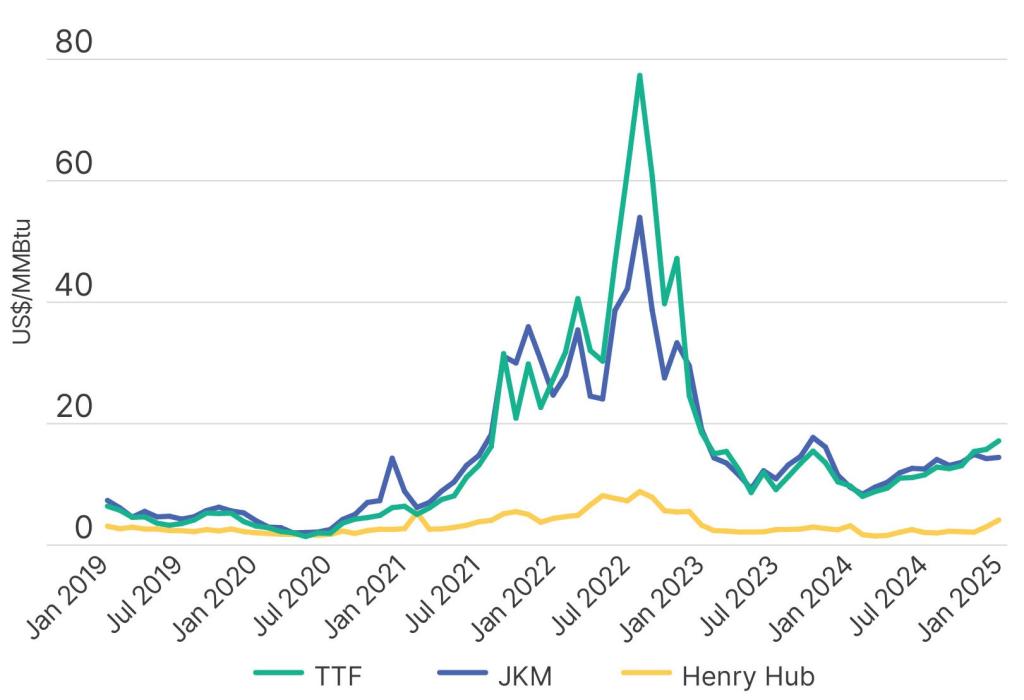
Piped natural gas and shipped LNG are each subject to supply shocks and price spikes that can be triggered by several events, including export facility outages, extreme weather, and geopolitical shocks. LNG markets spread these local supply risks globally, as shipments can be redirected to regions where gas prices are inflated by local supply constraints. In this way, regional gas price spikes can raise global LNG prices. The economic impacts of these supply disruptions are then amplified further by speculative trading in commodity markets, resulting in dramatic swings in benchmark prices (e.g., the Dutch Title Transfer Facility [TTF] and the Japan/Korea Marker [JKM]; see Figure 2).

Figure 2. Major gas and LNG pricing benchmarks from 2019 to 2025
 
Figure 2. Major gas and LNG pricing benchmarks from 2019 to 2025
Note: Prices are measured in U.S. dollar per million British thermal unit (US$/MMBtu).
Source: Institute for Energy Economics and Financial Analysis, 2025. 

LNG markets also work the other way, exposing regional gas and electricity markets to international shocks. In 2022, diverted shipments to Europe drove record-high LNG prices, which raised domestic gas costs in Canada to unprecedented highs in May 2022, with knock-on effects for home heating and electricity bills. Even larger impacts were seen in price-sensitive countries like India, Pakistan, and Bangladesh, where high prices and supply defaults led collective LNG consumption to fall 16% in 2022. Similarly, domestic gas consumers in countries that export LNG are exposed to higher prices during global price spikes as domestic gas is diverted for more lucrative exports abroad. This happened in both the United States and Australia during the 2022 price spike. Higher domestic gas prices are also expected in British Columbia as LNG exports grow, along with more expensive electricity rates for businesses and households as ratepayers partially subsidize LNG-related grid expansions.

This increasing awareness of LNG’s economic volatility and risks coincides with utility-scale renewables like wind and solar becoming the cheapest option for new electricity generation in most markets. Renewables now offer an affordable alternative to LNG imports that can reduce countries’ exposure to the international supply volatility and price spikes associated with traded fossil fuels. Meanwhile, high prices have sparked unprecedented plans to increase global LNG supply. Market analysts thus widely expect an oversupply of LNG, which could begin as early as 2026 and extend well into the 2030s, driving down prices and threatening exporter profitability. This market glut could extend indefinitely as the global energy transition accelerates (see Figure 3). While low prices may benefit importing countries with existing regasification facilities and pipelines in the short term, they are unlikely to incentivize the infrastructure investments in many emerging markets needed to sustain high LNG demand over the medium to long term, as we discuss below.

Figure 3. Global LNG capacity versus demand under three International Energy Agency scenarios
Figure 3. Global LNG capacity versus demand under three IEA scenarios
Note: Scenarios are based on current climate policies (Stated Policy Scenario), announced climate policies (Announced Pledges Scenario), and a trajectory consistent with the Paris Agreement’s 1.5°C global warming target (Net-Zero Emissions). Volumes are measured in billion cubic meters (bcm).
Source: International Energy Agency (IEA). CC BY 4.0.

The Downward Trend in Global Demand 

We can look at three key market geographies—Europe, East Asia, and South and Southeast Asia—to assess how energy security concerns appear to be influencing LNG demand.

Europe

Following the disruption and record prices of LNG in 2022, the European Union (EU) and some individual members, notably Germany, have emphasized the importance of replacing Russian gas in the long run with affordable and secure clean energy. This is most explicit in the RePowerEU plan, which, if implemented, would see total gas demand in the continent decline by over 40% from 2024 to 2030 in favour of renewable energy and energy efficiency. Even if Europe’s energy transition policies fall short of their targets, the benefits of domestic renewables over imported LNG are already evident for European consumers and governments. For example, the IEA estimated that the EU’s expansion of wind and solar saved consumers EUR 100 billion between 2021 and 2023 by reducing exposure to record gas prices. More recently, the European Commission’s Action Plan for Affordable Energy (February 2025) includes the goal of “decoupling retail electricity bills from high and volatile gas prices,” in part by scaling up stable and affordable renewables. Thus, while Europe may benefit from lower LNG prices in the short term as supply expands, sustained demand for LNG, even in the medium term, is unlikely.

Basing investment decisions on today’s high prices risks stranding costly LNG infrastructure in Europe and Canada alike.


East Asia

Some of the top LNG-importing countries in Asia are China, Japan, and the Republic of Korea (South Korea)—all of which are adopting measures to reduce LNG demand.

In China, renewables—not LNG—are displacing coal in power generation. Analysis shows that while gas use has remained steady, renewable energy has grown, reducing coal’s share in the power sector. As a major gas producer with access to cheaper pipeline supply and a goal to cut imports, China’s role as a future LNG growth market is increasingly uncertain, especially amid ongoing trade tensions with the United States.

Both Japan and South Korea are mature LNG markets with declining domestic demand. Japan’s LNG imports fell 8% in 2023, and South Korea’s declined 4.9%. In both cases, nuclear and renewables are cutting gas demand in the power sector, while in South Korea, high LNG prices accelerated the decline. As with Europe, importers with existing LNG import infrastructure may benefit from increased supply (and reduced prices) in the short term, but with domestic consumption in decline, excess supply is increasingly likely to be diverted to other markets for a profit.
 

Solar panels in India

South and Southeast Asia

Energy demand is certain to rise in South and Southeast Asian economies; the question, however, is what energy sources will be preferred to fill the gap? Cost is the first factor to consider, as high LNG prices are seen as a threat to energy security in many emerging economies, including India and Pakistan. While prices are expected to fall in the coming years due to the forecasted global supply glut (as outlined above), this in turn would threaten the profitability of new export facilities in countries such as Canada. As the IEA explains in its most recent World Energy Outlook:

“Gas-importing emerging and developing economies would generally need prices at around USD 3-5/MBtu to make gas attractive as a large-scale alternative to renewables and coal, but delivered costs for most new export projects need to average around USD 8/MBtu to cover their investments and operation.”

In other words, key importing countries need LNG prices to be lower than what new export projects would typically need to be profitable.

There are also significant infrastructure barriers to increased LNG consumption in South and Southeast Asia. In India, for example, “infrastructure development, including pipelines and LNG terminals, has not kept pace with internal demand,” and there are “no plans” to build new gas-fired power plants. Similarly, delayed LNG plant construction in Vietnam, regulatory restrictions in the Philippines, and an announced halt of new LNG-fired power plant construction in Pakistan demonstrate infrastructure constraints. As such, several governments in South and Southeast Asia have signalled that their energy future lies in rapidly expanding renewables, not LNG. Forecasted LNG demand in emerging Asian economies is being revised downward as energy security concerns rise.

Impacts of Canadian LNG on Climate Change 

Finally, LNG accelerates climate change across its entire value chain, due to emissions from energy-intensive gas extraction and liquefaction, transportation, end-use combustion, and methane leaks at all stages. New large-scale fossil fuel projects are incompatible with global climate goals (see also Figure 3). In Canada, LNG facilities will also undermine domestic climate commitments by generating direct local emissions and/or diverting clean electricity from other sectors. Rather than replacing coal abroad, LNG exports can reduce or delay investments in renewables and increase global fossil fuel use. For this reason, the U.S. Department of Energy recently concluded that “the overall global effect of producing and exporting U.S. LNG leads to an increase in global GHG emissions.” To displace coal use abroad, accelerating investments in renewable power generation is a more efficient approach. LNG, then, is more likely to exacerbate climate change than mitigate it, amplifying economic and environmental risks in Canada and beyond.  

An LNG shipping port.

Conclusions for Canada

LNG is a volatile commodity, and recent overreliance on it has undermined energy security across several importing countries following trade disputes and geopolitical shocks. Going forward, governments in Europe and Asia are increasingly favouring cheaper and more reliable renewable power over long-term reliance on fossil fuel imports.

Meanwhile, government support to expand Canadian LNG production exposes Canadians to economic risks. The forecasted oversupply of LNG on the global market could lead to prices trending lower, shrinking profit margins, and Canadian LNG assets becoming stranded, potentially triggering demand for more taxpayer-funded subsidies to keep projects viable. Meanwhile, short-term supply imbalances could raise Canadians’ heating and electricity bills as new LNG exports increase Canada’s exposure to international market volatility.

LNG expansion ultimately delays the shift to cleaner, more resilient energy systems for both exporters and importers, exacerbating climate change and compounding the risks of extreme weather events, such as wildfires and hurricanes. Every dollar spent on LNG expansion is a dollar lost for real clean energy solutions and a step backward on the path toward economic resilience for Canada and energy security for its trading partners abroad.

Press release

Canada’s Oil and Gas Growth Could Backfire—Study finds billions in oil and gas investment at risk as global demand declines

Up to 66% of future capital investments in Canadian oil and gas projects are in danger of becoming stranded.

June 25, 2025

Toronto/Winnipeg, June 25, 2025 — A new report released today by the International Institute for Sustainable Development and Environmental Defence warns that Canada’s continued expansion of oil and gas production risks stranding billions in future investment as the world accelerates its shift to cleaner energy.

Canada’s oil and gas industry is highly exposed to shifting international markets, with 81% of its oil and 44% of its gas exported abroad. This report reveals the extent to which new Canadian production is vulnerable to weakening international demand, rising competition, and trade disruptions, putting industry investments and government revenues at risk. 
Using data from the International Energy Agency and global oil and gas market modelling by Rystad Energy, the report finds that

  • Up to 66% of future capital investments in Canadian oil and gas projects (2025–2040) are at risk of becoming stranded in uncompetitive projects under a 1.5°C climate scenario.
    • This percentage of stranded investments could be even higher in a world where carbon capture and storage technologies underperform.
  • Under announced climate policies, including existing net-zero pledges, the share of stranded forecasted investments (2025-2040) is 39%.
  • Even under current policies, new and existing oil and gas projects in Canada are at risk of deflated returns.

“The more Canadian supply outpaces global demand, the greater the financial risk to investors, governments, and workers,” said Steven Haig, Policy Advisor for IISD. “We need to stop thinking of oil and gas expansion as a safe bet for Canada’s economy because it is quickly becoming the opposite.”

The report also highlights that Canadian oil is expensive compared to other international producers, while Canadian gas faces growing market access challenges. Export routes rely heavily on trade with the United States, which is increasingly subject to geopolitical risk, or expensive new liquefaction terminals, which are only viable in the unlikely scenario that long-term demand and prices remain high.

“Canadian governments must rethink what real leadership looks like in the energy sector,” said Aly Hyder Ali, Program Manager (Oil and Gas) at Environmental Defence. “As the world continues to move away from fossil fuels, the most strategic move is not to expand oil and gas, but to manage its decline while investing in renewable energy.”

Policy options to reduce risk 

The report lays out two complementary approaches that could protect the value of Canada’s oil and gas industry during the global clean energy transition:

  • restricting new oil and gas production projects to avoid overinvestment and overproduction
  • working with international partners to coordinate reductions in global oil and gas supply.

Modelling suggests these approaches could reduce stranded asset risk, increase public revenues, and help stabilize the value of remaining production, especially if the global energy transition accelerates.

“It may seem counterintuitive, but limiting new development could actually safeguard what we already have,” said Haig. “It’s about protecting the value of the sector from an overbuild that leaves future projects unprofitable.”

A call for strategic planning

The report urges Canadian governments, regulators, and financial institutions to take these risks seriously. It also calls for stronger alignment between domestic policy and international climate goals, noting that past investments, particularly those in long-lived infrastructure, may already be facing diminished returns.

“Business-as-usual investment in oil and gas production is out of line with the future global energy market,” said Ali. “The sooner we shift course, the better positioned we’ll be to protect workers, communities, and public revenues.” 

Download the full report here

Read the media backgrounder.

Media contact: 

For IISD: Trish Tervit, [email protected] 
For Environmental Defence: Midhat Moini, [email protected]

About Environmental Defence:  

Environmental Defence is a leading Canadian environmental advocacy organization that works with government, industry, and individuals to defend clean water, a safe climate, and healthy communities.

Press release details

Press release

Hudson Bay Lowlands bring nearly CAD 250 million to the Manitoba economy every year: New report

June 23, 2025

Winnipeg, MB, June 24, 2025 — The Hudson Bay Lowlands provide nearly CAD 250 million in ecosystem goods and services (EGS) per year through the value of biodiversity conservation, hunting, tourism, and mental health benefits. This vast landscape also stores an estimated 7 billion tonnes of soil organic carbon.

This is all according to a new report from the International Institute for Sustainable Development (IISD), commissioned by the Manitoba chapter of the Canadian Parks and Wilderness Society (CPAWS). The report highlights the economic, environmental, and social benefits of conserving these 67,000 square kilometres.

“The Hudson Bay Lowlands are one of Canada’s most powerful climate solutions and are part of the largest wetland and peatland system in the world,” said Marina Puzyreva, senior policy advisor at IISD. “The carbon storage value alone exceeds CAD 1.2 trillion, which is a substantial contribution in our efforts to mitigate climate change.”

The Hudson Bay Lowlands in northeastern Manitoba are one of the world’s most ecologically intact landscapes and, according to new research, provide millions in economic value every year. The region also holds immense value due to its rich Indigenous heritage, globally significant carbon stocks, and diverse wildlife, making it an excellent candidate for conservation.

Not only are they ecologically significant, but they are culturally vital. Five Indigenous Nations—York Factory First Nation, Fox Lake Cree Nation, Tataskweyak Cree Nation, War Lake First Nation, and Shamattawa First Nation—are working to conserve a vast expanse of this region as an Indigenous Protected Area and safeguard lands, waters, and ways of life.

“Protecting the Hudson Bay Lowlands means honouring generations of Indigenous stewardship and ensuring this globally significant landscape remains intact for our grandchildren’s grandchildren,” said Ron Thiessen, Executive Director of CPAWS’ Manitoba chapter.

The Lowlands cover nearly 10% of Manitoba’s landmass. Conserving large areas of this region would significantly advance the provincial government’s commitment to increasing protected lands and waters for future generations, a critical step in tackling climate change and biodiversity loss.

Read the full report: Manitoba’s Hudson Bay Lowlands: Ecosystem goods and services valuation  
 

Media Contacts

Brittney Le Blanc, Communications Officer, IISD: [email protected]

About CPAWS Manitoba

The Manitoba Chapter of the Canadian Parks and Wilderness Society (CPAWS Manitoba) is a not-for-profit organization dedicated to protecting Manitoba’s lands and waters for future generations. Founded in 1991, we are proudly built in Manitoba and committed to making sure the voice of conservation is heard on issues that affect our parks, wild spaces, and natural heritage.

We take a grassroots, science-based, and respectful approach to conservation—working collaboratively with communities, Indigenous Nations, and governments to safeguard nature and ensure sustainable land-use decisions. Our efforts have helped establish 23 parks and protected areas across the province, covering nearly 26,000 square kilometres—an area larger than Lake Winnipeg.

As Manitobans, we live, work, and play here—and we are passionate about protecting what makes this province so special.

Press release details

Topic
Water
Climate Change Mitigation
Region
Canada
Impact area
Nature
Webinar

Toward a New Canadian Industrial Strategy

This webinar explored findings from the Commission on Carbon Competitiveness (C3) and the Transition Accelerator’s new report and featured expert views on how Canada can enhance the competitiveness of its industries and capitalize on today’s opportunities.

June 19, 2025 1:00 pm - 2:30 pm EST

(Open to public)

Canadian industry is at a pivotal moment. In the wake of recent policy shifts in the United States, Canada is forced to find ways to diversify its economy and chart a path toward long-term growth and prosperity. This is a chance for the nation to consider industrial policy options.

With the election of a federal government focused on nation-building projects, Canada has a unique opportunity to revisit past industrial policy efforts to address persistent challenges, such as low productivity and barriers to innovation, while strengthening economic sovereignty. This renewed vision is being framed as a “New Canadian Industrial Strategy.” 

A newly released report from the Commission on Carbon Competitiveness (C3) and the Transition Accelerator explores how Canada can rethink its approach to industrial policy, with a focus on both legacy industrial sectors and new, innovative sectors and technologies.

Many of the most promising opportunities lie in the rapidly expanding global low-carbon markets. As the United States federal government abandons its pursuit of these opportunities, Canada is well-positioned to step forward as a stable, resource-rich, and innovation-driven destination for green investment.

This webinar explored key recommendations from the report and featured perspectives from different stakeholders on how Canada can enhance industrial competitiveness and seize the opportunities inherent in this critical moment.

Speakers:

  • Aaron Cosbey, Senior Associate, IISD and Chair, Commission on Carbon Competitiveness
  • Travis Southin, Future Economy Lead, The Transition Accelerator
  • Michael Bernstein, President and Chief Executive Officer, Clean Prosperity
  • Sarah Petrevan, Vice President, Industrial Decarbonization and Sustainability, Cement Association of Canada
  • Sean Speer, Senior Fellow, Munk School of Global Affairs & Public Policy, University of Toronto
  • Marie-Pierre Ippersiel, President and Chief Executive Officer, PRIMA Québec
  • Marisa Beck, Research Director for Clean Growth, The Canadian Climate Institute 

This webinar was hosted by the Commission on Carbon Competitiveness and the Transition Accelerator.

Read the report here.

C3 logo


Extra Small Transition Accelerator Logo

Webinar details