Report

The State of Global Environmental Governance 2022

With the pent-up need for countries to agree how to address climate finance, plastic pollution, biodiversity loss, and other pressing environmental issues, a tidal wave of in-person negotiations swept through 2022.

February 15, 2023
  • Great expectations were laid on environmental negotiations in 2022. And with over 634 decisions just in the 10 COPs and MOPs (the highest decision-making bodies for treaties), the year nearly lived up to its lofty goals.

  • In the tidal wave of global environmental negotiations in 2022, some ideas made their way from the sidelines to the spotlight, including carbon colonialism, nature-based solutions, and loss and damage.

  • Almost all environmental treaties have shifted to implementation mode, and countries have firm obligations to meet, write the @IISD_ENB team. Transparency may become the primary function of global environmental governance in 2023 and beyond.

Against a backdrop of ongoing conflict, natural disasters, and economic tumult—which helped the term “permacrisis” gain wide traction—international diplomats made significant and sometimes surprising steps forward in coordinating global environmental governance. After coordinated pressure from diverse G77 countries, climate negotiators agreed to establish a dedicated loss and damage fund. Countries adopted the Kunming-Montreal Global Biodiversity Framework despite thorny issues and late-night negotiating drama. Talks kicked off to shape an international legally binding instrument on plastic pollution.

However, how much traction these achievements will make remains to be seen, even as many multilateral environmental agreements shift into full “implementation mode.”

Join the globetrotting Earth Negotiations Bulletin team for a review of an unprecedented year in sustainable development negotiations as they draw links between talks, consider the context of an uneven pandemic recovery, and reflect on next steps in addressing the triple planetary crisis.

Subscribe to ENB Update to receive free reports, photos, and videos from environmental negotiations around the world.

Report

Policy Action Framework: Improving product sustainability information in e-commerce

How can policy-makers take action to improve product sustainability information for consumers using e-commerce platforms?

January 16, 2023

Shifting toward sustainable consumption is vital to addressing the world's pressing environmental issues and achieving the United Nations Sustainable Development Goals. The scope of the sustainable consumption challenge is daunting, with trillions of products produced in millions of locations and sold to billions of consumers. Meaningful progress will require a tectonic shift for consumers, retailers, and manufacturers.

Two trends offer an opportunity to accelerate this shift. The first is the growing number of consumers worldwide who are concerned about their environmental footprint and are willing to change their consumption habits to be more sustainable. The second is the significant growth of e-commerce, which will continue reshaping consumption worldwide after the COVID-19 pandemic.

This report outlines how policy-makers can realize e-commerce’s potential to accelerate sustainable consumption by supporting clear and reliable product sustainability information for online consumers. Toward that end, this report sets out five core and three supporting actions for policy-makers who regulate product sustainability information.

The Policy Action Framework is supported by a policy and literature review entitled: E-Commerce and Product Sustainability Information: An Overview of Policies and Practices.

These publications were created as part of a project led by Consumers International and implemented in partnership with IISD. They were launched along with two additional publications from Consumers International: The State of Sustainability Information: Critical Trends, Trade-offs, and Solutions and Action Agenda: Informing Sustainable Consumer Choices in E-Commerce.

Report details

Topic
Standards and Value Chains
Responsible Business
Sustainable Development Goals
Trade
Project
State of Sustainability Initiatives
Impact area
Sustainable Economies
Climate
Publisher
Consumers International
Copyright
Consumers International, 2023
Report

Achieving Sustainable Food Systems in a Global Crisis: Summary Report

Ceres2030 Deep Dives into the Nexus of Food Systems, Climate Change, and Diets

This report summarizes the evidence-based and costed country roadmaps for effective public interventions to transform agriculture and food systems in Ethiopia, Malawi, and Nigeria in a way that ends hunger, makes diets healthier and more affordable, improves the productivity and incomes of small-scale producers and their households, and mitigates and adapts to climate change.

January 26, 2023

The world is not on track to achieve the United Nations Sustainable Development Goals by 2030. The prevalence of hunger and poverty—the two core goals which are the litmus test for everything else—are on the rise. This is being made worse by the Russian invasion of Ukraine, skyrocketing food, fertilizer, and energy prices, COVID-19, and climate change. In Africa, the situation is exacerbated by internal conflicts, political unrest, economic recessions, and swarms of desert locusts. To get back on track, it is critical to pursue policy pathways that encourage synergies and limit the trade-offs between hunger, poverty, nutrition, and climate change. This report summarizes the evidence-based and costed country roadmaps for effective public interventions to transform agriculture and food systems in Ethiopia, Malawi, and Nigeria in a way that ends hunger, makes diets healthier and more affordable, improves the productivity and incomes of small-scale producers and their households, and mitigates and adapts to climate change.

The financing gap is immense. This report shows that while it is possible to achieve sustainable food system transformation in Ethiopia, Malawi, and Nigeria, in the next decade, it would require an average additional public investment of USD 10 billion per year from 2023 to 2030 and targeting spending on a more effective portfolio of interventions that achieve multiple sustainable development outcomes. Of the total USD 10 billion, the donor share averages USD 5.8 billion per year, and the country share averages USD 4.2 billion per year. Importantly, comparing the financing gap between the long-term investment needed to achieve Sustainable Development Goal 2 and the short-term investment needed for emergency food assistance shows that while emergency assistance has increased in recent years, there is significant underfunding of the longer-term investment needs. The shortfall in longer-term funding increases the vulnerability to shocks, pushing the number of people affected by hunger and poverty higher. Donors should therefore complement and better link the increased allocation of emergency food assistance with increased investments in longerterm agricultural development priorities to prevent future crises when the next shock hits.

Filling the financing gap of USD 10 billion per year will yield immense economic, social, and environmental benefits. The prevalence of undernourishment in all three countries will decrease to under 3% in 2030 from a current projection of 22% in Ethiopia, 25% in Malawi, and 21% in Nigeria, by 2030. The transition toward healthier diets will be achieved for 248 million people, or roughly 60% of the population in each country. The incomes of 29 million small-scale producers will double on average in 2030 compared to 2015 levels. These economic and social gains will be achieved while confining greenhouse gas (GHG) emissions to nationally determined contribution goals and increasing resilience to climate change of the most vulnerable.

The findings in this report are based on analysis of academic and grey literature, as well as donor-funded projects, micro- and macroeconomic modelling, and engagement and consultations with key stakeholders in Ethiopia, Malawi, and Nigeria. The report summarizes the findings of a project that explores the interactions between reducing hunger and poverty, achieving healthy diets, and addressing climate change within the evolving food systems in three countries—Ethiopia, Malawi, and Nigeria.


The project is funded by the German Federal Ministry for Economic Cooperation and Development (BMZ) and the European Commission, through the GIZ implemented projects Knowledge for Nutrition (K4N) and Agricultural Policy and Food and Nutrition Security. The project was designed as a contribution to, and to build upon the progress made at,  the 2021 UN Food Systems Summit.

Report details

Report

Proposals for the Canadian Just Transition Act

January 26, 2023
  • Canadian federal just transition legislation should be rooted in principles from the International Labour Organization, guided by an independent advisory body, grounded in social dialogue with workers and employers, and designed to advance nation-to-nation relationships.

  • Jurisdictions leading on the just transition, such as New Zealand, Scotland, Spain, and the European Union, all have legislation grounding their efforts, and Canada can learn from their examples.

  • To ensure the just transition reflects the diversity of Canada's regions and sectors, the legislation should establish just transition agencies in each province and territory that can work together alongside a dedicated federal just transition minister and institution.

A legal framework is central to planning and implementing an orderly, just, and equitable transition to a low-carbon economy in Canada. Jurisdictions around the world that are leading the just transition—including New Zealand, Scotland, Spain, and the European Union—all have legislation grounding their just transition efforts. This brief canvases best practices from these jurisdictions and builds off the IISD report Making Good Green Jobs the Law: How Canada Can Build on International Best Practice to Advance Just Transition for All to make recommendations for federal just transition legislation here in Canada.

Report details

Topic
Energy
Just Transition
Region
Canada
Impact area
Climate
Publisher
Ecojustice
Copyright
Ecojustice, 2022
Report

Good Regulatory Practice Provisions in Regional Trade Agreements

Examples and considerations for developing countries

Governments are increasingly negotiating rules on non-tariff barriers in their trade agreements, looking to address this significant source of trade costs. This paper looks at the U.S.-Mexico-Canada Agreement and the EU-Canada Comprehensive Economic and Trade Agreement to see how their respective approaches to good regulatory practices (GRPs)—a type of regulatory policy provision—and what developing countries and least developed countries should consider in their own trade negotiations. 

January 18, 2023

As non-tariff barriers become an increasingly relevant source of trade costs, regulatory policy has become an important feature in trade negotiations and the trade policy agenda overall. This paper provides an overview of how stand-alone regulatory policy chapters are increasingly featured in recent regional trade agreements (RTAs). It then does an in-depth analysis of a specific type of regulatory policy provision—that of good regulatory practices (GRPs)—as these types of provisions are becoming more prolific and are being integrated into a more diverse range of agreements involving both developed and developing countries.

The paper analyzes how GRPs, especially those promoting stakeholder engagement, are evolving in select key RTAs, notably that of the United States–Mexico–Canada Agreement (USMCA) and the EU-Canada Comprehensive and Economic Trade Agreement (CETA). The paper concludes with key insights highlighting the policy implications for developing and least developed countries and proposes some considerations for policy thinking.

This material has been produced with funding from UK aid from the UK Government. Views expressed in the publication are the author’s own and do not necessarily reflect HM Government’s official positions.

Report details

Topic
Trade
Impact area
Sustainable Economies
Publisher
IISD
Copyright
IISD, 2022
Report

Achieving Sustainable Food Systems in a Global Crisis: Ethiopia

Ceres2030 Deep Dives into the Nexus of Food Systems, Climate Change, and Diets

This report presents an evidence based and costed country roadmap for effective public interventions to transform agriculture and food systems in Ethiopia in a way that ends hunger, makes diets healthier and more affordable, improves the productivity and incomes of small-scale producers and their households, and mitigates and adapts to climate change. The report is part of a project that explores the interaction between achieving healthy diets, reducing hunger and poverty, and addressing climate change within the evolving food systems in three countries—Ethiopia, Malawi, and Nigeria. 

January 16, 2023

Ethiopia is not on track to achieve the United Nations Sustainable Development Goals by 2030, with poverty and hunger levels projected to be higher in 2030 than they are today. This is being made worse by the conflict in Tigray, swarms of desert locusts, an economic slowdown, skyrocketing food, fertilizer, and energy prices—exacerbated by the Russian invasion of Ukraine as well as the COVID-19 pandemic—and climate change. To get back on track, it is critical to pursue policy pathways that favour synergies and limit the trade-offs between hunger, poverty, nutrition, and climate change. This report presents an evidencebased and costed country roadmap for effective public interventions to transform agriculture and food systems in Ethiopia in a way that ends hunger, makes diets healthier and more affordable, improves the productivity and incomes of small-scale producers and their households, and mitigates and adapts to climate change.

The report shows that it is possible to achieve sustainable food system transformation in the next decade by increasing public investment by USD 4.6 billion and targeting this spending on a more effective portfolio of interventions that achieve multiple sustainable development outcomes. Importantly, when comparing the financing gap between the long-term investment needed to achieve Sustainable Development Goal 2 and the short-term investment needed for emergency food assistance, there is significant underfunding of the longer-term investment needs (Figure 11). The shortfall in longer-term funding increases the vulnerability of Ethiopia to shocks and crises, increasing the number of people affected by hunger and poverty. Donors should, therefore, simultaneously increase emergency food assistance while ensuring this is linked to—and complemented with—an increase in longer-term investments to build resilience and help mitigate against future shocks and crises.

The findings are based on a review of academic and grey literature, donor-funded projects, micro- and macroeconomic modelling, and engagement and consultations with key stakeholders in Ethiopia. This report is part of a project that explores the interaction between achieving hunger, poverty reduction, and healthy diets while addressing climate change within the evolving food systems in three countries: Ethiopia, Malawi, and Nigeria.

Report details

Report

Global Market Report: Cotton prices and sustainability

This report presents and analyzes the sustainable production and consumption trends in the global cotton sector and includes a detailed exploration of how adopting voluntary sustainability standards (VSSs) can affect prices and farmer incomes.

January 11, 2023

From the clothes we wear to critical medical equipment, cotton is the most widely used natural fibre in the textile industry today, accounting for almost one quarter of all fibres manufactured worldwide.

Cultivating cotton provides livelihoods for 100 million households, of which 90% are in lower-income countries. An additional 350 million people support cotton production and basic processing by working in transportation, ginning, baling, and storage. Voluntary sustainability standards (VSSs) emerged in the cotton sector more than 20 years ago to help address social and environmental challenges in the sector. As of 2019, VSS-compliant cotton accounted for at least 25% of global production. This IISD report shows that VSS compliance can help cotton producers build resilience to climate change by conserving water, protecting soil health, and adapting to climate change. In many cases, farmers that adhere to VSSs can also benefit from higher prices and incomes when compared to those growing conventionally produced cotton.

Report

Mapping India's Energy Policy 2022 (Update)

Tracking government support for energy

Mapping India’s Energy Policy 2022 (Update) presents the latest estimates of government support for fossil fuels, renewable energy, and electric vehicles in India, extending the data to include FY 2022 for the first time. It covers fiscal years 2014–2022.

December 19, 2022
  • Subsidies for renewable energy doubled in FY 2022, the first increase since FY 2017.

  • India provided at least INR 5 lakh crore (USD 68 billion) to support the energy sector in FY 2022, including over INR 2.25 lakh crore (USD 30 billion) in the form of subsidies.

  • Subsidies for fossil fuels remained over four times higher than subsidies for clean energy in FY 2022.

India’s energy sector is changing rapidly in response to increasing demand, the rise of clean energy, and the energy security imperative. Government policies—particularly financial support—are hugely influential in determining how the sector develops, including the direction of private sector investments, energy access, and the benefits and costs for the people of India. Mapping India’s Energy Policy is a resource to help the Government of India and others make the energy sector more equitable, secure, and aligned with the government’s target to achieve net-zero emissions by 2070.

Report details

Topic
Climate Change Mitigation
Energy
Sustainable Finance
Subsidies
Region
India
Project
Budgeting for India’s Energy Transition
Impact area
Climate
Publisher
IISD
Copyright
IISD, 2022
Report

The Value of Water Retention Beneficial Management Practices to Farmers and Landowners in the Seine Rat Roseau Watershed District

Considering the increasing frequency and length of droughts as well as a greater potential for flash floods in Manitoba, water retention projects are an important option to help agricultural producers maintain productivity on their farms while also providing benefits to the local watershed. This report examines the costs and benefits of 10 water retention projects constructed in the Seine, Rat, and Roseau watersheds in Manitoba to assess their economic returns and communicate these findings to producers, Watershed Districts, and government.

December 16, 2022
  • The design of the water retention project is key and can provide a win-win option for both farm owners and their neighbours.

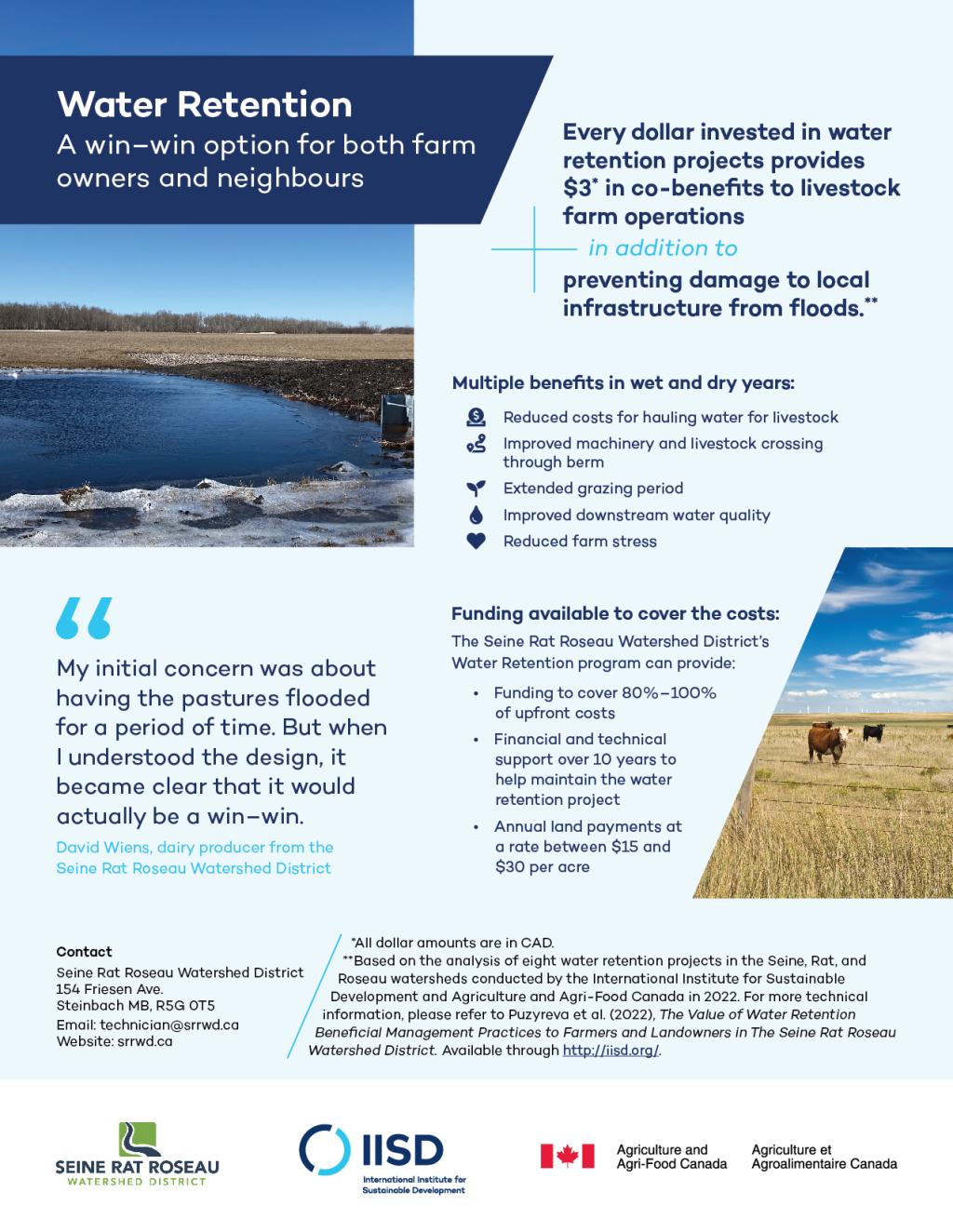
  • Every dollar invested in water retention projects provides CAD 3 in co-benefits to livestock farm operations in addition to preventing damage to local infrastructure from floods.

In 2022, the International Institute for Sustainable Development (IISD), Seine Rat Roseau Watershed District (SRRWD), and Agriculture and Agri-Food Canada Living Lab Eastern Prairies economic team collected and analyzed cost, benefit, and other related information for 10 water retention projects constructed in the Seine, Rat, and Roseau watersheds in Manitoba, Canada. The water retention projects examined in this study were constructed predominantly on livestock farms.  However, many of the producers surveyed had a combination of pasture and cropland on their farms.

Based on the evidence collected, the installation of water retention projects changed farm management, allowing for more efficiency and multiple benefits in wet and dry years. The most common benefits reported by producers were:

  • Flood protection
  • Extended grazing period
  • Reduced need to haul water for livestock
  • Improved livestock, machinery crossing through berm
  • Enhanced wildlife habitat
  • Improved downstream water quality

Based on the analysis of 10 projects, the average benefit-to-cost ratio for implementation of water retention project is 2.45, which means that for every dollar invested in water retention over the period of 20 years, producers and the watershed receive $2.45 in water quality, extended grazing, and other co-benefits.

Considering only livestock farms, the average benefit-to-cost ratio is 3.16, meaning that for every dollar invested, livestock producers and the watershed receive $3.16 in water quality, extended grazing, and other co-benefits. Net benefits tended to be highest for the projects that were in operation longer than other water retention projects and reported multiple on-farm benefits.

Learn more from Water Retention: A win-win option for both farm owners and neighbours

Water Retention: A win-win option for both farm owners and neighbours


Report details

Topic
Climate Change Adaptation
Food and Agriculture
Nature-Based Solutions
Water
Region
Canada
Impact area
Climate
Nature
Publisher
IISD
Copyright
IISD and SRRWD, 2022
Report

Seal River Watershed: The case for conservation

The Seal River Watershed Indigenous Protected Area (IPA) Initiative is an Indigenous-led conservation project that aims to establish a protected area under the active stewardship of Indigenous Peoples. This report presents an overview of the value of the Seal River Watershed, including its environmental, social, cultural, and economic value, and discusses the significance of protecting it for future generations. The report further lays out the benefits and considerations for establishing the Seal River Watershed IPA in Manitoba based on existing Canadian examples.

December 12, 2022
  • Canada and Manitoba are unlikely to meet or scale up their conservation targets without the support and involvement of Indigenous communities.

  • The Seal River Watershed provides important benefits to Manitobans and the world, ranging from habitat for threatened species to sustaining the cultures of Indigenous Peoples and promoting Northern tourism.

The Seal River Watershed is located in northern Manitoba, Canada, and encompasses an area of 50,000 km2, nearly 8% of the province. Due to its remote, pristine environment, the watershed holds immense value from environmental, cultural, social, and economic perspectives, including:

  • Biodiversity: The watershed is home to an estimated 250 bird species and at least 350 species of other taxa, including 48 mammal species.
  • Carbon storage: It stores an estimated 1.7 billion tonnes of carbon, equivalent to 6.2 billion tonnes of CO2, valued at CAD 314.5 billion.
  • Indigenous culture: The pristine nature of the watershed allows members of the Sayisi Dene First Nation, Northlands Denesuline First Nation, Barren Lands First Nation, and O-Pipon-Na-Piwin Cree Nation to maintain a connection to their culture and identity.

Establishing the Seal River Watershed IPA presents a unique opportunity to protect this important ecosystem for future generations and for the Indigenous communities to share their Traditional Knowledge, history, and culture with visitors from Canada and around the world.

To support the Seal River Watershed IPA Initiative, the government of Manitoba can:

  • Adopt interim measures to protect the watershed from commercial resource extraction and development.
  • Establish a Seal River Watershed IPA committee or working group to undertake a feasibility study and identify provincial legislative options for establishing an accompanying Crown designation for the watershed.
  • Provide in-kind technical and communications support for the Seal River Watershed Alliance, partner nations and organizations.

Report details

Topic
Climate Change Adaptation
Climate Change Mitigation
Nature-Based Solutions
Water
Region
Canada
Impact area
Climate
Nature
Publisher
IISD
Copyright
IISD, 2022