Deep Dive

Why Canada Is Unlikely to Sell the Last Barrel of Oil

The Bottom Line: Unpacking the future of Canada's oil & gas

Re-Energizing Canada is a multi-year IISD research project envisioning Canada's future beyond oil and gas. This policy brief is part five of The Bottom Line series, which digs into the complex questions that will shape Canada's place in future energy markets. (Download PDF)

December 14, 2022

Summary 

  • Canadian producers are vulnerable to two foreseeable threats: declining global demand for oil and falling oil prices. 
  • Almost all Canadian exports go to U.S. refineries. This reliance on captive buyers will initially shield Canada from the worst of the decline in demand, but this buffer will not last. 
  • Nothing will shield Canada from global oil price drops and volatility. Pressure on Organization of Petroleum Exporting Countries-plus discipline as members rush to increase oil production in the face of declining demand will result in prices that are low and even more volatile than normal. 
  • Canadian oil producers’ environmental, social, and governance performance will not help preserve Canada’s market share, since it does not matter to the refineries buying the product. 
  • Marginal producers will not survive in the post-peak market, and efficient producers will see low profits, remitting low royalties and taxes. In line with history, large numbers of workers will lose their jobs in the sector. 
  • Canada cannot afford to delay support for diversifying into sectors that can replace oil as an engine of economic prosperity. 

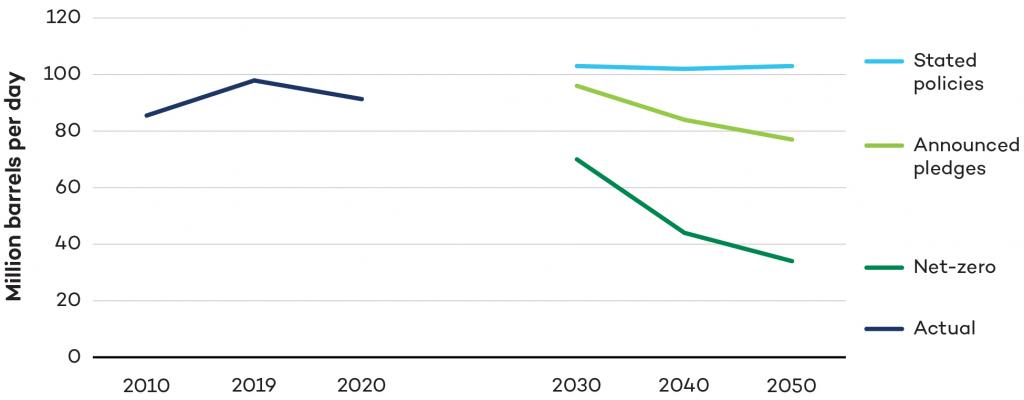
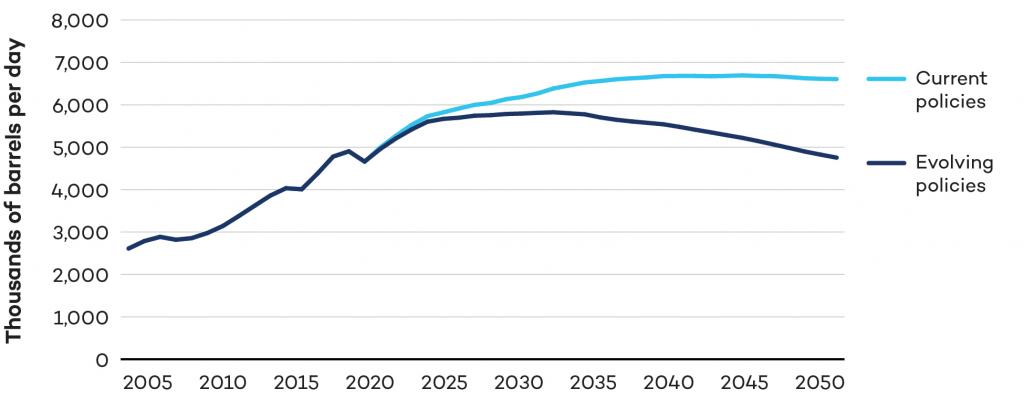
Oil demand and oil prices are currently booming, spurred by under-investment in exploration and an unexpected demand surge as COVID-19 restrictions were lifted, and greatly exacerbated by the Russian invasion of Ukraine. Nonetheless, almost all analysts see global demand for oil peaking around 2030 (Rystad Energy, 2022). Recent International Institute for Sustainable Development (IISD) analysis predicts falling demand by 2030 and significant declines thereafter as new technologies and ambitious climate policies eat into all of oil’s major end uses. 

It is not obvious, though, what that means for Canadian oil producers. Will they thrive even as the global market shrinks? Will Canadian environmental, social, and governance (ESG) credentials help grow or maintain the country’s market share? Will they, as suggested by former Premier of Alberta Jason Kenney, help Canada buck global circumstances and sell the proverbial last barrel of oil

This policy brief explores four factors that define the answers to those questions: 

  • The destination of Canada’s crude oil exports 
  • Whether Canada can win markets with its ESG credentials 
  • Whether Canada can win markets on price 
  • What to expect from Canada’s global competitors 
fossil-fuel-transportation

Almost All of Canada’s Oil Exports Go to U.S. Refiners

In 2021, Canada exported 3.3 million barrels per day (bpd) of crude oil, or 80% of domestic production. Over 94% of those exports went to the United States, and 80% were in the form of heavy crude of the type produced in Western Canada’s oil sands

Figure 1 shows where those exports went: overwhelmingly to Midwest refiners in Illinois and Minnesota (primarily through the Enbridge and Keystone pipeline systems), but increasingly also to Gulf Coast refiners as U.S. pipeline reversals and transport by rail have increased Canadian producers’ ability to reach them.  

Figure 1. U.S. refining district destinations for Canadian crude exports 
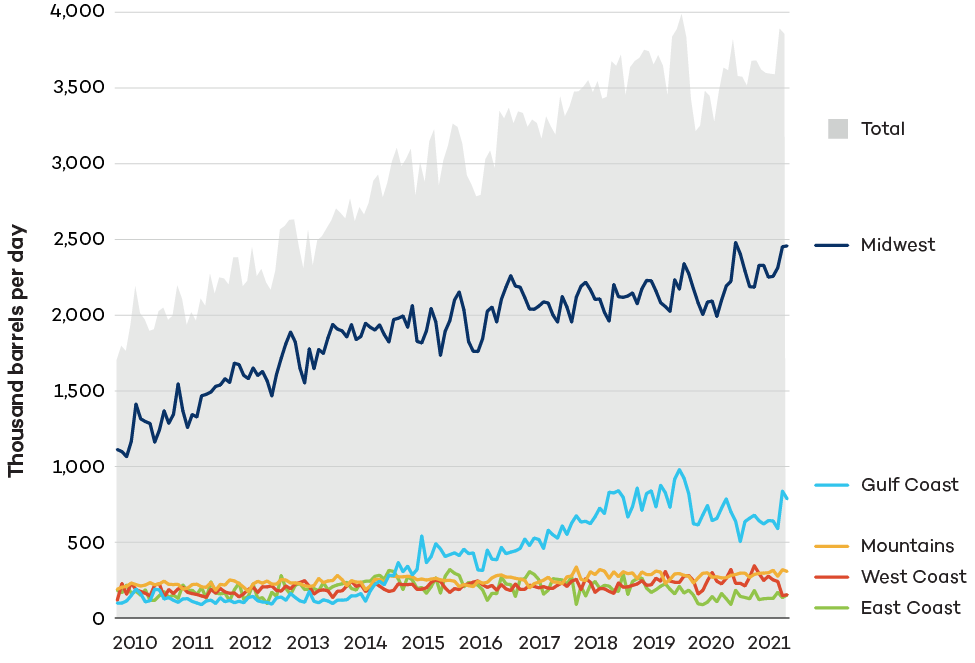
Graphs showing where Canadian exports went
Source: Canada Energy Regulator, 2022. 

Several major Midwest refineries and some Gulf Coast refineries are deliberately set up to refine oil sands-type heavy crude. Many in the Midwest have made recent multibillion-dollar investments in capacity specifically designed to do so. For the Midwest refineries, Canada is the only viable source of crude feedstock; they do not have tidewater access to import crude from other suppliers (or to export their final product). Gulf Coast refiners can import crude by tanker, but other global sources of heavy crude—primarily in Mexico and Venezuela—have dropped to almost negligible levels of production, so Canada is a critically important source. 

What will those export patterns mean for Canada when global demand drops? Canadian oil exporters are potentially vulnerable to two forces: lower demand and lower price. On demand, Canada is partially insulated from global trends because it mostly sells to Midwest U.S. refiners whose output is consumed in the United States. But Canada is not completely insulated from drops in global demand for three reasons:

  • U.S. demand itself will be dropping. The U.S. Inflation Reduction Act is projected to shave 2.1 million bpd off U.S. demand for petroleum products by 2030 and 4.1 million bpd by 2035, relative to 2021 U.S. consumption of 18.6 million bpd of crude. Those numbers are likely underestimates since they do not factor in the ban on the sale of conventional light cars and trucks in California by 2035 or the follow-on announcements that will come from 15 other states with linked regulatory regimes. 
  • Though U.S. demand decreases won’t necessarily translate directly into reduced Canadian imports (the complex modern refineries to which Canada sells would not likely be the first to cut production), the pressure for such cuts will be significant. U.S. refiners exported 46% of their production in 2021, and they will be selling into a declining global market. 
  • A small but increasing amount of Canadian crude finds its way to markets beyond the United States through the Gulf Coast in flows that reached almost 300,000 bpd in 2021. The expansion of the Transmountain pipeline to the Canadian West Coast would, if completed, add another 600,000 bpd of non-U.S. export capacity. Combined, that would amount to 27% of total 2021 exports. 
Hazard-fuel-transportation

The conclusion is that Canada’s U.S. export patterns provide a buffer but do not shield it much from lower demand for its exported crude oil as global demand drops.  

Canada is also directly vulnerable to the price impacts of a global decrease in demand, and its U.S. export markets do little to shield it from those impacts. Prices are, to a large extent, set in a global market. Those prices are set both by demand and supply, however, so it matters what Canada’s global competitors will do as demand falls—a topic that is explored below. 

ESG Credentials Will Not Preserve Canadian Oil’s Market Share

If Canada were vying to sell the proverbial last barrel of oil, would it matter how its oil was produced? Would greenhouse gas (GHG) intensity matter, for example, or would it matter whether it was considered “ethical” or produced to high ESG standards? The short answer is: probably not. 

For some products, production methods impact marketability. At comparable price and quality, final consumers will favour “green” and ethically produced products. For goods like food, clothing, and electronics, a variety of labelling schemes allow consumers to choose, even to pay a premium for labelled products. But for commodities like oil, the situation is different. When refined Canadian oil is finally sold at the pumps, it is indistinguishable from other gasoline, and tracking the source at the retail level would be daunting. The original customers are mostly U.S. refiners dependent on the supply of heavy Canadian crude, as detailed above, who focus on quantity, quality, and price—not ESG. ESG considerations clearly matter a great deal to oil sector investors, but they do not preoccupy most customers. While investors influence companies’ ability to finance expansion, new projects, and infrastructure, they don’t buy the final product, and therefore their opinions don’t directly affect a company’s market share. This will be especially true in the context of a shrinking market in which Canadian producers will not need to expand operations to compete for the few remaining buyers. Canadian crude oil’s emissions intensity would matter if the United States implemented a clean fuel standard governing the life-cycle carbon content of transportation fuels such as gasoline. By design, such a standard would reduce the market share of crude oil produced at high emissions intensity, including most of Canada’s U.S. exports (see Box 1). California, Oregon, and Washington have clean fuel standards in place. But, while such a policy has been suggested by legislators, it would face strong opposition from the domestic refining sector and raise the price of gasoline for American drivers, making it unlikely to pass in the foreseeable future. 
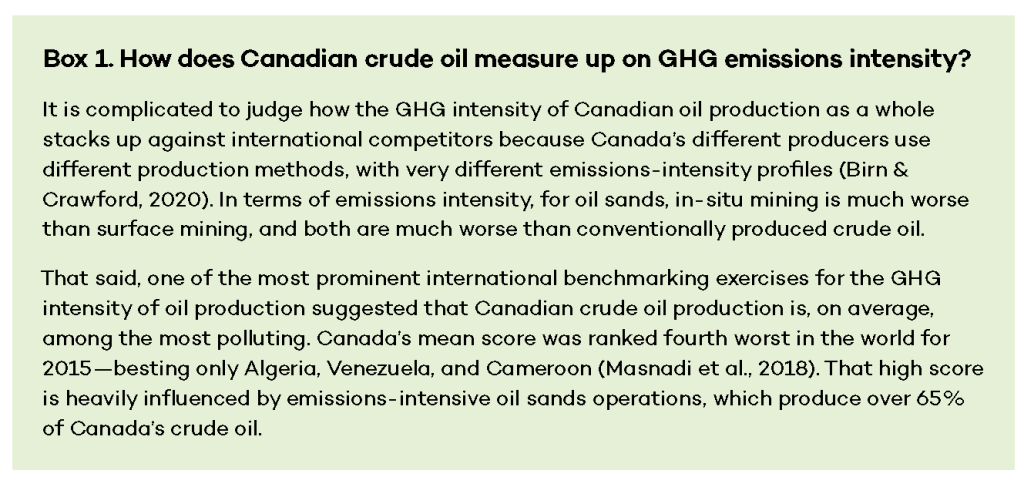
Box 1. How does Canadian crude oil measure up on GHG emissions intensity?

Beyond the question of whether ESG matters for Canadian oil’s market share is the more basic matter of whether Canada’s producers are, in fact, world leaders on ESG criteria, as claimed by some industry groups and pundits. 

On environmental performance, the section above makes it clear that Canada’s overall GHG intensity of production is not world class. Beyond emissions, Canada’s oil sands operations have been dogged for years by a record of serious water and air pollution impacts. Those impacts were singled out as disproportionately affecting Indigenous peoples by the United Nations Special Rapporteur on the implications for human rights of the environmentally sound management and disposal of hazardous substances and wastes. 

Oil sands development has been responsible for extensive impacts on the traditional territories of many First Nations in Alberta, in violation of treaty rights and without proper consultation or respect for basic principles such as cumulative effects management. In many instances, the industry’s consultations and impact assessments with respect to Cree, Dene, and Métis rights have been designed in a manner to expedite oil sands development. Members of many Nations in the region, such as Athabasca Chipewyan First Nation and Fort McKay First Nation, have denounced these impacts for decades. Additionally, the Beaver Lake Cree Nation has an ongoing lawsuit against the governments of Alberta and Canada on the basis that the cumulative impacts of this industrial development violate their Treaty 6 rights. 

While ESG matters to investors and to builders of pipelines seeking social license, it does not matter to the refineries that buy Canada’s oil.

Canadian producers’ mismanagement of the end of the oil and gas project life cycle should also be considered. In Alberta, as of September 2022, 3,309 oil and gas sites are considered orphaned, meaning the original owners failed to fulfill their responsibility for costly end-of-life decommissioning and restoration. Many of those sites were strategically sold to insolvent operators. Responsibility for them now falls to the industry-funded Orphan Well Association, but current industry contributions are grossly inadequate. The Association has CAD 169 million in assets against orphaned sites that it estimates will cost almost CAD 700 million to clean up. Liability estimates for all existing sites are much higher, reaching up to CAD 260 billion. The difference has partly been borne by taxpayers through government loans and bailouts to treat inactive and orphaned wells, violating the polluter-pays principle. But most orphan wells remain unremediated, and a large proportion of “active” wells are, in fact, inactive but not declared as such, meaning the farmers and ranchers on whose land they sit suffer the environmental and economic consequences

Similarly, it is arguably an ESG issue that some Alberta oil and gas companies owe hundreds of millions of dollars in unpaid municipal taxes and tens of millions of dollars in unpaid lease payments to landowners. 

Some insist the last barrel of oil should be sold by a country like Canada that respects democracy and human rights. However, this is largely beside the point: while Canada as a country may have better ESG institutions than many of the world’s top oil-producing countries, ESG criteria traditionally centre on the behaviour of the firm in question, not the government policies where they happen to operate. Some Canadian oil producers score well on ESG criteria, and others score poorly.  

Ultimately, however, whether Canada’s producers’ ESG rating should preserve its market share is irrelevant. As argued above, it won’t; buyers of Canadian oil don’t discriminate on ESG grounds. 

oil-production-sunset

Canada Is Far From the Lowest-Cost Producer

If ESG status won’t save Canadian oil’s market share, could Canada compete on price? Most of Canada’s crude oil exports do not compete directly on global markets, though there are increasing exports from the U.S. Gulf Coast that do, and there will be substantially more with the completion of the TMX pipeline. And Canadian crude does not compete directly with the lighter, sweeter crude produced in most other countries. But Canada’s costs of production relative to its major competitors still matter in the long run, especially in a shrinking post-peak global market. 

Figure 2 shows how those costs measure up among the top 10 oil-producing nations, expressed here as the weighted average Brent crude U.S. dollar per barrel breakeven price in each country. While costs of production have come down dramatically in Canada over the last 20 years, Canada is still not a low-cost oil producer, especially compared to its Middle Eastern competitors.  

Figure 2. Global costs and reserves 
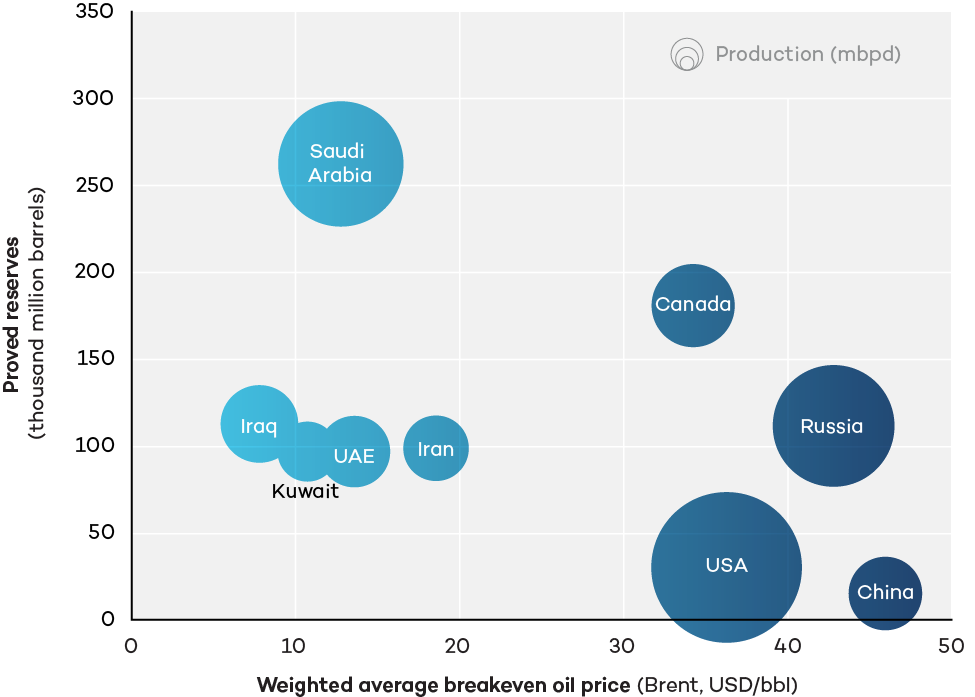
figure-2-last-barrel
Sources: Rystad UCube data; BP (2021).  
Note: Horizontal axis is the weighted average breakeven oil price for all existing producers. Bubble size indicates 2020 production levels. 

As of November 2022, the price of Brent crude is in the mid-eighties (USD), so prices could fall significantly before most Canadian producers, with a weighted average breakeven oil price of USD 35.21, became unprofitable. But in a future global market with falling demand and prices, there would be significant reserves and production in countries that would continue to be profitable long after Canadian production is not.  

The Post-Peak Market for Oil Will Be Savage

Despite Canada not currently participating directly in global markets, global supply and demand trends—and the prices that result from them—directly affect the price Canadian oil producers receive. It is, therefore, important to forecast the strategic behaviour of non-Canadian producers in response to what we know is coming: a peak of global demand by around 2030, followed by a marked decline. 

In the face of lower returns driven by climate policy, some have predicted a dynamic known as the green paradox, where producers predict their reserves will be worth less in the future, and rush to extract and sell more of them in the present. This would mean lower prices for all (and more consumption of cheap oil, hence the paradox). Others have criticized this theory, noting that significantly ramping up production is not a simple matter for most producers, particularly in the short term.  

In today’s circumstances, however, the green paradox would not necessitate a difficult ramp-up—it could simply amount to deliberately following existing plans in the face of declining demand. A survey of production plans for 12 major oil-producing countries shows projected increases by 2030 amounting to more than 10% of 2020 global production. By contrast, under plausible assumptions, global demand for oil could decline 22% by 2030 and more steeply thereafter.  

International (private) oil companies might change expansion plans in response to obvious decline trends; some shareholders would likely demand it. In the same vein, Cairns (2014) also criticizes the green paradox model on the grounds that it would be economically irrational for major producers to increase production and tank prices. But more than half of global oil supply comes from national oil companies. These companies are not strictly profit motivated, and are usually mandated by national governments to contribute to broader policy objectives, such as creating employment. Some national governments will very likely demand a ramping-up of production in the face of declining demand and prices. 

For decades, global oil markets have been protected from oversupply by the discipline of the Organization of the Petroleum Exporting Countries (OPEC) and, more recently, OPEC-plus. But the organization has always been subject to tensions, with heavily oil-dependent members seeking to increase production to address their urgent development needs. Declining oil prices with no long-term prospect for price recovery would ratchet those tensions up to new levels, risking a loss of collective discipline and resulting oversupply and volatility. 

All things considered, it is straightforward to predict whether Canada will sell the last barrel of oil; it will not.

Conclusions

How will the coming peak and drop in global demand affect Canadian producers?  

They will face low and volatile prices for oil. There is a mismatch between planned increases in production and potential decreases in consumption, which indicates prices will also go down. The weakening of OPEC discipline in a post-peak-oil world may also create increased price volatility, which has outsized impacts on investment, royalties, and other elements of the Alberta economy in particular. 

And they will face declining demand for their products. Canada’s focus on the United States as a destination market means it will be partly sheltered from global demand effects—U.S. refiners will buy Canadian crude even as global demand falls. But they will face increasing pressure as export markets are curtailed and domestic consumption falls. The refineries that buy Canada’s oil are large, complex, and low cost and are likely to maintain markets for some time even as demand shrinks, but at some point, even they will curtail production. 

Meanwhile, Canada cannot count on its producers’ (often questionable) ESG credentials to preserve market share. While ESG matters to investors and to builders of pipelines seeking social licence, it does not matter to the refineries that buy Canada’s oil; they are largely locked into Canadian heavy crude by massive investments in the capacity to use it as a feedstock. 

Neither can Canada rely on a low cost of production to help its position. While Canadian producers have reduced costs significantly since 2014, their oil is, on average, still much more costly than that of all the major Middle Eastern producers, which have huge reserves and capacity. In a battle to sell the last barrel, Canadian oil producers face a cost disadvantage. 

All things considered, it is straightforward to predict whether Canada will sell the last barrel of oil; it will not. But the more immediate and fundamental question is this: how will Canada fare in the savage post-2030 market of declining demand—a market characterized by low prices and even more volatility than the historical norm? Canada’s marginal producers will not survive; its more efficient producers will reap low profits, remitting low royalties and taxes. New investments will be almost unthinkable, other than incremental extensions of existing operations. Based on past experience, between cost-cutting and lack of new investment, the sector will shed large numbers of workers. 

The coming peak and drop in global demand matters for Canadian producers—in the long run, it presents an existential threat. In the near-to-medium term it promises to take the vitality out of a sector that has historically contributed enormously to the Canadian and provincial economies.  

These realities are acutely important for Canadian government policy. Canada cannot afford to delay support for diversifying into sectors that can replace oil as an engine of economic prosperity while simultaneously building a cleaner, healthier world. 

A full list of references can be found here.
Re-Energizing Canada is a multi-year IISD research project envisioning Canada's future beyond oil and gas. This publication is part three of The Bottom Line policy brief series, which digs into the complex questions that will shape Canada's place in future energy markets.

Deep Dive details

Deep Dive

From Sharm el-Sheikh to Montreal: Seizing the moment for the biodiversity–climate nexus at COP 15

The Post-2020 Global Biodiversity Framework negotiations at the UN Biodiversity Conference in Montreal represent a once-in-a-decade moment to set an ambitious agenda for biodiversity conservation. Building on the momentum of COP 27, enhancing synergies between the biodiversity and climate agendas is more important than ever.

December 9, 2022

With the once-bustling conference halls in Sharm el-Sheikh now quiet after an eventful 2-week UN Climate Change Conference (COP) 27, many familiar faces are now meeting again in Montreal from December 3 to 19, 2022, for the UN Biodiversity Conference COP 15. During these talks, Parties to the Convention on Biological Diversity (CBD) are seeking to finalize global biodiversity goals for 2050 as well as the intermediary targets for 2030, which will form part of the Post-2020 Global Biodiversity Framework (GBF).

The GBF is envisioned to be a blueprint both within and outside the UN system for catalyzing, enabling, and accelerating urgent and transformative actions to protect biodiversity, reduce threats, and meet people’s needs through the sustainable use of wild speciesa "Paris Agreement" for nature, as some call it. At COP 27 last month, key UN officials already raised the point that protecting biodiversity is protecting the Paris Agreement, as climate change and biodiversity loss are inherently intertwined, as are the human responses to combat the twin crises. 

The GBF’s predecessor, the Strategic Plan for Biodiversity 20112020 and its associated Aichi Targets, drew an essential linkage between ecosystem health and climate change, including a target of restoring at least 15% of degraded ecosystems to contribute to climate mitigation and adaptation (Aichi Target 15). At COP 15, the world will once again look to negotiators, civil society observers, and stakeholders for a set of ambitious targets that would facilitate urgent actions to address biodiversity loss, ecosystem degradation, and climate change.

One of the key integrated approaches to address the twin crises involves nature-based solutions (NbS). Much has happened in the climate and biodiversity landscapes since our article on how to get NBS right. One year later, we review why the two crises are interlinked, what progress has been made in reaching a common definition for NbS, how COP 27 has helped set the stage for CBD COP 15, and what this all means for the GBF negotiations in Montreal.

How COP 27 and COP 15 Are Paving the Way for Joint Action on Climate and Nature

Although scientists agree that the biodiversity loss and climate crises are intertwined, these issues have been treated separately in the policy world ever since the 1992 Rio Earth Summit. That conference saw the emergence of the United Nations Framework Convention on Climate Change (UNFCCC) and the CBD, along with calls from governments to negotiate a third UN convention that would address land degradation, which later became the United Nations Convention to Combat Desertification (UNCCD). These are known collectively as the Rio Conventions. 

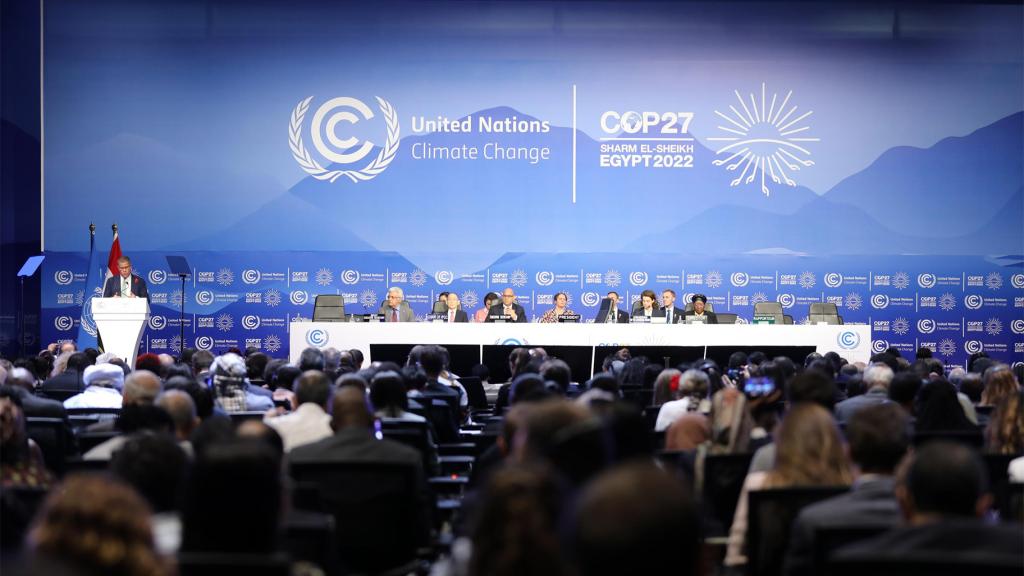
View of the dais on November 6, 2022, at COP 27
View of the dais during the opening plenary of the UNFCCC COP 27. Photo by IISD/ENB | Mike Muzurakis.

A great opportunity emerged in having COP 27 precede this year’s biodiversity COP 15, given that the former event has already signalled the urgent need to form stronger synergistic actions between these policy areas as countries aim to finalize and adopt a post-2020 GBF in Montreal. Here are four recent advancements that are paving the way for more joint action on climate and nature:

1. Science Is Telling Us We Cannot Address Climate Change Without Biodiversity Conservation—and Vice Versa.

Climate change is one of the key drivers of biodiversity loss. It increases the severity and frequency of hazards such as droughts and floods, changes the ranges in which species can thrive, alters food webs, and affects times and patterns of reproduction. Degradation of natural ecosystemsparticularly deforestationboth releases enormous volumes of greenhouse gases and reduces the ability of natural systems to continue to absorb carbon from the atmosphere and protect us from disasters.

Two rows of vertical stripes showing global warming and biodiversity loss from 1970-2018
The variety and abundance of species are declining, represented from the green stripes to grey, as global warming has intensified over the last half century.

Image from biodiversitystripes.info. Biodiversity stripes created by Miles Richardson (findingnature.org.uk) based on the warming stripes developed by Ed Hawkins. Data from LPI 2022 (Living Planet Index database, 2022).

A joint analysis by global climate change and biodiversity experts of the Intergovernmental Panel on Climate Change (IPCC) and the Intergovernmental Science-Policy Platform on Biodiversity and Ecosystem Services (IPBES) delivers one central message: It is essential for countries to focus on integrated approaches such as NbS. 

We cannot achieve the goals of the Paris Agreement without drastically reducing the threat to biodiversity. Equally, we cannot meet the proposed targets and goals of the Post-2020 Global Biodiversity Framework without more ambitious emission reduction targets and more urgent adaptation action.

2. A New Common Understanding for NbS Offers New Opportunities for Linkages

NbS have faced criticism in the past, which largely stems from a lack of a globally agreed upon definition, standards, and principles guiding the implementation of these solutions. This vacuum opened NbS up for harmful interpretations and misguided applications.

However, in March 2022, at the resumed Fifth United Nations Environment Assembly (UNEA 5.2), governments formally agreed on a definition of NbS and recognized the important role these solutions can play in the global response to climate change and biodiversity loss. 

The UNEA 5.2 resolution formally adopted the definition of nature-based solution as "actions to protect, conserve, restore, sustainably use and manage natural or modified terrestrial, freshwater, coastal and marine ecosystems, which address social, economic and environmental challenges effectively and adaptively, while simultaneously providing human well-being, ecosystem services and resilience and biodiversity benefits."

The decision by countries to adopt a multilaterally agreed definition of NbS is a big step forward for climate and biodiversity. It underscores the value of NbS as effective tools to jointly address climate change and biodiversity loss. It also presents a monumental step forward in developing a common understanding of what NbS are and the social and environmental safeguards that must be adhered to in their implementation.

3. Momentum Gained at COP 27 Creates Ripples for COP 15

The biodiversity COP has big ambitions, with a vision that "by 2050 biodiversity is valued, conserved, restored and wisely used, maintaining ecosystem services, sustaining a healthy planet and delivering benefits essential for all people."

View of the dais during the COP 15 plenary on December 5, 2022
View of the dais during the COP 15 plenary on December 5, 2022. Photo by IISD/ENB | Mike Muzurakis.

COP 27 spurred this momentum for COP 15 by underlining "the urgent need to address, in a comprehensive and synergetic manner, the interlinked global crises of climate change and biodiversity loss." For the first time, negotiators included dedicated sections on oceans, forests, and agriculture in the COP 27 cover decision—known as the Sharm el-Sheikh Implementation Plan. Specifically, the cover decision includes the term NbS within the forest section, emphasizing the importance of ensuring social and environmental safeguards, something IISD has advocated for as a crucial factor in delivering effective and sustainable NbS. Cover decisions provide a high-level political mandate to countries and signal the importance of an issue—meaning that NbS could be a regular element as part of future climate negotiations.

COP 27 also saw the launch of several new multi-country initiatives for tackling deforestation and restoring carbon-rich and biodiverse ecosystems, as well as the convening of the Finance Forum on NbS to close the NbS finance gap. These developments will also help accelerate the GBF’s major goal of protecting 30% of the planet’s land and sea areas by 2030 through area-based conservation.

4. Promoting Coherence Between National Climate and Biodiversity Strategies

Both conventions have created instruments to give countries the flexibility to develop their own national strategies to achieve the commitments they have made in these international forums. For the Paris Agreement, these are called Nationally Determined Contributions (NDCs) and National Adaptation Plans (NAPs) to address climate change mitigation and adaptation. Similarly, for the CBD, National Biodiversity Strategy and Action Plans (NBSAPs) allow countries to formulate and outline their strategies for protecting biodiversity and ecosystems.

Although national instruments and policies have been developed separately under these two conventions to make progress in tackling the issues, this does not impede governments from creating greater coherence and alignment between national commitments.

Given the current emphasis on NbS and the importance of protecting and restoring nature to address climate change, overlaps between the measures included under NDCs, NAPs, and NBSAPs are inevitable. For instance, commitments to protect and restore hectares of forests are not only a climate measure to sequester carbon and buffer against the impacts of extreme weather events, but also a conservation measure to protect biodiversity.

Recent international efforts such as the Leaders Pledge for Nature to build better bridges between the climate and nature are playing a key role in propelling and harmonizing these more coordinated climate-biodiversity responses at the national level.

CBD COP 15 Is a Once-in-a-Decade Moment to Set an Ambitious and Synergistic Agenda

As CBD parties iron out the details of the GBF in Montreal, negotiators must keep in mind the intricate linkages between biodiversity and climate change and design the GBF in a way that encourages joint actions. Below, IISD experts have assembled a list of key recommendations on setting the targets of the GBF that would build on the momentum of COP 27 and pave the way for a nature-positive, resilient future.

Recognize the right to a safe, clean, healthy, and sustainable environment. At COP 27, people’s right to a clean, healthy, and sustainable environment was recognized explicitly in the Sharm el-Sheikh Implementation Plan. This recognition was in line with the recently adopted UN General Assembly resolution (A/76/L.75) and UN Human Rights Council resolution (48/13). Negotiators at COP 15 should build on this momentum and explicitly include “the fulfilment of the right to a safe, clean, healthy and sustainable environment” as one of the key objectives of conserving and sustainably managing biodiversity in Section B and the proposed Goal B of the GBF.

Build in ambitious climate mitigation and adaptation targets for the biodiversityclimate nexus. The proposed Target 8 of the GBF should include clear and measurable commitments relating to climate mitigation and adaptation and disaster risk reduction. It should also recognize the importance of integrated approaches to addressing biodiversity degradation and climate change, including NbS and other ecosystem-based approaches. However, it is equally crucial to recognize that NbS cannot be a substitute for rapid, deep, and sustained emissions reduction measures. Without ambitious commitments to fossil fuel phase-out or the elimination of environmentally harmful subsidies (including fossil fuel subsidies), NbS alone cannot successfully address the twin crises.

Establishing robust social safeguards for NbS is key. Throughout the GBF, references to integrating human rights-based and gender-responsive approaches and social inclusion considerations in the planning and implementation of biodiversity actions are central to the legitimacy and integrity of the Framework. Robust social safeguards should be at the heart of NbS planning and implementation to protect people’s rights, especially those of Indigenous Peoples and local communities, and ensure equitable benefit-sharing, leaving no one behind. These safeguards are especially critical in the context of the proposed "30x30" target for ecosystem conservation.

Encourage synergistic implementation of biodiversityclimate actions. Amplifying and promoting the joint financing and implementation of projects that deliver multiple goals under the GBF and the Paris Agreement will further enhance synergies between the two conventions. This includes encouraging the joint planning and implementation of the NBSAPs and NAPs, as well as mobilizing public and private sector finance for NbS to fulfill the estimated USD 384 billion per year of investment needed for NbS by 2025. These considerations should be reflected in the GBF Targets 1422.

Enhance cooperation and joint programming between the Rio Conventions. The UNEA’s definition of NbS represents a leap forward in reaching a legally binding definition for NbS within international law. With this newfound momentum, it is time for the three Rio Conventions—the CBD, UNFCCC, and the UNCCD—to create a shared understanding of the values, impacts, and limitations of NbS, as well as a set of common guiding principles and safeguards needed during their planning and implementation. It is also time for enhanced cooperation to assess the complementarity and compatibility between the goals and targets of each convention’s legal instruments and financing facilities, including the GBF, the Paris Agreement, the Global Environment Facility, and other entities of the financial mechanism, and the UNCCD’s Global Mechanism.

*The image of the dais from the COP 15 plenary used for the top banner of this article is by IISD/ENB | Mike Muzurakis.


Deep Dive

How to Raise the GlaSS on the Global Goal on Adaptation at COP 27: Four foundations to build upon

As the Global Goal on Adaptation (GGA) draws increasing attention from country policy-makers, practitioners, and academics, the evolution of the debate and what to expect next remains to be seen. Ahead of the upcoming UN climate talks in Sharm el-Sheikh, Egypt, this article summarizes key resources and points about the GGA and highlights four foundations that countries and supporting actors must keep in mind as they work to determine what the GGA will ultimately entail.

November 1, 2022

Over the past year, the Global Goal on Adaptation (GGA) has gained attention from country policy-makers, practitioners, and academics trying to solve this puzzle: What relevant and appropriate global goals on adaptation should the Paris Agreement incorporate?

Despite the GGA gaining visibility, the evolution of the debate and what to expect next is ambiguous. Ahead of the upcoming 27th Conference of the Parties (COP 27) of the United Nations Framework Convention on Climate Change (UNFCCC) in Sharm el-Sheikh, Egypt, this article summarizes key resources and points about the GGA and highlights four foundations that countries and supporting actors must keep in mind when striving to make progress on determining what the GGA will finally entail. 

Slow progress…

In 2015, the Paris Agreement established the GGA with the aim of driving collective action on climate adaptation. The GGA was expected to be the counterpart to the goal of limiting global temperatures to “well below 2°C” and to 1.5°C, with the hope of raising the visibility of adaptation on par with mitigation. Yet the architecture of the GGA was not defined at that stage. The main issue is that, unlike mitigation, there are no global metrics that can meaningfully capture what enhanced adaptation means across all contexts and ecosystems. 

Six years later, at COP 26 in Glasgow, UNFCCC parties agreed to launch the Glasgow-Sharm el-Sheikh work program (also known as GlaSS) under Decision 3/CMA.7 to advance the GGA. This agreement represented a successful outcome of COP 26 and a significant step toward translating the GGA from the high-level goal in the Paris Agreement into concrete actions. The GlaSS is a 2-year work program led by the Subsidiary Body for Implementation (SBI) and the Subsidiary Body for Scientific and Technological Advice (SBSTA) with the support of the UNFCCC secretariat, under which a series of four workshops per year are organized. These workshops aim to enhance the understanding of the GGA across party and non-party stakeholders and advance discussions on some of the thorny issues of the GGA

The launch of the GlaSS work program reflected the ongoing requests from developing country parties over the years to make progress on the GGA, with the African Group of Negotiators (AGN) as the most vocal proponent. The Adaptation Committee’s work, based on mandates from the Paris Agreement, also played a key role in providing a technical basis for these discussions. The Adaptation Committee is the lead adaptation body under the UNFCCC, comprised of 16 members from across world regions. The committee’s technical report on Approaches to Reviewing the Overall Progress Made in Achieving the Global Goal on Adaptation, its recommendations under the committee’s 2021 annual report to COP 26, and a related webinar provided a strong base for the GlaSS decision text. 

From the work of the Adaptation Committee in 2021 and a study by the International Institute for Environment and Development (IIED) reviewing the developments under the GGA since 2015, areas of broadly shared understanding among parties and the UNFCCC have emerged. These include the need for the GGA to include several dimensions, as opposed to one single goal; to ensure collection and assessment methods are mixed, flexible, and country-driven; to be informed by current reporting and communications instruments, avoiding any additional reporting burdens for the parties; and to contribute to enhancing national adaptation planning, implementation, and monitoring, evaluation, and learning (MEL). The GlaSS decision text also supports the GGA following participatory approaches based on social inclusion and human rights. 

Yet, the tricky point of what the goal(s) itself actually is has meant that efforts to define the GGA’s architecture, goals, and approach are mired in confusion. In fact, the GlaSS decision text does not mention the definition of targets or goals—yet the fact that the GGA is in itself a goal renders this assumption an implicit end point of the GlaSS.

Midway through the GlaSS

Under the 2-year GlaSS work program, the SBI and the SBSTA are organizing a series of four workshops per year with the support of the UNFCCC secretariat. 

Midway through the GlaSS work program and on the eve of COP 27, what can be said about progress on the GGA? Over the past year, the GlaSS work program organized one informal event in May, along with three of its four annual workshops. The first workshop took place at the Bonn Climate Change Conference 2022 and was devoted to enhancing the understanding of the GGA, while the second workshop was held virtually in August and focused on enhancing adaptation action and support. The third workshop was held in Cairo, Egypt, and online, with a focus on adaptation methodologies, indicators, data and metrics, and monitoring and evaluation. The third workshop built on a compilation and synthesis of indicators, approaches, and metrics that the UNFCCC secretariat had prepared. The fourth and final workshop is scheduled on November 5, immediately prior to COP 27. The SBI co-chairs then have the mandate to present an annual report at COP 27. 

The slow progress on the GGA is partly due to the methodological complexity involved, which requires a shared understanding and usage of technical concepts. The pace is also the result of the sensitivity of politics around adaptation, especially when compared to mitigation. Additionally, there have been ongoing questions from UNFCCC parties and observers about the modalities of the GlaSS work program, which have not been conducive to exchanges and discussions. The formats have improved dramatically after the first workshop, now integrating breakout groups and presentations by external experts, allowing for more interactive discussions informed by a more diverse range of views. But participation has been an ongoing issue for many actors. For example, several developing country parties have called for the workshops to accommodate larger in-person participation due to the challenges of virtual attendance. Additionally, the lack of presence and inclusion of local actors in the workshops calls into question whether the GlaSS work program will be representative of the adaptation challenges of local communities and actors. 

Despite the workshops, there have been few advances in additional emerging areas of consensus this year. There is still a year to go under the GlaSS work program, but few concrete proposals have been made about what the GGA can consist of—and vagueness remains even after the third workshop focusing on metrics. A few actors have provided suggestions: the Small Island Developing States (SIDS) have given examples of sectoral goals, while the Maldives’ submission highlights five core functional elements to be included in the GGA. These five elements are sustainable development, support, collective action, capabilities, and transformation. Lastly, South Africa has pitched a high-level goal in an attempt to put something on the table. 

With no consensus across UNFCCC parties, the elusive question remains: What should be the goals of the GGA?

Reinforce and build upon existing foundations to accelerate adaptation

With the multiplicity of frameworks and approaches to assess adaptation, it is easy to lose track of the GGA’s primary purpose, as stated under the Paris Agreement: to advance adaptation actions towards “enhancing adaptive capacity, strengthening resilience and reducing vulnerability to climate change.” 

In ongoing efforts to support developing country parties in advancing their National Adaptation Plan (NAP) processes, the NAP Global Network, whose secretariat is hosted by IISD, has worked with over 21 developing countries on MEL systems as part of their NAP processes over the past year. Based on this experience and external literature stated in this article, there are four foundations that UNFCCC parties and supporting actors must keep in mind when raising ideas on the GlaSS work program and the GGA at COP 27 and in 2023. 

1. The GGA must start by looking at existing adaptation information and plans.

UNFCCC parties are using various vehicles to share their adaptation information under the Paris Agreement. These include forward-looking vehicles for planning, such as nationally determined contributions (NDCs) and NAPs, and for communicating, such as Adaptation Communications (AdComs) and National Communications. Additionally, parties will be expected to submit Biennial Transparency Reports (BTRs) to the UNFCCC from 2024 onward to report on what they have achieved. For each vehicle, guidelines have been developed—for example, the Adaptation Committee has just finished work on the supplementary guidance for AdComs, while modalities, procedures, and guidelines for BTRs were finalized in early 2022. 

Among other functions, NAP processes establish parties’ adaptation priorities, actions, and systems, grounded in considerations of climate risks through vulnerability and risk assessments. As such, NAP processes (and other sources of information) must be leveraged to inform the GGA, as well as the Global Stocktake

When thinking of propositions for the GGA, the international community and UNFCCC parties themselves could benefit by taking stock internally of the priorities and actions that parties have already communicated rather than looking outward to examples of frameworks that could be replicated. For example, Fiji developed a catalogue of adaptation measures with relevant tags to cross-reference different sustainable development policies and agendas as part of their NAP. Compiling an evidence base of adaptation priorities and sectors across instruments and policies would support a country-driven and bottom-up GGA, an approach that is also supported by the United Nations Development Programme. In turn, parties must consider how to increase the information they include in their adaptation vehicles to provide increasingly comprehensive and robust data.

2. The GGA must recognize parties’ efforts in MEL for adaptation.

Only 38% of NAP documents include mentions of monitoring and evaluation (M&E) frameworks, according to the latest information available under the NAP Global Network’s NAP Trends database and a 2021 article in Environmental Science & Policy giving a global overview and analysis of national M&E systems. Yet, the number of parties engaged in developing or using mechanisms to track NAP implementation has increased by 40% since 2017. These numbers show that while MEL systems are still being developed, parties are already receiving support and investing resources into them. Today, it is rare to find parties with no MEL system in place. But models and approaches vary considerably, and there is no one-size-fits-all national model for MEL. The GGA must respect and recognize the existing work on parties' MEL systems rather than try to develop new or parallel structures.

For example, Namibia is taking an incremental approach to developing the MEL system for its NAP by building from the protocols and institutional structures in its monitoring, reporting, and verification system for mitigation. On the other hand, Rwanda is starting to build its MEL systems from a sectoral approach, using the priority sector of agriculture as a pilot to develop a large-scale, comprehensive MEL system. Existing national MEL systems for adaptation—like Fiji’s Monitoring and Evaluation Framework for its NAP process or the guidance for the development of Grenada’s MEL system—can inform the GGA’s discussion on the methodologies, objectives, and approaches of measuring collective progress and what could be appropriate global targets.

3. The GGA must steer away from indicators and consider evaluation and learning. 

Discussions on the GlaSS work program and the GGA to date have spent a lot of time looking at indicators but much less on how the evidence from the GGA can improve evaluation and learning (E&L) to enhance adaptation actions. Without evaluations and learning about outcomes and impacts, the monitoring of indicators is of little value for advancing adaptation. Although a compilation of indications can be helpful for understanding what MEL systems are currently capturing, there are several limitations to consider. For example, the African Group of Negotiators Expert Support group reports that African countries use over 400 indicators for adaptation in their NAPs and NDCs. Similarly, the SIDS perspective on the GGA highlights the types and examples of indicators that countries use across instruments. 

These exercises show that while some indicators are similar, the variety of indicators used within a region signals how difficult it is to develop indicators that will be meaningful across contexts. Yet it is crucial for indicators to capture the exact nature of the context it aims to capture. As such, standardized indicators face even further difficulty in remaining meaningful across scales. For example, even relative measures such as the number of people living below national poverty lines hardly provide an appropriate basis for comparing the quality of life between poor and rich countries. In fact, there is already a body of research showing the perils of focusing on metrics. For example, given that the aggregation required to represent a metric must confine itself to using simple, quantitative numbers, it cannot account for important insights about progress being made. Parties have repeatedly called for the GGA to collectively represent a (set of) goal(s) rather than a set of top-down indicators.

"The danger is to just do things that can be measured easily. The GGA must monitor the indicators with the aim to evaluate outcomes of adaptation, the success of which should be seen through, amongst other outcomes, reduced losses and damages."

Animesh Kumar, United Nations Office for Disaster Risk Reduction (UNDRR), Third GlaSS workshop, Cairo, Egypt, October 18, 2022.

Current efforts by parties on evaluation are less documented than the monitoring of indicators. But evaluation exercises exist. For example, more and more parties are using progress reporting to take stock of actions and identify gaps: over 30 parties have already published NAP progress reports or NAP evaluations. Lessons from progress reporting show it can be a flexible approach for adaptive management through learning-by-doing, capturing impact stories, improving data collection, enhancing collaboration between ministries and agencies, and incorporating insights from disaggregated data on gender and social groups. Progress reports such Saint-Lucia’s and Kiribati’s can generate valuable information upon which the GGA can be designed. 

The work of the NAP Global Network shows that learning from MEL systems is happening, but often in a manner that is unplanned and unsystematic. In this effort, NAP processes and related MEL systems can support learning by including dedicated communication, dissemination, and learning mechanisms that would reinforce mutual accountability and transparency in national and subnational systems. For example, Peru’s NAP process includes a multistakeholder communication strategy with the objective of promoting opportunities for dialogue in order to drive action. The GGA can again leverage and reinforce these processes. For example, including mechanisms and spaces where parties can learn from cross-country peer exchanges has proven to be an impactful exercise within the NAP Global Network.

4. The GGA must be participatory in its processes and outcomes.

Climate impacts are highly contextual, which means that a large proportion of adaptation decisions and actions must be devolved and locally led to be effective. With the principle of subsidiarity in mind, this means that the GGA must reinforce subnational adaptation planning, implementation, and monitoring to achieve its stated objective. As such, participation from different constituencies and social groups in the processes of both undertaking the GlaSS work program and informing the GGA is essential to reflect local adaptation realities and experiences. In this, parties must serve as the nexus of integration between all of their respective society’s actors and the GGA, using gender-responsive and socially inclusive processes in their national processes, such as NAPs and AdComs, so that these can, in turn, inform the GGA.

Learn from MEL systems: Aim for a realistic, adaptable GGA

The four foundations outlined here provide ample examples that showcase adaptation actions in national and subnational systems. Aiming for simplicity in effective MEL systems, the GGA could use a synthesis of these systems as a simple, bottom-up approach and learn from there—one of the approaches a recent Center for Climate and Energy Solutions paper highlights. The international community and parties must accept that setting adaptation goals will be an iterative process, with lessons learned along the way that can inform future goals. In fact, MEL systems should always be evolving to adapt and capture the changing nature of adaptation priorities in the face of increasing yet unpredictable climate changes and shocks. Being pragmatic and basing outcomes on what parties can already provide, along with considering the first GGA as a first draft rather than a final outcome, may further help parties make substantive progress as they seek to advance the GGA, with the understanding that having imperfect yet realistic goals may be better than having none.

For further discussion on the GlaSS work program and the GGA, join us at our NAP Global Network and WWF co-organized event at COP 27 on Thursday, November 10, 2022, from 19h00-20h00 local time at the WWF Pavilion.

The banner image used in this article is by Kiara Worth for IISD/ENB and is from the IPCC Special Event under the GlaSS work program at the June 2022 climate talks in Bonn.
 

Deep Dive

Why Government Support for Decarbonizing Oil and Gas Is a Bad Investment

The Bottom Line: Unpacking the future of Canada's oil & gas

Re-Energizing Canada is a multi-year IISD research project envisioning Canada's future beyond oil and gas. This policy brief is part four of The Bottom Line series, which digs into the complex questions that will shape Canada's place in future energy markets. (Download PDF)

October 24, 2022

Summary:  

  • Oil and gas use is driving climate change, and prolonged extraction and increased production are not compatible with the global climate goal to limit warming to 1.5°C.

  • The Canadian oil and gas industry has sufficient funds to invest in decarbonizing its production, particularly in light of recent windfall profits.

  • However, despite some companies’ 2050 net-zero targets for their operations and a recent commitment to invest in decarbonization technologies, the industry has failed to take the necessary steps to reduce its emissions this decade. A credible 1.5°C trajectory requires substantially reducing emissions in the near term, as well as meeting longer-term targets.

  • The industry already receives significant government financial support, and the federal government has committed to ending this support by phasing out inefficient subsidies and public finance for the sector in the near term.

  • Existing government support for decarbonizing the sector has not been consistently successful in lowering emissions.

  • Further support to the sector comes with significant opportunity costs, will slow the energy transition, and entails economic risk, including public liabilities. Public dollars are more effectively spent supporting readily available and proven low-carbon technologies.

Oil-and-gas-emissions

As the world moves to limit the worst impacts of climate change, addressing the immense challenge of decarbonizing high-emitting industries is increasingly urgent. Canada’s largest source of greenhouse gas emissions, the oil and gas sector, is under pressure to curb its emissions. While long-term reliance on oil and gas production is not compatible with global climate goals, lowering emissions from current Canadian oil and gas production is also critical in the short term to ensure early emissions reductions before 2030, particularly given the outsized contribution of the sector’s emissions and the stepwise nature of the transition. Reducing these emissions through readily available actions like electrification, process improvements, energy efficiency, and addressing methane leakage is essential to meeting Canada’s 2030 target of 40%–45% reductions below 2005 levels. Despite uncertainty regarding its deployment, carbon capture, utilization, and storage (CCUS) has also garnered significant attention as a proposed technology to reduce the sector’s emissions, but it is not expected to contribute significantly to reductions before 2030. Although operations- and production-related emissions represent only a small fraction of overall life-cycle emissions from oil and gas, they have been the primary focus of government and corporate net-zero targets and commitments for the sector.

To date, the Canadian federal government has directed a substantial amount of public money toward decarbonizing the oil and gas sector. One of the largest supports is the new investment tax credit for CCUS projects, estimated to cost up to CAD 1.5 billion per year to 2030. Aside from the tax credit, the federal government has provided CAD 2 billion in support to CCUS since 2000. Other federal programs have aimed to support decarbonization projects in the sector as well, such as the CAD 750 million Emission Reduction Fund and Export Development Canada’s new “transition bonds”. The new CAD 8 billion Net Zero Accelerator initiative supports large investments in the decarbonization of key industrial sectors and is expected to include allocations for oil and gas. Provincial governments also direct substantial funds toward decarbonizing the sector. For instance, Alberta has allocated significant subsidies for CCUS projects through the CAD 750 million Technology Innovation and Emissions Reduction Fund.

With limited public dollars available to fund the energy transition, it is critical to assess whether such supports are an appropriate use of public funds or whether they present an opportunity cost—reducing the money available for clean, viable, long-term energy solutions.

Oil and Gas Are Driving Climate Change, and Further Investment Slows the Clean Energy Transition

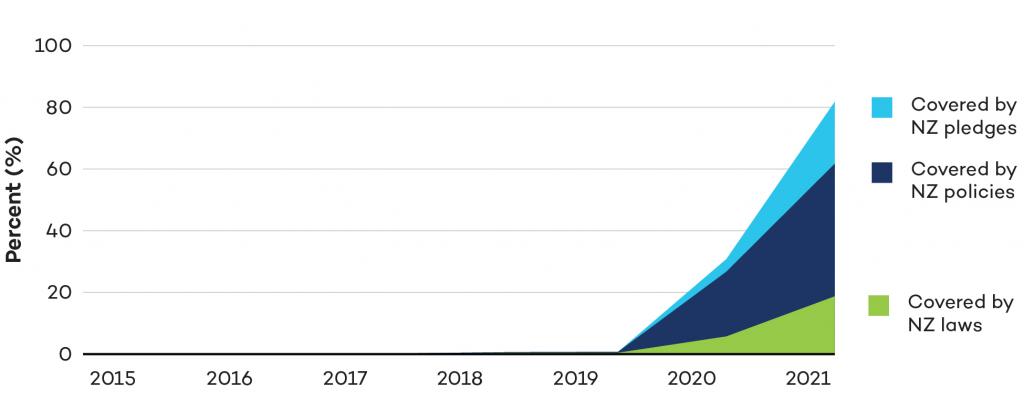
The Intergovernmental Panel on Climate Change’s (IPCC’s) Sixth Assessment Report declared the evidence that humans are driving climate change “unequivocal,” with the production and use of oil and gas being major drivers. Carbon dioxide created primarily through the burning of fossil fuels accounted for 80% of total emissions in Canada in 2020, with an additional 7.4% from fugitive methane emissions alone. Globally, net emissions have continued to increase across all sectors, including oil and gas, since 2010. The IEA’s net-zero scenario finds that no new fossil fuel fields need to be developed in a world where global warming is limited to 1.5°C. In the same scenario, oil and gas production decline by 75% and 55%, respectively, by mid-century. As a result of changing markets, global net-zero pledges, and ratcheting climate commitments, leading energy scenarios, including the IEA’s, forecast a steep decline in oil demand beginning by 2030.

pollution-forest-fires

Nonetheless, a major focus of Canadian net-zero policy discussions has been the decarbonization of the oil and gas sector, given that the sector is responsible for approximately 27% of Canada’s emissions. Decarbonizing production is essential in the short term, particularly to ensure meeting Canada’s 2030 target, but ultimately does not reduce the vast majority—70% to 80%—of the life-cycle emissions created when those fuels are burned. Canada exports more fossil fuels than it uses domestically, meaning that emissions from the end uses of Canadian oil and gas exports are higher than total domestic emissions from all sectors—30% higher in 2019, at a total of 954 Mt. Because of the export orientation of the Canadian oil and gas sector, declining global demand poses a significant risk to the sector that cannot be fully addressed by decarbonizing production.

Government financial support for decarbonizing oil and gas decreases the cost of production, prolongs the lifespan of projects, and can enable increased production, making the transition to renewable energy more difficult. Prolonging production in a sector that will decline in a world that successfully limits warming to 1.5°C globally is inconsistent with Canada’s climate goals. This support also increases the risk of stranded assets in the context of a shifting energy landscape. A recent study estimates that the value of stranded assets in the oil and gas sector exceeds USD 1 trillion globally, including around USD 100 billion in stranded assets in Canadian oil and gas fields. Government-supported projects that risk becoming stranded assets, including decarbonization projects whose viability relies on continued demand, would result in financial risk, and any ensuing costs would be borne by Canadian taxpayers. 

Oil and Gas Companies Do Not Need Government Support to Decarbonize

The “polluter-pays” principle holds that the private sector should be financially responsible for managing the environmental damage it causes. In the case of oil and gas, this includes both lowering production emissions and taking responsibility for downstream climate impacts that result from the fuels being burned.

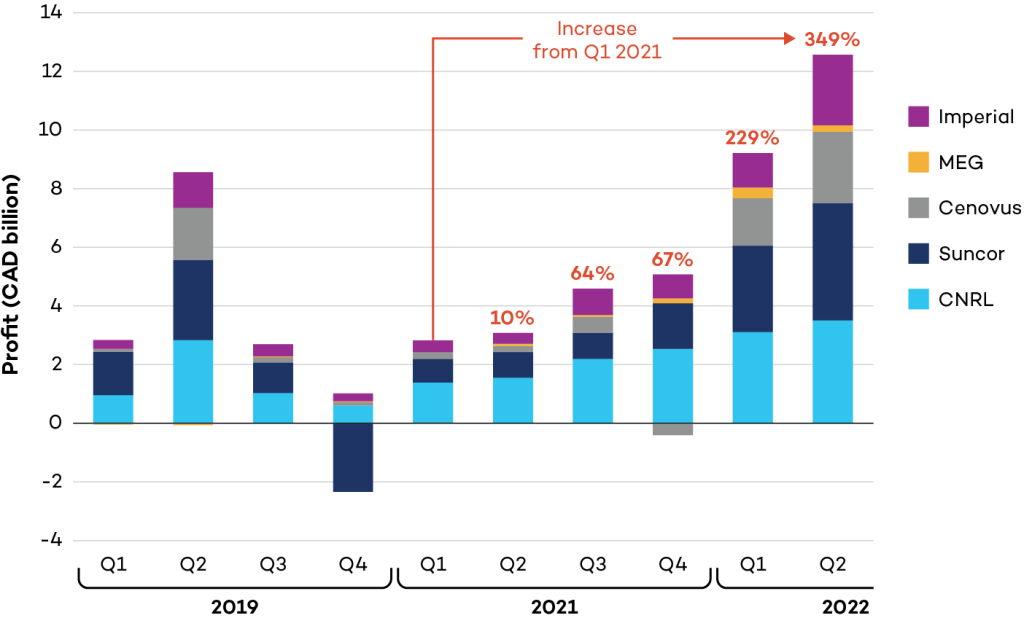
Oil and gas companies are well positioned to cover these costs, particularly in light of recent windfall profits due to high energy prices exacerbated by Russia’s invasion of Ukraine. Canadian oil and gas companies’ profits are projected to reach CAD 152 billion this year, while five of the biggest firms have seen a nearly 350% increase in free cash flow from the first quarter of 2021 to the second quarter of 2022. For example, on the same day that the CEO of Cenovus requested more government investment in CCUS, the company announced a sevenfold increase in quarterly profits.

Figure 1. Profits of five oil and gas companies pre- and post-pandemic

Profits of five oil and gas companies
Source: Gorski & El-Aini, 2022.

Given these profits, oil and gas companies should be able to prioritize lowering emissions without government support. Government spending on oil and gas decarbonization would contribute to lowering the cost of production without guaranteed reductions in emissions. For example, in 2021 Canadian Natural Resources Limited invested CAD 84 million in emissions reduction research and development. This investment was found to have little impact on absolute net emissions reductions—while the company expects to return CAD 14 billion to shareholders between 2021 and 2022.

All economic sectors, including the oil and gas industry, have a responsibility to reduce emissions in line with global climate goals. The electricity sector has reduced emissions by 52% since 2005, while emissions from heavy industry have dropped by 18%. Meanwhile, emissions from the oil and gas sector increased by 20% from 2005 to 2019. Emissions reductions will only be effective if we see economy-wide action; failure to decarbonize in one sector puts additional and unfair pressure on other sectors to make up the difference.

The Industry Has Yet to Demonstrate Sufficient Commitment to Climate Action

In recent years, the oil and gas industry has voiced recognition of the need to address climate change and publicly positioned itself as part of the solution. In 2021, Canada’s largest oilsands producers established the Pathways Alliance, which set a target of net-zero emissions from oil sands production by 2050.

Current research shows that, to be effective, oil and gas sector net-zero targets should, at minimum:

  • Be aligned with or exceed Canada’s climate commitments.

  • Emphasize early, deep, and absolute emissions reductions.

  • Include interim targets for 2030 that are in line with IPCC 1.5°C pathways and do not rely heavily on carbon dioxide removal or CCUS.

  • Outline clear plans to end exploration for and development of new oil and gas fields.

  • Cover Scope 1, 2, and 3 emissions.

The net-zero plans of oilsands majors are, however, inconsistent with these criteria: many companies omit Scope 3 emissions, do not include robust interim targets, and/or rely heavily on carbon offsets rather than absolute emissions reductions.

Meanwhile, Canadian oil and gas companies plan to expand production of oil and gas by nearly 30% from 2020 to 2030, which would lead to a 25% increase in associated annual emissions. Existing Canada Energy Regulator scenarios—which are not aligned with the 1.5°C target—also forecast increases in oil and gas production. Reducing the emissions intensity of production is insufficient in a context of growing production since overall emissions will still increase.

Despite some industry net-zero announcements, existing government supports, continued calls to action, and windfall profits, Canadian oil and gas companies have not made substantive financial commitments to decarbonization, nor have they released sufficiently detailed plans for their emissions reductions. Instead, they are directing record portions of their cash flow toward shareholder benefits. Despite methane reductions being one of the most cost-effective and impactful means of climate mitigation, action by Canadian companies to reduce methane has been slow, and methane emissions from the sector remain largely underestimated.

The Pathways Alliance committed to investing CAD 24 billion in emissions reduction projects between now and 2030. This figure may sound significant; however, spread over 8 years it represents only 2% of these companies’ annual profits based on projected 2022 revenues. Further, they plan to invest the majority of this amount in carbon capture and storage, which is not expected to lower emissions by 2030. Notably, the group has indicated that the commitment is conditional on further government support for their proposed projects.

At the same time, the industry has pushed back significantly on emissions regulations while lobbying extensively for government financial supports. The Canadian Association of Petroleum Producers opposes the federal government’s forthcoming legislation to cap and cut emissions from the oil and gas sector. The group also lobbied for the CCUS investment tax credit to cover 75% of the costs of building CCUS facilities, which is the level they deemed high enough to make companies’ own investment in the technology worth their while. When the government announced a 50% CCUS investment tax credit, many oil and gas companies claimed it would be insufficient to incentivize them to reduce their emissions. This raises questions about whether the sector is financially viable in the long term if the industry itself is not able to invest without substantial public support.

Additional liabilities to taxpayers

The industry already has a track record of unpaid taxes and environmental liabilities for which Canadian taxpayers may be held liable. For instance, oil and gas companies owe Alberta municipalities CAD 253 million in unpaid property taxes. Additionally, there are 300,000 oil and gas wells unreclaimed in the province, which the Alberta Liabilities Disclosure Project estimates would cost between CAD 40 to 70 billion to clean up. On a national scale, cleaning up abandoned wells—those that do not have a known, financially viable operator—would cost an estimated CAD 361 million as of 2020, which is expected to rise to CAD 1.1 billion by 2025.

Reducing the emissions intensity of production is insufficient in a context of growing production since overall emissions will still increase.

Government Support for Decarbonizing Oil and Gas Has Not Yielded Meaningful Results

Governments across Canada already provide substantial subsidies and other supports, such as public finance to the industry. Subsidies of at least CAD 4.8 billion per year are provided through measures such as tax breaks and direct cash transfers by both provinces and the federal government. For example, since 2019 the Alberta government has provided CAD 4.3 billion in tax cuts to the four largest oil sands companies. Meanwhile, in the same period these companies cut thousands of jobs and increased profits for executives and shareholders. In addition to fossil fuel subsidies, Canada is among the largest providers of public finance to oil and gas in the world, averaging CAD 11 billion per year between 2018 and 2020.

The federal government has made multiple commitments to phase out financial support for the fossil fuel industry: to end inefficient fossil fuel subsidies by 2023; to end international public finance for unabated fossil fuels by the end of 2022; and to eventually end all public financing (including domestic) for fossil fuels (though no date has been specified). Action on these commitments is lagging; Canada is last among 11 OECD countries ranked on progress to end support for fossil fuels and is not on track to meet its Glasgow commitment on international public finance. Further support, even for decarbonization, could undermine domestic and international commitments on climate change and ending support for fossil fuels.

Previous government support aimed at decarbonizing oil and gas production has not been consistently successful and in some cases has actually led to increased overall emissions. The Onshore Program of the Emissions Reduction Fund—a fund providing up to CAD 675 million to oil and gas companies for emissions reductions—failed to achieve emissions reductions value for money. The Office of the Auditor General found that 27 of the funded projects led to an increase in oil or gas production, which lessened or outweighed the emissions reduced, due to a lack of sufficient safeguards. In another example, CAD 1 billion in federal funds for the cleanup of abandoned and inactive oil and gas wells distributed through Alberta’s Site Rehabilitation Program likely replaced industry’s own cleanup budget, lowering the cost of business for producers, and failed to create the number of expected jobs.

Public Money Can Best Support Emissions Reductions Through Other Sectors

Government funds for decarbonizing the economy are limited, and funding must be prioritized to ensure the effective use of public money. Support for decarbonizing the oil and gas sector comes with significant opportunity costs for advancing other viable low-carbon solutions and for supporting workers and communities through economic diversification.

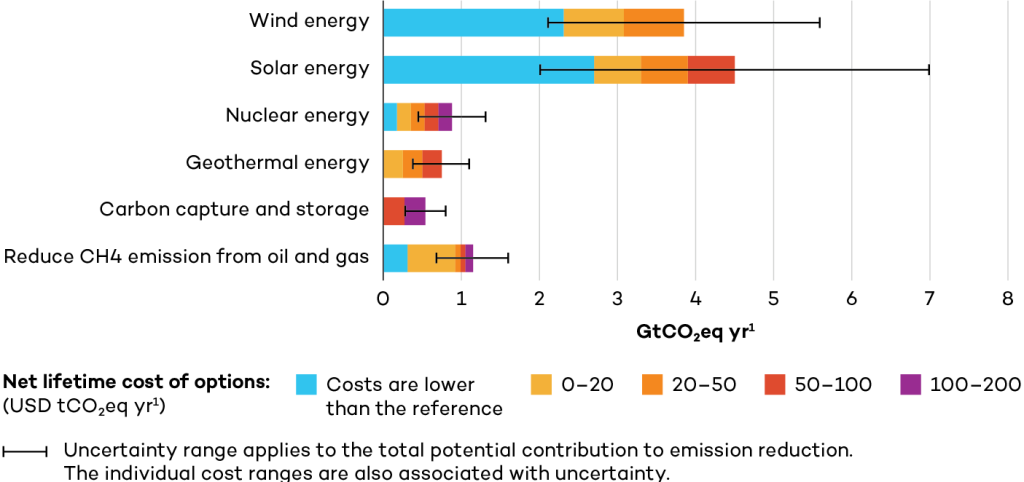
CCUS, a technology increasingly favoured by the Canadian oil and gas sector, is among the most expensive decarbonization measures with the lowest potential for emissions reductions globally by 2030. CCUS requires significant infrastructure buildout, including pipelines, making it slow to come online, and it has not been proven cost effective at scale. As a result, it is considered a “wild card” technology that is not expected to significantly impact emissions before 2030. Analysis has found that the seven operational CCUS plants in Canada capture only 0.05% of national emissions. Further, 70% of carbon captured in Canada is used for enhanced oil recovery—that is, to increase production. The IPCC warns that overreliance on carbon dioxide removal and CCUS poses a major risk to achieving the goals of the Paris Agreement and outlines 26 energy pathways to 1.5°C that make little use of these technologies.

Figure 2. The emissions reduction potential and cost of various mitigation options in the energy sectors globally according to the IPCC

The emissions reduction potential and cost of various mitigation options in the energy sectors globally according to the IPCC
Source: Based on data from Babiker et al., 2022.

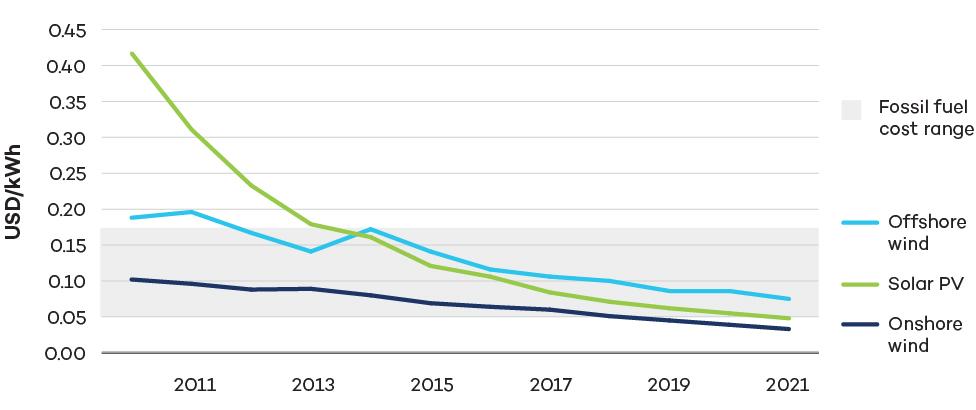
Prioritizing government spending on proven and cost-effective clean technologies such as renewable energy, building retrofits, and clean and scaled-up electricity grids is the most reliable way to support a swift transition to a low-carbon society. The cost of renewable energy has plummeted in the past decade, making many clean technologies competitive with conventional energy sources. From 2010 to 2019, the unit cost of solar fell by 85%, wind by 55%, and lithiumion batteries by 85%, resulting in large increases in their deployment globally. Wind and solar energy have some of the greatest potential to contribute to emissions reductions globally in 2030 at relatively low costs.

renewable-wind-solar

Investing in renewable energy and electrification can increase both affordability and energy security for Canadians. This would protect Canadian consumers from the volatility of global fossil fuel markets and geopolitics while furthering the federal government’s commitments to having a non-emitting electricity grid and no new combustion engine vehicles by 2035. While investment from the private sector will undoubtedly be key, government support will play a central role in enhancing grid infrastructure, ensuring regulatory reform, and de-risking investment in the sector.

Conclusion: No room for government support for oil and gas decarbonization

Government support is needed to reduce emissions of high-emitting industries that are challenging to transition, but proven solutions should be the priority. Governments should focus on industries that will be increasingly necessary in the years to come, attaching strong conditions to ensure significant emissions reductions are achieved. Governments should also focus on supporting workers and communities to plan and implement energy and economic diversification with focus on long-term, good-quality, sustainable jobs.

Fossil fuels are driving climate change, and we expect declining demand in the decades to come, given Canadian and global net-zero commitments. As pressure for the oil and gas industry to lower emissions mounts, Canadian companies should be able to decarbonize independently, without public support, in light of recent strong profits. Even with already-high levels of government support in recent years, industry progress on decarbonization has been slow. Given the uncertain future of the sector because of declining demand and the availability of cost-effective alternatives to many fossil fuel end uses, government support for decarbonizing oil and gas is a risky and ineffective use of public funds. It is also at odds with Canada’s international commitments. Public funds are much better spent on proven tools like renewable energy and energy efficiency, which will enable more long-term emissions cuts. Shifting support from oil and gas to clean energy is critical to simultaneously further our net-zero goals, increase energy security, and reduce energy costs for Canadians.


A full list of references can be found here.

Re-Energizing Canada is a multi-year IISD research project envisioning Canada's future beyond oil and gas. This publication is part four of The Bottom Line policy brief series, which digs into the complex questions that will shape Canada's place in future energy markets.

Deep Dive

Why Canada’s Energy Security Hinges on Renewables

The Bottom Line: Unpacking the future of Canada's oil & gas

Re-Energizing Canada is a multi-year IISD research project envisioning Canada's future beyond oil and gas. This policy is part three of The Bottom Line series, which digs into the complex questions that will shape Canada's place in future energy markets. (Download PDF)

October 3, 2022

Summary 

  • Energy security stems from energy availability and affordability.   
  • Canada’s energy system is dominated by oil, gas, and coal and is therefore susceptible to the geopolitics of global producers and unpredictable market forces. 
  • The cost of renewable energy has declined to the point where, in many markets, it is less expensive than gas or coal-fired electricity.   
  • Renewable energy prices do not fluctuate with global fuel markets, making them far less susceptible to volatility and price spikes.  
  • Canada is well positioned to manage high amounts of variable renewable energy without compromising reliability. 
  • Electrification of transportation and heating can further protect Canadians from exposure to volatile fossil fuel markets. 
  • Governments should prioritize investments in clean, flexible, and reliable electricity grids to support energy security. 

Oil, gas, and coal have been the central pillar of the global energy system throughout the 20th century. And for decades, these fossil fuels have been closely associated with energy security.  

The perception of energy security, however, is rapidly changing. Renewables form an increasing share of energy sectors worldwide as countries look to deliver on the Paris Agreement and mitigate the effects of climate change. Moreover, Russia’s invasion of Ukraine has demonstrated how relying on fossil fuels for power, heating, and transport has left many countries vulnerable or energy insecure.  

The International Energy Agency (IEA) defines energy security as “the uninterrupted availability of energy sources at an affordable price” (IEA, 2019a). This definition hardly describes today’s global energy situation, with the cancellation of natural gas deliveries and skyrocketing prices for oil and gas products. These circumstances have cascading effects on electricity prices in countries like the United Kingdom that rely heavily on natural gas to produce electricity. In Europe, energy insecurity has been even further amplified since the Russian corporation Gazprom recently cut off gas supplies to several countries.  

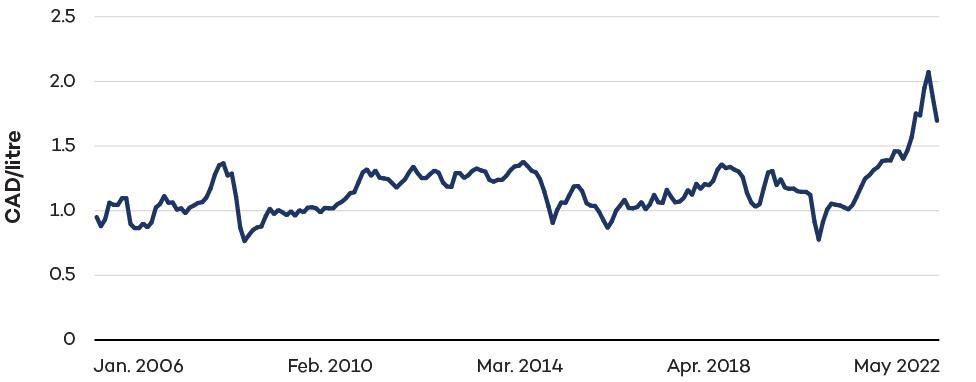
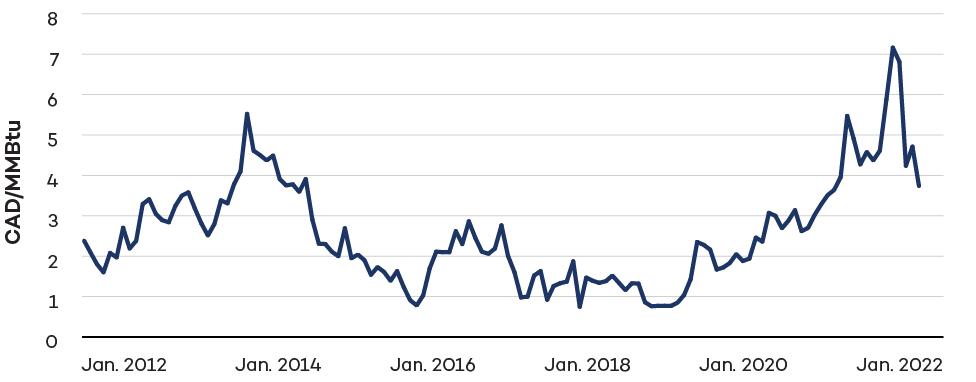
As a result, energy security has gained new urgency in Canada and worldwide. Recent events provide a stark reminder of the volatility and potential vulnerability of global fossil fuel markets and supply chains. Even in Canada, as one of the largest producers of oil and gas in the world, the price of fuels depends on global and regional market forces rather than government policy or market design. Thus, the average monthly price for gasoline in Canada hit a record high of CAD 2.07 per litre in May 2022 (Figure 1), and natural gas prices surged to a record CAD 7.54 per MMBtu in May 2022 (Figure 2).  

Energy price increases of this magnitude are more than enough to strain Canadian household budgets. But on top of that, oil and gas prices have accelerated inflation more broadly as it has become more expensive to produce, transport, and store goods, including food and other basic commodities.

Figure 1. Monthly average prices of gasoline in Canada, 2006–2022 (CAD cents/litre)  

Graph showing volatility of monthly average gasoline prices in Canada
Source: Statistics Canada, 2022, Table 18-10-0001-01.


Figure 2. Alberta Energy Company (AECO) natural gas prices in Canada (CAD/MMBtu) 

Figure 2. Alberta Energy Company (AECO) natural gas prices in Canada (CAD/MMBtu) 
Source: GLJ, 2021.

Although the dynamics of rapidly transitioning energy systems remain uncertain, renewable energy technologies have the potential to improve energy security by providing uninterrupted and affordable energy in the immediate future.  

Oil and Gas Markets Are Inherently Volatile—and Will Continue To Be  

The inherent volatility of global fossil fuel markets became painfully evident in 1973 when the world saw its first oil crisis after World War II. The price of oil increased from USD 2.90 per barrel in October to USD 11.65 in January 1974, leading to a global recession. The oil crisis spurred governments worldwide to pursue other energy types, including renewable energy, nuclear, and hydropower, to ensure the security of supply. Most countries also increased efforts to extract fossil fuels domestically. Likewise, coal saw a resurgence, and governments turned to energy-efficiency policies such as car-free Sundays and other consumer-focused measures to curb demand

Natural gas markets are more regional than oil markets. However, in the last decade, the regional gas markets have become more integrated due to better transportation opportunities and increased trade in liquified natural gas. Despite being more regional, due to market design, consumption patterns, and storage and transportability challenges, natural gas markets have arguably been more volatile than the market for crude oil.  

The volatility of natural gas markets has been evident over the last year. Even before the Russian invasion of Ukraine, natural gas market instability was notable, with prices spiking significantly across all markets. In October 2021, record-high gas prices in Europe and Asia associated with the COVID-19 recovery were spilling over into the American market, driving 12-year high prices of USD 6.31 per million Btu. Likewise, implied volatility, a measure of the expected fluctuations of future gas prices, rose to an all-time high of 122.5% in early October. The war in Ukraine exacerbated these trends, leading to record-high prices in the North American market in 2022.  

Faced with an energy crisis, the European Union (EU) and member states are doubling down on existing climate commitments and accelerating the transition away from natural gas. EU leaders are calling for more renewable energy to improve energy security: as EU Energy Commissioner Kadri Simson said, “The only long-term remedy against demand shocks and price volatility is a transition to a green energy system”. Similarly, the German Finance Minister has labelled renewable energy the “energy of freedom”, and the Danish government has decided to phase out natural gas completely by 2030 on energy security grounds. 

“The only long-term remedy against demand shocks and price volatility is a transition to a green energy system”.

Kadri Simson, EU Energy Commissioner

Renewable Energy Is More Affordable 

In contrast to oil and gas, renewable energy can reliably deliver affordable energy. This is a unique and positive aspect of today’s energy crisis compared to historical crises: options for electrification and renewable-based electricity systems are both available and cost-effective.  

For new power capacity, wind and solar are now cheaper than any other source. According to Equinor, wind and solar were already cheaper than gas-based power in 2020. This means that renewable energy was already the cheaper option for new power before the recent natural gas price spikes. As illustrated in Figure 3, the cost of new renewable energy has dropped so dramatically that, for many countries, it is cheaper to install new solar or wind infrastructure than to keep operating existing fossil fuel-based power plants. This means that replacing fossil-based electricity generation with renewables would save money and reduce emissions. Wind and solar prices are expected to continue their downward trends as more countries increase deployment and learn how to best integrate these sources into the grid.  

Figure 3. Levelized cost of electricity (LCOE) for newly commissioned utility-scale solar photovoltaic (PV) and onshore and offshore wind from 2010 to 2021 (USD/KWh)  

Figure 3. Levelized cost of electricity (LCOE)1 for newly commissioned utility-scale solar photovoltaic (PV) and onshore and offshore wind from 2010 to 2021 (USD/KWh)
Source: IRENA, 2022. 

The LCOE is a measure of the average net present cost of electricity generation for a generator over its lifetime. LCOE is frequently used to compare the price of different electricity generation options over an asset’s lifetime. Figure 3 shows significant price decreases for renewables over the past decade, with costs declining 88% and 68%, respectively, since 2010 for solar PV and onshore wind. The fossil fuel range illustrates that both solar PV and onshore wind prices are now lower than the cheapest fossil fuel-based alternative by 11% and 38%, respectively. IRENA’s LCOE numbers are based on a global weighted average.

One benefit of an electrified system powered by renewable energy is that it does not rely on input fuel to operate. Once built and connected to the grid, the cost of renewables does not fluctuate based on fuel prices; renewables can then operate at consistent, low costs, which, in turn, can lower electricity prices across the entire system. For instance, when the wind is blowing in Alberta, wholesale electricity prices in the province drop (Independent Power Producers Society of Alberta, 2022). Long-term price stability can also be locked-in through energy purchase agreements that guarantee the price of renewable resources decades into the future.    

And finally, renewable energy is either installed (provincially/territorially) or imported regionally through transmission lines. With an electricity system based on renewables, governments can more directly ensure affordable and reliable energy through market design and policy.    

Renewable Energy Is Reliable 

To deliver on the uninterrupted availability side of the energy security equation, renewable power must remain reliable even as more variable energy sources, like wind and solar, are added to the system. For Canada and other countries to achieve high energy security through electrification, grid system operations must be able to support this.  

Integrating variable resources on a large scale requires

  1. Strong transmission grids and interconnectors 
  2. Regional electricity markets 
  3. Flexible generation 
  4. Specialized forecasting and planning tools. 
electricity_grid.jpg

Canada’s power sector is well placed to perform in all four categories. Canada has more than 160,000 km of transmission network lines, mainly running north to south across the U.S.-Canadian border. In terms of regional electricity connections, Canada has 37 connection lines to the United States and exports around 10% of its total electricity generation. More integration of provincial electricity grids is needed and there remain political, social, and institutional barriers to increasing interprovincial transmission infrastructure, however, interprovincial trade presents a technically feasible and cost-effective means to support increased renewables and improve the resilience of the grid. 

Large hydroelectric resources can be operated with flexibility in order to ramp up and down to match changes in electricity supply or demand. Canada’s existing hydroelectricity capacity, which accounts for about 60% of the country’s electricity generation, provides significant flexibility to complement variable resources like wind and solar. In addition, all provinces and territories with a high proportion of fossil fuels on their electricity grids—which are thus prime candidates for a large scaling-up of renewables—are adjacent to provinces and territories with extensive hydroelectric resources that could support them. Additionally, provinces with existing large hydroelectric resources benefit greatly from purchasing low-cost renewable electricity from neighbouring regions, and shifting the use of more expensive hydro to when it’s needed.

Storage technologies are another means to improve the flexibility of the grid. Like renewables, the costs of utility-scale lithium-ion batteries are falling rapidly and are projected to continue to decrease, in part due to innovation in transportation applications.  

Forecasting is also well advanced, with regions using 12-hour power forecasts that are updated every 10 minutes. As wind and solar capacity in the power system increases, forecasting will improve based on the analysis of historical data from installed sources.  

The integration challenge has already been solved in European countries with high shares of variable renewable resources. In Denmark, the security of supply is 99.997% (the highest in Europe), with 50% of all power coming from wind. Moreover, forecasting and the reliability of wind power are so advanced that it is part of the capacity market for manual reserves, which means that variable renewable energy is considered as reliable as thermal power plants based on biomass or coal.   

Renewables Can Provide Energy Security to Canadians 

In Canada, gas-generated power accounts for 11% of total electricity production. Refined petroleum products and natural gas use account for 76% of total end-user demand across the country, including for transport and heating. Therefore, most of the energy that Canadians use is priced based on markets that are outside of Canadian control. As the current energy crisis shows, global price mechanisms for fossil fuels provide no shelter for Canadian consumers, even though Canada is a major oil and gas producer. Nevertheless, Canada is well placed to bolster its energy security by supporting electrification and renewable energy.  

fossil-fuels-emission

Clean electricity grids are well within reach across the country. Canada is already a global leader in the power sector, with 82% of its electricity coming from non-emitting sources, mainly hydropower. Legacy hydroelectric development has been bolstered by coal phase-outs, implemented first by Ontario and Alberta and followed by a federal regulation ensuring a nationwide phase-out by 2030. More recently, the federal government has committed to a non-emitting electricity grid by 2035 and developing clean electricity regulations to meet that end. Detailed modelling has shown how Canada can meet its 2035 target, support increased electrification, and provide reliable, affordable electricity across the country by prioritizing wind, solar, electricity storage, and additional interprovincial transmission. This scenario is modelled with no new nuclear or natural gas generation.  

Expanding renewables is also a cost-effective option. Electricity prices across the country demonstrate that provinces and territories with high shares of renewable energy have been able to keep power prices low with renewable electricity production. Households in fossil fuel-reliant provinces such as Saskatchewan pay 60% more for their power than households in Quebec and 45% more than households in Manitoba. Although the cost differential is related to legacy hydroelectric development, the falling costs of solar, wind, and battery technology mean that these sources provide the lowest cost options for supplementing existing hydroelectricity or replacing coal and gas power generation.   

Information from the Alberta Electric System Operator confirms that wind and solar are already the cheaper options for new power than gas (normally the cheapest fossil fuel-based alternative). This shift is also evident when looking at actual power sector development in Alberta in recent years. In its deregulated and competitive market, Alberta added a remarkable 1.6 GW from wind and solar between 2019 and 2021, resulting in wind and solar accounting for 17% of total capacity in 2021. At the same time, the province has phased out coal faster than expected.

Modelling in Alberta, New Brunswick, and Nova Scotia has also shown that clean energy portfolios, including wind, solar, battery storage, demand flexibility, and energy efficiency, can provide the same grid services as natural gas generation at a lower cost.  

As noted above, more flexible electricity grids will be needed to support renewables. This flexibility will include more integrated provincial and territorial grids that maximize renewable energy sources across the country. Currently, Canadian provinces are better connected to the United States than to each other. Provinces and territories need to improve connectivity so that Canada can benefit from their different strengths—from plentiful hydropower in some provinces and territories to the enormous potential for wind and solar in others. Additional investments and regulatory reforms are necessary to ensure adequate storage and “smarter” grids that support improved forecasting of supply and demand and that fully enable demand management.  

Reducing Demand for Fossil Fuels Increases Energy Security 

While renewables and storage technologies can eliminate fossil fuels from the electricity grid, electrifying end uses and reducing demand through energy efficiency will limit Canadians’ direct exposure to fluctuating fossil fuel prices. At the household level, electricity currently accounts for 23% of energy use. However, that is predicted to grow to 96% in 2050 if Canada achieves its net-zero target. 

While this transition is already underway, accelerating the phase-out of fossil fuels in household consumption will improve energy security, in part because sectors such as personal transport and heating, where demand for fossil fuels is high, have readily available, cost-competitive alternatives.  

The federal government’s target of no new combustion engine vehicles as of 2035 is a policy step that will not only help Canada build a cleaner future but also help to considerably reduce its dependency on oil and gas. Canada has more than 25 million light-duty vehicles on the road, and to reach the 2035 target, the government is aiming for 60% of new sales to be zero-emission vehicles by 2030. However, it has been noted that the market for electric vehicles is now established to the point where market dynamics are replacing government policy as the key driver for adoption.  

Other demand-side policies could include efforts in Canada’s building sector, where gas plays a key role. About a quarter of Canada’s final energy consumption comes from buildings, with 65% going to heating and cooling (IEA, 2019a). Choosing high-efficiency electric heat pumps for heating and cooling and investing in deep energy retrofits will help reduce Canadians’ exposure to volatile natural gas prices while reducing emissions and improving the comfort of homes.  

The electrification of buildings and transport will create additional demand for electricity requiring 2.2 to 3.4 times more electricity capacity in 2050. However, detailed modelling shows how this increased demand can be reliably met with wind, solar, energy storage, and interprovincial transmission.   

electric-vehicle-charging.jpg

Renewables and Electrification Are Key to Energy Security 

Canada is a leading producer of oil and gas. However, systems that rely on fossil fuels to operate will continue, throughout their lifetime, to be subject to volatile market forces, supply chain disruptions, and geopolitics. This volatility is a risk to energy security because it means that Canadian governments, both provincial and federal, have little recourse to ensure that affordable and reliable energy supplies are available.  

Fortunately, the transition to an electrified system based on renewables has already begun, and cost-competitive, clean alternatives to oil, gas, and coal are available. The costs of wind, solar, and battery storage technologies are rapidly declining, and experience shows how grids can support significant amounts of variable renewables while maintaining reliability. At the same time, the electrification of transport, heating, and cooling are poised for major gains. 

Limiting the effects of climate change has been a driver for electrification and the deployment of renewables. However, energy security provides a rationale to accelerate the transition. Although the amount of electricity that households use will increase, overall energy costs are projected to decrease. Since renewables do not require input fuels, their operational costs are both low and predictable. Completing the transition will require planning and investment. In particular, governments need to ensure that regulatory reform, market design, and investment in grid infrastructure enhance the flexibility and resilience of electricity grids. In addition, it will be necessary to ensure that access to clean, affordable energy services—including energy efficiency options—is available to Canadians in all regions and income levels.   

Nevertheless, renewables and electrification are the best options to increase Canada’s energy security, particularly the long-term affordability of supply. For the first time in history, governments have the tools to address the systemic problems with oil and gas that an energy crisis has once again laid bare—Canada now needs all hands on deck to seize the opportunity and reap the benefits. 

A full list of references can be found here.
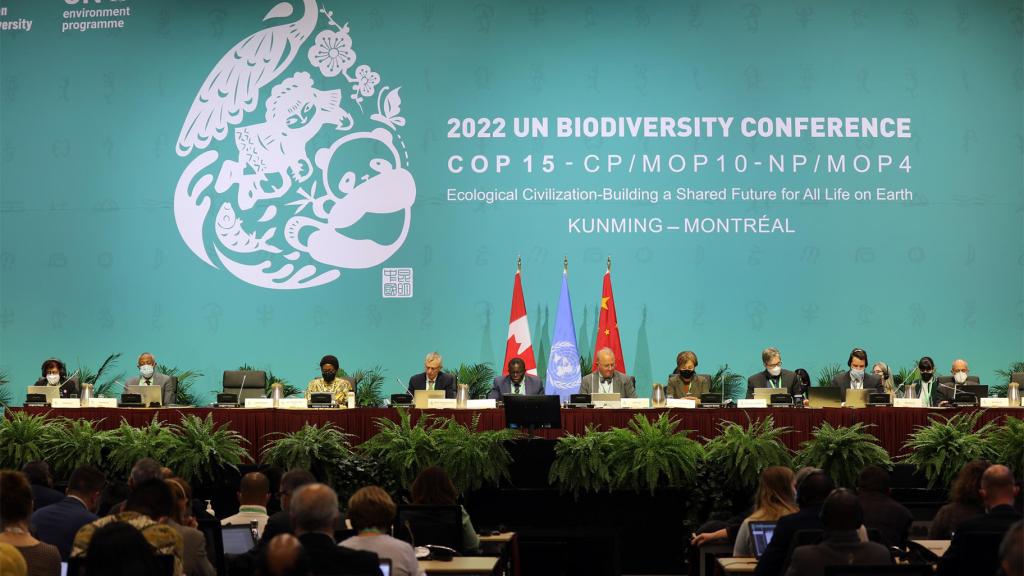
Re-Energizing Canada is a multi-year IISD research project envisioning Canada's future beyond oil and gas. This publication is part three of The Bottom Line policy brief series, which digs into the complex questions that will shape Canada's place in future energy markets.

Deep Dive details

Deep Dive

Why Canada Needs to Plan for a Steep Decline in Global Oil Demand

The Bottom Line: Unpacking the future of Canada's oil & gas

Re-Energizing Canada is a multi-year IISD research project envisioning Canada's future beyond oil and gas. This policy brief is part two of The Bottom Line series, which digs into the complex questions that will shape Canada's place in future energy markets. (Download PDF)

September 16, 2022

Summary

  • International Energy Agency scenarios project a decline in oil demand globally as climate policies intensify.
  • Canada’s own energy body, the Canada Energy Regulator, shows a projected decline in Canadian production.
  • Decline in oil demand is driven primarily by road transport, the largest component of crude oil demand at 44%, with the electrification of passenger vehicles especially leading the way.
  • Other end uses for oil will reduce demand post-2030 or earlier under aggressive policy scenarios.
  • Trends suggest global demand for oil will be in decline by 2030 and will drop significantly thereafter.

What is the future of global demand for oil? This is a critically important question for Canada as the global energy transition gains momentum, and governments establish policies to limit greenhouse gas (GHG) emissions, support economic stability, and promote energy security. To limit warming to 1.5°C, the world’s economy must quickly move away from fossil fuel consumption and reduce demand significantly, and trends in policies and technologies suggest this transition is already underway. This means that Canada, as a major oil exporter, will have to contend with a shrinking global market post-2030.

This brief will make the case for a near future with much less global demand for oil. Future briefs in this series will explore what this means specifically for Canadian producers.

fossil-fuels-emission-fumes.jpg

Climate Action Continues to Build Momentum That Is Reflected in Future Oil Demand Scenarios

To understand potential future demand for oil, it is useful to consider both international and domestic analyses. Two influential analyses of possible futures for oil are annually delivered by the International Energy Agency (IEA) and the Canada Energy Regulator (CER). While only these two outlooks are discussed in this brief, as the most relevant and authoritative, they are in line with the many other credible analyses that predict a peak of global oil demand by 2030 or earlier.

The IEA’s World Energy Outlook 2021 describes three scenarios for the future of global oil demand and production:

  • Stated Policies Scenario (STEPS)—A low climate-ambition scenario that assumes only current energy-related climate policies and those in progress will be adopted between now and 2050, with no ratcheting up of plans or targets.
  • Announced Pledges Scenario (APS)—This scenario assumes the energy-related climate targets made by governments as of 2021 are achieved by 2050, even if policies to achieve these targets are not yet in place.
  • Net-Zero (NZE)—A more ambitious scenario where the global energy sector reaches net-zero GHG emissions by 2050, via a hypothetical set of government policies and behavioural changes. This is the only IEA scenario that is consistent with limiting global warming to 1.5°C.

Figure 1. WEO 2021 global oil demand

Graph showing IEA WEO 2021 global oil demand
Source: International Energy Agency, 2021.

As shown in Figure 1, in the STEPS, demand for oil rebounds in the near term to pre-COVID levels, increases slightly out to the 2030s, and stays more or less stable at 103 million barrels per day (mbpd) to 2050. By contrast, in the APS, demand peaks around 2025 and falls by 1 mbpd per year between 2030 and 2050. In the NZE, oil demand has already peaked. It falls to 70 mbpd by 2030 and by 2.4 mbpd (or 5.3%) per year thereafter to 2050.

The CER’s Canada’s Energy Future 2021 also produces scenarios on the future of oil, but these are different from the IEA scenarios; they describe future production of Canadian oil given projected oil prices rather than future demand. They are not based on the same depth of global policy and technology analysis that is used by the IEA. At present, the CER does not model a scenario that is consistent with limiting global warming to 1.5°C. In 2021, the CER modelled two scenarios that cover Canadian crude oil production:

  • Current Policies Scenario—This scenario assumes future energy-related climate policy remains unchanged from what is in place at the time of modelling. There is some technological improvement in mature technologies but limited uptake.
  • Evolving Policies Scenario—This scenario assumes global energy-related climate policies are expanded at the same pace as they have been in recent years. Policies in development are adopted, and existing policies are somewhat strengthened over time. This scenario assumes technological innovation and uptake.

In the Current Policies Scenario, as shown in Figure 2, Canadian crude oil production is projected to rise until 2043 before falling slightly out to 2050. In the Evolving Policies Scenario, production climbs from pre-pandemic levels by 19% to peak in 2032, falling thereafter by an average annual rate of 1.1%, to reach roughly 2018 levels by 2050.

Figure 2. Total crude oil production – CER 2021

Graph showing total crude oil production – CER 2021
Source: Canada Energy Regulator, 2021.

In the analysis that follows, the CER scenarios are not used as a basis for demand forecast; as noted above, that is not what they are intended for. They are shown here to illustrate that even under the CER’s relatively unambitious Evolving Policies Scenario assumptions, oil production in Canada will peak shortly after 2030.

Implications of IEA and CER Scenarios

The various scenarios from the IEA and CER paint very different pictures of the future, with corresponding implications for climate change outcomes and the Canadian oil and gas sector. To plan for economic resilience, it is paramount to assess which of those pictures is most likely.

Figure 3. Global GDP covered by NZ laws/policies/pledges

Graph showing global GDP covered by net-zero laws/policies/pledges
Source: Net Zero Tracker, 2022.

Figure 4. Global emissions covered by NZ laws/policies/pledges

Graph showing global emissions covered by net-zero laws/policies/pledges
Source: Net Zero Tracker, 2022.

Some scenarios are easily eliminated. The IEA’s STEPS and the CER’s Current Policies Scenario both assume no evolution of existing or in-process climate policies from those that exist today out to 2050. That is so unlikely as to be effectively impossible. Since 2019, there has been a significant increase in national commitments to achieve net-zero GHG emissions. Figures 3 and 4 show a sharp increase in demonstrated commitments to stronger climate policy, with an increasing number of countries—including Canada—putting those commitments into law.

There are three drivers fuelling the trend of strengthened climate policies: 

  1. Increasing certainty of the science of climate change and necessity to align with 1.5°C scenarios, and growth in public acceptance of that science.
  2. More frequent and powerful physical impacts of climate change the world over, such as heat waves, floods, storm surges, droughts, and wildfires. Compare the last 20 years with the 20 years previous: climate-related disasters ­(6,681 vs. 3,656); major recorded disaster events (7,348 vs. 4,212); people affected (4.2 billion vs 3.25 billion); and global economic losses (USD 2.97 trillion vs. USD 1.63 trillion). These occurrences also augment public acceptance of the science.
  3. As a result of both those drivers, growing pressure on governments to take action to mitigate climate change.

As atmospheric concentrations of GHGs grow, these drivers will only strengthen. The inevitable policy response means that the only plausible scenarios are those that show either a near-term peak in global oil demand (IEA APS, NZE) or that show Canadian production peaking in 2032 (CER Evolving Policies).

Trends Show Declining Demand for Oil

There is still variability in the remaining scenarios, driven by different assumptions about technology uptake and government policy responses to climate change. To assess the likelihood of the remaining scenarios, it is instructive to consider the major end uses for crude oil and the policies, trends, and technologies that are likely to affect each of them. We examine each in turn below.

Road Transport

Road transport represents the largest share of demand for crude oil, at 44% (Figure 5) with the pace of transport electrification the most significant factor in determining future demand for oil. Figures 6 to 9 show that the electrification trend in the transport sector is gathering pace with electric vehicle (EV) sales, deployment of charging infrastructure, and battery range (as a proxy for technological development) all showing accelerating trends. In the case of passenger cars, it is easy to envision that in the next decade there will be a sharply reduced market for internal combustion engine vehicles.

The steep rate of change is being driven by evolving government policy. Governments covering 25% of the global market have announced 100% EV sales mandates for 2035, and EV-related subsidies doubled in 2021 to nearly USD 30 billion. These kinds of policies are low-hanging policy fruit for the many governments looking for ways to address climate change. They can be combined with popular industrial subsidies aimed at fostering competitive firms in the green markets of the future and employment-creating spending on charging infrastructure.

Figure 5. Global demand for oil

Graph showing makeup of sectors driving global demand for oil
Source: International Energy Agency, 2019.

As a result, consumer uptake is poised to hit significant tipping points well before 2035, triggered by several factors, including the increasing affordability of electric vehicles. Under most assumptions, EVs are already cheaper on a lifetime basis or even straight off the lot if financed. Upfront cost parity is expected to come in the mid-2020s. Increasing range, the availability of infrastructure, and growing consumer confidence that comes from familiarity with the technology will also drive EV uptake.

According to Bloomberg NEF, “The market is shifting from being driven primarily by policy, to one where organic consumer demand is the most important factor. As regulatory drivers begin to play less of a role, consumer adoption dynamics—the ‘S-curve’—take over”. The S-curve describes the uptake of new technology that eventually takes off not in a linear fashion but exponentially, with sudden and overwhelming effects (Foster, 1986). There are numerous examples of such a dynamic with past technologies, including cellphones, personal computers and, ironically, internal combustion engine passenger vehicles.

Another driver of S-curve adoption rates will be the reluctance of new car buyers to purchase a conventional vehicle that they see as having low resale value—a positive feedback effect that will intensify as the market share of EVs climbs. EVs may also play an outsized role in the destruction of demand for oil well beyond their market share. Fleet owners, taxis, and ride-hailing services will be early adopters of EVs, given lifetime cost considerations, and their vehicles are driven many more kilometres than the average. Owners of multiple vehicles will likely also prefer to use the EVs over conventional vehicles if they have a choice, given the significant difference in operating costs.

To be on track with the IEA’s Net-Zero scenario, 64% of passenger car sales and 5% of truck sales would have to be electric by 2030. The above trends suggest that this trajectory is within range.

The outlook for uptake in heavy-duty vehicles (HDVs) is not as straightforward, as there would need to be large investments in highway charging infrastructure. However, policy and technological developments for HDVs have been accelerating, with China as an important early adopter. EVs for medium-duty trucks on urban duty cycles as commercial vehicles are already the cheapest option for many users, and face few infrastructure challenges.

Figure 6. Global EV sales (Light-Duty Vehicles)

Graph showing rise in global EV sales (Light-Duty Vehicles)
Source: International Energy Agency, 2022.

 Figure 7. Global EV sales share (Light-Duty Vehicles)

Graph showing rise in global EV sales share (Light-Duty Vehicles)
Source: International Energy Agency, 2022.

Figure 8. Global EV public fast charging points 

Graph showing rise in global EV public fast charging points
Source: International Energy Agency, 2022.

From the perspective of road transport—the biggest factor in oil demand—the trends are tracking toward the IEA’s Net-Zero scenario. This would mean a significant displacement of oil demand beginning before 2030 and picking up pace as the share of electric vehicles grows exponentially. Compared to the business-as-usual Stated Policies scenario, the Net-Zero Scenario implies a drop in the demand for oil needed for road transport of 18.8 mbpd by 2030 and 49.9 mbpd by 2050.

Figure 9. Maximum range (U.S. EV models)

Graph showing maximum range of U.S. EV models
Source: United States Department of Energy, 2021.

Plastics

Industry and petrochemicals make up the second largest share of demand for crude oil globally at 19%. Oil is a feedstock to the petrochemical industry, which uses it to produce a wide range of plastic products (though in North America the more common feedstock is natural gas). Demand destruction in this sector would come from policies aimed at reducing plastic pollution.

The IEA scenarios do not predict such policies will have a major impact on oil demand out to 2050. The IEA calculates petrochemicals’ share of growth to be 50% by 2050 on current trajectories. BP’s assumption is even higher, at 95%. This is based on assumptions about economic growth in developing countries and their catching up with OECD rates of plastic consumption, though others argue that developing country uptake will not mirror historical patterns in developed countries.

Measures such as bans on single-use plastics, now in force in a slew of countries, only nibble at the edges of demand, but a global ban would reduce petrochemical-related oil demand by more than a quarter. Aggressive recycling policy and legislation could lead to more significant impacts, reducing annual growth in oil demand by up to 1% by 2040 or the possibility of peak plastic demand by 2027.

There is growing momentum behind regulatory policies to reduce plastic use more broadly and accelerate recycling. For example, a new multilateral environmental agreement on plastics is progressing quickly. The resulting multilateral agreement is expected to facilitate national commitments and actions in the same way that the United Nations Framework Convention on Climate Change and its Paris Agreement do for climate change. Critically, the scope of talks includes considering measures along the entire life cycle of plastics, including production restrictions.

The IEA’s Net-Zero scenario requires an increase in plastics recycling rates globally, from 17% to 27%, by 2030, and even that would fail to completely avoid an increase in oil demand for the sector—predicted at 1.5 mbpd. But while reduction in plastics demand in the near term may only marginally affect oil demand, the strong rise in multilateral and national regulatory efforts to reduce plastics pollution is likely to have significant impacts post-2030.

Aviation and Shipping

Policies and technologies are not as advanced in the area of aviation and shipping, which accounts for 12% of final demand for crude oil globally. However, policy responses are beginning to take shape. In aviation, 2021 brought a flurry of net-zero pledges from major global carriers and associations. In the same year, 28 states signed on to the International Aviation Climate Ambition Coalition (COP 26 declaration, 2022), committing to a pathway consistent with the Paris Agreement 1.5°C target, and the U.S. Federal Aviation Authority (2021) committed to net-zero by 2050. Proposed mandates such as ReFuel EU and the United Kingdom’s Jet Zero Consultation will act as drivers of cost reduction and uptake for sustainable aviation fuel, which will eventually anchor emission reductions in long-haul flights. For short-haul flights, alternatives have advanced enough that Sweden and Denmark have announced that all domestic flights will be fossil fuel-free by 2030, with Norway aiming for 2040.

While the shipping sector is not likely to contribute to a significant displacement of oil demand between now and 2030, a revision to the International Convention for the Prevention of Pollution from Ships comes into effect in November 2022, requiring all ships to meet annual ship-specific targets to reduce their carbon intensities—a measure that could cut emissions 11% over 2019 levels by 2026 in a full-compliance scenario (Brooks & Adler, 2021). As well, frustration with the International Maritime Organization’s lack of action is spurring national-level efforts that may have significant impacts, including the European Union's proposal to include shipping in its emissions trading system and legislative proposals in the United States to mandate low carbon intensity for ships docking at U.S. ports (Clean Shipping Act of 2022).

city-buildings-and-highways.jpg

Buildings and Power

Buildings, where oil is used for heating, and power, where oil is used to generate electricity, account for 13% of global oil demand, split fairly evenly between the two. For both end uses, oil has alternatives that are, in most cases, cheaper and cleaner, and even the IEA’s most conservative Stated Policies scenario shows demand for both uses falling by 2030.

Relative to 2020 global demand of 91.3 mbpd, these two sectors show a combined drop in demand of 2.7 mbpd by 2030 in the Announced Policies scenario, or 5.8 mbpd in the Net-Zero scenario.

These are small but significant reductions in global demand that, like the impacts of transport electrification, would manifest in the near term, that is, by 2030.

Global Demand for Oil Will Be in Decline by 2030

Comparing the IEA’s scenarios against observed trends suggests global demand for oil will peak before 2030 and thereafter decline. Similar conclusions have been drawn by other independent analysts, and, in the same vein, the CER’s only plausible scenario shows Canadian production peaking in 2032.

Demand reduction will be driven primarily by road transportation, which accounts for 44% of oil demand. Trends in climate policies, technological improvements, and consumer behaviour suggest demand reduction in line with the IEA’s NZE. These will begin before 2030 and will accelerate thereafter.

crowded-road-transportation.jpg

For other drivers of demand, it is less certain whether trends will bring us closer to the APS or NZE. In either scenario, buildings and electricity, accounting for 13% of global oil demand, will contribute to demand destruction by 2030, dropping by 3.2 mbpd even in the more conservative APS.

The other major elements of global oil demand—plastics, aviation, and shipping, at 31%—are less likely to achieve the IEA’s NZE conditions by 2030. But in the medium term (post-2030), all of them are likely to contribute significantly to falling demand.

If we assumed the IEA’s NZE trajectory for road transport out to 2030 as argued above, and its more conservative APS trajectory for the other elements of global oil demand whose paths are less certain, the result would be a drop in oil demand from pre-COVID (2019) levels of 22 mbpd, or 22%. These same assumptions carried out to 2050 would reduce demand for oil by 57 mbpd, or 58%, even without assuming any of the trends in aviation, shipping, or plastics lead to more destruction of demand than currently announced policies. To put those numbers in perspective, the drop in global demand that devastated oil markets and sent prices for Western Texas Intermediate briefly negative in 2020 amounted to less than 7 mbpd (though that was more abrupt than the changes envisioned here).

Overall, the data suggests that structural changes in road transport will permanently cause a sustained decline in oil demand in the very near term. Post-2030, this will be compounded by reduced oil demand for other key uses. What this means for Canadian producers specifically is not straightforward and will be assessed in future installments of The Bottom Line policy brief series. But the inescapable starting point for Canadian energy policy is clear: global demand for oil will soon unravel in an unprecedented fashion and will not recover.


Re-Energizing Canada is a multi-year IISD research project envisioning Canada's future beyond oil and gas. This publication is part two of The Bottom Line policy brief series, which digs into the complex questions that will shape Canada's place in future energy markets.

Deep Dive details

Deep Dive

Preparing Financing Strategies for Adaptation: Emerging good practices

Although there’s a growing interest in the preparation of financing strategies for adaptation, there is no common understanding of what the scope of these strategies should entail, what constitutes good practices for their development, or whether these strategies are truly effective. We sought to shed some light on these questions as part of a 4-year research project focused on ways to scale up investment of development finance in actions that align with the adaptation priorities of developing countries.

August 25, 2022

Developing countries are increasingly shifting the focus of their climate adaptation efforts from planning to implementation. A critical step in this transition is securing funding to implement the adaptation actions that countries have deemed priorities after undertaking strategic processes, such as the preparation of a National Adaptation Plan (NAP) or nationally determined contribution (NDC) under the UN’s Paris Agreement.

To achieve this step, several developing countries have prepared or plan to prepare financing strategies for adaptation. This term encompasses the various finance, investment, and resource mobilization plans, strategies, or roadmaps that seek to increase financing for climate adaptation. Many countries have included the development of these strategies in their proposals submitted to the Green Climate Fund to increase their readiness to prepare their NAPs. 

Although there’s a growing interest in the preparation of financing strategies for adaptation, there is no common understanding of what the scope of these strategies should entail, what constitutes good practices for their development, or whether these strategies are truly effective. We sought to shed some light on these questions as part of a 4-year research project focused on ways to scale up investment of development finance in actions that align with the adaptation priorities of developing countries.

Gathering Details: A global scan

We carried out a first-of-its-kind review of publicly available financing strategies for adaptation in developing countries. This review covered two types of strategies:

  • Discrete financing strategies: those that focus solely on adaptation, such as NAP resource mobilization strategies.
  • General financing strategies for climate action: those that seek financing for adaptation as part of a broader package, as seen with climate change financing strategies and NDC financing roadmaps.

We examined a total of 24 financing strategies for adaptation—10 discrete financing strategies and 14 general financing strategies—covering a broad range of countries and regions (see Figures 1 and 2 below).

A map of the 9 individual countries and 1 region whose discrete financing strategies for adaptation were examined in an IISD study
Figure 1. The 9 individual countries and 1 region whose discrete financing strategies for adaptation were examined
A map of the 11 individual countries and 3 regions whose general financing strategies for adaptation were examined in an IISD study
Figure 2. The 11 individual countries and 3 regions whose general financing strategies for adaptation were examined

These strategies were prepared by developing countries or for them by other organizations, such as multilateral development banks, United Nations specialized agencies, and technical partners like the NDC Partnership and the NAP Global Network, whose secretariat is hosted by IISD. The capacity-building and technical support provided by these organizations plays a significant role in facilitating the creation of financing strategies for adaptation and shaping their content. 

To better understand the landscape of financing strategies for adaptation, each country’s strategy was assessed using a common framework, as seen below. 

The elements used to assess each financing strategy for adaptation in an IISD study
Figure 3. The elements used to assess each financing strategy for adaptation

Connecting the Dots: What did we find?

The review process showed that countries are taking a wide range of approaches when preparing their financing strategies for adaptation. Some countries prepared shorter, less-detailed documents that aimed to build high-level support for financing climate (adaptation) priorities, such as the Island States in the Indian Ocean’s eight-page strategy. Other countries developed longer, comprehensive documents with detailed costing information, such as Cambodia’s 123-page financing framework for adaptation.

Some countries attempted to identify an adaptation financing gap and ways to fill this gap using domestic and international sources of finance, while others did not—perhaps because many do not have information about the amount of domestic and international public financing already mobilized to support climate adaptation or ready access to detailed cost estimates for specific adaptation actions. Few financing strategies for adaptation included an analysis of which types of adaptation projects would be most appropriate for funding by different types of finance instruments, such as which are most likely to attract private sector investment. Very few included processes to monitor and evaluate the financing strategy’s success.

A Fuller Picture: Guidance for future strategies

Despite these differences, four emerging insights surfaced from the review that governments, as well as the organizations working with them, could use as they prepare financing strategies for adaptation in the future. 

1. Countries may not need to calculate an adaptation finance gap in their strategies.

The development of costing information for a long list of adaptation actions can be expensive, time-consuming, and requires extensive stakeholder consultation. Rather than investing in this analysis, developing country governments could choose to use the strategy to identify a few key areas for resource mobilization in the short term and provide direction on the strategic use of public funds to scale up adaptation financing within these priority areas.

2. Financing strategies could place greater emphasis on the targeted use of public finance to enable more transformative change and attract additional investment, including from the private sector.

While most strategies identified ways to increase domestic public finance allocations and sources of international public finance for adaptation, governments and collaborating organizations could place greater attention on how these investments fit together. They should also see how this public finance could help leverage funding for other purposes and from other sources, such as the private sector. For instance, public finance could be used to fund the climate-resilience component of an agriculture sector project otherwise financed by the private sector.

3. Ministries that lead on adaptation need to engage actively in processes to develop financing strategies for NDCs, the Sustainable Development Goals, national development plans, and COVID-19 pandemic recovery.

By engaging in these processes, ministries responsible for adaptation can inform other ministries of their financing priorities and ensure that these needs are considered as part of a country’s broader financial planning and decision-making processes. Doing so can encourage the use of development finance to finance adaptation needs and promote alignment of national priorities.

4. Improved tracking of finance for adaptation by developing country governments is needed at the country level.

A lack of data regarding current flows of financing for adaptation constrains the capacity of developing countries to estimate their financing gaps and determine the impact of their financing strategies. Greater investment by developing countries, with the assistance of their development partners, in systems to monitor international public finance flows for adaptation can help assess the extent of—and conditions that enable—success in mobilizing investment.

The review also reiterated the importance of three well-established good practices to be followed by developing country governments, as well as the organizations working with them, to increase their likelihood of securing financing for adaptation:

1. Ensuring that financing strategies for adaptation are country driven and fit for their purpose, which could be to either raise awareness of financing needs among domestic policy-makers and/or to secure financing for specific initiatives.

2. Including ministries of finance and planning in the development of financing strategies for adaptation, as they typically have stronger connections to a range of financial actors and are engaged in other broader financing processes. 

3. Engaging potential international funders in the development of financing strategies for adaptation, such as multilateral development banks, as it may enhance the mobilization of international public finance for adaptation priorities.

Where to Next?

Countries are taking a wide range of approaches to the development of their financing strategies for adaptation. The success of these strategies in generating greater financing for adaptation is currently difficult to determine, given that many are relatively new—having been developed in 2015 or later—and there is limited publicly available information regarding their outcomes. More tracking and analysis by the research community are needed to inform developing country governments and their partners of the impact of these strategies and gather insights on how best to make them effective and useful.

However, the review underscored that a well-defined financing strategy for adaptation can clearly communicate to development partners a country’s key funding priorities and suggests that they can help scale up financing for adaptation. These strategies can be a critical tool to help governments take a strategic approach that integrates international and domestic public and private finance to most cost-effectively implement adaptation priorities identified through NAP and NDC processes.


Deep Dive

Why Canadian Liquefied Natural Gas Is Not the Answer for the European Union’s Short-Term Energy Needs

The Bottom Line: Unpacking the future of Canada's oil & gas

Re-Energizing Canada is a multi-year IISD research project envisioning Canada's future beyond oil and gas. This policy brief is part one of The Bottom Line series, which digs into the complex questions that will shape Canada's place in future energy markets. (Download PDF)

August 16, 2022

Summary 

  • Canada has no ready liquefied natural gas export infrastructure, and it will take at least 3 years before new projects come online.
  • Dependence on Russian gas supplies has the EU looking for supplies to fill immediate needs before winter 2022.
  • Due to climate commitments and energy security concerns, Europe is accelerating its plans to reduce gas use by ramping up energy efficiency and the use of renewable energy sources. While there may be demand for some fossil fuels, markets like Norway are more logical to fill immediate needs.
  • This results in a fundamental mismatch with Canadian supply opportunities. Canada cannot ramp up supply before 2025, while Europe’s energy needs will largely be resolved by that time.
  • High prices and energy security concerns, combined with climate commitments, suggest that new Canadian liquefied natural gas infrastructure would be at risk of becoming stranded.


The Russian invasion of Ukraine has led to a global energy crisis that has caused already-high gas and oil prices to rise even more, with huge consequences for people and societies across the globe.

In response, the Canadian government recently stated that Canada would aim to increase domestic oil and gas production by 200,000 bpd and 100,000 barrels of oil equivalent per day (boepd), respectively, before the end of the year. This includes discussions with Germany and Spain regarding the development of liquefied natural gas (LNG) facilities that would allow Canada to export gas to European countries in the future.

However, despite recent requests to support the immediate needs of Germany, Canadian LNG infrastructure cannot be scaled up in time to meet Europe’s short-term needs. An examination of the EU’s medium-term (1–4 years) plans to become independent of Russian gas shows that overall demand for gas will be rapidly declining by the time new Canadian export facilities can come online. In addition, the current high prices and insecurity of supply have caused the International Energy Agency (IEA) to scale back projected increases in global demand for gas. As a result, investment in new Canadian infrastructure, especially infrastructure intended for European markets, risks being stranded.

Figure 1. EU phase-out of Russian gas compared with proposed Canadian LNG projects 

Figure 1 showing EU phase-out of Russian gas compared with proposed Canadian LNG projects
Source: Author diagram. 

Canada Has No Overseas LNG Export Infrastructure

In 2020, Canada was the world’s 5th largest producer of gas, responsible for around 5% of global supply. Only the United States, China, Iran and Russia produced more. The majority of gas produced in Canada is used domestically, with the remainder exported almost exclusively to the United States. Compared to oil, gas is not easy to ship and is mainly transported via an extensive pipeline network that is interconnected with the United States. Since Canadian gas is mainly produced in British Columbia, Alberta, and Saskatchewan, eastern Canada imports gas from the United States. Although numbers vary year over year, in 2020 Canada produced 3.9 trillion cubic feet of gas and exported 2.4 trillion cubic feet.

Over the past two decades, gas markets across the world have started to better integrate due to increased demand and higher prices that have allowed for transportation of gas via marine shipping. This requires specialized facilities to cool the gas to a liquid state, transportation on specialized tankers, and regasification facilities so that the gas can be again distributed via pipelines at its import destination.

Figure 2. LNG shipping process

Figure 2 showing LNG shipping process
Source: Author diagram.

Canada has one LNG import facility, Canaport LNG in Saint John, New Brunswick, which is owned by Madrid-based Repsol. Although there have been many LNG export facilities proposed and approved over the last decade, due to low LNG prices and inability to access finance, nearly all have been cancelled or postponed. As a result, Canada has no operating LNG export infrastructure.

LNG Canada, under construction in Kitimat, British Columbia, will be Canada’s first completed export facility. Led by Royal Dutch Shell and scheduled to come online in 2025, the USD 30 billion project is intended to serve Asian markets. It will connect to the Coastal GasLink pipeline, a 650 km pipeline that continues to be contested by the Wet'suwet'en Hereditary Chiefs. To support project completion, the federal government has already provided subsidies including a direct investment of CAD 275 million and steel tariff exemptions worth CAD 1 billion. This is in addition to the significant subsidies offered by the BC government via the BC–LNG Canada Agreement. Export Development Canada has also provided the Coastal GasLink pipeline with CAD 500 million in loans.

Meanwhile, over the past decade, there have been several other failed attempts to develop LNG shipping facilities in Canada. This includes mainly projects in British Columbia for the Asian market, but also projects in central and Atlantic Canada. Although some projects, like Energie Saguenay in Quebec, have been rejected by governments, most delayed or abandoned projects have floundered due to low global LNG prices and a lack of access to finance.

Despite occasional spikes, gas prices in the European and U.S. markets have historically been much lower than what we have seen in 2021 and 2022. Since 2000, gas prices have fluctuated between 2 and 12 USD/MBtu (see Figure 3), far lower than record high prices in 2022, which in Europe reached more than 50 USD/MBtu.

According to the IEA, recent price spikes are due to a range of specific temporal factors, including strong economic recovery after COVID-19 lockdowns ended and colder-than-average temperatures that increased demand for LNG around the world. Likewise, low gas prices in 2020 facilitated a large uptake of coal-to-gas switching that further helped increase demand for gas. These trends were accompanied by record levels of supply-side capacity outages and upstream underperformance that also played a role in limiting supply. Nevertheless, the IEA expects global LNG price volatility to somewhat stabilize over the course of 2022, with European and Asian prices remaining in the range of 26–28 USD/MBtu through to the end of the year.

Figure 3. Regional gas prices 1990–2021

Figure 3 showing and comparing Regional gas prices 1990–2021
Source: World Bank, n.d.

The EU Will Be Onto Cleaner Alternatives Before Canada Can Deliver LNG

The Russian invasion of Ukraine has underlined the fact that the EU has been extremely dependent on Russian fossil fuels. In 2021, the EU imported more than 40% of its gas (and almost a third of its oil) from Russia. In 2021, gas imports from Russia equalled 155 billion cubic metres (bcm) in absolute terms.

However, over the past decade, the EU has also progressively raised its climate targets. The European Climate Law sets a binding target of climate neutrality by 2050 and an emissions reduction target of 55% by 2030. Further, as part of its implementation proposal for the Climate Law, the “Fit for 55” package includes a range of ambitious targets. As a result of these policies, final EU gas demand is projected to decrease by 32%–37% by 2030.

Russia’s invasion of Ukraine has only strengthened the EU’s commitment to reduce its reliance on fossil fuels. Although it does not yet include a complete timeline for getting off gas completely, the EU’s REPower response to the war accelerates and strengthens all major initiatives from the Fit for 55 package with the intention of reducing Russian gas imports by two-thirds before the end of this year.

For example, it speeds up 420 GW solar photovoltaic deployment plans by 20% and increases existing targets in the Fit for 55 plan by 80 GW of wind and solar capacity. The REPower plan also proposes to double the rate of heat pump installation to 10 million units over the next 5 years, which would reduce gas demand by 1.5 bcm this year, while at the same time proposing to increase the production of biomethane in Europe.

The plan also includes immediate efforts to replace Russian gas with shipped imports of around 50 bcm from the United States, Qatar, West Africa, and Egypt. In addition, it expects pipe source diversification with increased imports from Algeria, Norway, and Azerbaijan to deliver around 10 bcm yearly.

“The goal is to slash EU demand for Russian gas by two thirds before the end of the year, and to make Europe independent from Russian fossil fuels by 2027.”

Paolo Gentiloni, European Commissioner for Economy

Overall, the plan concludes that the EU can phase out Russian gas “well before 2030,” with the EU’s Economic Commissioner, Paolo Gentiloni, suggesting that they could be completely off Russian gas by 2027.

Although the EU plans to get off Russian gas are widely recognized as ambitious, independent analysis concludes that the EU could phase out Russian gas imports in 2025 by implementing the Fit for 55 package and introducing additional measures on energy efficiency, heat pumps, and renewable energy supply. The remaining gas requirements of 51 bcm per year could then be replaced via imports through existing gas infrastructure.

Figure 4. Potential replacement of Russian gas by 2025

Figure 4 showing Potential replacement of Russian gas by 2025
Source: Reproduced with permission from Brown et al. 2022.

Analysis showing how the EU can accelerate the transition away from gas has been supported by thought leaders and the actions of member states. Eleven former EU policy chiefs have warned that “simply diversifying the import of fossil fuels will only serve to maintain EU energy dependence on other countries,”. Similarly, in April, 11 EU member states (Denmark, Austria, Germany, Spain, Finland, Ireland, Luxembourg, Latvia, the Netherlands, Sweden, and Slovenia) called for accelerated negotiations to phase out Russian gas while also citing the need to avoid any lock-in of greenhouse gas emissions.

National-level plans and analyses for member states, including Germany, Italy, and Denmark, show how phasing out Russian imports will be accomplished, in part, by an accelerated transition away from gas (Holz et al., 2022). Noting these dynamics, one of Germany’s leading economic institutes, DIW Berlin, has said that “building fixed LNG terminals in Germany … does not make sense because of the long construction times and the sharp decline in natural gas demand in the medium term” (Holz et al., 2022).

This is in line with the IEA’s recent gas outlook. Due to high prices, energy security concerns, and accelerated demand reduction, the outlook lowered projections for global gas demand in the medium term (2022–2025). Although the long-term impact of the current situation is still unknown, energy efficiency and fuel-switching in the next several years will significantly reduce demand for LNG in the EU.

“Simply diversifying the import of fossil fuels will only serve to maintain EU energy dependence on other countries.”

Eleven former EU policy chiefs

Canadian LNG Infrastructure Can’t Be Scaled Up in Time

The EU is looking for gas supplies to meet immediate demand but is also planning for structural transformation to its energy system that has the potential to phase out Russian gas over the next 3 to 5 years. Nevertheless, in Canada, high prices and the short-term supply crunch have ignited interest in reviving or fast-tracking LNG proposals in the Atlantic provinces.

natural-gas-pipeline.jpg

In particular, three projects are being discussed:

LNG NL

LNG Newfoundland and Labrador has proposed a 5.5 USD billion project in Newfoundland and Labrador that would liquefy gas from offshore oil production to produce around 2.6 million tonnes of gas per year. Due to recent events, LNG Newfoundland and Labrador has suggested fast-tracking the project so that exports begin in 2028 instead of the current 2030 timeline.

Goldboro LNG

Calgary-based Pieridae’s proposed Goldboro project in Nova Scotia was originally abandoned on financial grounds (including a rejected call for USD 1 billion subsidy) in the summer of 2021. Recently, the company has revised the project, proposing a floating terminal that would be able to produce around 2.5 million tonnes of LNG per year from around 2025 (around 3.5 bcm). The proposal enjoys some support from local municipalities, but the province has stated that a substantially revised project would need to apply for regulatory approval before construction could begin. Pieridae has indicated that the project would not be operational until 2027.

Saint John LNG Terminal

Repsol has revived a plan to build an export terminal at its existing import facility, in New Brunswick. This project was initially shelved in 2016 when the proponents could not attract investors and concluded that the expansion was not economically viable.

Of the three, the Repsol project is the frontrunner for early completion because there is an existing facility in place. However, estimates for completion still range from 3 to 5 years, and LNG facilities have a poor track record for delays. Importantly, both the Goldboro and the Repsol projects would need additional pipeline capacity to supply gas for export and would need to source gas from the United States or via additional pipeline volumes through Quebec. Expanding fossil fuel infrastructure in Quebec would likely be met with public opposition, which could add time and expense to the project. In addition, directing existing supply to export raises questions about whether export contracts will conflict with supplying gas to meet domestic demand.

Canada has little experience in building LNG export facilities. However, most U.S. LNG facilities have taken more than 4 years to complete after the final investment decision. “According to McKinsey, a final investment decision, or FID, is “the point in the capital project planning process when the decision to make major financial commitments is taken. At the FID point, major equipment orders are placed, and contracts are signed for [Engineering, Procurement, and Construction].” While pre-FID projects are typically considered proposals that may or may not advance, a positive FID indicates that a project is likely to be built”.

Only two projects were carried out within a three-year timeline and these were both expansions of existing facilities. This does not include time to secure regulatory approvals. As a result, it is not realistic that new Canadian LNG export projects could be commercial in time to meet Europe’s immediate gas needs.

Canadian LNG Is Not the Solution for the EU’s Desire to Get Off Russian Gas

The EU is moving swiftly to slash dependence on Russian fossil fuels—especially gas. However, this is a structural transformation that will reduce overall demand for gas. The EU’s response to the crisis will lead to a strengthening of those trends that have been present across member states for some years now, including a significant ramping up and support of clean energy and ambitious climate targets for implementation.

At the same time, high prices and a renewed concern for energy security suggest that in the medium term, demand will be lower than expected—not just in Europe but globally.

New Canadian export facilities will take a minimum of 3 years to complete, and possibly much longer. This means that as any new Canadian infrastructure is coming online, European demand will be dropping. A faster-than-expected transition away from gas in the EU risks stranding assets that are built explicitly to supply that market. There is also the risk that global gas markets will continue to be volatile and unpredictable, with current high prices and the imperative to reduce greenhouse gas emissions also leading to an accelerated transition away from gas in non-EU markets.

Naturally, Canada is considering how to best support the energy needs in Europe. Building new LNG infrastructure is not the solution. There is a fundamental mismatch between Europe’s immediate need to diversify gas supply and the 3-to-5 year timeline for scaling up Canada’s LNG exports. Canada cannot get new LNG infrastructure in place in time to help Germany and other allies, and attempts to do so risk stranding emissions-intensive infrastructure at a time when the clean energy transition is accelerating.

A full list of references can be found here.

Re-Energizing Canada is a multi-year IISD research project envisioning Canada's future beyond oil and gas. This publication is part one of The Bottom Line policy brief series, which digs into the complex questions that will shape Canada's place in future energy markets.

Deep Dive

What We Heard From the Global Stocktake's First Technical Dialogue on Adaptation

June’s Bonn Climate Change Conference kickstarted an important part of the inaugural 2-year Global Stocktake under the Paris Agreement. What did participants say about climate change adaptation during the Global Stocktake’s first Technical Dialogue, and what does it mean for global adaptation ambition?

August 11, 2022

When it comes to global climate action, we are falling dangerously behind the level of ambition that scientists are urging us to reach. As the United Nations Framework Convention on Climate Change (UNFCCC) process makes the transition from the negotiation to the implementation of the landmark Paris Agreement, countries began taking stock of the progress they have made so far and asking what more the world should be doing to tackle the climate crisis.

At the heart of the Paris Agreement, the Global Stocktake (GST) can be understood as a periodic review mechanism for both climate mitigation and adaptation. The first GST concludes in 2023, involving a 2-year process that brings together climate change experts, decision-makers, practitioners, and civil society stakeholders to assess the world’s collective progress in meeting the long-term goals of the Paris Agreement. The GST will then take place every 5 years. The outputs of each GST—which is envisioned to be a set of policy-relevant recommendations—will then help countries update their Nationally Determined Contributions, as well as other climate action plans such as the National Adaptation Plans (NAPs), with the intention that each update is grounded in the best-available science and will be more ambitious than previous ones.

When we talk about the Paris Agreement’s long-term goals, we usually think of the 1.5°C and 2 °C temperature goals—but there is more than that. The GST takes stock of more than the world’s collective progress toward mitigation—it also measures progress in adapting to climate change impacts, increasing adaptive capacity, strengthening resilience, and reducing vulnerabilities.

The Technical Dialogues: Building a shared understanding

The recently concluded Bonn Climate Change Conference (SB56) kickstarted the Technical Dialogue (TD)—a core activity of the 2-year GST process that engages country representatives, climate change experts, and civil society actors in a series of roundtable dialogues and workshops. The aim of the TD is for participants to share the best-available science and assessments of mitigation, adaptation, and means of implementation (climate finance, technology transfer, and capacity building), as well as experiences, case studies, challenges and barriers, best practices, and lessons learned. The TD helps countries arrive at a common understanding of the progress made to date and the way forward for future improvements.

The Technical Dialogue and the World Café were much-needed opportunities for countries, civil society actors, experts, and scientists to engage in meaningful and frank conversations on how to overcome challenges and barriers to enhancing collective adaptation ambition.

Anne Hammill, reflecting on the GST’s first Technical Dialogue in Bonn

Packed rooms, masked chatter, and a buzz of excitement filled the TD roundtables at the World Conference Center in Bonn. The roundtable on adaptation gathered much interest from country negotiators, Intergovernmental Panel on Climate Change (IPCC) scientists, adaptation experts and practitioners, and civil society representatives. Experts from the NAP Global Network, whose secretariat is hosted by the International Institute for Sustainable Development (IISD), were invited as subject matter experts to participate in the first TD roundtables. With the upcoming UNFCCC COP 27 in Sharm el-Sheikh, Egypt, being a pivotal moment for adaptation and the rest of the GST process, we revisit what we heard on adaptation during the TD and what it means for the way forward.

Assessing Adaptation Progress and Needs Through the GST

Adaptation is a crucial part of the GST, and its importance is not being overlooked by the TD participants. At the adaptation roundtables, experts from the IPCC and research institutions—including Anne Hammill from the NAP Global Network—gave presentations to the dozens of representatives from both developing and developed countries and major negotiation groupings (such as the G77 & China, the African Group, the Least Developed Countries, the Alliance of Small Island States etc.), as well as representatives from the nine observer constituencies representing civil society actors. Building on these expert presentations and a set of guiding questions, roundtable participants then engaged in a lively discussion.

Participants at World Café tables discussing case studies, best practices, challenges, and solutions regarding implementing the Paris Agreement and meeting the long-term goals. (Photo by IISD/ENB | Kiara Worth)
Participants at World Café tables discussing case studies, best practices, challenges, and solutions regarding implementing the Paris Agreement and meeting the long-term goals. (Photo by IISD/ENB | Kiara Worth) 

In contrast to the large, meeting-room-style roundtables, the World Café sessions of the TD brought together smaller, more focused group discussions over specific topics. Participants rotated tables every 30 to 40 minutes so that a diversity of views and experiences could be captured. After listening in on all three roundtable sessions and the World Café table discussions on national and subnational adaptation planning, four key messages on adaptation emerged.

Key Message One: Mind the Gaps

An overarching message from the TD is that there are significant gaps in adaptation implementation. Currently, a lot of countries are focusing on adaptation planning through policy instruments such as NAPs or National Adaptation Strategies. But not enough of these plans are being translated fast enough into implementation.

Developing country representatives pointed to a few factors that widened this gap. First, barriers in accessing adaptation financing and capacity building, as well as the slow pace of climate-relevant technology transfer from developed countries to developing countries, continue to hinder developing countries’ ability to invest in adaptation and put their plans into practice. The 2021 United Nations Environment Programme Adaptation Gap Report concluded that the tracked global climate finance for developing countries reached USD 79.6 billion in 2019. Yet, the projected annual cost for adaptation alone will reach USD 140–300 billion by 2030—well above the level of adaptation finance currently available.

Secondly, current adaptation financing by countries and multilateral financing institutions often see the adaptation plan document as the finished product of their support. However, to realize what’s included in these plans—like investing in early warning systems, implementing nature-based solutions, or building the awareness and capacity of local actors in adaptation—the TD participants argued that funders need to move beyond a short-term, incremental, project-by-project approach to supporting adaptation. However, this doesn’t mean that planning itself is cheap. In contrast, many country representatives have shared that it is very costly to undertake the NAP process in a comprehensive and inclusive way. Ensuring adequate support for both planning and implementation would allow the NAP process to be continuous, iterative, and effective.

Thirdly, both developed and developing countries face significant challenges in building monitoring, evaluation, and learning (MEL) systems for adaptation. The TD participants shared a consensus that finding the right data, metrics, indicators, and methodologies for tracking progress in adaptation actions continues to be a significant barrier to establishing an iterative cycle of adaptation planning, implementing, reviewing, and improving. A developed country representative revealed that even though their country has a functioning MEL system for adaptation, the indicators were not selected because they are good indicators but because they are the only indicators that have available data sources already in place.

Progress in adaptation is uneven and slow, challenges and gaps persist, and more needs to be done to achieve the Paris Agreement’s goal on adaptation.

Key Message Two: Top-Down and Bottom-Up, Together

The TD discussions also pointed to practical solutions and best practices that helped countries mainstream adaptation domestically. One element many countries and experts emphasized is the importance of coherence and alignment between national, subnational, and local adaptation planning and implementation. A bottom-up approach to adaptation planning allows communities to feed local and Indigenous knowledges, vulnerability information, needs, and capacity gaps to the national level so that national-level policies and plans truly reflect local needs and priorities and help develop the capacity of actors at all levels. 

At the same time, some country representatives highlighted the importance of a top-down approach in signalling national priorities, generating political will for enhancing adaptation actions, and facilitating coordination in adaptation planning and implementation across multiple levels of government. Once local needs and priorities are channelled to the top level, it is up to the national governments to explore synergies between adaptation and development planning processes across national and subnational jurisdictions. Nurturing these cross-level links will also help ensure that adaptation financing reaches subnational levels while encouraging the sharing of information and fruitful collaborations through institutional arrangements at all levels.

A clear message from the TD is that combining top-down and bottom-up approaches in adaptation planning and implementation allows countries to achieve coherent and synergistic cooperation across all levels of governance and accelerate capacity building and implementation.

Key Message Three: Better Cross-Governmental Coherence, Better Coordination

Some participants at the World Café table also pointed to good institutional arrangements as an important avenue for enhancing adaptation planning and implementation. These include cross-governmental, horizontal integration efforts that bring together different ministries, sectors, and responsible agencies to work on adaptation and vulnerability reduction collectively.

Participants observed that in many countries adaptation planning is often siloed and its implementation fragmented. For instance, an expert shared that in one country, over a dozen ministries and agencies were involved in the water sector’s adaptation planning and actions, with each ministry and agency having a particular role, but no one was willing to lead or coordinate the effort in a more structured and synergistic manner. Other country representatives and experts concurred that this messy scenario happens more often than not—partly due to perceived competition between these different actors over their priorities or funding and partly because of a lack of political buy-in for setting up more coherent institutional arrangements supporting cross-governmental collaboration on adaptation.

Fortunately, many developing countries shared their experiences in tackling this challenge. Kenya has established a Climate Change Unit that is responsible for coordinating and mainstreaming climate change considerations across ministries’ and sectors’ budgeting and planning cycles. Meanwhile, Ghana’s NAP was developed using participatory consultations and engagements across government ministries. This helped both in building political support for adaptation, while also ensuring the NAP’s alignment with the country’s medium and long-term development plans across different sectors.

However, many participants cautioned that challenges remain when it comes to resource availability for translating plans into action, as well as knowledge and capacity gaps for line ministries that are not typically involved in adaptation planning and implementation.

Participants at the GST’s first TD roundtable on adaptation (Photo by IISD/ENB | Kiara Worth)
Participants at the GST’s first TD roundtable on adaptation (Photo by IISD/ENB | Kiara Worth) 

Key Message Four: Inclusive Adaptation Through Gender-Responsive and Participatory Approaches

One way that developing countries are embracing cross-governmental collaboration while ensuring their adaptation planning and implementation efforts are inclusive and gender-responsive, is the inclusion of the women’s ministry in their NAP processes. Anne Hammill, drawing on the recently published 2021–2022 NAP Global Network Synthesis Report on Gender-Responsive NAP Processes, shared during the TD that a growing number of countries have now included ministries responsible for gender in their coordination mechanisms for the formulation and the implementation of NAPs. Similarly, many also delegated the responsibility for implementing specific adaptation plans or thematic sector work programs to their gender bureau or women’s ministry.

Trend in the number of countries committed to including ministries responsible for gender equality in their institutional arrangements for adaptation (Source: NAP Global Network Gender Synthesis Report)

For example, in Nepal, the Ministry of Women, Children and Social Welfare is responsible for coordinating the work of their NAP’s Gender Equality, Social Inclusion, Livelihoods and Good Governance thematic sector. And Côte d’Ivoire is accelerating gender mainstreaming in adaptation through a robust gender analysis of the nexus between gender equality and climate change issues and formal collaboration in the form of a memorandum of understanding between the Ministry of Women, Family and Children and the Ministry of Environment and Sustainable Development. Recognizing ministries responsible for gender equality as key partners is not only valuable for cross-governmental coherence on adaptation but also demonstrates that countries are more committed to ensuring their adaptation actions benefit people of all genders and social backgrounds.

Experts and country representatives shared a consensus that a robust, inclusive, equitable, and participatory stakeholder engagement process fosters a sense of ownership in adaptation plans and actions that secures the long-term engagement of all relevant stakeholders. However, women are often positioned as a particularly vulnerable group and as mere beneficiaries of adaptation projects. Instead, a truly transformative adaptation agenda would recognize women as agents of change, with the capacity and knowledge to lead the innovation of adaptation actions.

Recognizing ministries responsible for gender equality as key partners is not only valuable for cross-governmental coherence on adaptation, but also demonstrates that countries are more committed to ensuring their adaptation actions benefit people of all genders and social backgrounds.

Angie Dazé and Cameron Hunter, in the NAP Global Network’s Gender Synthesis Report
Despite growing recognition that participatory, inclusive, and gender-responsive approaches can strengthen adaptation planning and action, the TD participants agreed that much remains to be done. Existing inequalities, coupled with the continued exclusion of women and other marginalized communities from the decision-making process, hinder gender-responsive and inclusive adaptation planning and implementation. One expert noted that we need to move beyond the “invest to survive, not to thrive” paradigm of adaptation financing to make adaptation a step toward achieving gender equality, breaking the poverty chain, and avoiding maladaptation and missed opportunities to attain sustainable development.

The Road Ahead

So, what do these key messages from the first TD mean for the GST and the global adaptation ambition in general? The Bonn sessions concluded with an initial assessment of the state of global adaptation ambition: progress is uneven and slow, challenges and gaps persist, and more needs to be done to achieve the Paris Agreement’s goal on adaptation—increasing adaptative capacity, strengthening resilience, and reducing vulnerability. 

But despite this dreary synthesis, we also saw the increased profile and awareness of adaptation within the global climate arena. We heard many examples and cases of successful adaptation action. We witnessed genuine and frank exchanges during the World Café table discussions on stories, best practices, and solutions to many of the challenges and barriers identified. And we noticed the desire for collaborative engagements that will set the tone for the remainder of the GST process.

The TD roundtables will convene again at the upcoming UNFCCC COP 27 in Sharm el-Sheikh in November. To fulfill the ambition of the Paris Agreement and to enable the ratchet mechanism to reach its full potential, we need more sharing of stories, best practices, challenges and barriers, and case studies to feed into the final output of the GST. When the first GST concludes next year, countries should have a host of policy-relevant recommendations that support governments as they update their national climate policies and step up their ambition.

An artistic presentation of the discussions during the TD roundtable on adaptation (Photo by IISD/ENB | Kiara Worth)
An artistic presentation of the discussions during the TD roundtable on adaptation (Photo by IISD/ENB | Kiara Worth) 
Deep Dive

The Legacies of the Stockholm Conference

Still Only One Earth: Lessons from 50 years of UN sustainable development policy

Fifty years after the Stockholm Conference ushered in modern environmental diplomacy, we still face a triple planetary crisis of climate change, nature and biodiversity loss, and pollution. Multilateralism is key to solving today’s global environmental challenges, but it may not be enough to avert catastrophic damage unless governments and all stakeholders rise to the occasion. (Download PDF) (See all policy briefs) (Subscribe to ENB)

June 1, 2022

Fifty years ago, governments convened in Stockholm, Sweden, and formally acknowledged the link between the environment and development, placing it at the centre of the international agenda. Key ideas and institutions—such as “sustainable development” and the United Nations Environment Programme (UNEP)—exist today because of the work sparked by the 1972 UN Conference on the Human Environment. The Stockholm Conference demonstrated that intergovernmental cooperation is possible.

Many environmental and sustainable development issues were laid out in the Stockholm Declaration and Action Plan. The Stockholm Conference took the first step to recognize these problems, raise awareness of the challenges that had to be addressed, and set the world on a path toward a more environmentally sustainable existence. Along this path, governments negotiated treaties, adopted action plans and programmes, collected environmental data, created scientific bodies, convened global conferences, and established environment ministries.

The environmental crisis points up the need to review our activities, not just in relation to the particular purpose and interest they are designed to serve, but in their overall impact on the whole system of interacting relationships, which determines the quality of human life.

Maurice Strong, Opening Statement, 1972 Stockholm Conference

Yet 50 years later, climate change, biodiversity loss, and pollution are at levels that couldn’t have been foreseen in 1972. While the environment is no longer considered a “fringe” issue as it was in the 1960s and there is greater awareness of the human impact on the environment, progress has been uneven. The nature of human activities has not shifted sufficiently to reflect the limits of what our natural environment can sustain.

But the world actually has the tools it needs to confront the greatest environmental and development issues of the 21st century. And those tools had their start in Stockholm. This final brief in our series, “Still Only One Earth: Lessons from 50 years of UN sustainable development policy,” examines the legacies of Stockholm and the challenges that lie ahead.

Global Cooperation for Interlinked Challenges

Perhaps the most important legacy of the Stockholm Conference is intergovernmental cooperation. Although the Stockholm Conference came amid Cold War tensions, East and West joined together to support Sweden’s initiative to convene the conference.

A second, connected legacy is the recognition that global challenges are interlinked. In 1972, developing countries were wary of the environmental concerns of the North. They wanted to focus on issues of economic and social development and poverty. As Indian Prime Minister Indira Gandhi famously asked those gathered in Stockholm, “Are not poverty and need the greatest polluters?” From the focus on environment and development in Stockholm, to the evolution of the three pillars of sustainable development—economic and social development and environmental protection—to the 17 interlinked Sustainable Development Goals, the past 50 years have confirmed the importance of intergovernmental collaboration to address deeply intertwined, global challenges.

Charting the Path

With the recognition that many environmental problems transcend national boundaries and international cooperation is necessary, the Stockholm Conference catalyzed a new era of multilateral environmental cooperation and treaty-making. Stockholm triggered subsequent mega-conferences—including the 1992 UN Conference on Environment and Development, also known as the Earth Summit. And numerous multilateral environmental agreements (MEAs) were born out of these conferences.


The MEAs of the early 1970s, including the 1971 Ramsar Convention on Wetlands, the 1973 Convention on International Trade on Endangered Species of Wild Fauna and Flora (CITES), the 1972 Convention on the Prevention of Marine Pollution by Dumping of Wastes and Other Matters (London Convention), and the 1973/78 International Convention for the Prevention of Pollution from Ships (MARPOL), represented some of the first global attempts to address both conservation of species and habitats as well as protection from ocean pollution.

Following the Stockholm Conference, UNEP took the lead in developing numerous international environmental treaties, including the 1979 Convention of Migratory Species of Wild Animals, the 1985 Vienna Convention and 1987 Montreal Protocol on Substances that Deplete the Ozone Layer, the 1989 Basel Convention on the Control of Transboundary Movements of Hazardous Wastes and Their Disposal, and the Regional Seas Conventions and Action Plans.

In 1992, the Earth Summit in Rio de Janeiro resulted in a new set of MEAs, including the three “Rio Conventions”: the 1992 UN Framework Convention on Climate Change (UNFCCC), the 1992 Convention on Biological Diversity (CBD), and the 1994 UN Convention to Combat Desertification (UNCCD). Rio also set the stage for the negotiation of the 1995 UN Fish Stocks Agreement, the 1998 Rotterdam Convention on the Prior Informed Consent Procedure for Certain Hazardous Chemicals and Pesticides in International Trade, the 2001 Stockholm Convention on Persistent Organic Pollutants, and the 2001 International Treaty on Plant Genetic Resources for Food and Agriculture. The Minamata Convention on Mercury followed in 2013.
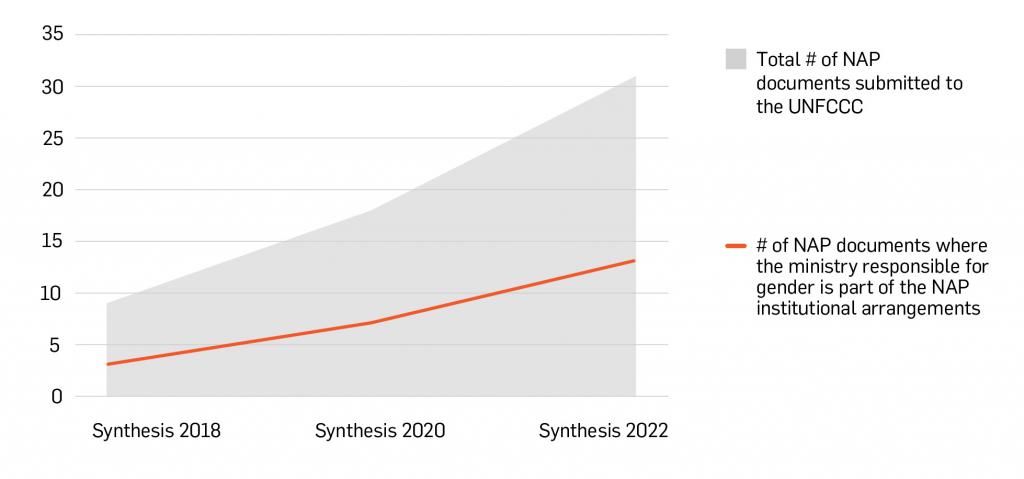
Twenty years after the Earth Summit, and 40 years after Stockholm, governments gathered again in Rio de Janeiro for the UN Conference on Sustainable Development (Rio+20). This conference set in motion the process to negotiate the 2030 Agenda for Sustainable Development and its 17 Sustainable Development Goals (SDGs), which were adopted in 2015. The SDGs have taken the concept of sustainable development that emerged from Stockholm and articulated it in the most measurable and inspiring framework to date.
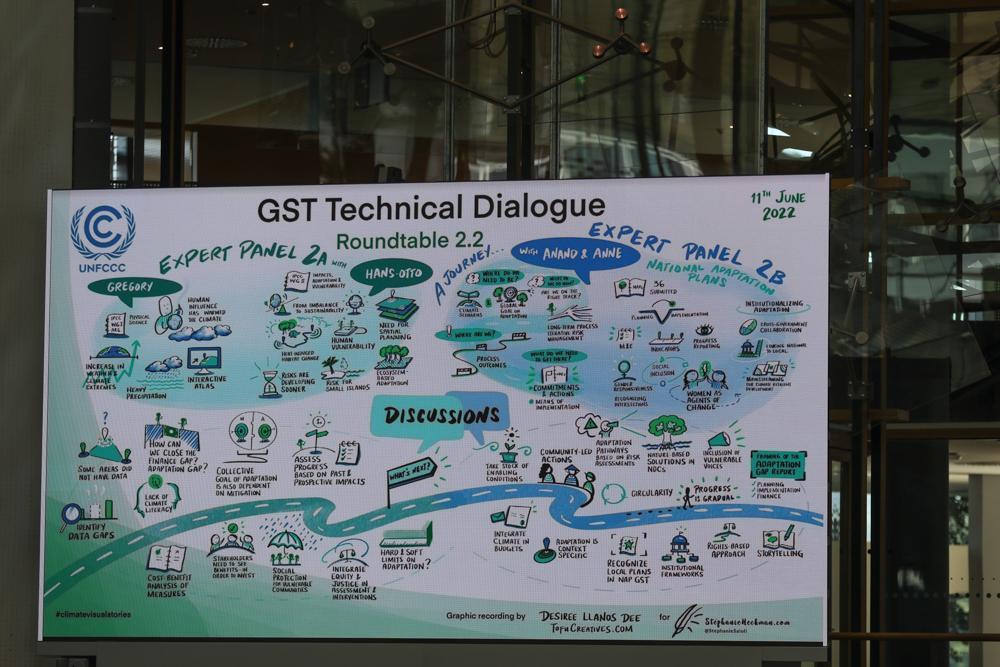
Learning about the Planet

The Stockholm Conference also recognized the need for a strong scientific foundation for global environmental policymaking. With that in mind, one of UNEP’s key mandates is to monitor, track, and record environmental data. At the inaugural meeting of the UNEP Governing Council in 1973, governments established Earthwatch, a programme to coordinate, harmonize, and integrate observation, reporting, and assessment activities across the UN system (Ivanova, 2021, p.72). While financial constraints prevented Earthwatch from achieving its potential, UNEP’s focus on monitoring the environment has evolved from tracking indicators to synthesizing data into environmental assessment reports, including the influential Global Environment Outlook reports and the Emissions Gap Reports.

UNEP’s convening power and scientific research also spur countries to engage, act boldly, and advance the global environmental agenda. UNEP contributed to the establishment of two major science-policy bodies: the Intergovernmental Panel on Climate Change (IPCC) and the Intergovernmental Science-Policy Platform on Biodiversity and Ecosystem Services (IPBES). This mandate continues to grow; the 2022 session of the UN Environment Assembly agreed to establish a new science-policy panel on chemicals (UNEA, 2022, Annex I). Since its birth in Stockholm, UNEP has become the arena where the policy and science communities can meet and trigger policy responses.

IPBES photo
Members of the Intergovernmental Platform for Biodiversity and Ecosystem Services (IPBES) celebrate the adoption of IPBES Global Assessment Report on Biodiversity and Ecosystem Services in 2019. (Photo: Diego Noguera, IISD/ENB)

Establishing Key Principles

The Stockholm Declaration was also the starting point for the introduction of concepts and principles into international law that previously were only used in national legislation. Three of these international legal principles have come to underpin environmental discourse and law-making.

The precautionary principle is one of the most prominent and possibly controversial of these principles. While it existed in national legal frameworks as early as 1969, the Vienna Convention for the Protection of the Ozone Layer was the first MEA that codified precautionary measures in 1985. This recognition was extended in 1987 when governments pledged in the preamble to the Montreal Protocol on Substances that Deplete the Ozone Layer their determination to protect the ozone layer by “taking precautionary measures to control equitably total global emissions of substances that deplete it.” Following the adoption of Principle 15 of the 1992 Rio Declaration, which was also the first international instrument to include a definition of the precautionary principle, many multilateral and regional agreements, as well as national laws, now include precautionary action in some form.

The second principle is additionality. Principle 12 of the Stockholm Declaration recognized additional international technical and financial resources should be made available to developing countries “to preserve and improve the environment.” This principle was expanded in the Rio Declaration, which recognizes developed and developing countries have “common but differentiated responsibilities” due to their different contributions to global environmental degradation and in view of “the technologies and financial resources they command” (Principle 7). Rio Principle 9 provides for scientific and technological knowledge exchange and for enhanced development, adaptation, diffusion, and transfer of technologies.

Finally, the polluter-pays principle (PPP), which had a long history of use at the national level, was incorporated in Principle 22 of the Stockholm Declaration. The PPP requires those who produce pollution to bear the costs of managing it to prevent damage to human health and the environment. Twenty years later, the PPP was included broadly in Principle 16 of the Rio Declaration and is contained in numerous legally binding and non-legally binding international agreements that form a backbone of international environmental policy.

Governments Cannot Solve Environmental Problems Alone

Despite these advances in international environmental law, science, assessments, and principles, implementation is still lagging. The true challenge of global environmental action may lie in designing treaties that can adapt over time to evolving science and changing levels of socio-economic development, and recognize the importance of stakeholder engagement. Multilateralism may be part of the answer, but it may also be insufficient to avert catastrophic environmental damage unless governments and all stakeholders rise to the occasion.

The Stockholm Conference opened the door to broader participation in the international sustainable development arena. By welcoming non-governmental organizations (NGOs), Indigenous Peoples, the scientific community, and the private sector—groups that previously did not have great access to the UN system—Stockholm increased transparency and inclusivity.

Civil society at the 2022 Geneva Biodiversity Conference
The Stockholm Conference opened up UN processes to non-state stakeholders. Today, members of civil society fully engage at UN meetings, sometimes through protests, like this one at the 2022 Geneva Biodiversity Conference. (Photo: Mike Muzurakis, IISD/ENB)

Recognizing the growing civil society interest in environmental issues, the Stockholm Conference established the Environmental Forum (Engfeldt, 2009, p.50). This became a model for subsequent UN sustainable development conferences. In fact, twenty years later at the Earth Summit in Rio, the parallel NGO forum—the Global Forum—attracted an estimated 20,000 environmentalists and representatives of a wide spectrum of groups (Engfeldt, 2009, p.187).

This led to the growing recognition that governments cannot solve environmental problems alone. The Earth Summit called for broad public participation in decision-making. Chapters 24-32 of Agenda 21 formalized nine sectors of society as the main channels where participation was needed to implement activities related to sustainable development. These “Major Groups” include women, children and youth, Indigenous Peoples, NGOs, local authorities, workers and trade unions, business and industry, the scientific and technological community, and farmers.

One of the fundamental prerequisites for the achievement of sustainable development is broad public participation in decision-making.

Chapter 23, Agenda 21

Two decades after the Earth Summit, the importance of effectively engaging these nine sectors was reaffirmed by the UN Conference on Sustainable Development (Rio+20). Furthermore, governments and the UN opened up to other stakeholders, including local communities, volunteer groups and foundations, migrants and families, older persons, persons with disabilities, and the lesbian, gay, bisexual, and transgender (LGBT) community. By welcoming nonstate stakeholders to the UN, the Stockholm Conference started to expand the nature of the sustainable development discourse.

For example, Grand Chief George Manuel from the National Indian Brotherhood was part of the Canadian delegation to the Stockholm Conference (Crossen, 2017). But the Stockholm Declaration and Action Plan did not acknowledge Indigenous Peoples. Twenty years later, Indigenous Peoples played a more prominent role in the preparations for the 1992 Earth Summit, which explicitly called for the involvement of Indigenous Peoples and their communities in resource management and conservation strategies and to support sustainable development strategies. Indigenous Peoples also participate in global environmental governance of biodiversity, climate change, persistent organic pollutants, and the Arctic. However, there is still a need to ensure Indigenous Peoples’ worldviews and knowledge are genuinely integrated into decision-making processes.

The Stockholm Conference did not address women or gender issues either. However, twenty years later, the women’s agenda and the environmental agenda came together at the international level during the preparations for the Earth Summit. This discussion led to Principle 20 of the Rio Declaration: “Women have a vital role in environmental management and development. Their full participation is therefore essential to achieve sustainable development.” It is now widely recognized that addressing gender inequalities—including access to and control over natural resources—accelerates the impact of sustainable development policies. However, much work remains to enable women’s participation and decision-making at all levels.

The private sector, including corporations, investors, industry interest groups, and philanthropists, has engaged in sustainability policy and practice in three main ways: actively blocking action on environmental and social issues; partnering with governments and other stakeholders to advance sustainable development; and working to transform the systems that have led to climate change and unsustainability, particularly growth-based economic models. Many now recognize that bringing in industry and the private sector is essential to responding to environmental challenges and to scaling up implementation of MEAs and the SDGs, but clear policy guidance is still needed.

Sustainable Development Challenges

The Stockholm Conference also identified a theme that has since been at the centre of international environmental discourse: sustainable development. The debates held in 1972 foreshadowed discussions ever since: Who bears the blame for pollution? How can we lift people out of poverty while conserving ecosystems? What is the relationship between human and environmental health? Can economic development be sustainable? Thus, another legacy of the 1972 Conference is the enduring search for solutions to reconcile economic development and environmental management, which culminated in 2015 with the 2030 Agenda for Sustainable Development and its 17 SDGs, the Paris Agreement on climate change, and the Sendai Framework for Disaster Risk Reduction.

At the heart of the SDGs—and the Millennium Development Goals before them—is poverty eradication, which is necessary to achieve sustainable development. Work to define poverty and to bring together the environment and poverty eradication agendas has been aided by efforts to holistically measure and communicate changes in poverty levels, environmental impacts, and the relationships between the two. As a result, millions were lifted out of poverty over the past 50 years, but the once-in-a-generation catastrophe of the COVID-19 pandemic reversed progress.

COVID-19 also magnified the inequalities in healthcare systems and demonstrated that existing environmental policies do not effectively support global health and sustainable development objectives. The pandemic exacerbated these negative trends and magnified underlying systemic problems, including social and economic inequality and weak healthcare systems.

SDGs symbols on pillars
Another legacy of the Stockholm Conference is the enduring search for solutions to reconcile economic development and environmental management, which culminated in 2015 with the 2030 Agenda for Sustainable Development and its 17 Sustainable Development Goals. (Photo: Kiara Worth, IISD/ENB)

The Stockholm Conference identified water and sanitation as necessities for a decent life, along with food, clothing, shelter, and education. The Stockholm Action Plan’s 109 recommendations included calls for water supply, sewerage, and waste disposal systems adapted to local conditions. Yet 50 years later, ensuring water and sanitation for all remains one of the world’s biggest challenges.

In 1972, 37% of the world’s population lived in urban areas. Today, over 56% of the world’s population can be found in cities and this is expected to reach 68% by 2050 (UNDESA, 2019). Increasing urbanization contributes to biodiversity loss, increased material consumption, and climate change. Many cities recognize these challenges and have become sustainable development leaders as they experiment with urban agriculture, sustainable transport, and fostering decarbonization across the energy, building, waste, and transport sectors, while improving quality of life.

The challenges of sustainable economic development have not abated over the past 50 years. Whether we are talking about the need for more sustainable mining, fishing, forests, or resource consumption in general, the need to balance economic development and environmental conservation is as important as ever. The Stockholm Declaration not only addressed resource depletion but also benefit-sharing, emphasizing that we must ensure natural resource use not only benefits the few, but the many—both within and across countries. It also speaks to the principle of inter-generational equity, ensuring today’s resource use does not compromise the availability of natural resources for future generations.

The Path Forward

What will these future generations say of the legacy of Stockholm? Fifty years after Stockholm, we face a triple planetary crisis of climate change, nature and biodiversity loss, and pollution that could not have been imagined in 1972. To move forward, everyone must work together to find ways to transform our societies and economies.

We are already seeing the impacts of a warming world on biodiversity, coral reefs, small island states, natural disasters, and human health. The window to transition to a sustainable future is open but closing fast.

Climate change, nature and biodiversity loss, and pollution and waste are threatening to pull the very rug out from under the SDGs—and with it whip away our aspirations to end hunger and poverty, deliver peace and equity, and live in harmony with the natural world.

Growing pressure for new rules and agreements that meaningfully consider sustainable development and trade—including by eliminating harmful energy, agricultural and fisheries subsidies—is challenging multilateralism, especially at the World Trade Organization (Hopewell, 2016). Plastics pollution, the illegal wildlife trade, and new forms of biotechnology—issues that were not even on the radar in 1972—are putting multilateral cooperation to the test.

The Stockholm Conference began a global conversation about the importance of environmental issues, along with their interconnections with economic and social development. Stockholm will always be remembered as the moment these challenges were brought together. Perhaps the best legacy of Stockholm will be accelerated implementation of the treaties and agreements to address the triple planetary crisis. These agreements include the 2030 Agenda, the Paris Agreement on climate change, the global biodiversity framework, and the Sendai Framework, along with all the other MEAs that grew out of the Stockholm Conference.

Now is the time to continue to connect and better understand scientific data and to involve everyone on the planet—not just governments—in the decision-making processes of our collective future. Now is the time to remember and live up to the promise of Stockholm.

Stockholm train station
The Stockholm+50 conference commemorates the 50th anniversary of the 1972 Conference under the theme “A healthy planet for the prosperity of all – our responsibility, our opportunity.” (Photo: Norman Tsui/Unsplash)

Works Consulted

Crossen, J. (2017). Another wave of anticolonialism: The origins of indigenous internationalism. Canadian Journal of History 52(3), 533-559. doi.org/10.3138/cjh.ach.52.3.06

Engfeldt, L. (2009). From Stockholm to Johannesburg and beyond. Swedish Ministry for Foreign Affairs.

Hopewell, K. (2016). Breaking the WTO: How emerging powers disrupted the neoliberal project. Stanford University Press.

Ivanova, M. (2021). The untold story of the world’s leading environmental institution: UNEP at fifty. MIT Press.

United Nations Department of Economic and Social Affairs. (2019). World population prospects 2019. Population Division. esa.un.org/unpd/wpp/

United Nations Environment Assembly of the United Nations Environment Programme. (2022). “Proceedings of the United Nations Environment Assembly at its resumed fifth session” UNEP/EA.5/28. unep.org/environmentassembly/unea-5.2/proceedings-report-ministerial-declaration-resolutions-and-decisions-unea-5.2