Webinar

Understanding Investment, Trade, and Battery Waste Management Linkages for a Globally Competitive Electric Vehicles Manufacturing Sector

April 29, 2022 9:30 am - 3:35 pm IST

Magnolia Hall, India Habitat Centre and virtual via Zoom

(Open to public)

Increasing the uptake of electric vehicles (EVs) is a strategic objective of the Government of India. The development of the Indian EV landscape, however, is likely to entail momentous investment and for this level of investment to take place, India's EV ecosystem will have to be globally competitive.

In this context, this hybrid event presents detailed stylized facts on trade and tariffs of goods involved in the EV value-chain; addresses regulatory barriers to trade in services that perform complementary and enabling functions in the EV value-chain; presents key takeaways from an in-depth consultation exercise with key investors and companies; discusses existing government policies such as FAME II and PLI; identifies key barriers such as charging infrastructure, supply chains, and skill gaps; highlights new government initiatives to address these barriers; and discusses state EV policies.

This event is organized by the Indian Council for Research on International Economic Relations (ICRIER), ClimateWorks Foundation, and the International Institute for Sustainable Development (IISD), alongside knowledge partner the Shakti Sustainable Energy Foundation.

Agenda

Welcome

Deepak Mishra, Director and Chief Executive, ICRIER

Introduction Note

Siddarthan Balasubramanian, Principal Strategist, ClimateWorks Foundation

Keynote Session and Unveiling the Summary for Policy-Makers

Shri Amitabh Kant, CEO, NITI Aayog
Shri Sudhendu J. Sinha, Adviser, NITI Aayog

Session 1: High-Level Panel Discussion

Moderator
Ruchir Shukla, Director, Electric Mobility Initiative, Shakti Sustainable Energy Foundation

Panellists

  • Dev Ashish Aneja, Assistant Vice President and Sector Lead Automobiles, Electric Vehicles and Batteries, Invest India
  • Nitin Seth, CEO, New Mobility, Reliance Industries
  • Shri Randheer Singh, Director, Electric Mobility, NITI Aayog
  • Chaitanya Kanuri, Senior Program Manager - Electric Mobility, World Resources Institute India (WRI India)

Session 2: Trade and Investment

Presentation on Investment
Tom Moerenhout, Associate, IISD
Siddharth Goel, Senior Policy Advisor, IISD

Presentation on Trade
Anirudh Shingal
Prachi Agarwal

Panel Discussion

Moderator
Saon Ray, Visiting Professor, ICRIER

Panellists

  • Deb Mukherji, Managing Director, Omega Seiki Mobility
  • Vikram Handa, Managing Director, Epsilon Advanced Materials Private Limited
  • Ajith Chandran, Managing Director, Development Interlinks International Pvt. Ltd.
  • Komal Kareer, Analyst, Bloomberg New Energy Finance

Session 3: Towards Sustainable EV Battery Supply Chains

Chair Remarks
A.L.N Rao, CEO, Exigo Recycling

Presentation
Amrita Goldar, Senior Fellow, ICRIER

Panel Discussion

Moderator
Amrita Goldar, Senior Fellow, ICRIER

Panellists

  • Shobha Raghavan, Chief Operating Officer, Saahas Zero Waste
  • Rahul Walawalkar, President and Managing Director, Customized Energy Solutions and India Energy Storage Alliance
  • Moushumi Mohanty, Head of Electric Mobility Programme, Centre for Science and Environment

Final Remarks

Tom Moerenhout, Associate, IISD

Vote of Thanks

Amrita Goldar, Senior Fellow, ICRIER
Webinar

Getting Started – The CO2 Performance Ladder for low-carbon procurement

May 17, 2022 2:00 pm - 3:30 pm CET

(Open to public)

Getting Started – the CO2 Performance Ladder for low carbon procurement

The International Institute for Sustainable Development (IISD) and the Foundation for Climate Friendly Procurement and Business (SKAO) were pleased to create a virtual event that showcased a joint project on low-carbon infrastructure procurement. 

Since 2021, IISD and SKAO have been collaborating on a project to scale-up the use of the CO2 Performance Ladder in Europe. Already used by over 200 procuring authorities in the Netherlands, and recently deployed successfully through public procurement in Belgium, the CO2 Performance Ladder is quickly becoming recognized best practice for structurally decreasing carbon emissions, particularly in heavy infrastructure sectors. Moreover, the CO2 Performance Ladder has been developed and used in compliance with the European Union Procurement Directive, making it immediately applicable in other EU countries. 

In this 1.5-hour virtual event, IISD and SKAO introduced you to this carbon-management system and its use in public procurement. After that, procurement authorities and companies from the Netherlands and Belgium explained the practicalities of using the CO2 Performance Ladder in public procurement processes and provided tips for getting started.

Discussion Topics:

  • About the CO2 Performance Ladder for managing and reducing carbon emissions
  • Insights from procurement authorities on using the CO2 Performance Ladder (Netherlands and Belgium)
  • Insights from the company side on implementing the CO2 Performance Ladder and responding to public tenders (Belgium)

Moderator:

  • Laura Turley, International Institute for Sustainable Development

Speakers:

  • Maud Vastbinder, Foundation for Climate Friendly Business and Procurement (SKAO)
  • Harald Versteeg, Programme Manager at Rijkswaterstaat
  • Dirk Van Troyen, Road Structures Engineer, Flemish Agency for Roads and Traffic (AWV)
  • Franky van den Berghe, Sustainability Manager, Willemen Group
Webinar

Designing Fair and Equitable Climate and Energy Policies

April 25, 2022 2:00 pm - 3:30 pm CEST

via Zoom

(Open to public)

This event, jointly organized by the Institute for Climate Economics (I4CE), ODI, and the International Institute for Sustainable Development (IISD), and supported by the European Climate Foundation (ECF), examines the complex social impacts of climate and energy policies. In doing so, it shows the importance of integrating climate and social perspectives to increase the sustainability and viability of these policies.

Closing the gap between the emission reductions required to limit global warming to 1.5°C and actual government commitments requires climate and energy policies to significantly ramp up by 2030. Yet more research is needed to understand the economic and social impacts, including which population groups may be positively or negatively affected, and how the social outcomes of such policies can be maximized or mitigated. To address these issues, this event:

  1. Discusses the range of social impacts to be expected from climate and energy policies.
  2. Shares recommendations on how to design climate and energy policies to alleviate potential detrimental social impacts.
  3. Presents figures and an assessment outlining the likely social impacts of climate and energy policies from both the Energy Policy Tracker and the French green budget.
  4. Highlights current challenges in the evaluation of social impacts of climate and energy policies, as well as the type of frameworks that can be used by governments to better assess these impacts.

Agenda

Welcome
Nohman Ishtiaq, Public Finance Expert, United Nations Development Programme

Overview of the Inequality and Poverty Dashboard
Joachim Roth, Policy Analyst, IISD

Overview of the Social Impacts of the French Green Budget
Solène Metayer, Research Fellow, I4CE

Perspectives From Civil Society, Academia, and Intergovernmental Organizations
Jason Farr, Associate Policy Advisor for Climate Change and Energy, Oxfam
Michael Jakob, Fellow, Mercator Research Institute on Global Commons and Climate Change
Luisa Miranda Morel, Senior Manager, C40
Enrico Botta, Policy Analyst, Organisation for Economic Co-operation and Development

Q&A

Webinar

Achieving Gender Equality in Climate Change and Food Systems

April 20, 2022 6:00 am - May 6, 2022 6:00 am

(Open to members)

Acheiving gender equality in climate change and food systems

IISD, in partnership with the Food and Agriculture Organization of the United Nations, the International Training Centre of the International Labour Organization (ITCILO), OXFAM, and Women in Law and Development in Africa, is organizing an online training course on Achieving Gender Equality In Climate Change and Food Systems, which is planned to take place online from April 20 to May 6, 2022.

Format and Methodology

This online training aims to deepen the knowledge of parliamentarians and policy-makers on key gender equality issues in agriculture and food systems. It will assist them with the design and implementation of gender-responsive interventions and policies that advance gender equality in relation to climate change and food security. The course has three modules: 

  • Module 1: Addressing gender equality in climate change adaptation and mitigation in agriculture.
  • Module 2: Building equitable and inclusive food systems.
  • Module 3: Supporting gender-responsive budgeting and planning for agricultural and climate change policies.

Each module will be introduced by a live webinar with topic experts, followed by interactive sessions on each of the modules. Participants will have access to the platform and will be enrolled in the course on the ITCILO e-campus to join live webinars and take the online classes.

Language 

The course material will be available in English and French. Live webinars and interactive sessions will be presented with live interpretation in both languages.

Duration

Each module takes approximately 45–60 minutes to complete, supported by 2 hours of live webinars weekly.

Target Group

The course is aimed at parliamentarians and policy-makers from Africa, Asia, the Middle East and North Africa region, and Latin America. Any member of the Alliance Against Hunger can apply.

Eligible participants are expected to: 

  • Have good knowledge of either English or French.
  • Preferably be members of the committee in charge of gender, agriculture, or climate change.
  • Be able to commit to the full online course period.

Certificate of Completion

At the end of this course, a certificate of completion will be awarded to all the participants who successfully completed the course.

How to Apply

Please complete and submit the application form by April 14 using this link.

Webinar

Investing in Sustainable Agriculture: How can sustainability standards reduce financial risks?

April 26, 2022 9:00 am - 10:15 am ET

(Open to public)

(French below)

Achieving food security requires a rapid shift to a more sustainable and resilient agriculture that remains viable in the face of economic volatility, supply chain disruptions, and increasing adverse impacts from the changing climate, which will exacerbate the estimated USD 260 billion investment gap that needs to be overcome to meet the targets of Sustainable Development Goal 2 (zero hunger). We need to feed the planet using farms that can limit greenhouse gas emissions and adapt to the changing climate while protecting forests and biodiversity. And we need investors to quickly get behind this transition to make it happen.

On April 26th, 2022, we hosted a webinar that explored the findings from IISD's State of Sustainability Initiatives (SSI) Review: Standards and Investment in Sustainable Agriculture. The report looks at voluntary sustainability standards (VSSs) from the investor's perspective and shows that sustainability standards promote synergies between sound business practices and better environmental and social performance to catalyze much needed investment in sustainable agriculture. 

Moderators and presenters:

  • Cristina Larrea, Lead II, Sustainability Standards, IISD and report co-author
  • Nathalie Bernasconi-Osterwalder, Senior Director, Economic Law and Policy, IISD
  • Vivek Voora, Senior Associate, IISD and lead report author

Confirmed speakers:

  • Andrew Ahiaku, Agricultural Investment & Technical Assistance Specialist, Aceli Africa
  • Ignacio Antequera, Team Leader Technical Key Accounts, Senior Technical Expert, Global G.A.P
  • Lava Bellarmin, Director of Cooperative PAACO (Agricultural and Artisanal Products of the East Coast) and President of the Network of Fair-Trade Cooperatives, Madagascar
  • Marinà Herisoa Rakotoniaina, Director of the Directorate of Support to Producers' Organization and Agribusiness, Ministry of Agriculture and Livestock, Government of Madagascar
  • Eric Kabayiza, Coordinateur SPIU (single project implementation unit), Representative of National Agriculture Export Development Board (NAEB), Rwanda

Pour atteindre la sécurité alimentaire, il faut passer rapidement à une agriculture plus durable et plus résiliente qui reste viable face à la volatilité économique, aux perturbations de la chaîne d'approvisionnement et aux effets néfastes croissants du changement climatique, ce qui aggravera le déficit d'investissement estimé à 260 milliards USD qu'il faut combler pour atteindre les cibles de l'objectif de développement durable n° 2 (faim zéro). Nous devons nourrir la planète grâce à des exploitations capables de limiter les émissions de gaz à effet de serre et de s'adapter au changement climatique tout en protégeant les forêts et la biodiversité. Et nous avons besoin que les investisseurs soutiennent rapidement cette transition pour qu'elle se réalise.

Le 26 avril 2022, nous avons organisé un webinaire qui explorait les conclusions de l'examen de l'état des initiatives de durabilité de l'IISD : Normes et investissements dans l'agriculture durable. Le rapport examine les normes volontaires de durabilité du point de vue de l'investisseur et montre que les normes de durabilité favorisent les synergies entre les pratiques commerciales saines et une meilleure performance environnementale et sociale afin de catalyser les investissements indispensables dans l'agriculture durable. 

Modérateurs et présentateurs :

  • Cristina Larrea, chef, normes de durabilité, IISD et co-auteur du rapport
  • Nathalie Bernasconi-Osterwalder, directrice principale, droit et politique économiques, IISD
  • Vivek Voora, associé principal, IISD et auteur principal du rapport

Orateurs confirmés

  • Andrew Ahiaku, spécialiste des investissements agricoles et de l’assistance technique, Aceli Africa
  • Ignacio Antequera, chef d’équipe des comptes clés techniques – expert technique senior, Global G.A.P.
  • Lava Bellarmin, Directeur de coopérative PAACO (Produits Agricoles et Artisanaux de la Côte Orientale), Madagascar et Président du Réseau des Coopératives de Commerce Équitable, Madagascar
  • Marinà Herisoa Rakotoniaina, Directeur de la Direction de l’appui à l’organisation des producteurs et de l’agrobusiness, Gouvernement de Madagascar
  • Eric Kabayiza, Coordinateur SPIU (unité unique de mise en œuvre du projet) au National Agriculture Export Development Board (NAEB), Rwanda
Webinar

Carbon Tax at the G20: Building momentum to accelerate a green recovery

April 8, 2022 3:00 pm - 5:00 pm WIB

via Zoom

(Open to public)

As part of its G20 Presidency in 2022, Indonesia aims to accelerate the global energy transition. For this purpose, its interministerial Energy Transition Working Group (ETWG) has defined three energy priority issues:

  1. Securing energy accessibility
  2. Scaling up smart and clean energy technologies
  3. Advancing energy financing.

Against this background, Indonesia's first-ever carbon tax will apply from July 1, 2022 (postponed from April 1, 2022), starting with coal-based power plants. The question of to what extent carbon taxation can and must play a role in achieving the three priorities under Indonesia’s G20 Presidency, however, has not yet been widely discussed.

This webinar, featuring an international expert panel, will therefore examine how carbon taxation can be driven forward within the context of ETWG priorities and the post-pandemic recovery. This event is the second session of our series of three webinars.

First, Arifin Tasrif, Minister of Energy and Mineral Resources, will present the current plans for carbon tax on fossil fuels in Indonesia. The International Institute for Sustainable Development's (IISD) Tara Laan will then deliver a keynote address on how exactly carbon taxation can support Indonesia’s G20 presidency's three energy-transition priority issues. Finally, the high-profile panelists (including Rida Mulyana, Director-General of Electricity, Ministry of Energy and Mineral Resources of Indonesia) will respond individually on how the carbon tax correlates with the priority issues of the G20 Indonesian Presidency before the discussion is opened.

This event is part of the Katadata Indonesia Data and Economic Conference.

Agenda

Opening Remarks

Dadan Kusdiana, Director General New Renewable Energy and Energy Conservation, Ministry of Energy and Mineral Resources, Republic of Indonesia

Keynote Address

Tara Laan, Senior Associate, IISD

Panel Discussion

Malin Ahlberg, Federal Ministry for Economic Affairs and Climate Action, Germany

Wahyu Marjaka, Director of Sectoral and Regional Resource Mobilization, Ministry of Environment and Forestry, Republic of Indonesia

Memory Machingambi, Senior Economist, Environmental and Fuel Taxes, National Treasury, Republic of South of Africa

Bayu Nugroho, Coordinator of Environmental Protection for Electricity, Ministry of Energy and Mineral Resources, Republic of Indonesia

Closing Remarks

Webinar

Gender Responsive Policies in Artisanal and Small-Scale Mining

April 5, 2022 10:00 am - 1:00 pm ET

(Open to public)

The global artisanal and small-scale mining (ASM) sector employs an estimated 45 million people and indirectly supports 150 million. Earlier this year, the IGF Secretariat worked with Levin Sources to release two resources to help policy-makers and researchers better understand the difficulties that women face in ASM.

To further explore these challenges and advance good ASM governance, the IGF and Levin Sources hosted a webinar with leading policy experts discussing gender-responsive government actions for the ASM sector on the 5th of April, 2022. Speakers shared experiences from government and industry and discussed the following questions:

  • What is the current status of gender-responsive policies within the ASM sector?
  • How has COVID-19 uniquely affected women in ASM, and what are the key lessons learned for policy-makers?
  • How will a low-carbon energy transition impact women in ASM?
  • Can new technologies benefit women in ASM?

Moderators

  • Ashley Smith-Roberts, Specialist, Levin Sources
  • Ege Tekinbas, Gender Equality Advisor, IGF

Speakers

  • Janet Adeyemi, President, Women in Mining in Nigeria
  • Ruth Arpasi, Technical Coordinator, Alliance for Responsible Mining, Peru
  • Yaw Britwum, Programme Manager-Responsible Mining, Solidaridad, Ghana
  • Diana Gonzalez, Environmental Manager, Alliance for Responsible Mining, Colombia
  • Urica Primus, President, Guyana Women Miners Organisation
Webinar

Gas Pressure: Exploring the case for gas-fired power in South Africa

March 31, 2022 10:00 am - 11:30 am SAST

via Zoom

(Open to public)

This webinar, organized in partnership with WWF South Africa, provided participants with a first look at findings from the new International Institute for Sustainable Development (IISD) report Gas Pressure: Exploring the case for gas-fired power in South Africa, presenting key takeaways and recommendations.

Within the power sector, this report examines the increasing risks associated with natural gas, the improvements in alternatives, and ways the energy mix could evolve. From this, the report provides recommendations on how South Africa could alleviate the constrained power system, reduce the chances of stranded assets, and meet climate change objectives. 

Through a panel discussion and a Q&A session, participants engaged in a debate on whether South Africa should be investing in a gas-to-power sector now, given the disruptive changes in the energy landscape.

Agenda

Opening Remarks

Ellen Davies, Senior Research Advisor, The African Climate Foundation

Launching Gas Pressure: Exploring the case for gas-fired power in South Africa Report

Richard Halsey, Policy Advisor, IISD

Panel Discussion

Moderator

Shruti Sharma, Senior Policy Advisor, IISD

Panellists

Q&A

Close

Webinar

Paris-Aligned Phase-Out: Pathways to end fossil fuel production

March 24, 2022 1:00 pm - 3:00 pm ET

via Zoom

(Open to public)

At this webinar, Professor Kevin Anderson of the Tyndall Centre at Manchester University presents his new research on pathways for phasing out fossil fuel production consistent with the Paris Agreement goals.

It is widely agreed that Organisation for Economic Co-operation and Development (OECD) and European Union countries need to phase out coal power generation by 2030, and other countries by 2040 or 2050. This new research for the first time proposes phase-out timelines for oil and gas, taking into account countries’ different capacities to fund a just transition.

The research was commissioned by the International Institute for Sustainable Development.

Speakers

Ivetta Gerasimchuk, Director, Sustainable Energy, International Institute for Sustainable Development

Kevin Anderson, Professor of Climate and Energy, Manchester University

Colin Besaans, Programme Manager, African Energy Transition, Power Shift Africa

Webinar

Women’s Voices in Climate Action: The power of visual storytelling

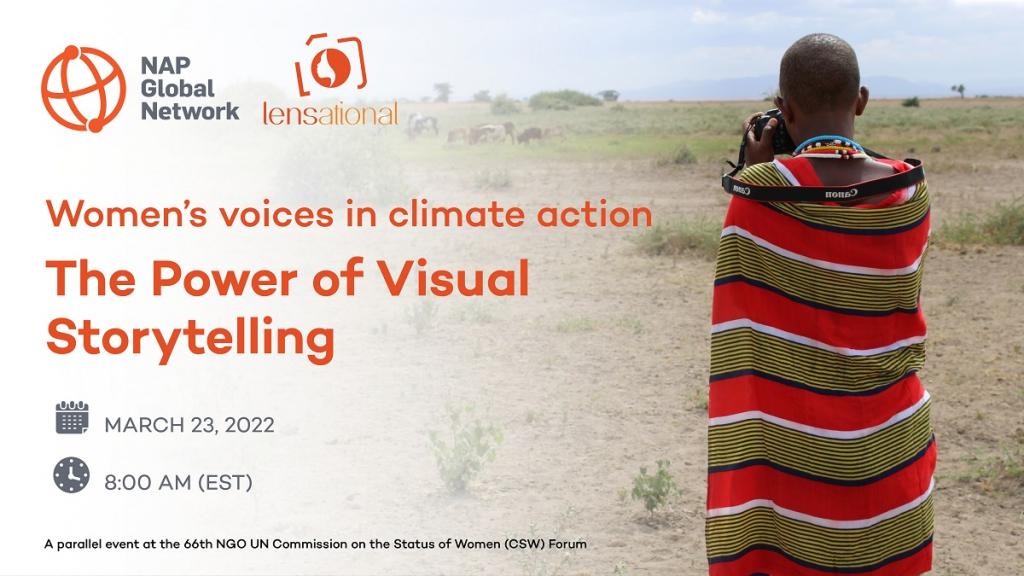
Organized by the National Adaptation Plan (NAP) Global Network and Lensational, this event explores the power of visual storytelling in bringing women’s voices into climate change adaptation planning processes.

March 23, 2022 8:00 am - 9:15 am EST

(Open to public)

A parallel event at the 66th NGO UN Commission on the Status of Women (CSW) Forum

Women’s leadership is crucial for effective climate action, but policy and planning processes may not create the space for women, in all their diversity, to meaningfully participate and drive solutions.

This event, organized by the National Adaptation Plan (NAP) Global Network and Lensational, will explore the power of visual storytelling in bringing women’s voices into climate change adaptation planning processes—especially women from underrepresented groups and communities. It will showcase visual stories captured by women on the frontlines of climate change in Ghana and Kenya and discuss how these can influence decision-making in NAP processes towards locally-led and gender-responsive adaptation action.

event graphic featuring a woman taking a photograph

To learn more, check out the digital story and video about the NAP Global Network and Lensational partnership in Kenya and Ghana.

This partnership between Lensational and the NAP Global Network was made possible through generous financial support from Global Affairs Canada.

Webinar details