Insight

Taking Action to Boost Sustainable Consumption in Asia

How consumers, supply-chain actors, and governments can make a difference

November 24, 2021

For too long, the way we produce and consume products has unintentionally harmed people and the planet. The processes through which commodities such as tea leaves are plucked by farmers in India and transformed into the steaming mug of tea served in your local Starbucks can often contribute to social and environmental problems like climate change, biodiversity loss, and inequality.

As consumers, we have the power to influence the way products are made, transformed, transported, and sold. By choosing sustainably grown products, we can motivate producers, manufacturers, and retailers to adopt and invest in more sustainable practices. Likewise, these actors must play a role—alongside bodies that set voluntary sustainability standards (VSSs)—in educating consumers and making sure we have the information we need to make informed choices.

Sustainable consumption trends in Asia and beyond

Global consumption of sustainably produced products such as coffee, cotton, palm oil, and tea is increasing, according to the findings from the International Institute for Sustainable Development’s (IISD) commodity series reports and IISD’s contribution to the International Trade Centre’s State of Sustainable Markets reports. This encouraging trend is driven by factors such as changing consumer preferences, reputational risk management and marketing opportunities for businesses, as well as an increase in supportive regulatory frameworks and export promotion measures from governments.

Emerging and developing countries, particularly in Asia, represent the largest consumer base for many of these commodities, but demand for sustainable products there remains low.

However, this growth in demand comes mainly from Europe and North America. For some commodities, like coffee and tea, the supply of VSS-compliant products still outpaces demand. Emerging and developing countries, particularly in Asia, represent the largest consumer base for many of these commodities, but demand for sustainable products there remains low. There are many reasons for this, ranging from the higher price of products that comply with VSSs to a lack of awareness among buyers, consumers, and government officials on the sustainability issues affecting commodity production.

Promising initiatives aimed at boosting sustainable consumption in Asia

In September, IISD and Evidensia organized a webinar that brought together various actors—from buyers and producers to VSS representatives—to discuss initiatives aimed at increasing sustainable consumption in Asia.

Many of these projects focus on improving the transparency and accountability of sourcing practices within supply chains and enhancing the credibility of product sustainability claims. For example, One Planet Network’s Consumer Information Programme provides reliable sustainability information on goods and services to help consumers make more informed choices. The World Wildlife Fund has done research on traceability in palm oil supply chains to help companies and consumers better understand where their products come from and how they affect forests, as well as promote accountability in the sector. And VSSs like the Global Organic Textile Standard (GOTS) provide labels that reassure consumers that their products have met measurable social and ecological criteria throughout their life cycle.

We also heard examples of how organizations are seeking to raise consumers’ awareness about the implications of their buying habits. For example, the Eco-fair project runs campaigns and offers online training to promote sustainable consumer choices in Vietnam. Similarly, the Trustea Sustainable Tea Foundation is developing a consumer outreach campaign on sustainability. The Sustainable Coffee Platform of Indonesia (SCOPI) aims to promote sustainable coffee production and consumption through partnership and collaboration.

Where do we go from here?

While these initiatives are encouraging, the journey has only just begun. To further boost sustainable consumption in Asia, we need to work together across all sectors.

Standard-setting bodies and other supply chain actors can improve product traceability and offer credible and transparent information to consumers on product sustainability so they can make better choices in the market. They can also help educate consumers on the true social and environmental costs of commodity production and the impacts our purchases can have on people and our planet.

To further boost sustainable consumption in Asia, we need to work together across all sectors.

Finally, governments can consider the role of regulatory frameworks and policies in enforcing more sustainable practices across supply chains. They can also help make sustainable products more affordable by offering monetary incentives to consumers or taxing products that do not comply with sustainability requirements.

Globally, we produce more sustainable products, such as coffee and tea, than we consume. Given the size of its consumer base, Asia must play a big part in closing the demand gap and achieving broader systemic change in sustainable consumption patterns worldwide.

This blog was originally published by Evidensia and reprinted on the IISD main website and the IISD State of Sustainability Initiatives website with permission. The author would like to thank Jennah Landgraf for her contributions to this blog and Cristina Larrea and David Perri for their valuable feedback on earlier drafts of this blog.
Insight

Canadian Youth Look to Move Mountains for the Climate Crisis

As extreme weather events become more common, young people throughout Canada are looking at how they can influence climate policy and inspire change.

November 24, 2021

Young people in Canada have set their sights on revolutionizing climate action. The new generation of activists is going beyond the traditional avenues of protest and is now engaging directly with policy and power structures. There is much we can learn from the efforts of young climate activists, both in Canada and abroad.

Over the last couple of months, I have had the privilege of meeting with some of Canada’s dedicated young climate activists to hear about their goals and tactics. I have heard from young people who are striking from school, communicating directly with policy-makers, rallying to change the legal voting age, and even going directly into damaged ecosystems to begin restoration work themselves.

Katia Bannister: Combining advocacy and ecological restoration

One of these activists is British Columbia’s Katia Bannister, a teenager who has already dedicated most of her life to nature and the environment. Katia became involved with nature from a young age, thanks to her ethnobotanist mother. “There are photos of me as a one- and two-year old strapped into a baby backpack accompanying my mom as she did fieldwork,” reminisced Katia as we spoke to her. 

As Katia grew older and became more aware of the climate crisis, her love of nature spurred her to action. Over the last several years, Katia has participated and been a leader in some very high-profile advocacy, including the Friday strikes from school (initiated by Greta Thunberg) and the Vote16 movement, which aims to lower British Columbia’s legal voting age to 16. Katia is also the current co-leader of the Cowichan Valley Earth Guardians Crew, which works to create inter-generational change on environmental issues. 

At the moment, Katia’s biggest project is engaging directly with ecological restoration work, going out into damaged ecosystems to pull invasive weeds and propagate native plants. “Ecological restoration is tangible, place-based, and rewarding. It helps to contextualize our personal and collective relationships with the Earth,” explained Katia as she recounted her experience restoring an abandoned railroad site. “I planted riparian plants to strengthen the banks of the estuary, a place that had endured decades of degradation. It was exciting, tangible, and interesting.” 

“Ecological restoration is tangible, place-based, and rewarding. It helps to contextualize our personal and collective relationships with the Earth."

Katia Bannister

After hearing Katia describe her own experiences, I asked her what other Canadians of all ages could do to get involved and make a difference. She told us, “Research potential opportunities to do restoration work in your community. Connect with local conservation organizations. Get out there and get your hands dirty.” 

Sara Campbell: Blending justice issues with climate action

Across Manitoba, Sara Campbell has been involved in environmental and social justice issues since childhood. “I was involved in social justice activism work from a young age with the support of my family,” she explained. Sara is now the Outreach and Education Assistant at the University of Winnipeg’s Campus Sustainability Office. She has been a leader on multiple different sustainability-based projects throughout her life, but Sara’s intersectional activism targets climate justice by centring issues of poverty and injustice as key to reducing our carbon footprint. “Housing is a main determinant in stability and health,” Sara said. “Buildings are also a large opportunity to reduce our emissions to prepare for the pre-existing and upcoming climate realities ahead.” According to Sara, climate justice cannot be achieved in isolation. The various other socio-economic issues that plague our society are inherently intertwined with the climate crisis.

“Buildings are also a large opportunity to reduce our emissions to prepare for the pre-existing and upcoming climate realities ahead.”

Sara Campbell

Sara’s activism goes well beyond traditional methods of protesting. Sara engages directly with policy-makers and has even made policy recommendations at the provincial level of government to former Manitoba premier Brian Pallister. Her proposed policy outlines a method for implementing a basic income program in Manitoba that she believes to be feasible and necessary. “Basic income would substantially improve quality of life to allow people the chance to get out of ‘survival mode’ and to move forward,” Sara told us. 

I concluded our interview by asking Sara: if she could send one message to her fellow activists, what would it be? Her response was simple and clear: “To my fellow activists: We need you. Life is not a game. Be a good ally. Listen. Amplify voices. Step back. Stand up. Keep going. Let’s do this.”

Time to give youth a real say

It is becoming increasingly clear that young people in Canada are done with waiting for older generations to make changes for them. In a recent global survey, 65% of youth respondents said that governments were failing them when it comes to climate action, and three quarters said they thought the future was frightening. This reality has become especially apparent since COP 26 in Glasgow this year, where youth from around the world made their presence known, by protesting portions of the agreement they felt were insufficient, proposing their own ideas, and pressuring negotiators not to lose steam. 

There is a strong appetite from young people to be included in major climate decisions, but there is still more to be done to include youth in decision making. In Canada, we have yet to see meaningful inclusion of youth in federal- and provincial-level decision making, and those reluctant to engage young people in these processes often cite immaturity or lack of life experience as their reason. However, it is clear by the words and actions of the youth who attended COP 26 this year, as well as the youth I have had the privilege of working with myself, that their contributions can help transform climate ambition into concrete climate action. 

We have just achieved an important milestone with the culmination of COP 26, but it is by no means an endpoint. As much as Canada has work to do, there are other countries where youth engagement is just as much, if not more of an issue. The dedicated activists we have in Canada provide us with an opportunity, which the wider policy community needs to help translate into action. If Canada takes youth voices seriously, we could become a role model for countries worldwide in youth engagement for climate action, perhaps even working with other nations to ensure youth voices are heard. We have mountains ahead of us that need to be moved, and if we want this planet to stand a chance in the face of climate change, it is time to give youth a real say. 

Insight

Propelling Nature-Based Infrastructure to an Asset Class

To improve lives and livelihoods, we must recognize the value of nature and the infrastructure it provides when making investment decisions.

November 18, 2021

Our current system of evaluating investments is broken. It is based on outdated understandings of the impacts of public and private investments, who bears risk, and how investment returns should be allocated. This system has perpetuated itself in earnest over the past few decades, and a path to aligning the health of our planet and economic growth remains unclear. What is clear at this juncture is that we cannot afford business-as-usual valuation methods: nature and the economies it supports cannot bear it. 

There is a clear disconnect between current, business-as-usual valuation techniques and our collective futures. While there are different valuation techniques for investments and/or assets, they all fundamentally rely on estimating future cash flows and the future replacement values of assets. These estimates are based on past information. 

What is clear at this juncture is that we cannot afford business-as-usual valuation methods: nature and the economies it supports cannot bear it. 

These estimates will often consider the risk that the final result may not match up to these expectations.  Yet, there remains no accepted methodology to evaluate climate risk when discussing these investments. Reporting on the climate-related risks facing businesses also remains in the early stages. Moreover, investments that would be positive forces against the march of climate change are often ignored by these valuation techniques.  

To respond to this need, our team developed the Sustainable Asset Valuation (SAVi) methodology to show the value that infrastructure projects can deliver to society when environmental, social, and economic risks and externalities are considered. In 2018, our team expanded the SAVi methodology to cover nature-based infrastructure (NBI). We made this change to better understand how specific investments can protect and enhance ecosystems while supplying critical public goods and services. The evidence so far from completed valuations point to NBI outperforming traditional infrastructure investments when environmental and social benefits are considered. 

While we have continually proven the multiple benefits associated with investing in NBI projects, we remain confronted with views that NBI investing is niche and has limited potential to scale. There remains a common perception that NBI investing is the purview of public financiers and philanthropies, not institutional investors and other large, private investors. 

One major constraint on scaling investment into NBI is that it is not considered a distinct “asset class” in its own right. This misunderstanding can be alleviated by better communication and understanding of the opportunities provided by NBI investments and by policies that are conducive to these investments.

Communicating the benefits of investing in nature

One of the key challenges we are tackling at IISD is how we communicate the benefits of NBI investments. To date, these communication efforts remain in early stages, and part of the challenge in telling this story comes from how the terms “asset” and “asset class” are applied to NBI relative to other assets. 

Our work has found that investments in NBI protect and enhance ecosystems and deliver economic returns. Assets are considered holdings that provide current, future, or potential economic benefits; therefore, NBI, by definition, is an asset. 

Assets are considered holdings that provide current, future, or potential economic benefits; therefore, NBI, by definition, is an asset.

To make NBI an asset class is to simply consider that these assets are similar, given that asset classes are defined as groupings of investments that exhibit similar characteristics and are subject to the same regulations. However, discussions of NBI as an asset class are usually shaded by an acknowledgement that economic benefits are disparate, inconsistent, and do not accrue solely to the investor. 

While in certain instances this situation may be true, in other instances, enough but not all economic benefits accrue to the investor to make the investment financially viable. The current practice of treating NBI assets as requiring one owner to reap all the benefits to justify the investment is not something we ask of other asset classes. For example, equity investors share in the profits of a company after salaries, debtors, and other expenses are paid, but equity investments are still viewed as an asset class. 

Moreover, there are substantial equity and debt investments made by venture capital firms in companies, projects, and/or new products that do not have discernable revenue streams at the outset or where the revenue streams may not be consistent. However, we do not label these opportunities as unworthy of investment. Our work will continue to meet this challenge of communicating that NBI, in many cases, performs similarly to other assets while also enhancing our ecosystems, supporting our economies, and providing for the well-being of affected populations. With a larger evidence base, greater recognition of these points, and the treatment of NBI as an asset class, we expect that NBI will increasingly become a go-to choice for investors. 

Improving the investment climate

A conducive investment environment can also make it easier to scale up NBI investments. While national and subnational governments have created incentives for private citizens and businesses to lower the cost of “going green” or to make their dwellings and businesses more energy efficient, these governments remain behind in creating incentives for large investment flows to go to NBI projects. 

Governments remain behind in creating incentives for large investment flows to go to NBI projects.

For example, if governments made capital gains and distributions from NBI holdings more tax advantageous than gains or distributions from other asset classes, investors would have an incentive to move more money toward these beneficial projects. While we acknowledge that issues over how to define NBI and nature-based solutions could undermine government efforts to make the necessary policy changes, we also acknowledge the painstaking work being done by the International Union for Conservation of Nature (IUCN) in this area.

Clearer parameters around what can be considered an NBI investment could catalyze government action and scale investment, so long as stakeholders understand the benefits of NBI.

Our continued work through the NBI Global Resource Centre and our SAVi assessments aims to provide the evidence base to communicate the benefits of NBI, shaping the understanding of NBI as both an asset and an asset class and inducing policy-makers to create a conducive environment for scaling up investment in this type of infrastructure. 

We recognize that we need a stronger evidence base for NBI than what we have now, and we look forward to working with all stakeholders to build that evidence base together. What we cannot do is continue to ignore the value of nature and the infrastructure it provides when making investment decisions. If we do so, we miss a crucial opportunity to improve the lives and livelihoods of many. Understanding NBI as an asset class is one step in that direction, as it puts NBI on a level playing field with other investment options in the hopes of driving much-needed investment flows toward NBI as a solution to our future infrastructure questions.

Insight

Facing Climate Financing Realities: How to think about coming pledges at COP 26

With the Glasgow climate talks now on the horizon, we need to consider the lessons learned from public and private climate finance so we don't repeat past mistakes.

October 26, 2021

With the first part of the Conference of the Parties to the Convention on Biological Diversity in China now in the rearview mirror and the 2021 United Nations Climate Change Conference (COP 26) in Glasgow just days away, we must consider how we’ll be able to meet the increasing need for financial resources to address the acute climate and biodiversity crises we face. 

A crucial aspect of this work is that we must acknowledge that public and private actors have different roles and interests in tackling climate financing challenges.

There is little doubt that new financial pledges will be made in Glasgow, which will send important political signals in their own right. However, these pledges must be placed in the context of prior commitments and actions so that we can learn from the past and improve our approach for the future. 

A crucial aspect of this work is that we must acknowledge that public and private actors have different roles and interests in tackling climate financing challenges. We also need to learn why both groups have yet to meet the expectations outlined in prior pledges so that we can target our efforts accordingly.

Learning From the Past: How we missed the targets

There are two recent reports that document how and why public and private actors have not been able to meet the climate finance commitment set out in Copenhagen over a decade ago. The first, published by the Overseas Development Institute (ODI), highlights the leaders and laggards among countries in their efforts to fulfill their existing commitments to mobilize USD 100 billion annually for climate by 2020. The second is the Organisation for Economic Co-operation and Development’s (OECD) latest iteration of its work on climate finance provided and mobilized by developed countries. 
Both reports speak to an urgent need to increase allocations to public climate finance, especially among those countries most responsible for our current climate predicament. They also highlight a need to understand that the private sector’s interest in climate investments does not reach all sectors. 

Of the 23 donor countries analyzed in the ODI working paper, only Norway, Sweden, and Germany were estimated to be providing their fair share of finance, while Canada, Australia, and the United States were among the cadre of countries that were deemed to be providing the least amounts of climate financing based on their estimated climate impacts. 

While pledging governments may have over-committed in Copenhagen in 2009, it is also apparent that their assumptions regarding private finance were also overly optimistic. Private sector finance, viewed as critical to delivering on the Copenhagen pledge, failed to participate as expected. The OECD’s recent analysis shows that private finance has been largely uninterested in working alongside public finance toward climate goals. According to the OECD, in 2016, for every USD 1 of bilateral and multilateral climate finance, 21 cents was mobilized from private investors. In 2019, that number was roughly the same.

A Better Understanding of Private Sector Climate Finance

Before we assume how the private sector will respond to pledges made in Glasgow, we need to consider the history so far. Specifically, private finance is currently more interested in investing in certain sectors of the climate change issue, namely climate mitigation through green energy, and has shown less interest in others, such as adaptation and nature-based solutions. Organizations such as ours are working on building the track record and business case for underinvested sectors such as sustainable and resilient infrastructure, including nature-based infrastructure. Yet we also recognize that the public sector will remain the key financier going forward.

The meetings over the next few months will set the trajectory for the next decades on climate and biodiversity and must include a serious discussion regarding finance.

Donor governments, for their part, must recognize this evidence and make sure that public climate finance continues to fill the gaps. They also need to know where to target their efforts. Public climate finance should not be used to incentivize private investors in sectors where they are already closely involved. Donor governments should instead use public finance to attract investors to underinvested sectors where possible while acknowledging that in some sectors, public finance is currently—and will likely remain—the only source of investment. While Glasgow will bring targets for more finance, better targeting of that finance is crucial for learning from past missteps.

The meetings over the next few months will set the trajectory for the next decades on climate and biodiversity and must include a serious discussion regarding finance. However, that discussion needs to recognize where we were leaving Copenhagen and Paris, where we are now, and who the actors are that continually bring needed finance to the table. Facing these financing realities is crucial to setting meaningful pledges and attainable goals for the future. We cannot afford to miss again. 

Insight

All Hands on Deck: Mobilizing our climate community for COP 26 and beyond

October 25, 2021

In a matter of days, the global community will gather in Glasgow for the first UN climate conference since the beginning of the COVID-19 pandemic.  

Because no formal negotiations have taken place in the last two years, COP 26 is an important signal of whether the Paris Agreement can serve as an effective catalyst for countries to act together to keep a 1.5° Celsius pathway within reach. 

The list of issues before climate diplomats at COP 26 is long, and the stakes are high: the August report from the Intergovernmental Panel on Climate Change made clear that without immediate and drastic cuts to greenhouse gases, temperatures are likely to rise by more than 1.5° Celsius above pre-industrial levels in the next 20 years, causing widespread devastation.

Here are key deliverables IISD will be watching for at COP 26:

More Ambitious National Pledges 

When they arrive in Glasgow next month, all countries are now being urged to revise their national pledges in line with a 1.5° Celsius target, the lower of the two Paris temperature goals. Some countries have come forward with new targets, but major emitting countries, including Australia, China, and India, have yet to submit new pledges, and it is unknown if they intend to do so in Glasgow. 

The United Nations Framework Convention on Climate Change Secretariat analyzed the new pledges submitted as of the end of July 2021. The good news is that they represent a 12% decrease in emissions. The bad news is that the pledges may lead to a temperature rise of 2.7°C by the end of the century.

There’s no time to lose. IISD has been following the current slate of COVID-19 recovery packages that governments have announced over the past year, and many are still allocating large sums of money to support oil, gas, and coal. New reports from organizations like the International Energy Agency and the Energy Transitions Commission lay out in detail how a cleaner path can be achieved.

Wealthy Countries Delivering on Climate Finance, Increasing Focus on Adaptation

Over 10 years ago, developed countries pledged to provide or mobilize USD 100 billion per year by 2020. That target has been missed. Current estimates by the Organisation for Economic Co-operation and Development show that USD 79.6 billion was provided or mobilized in 2019, roughly similar to 2018 levels. 

Developing countries have linked the provision of finance to the success of COP 26. They want to know that the money will be provided as soon as possible, paving the way for a new financial commitment that would expand the funds available beyond 2025. The recent announcement of a climate finance delivery plan published by the UK COP presidency and developed by top German and Canadian officials is already drawing close scrutiny ahead of the negotiations for its level of ambition, approach, and proposed timeframe. 

Developing countries have also long argued that adaptation should be given the same amount of consideration and funding as mitigation. According to the UN Environment Programme, annual adaptation costs alone in developing countries are expected to reach USD 140 billion to 300 billion per year by the end of the decade, going up to USD 280 billion to 500 billion by mid-century. Yet only about 25% of climate finance is going toward adaptation now.

IISD’s work with the National Adaptation Plan (NAP) Global Network gives us a window into the demand for adaptation planning in developing countries. Almost three-quarters of nations have some adaptation plans in place, but financing to implement those plans is urgently needed. 

The global community also needs to advance guidance on measuring progress toward achieving the Global Goal on Adaptation (GGA), which is an important part of the Paris Agreement. By tracking collective progress toward the GGA, nations can keep tabs on what adaptation action and support are needed. 

A Focus on Nature-Based Solutions

This year’s COP presidency will also have an entire day dedicated to nature on November 6, and how negotiators treat the subject of nature in Glasgow will have implications for the UN Convention on Biological Diversity’s (CBD's) efforts to develop a post-2020 biodiversity framework, which they plan to endorse next year. Already, the research shows that incorporating both issues in countries’ national adaptation planning can lead to better outcomes, which is a lesson that both the climate COP and the CBD talks should take forward.

Ahead of COP 26, IISD has launched a new Nature-Based Infrastructure Global Resource Centre together with our partners, the Global Environment Facility, the MAVA Foundation, and the United Nations Industrial Development Organization. The new Centre will show how much money can be saved and crucial benefits gained by investing in nature to meet some of our global infrastructure needs, and we will conduct over 40 assessments of nature-based infrastructure projects through the Centre over the coming years. 

Solidarity in a Time of Uncertainty

A sense of solidarity in the face of international crises is also being tested by the pandemic, given the large disparities in vaccine distribution and access between countries. 

As we have learned from other negotiating processes that have had to operate online or in hybrid mode during the COVID-19 pandemic, this new virtual reality of international diplomacy leads to mixed results, and we are still learning how to navigate these challenges.

Even with the efforts of the U.K. government to facilitate vaccine access and quarantine costs for incoming participants, many delegations and observers are facing the prospect of not being able to participate in this year’s climate talks or being involved in only a minimal way. 

The pandemic also means there will be fewer participants representing the private sector, sub-national governments, civil society, and youth at this COP event. This is a loss, as these groups add a significant dynamism and urgency to the talks and help build the collective solidarity needed at this moment. 

Other international negotiations that hope to convene in person, such as the World Trade Organization with its upcoming ministerial conference this December, will be looking to see how the pandemic affects the COP 26 process and outcomes. 

That’s why IISD’s most important role at COP 26 is making sure that everyoneregardless of their ability to attendcan be up to date on where the negotiations are going and what they mean. Our Earth Negotiations Bulletin team will be undertaking daily reporting and analysis throughout the conference, and they will also hold a halfway point webinar to take stock of the talks after the first week, answer questions, and show what remains at stake for the second and final week. 

This inclusion is crucial because the real test of Glasgow’s success will be the work that comes after, once negotiators return home. Domestic political realities often make it hard for international commitments to translate into action. However, as COVID-19 has taught us, our world can change nearly overnight, with devastating consequences. We must mobilize our whole community to act now to avert further damage tomorrow.

Insight

G20 Members Must Commit Now to Reducing Fossil Fuel Spending

As governments put their COVID-19 recovery strategies into action, they must ensure that public funds go to support the energy transition, rather than perpetuate past reliance on fossil fuels.

October 11, 2021

The members of the G20 generate 80% of global greenhouse gas emissions. This means any meaningful climate action will require these countries to change course—and quickly. The fourth G20 Finance Ministers meeting on October 13 and the G20 Heads of State Summit on October 30–31 are major opportunities for members to make a public commitment in this direction that leaders need to take back home and put into practice. 

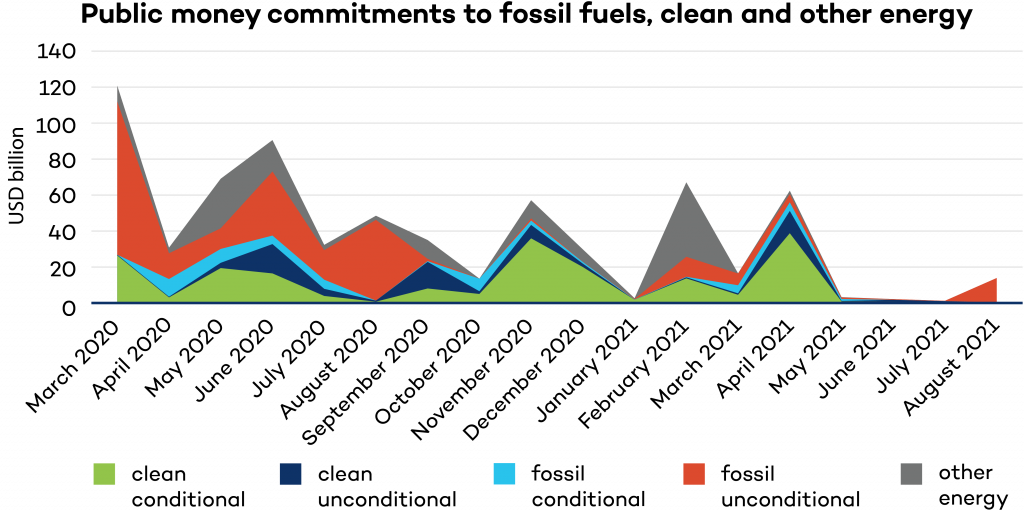
Key to this effort is ensuring that public funds no longer support a fossil fuel-based recovery. Over the past year, the Energy Policy Tracker has shed light on public financial commitments to energy-intensive sectors, revealing gaps between governments’ actual spending and a green recovery. As of this week, the Energy Policy Tracker website now shows how these commitments have evolved since last year. Let’s take a closer look at the trends revealed in G20 members since the start of the COVID-19 pandemic.

First, there is still a long road ahead for G20 members to truly “green” their recoveries at home.

Almost half (USD 311 billion) of the COVID-19 response in G20 members served fossil fuel-producing and consuming activities. Meanwhile, clean energy received only USD 278 billion (USD 134 billion went to “other” energy policies—those neither strictly in the clean or fossil categories). Furthermore, less than one in every ten US dollars committed to energy in the COVID-19 response benefited the cleanest energy measures, such as renewables or energy efficiency. More than eight in every ten dollars committed to fossil fuels came with no green strings attached, benefiting fossil fuel production and consumption without establishing any climate targets or reductions in pollution. 

Nevertheless, some progress is noticeable from 2020 to 2021.

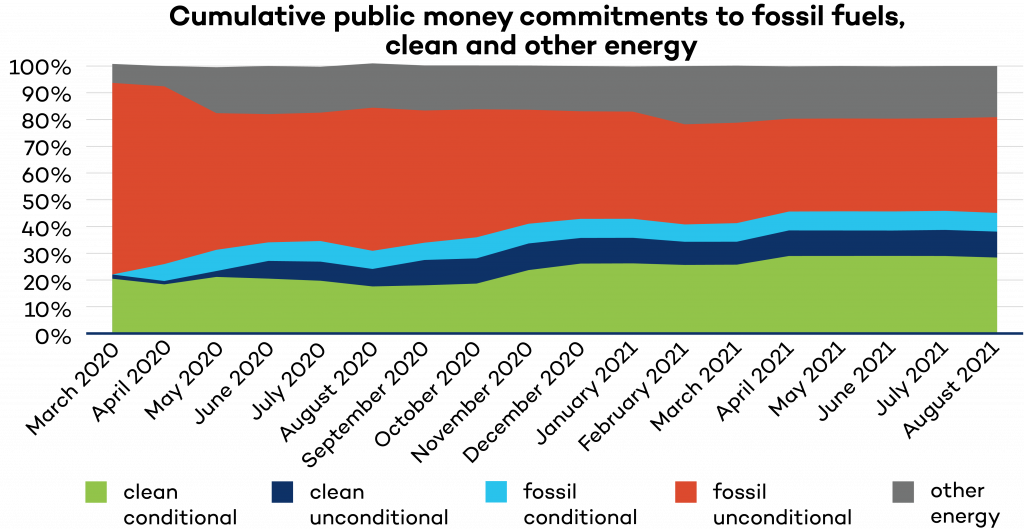
In March–May 2020, when G20 members began approving COVID-19 response measures en masse, the share of clean commitments was just 22% on average. Fast forward to June–August 2021 and this share increased to 39%. The share of clean energy support could continue making gains as new, greener plans are approved. 

In the transport sector, most early commitments supported the airline or car industry, usually with no green strings attached. But looking at overall recovery support for transport in the G20 today, half of the total now targets clean energy transportation such as electric and low-emission vehicles. This dramatic green shift was largely driven by just three major policies: USD 25 billion for public transportation committed by the United States in March 2020, USD 27 billion for biogas plants committed by India in November 2020, and USD 35 billion committed to high-speed railways, electrification of transport, and electric charging infrastructure in Italy in April 2021. Similarly, in the power sector, the total amount committed to clean power has now overtaken the amount committed to fossil fuel-based power. 

Despite these positive developments, more efforts are needed to achieve a fossil-free recovery.

While the share of clean energy commitments increased from March 2020 to August 2021, since December 2020, this progress has largely stagnated, with only a 2% rise since 2021 began.  

G20 public money commitments to energy sectors over time

Note:  “Other energy” includes policies outside of the fossil fuel or clean energy categories or in both of them. This includes, among other policy measures, combined support for fossil fuels and clean energy, nuclear energy, first-generation biofuels, and hydrogen of unspecified origin. The Energy Policy Tracker methodology page gives an overview of which policies are included in each category.
Graph of cumulative public finance by G20 members for fossil fuels (2020-21)

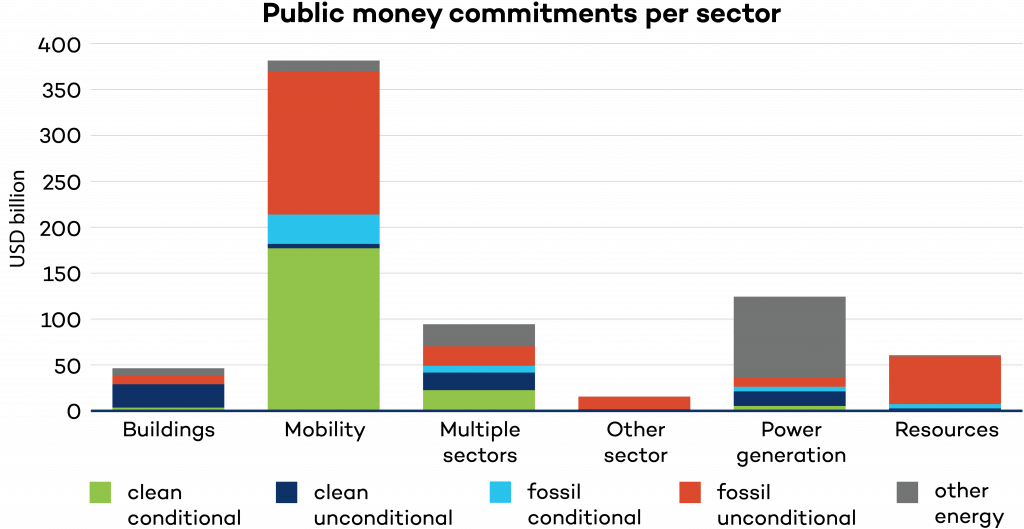
Certain policies and sectors remain neglected, while others are almost entirely fossil fuel-based. For example, fossil fuel subsidy reform and fossil fuel taxation remain untapped measures despite their potential to raise significant revenue without increasing the public deficit of G20 economies. Recent IISD research shows that both of these tools can raise over USD 550 billion per year globally. In the G20 alone, fossil fuel subsidy reform could have raised USD 259 billion in 2019.  Similarly, policies aimed at improving energy efficiency in buildings are low-hanging fruit in terms of job creation and emissions reductions, but buildings received only 6% of total recovery commitments. 

In the resource sector, G20 members’ domestic measures also demonstrate important shortcomings, with commitments almost entirely based on new coal investments in India and China. These include investments to support new coal power plants, coal mining and coal to chemical projects, coal transportation infrastructure, and the rollback of environmental norms. This runs directly counter to the International Energy Agency’s Net Zero by 2050 Report, which calls for ending new coal projects and investments in new fossil fuel supply by the end of 2021. Clearly, much work remains for G20 members to align the public money commitments they are making at home with a net-zero future. 

Public money from G20 members to different sectors

Note: “Multiple sectors” refer to policies that apply across sectors, such as some policies supporting hydrogen. “Other sector” refers to policies that apply to energy-intensive activities (such as metal smelting) but that do not fit into any of the sectors listed.

A green recovery cannot be the purview of only a few governments. Stagnation is no longer an option. This week, G20 leaders have a window of opportunity to shift course to a fossil-free recovery before the G20 Leaders Summit and the United Nations Convention on Climate Change’s (UNFCCC) Twenty-Sixth Conference of the Parties (COP 26). To take advantage of this political moment, they must commit to ending all new recovery spending on fossil fuel production and to redirecting public finance away from fossil fuels and toward clean energy, and when G20 leaders return home, they need to translate these commitments into practice. 

Insight

Why aren't energy PSUs at the forefront of India's energy transition?

October 1, 2021

This originally appeared as an op-ed in The Economic Times on September 28, 2021. The introductory paragraphs are reprinted below with permission.


In recent months, India’s biggest private sector players have made ambitious clean energy commitments. Reliance India Ltd announced clean technology investments worth Rs 75,000 crore; ArcelorMittal pledged Rs 19,000 crore for solar power; and Adani Green raised Rs 9,570 crore in debt financing. Backed by India’s billionaires, these announcements herald a new chapter of clean energy expansion in our country. But why aren’t our energy public sector undertakings (PSUs) also at the forefront of India's energy transition?

PSUs continue to play a vital role in India’s energy sector and the wider economy. Energy sector PSUs account for seven of India’s 10 Maharatnas — firms that have an annual turnover of more than Rs 25,000 crore. Over 50 per cent of the country’s power generation is publicly owned. Just two PSUs produce around 90 per cent of the country’s coal output. Publicly-owned oil marketing companies are responsible for 57 per cent of refining and almost all retail distribution. Since independence, these companies have been vehicles of nation-building, creating millions of jobs and generating revenue for the government. But as the world shifts away from fossil fuels, India’s energy majors, unfortunately, continue to invest in them.

Read the full article in The Economic Times.

Insight details

Insight

Five Steps to a Fossil-free COVID Recovery for Every Government to Follow

Since the start of the Covid-19 pandemic, governments have spent billions of dollars bailing out coal, oil and gas. Here’s how they can pivot to clean energy.

September 28, 2021

Covid-19 recovery spending offers a golden opportunity to accelerate the transition from fossil fuels to clean energy while ensuring no one gets left behind.

This is the major finding from a recently published report which offers a system aimed at helping world governments design processes and define roadmaps to accelerate the energy transition.

The report, written by the Global Subsidies Initiative (GSI) at the International Institute for Sustainable Development (IISD), also encourages policymakers to take immediate action and suggests that decisions made now will prove vital in the years ahead.

“Since the beginning of the pandemic, governments pledged hundreds of billions of dollars to fossil fuel-intensive sectors putting climate commitments on the backburner,” said Paulina Resich, senior communications officer for IISD’s energy team.

“Our work shows how to get back on track to limit global warming to 1.5C and align economic recovery with a just transition to clean and sustainable economies,” she added.

The report takes the form of a five-step blueprint, with each principle building on the previous. This is what it suggests.

1) Divest from fossil fuel production

As of September 2021, G20 and 11 other governments have committed to over $350 billion to support fossil fuels, in addition to the over $800 billion already spent annually. Financing support is seen through direct budgetary transfers, tax expenditures, public finance, state-owned enterprise investments and more and completely swamps spending commitments for clean and renewable energies.

Instead, recovery packages should be centred around a low-carbon future, meaning more support to clean energy and incentivising a just transition away from fossil-fuel intensive sectors.

Directing spending towards the latter also gives the wrong signals to the market and, perhaps more importantly, preserves the idea that the main driver of our economies is the fossil fuel industry.

2) Reform subsidies

Fossil fuel subsidy reform and taxation can raise – and unlock – at least $553 billion globally per year, which can significantly help to bolster post-pandemic recovery efforts and a transition to net zero.

“Raising fossil fuel prices is a great way for governments to generate funds for the pandemic response as long as some of the revenues are used to boost incomes for the poor,” said Tara Laan, report author and senior associate at IISD, arguing that the approach “has the double benefit of encouraging consumers and investors to switch to cleaner energy and transport alternatives.”

“The solution to a fossil fuel recovery doesn’t need to be complicated: just gradually increase taxes on fossil fuels and use the revenues for more productive purposes, including helping the vulnerable,” she added.

3) Support clean energy

Money raised from FFSR and taxation can be funnelled or “swapped” into clean energy, energy efficiency, energy access, and the decarbonisation of transport – pressing areas to target and achieve Sustainable Development Goals and net-zero commitments.

These changes often demand high upfront costs, such as improving HVAC in buildings or developing electric road and rail infrastructure, and a swap from fossil fuels will help overcome this barrier, as well as ensure alignment between fiscal and energy policies and environmental and social priorities.

4) Incentivise clean electricity

To move towards electricity, the International Energy Agency suggest that around 70% of all investments are expected to be provided by private sources, and thus incentivisation and leverage needs to come from the top.

“Clean electricity is going to be the backbone of the energy transition but it will need major investment and it’s up to governments to make sure this investment flows into clean energy,” said Anna Geddes, report author and IISD associate.

“Governments can help re-direct investments to clean electricity by providing well-targeted subsidies and policies and making public finance institutions and state-owned enterprises key agents of change for achieving net-zero,” she added.

5) Ensure a just transition

While the energy transition is inevitable, governments must carefully plan for it to mitigate any economic, social and environmental risks, and take a negotiated approach based on social dialogue between themselves, workers, employers, and stakeholders.

“For any recovery to be just you have to make sure that social partners all have an equal role in policy design and that this is coupled with meaningful stakeholder engagement where communities who are affected are part of the process, have their voices heard, and their issues and concerns are addressed fairly,” said Philip Gass, report author and IISD lead for transitions in its energy programme.

Ultimately, these principles are individual pieces of a larger puzzle, where all five must be adopted in a multidisciplinary system.

“Fossil-free recovery needs strategic thinking and planning as well as consistent and coordinated action,” concluded Lourdes Sanchez, report lead and IISD senior policy advisor.

“There is an urgency to act and direct limited financial resources to the areas that will support the energy transition while creating jobs and fostering sustainable economic and social development.”

Find out more in the report “Achieving a fossil-free recovery”.

Listen to the podcast “How to achieve a fossil-free recovery”.

This article was originally published by Climate Home News and has been reprinted with permission.

Insight

The Air That Trees Breathe: Translating climate science into Ojibwe

Over the past three years, our freshwater scientists at the IISD Experimental Lakes Area, located on Treaty 3 Land, have been working with a group of Elders, language experts, and youth to translate research on mercury contamination and climate change into Ojibwe.

September 28, 2021


Anishinaabemowin—also known as Ojibwe—is the language spoken by the Anishinaabe people.

Over the past 3 years, here at IISD Experimental Lakes Area, we have been working with a group of Elders, language experts, and youth to translate two animated videos explaining our research on mercury contamination and climate change into Ojibwe.

We now not only have the Ojibwe versions of these videos, but we also put together two supplementary lesson plans—each consisting of a full transcript, sentence breakdown, list of new words, and root word collections.

We hope that all-level language learners can benefit from these visual, audio, and grammatical resources and, at the same time, learn about some interesting scientific concepts. Language teachers can also include them in their teaching activities, as suggested in the lesson plans.

Speaking personally, I am a massive language enthusiast and have greatly enjoyed this process.

Given that, and the fact that the number 4 is sacred in Anishinaabe culture (and many other Indigenous cultures), I wanted to share four interesting aspects about Anishinaabemowin that I have learned.

The Creational

The Ojibwe language energizes and replenishes itself and does not borrow foreign vocabulary. For instance, many popular languages around the world derive the word for the element “carbon” from its Latin root carbo, meaning “coal,” including carbone in French, carbono in Spanish, Karbon in Turkish, كربون (Karbun) in Arabic … you get the gist! This “borrowing” phenomenon is very common in many scientific terminologies.

However, the Ojibwe language does not follow the same rule. Instead, the Ojibwe translation of some of the terminologies we encountered was based on the function, the action, and the observer’s understanding associated with these terms.

For example, carbon dioxide in Ojibwe is mitigoo-inanaamowin, meaning “(the air that) the trees breathe.” You will find many more such neologisms created in the lesson plans.

Nancy and Jason Jones translating Ojibwe
Nancy and Jason Jones (who led the translation exercise), hard at work.

The Cultural and Spiritual

Jason Jones, an Ojibwe language teacher and a member of our translation team, explained that there are three forms of translation: literal, implied, and cultural.

All three methods were implemented in our translation exercise.

For example, in the climate lesson plan, you will notice that some parts of the translation do not follow the order of the English texts. In other words, literal (word-by-word or sentence-by-sentence) translation was replaced by implied translation, where translators interpreted the overall meaning in a way that they observed or understood.

The term for the “United States” is “gichi-mookomaanakiing” in Ojibwe, meaning “the land of the big knives.” This is, according to Jason, an example of a cultural interpretation: long ago, Anishinaabe people would bring their sacred items into battles and carry them on their sides. They saw early Europeans carrying their swords—big knives—by their sides all the time and thought these big knives were their sacred items.

Jason also explained that there are Elders who speak spiritual Ojibwe—a form of the language that he insightfully described as “being loaded with culture” and “untouched by the residential schools.”

For instance, “gookomisinaan” (literally “our grandmother”) represents “the moon” in spiritual Ojibwe. In one of the Anishinaabe stories, the hero Nenaboozhoo’s grandmother turns herself into the moon. That concept, therefore, is forever connected to water and women. This type of spiritual Ojibwe language has been lost over the years, and “language helpers” are trying to get it back.

The Action-Based

Many languages, including English, are noun-based, meaning that the majority of the words in the language domain are nouns, as opposed to verbs. But the Ojibwe language is quite the opposite in that the majority of its vocabulary consists of verbs (actions) as opposed to nouns (objects).

For instance, the noun mercury in Ojibwe is biiwaabikowaabo gaa-waawaakeshkaag, meaning “the liquid metal that is (very) shiny” or “the liquid metal that shines brightly.” That term was created and eventually transformed into a noun form, however, with an action (“shines”) built into it.

The action-based aspect of the language, in a way, reflects the teaching of the Anishinaabe Elders in terms of taking responsibility and action to protect the land and the water.

The lesson plans include the breakdown of each sentence into its root words. Go ahead and see if you can find the actions associated with the words.

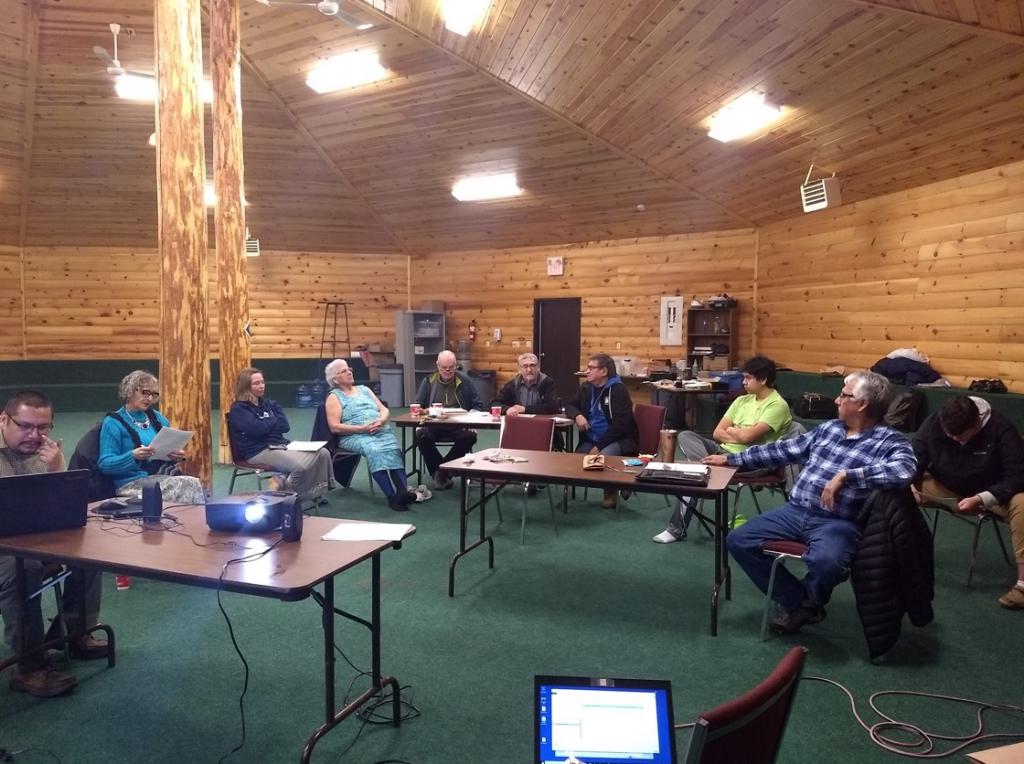
People sitting in a circle working on an Ojibwe translation exercise
This translation project depended on high levels of collaboration with Elders and language helpers.

Animate or Inanimate?

Many Ojibwe words are categorized as animate or inanimate, meaning the object is either living or non-living, spirited or non-spirited.

In Western science, we often describe a compound as being organic or inorganic, a concept that could potentially help us understand this dualism. However, here’s a story that I love sharing when I speak about this fourth aspect of the Ojibwe language.

Elder Nancy Jones asked us, during one of our translation sessions, “Where is mercury from?” We answered: “Mercury is a naturally-occurring element found in rocks.” She followed with another question: “Then why is it considered non-living (inorganic)? Because in Anishinaabemowin, a rock is animate, living, and has a spirit.”

Elder Nancy’s simple question profoundly changed my way of looking at nature and all the elements we find there.

While Western science helps us objectively observe the environment, which is defined by a separation between the observer and the observed, Indigenous traditional wisdom unites the observer and the observed. Nature as a whole is a giant living being, and we are a part of it!

We often talk about sharing each other’s worldviews or bridging the Western and Indigenous ways of looking at the world. But how can we achieve this goal? I believe that language plays a key role.

The language we speak shapes our worldview. Many Indigenous languages are at risk of disappearing. Understanding the importance of a language and helping to find creative ways to preserve and revitalize it can reverse this trend.


I would like to thank the Elders and language helpers for their teachings and for giving me the permission to share those stories in this blog article.

Insight details

Insight

Nature-Based Infrastructure: A powerful tool for women's empowerment in climate adaptation

Women are hit hardest by climate change, yet they are key to effective and inclusive climate adaptation. How can nature-based infrastructure provide equitable benefits for women, and how can we value that contribution?

September 14, 2021

With the latest report from the Intergovernmental Panel on Climate Change warning of “unprecedented” changes to our climate, decision-makers are facing renewed calls to take firm and immediate action. As they weigh options for undoing the damage, a crucial step will be to empower women in climate adaptation efforts while marshalling the potential of our natural environment in the process.

Nature-based infrastructure (NBI) can and should be part of these efforts. The term NBI has grown in prominence in recent years, as governments and infrastructure investors look to use ecosystems for valuable infrastructure services, such as water filtration and flood protection. NBI also provides other benefits that can improve human health, support livelihoods, and enable climate adaptation and mitigation. 
 
As this conversation evolves, an important issue that must be at the forefront is how to ensure women and girls play a leadership role in this NBI work, from project design to implementation, as well as in monitoring and evaluation. 

Women have long faced a greater burden from a changing climate compared to men, which exacerbates many other inequalities. For example, in the Global South, women rely heavily on natural resources for their livelihoods. This is common in rural areas, where women are often responsible for gathering and supplying food for their households, along with collecting water and firewood for heating and cooking. With climate change making these tasks more labour intensive and time consuming, women are left with little time to access education and training, earn income, or develop new skills. 

Moreover, women often face barriers to accessing and control over natural resources. Traditional roles and norms, land tenure systems, and a lack of capital tend to disadvantage women, restricting their access to the land, fisheries, and forests they depend on. Women are also underrepresented in environmental decision making and natural resources management, such as forest user groups, water user associations, and environmental policy-making. Due to these disadvantages, women are less likely to benefit from NBI projects.

There is another way, however: including women as powerful and dynamic advocates of climate adaptation, especially as NBI becomes a greater part of the solution. 

How a mangrove forest is supporting the livelihoods of 100,000 people

The Saloum Delta is a prime example of how women’s livelihoods are under threat from declining ecosystems—and how NBI can play a transformative role.

Restoring and keeping ecosystems like the Saloum Delta intact is not only good value for money but also key for protecting people’s livelihoods.

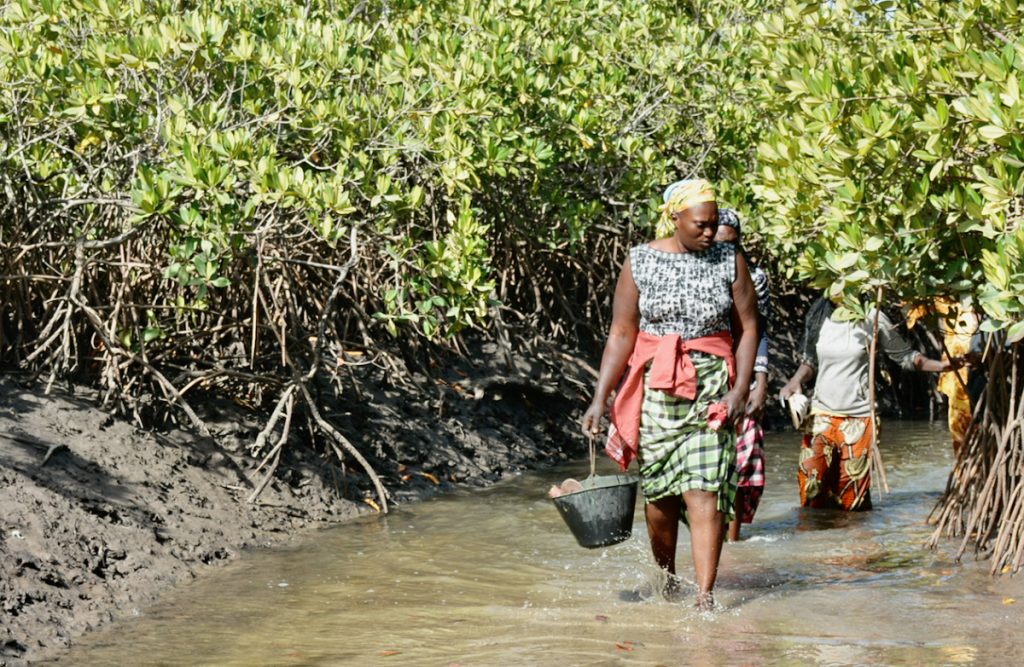
Located in Senegal, the delta is a tropical mangrove ecosystem that supports the livelihoods of more than 100,000 people. It filters water, provides fuelwood, prevents floods and erosion, and supports fish stocks. Based on our assessment using the Sustainable Asset Valuation (SAVi) methodology, its ecosystem services will be worth CFA 3.589 billion (EUR 5.47 billion) over 40 years. 

Women walking in Senegal's Saloum Delta
The Saloum Delta filters water, provides fuelwood, prevents floods and erosion, and supports fish stocks. Wetlands International - Africa.

However, climate change and unsustainable uses put pressure on ecosystems like the Saloum Delta, threatening the livelihoods of communities who depend on it. Data from the Convention on Biological Diversity (CBD) shows, for example, that in poor rural households, ecosystem goods and services can account for at least half of local livelihoods. In some cases, that figure can go up to 90%. Restoring and keeping ecosystems like the Saloum Delta intact is not only good value for money but also key for protecting people’s livelihoods. However, to make sure women and girls can access these resources, it is essential to also address restrictive social and cultural norms.

How can NBI be a game-changer for women?

The Saloum Delta is just one example of how NBI can yield tangible benefits for communities. NBI projects can contribute to public health efforts by providing clean and safe drinking water, improved sanitation, and better nutrition. For example, our research in India has shown that constructed wetlands are a cost-efficient solution for wastewater treatment. 

NBI projects can also improve access to water for household use, making it easier and faster for women to collect water—thus minimizing their exposure to health and security risks on the way. 

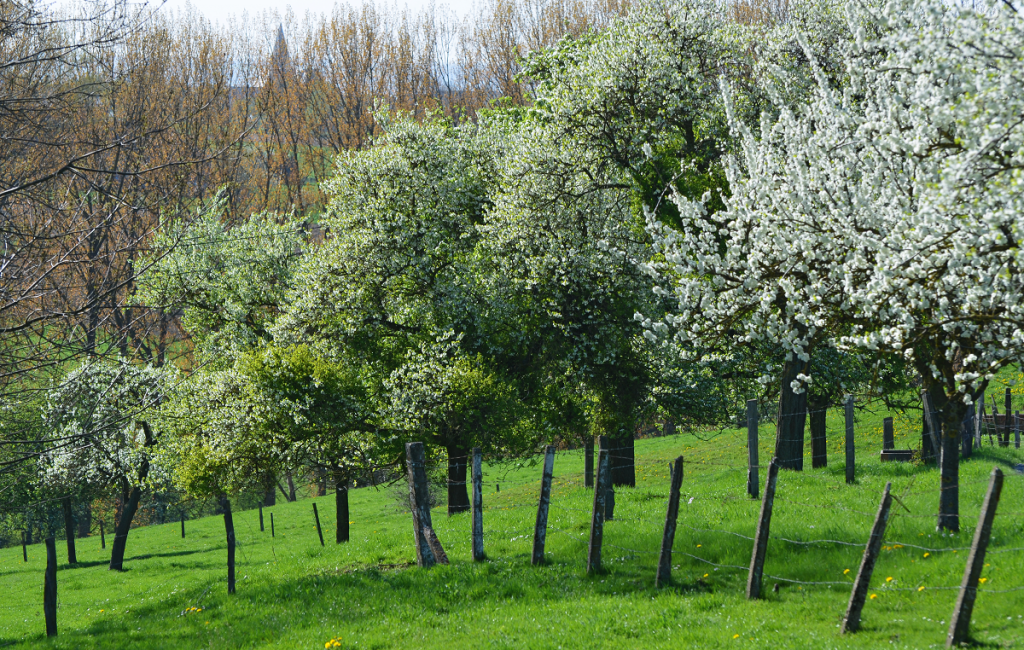
These projects can also support and protect livelihoods. For example, our SAVi assessment in Belgium shows how planting trees and hedges on farmlands, also known as agroforestry, can lead to increased crop yields, provide biomass as an energy source, and help regulate the water cycle.

Agroforestry work in Belgium
Agroforestry, as seen in Belgium, can provide benefits such as better crop yields. Freddy Creuen.

While these are impressive gains, they can be made even more successful and sustainable when gender considerations are a core component of NBI projects and strategies. 

Capacity-building strategies that are paired with NBI projects can strengthen women’s roles as decision-makers and experts, especially when it comes to climate adaptation.

A recent IISD report illustrates why a gender-responsive approach toward ecosystem-based adaptation has proven benefits and shows how practitioners and policy-makers can implement it. For example, the authors present mounting evidence that integrating gender considerations in initiatives related to water and land management makes them more effective and sustainable.

Capacity-building strategies that are paired with NBI projects can strengthen women’s roles as decision-makers and experts, especially when it comes to climate adaptation. For instance, training about afforestation and water management related to our recent SAVi project in Indonesia is designed to empower women in these fields. NBI projects also serve as a platform where women can network to share and exchange best practices and knowledge.

How can we integrate gender issues in valuing NBI?

Given these lessons, our upcoming NBI Global Resource Centre aims to work closely with women stakeholders, integrate their knowledge, and train them in NBI and climate adaptation. 

The NBI Global Resource Centre is led by IISD and supported by the Global Environment Facility (GEF), the MAVA Foundation, and the United Nations Industrial Development Organization (UNIDO). Its online site will launch later this year and will progressively aim to establish the business case for NBI by providing data, training, and sector-specific valuations. 

Where possible, our valuations of NBI projects will pay close attention to gender-specific challenges and benefits. For example, the proportion of women engaged in agricultural activities may be higher, which means that they are more vulnerable to the risks of a variable climate, but at the same time, they can reap greater benefits from NBI, like agroforestry.  

Incorporating gender considerations into infrastructure decisions is challenging because we often lack gender-disaggregated data. We will therefore start by including gender issues in our NBI valuations by considering questions such as: 

  • How are roles and responsibilities allocated in the local context? 
  • Do women and girls face specific risks, for instance, from natural disasters or air pollution? 
  • Do women and men have equal access to information and training for climate adaptation? 
  • Who would be employed in building and maintaining the NBI project, and who will benefit from it?

Where disaggregated data is available, we will include it in upcoming NBI valuations to provide more accurate estimates of how these projects can provide equitable benefits—and other gains not captured by traditional valuations—for women, especially in comparison with engineered, “grey-built” infrastructure.

The burdens of climate change and the benefits of adaptation are spread unevenly in society. Gender-responsive valuations will help us to understand these differences and design inclusive, beneficial NBI projects that support climate adaptation. Only by ensuring that gender issues are a vital component of this work can we create NBI that empowers those who need it the most and advances gender equality.

A PDF version of this article is available here