Report

Assessing the Climate Action Investment Practices of Canadian Community Foundations

April 19, 2022

In this report, IISD proposes eight recommendations that foundations should undertake to better utilize their endowments to tackle the challenges of climate change:

  • Move toward positive screening investment strategies and climate investing
  • Make all governance documents public
  • Make the reporting of endowment holdings and returns transparent
  • Streamline endowment management
  • Join the Canadian Philanthropy Commitment on Climate Change
  • Set targets for diversity, equality, and inclusion on investment committees
  • Ensure one investment committee member has recent, relevant environment, social, and governance experience
  • Work with smaller foundations to allow access to enhanced endowment management strategies

Report details

Topic
Climate Change Mitigation
Responsible Business
Impact area
Sustainable Economies
Publisher
IISD
Copyright
IISD, 2022
Report

A Value on the Priceless: Ecological goods and services generated in the Seal River Watershed

This report assesses the economic value of ecosystem benefits provided by the Seal River Watershed, a large pristine region located in Northern Manitoba, Canada. The Seal River Watershed is not impacted by dams, industrial development, or forestry. It maintains clean water, is home to abundant wildlife, and supports the livelihoods and culture of Dene, Cree, and Inuit people. To stop and reverse global biodiversity loss and limit climate warming, it is critical to protect the world's last remaining intact regions like the Seal River Watershed.

April 18, 2022
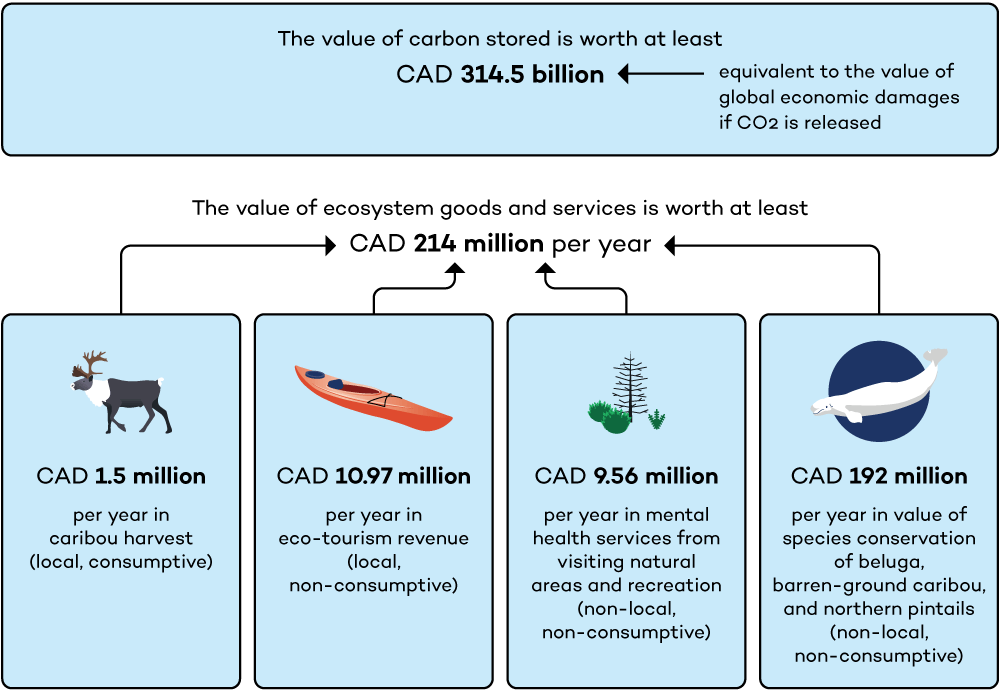
  • The Seal River Watershed provides at minimum CAD 214 million worth of ecosystem goods and services annually.

  • The importance and value of ecosystem goods and services provided by the Seal River Watershed will increase as we are faced with the global decline of intact forest ecosystems and the global decline in biodiversity, which reinforces the need for its protection.

  • A fully functioning, ecologically intact watershed that is sustainably managed and monitored by Indigenous stewards will help contribute to our action on climate mitigation, resiliency, and biodiversity conservation.

Articulating the values of intact regions in monetary terms is one way to demonstrate how they benefit local and global communities. Economic valuations inform decision-makers and help strengthen the case for conservation. They also identify data and monitoring needs.

The International Institute for Sustainable Development partnered with the Seal River Watershed Alliance and the Canadian Parks and Wilderness Society Manitoba Chapter in a project to assess the economic value of ecosystem benefits provided by the Seal River Watershed.

Our study found that in the Seal River Watershed:

The value of carbon stored and annual flow of EGS, CAD 2020 Seal River Watershed

This is a partial valuation based on the available data and economic valuation methods. Efforts are already underway to protect the entire watershed as an Indigenous Protected Area (IPA) led by the Sayisi Dene First Nation and supported by the Cree, Dene, and Inuit neighbours. The IPA model allows local Indigenous communities to chart their own path for the stewardship of the Seal River Watershed based on local and Traditional Knowledge and sustain the watershed’s people, culture, and animals into the future. Protecting the Seal River Watershed would add 0.5% to Canada’s protected areas targets.

Report details

Topic
Climate Change Adaptation
Climate Change Mitigation
Water
Region
Canada
Impact area
Climate
Nature
Publisher
IISD
Copyright
IISD, 2022
Report

The State of Play for Sustainable Development in the Joint Statement Initiative on Investment Facilitation for Development

This paper examines the ways in which negotiations under the Joint Statement Initiative on Investment Facilitation for Development take into account sustainable development aspects.

April 15, 2022

Participants of the Joint Statement Initiative on Investment Facilitation for Development at the World Trade Organization are aiming to finalize an agreement by the end of 2022. One of the central objectives of such an agreement is to facilitate sustainable development by increasing investment flows into developing and least-developed country members.

This paper examines the development-oriented elements that are currently included in the framework to understand how and to what extent they may contribute to sustainable development. The issues covered include special and differential treatment and needs assessments, specific proposals for promoting more sustainable investments, and the potential role of home state measures. The paper also explores the main challenges encountered in the negotiations and whether and how the policy positions of members have been reflected in the negotiating text.

This material has been produced with funding by UK Aid from the UK Government. The Umbrella Grant is a project of the Trade and Investment Advocacy Fund (TAF2+) and is implemented by the International Institute for Sustainable Development, in consortium with CUTS International, Geneva and BKP Economic Advisors.

Views expressed in the publication are the authors’ own and do not necessarily reflect HM Government’s official positions or those of TAF2+.

CUTS International Geneva

Report details

Topic
Governance and Multilateral Agreements
Investment Law & Policy
Trade
Project
Investment Facilitation
Impact area
Sustainable Economies
Publisher
IISD
Copyright
IISD and CUTS International, 2022
Report

2021 IGF Annual Report

The 2021 IGF Annual Report includes highlights of the Secretariat's work serving its 79 member countries with a focus on key outputs, events, and other activities.

April 17, 2022

Throughout 2021, our members adapted to some of the worst crises society has seen, from the effects of COVID-19 to climate change. We tailored our support to help them advance their sustainable development goals.

Our 17th annual general meeting, entitled Building Tomorrow Together: Mining for a Responsible and Inclusive Future, was held virtually. Over 1,500 registrants, representing delegates from more than 100 countries, as well as companies, international organizations, and civil society, came together to further sustainable mining governance.

We adapted how we deliver our flagship Mining Policy Framework (MPF) to meet members’ current realities. We conducted hybrid MPF Assessments alongside virtual capacity building and training to further support implementation across Africa, Asia, Latin America, and the Caribbean. We published our fourth Guidance for Governments to advance members’ effective management of natural resources and ecosystems throughout mining operations.

Our work on tax base erosion and profit shifting in mining continued to expand. We delivered three regional training sessions on international taxation to over 650 government officials in dozens of countries.

We have no plans to slow down. In 2021, we welcomed three new members: Costa Rica, El Salvador, and the United States, bringing our membership to 79 countries. The Government of the Netherlands also joined the Secretariat as a core funder alongside the Government of Canada. We are proud to continue our work with governments and partners around the globe to advance responsible resource governance in mining.

Report

State of Sustainability Initiatives Review: Standards and Investments in Sustainable Agriculture

This SSI Review looks at voluntary sustainability standards (VSSs) from the investor's perspective and shows that sustainability standards promote synergies between sound business practices and better environmental and social performance to catalyze much-needed investment in sustainable agriculture. The report also identifies opportunities for standard-setting bodies, financial service providers, and governments to leverage standards to increase investment in sustainable agriculture.

April 6, 2022

Achieving food security requires a rapid shift to more sustainable and resilient agriculture that remains viable in the face of economic volatility, supply chain disruptions, and increasing adverse impacts from the changing climate—that will exacerbate the estimated USD 260 billion investment gap to meet the targets of SDG 2 (zero hunger). We need to feed the planet using farms that can limit greenhouse gas emissions and adapt to the changing climate while protecting forests and biodiversity. And we need investors to quickly get behind this transition to make it happen.

Investors are ever focused on financial risk, but it's increasingly clear to many financial service providers (FSPs) that risk and sustainability profiles have considerable overlap in the agriculture sector. How does VSS-compliance lower financial risk for investors?

The research shows that when farmers adhere to sustainability standards their operations can become more productive, profitable, and can lower environmental and social risks to FSPs. This report finds that compliance helps producers build market linkages and secure contracts that farmers can use as collateral for financing.

The report benchmarks the production criteria of 12 widely adopted VSSs against the themes of 10 popular sustainable finance frameworks. Researchers also surveyed 51 FSPs active across the globe to understand how sustainability affects investment decisions. The report finds that in many cases VSS and investment criteria overlap. With standards compliance, farmers improve their practices in many ways that facilitate financing, such as detailed records, conserving water, soil and forests, as well as building good relationships with workers and communities.

Funded by

Report

Gas Pressure: Exploring the case for gas-fired power in South Africa

As of 2022, South Africa does not have gas-fired power. There is increasing pressure from the national government, industry lobby groups, and the electricity utility to develop a gas-to-power sector, while there is also mounting pressure from many stakeholders opposed to gas. This report aims to provide an evidence base for rational decision making at this important juncture in developing the national energy mix.

March 31, 2022
  • In South Africa, renewables are cheaper than gas for bulk electricity supply, and energy storage has dropped enough in price to displace gas for peaking power too.

  • Government must hold off on developing gas-fired power and urgently boost renewables and energy storage.

  • The South African power system can be developed so that gas supply is not needed until 2035, if ever.

The Gas Pressure report looks at whether South Africa should consider building gas-fired power stations and associated gas supply infrastructure. The recent disruptive changes in the power sector from technological advances and cost reductions—first in renewable energy and then in energy storage—are challenging the view that gas is still required for a low-carbon energy transition. The report analyzes the status quo of gas development, the risks associated with gas, the improvements in alternatives to gas, and whether gas is necessary in the power sector before 2035, if ever. Recommendations are made for short-term priorities to address the constrained national power system.

Report details

Topic
Climate Change Mitigation
Energy
Just Transition
Region
South Africa
Impact area
Climate
Sustainable Economies
Publisher
IISD
Copyright
IISD, 2022
Report

Phaseout Pathways for Fossil Fuel Production Within Paris-Compliant Carbon Budgets

This new research by the Tyndall Centre at The University of Manchester reveals phaseout pathways for fossil fuel production, particularly oil and gas, within Paris-compliant carbon budgets.

March 22, 2022
  • Wealthy countries must end oil and gas production by 2034 to keep the world on track for the 1.5°C goal and give poorer nations longer to replace their income from fossil fuel production.

  • Taking into account countries' differing levels of wealth, development, and economic reliance on fossil fuels, the poorest nations should be given until 2050 to end oil and gas production consistent with the Paris goals. They will also need significant financial support to transition their economies.

  • The Paris goals leave no room for any nation to increase oil and gas production; all will have to make significant cuts this decade. The richest countries must cut output by 74% by 2030; the poorest by 14%.

There is a growing consensus that, to align with the Paris goals, coal must be phased out from power generation (its most significant use) by 2030 in developed countries and by 2040 or 2050 in developing countries. But what about oil and gas? IISD commissioned the Tyndall Centre at The University of Manchester to research Paris-aligned phaseout pathways for oil and gas production in different countries.

The report, by Professor Kevin Anderson, a leading researcher at the Tyndall Centre for Climate Change Research, and Dr. Dan Calverley, warns that there is no room for any nation to increase production; instead, all will have to make significant cuts this decade.

The Paris Agreement requires that countries must act according to their common but differentiated responsibilities and respective capabilities, meaning that developed countries must act first and fastest to mitigate emissions and must provide financial and other support to enable developing countries to mitigate. This report starts with carbon budgets published by the Intergovernmental Panel on Climate Change (IPCC) and shares them among countries, in proportion to their ability to fund and enable a just transition for fossil fuel-dependent workers and communities.

Taking into account countries’ differing levels of wealth, development, and economic reliance on fossil fuels, the report says the wealthiest countries—which produce over a third of the world’s oil and gas—must cut output by 74% by 2030 and end oil and gas production by 2034. This action will keep the world on track for 1.5°C and give poorer nations longer to replace their income from fossil fuel production.

The poorest nations should be given until 2050 to end production, but they will also need significant financial support to transition their economies. However, even these countries must cut back by 14% by 2030, compared to today's production.

These challenging timelines arise because the 1.5°C carbon budget is smaller than many people realize. Furthermore, differentiated timelines deliver equity on their own. Significant financial transfers from the Global North to the Global South are prerequisites for delivering a fair phaseout schedule.

Report details

Topic
Climate Change Mitigation
Energy
Just Transition
Impact area
Climate
Publisher
Tyndall Centre at The University of Manchester
Copyright
Tyndall Centre at The University of Manchester, 2022
Report

Integrating Gender Considerations into Sustainable Bonds

A How-to-Guide

The purpose of this guide is to stimulate action through a step-by-step explanation of how a gender equality lens can be integrated into all sustainable bond issuances. It especially focuses on integrating a gender lens into green bonds and sustainability-linked bonds, which together comprise the bulk of the current sustainable bond market.

March 3, 2022
  • One way to significantly scale up gender-smart financing is through mainstreaming gender considerations by looking for opportunities to promote gender equality in sustainable bond issues, including green, social, sustainability, and sustainability-linked bonds.

  • Sustainable bond issuance has been growing rapidly, both in terms of volume and types of instruments. New issuance reached a record USD 732.1 billion in 2020. But there are reasons why the adoption of gender considerations in these bonds is growing more slowly.

  • This how-to guide is a tool to support actors in the bond ecosystem to translate a commitment to gender integration into reality.

The purpose of this guide is to stimulate action through a step-by-step explanation of how a gender equality lens can be integrated into all sustainable bond issuances. It especially focuses on integrating a gender lens into green bonds and sustainability-linked bonds, which together comprise the bulk of the current sustainable bond market.

Report details

Topic
Sustainable Finance
Gender Equality
Project
Sustainable Finance Advice for the ASEAN Low Carbon Energy Program
Impact area
International Governance
Sustainable Economies
Publisher
ASEAN Low Carbon Energy Programme
Copyright
IISD and GenderSmart, 2022
Report

Options for Taking Forward a Potential Voluntary Standstill Commitment on Inefficient Fossil Fuel Subsidies

The study supports the exploration of options for a voluntary standstill on inefficient fossil fuel subsidies, including a review of existing standstill commitments, identification of potential actions APEC member economies could take to implement a standstill on such subsidies, considerations for ensuring that a standstill process is just, and the potential implications of a standstill on APEC member economies. The study was completed to support APEC officials in carrying out the task set by APEC Ministers Responsible for Trade “to explore options, for those members that are in a position to do so, to undertake a potential voluntary standstill on inefficient fossil fuel subsidies.”

December 29, 2021

As specified in the joint statement made by the Asia-Pacific Economic Cooperation (APEC) Ministers Responsible for Trade on 5 June 2021, “market-distorting subsidies undermine a level-playing field.” The Ministers also noted increasing concern about subsidies that have a negative environmental impact. APEC member economies made a commitment in 2009 to rationalize and phase out fossil fuel subsidies (FFSs) that encourage wasteful consumption; subsequent restatements of this commitment by APEC member economies added the qualifier “inefficient” in front of FFSs. Building on this background, APEC Ministers Responsible for Trade tasked APEC officials to explore “options, for those members that are in a position to do so, to undertake a potential voluntary standstill on inefficient fossil fuel subsidies.” This study is intended to support the exploration of standstill options, including a review of existing standstill commitments, identification of potential options for a standstill on inefficient FFSs, considerations for ensuring that a standstill process is just, and the potential implications of a standstill on APEC member economies.

Standstills have an international track record of use in trade in particular, but also in other forums, including environmental and sustainable development agreements. A standstill on inefficient subsidies has the benefit of creating a voluntary agreement amongst APEC economies in a position to do so to ensure that inefficient subsidies do not increase and exacerbate any adverse impacts. A voluntary standstill can also complement existing individual efforts that APEC economies are undertaking to support inefficient fossil fuel subsidy reform.

Based on the research conducted as well as feedback from a workshop held on 19 August 2021, the following options could be explored to undertake a potential voluntary standstill on inefficient FFSs for APEC member economies that are in a position to do so:

a) Adopt an inventory-based voluntary standstill commitment: In this case, a standstill would be based on an inventory (list) of an economy’s inefficient FFSs. Economies that are in a position to do so would commit to not adding any new items to the inventory. Further, a voluntary commitment could be made that any inefficient FFSs within the inventory that already had a specified end date would not be extended beyond that expiration date.

b) Adopt a value-based voluntary standstill commitment: In this case, a standstill would prohibit the financial value of inefficient FFSs from increasing compared to a set baseline (e.g., a particular year or an average over a period).

c) Adopt a hybrid standstill commitment: This could be inventory-based for certain categories of inefficient FFSs and value-based for others. Noting the weaknesses of the purely inventory-based and value-based approaches, one option would be to use an inventory-based approach for inefficient FFS categories like direct transfer of funds; tax expenditure, other revenue foregone and under-pricing of goods and services; and transfer of risk. A value-based approach could be used for the induced transfer (price support) category.
Report details

Topic
Energy
Subsidies
Impact area
Climate
Publisher
APEC Secretariat
Copyright
APEC Secretariat, 2022
Report

Progressing National SDGs Implementation

An independent assessment of the voluntary national review reports submitted to the United Nations High-level Political Forum on Sustainable Development in 2021

The Progressing National SDGs Implementation report provides an independent analysis of reporting by United Nations Member States to the High-level Political Forum on Sustainable Development (HLPF). Supported by a coalition of civil society organizations from around the world and prepared by Cooperation Canada, the report examines the status of 2030 Agenda implementation, unpacks trends in reporting, and identifies good practice.

February 23, 2022
  • The 6th edition of the Progressing National #SDGs Implementation report underlines that most voluntary national review reports are silent on shrinking civic spaces and ongoing attacks on human rights defenders and environmentalists.

  • The latest Progressing National #SDGs Implementation report shows reporting on #LeaveNoOneBehind increased, including around the impacts of #COVID19 on the most vulnerable. #GoForTheGoals

  • Countries continue to consistently provide information on most aspects of #2030Agenda implementation. However, backslides have been observed on awareness-raising activities and budgeting.

This report, the sixth edition of Progressing National SDGs Implementation, aims to provide useful insights and recommendations to inform these discussions and help guide improved implementation and reporting. The review of the 42 VNR reports submitted to the HLPF in 2021, as well as the analysis of 17 VNR-related civil society reports, show both positive and concerning trends.

The report covers all aspects of 2030 Agenda implementation through an examination of governance arrangements, institutional mechanisms and stakeholder engagement, policies, means of implementation, and reporting. Key findings, good practice case studies, emerging best practices and recommendations are presented throughout this edition.


Report details

Topic
Measurement, Assessment, and Modelling
Sustainable Development Goals
Impact area
Engage
International Governance
Publisher
Cooperation Canada
Copyright
Cooperation Canada, 2022