Report

IGF Mining Policy Framework

A compendium of best practices for governments to manage the full range of issues in the mining sector.

December 11, 2023

The Intergovernmental Forum on Mining, Minerals, Metals and Sustainable Development supports more than 80 member countries to advance sustainable development objectives through effective mining laws, policies, and regulations. The IGF's cornerstone Mining Policy Framework (MPF) represents the best practices required for good environmental, social, and economic governance of the mining sector and the generation and equitable sharing of benefits to contribute to sustainable development.

The MPF was first ratified by IGF members in 2010 before being tabled in 2011 at the 19th session of the United Nations Commission on Sustainable Development (CSD19) in New York. Delegates at CSD19 recognized the MPF as a way to provide a systemic approach to developing mining in accordance with sustainable development principles.

In 2023, IGF members ratified an updated MPF that outlines international best practices throughout the full mining life cycle and affirms the IGF’s mandate to work on the following six policy areas:

  • Laws, policies, and institutions
  • Financial benefits
  • Socio-economic benefits
  • Environmental management
  • Post-mining transition; and
  • Artisanal and small-scale mining.

The MPF is complemented by Guidance Notes that support the framework's implementation.

Report

Producer Inclusion in Voluntary Sustainability Standard Governance

This report analyzes the extent to which producers are included in the governance of agricultural standards and recommends ways for standard-setting organizations to give producers opportunities to help steer their course.

November 30, 2023

Voluntary sustainability standards (VSSs) have emerged and proliferated over the last 3 decades to help address social and environmental challenges associated with how we produce and consume food and goods. Many VSS-setting organizations (VSSSOs) in the agricultural sector seek to improve the livelihoods of producers—by which we mean farmers, farm workers, and factory workers—as part of their mandate. But to what degree do VSSSOs include the people they intend to help in the decisions that affect their lives?

This report analyzes the extent to which producers are included in the governance systems of six VSSSOs in the agricultural sector. It focuses on four main principles of inclusion—representation, participation, transparency, and subsidiarity—and aims to identify and share what is working well and what needs further attention.

While the findings suggest that progress is promising, much more needs to be done to provide opportunities for producers to have their say in decisions that impact their lives. The report outlines a series of recommendations for how VSSSOs can enhance their democratic processes and include a greater quantity and breadth of producers in their governance systems. These recommendations include

  • giving producers votes and veto power in the highest governance bodies;
  • establishing and integrating producer-led networks in their governance structures;
  • providing training to bring producers up to speed ahead of governing body meetings;
  • ensuring producers are engaged in consultation processes;
  • giving producers a seat and vote on grievance committees;
  • increasing their transparency by publishing both executive and grievance decisions;
  • giving producers access to data and a vote on what data to collect; and
  • creating systems for open, two-way communication with producers.

Producers are at the heart of the work that VSSSOs do. Giving them the opportunity to help steer the agenda is key to ensuring that VSSs stay relevant to the context, priorities, and needs of those they are trying to reach.

Funded by

Report

A Sustainable Asset Valuation (SAVi) of the Uchkuduk-Kazakhstan Border Highway, Uzbekistan

This Sustainable Asset Valuation (SAVi) assessment is a comprehensive analysis of the costs and benefits of a proposed highway project in Uzbekistan, under the Sustainable Infrastructure Programme in Asia (SIPA) project.

November 29, 2023

In collaboration with the Ministry of Transport in Uzbekistan, we developed a Sustainable Asset Valuation (SAVi) assessment of a highway road in Uzbekistan. The assessment aimed to raise awareness on how to value the wider socio-economic and environmental outcomes of transport investment while demonstrating how such values can be integrated into a cost-benefit analysis. It is crucial that policy-makers design and implement processes that enable the recognition and accounting of these wider benefits, so decisions are made that drive sustainable transport investments to provide the greatest benefits to society and minimize environmental impacts.

Report details

Topic
Infrastructure
Project
Sustainable Infrastructure Programme in Asia (SIPA)
Impact area
Sustainable Economies
Publisher
IISD
Copyright
IISD, 2023
Report

A Strategic Vision for Enhancing Naturalized Water Retention in Manitoba

In Manitoba, water retention already represents a strong option for climate adaptation and has been included in policy discussions surrounding provincial water management. Now, it's time to enhance water retention infrastructure within the province. Experts share their recommendations on how to make better decisions for the region.

December 4, 2023

With an increase in more frequent and extreme flooding and droughts, water retention infrastructure represents a strong option for climate adaptation. In Manitoba, the solution has been highlighted in the new Manitoba Initial Water Strategy Action Plan, commonly included in policy discussions around water management.

But proper water retention can provide more benefits than minimizing flood and drought risks.

Water retention can also provide numerous other benefits, especially if it is naturalized and is located, designed, and maintained strategically. In this report, we detail recommendations which can significantly influence the return on investment for water retention practices and should, therefore, be considered through long-term monitoring to help influence future implementation plans within Manitoba.

Report details

Report

Putting Promises Into Practice: Clean Energy Transition Partnership signatories' progress on implementing clean energy commitments

Signatories to the Clean Energy Transition Partnership (CETP) committed to shifting international public finance away from fossil fuels and into clean energy. While progress has been made in restricting fossil fuel finance, it is not clear that similar progress has been made in prioritizing support for clean energy. This report analyses CETP signatories' clean energy support policies and identifies key recommendations for signatories to meet their commitment.

November 28, 2023
  • NEW REPORT: CETP signatories have not yet fully realized the CETP's potential to shift international public finance to clean energy. Almost all signatories have yet to increase support for clean energy, despite having largely met #StopFundingFossils pledge.

  • Commitments to increase support for clean energy CAN be implemented with concrete financing targets, as a handful of countries has shown. Dive into our report to see how countries can build an energy-secure, sustainable, and safe future by shifting finance to clean energy!

  • To realize the CETP's transformative potential, new policies are still needed to "fully prioritize" international public finance for a just clean energy transition. All high-income signatories need to review and update their policies!

At the 26th Conference of the Parties (COP 26) of the United Nations Framework Convention on Climate Change in November 2021, 34 countries and five public finance institutions signed a joint commitment to end international public finance for fossil fuels and instead prioritize international public finance for clean energy: the Clean Energy Transition Partnership (CETP), also known as the Glasgow Statement on International Public Support for the Clean Energy Transition.

Over the past 2 years, CETP signatories have made significant progress in restricting international fossil fuel finance. In contrast, it is not clear that similar progress has been made on the corresponding commitment to "fully prioritize" support for the clean energy transition.

This report analyzes current trends in CETP signatories’ international public finance for clean energy and policies to support this finance. Its findings:

  • The CETP signatories are not yet living up to their potential to shift international public support to clean energy. In the first year of the CETP's implementation, signatories collectively moved a total of USD 6.5 billion out of fossil fuels and USD 5.2 billion into clean energy, compared to the annual average of the previous 3 years. This shift into clean energy is small in comparison to the CETP's potential to shift USD 28 billion in finance to clean energy annually, over and above existing financing levels. Moreover, the overall increase in clean energy financing in the first year of implementation was due to a small number of signatories.
  • The signatories who provided the most international public finance to clean energy between 2020 and 2022 were the European Investment Bank (USD 12 billion per year on average), Sweden (USD 3.4 billion), France (USD 2.6 billion), Germany (USD 2.5 billion), and Denmark (USD 2.2 billion).
  • All high-income signatories have yet to publish CETP-aligned policies that "fully prioritize" international public finance for clean energy.
  • Elements of good practice exist: for example, monetary targets for scaling up clean energy financing are in place at several institutions.
  • A common gap across clean energy financing policies is provisions that ensure fair and transformative financing practices, such as the prioritization of highly concessional or grant-based instruments and geographical prioritization for the countries most in need.

CETP signatories still have an opportunity to put into practice their promises to scale up transformative public finance for clean energy and support a just energy transition in line with their fair share of climate action. The report recommends that high-income signatories develop and publish updated policies that support scaling up public finance in clean energy. These policies should follow best-practice elements, including setting ambitious and quantitative targets; prioritizing transformative sub-sectors and recipients most in need; increasing the use of grant-based and highly concessional instruments; supporting a just energy transition; adopting strong human rights and environmental safeguards; and ensuring strong reporting and monitoring, evaluation, and learning. In addition, signatories should use the CETP framework to share best practices, lessons learned, and opportunities for aligning on the strongest possible policies.

Report details

Report

Burning Billions: Record public money for fossil fuels impeding climate action

This briefing provides the latest data on global public financial flows to fossil fuels and clean energy in advance of UN Climate Change Conference COP 28. The first four sections focus on government support for fossil fuels through subsidies, investments by state-owned enterprises, international lending from public financial institutions, and under-taxation. The final two sections summarize current data on renewable energy support and investment. Each section contains recommendations for parties to the United Nations Framework Convention on Climate Change convening at COP 28.

November 21, 2023
  • In 2022, public financial support for fossil fuels exceeded USD 1.7 trillion globally—a record high.

  • Fossil fuel subsidies in 2022 reached a record high of USD 1.3 trillion.

  • The G7 provided twice international public financing for fossil fuels (USD 20 billion) than for clean energy (USD 10 billion) in 2022.

Governments globally have made bold commitments to address climate change, yet they continue to pour billions of dollars every year into the production and consumption of fossil fuels, the single biggest contributor to the climate crisis. In 2022, public financial support for fossil fuels, in the form of subsidies, investments by state-owned enterprises (SOEs), and lending from public financial institutions, exceeded USD 1.7 trillion globally—a record high.

Under the Paris Agreement, concluded at the 21st United Nations Climate Change Conference (COP 21) in 2015, parties pledged to make "finance flows consistent with a pathway toward low GHG emissions and climate-resilient development" (Article 2.1(c)). At COP 26 in 2021, they promised to accelerate "efforts towards the phasedown of unabated coal power and phase-out of inefficient fossil fuel subsidies."

These commitments have not been achieved. In fact, the data presented in this briefing demonstrates that the gap between commitments and implementation on public financial support has become a yawning chasm.

Parties to the United Nations Framework Convention on Climate Change convening at COP 28 need to commit to phasing out all production and consumption of fossil fuels, set a deadline to shift all public financial flows from fossil fuels to more productive uses, and put in place measures that ensure fossil-dependent communities and energy consumers are supported in a just transition to clean energy.

Report

Natural Infrastructure and Prairie Prosperity

Current contributions and opportunities for growth in the natural infrastructure sector

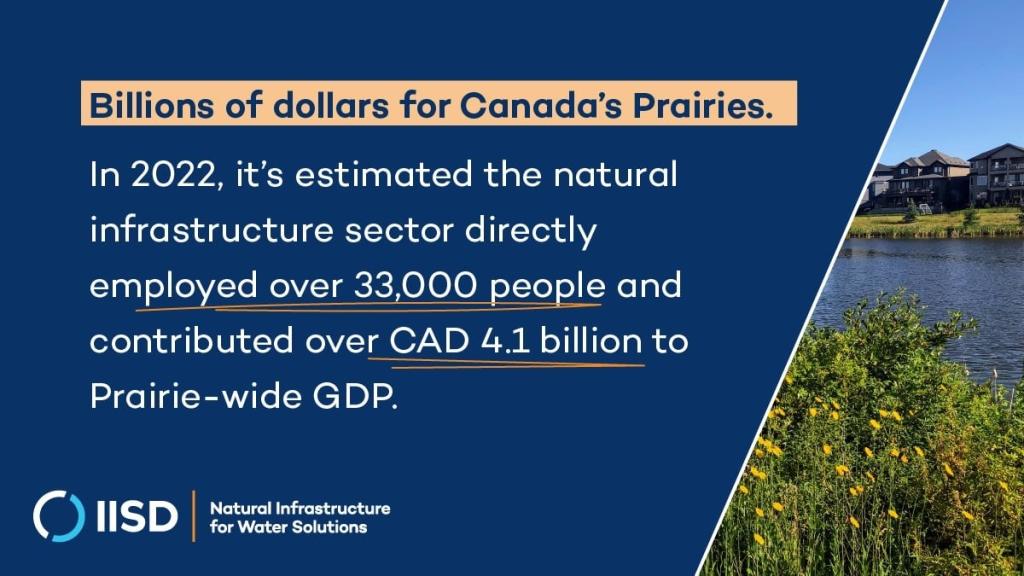
The natural infrastructure sector contributes billions to the Prairie-wide economy and creates jobs. In 2022, the sector's direct contribution to the GDP of the Canadian Prairies was estimated to be CAD 4.1 billion, and it directly employed over 33,000 people in Alberta, Saskatchewan, and Manitoba. We need greater investment in this sector, which is required to treat and supply clean, fresh water to the millions who live in Canada's Prairies.

November 14, 2023
  • The natural infrastructure sector contributes billions to the Prairie-wide economy and creates jobs. We need more investment in this sector, which is required to treat and supply clean, fresh water to the millions who live on Canada's Prairies, as well as to protect them from natural disasters.

  • CAD 4.1 billion. The estimated direct contribution to the GDP of the Canadian Prairies in 2022 by the natural infrastructure sector. It's also estimated the sector directly employed over 33,000 people in Alberta, Saskatchewan, and Manitoba.

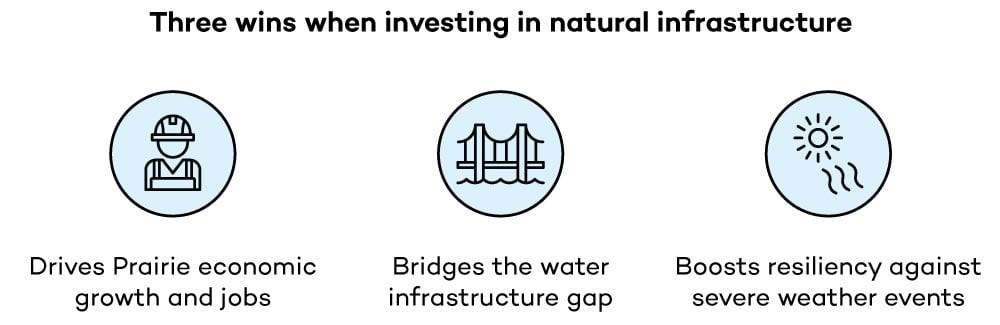
  • Natural Infrastructure investments support greater resiliency in the face of floods, droughts, fires, and other severe weather impacts-important across the Prairies, which faced devastating droughts and fires in 2023.

Natural infrastructure contributes over CAD 4 billion annually to the economy of Canada’s Prairies, as well as tens of thousands of jobs. There’s still room for growth: more investment can build greater resilience to droughts, floods, fires, and other severe weather impacts—many of which afflicted the region this summer—as well as increase jobs and GDP.

In Alberta, Saskatchewan, and Manitoba, it is estimated that this sector directly employed more than 33,000 people and contributed over CAD 4.1 billion to Prairie-wide GDP in 2022. With additional investments across the Prairie provinces of CAD 40 million to CAD 100 million per year, the sector could see between 18% and 25% in direct job growth by 2030 compared to business as usual.

Billions of dollars for Canada's Prairies. In 2022, it's estimated the natural infrastructure sector directly employed over 33,000 people and contributed over CAD 4.1 billion to Prairie-wide GDP.

Natural infrastructure involves the conservation, restoration, or enhancement of natural landscapes to provide specific results. For example, wetlands can naturally house excess water during floods; green roofs can help manage runoff; and forests, grasslands, and restored stream banks can replenish groundwater, mitigate flood- and drought-related risks, support fisheries, and provide opportunities for recreation. The sector employs a variety of workers, including landscape architects, ecologists, urban planners, stormwater managers, and environmental consultants.

NIWS infographic showing "three wins when investing in natural infrastructure."
Report

The Production Gap

Phasing Down or Phasing Up? Top fossil fuel producers plan even more extraction despite climate promises

The report measures the misalignment between governments' planned production of coal, oil, and gas and the global production levels consistent with meeting the Paris Agreement temperature goals. The 2023 Production Gap Report finds that governments plan to produce around 110% more fossil fuels in 2030 than the 1.5°C temperature limit allows.

November 9, 2023
  • Governments plan to produce more fossil fuels in 2030 than would be consistent 1.5°C. With increasing coal, oil, and gas production the fossil fuel #ProductionGap is expected to grow over time.

  • Governments plan to produce more than double the amount of #FossilFuels than is consistent with the Paris Agreement. To limit warming to 1.5°C, governments must close the #ProductionGap.

  • The #ProductionGap Report finds that governments' production plans and projections would lead to 460% more coal, 29% more oil, and 82% more gas in 2030 than would be consistent with limiting global warming to 1.5°C.

The 2023 Production Gap Report: Phasing down or phasing up? Top fossil fuel producers plan even more extraction despite climate promises tracks the gap between governments' planned and projected global fossil fuel production and the amount that would be consistent with the Paris Agreement. In this fourth edition, the report finds that governments plan to produce more than double the fossil fuels in 2030 than would be consistent with limiting warming to 1.5°C.

The report's main findings include:

  • Governments, in aggregate, still plan to produce more than double the amount of fossil fuels in 2030 than would be consistent with limiting warming to 1.5°C. The persistence of the global production gap puts a well-managed and equitable energy transition at risk.
  • Taken together, government plans and projections would lead to an increase in global coal production until 2030 and in global oil and gas production until at least 2050. This conflicts with government commitments under the Paris Agreement and clashes with expectations that global demand for coal, oil, and gas will peak within this decade, even without new policies.
  • Major producer countries have pledged to achieve net-zero emissions and launched initiatives to reduce emissions from fossil fuel production, but none have committed to reducing coal, oil, and gas production in line with limiting warming to 1.5°C.
  • Governments should be more transparent in their plans, projections, and support for fossil fuel production and how they align with national and international climate goals.
  • There is a strong need for governments to adopt near- and long-term reduction targets in fossil fuel production and use to complement other climate mitigation targets and to reduce the risks of stranded assets.
  • Given the risks and uncertainties of carbon capture and storage and carbon dioxide removal, countries should aim for a near total phase-out of coal production and use by 2040 and a combined reduction in oil and gas production and use by three-quarters by 2050 from 2020 levels, at a minimum. The potential failure of these measures to develop at scale calls for an even more rapid global phase-out of all fossil fuels.
  • An equitable transition away from fossil fuel production must recognize countries' differentiated responsibilities and capabilities. Governments with greater transition capacity should aim for more ambitious reductions and help finance the transition processes in countries with limited capacities.

The 2023 Production Gap Report is produced by the Stockholm Environment Institute, Climate Analytics, E3G, the International Institute for Sustainable Development, and the United Nations Environment Programme (UNEP). More than 80 researchers contributed to the analysis and review, spanning numerous universities, think tanks, and other research organizations.

Report details

Topic
Climate Change Mitigation
Energy
Governance and Multilateral Agreements
Project
Advancing the Transition Away from Fossil Fuels
Impact area
Climate
Publisher
Stockholm Environment Institute
Copyright
Stockholm Environment Institute, 2023
Report

Determining the Price of Minerals: A transfer pricing framework

Practical guidance to support developing countries in accurately pricing mineral sales for the purposes of revenue collection.

November 3, 2023

In the mining sector, royalties and corporate income taxes are generally based on the value of the mineral transacted. Consequently, it is critically important that any transactions involving the purchase and sale of minerals are valued correctly. Due to the frequency and scale of related-party transactions, the potential risk to tax revenues posed by transfer pricing non-compliance can be high, particularly around the value of the extracted minerals.

Determining the Price of Minerals: A Transfer Pricing Framework is a practice note providing practical and meaningful guidance for developing countries to accurately delineate the transaction and price of mineral sales to support revenue collection in the mining sector.

Focused price schedules for key minerals

Determining the Price of Minerals: A Transfer Pricing Framework for Bauxite provides a specific application of the framework for bauxite.

Determining the Price of Minerals: A Transfer Pricing Framework for Lithium provides a specific application of the framework for lithium.

Price schedules for copper and other minerals will be released gradually over time.

Report details

Report

Integrating Gender Equality and Mine Closure: Actions for governments

Report on how mine closure and gender equality intersect and how governments can ensure closure practices and policies integrate gender considerations.

November 1, 2023

Mine closure is an essential component of developing, operating, and closing a mining operation. Proper mine closure planning ensures that the mine site is safe, stable, and environmentally sound, and mining communities are economically and socially sustainable in the post-mining transition. Gender equality is also an essential element of mining across the entire life cycle, including mine closure. Women in mining communities often experience unequal and negative impacts from mining and, at the same time, do not benefit equally from opportunities, such as employment and community support. As such, their experience with mine closure can be expected to be different than men’s.

However, the social impacts of mine closure on women—and the interconnectedness of gender equality and mine closure—are often insufficiently considered. A limited number of studies from South Africa, sub-Saharan Africa, and Canada have identified a strong correlation between mine closure and women’s social, economic, and domestic vulnerability. The research shows that the outmigration of the male population to find livelihoods elsewhere and the social upheaval that comes with loss of employment and decreased economic activity are triggers for these impacts. The consequences can include increased crime rates, prostitution, poor nutrition, lack of food security, and heavier domestic and care responsibilities. The decline in the economic and social well-being of women can increase if the impacts of mine closure are not adequately considered.

This report addresses the interconnectedness of gender equality and mine closure by reviewing current issues and practices in both mine closure and gender equality—and, importantly, where they intersect—and provides policy recommendations for governments to ensure that gender considerations are integrated into all aspects of mine closure. The report explores how to implement processes that assess and respond to the interests of the entire community, including the following:

  • gender-based analysis and intersectionality
  • community engagement approaches
  • post-mining land-use decisions
  • transitioning mine workers and those in the service and supply sector
  • community, social, and economic support for closure and the post-mining transition

While most of the work to plan and implement mine closure is the responsibility of the mine operator, governments have an important role in setting regulations, standards, and guidance on how that closure work should be undertaken. As an overarching recommendation, governments should develop a gender mining strategy that addresses the concerns of women and men and takes an intersectional approach.