Report

Measures to Enhance Forest Conservation and Reduce Deforestation

Viewpoints and lessons from producing countries

This report outlines and compares various policy measures that Costa Rica, Gabon, Indonesia, Peru, and Rwanda have put in place to address deforestation.

February 22, 2024

Forests sustain and protect us in a myriad of ways. They absorb carbon dioxide and provide us with oxygen, they harbour more than three quarters of terrestrial biodiversity, and they support the livelihoods of millions of people worldwide.

But the world has lost 420 million hectares of forest since 1990. That's an area bigger than India. Given looming environmental crises—including climate change and biodiversity loss—the need to protect these vital ecosystems has gained significant prominence in political agendas.

This report outlines and compares various policy measures that Costa Rica, Gabon, Indonesia, Peru, and Rwanda have put in place to address deforestation and explores the role of voluntary sustainability standards (VSSs) in complementing them.
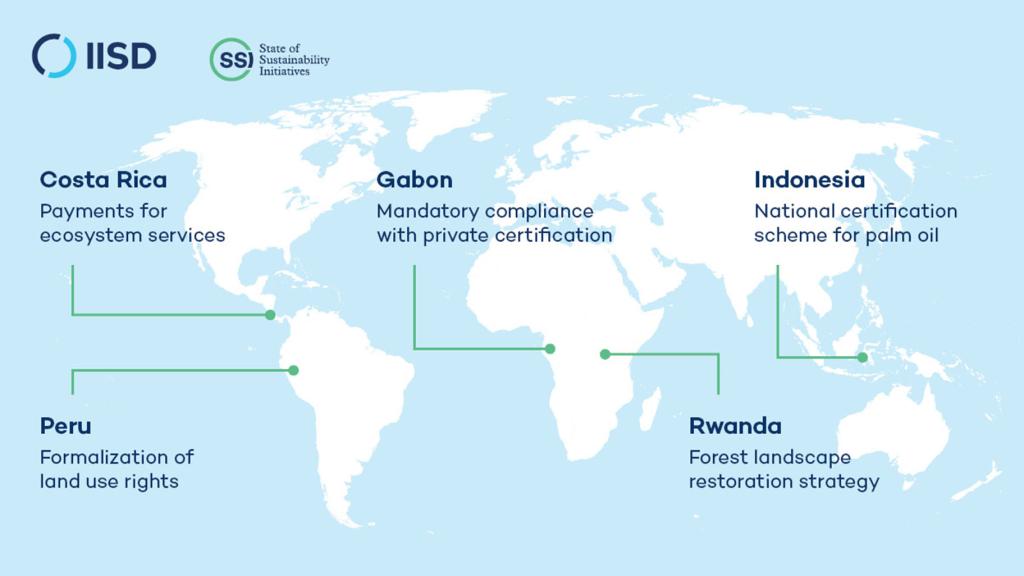
A map of producing countries—Costa Rica, Gabon, Indonesia, Peru, and Rwanda—with policy measures to address deforestation.

The report provides a detailed analysis of the successes and challenges each country has encountered in their attempts to reduce deforestation and improve forest conservation. From these experiences, it distils seven common findings to help guide governments in the Global South seeking to embark on similar journeys.

In summary, governments tend to have more success at preserving and restoring forests if they

  • use a combination of measures tailored to the local context
  • target areas that are at high risk of deforestation
  • recognize the true economic and environmental value of forests
  • provide support to enable producers and forestry operators to comply with the measures
  • engage with multiple actors and mobilize funds from both the public and private sector
  • leverage VSSs to complement and support policy measures
  • use both physical and digital monitoring to measure results and flag issues early
Funded by

Report details

Report

National State of the Environment Report: Uzbekistan

A healthy environment and its sustainable management are critical for citizens' well-being and supporting Uzbekistan's growing economy. The National State of the Environment Report (NSoER) is a comprehensive document that provides a snapshot of current environmental trends in Uzbekistan's socio-economic development for citizens, experts, and policy-makers. This report was prepared with the support of the United Nations Economic Commission for Europe, the United Nations Environment Programme (UNEP), and the Food and Agriculture Organization of the United Nations, along with financial support from the Global Public Goods and Challenges Programme Cooperation Agreement between the European Commission and UNEP.

February 9, 2024
  • A decade of environmental change is captured in the recent National State of the Environment Report of Uzbekistan.

  • The National State of the Environment Report is a comprehensive document that provides a snapshot of current environmental trends in Uzbekistan's socio-economic development for citizens, experts, and policy-makers.

  • Decade of trends for critical environmental issues, including air, water, and biodiversity, are reviewed in the recent National State of the Environment Report.

The analyzed environmental trends need to inform decision making and improve citizen engagement in natural resource management and environmental protection. This report thus aims to connect actions creating drivers and pressures influencing the state of the environment and relevant responses to address environmental challenges.

Our approach uses the Drivers– Pressures–State–Impacts–Responses (DPSIR) framework to draw connections between the state of the environment and the drivers and pressures on the environment. The framework brings together five critical elements of development in a connected framework to integrate the causes of environmental degradation (as well as environmental improvements) into a chain of causes and consequences. The DPSIR framework provides a suitable model for describing the interaction between human activities and the environment.

Based on the application of the DPSIR framework, the NSoER team, with the participation of stakeholders, identified the specific drivers, pressures, and components of the environment, such as atmospheric air, water resources, land, and specific ecosystems.

Report

The Investment Facilitation for Development Agreement: A reader's guide

After three years of informal talks and three years of formal negotiations, a group of more than 115 WTO members announced a major milestone on July 6, 2023: the finalization of the legal text of a new global agreement on investment facilitation. The agreement establishes a set of binding rules on transparency, streamlining, and improved cooperation on investment facilitation.

February 6, 2024

This reader's guide provides an overview of the Investment Facilitation for Development Agreement. It describes the rules and legal provisions that have been agreed and succinctly explains what the disciplines require. It has been designed to provide all interested stakeholders with a short and clear summary of the treaty.

This material has been funded by the UK Government Centres of Expertise as part of UK International Development; however, the views expressed do not necessarily reflect the British government's official policies. The Umbrella Grant is a project of the Trade and Investment Advocacy Fund (TAF2+) and is implemented by the International Institute for Sustainable Development.

Report details

Topic
Investment Law & Policy
Trade
Project
Investment Facilitation
Impact area
Sustainable Economies
Publisher
IISD
Copyright
IISD, 2024
Report

Northwest Ontario Side Story: IISD Experimental Lakes Area Annual Report 2022-2023

It’s certainly no secret that IISD Experimental Lakes Area is a place where world-class and unique scientific approaches to discovering what threatens the health of our fresh water truly thrive.

January 30, 2024

What we manage to obscure a little better is that, despite all the incredible scientific discoveries that go down at the world’s freshwater laboratory, we also harbour some artistic flourishes, theatrical leanings, and even full-on musical talents.

This year's annual report is a celebration of all things creative at the world's freshwater laboratory, from the science to music, photography and theatre.

Report details

Topic
Water
Region
Canada
Project
IISD Experimental Lakes Area
Impact area
Nature
Publisher
IISD
Copyright
IISD, 2023
Report

Voluntary Standards and Initiatives for Carbon Management

Navigating the landscape

These two reports unpack the complex landscape of voluntary standards and initiatives for carbon management to help private sector actors reach net-zero emissions.

January 29, 2024

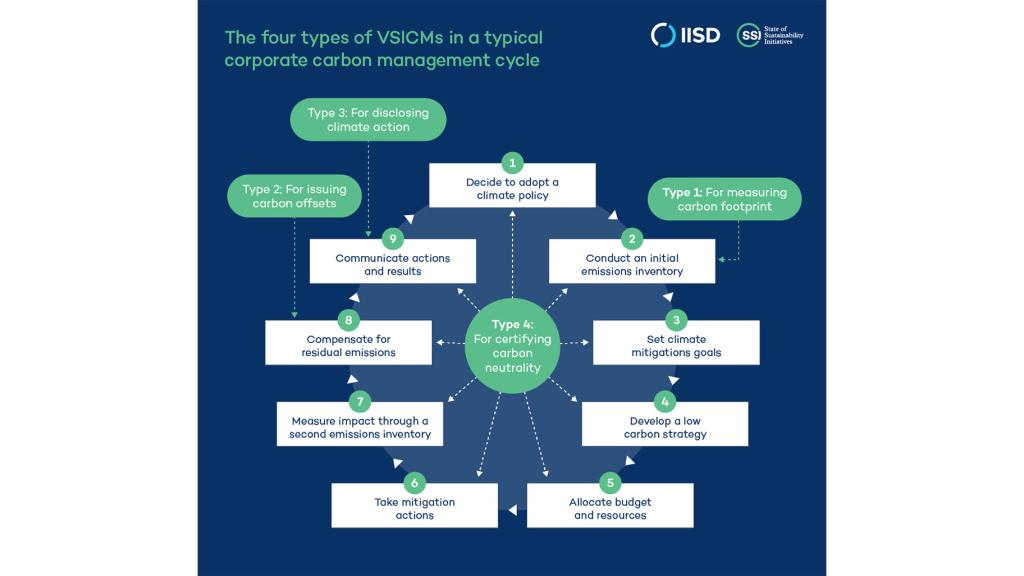
As people worldwide grapple with the effects of rising temperatures, companies are under increasing legal, financial, and societal pressure to cut their emissions. Voluntary standards and initiatives for carbon management (VSICMs) are voluntary measures that organizations can use to develop, report, register, or certify certain activities or processes related to climate action.

VSICMs have emerged and developed rapidly in the past 30 years in response to the escalating climate emergency. They offer companies step-by-step methods and guidance to help them initiate or increase the ambition of their climate change mitigation strategies.

Non-governmental organizations, international organizations, and private sector actors have established VSICMs at a faster rate and with more flexibility than legally binding initiatives. This has led to the co-existence of—and competition among—multiple standards and initiatives. They often have overlapping and complementary goals but different scopes and functions, creating a complex landscape.

Voluntary Standards and Initiatives for Carbon Management: Navigating the Landscape helps private sector actors understand the different types of VSICMs and how they can help them to advance their carbon management practices.

The four types of VSICMs in a typical corporate carbon management cycle.

The report also outlines various challenges that have arisen due to the organic evolution of VSICMs and highlights the need for a clear governance framework to promote coordination and alignment across initiatives and enhance the credibility of voluntary efforts.

The accompanying report, State of Sustainability Initiatives Review: Standards and Carbon Neutrality, and appendix delve further into carbon neutrality standards. They compare nine standards of this type using the State of Sustainability Initiatives’ CARE methodology, which uses a comprehensive list of indicators to benchmark standards according to their coverage, assurance, responsiveness, and engagement.

Report

Mainstreaming Gender Equality and Social Inclusion in Nature-Based Solutions for Climate Change Adaptation

Discover tools, recommendations, and case studies on how to plan, design, and implement nature-based solutions for adaptation that advance gender equality and social inclusion while enhancing resilience, biodiversity, and ecosystem integrity.

January 22, 2024
  • Equity-deserving groups have unique and specialized knowledge concerning climate adaptation and biodiversity loss prevention that should be respected and leveraged in nature-based solutions initiatives through meaningful engagement processes.

  • Populations that face systemic marginalization and discrimination are often disproportionately affected by the impacts of the climate and biodiversity crises.

  • International actors and scientific bodies acknowledge the importance of incorporating gender equality and social inclusion measures within nature-based solutions programming to enhance climate adaptation.

This technical report offers contextual information, tools, and recommendations to help plan, design, and implement nature-based solutions (NbS) for adaptation that advance gender equality and social inclusion (GESI) while enhancing resilience, biodiversity, and ecosystem integrity.

It contributes to the nascent field of gender-responsive and inclusive NbS by providing practitioners working on NbS programming with guidance on how to consider gender and other intersecting identity factors that are grounded in a human rights-based approach at each stage of their NbS projects. Looking beyond NbS projects, applying a GESI lens should become “business as usual” within all facets of climate adaptation and resilience planning, processes, and practices.

This report was developed through a review of relevant literature, case studies, and discussions with experts. It is part of a compendium of resources developed by the International Institute for Sustainable Development (IISD) for the Nature for Climate Adaptation Initiative (NCAI), which is supported by Global Affairs Canada. The resources include an introductory guidance note that provides an overview of basic terminology and concepts behind NbS for adaptation and a report that provides guidance on enhancing biodiversity co-benefits from implementing NbS for adaptation (along with two case studies).

Participating experts

Report

Enhancing Biodiversity Co-Benefits From Nature-Based Solutions for Adaptation in Practice

By sharing promising practices and lessons learned, these case studies seek to inform and inspire adaptation practitioners and planners to help ensure that biodiversity co-benefits are captured throughout the lifetime of a project.

November 30, 2023
  • Nature-based solutions for adaptation projects that protect biodiversity and ecosystems help sustain livelihoods and support community adaptation to climate change.

  • From mangrove restoration in Grenada to interurban biological corridors development in Costa Rica, nature-based solutions for adaptation projects help increase our resilience to climate change.

  • To ensure that nature-based solutions for adaptation interventions deliver biodiversity co-benefits, projects must be designed from the outset to provide measurable benefits for ecosystem health.

While nature-based solutions (NbS) for adaptation projects are increasingly being promoted and implemented, there is still little understanding of how such projects can achieve biodiversity co-benefits—multiple wins for both biodiversity and ecosystem functioning. Protecting and supporting biodiversity and ecosystems is important to delivering critical ecosystem services that help communities adapt to climate change and sustain their livelihoods, such as conserving wetlands to absorb floodwaters.

To address the gap in evidence, these two case studies have been developed as a supplement to the Nature for Climate Adaptation Initiative report Enhancing Biodiversity Co-Benefits From Nature-based Solutions on planning, designing, and implementing NbS for climate change adaptation that enhances biodiversity and ecosystem integrity. 

The first case study describes how civil society organizations protect and restore mangroves to strengthen coastal resilience to climate change in Grenada. The second case study examines the role of biological corridors in urban areas in Costa Rica to enhance biodiversity while contributing to the development of sustainable cities and a higher quality of life.

Each case study includes an overview of the local context and climate risks, how the project adapted to climate change and integrated biodiversity in practice, and lessons learned. The case studies were developed through interviews with project implementers and by reviewing relevant reports and documents.

This report is part of a compendium of resources developed by the IISD for the Nature for Climate Adaptation Initiative (NCAI), which is supported by Global Affairs Canada.

Report details

Report

Global Market Report: Tea prices and sustainability

This report explores recent market trends in the tea sector and explains why sustainability standards and other value chain actors need to get better at recognizing the social and environmental costs of tea production.

January 17, 2024
  • Over two thirds of the 13 million people employed in the global tea sector are smallholder farmers in developing countries. They produced 60% of the world's tea in 2022.

  • Global tea production has surpassed USD 17 billion annually, with tea trade valued at USD 9.5 billion, representing a significant source of export earnings for low-income and emerging economies.

  • In 2019, at least 1.67 million tonnes of VSS-compliant tea was produced by more than 1 million farmers, reaching a farm gate value in excess of USD 155 million.

Tea is consumed more than any other drink in the world, excluding water. Originally from China, it spread across trade routes over centuries to become the USD 9.5 billion industry it is today.

But behind this popular beverage are 13 million people working hard to grow, pluck, and process tea leaves into the neat packages we find in the supermarket. Two thirds of those people are smallholder farmers in developing countries. They face the formidable challenge of producing an affordable, quality, and more sustainable product in a highly competitive market and under increasingly harsh and unpredictable weather conditions.

In some tea-producing countries, smallholder farmers make no profit at all, as their total production costs can exceed their earnings. On top of bearing all the risks related to extreme weather changes and variations in the cost and availability of crucial inputs like fertilizers, they are also most affected by low prices and volatility in the tea sector.

Voluntary sustainability standards (VSSs) have been working to address sustainability challenges in the tea sector for 30 years. Many focus on building climate resilience, for example by encouraging farmers to use techniques that help them cope with periods of drought or that maintain soil fertility to improve yields and quality. Some also seek to improve the prices and incomes of smallholder farmers.

VSS-compliant tea now represents at least a quarter of total global production. However, evidence of VSSs’ impact on farmers’ incomes is limited and tends to be very context specific. It is not clear if minimum prices, premiums, and other differentials really make a difference to tea farmers’ livelihoods—or even make up for the costs of certification. They certainly will not if VSS-compliant tea is sold as conventional, which estimates suggest happens 90% of the time.

There is an urgent need to develop new approaches for recognizing the social and environmental costs of conventional tea production so that farmers can be adequately rewarded for using more sustainable practices. Our report provides recommendations for how governments, private sector actors, and standard-setting bodies can better support smallholder farmers and make tea production fairer and more sustainable.

Report

Progress on Vertical Integration in National Adaptation Plan Processes

Analysis of strategic linkages between national and sub-national levels

Vertical integration for climate change adaptation is the process of creating intentional and strategic linkages between national and sub-national governance levels in the planning, implementation, and monitoring, evaluation, and learning stages. This synthesis report presents an analysis of how countries are advancing vertical integration in national adaptation plan processes.

November 27, 2023
  • Most developing countries' NAPs define a role for sub-national governments in climate change adaptation—most often planning and implementation, and, to a lesser extent, MEL.

  • All NAPs reference at least one non-state sub-national actor-CSOs, small businesses, communities, smallholder producers, and groups representing women, Indigenous Peoples, youth, and persons with disabilities.

  • Many NAPs refer to community-based adaptation and locally led adaptation, recognizing the importance of local context for adaptation action.

Vertical integration for climate change adaptation is the process of creating intentional and strategic linkages between national and sub-national governance levels in the planning, implementation, and monitoring, evaluation, and learning (MEL) stages. Sub-national-level governments and local actors are already taking action to adapt to the climate change impacts being felt by communities. Local-level adaptation needs to be carefully linked to and supported by national-level adaptation planning to channel resources to the people, places, and systems that need them most.

The national adaptation plan (NAP) process presents a critically important opportunity to scale up effective, inclusive adaptation. By building strategic and intentional links with sub-national adaptation planning and implementation through vertical integration, the NAP process can support climate change adaptation priorities so that they reflect local realities, channel resources to sub-national actors and actions, and ensure that sub-national adaptation efforts are captured when progress is tracked and reported.

This synthesis report presents an analysis of how countries are advancing vertical integration in NAP processes. The findings are based on data collected through a review of NAP documents submitted to the United Nations Framework Convention on Climate Change's NAP Central as of July 2023. The recommendations are complemented by information gathered during the NAP Global Network Secretariat's engagement with countries' NAP teams.

Report details

Topic
Climate Change Adaptation
Project
NAP Global Network
Impact area
Climate
Engage
International Governance
Publisher
IISD
Copyright
IISD, 2023
Report

Navigating Decisions: The risks to Mozambique from liquified natural gas export projects

Liquified natural gas (LNG) export projects have been promoted as a way to boost economic development in Mozambique. The European Union has ties to all these projects. This report highlights the negative impacts, economic concerns with project designs, and risks to both future government revenues and sovereignty. Decision-makers should reconsider these LNG projects and investigate more sustainable alternatives for Mozambique.

December 13, 2023
  • The TotalEnergies Mozambique LNG project has received disproportionate public finance support—60 times that of renewable energy in the country. It has also increased national oil company debt and sovereign liability.

  • Risks to future financial benefits to Mozambique from LNG projects include delayed government revenues, decreased global LNG demand, volatile gas prices, trade competition, and the security situation near LNG facilities.

  • International investment law protects LNG projects at Mozambique's expense, restricting government actions and placing significant liability on the state.

The climate science is clear that there should be no new natural gas project developments, including in Mozambique, if the world is to limit global warming to 1.5°C. Nevertheless, on a purely social and economic basis, there are significant risks that undermine the contribution LNG is expected to make to the Mozambique economy. Most of the proposed financial benefits to Mozambique rely on robust international demand for LNG in the late 2030s and 2040s, which is looking increasingly unlikely. At this juncture, as the global energy transition away from fossil fuels gathers pace, more sustainable projects should be favoured over further investment in LNG.