Webinar

Supporting Clean Energy Transitions Through Fossil Fuel Subsidy Reform

September 7, 2021 7:00 am - 9:00 am EST

(Open to public)

Fossil fuel subsidies reduce the price of fossil fuels and distort energy markets, further fuelling the climate crisis. Fossil fuel subsidy reform (FFSR) can not only support transitions to clean energy, but also help make these transitions just and inclusive.

This online event, presented by the Government of Denmark, the International Energy Agency (IEA), and the International Institute for Sustainable Development Global Subsidies Initiative (IISD-GSI), in the context of the Global Commission on People-Centred Clean Energy Transitions, outlined how FFSR can contribute to clean energy transitions.

The event specifically focused on practical examples of how to conduct FFSR in a way that supports people by taking into account issues such as gender, health, local community considerations, and broader social impacts. The panel further focused on ways to approach people-centred clean energy transitions and how to seize opportunities and overcome barriers and challenges related to the issues identified.

Agenda

Opening remarks

Peter Wooders, Senior Director, Energy, IISD

Dr. Brian Motherway, Head of Energy Efficiency, International Energy Agency (IEA)

Member of the Global Commission on People-Centred Clean Energy Transitions (TBC)

Panel: FFSR and Social Impacts

Principles of Fossil-Free Recovery and the Newly Launched Fossil Fuel Subsidy Tracker
Peter Wooders

Health Impacts of FFSR
Heather Adair-Rohani, Team Leader on Household Energy and Health, World Health Organization (WHO)

Community-Level and Social Impacts of FFSR and the Shift to Clean Energy
Ruddy Gobel, Head of Communications and Partnership, National Team for the Acceleration of Poverty Reduction (TNP2K), Indonesia

FFSR, Civil Society Engagement, and People-Centred Transition
Tasneem Essop, Executive Director, Climate Action Network International

Gender Aspects of FFSR
Shruti Sharma, Associate and Energy Specialist, IISD

Q&A Session

Moderator: Peter Wooders

Closing

Dr. Brian Motherway

Peter Wooders

Webinar

Consumer Demand for Sustainable Products in Asia: Successes and challenges

September 21, 2021 1:00 pm - 2:15 pm CET

(Open to public)

Asia is home to a majority of the world’s population, and consumption patterns on the continent have significant implications on a global scale.

This webinar presented research findings on the consumption trends of certified and sustainable products in Asia, focusing on coffee, cotton, palm oil, and tea. Various actors (buyers, voluntary sustainability standards, producers) then shared successes, challenges, and potential ways to increase sustainable consumption in Asia.

Moderators:

  • Cristina Larrea, Lead, Sustainability Standards, IISD
  • Vidya Rangan, Senior Manager, Impacts and Evidence, ISEAL Alliance

Speakers:

  • Steffany Bermúdez, Policy Analyst, IISD
  • Rajesh Bhuyan, Director, Trustea
  • Irvan Helmi, Co-Founder, Anomali Coffee
  • Nils Heuer, Associate Programme Officer, Consumption and Production Unit, UN Environment Programme
  • Ganesh Kasekar, Representative in South Asia, Global Organic Textile Standard
  • Teddy Somantri, Co-Founder and President Director, Javanero Indonesia Coffee
  • Nguyen Bao Thoa, Director, Vietnam Rural Industries Research and Development Institute
  • Philippa Walker, Programme Manager, Asia Sustainable Palm Oil Links, WWF Singapore

Referenced Resources: 

This event was co-hosted by the International Institute for Sustainable Development (IISD) and Evidensia.

IISD and Evidensia logos
Webinar

2021 Mining and Sustainability Forum of the Americas: Regional supply chains for critical minerals

The 2021 Mining and Sustainability Forum of the Americas: Regional Supply Chains for Critical Minerals will convene stakeholders from government, international organizations, academia, civil society, and the private sector for a two-part virtual event aiming to advance regional policies for critical minerals supply chains in the Americas.

July 27, 2021 10:00 am - August 10, 2021 12:00 pm EDT (GMT -4)

(Open to public)

***Español aquí***

Critical minerals will fuel the global shift to renewable energy and electrification. This transformation will depend on resilient supply chains delivering large quantities of copper, lithium, nickel, and other mineral inputs for new energy infrastructure and technology.

The Americas have been a great source of these minerals, but supplying the low-carbon transition will require an expanded and sustainably managed minerals sector and supply chain. If countries work together, this transformation may bring important widespread economic benefits to the region and help countries recover from the COVID-19 pandemic.

You are invited to join stakeholders from government, international organizations, academia, civil society, and the private sector at the 2021 Mining and Sustainability Forum of the Americas on the theme: Regional Supply Chains for Critical Minerals.

With the aim of achieving new regional policies on critical minerals supply chains, this two-part virtual event will discuss practical regional policy options to be presented to mining ministers and the Annual Mines Ministries of the Americas Conference (CAMMA) meeting on September 2.

The webinars will include interpretation for participants in English and Spanish and are hosted by the Intergovernmental Forum on Mining, Minerals, Metals, and Sustainable Development (IGF) in partnership with the Inter-American Development Bank (IDB) and Mines Ministries of the Americas Conference (CAMMA).

You must register for each session separately.

Session 1 | Critical Minerals in the Americas: Understanding the opportunity
Moderator
  • Alejandra Wood, Executive Director, Center for Copper and Mining Studies (CESCO)
Confirmed Speakers
  • Luc Leboeuf, Director, Natural Resources Canada
  • Enir Sebastião Mendes, Director, Department of Mineral Transformation and Technology, Ministry of Energy and Mining, Brazil
     
  • Date: Tuesday, July 27, 2021
  • Time: 09:00–11:00 (Bogota, Lima) / 10:00–12:00 (Ottawa, Santiago)
  • Register for session 1
Session 2 | Critical Minerals in the Americas: Proposals to strengthen supply chains
  • Date: Tuesday, August 10, 2021
  • Time: 09:00–11:00 (Bogota, Lima) / 10:00–12:00 (Ottawa, Santiago)
  • Register for session 2
Webinar

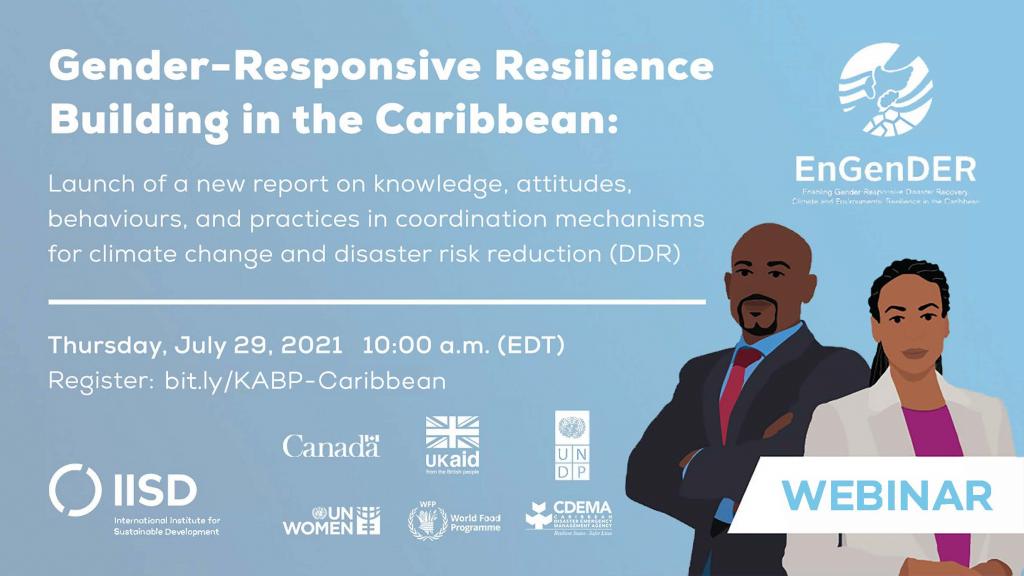
Gender-Responsive Resilience Building in the Caribbean

Hosted by UN Women and the International Institute for Sustainable Development (IISD) under the EnGenDER Project, this webinar will share findings and recommendations from our knowledge, attitudes, behaviours, and practices (KABP) analysis, based on data from nine Caribbean countries. 

July 29, 2021 10:00 am - 11:00 am EDT

(Open to public)

Gender-Responsive Resilience Building in the Caribbean Webinar taking place July 29 at 10:00 a.m. EDT. Register at bit.ly/KABP-Caribbean.


Efforts to build resilience to climate change and disasters in developing countries will not be effective or sustainable if they do not take gender into consideration. Policies, plans, and initiatives must take into account gender differences in roles and responsibilities, access to information, resources, opportunities, and decision-making power. 

Our KABP analysis explores gender-related perceptions and biases and how they play out in coordination mechanisms for climate change adaptation and disaster risk reduction. It provides the foundation needed to understand how gender-related knowledge, attitudes, behaviours, and practices within institutions may enable or inhibit gender-responsive approaches. 

This webinar marks the launch of our KABP analysis

Webinar

Trade and Climate Change Mitigation and Adaptation: Implications for developing countries

July 27, 2021 8:00 am - 9:00 am EDT

via Zoom

(Open to public)

Climate change mitigation and adaptation policies have taken on many forms, including net-zero commitments, green new deals, and circular economy plans. Each of these policies combine more abstract carbon reduction objectives with a more or less comprehensive set of policy and market interventions needed to reach those goals. While these policy interventions are both necessary and welcome, their impact on developing countries has not yet been a central issue of discussion.

In this webinar, we present two new papers that aim to kickstart this dialogue. A first presentation looks at the impact of such commitments on developing country exports of goods, particularly metals and minerals needed for the energy transition and fossil fuels. A second presentation assesses how to leverage trade to support climate change adaptation strategies in developing countries.

This is the second of two online sessions organized by the International Institute for Sustainable Development on the topic of Trade and Climate Change. The first session took place on 22 July from 2:00 to 3:00 p.m. CEST.

Agenda

Introductory Remarks

Representative of the UK mission to the WTO

Discussion

Impact of Net-Zero and Climate Commitments on Developing Country Exports of Goods
Tom Moerenhout, Senior Associate, IISD

Henrique Pacini, Economic Affairs Officer, United Nations Conference on Trade and Development: Discussant

Leveraging Trade to Support Climate Change Adaptation in Developing Countries
David Hoffmann, Policy Analyst, IISD

Amb. Mere Falemaka, Permanent Representative of the Pacific Islands Forum to the United Nations, World Trade Organisation, and Other International Organisations in Geneva

Q&A

Webinar

Trade and Climate Change: How can trade policy maximize developing countries' benefits from a clean energy transition?

July 22, 2021 8:00 am - 9:00 am EDT

via Zoom

(Open to public)

According to the International Energy Agency's net-zero and sustainable development models, the power and transport sectors are the most important for reducing carbon emissions in the next two decades. The energy transition in each of these sectors will require strengthening existing value chains and supporting policies in developing countries.

In this webinar, we presented two new papers that look at these supporting policies in developing countries. A first presentation looked at the trade of raw materials of use for electric vehicles and highlight key lessons from cobalt in the Democratic Republic of the Congo and lithium in Chile, two of the most important producers and exporters of these respective materials worldwide. A second presentation assessed how trade policy can incentivize clean energy production in developing countries including through domestic production.

This is the first of two online sessions organized by the International Institute for Sustainable Development on the topic of Trade and Climate Change. The second session will take place on 27 July from 2:00 to 3:00 p.m. CEST.

Agenda

Introductory remarks

Discussion

Electric Vehicles and Trade in Raw Materials
Richard Bridle, Senior Policy Advisor, IISD

Isabelle Ramdoo, Deputy Director, Intergovernmental Forum on Mining, Minerals, Metals and Sustainable Development

The Role of Trade Policy in the Production of Wind and Solar Energy Components
Christophe Bellmann, Senior Policy Advisor, IISD:

Brendan Vickers, Head of International Trade Policy, Commonwealth Secretariat

Q&A

Webinar

VNR lessons for the Decade of Action and to Build Forward Better: Identifying Best Practices and Progressing Effective SDGs Implementation

This United Nations 2021 High-level Political Forum side event focuses on the growing body of work related to Voluntary National Review (VNR) analysis and identification of best practices carried out by various stakeholders, including civil society, UN agencies, governments, and other actors.

July 14, 2021 7:30 am - 9:00 am EDT

(Open to public)

The side event will explore how the outputs of these different research processes could be more widely disseminated and used as the basis for building stakeholder capacities and promoting better quality VNRs.

It will produce a range of recommendations for the Member States and other stakeholders on how the quality of VNRs submitted to the HLPF can continue to be improved each year through the development of a more structured and integrated multi-stakeholder system of VNR-related research, reflection, exchange, and capacity building.

7:30 - 8:15 AM: First Panel | Promoting good practices around VNR reporting

Deirdre de Burca, Advocacy Coordinator at Forus (Moderator)
Ana de Oliveira, Research and Knowledge Management Officer at Cooperation Canada
Joern Geisselmann, Adviser at Partners for Review (Agenda 2030), German Development Cooperation (GIZ) GmbH
Arelys Bellorini, Senior United Nations Representative at World Vision International)

Q & A (15 minutes)

8:15 - 9:00 AM: Second Panel | Practical country examples: Governments linked with good practice on VNRs highlight their strengths and identify some of the gaps on the VNR processes

Andrew Griffiths, Head of Advocacy at Sightsavers (Moderator)
Martin Bille Hermann, Danish Ambassador to the United Nations
Speaker from the Government of Guatemala
Riccardo Messiano, Sustainable Development Officer at UN ESCAP

Q & A (15 minutes)

Webinar details

Webinar

Towards a Zero Hunger Private Sector Pledge

The Zero Hunger, Nourish the Future Pledge is an opportunity for companies, investment funds, and philanthropies to align USD 5 billion of their resources with new evidence and complement their pledges with new commitments being made by global institutions and governments to end hunger and nourish the future by 2030.

July 26, 2021 7:30 pm - 8:20 pm CEST

(Open to public)

Hunger has steadily been on the rise prior to the COVID-19. But the pandemic has supercharged these trends, with an additional 130 million projected to be suffering from hunger in 2020 alone, even before the devastating situation we are currently seeing in India and Brazil. But as shown in the ground-breaking Ceres2030 studies—backed up by another study by German organizations, the PARI Report—this situation can be turned around. With USD 33 billion in additional annual spending, we can reduce the number of hungry people from 811 million today to USD 170 million by 2030. The new evidence shows that a specific set of investments is needed to end hunger in ways that also ensure access to safe and nutritious food for all, support sustainable consumption shifts, reduce greenhouse gas emissions, generate decent and dignified livelihoods, and build food system resilience to future shocks.

Most of the additional USD 33 billion will come from governments—but they are already under pressure from the pandemic and the associated economic downturn. Large companies can and should step in to play a catalytic role in this effort.

Speakers

  • Peter Bakker, President, World Business Council for Sustainable Development (WBCSD)
  • Dr. Lawrence Haddad, Executive Director, GAIN & Chair, Action Track 1, UN FSS
  • Ute Klamert, Assistant Executive Director, World Food Programme (WFP)
  • Ibrahim Gourouza, Grow Africa & AUDA-NEPAD
  • Sanne Helderman, Lead research, World Benchmarking Alliance
  • Takaaki Nishii, CEO, Ajinomoto
  • Caroline Keeling, CEO, Keelings 
  • Hanneke Faber, President, Food & Refreshments, Unilever 
  • Julia Friederike Harnal, Vice President Sustainability & Governmental Affairs Agricultural Solutions, BASF

Watch the event's full recording

Check out the presentation given by Dr. Lawrence Haddad


The Zero Hunger, Nourish the Future Pledge is an opportunity for companies, investment funds, and philanthropies to align USD 5 billion of their resources with new evidence and complement their pledges with new commitments being made by global institutions and governments to end hunger and nourish the future by 2030. The purpose of this parallel session is to get buy-in from CEOs and ministers on the pathway to an ambitious partnership that leverages their combined resources and that leads to a high-level pledging moment by companies, investment funds, and philanthropies at the UN Food Systems Summit.

This event was organised jointly by the Global Alliance for Improved Nutrition (GAIN), Grow Africa, Grow Asia, the World Benchmarking Alliance, the World Food Programme,  the International Food Policy Research Institute (IFPRI), the International Institute for Sustainable Development (IISD), and Cornell University 


#ActionforZeroHunger


Why is this session important for the Food Systems Summit?

The Zero Hunger, Nourish the Future Pledge is a game-changing solution that emerged from the Summit Action Tracks and is supported by Dr. Agnes Kalibata, UN Special Envoy for the Food Systems Summit, and by Professor Joachim Von Braun, Chair of the Science Group of the Summit.

It is an opportunity for companies, investment funds, and philanthropic organizations to play a catalytic role by pledging USD 5 billion per year until 2030 to trigger the end of hunger.

This is the missing piece of the puzzle needed to remove 500 million people from hunger, double the incomes and productivity of 545 million poor farmers, and protect the climate, in line with the objectives of the UN Food Systems Summit, the Sustainable Development Goals (SDGs), and the Paris Climate Agreement.

This parallel session laid the groundwork for a high-level pledging moment from companies at the Summit.

Webinar

Deep Dives Into the Nexus of Food Systems, Climate Change, and Nutrition

July 28, 2021 8:00 am - 8:50 am CEST

(Open to public)

The 2021 UN Food Systems Summit is taking place in the context of the climate crisis and exacerbated global food insecurity resulting from the COVID-19 pandemic. While the world is facing these challenges and a global response will be needed, developing countries—and in particular African countries—are dealing with an even more extreme situation. Their development dynamics and needs involve an increase in food consumption and production to address the nutritional requirements of their populations in an approach that also ensures the environmental sustainability and resilience of their agricultural practices. Based on developed country experience, there is no evidence that such a transition could be achieved by relying on market economic forces alone, especially if the social inclusiveness of the process has to be guaranteed. Therefore, policy pathways must be identified and implemented that favour synergies and limit trade-offs within the nexus between climate change, food systems, and nutrition.

Speakers

  • Francine Picard, Senior Policy Advisor and Partnerships Lead, IISD 
  • Carin Smaller, Director of Agriculture, Trade and Investment, IISD 
  • Dr. Andrew Kwasari, Senior Special Assistant to the President on Agriculture, Office of the Vice President of Nigeria
  • Christel Weller-Molongua, Director of Rural Development and Agriculture Division in the Global Department at GIZ 
  • Dr. Felix Phiri, Department of Nutrition, HIV and AIDS of the Ministry of Health in Malawi  
  • Willem Olthof, Deputy Head of Unit, DEVCO C1 - Rural Development, Food Security, Nutrition, European Commission  

This session explains how we can influence consumption patterns through policy interventions that will lead to better environmental and nutritional outcomes in three countries—Malawi, Ethiopia, and Nigeria—in order to identify policy roadmaps to sustainable food system transformation. Specifically, by building on the Ceres2030 literature review and cost modelling exercise, this research supports analytical work to strengthen the evidence base for climate-smart nutrition interventions in the context of a sustainable food system. This aligns with the overarching transformative theme of the UN Food Systems Summit.

The purpose of this parallel session is to present the results from the country case studies, together with country focal points from the three countries: the Office of the Vice President of Nigeria, the Ministry of Public Health in Malawi, and the Federal Ministry of Health in Ethiopia. We aim to develop joint ownership of the final recommendations and enhance the utilization of the research in the Food Systems Summit, dialogues, and long-term country-level strategies.

Deep Dives Into the Nexus of Food Systems, Climate Change, and Nutrition in Malawi, Ethiopia, and Nigeria will provide examples of how to develop a country-level roadmap for food systems transformation that could serve as a blueprint for other countries and that is based on the best available evidence, economic modelling, and a deep engagement with national-level stakeholders working together with experts.

This event is the result of a collaboration between the International Food Policy Research Institute (IFPRI), the International Institute for Sustainable Development (IISD), Deutsche Gesellschaft für Internationale Zusammenarbeit (GIZ), the European Union, the Malawi Ministry of Public Health, and the Office of the Vice President of Nigeria.

Interpretation in French and in English will be available.

Webinar

Climate Advocacy and the Politics of National Oil Companies

July 13, 2021 10:00 am - 11:15 am EST

via Zoom

(Open to public)

Evolving shareholder, consumer and reputational pressures have begun to influence the emissions approaches of some international oil companies (IOCs). The decisions of most national oil companies (NOCs), by contrast, have been driven by domestic political pressures: they serve the national interest, the political interest of the regime in power, or both. Conversely though, NOCs also influence their governments, creating a chicken-and-egg question: can governments drive NOCs on climate issues, or can NOCs drive governments? Given this very different set of incentives and influences, the pathway for constructive dialogue between NOCs and climate advocates will be different from the pathways of IOCs.

This session focuses on drivers and opportunities for transforming NOCs across different types of political contexts, including the potential roles of investor and partner pressure, diplomatic initiatives, and environmental advocacy groups.

This event is the third webinar in the NRGI-IISD series National Oil Companies and Climate Change following the second event in May.