Can Sustainability Standards Help Protect the World’s Biodiversity?
Voluntary sustainability standards provide an opportunity to reduce agriculture’s impact on biodiversity and promote best practices.
May 22, 2018
Agriculture is responsible for 70 per cent of projected losses in terrestrial biodiversity due to land conversion, pollution and soil degradation.
However, voluntary sustainability standards provide an opportunity to reduce agriculture’s impact on biodiversity and promote best practices. This can result in improved yields, in turn helping to feed the world’s growing population. Agricultural production that is compliant with these voluntary sustainability standards has grown an average of 35 per cent each year between 2008 and 2014.
In celebration of World Biodiversity Day, we interviewed Vivek Voora, an associate with IISD working on the State of Sustainability Initiatives, to get his thoughts on how standards can impact biodiversity.
What does biodiversity mean?
Biodiversity refers to all living matter on earth. This can range from the smallest unicellular entities, like bacteria, to the largest pluricellular beings, like the blue whale. These species can have varying lifespans, from mere days to thousands of years, and biodiversity works in concert to enable life on earth.
What role do standards play in protecting biodiversity?
One of the greatest threats we’ve seen to biodiversity has been the loss of natural habitats, driven in large part by the expansion of agricultural lands.
Voluntary sustainability standards leverage market demands to incentivize more sustainable production methods. This provides consumers of standard-compliant products with some level of assurance their purchases are more sustainable.
For example, a number of agricultural standards have adopted zero-deforestation criteria to curb the expansion of agricultural lands into natural environments and help protect biodiversity. That means a consumer of a product that complies with this standard can be assured that no forest areas were cleared or converted in the production process.
IISD launched a report called “Standards and Biodiversity” in 2017. What impact or change was this report hoping to achieve?
The Standards and Biodiversity report examined how agricultural sustainability standards align with the biodiversity indicators for commodity production developed by the Convention of Biological Diversity partners. It looked at where standards are operating and how they are performing in the marketplace. In writing this report, we not only underwent this thorough examination, but we also provided recommendations on how to further protect biodiversity.
What were the main findings of the report?
A key finding is how standard-compliant production is growing a lot faster than conventional production. But standard-compliant production still operates on a small fraction of the overall land allocated to agriculture worldwide.
Also, although these standards have been created to adequately address habitat loss, they need to be designed to also address emerging drivers of biodiversity loss. These include climate change and invasive species, for example.
In the past, standards have typically been practice-based as opposed to performance-based. This means standards focused on the practice farmers use, as opposed to the actual field-level impacts the practices have. Because of this, there is an abundant amount of information on the practices that standard-compliant farmers are adopting, but not on the actual sustainability impacts they are having.
One of the greatest threats we’ve seen to biodiversity has been the loss of natural habitats, driven in large part by the expansion of agricultural lands.
Essentially, although some standards operate in parts of the world where the potential for biodiversity protection is high, the lack of actual spatial information on the farms where they work prevents a better understanding of how they affect biodiversity protection.
In what other ways can standards contribute to sustainable development?
One of the most important contributions of standards to sustainable development is that they create partnerships and governance systems across the globe to enable sustainable production and consumption in various commodity sectors.
Food for Thought: Weighing up health and investment in the age of the new pandemic
Obesity is increasing in developing countries and trade agreements could help monitor this. Read more to find out how.
May 14, 2018
As the burden of non-communicable diseases grows, countries are increasingly regulating the unhealthy food and drinks that can cause them. But will they soon feel the regulatory chill?
***Français suit***
In March, the New York Times reported on the United States using renegotiation talks for the controversial North American Free Trade Agreement (NAFTA) to prevent the three member governments from using product labelling laws to warn consumers of health risks from junk food. This is the latest in a series of developments pointing towards a potential collision course between trade and investment agreements and public health measures aimed at reducing non-communicable diseases.
Non-communicable diseases are one of this century’s greatest challenges for development. These diseases are chronic, non-infectious conditions like heart attacks, strokes, cancer, asthma and diabetes. Their causes include what we eat and drink, especially sugary drinks and processed foods high in saturated fats, sugar and sodium.
There are already attempts to use trade agreements to prevent unhealthy food warning labels.
Non-communicable diseases kill 40 million people each year and account for 70 per cent of deaths worldwide. We tend to think of these types of diseases as a "First World problem" afflicting countries where high incomes, urbanization and sedentary office jobs have all contributed to unhealthy lifestyles and consumption habits. But this has changed in recent years, and today 80 per cent of "premature" deaths from non-communicable diseases occur in low and middle-income countries. More astounding is that 62 per cent of the obese or overweight people in the world live in low- and middle-income countries.
There are growing hints that "Big Food" and "Big Soda" may be starting to take similar approaches to the tobacco industry in resisting the regulation of their products.
Part of the reason for this is that growing incomes and changing dietary preferences in developing countries has increased demand for unhealthy processed foods and drink. And multinational food and beverage companies are eager to meet this demand. The Coca-Cola Company was among the first foreign companies awarded an investment permit in Myanmar in 2013. YUM! Brands, which owns KFC and Pizza Hut, are actively pursuing sub-Saharan African markets. Last month they became the first major international food franchise in Ethiopia, with a Pizza Hut opening in Addis Ababa.
With prevention being better than cure, regulation of unhealthy food and drink to lower consumption is one of the most affordable and sustainable ways for developing countries to reduce poor health and early deaths. The World Health Organization’s "best buy" (most cost-effective and high impact) policy measures include warning labels, packaging restrictions and regulation of the marketing and advertising of unhealthy food and drink, as well as alcohol and tobacco. But with growing investment in developing countries from multinational food and drink companies, what might happen to the ability of governments to regulate for public health?
62 per cent of the obese or overweight people in the world live in low- and middle-income countries.
Many foreign companies are protected by international investment agreements and contracts, which sometimes allow them to sue governments when they introduce new public health regulations. "Big Tobacco" giant Philip Morris tried (unsuccessfully) to stop Australia and Uruguay from introducing laws to warn people about the health risks of smoking. There are growing hints that "Big Food" and "Big Soda" may be starting to take similar approaches to the tobacco industry in resisting regulation of their products.
This year, Chile introduced far-reaching regulations to try and tackle rising levels of obesity. Chile’s new Food Health Regulations prevent the use of cartoon characters to advertise products to children—think Tony the Tiger on Kellogg’s Frosted Flakes or the Nesquik bunny. Already, there are companies taking legal action in Chile’s courts to challenge the regulations as a breach of intellectual property rights. British American Tobacco and other multinational tobacco companies brought similar intellectual property-based action in the Australian courts against the country’s plain tobacco packaging laws. Is it simply a matter of time before food companies follow suit and move from the domestic to the international arena?
With prevention being better than cure, regulation of unhealthy food and drink to lower consumption is one of the most affordable and sustainable ways for developing countries to reduce poor health and early deaths.
There are already attempts to use trade agreements to prevent unhealthy food warning labels. In the NAFTA renegotiations, the United States wants to limit the use of any warning label that "inappropriately denotes that a hazard exists from consumption of the food or non-alcoholic beverages." This could scupper the Canadian government’s plans announced in February of this year to require warning labels on packaged foods high in sugar, sodium and saturated fat. The World Trade Organization has heard concerns that similar food labelling initiatives in Thailand, Chile, Indonesia and Peru create unnecessary barriers to international trade. Looking again to tobacco industry tactics—where trade concerns raised by producer countries at the World Trade Organization coincided with investment arbitrations brought by tobacco companies—suggests that these issues will soon make their way to the investment sphere.
What will happen when they get there? And how many cost-effective, life-saving public health policy measures will be shelved by developing country governments along the way?
Matière à réflexion : peser la santé et l'investissement à l'ère de la nouvelle pandémie
A mesure que le fardeau des maladies non transmissibles augmente, les pays réglementent de plus en plus les produits alimentaires et les boissons néfastes qui peuvent les causer. Mais vont-ils bientôt sentir le gel réglementaire ?
En mars, le New York Times a indiqué que les États-Unis étaient en pourparlers pour renégocier le controversé Accord de libre-échange nord-américain (ALENA) afin d'empêcher les trois gouvernements membres d'avoir recours à des lois sur l'étiquetage des produits visant à avertir les consommateurs sur les risques pour la santé liés à la malbouffe. Il s'agit du dernier d'une série de développements laissant présager un affrontement potentiel entre les accords commerciaux et d'investissement et les mesures de santé publique visant à réduire les maladies non transmissibles.
Les maladies non transmissibles représentent l'un plus grands défis du développement de ce siècle. Ces maladies sont chroniques, non-infectieux comme les crises cardiaques, les accidents vasculaires cérébraux, le cancer, l'asthme et le diabète. Parmi les causes à l'origine de ces maladies, il y a ce que nous mangeons et buvons, en particulier les boissons sucrées et les produits alimentaires transformés riches en graisses saturées, en sucre et en sodium.
Des tentatives ont déjà été faites pour recourir à des accords commerciaux afin d'empêcher les étiquetages d'avertissement sur les produits alimentaires néfastes pour la santé.
Les maladies non transmissibles tuent 40 millions de personnes chaque année et représentent 70 % des décès dans le monde. Nous avons tendance à considérer ce type de maladies comme un « problème des pays développés » touchant les pays où les revenus élevés, l'urbanisation et les emplois de bureau sédentaires ont tous contribué à des habitudes de vie et de consommation malsaines. Mais cela a changé au cours des dernières années et aujourd'hui 80 % des décès « prématurés » dus à des maladies non transmissibles surviennent dans des pays à revenu faible ou moyen. Plus étonnant encore, 62 % des personnes obèses ou en surpoids dans le monde vivent dans des pays à revenu faible ou intermédiaire.
De plus en plus d'indices indiquent que « Big Food » et « Big Soda », soit les grosses sociétés de produits alimentaires et de boissons sucrées, pourraient commencer à adopter des approches semblables à celles de l'industrie du tabac pour résister à la réglementation de leurs produits.
De plus en plus d'indices indiquent que « Big Food » et « Big Soda », soit les grosses sociétés de produits alimentaires et de boissons sucrées, pourraient commencer à adopter des approches semblables à celles de l'industrie du tabac pour résister à la réglementation de leurs produits.
Cela s'explique en partie par le fait que l’augmentation des revenus et l'évolution des préférences alimentaires dans les pays en développement ont fait grimper la demande de boissons et de produits alimentaires transformés malsains. Et les multinationales de l'industrie alimentaire et des boissons sont soucieuses de répondre à cette demande. La société Coca-Cola a été parmi les premières entreprises étrangères à avoir obtenu un permis d'investissement en Birmanie en 2013. La société YUM! Brands, qui détient KFC et Pizza Hut, s’emploie activement à s’implanter sur les marchés de l'Afrique subsaharienne. Le mois dernier, elle est devenue la première grande franchise alimentaire internationale en Éthiopie, avec l'ouverture d'un Pizza Hut à Addis-Abeba.
Sachant qu'il vaut mieux prévenir que guérir, la réglementation sur les produits alimentaires et les boissons néfastes pour la santé dans le but d'en réduire la consommation est l'un des moyens les plus abordables et les plus durables pour les pays en voie de développement de réduire les problèmes de santé et les décès prématurés. La politique du « Best Buy » (les mesures les plus rentables et ayant le plus fort impact en matière de coût) de l'Organisation mondiale de la santé comprend des étiquettes d'avertissement, des restrictions sur l'emballage et la réglementation du marketing et de la publicité des produits alimentaires et des boissons néfastes pour la santé, ainsi que de l'alcool et du tabac. Mais avec l'augmentation des investissements dans les pays en voie de développement de la part des multinationales de l'industrie alimentaire et des boissons, qu'en serait-il de la capacité des gouvernements à réglementer pour la santé publique ?
62 % des personnes obèses ou en surpoids dans le monde vivent dans des pays à revenu faible ou intermédiaire.
De nombreuses entreprises étrangères sont protégées par des accords et des contrats internationaux d'investissement, qui leur permettent parfois de poursuivre les gouvernements en justice lorsqu'ils instaurent de nouvelles réglementations en matière de santé publique. Le géant du « Big Tobacco » Philip Morris a tenté (sans succès) d'empêcher l'Australie et l'Uruguay d'instaurer des lois pour avertir les gens sur les risques du tabagisme pour la santé. De plus en plus d'indices indiquent que « Big Food » et « Big Soda », soit les grosses sociétés alimentaires et de boissons sucrées, pourraient commencer à adopter des approches similaires à celles de l'industrie du tabac pour résister à la réglementation de leurs produits.
Cette année, le Chili a instauré une réglementation de grande envergure pour tenter de lutter contre les niveaux croissants d'obésité. Le nouveau Règlement sur la santé alimentaire du Chili interdit l'utilisation de personnages de dessins animés pour promouvoir des produits auprès des enfants, par exemple Tony le tigre sur les céréales Frosties de Kellogg's ou le lapin Nesquik. Déjà, des entreprises intentent des actions en justice devant les tribunaux chiliens pour contester la réglementation comme étant une violation des droits de propriété intellectuelle. British American Tobacco et d'autres multinationales du tabac ont intenté une action similaire fondée sur la propriété intellectuelle devant les tribunaux australiens contre les lois du pays sur la présentation des paquets de tabac. Est-ce simplement une question de temps avant que les entreprises du secteur alimentaire ne suivent le mouvement et passent de la scène nationale à la scène internationale ?
Sachant qu'il vaut mieux prévenir que guérir, la réglementation sur les produits alimentaires et les boissons néfastes pour la santé dans le but d'en réduire la consommation est l'un des moyens les plus abordables et les plus durables pour les pays en développement de réduire les problèmes de santé et les décès prématurés.
Des tentatives ont déjà été faites pour recourir à des accords commerciaux afin d'empêcher les étiquetages d'avertissement sur les produits alimentaires néfastes pour la santé. Dans les renégociations de l'ALENA, les États-Unis veulent limiter l'utilisation de toute étiquette d'avertissement qui « dénote de façon inappropriée l'existence d'un danger lié à la consommation des produits alimentaires ou des boissons non alcoolisées ». Cela pourrait faire échouer les projets que le gouvernement canadien a annoncé en février de cette année pour exiger des étiquettes de mise en garde sur les produits alimentaires emballés riches en sucre, en sodium et en graisses saturées. L'Organisation mondiale du commerce (OMC) a entendu des préoccupations selon lesquelles des initiatives similaires d'étiquetage des produits alimentaires en Thaïlande, au Chili, en Indonésie et au Pérou créent des obstacles non nécessaires au commerce international. En se penchant encore une fois sur les tactiques de l'industrie du tabac - où les préoccupations commerciales soulevées par les pays producteurs à l’OMC coïncidaient avec les arbitrages d'investissement lancés par les compagnies de tabac - on peut supposer que ces problèmes feront bientôt leur chemin vers la sphère de l'investissement.
Que se passera-t-il lorsqu'on en sera là ? Et combien de mesures de santé publique rentables qui sauvent des vies seront mises de côté en cours de route par les gouvernements des pays en voie de développement ?
Could a U.S.–China Trade War Lead to a New Wave of Land Grabs?
A trade war could force China to search for new frontiers to secure its soybean demand and protect its supply chains, leading to another wave of so-called “land grabs.”
May 8, 2018
A trade war is looming between the United States and China. President Donald Trump has proposed tariffs on over 1,000 Chinese imports.
***Français suit***
China has responded, saying it would impose duties on U.S. imports, including agricultural products. If they follow through, the resulting trade war would be disastrous—and not just for those two countries. What could it mean for global food security and the environment?
Let’s examine the case of soybeans, which China threatens to hit with a 25 per cent import tariff. Today, soybeans are a ubiquitous commodity in the global food chain. Seventy per cent of soy production goes to feed animals, particularly chickens, pigs and cows, as producers cater to the increased demand for meat from growing middle classes. The rest goes toward cooking oil, biodiesel, oleochemicals and other processed foods.
Agriculture and changes in land use already account for about a quarter of global greenhouse gas emissions—a new wave of investment in soybean production outside the U.S. will lead to still more clearing of land, making matters worse.
The United States is the largest producer and exporter of soybeans, while China is the largest importer, importing two thirds of all U.S. exports. China cannot meet its own soybean demand because of limited agricultural land and stagnant yields. And yet its appetite for soybeans is immense: China imports close to 100 million metric tonnes annually—equivalent to 10,000 shipping containers per day. So what might happen if soybean imports from the United States are disrupted?
Shifts in China’s soybean supply typically have major market consequences. In March of this year alone, China purchased a third more soybeans from Brazil than a year earlier, driving up Brazilian soybean prices. If China replaces U.S. soybean imports with imports from other countries, their prices will rise. On the flip side, the U.S. could end up with a huge surplus of soybeans, driving down domestic prices and/or leading to dumping on other markets.
Historically, this type of disruption has had long-term impacts on the agricultural sectors of affected countries: When the Nixon administration implemented an embargo on soybean exports in the early 1970s, Brazil and Argentina expanded their production to fill the gap, triggering a trend that continues today.
More recently, the 2008 food price crisis triggered a global land rush. Many food-importing countries lost faith in the ability of world markets to reliably provide for their populations, and foreign and domestic investors acquired large tracts of farmland across Africa and Asia as a hedge against future uncertainty. A U.S.–China trade war could revive this unfortunate trend. China could be forced to search for new frontiers to secure its soybean demand and protect its supply chains, leading to another wave of so-called “land grabs.”
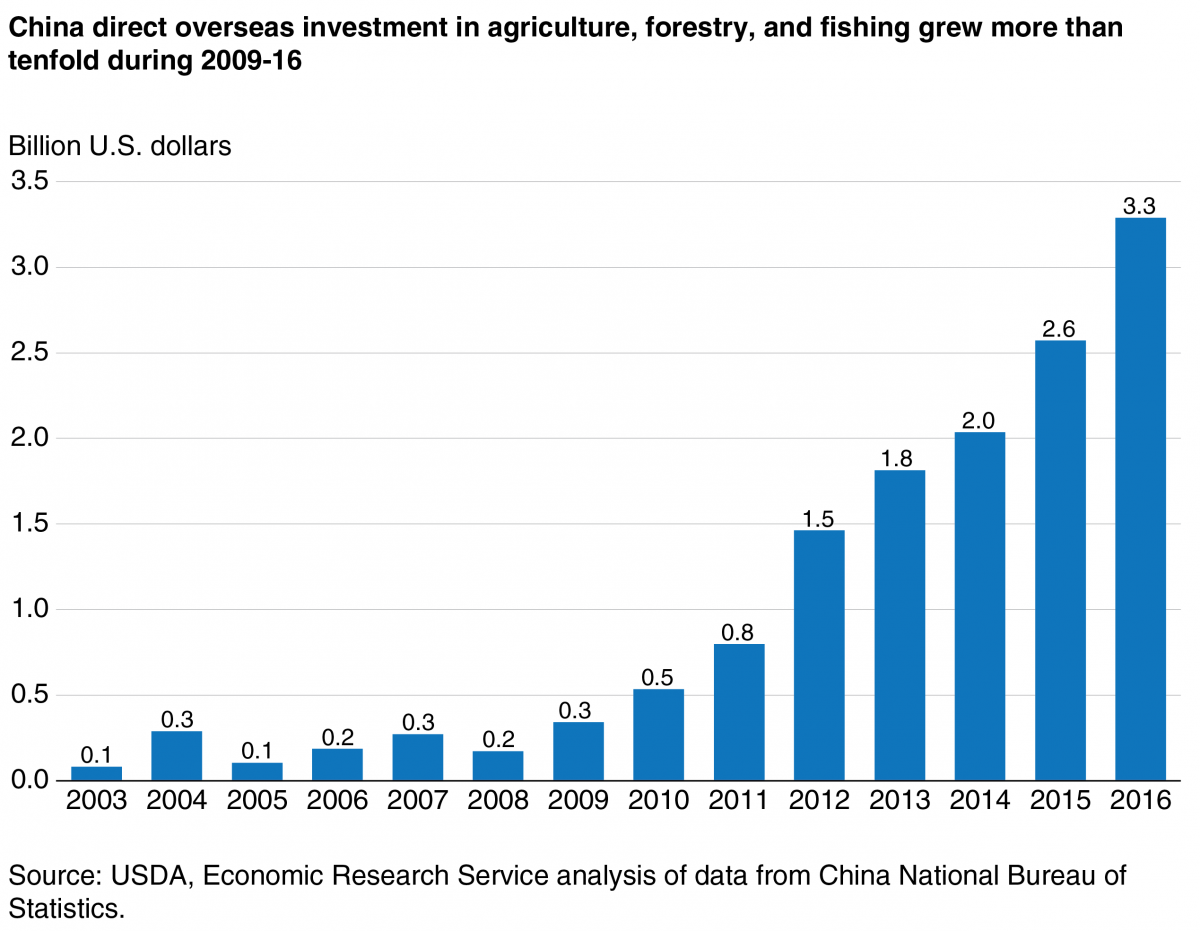
Indeed, China’s agricultural investments abroad have been growing steadily over the past decade, from USD 300 million in 2009 to USD 3.3 billion in 2016, most of it going to Asia (see chart below). Meanwhile, the Chinese chemicals giant ChemChina recently bought Swiss agrochemical giant Syngenta for CHF 43 billion.
If China and other countries expand global soybean production, that could exacerbate the negative environmental impacts of the global soy footprint. Soybeans are already a driver of deforestation in Brazil and Argentina. The area of land in South America devoted to soy more than tripled, from 17 million to 58 million hectares, between 1990 and 2015, mainly on land converted from natural ecosystems (FAOSTAT). Agriculture and changes in land use already account for about a quarter of global greenhouse gas emissions—a new wave of investment in soybean production outside the U.S. will lead to still more clearing of land, making matters worse.
What can be done to head off disaster? First and foremost, a trade war must be averted at all costs. But there are other opportunities for action. Governments in Africa and Asia could now act on the lessons learned from the last wave of foreign land investment. Reforms have already been introduced in many countries to reform corrupt or insider-driven business practices, and better represent the interests of people and the environment. New land laws in Mali and Benin provide a durable solution to land tenure insecurity in rural communities. Laos introduced a temporary moratorium on land investments in order to conduct a comprehensive inventory of deals and improve the legal framework for foreign investment.
China cannot meet its own soybean demand because of limited agricultural land and stagnant yields
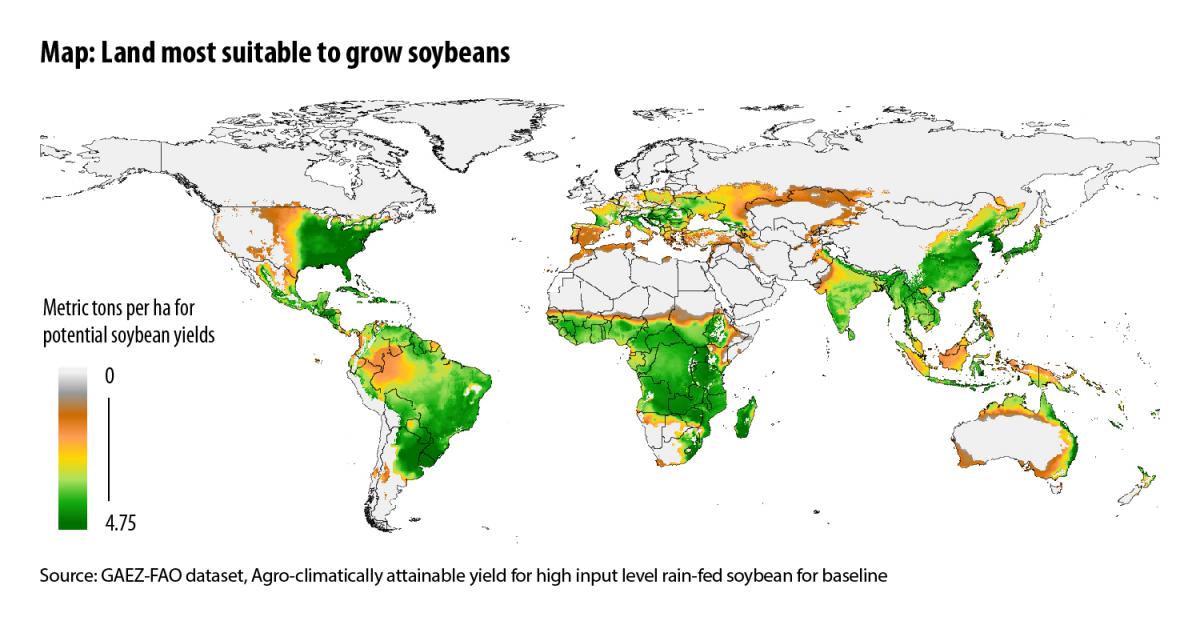
Indeed, as shown on the map below, several African countries could become the new frontier for soybean expansion, in particular in Central and Eastern Africa. This means that the new East African Community (EAC) model contract for farmland investments is highly relevant, as it strengthens the processes for managing environmental and social impacts, and for ensuring that women’s land rights are protected.
Finally, the threats posed by today’s trade tensions offer an opportunity to rethink current production and consumption patterns and reform food systems. For the sake of the environment and for global food security, meat and dairy consumption must be reduced in countries where the consumption is too high: essentially all industrialized countries. In addition, sustainable agricultural production methods such as reducing the use of chemical fertilizers and promoting the use of animal manure as natural fertilizer must be adopted. By taking such proactive steps, the world can build sustainable, more resilient food systems that can weather both the trade and climate upheavals.
Carin Smaller is Advisor on Agriculture and Investment at the International Institute for Sustainable Development (IISD).
Une guerre commerciale entre la Chine et les États-Unis pourrait-elle conduire à une nouvelle vague d'accaparement de terres agricoles ?
Une guerre commerciale se profile entre les États-Unis et la Chine. Le président Donald Trump a proposé d'instaurer des droits de douane sur plus de 1 000 produits importés de Chine.
La Chine a répliqué en annonçant qu'elle imposerait des taxes sur les importations américaines, dont les produits agricoles. S'ils poursuivent sur cette voie, la guerre commerciale qui en résulterait serait une catastrophe — et pas seulement pour ces deux pays. Quel serait l'impact sur la sécurité alimentaire et environnementale mondiale ?
Prenons l'exemple du soja, auquel la Chine menace d'appliquer une taxe d'importation de 25 %. Aujourd'hui, le soja est un produit omniprésent dans la chaîne alimentaire mondiale. Soixante-dix pour cent de la production de soja est destinée à l'alimentation des animaux, notamment des poulets, des porcs et des vaches, les producteurs répondant à la demande croissante de viande de la part des classes moyennes toujours plus nombreuses. Le reste est destiné à l'huile de cuisson, au biodiesel, aux produits oléochimiques et à d'autres produits alimentaires transformés.
L'agriculture et les changements dans l'utilisation des terres sont déjà à l'origine d'environ un quart des émissions mondiales de gaz à effet de serre - une nouvelle vague d'investissements dans la production de soja hors des États-Unis entraînera encore plus de défrichement, aggravant la situation.
Les États-Unis sont les plus grands producteurs et exportateurs de soja, tandis que la Chine est le plus grand importateur, important les deux tiers de l'ensemble des exportations américaines. La Chine ne peut pas répondre à sa propre demande en soja, ses terres agricoles étant limitées et ses rendements stagnants. Et pourtant, son appétit pour le soja est énorme : la Chine importe près de 100 millions de tonnes métriques par an, soit l'équivalent de 10 000 conteneurs par jour. Alors, que se passerait-il si les importations de soja en provenance des États-Unis étaient perturbées ?
Les changements dans l'approvisionnement du soja en Chine ont généralement des conséquences majeures sur le marché. Rien qu'en mars cette année, la Chine a acheté un tiers de soja de plus au Brésil que l'année précédente, faisant grimper les prix du soja brésilien. Si la Chine remplace les importations américaines de soja par des importations d'autres pays, leurs prix augmenteront. D'un autre côté, les États-Unis pourraient se retrouver avec un énorme surplus de soja, ce qui ferait baisser les prix sur le marché intérieur et/ou entraînerait du dumping sur d'autres marchés.
Historiquement, ce type de perturbation a eu des impacts à long terme sur les secteurs agricoles des pays concernés : lorsque l'administration Nixon a imposé un embargo sur les exportations de soja au début des années 1970, le Brésil et l'Argentine ont augmenté leur production pour combler l'écart, déclenchant une tendance qui se poursuit aujourd'hui.
Plus récemment, la crise des prix des produits alimentaires de 2008 a déclenché une ruée mondiale sur les terres. De nombreux pays importateurs de produits alimentaires ont perdu leur confiance dans la capacité des marchés mondiaux à approvisionner leurs populations de manière fiable, et les investisseurs étrangers et nationaux ont acquis de vastes surfaces de terres agricoles en Afrique et en Asie pour se prémunir contre l'incertitude future. Une guerre commerciale entre les États-Unis et la Chine pourrait relancer cette tendance déplorable. La Chine pourrait être contrainte de chercher de nouvelles frontières pour assurer sa demande en soja et protéger ses chaînes d'approvisionnement, ce qui conduirait à une autre vague de ce que l'on appelle communément « accaparements de terre ».
En effet, les investissements agricoles de la Chine à l'étranger ont augmenté de façon régulière au cours de la dernière décennie, passant de 300 millions en 2009 à 3,3 milliards de dollars américains en 2016, dont la plus grande partie est destinée à l'Asie (voir graphique ci-dessous). Entre-temps, le géant chinois de l'industrie chimique ChemChina a récemment racheté le géant suisse de l'agrochimie Syngenta pour 43 milliards de francs suisses.
.
Les investissements directs à l'étranger de la Chine dans l'agriculture, les activités forestières et la pêche, ont été multipliés par plus de dix entre 2009 et 2016
Source : USDA, analyse de données du service de recherche économique du bureau national des statistiques chinois.
Si la Chine et d'autres pays accroissent la production mondiale de soja, les impacts négatifs de l'empreinte mondiale du soja sur l'environnement pourraient s'aggraver. Le soja est déjà un facteur de déforestation au Brésil et en Argentine. La surface de terres consacrées au soja en Amérique du Sud a plus que triplé, passant de 17 millions à 58 millions d'hectares entre 1990 et 2015, principalement sur des terres converties à partir d'écosystèmes naturels (FAOSTAT). L'agriculture et les changements dans l'utilisation des terres sont déjà à l'origine d'environ un quart des émissions mondiales de gaz à effet de serre - une nouvelle vague d'investissement dans la production de soja hors des États-Unis entraînera encore plus de défrichement, aggravant la situation.
Que peut-on faire pour éviter la catastrophe ? Tout d'abord, une guerre commerciale doit être évitée à tout prix. Et il existe d'autres possibilités d'action. Les gouvernements d'Afrique et d'Asie peuvent désormais tirer les leçons de la dernière vague d'investissements fonciers étrangers. Des réformes ont déjà été instaurées dans de nombreux pays pour réformer les pratiques commerciales corrompues ou menées par des initiés. Ces réformes visent à mieux préserver les intérêts des personnes et de l'environnement. De nouvelles lois foncières au Mali et au Bénin apportent une solution durable à l'insécurité du régime foncier dans les communautés rurales. Le Laos a instauré un moratoire temporaire sur les investissements fonciers afin de dresser un inventaire exhaustif des transactions et d'améliorer le cadre juridique de l'investissement étranger.
La Chine ne peut pas répondre à sa propre demande en soja, ses terres agricoles étant limitées et ses rendements stagnants
En effet, comme le montre la carte ci-dessous, plusieurs pays africains pourraient devenir la nouvelle frontière pour le développement du soja, en particulier en Afrique centrale et orientale. Cela signifie que le nouveau Contrat type de la Communauté de l'Afrique de l'Est (CAE) pour les investissements en terres agricoles est très pertinent, dans la mesure où il renforce les processus de gestion des impacts environnementaux et sociaux et garantit que les droits fonciers des femmes sont protégés.
Carte : les terres les plus propices à la culture du soja
Source : ensemble de données de GAEZ-FAO, production atteignable agro-climatiquement pour du soja à haut niveau d'entrée arrosé par la pluie pour point de comparaison
Enfin, les menaces que représentent les tensions commerciales en cours offrent l'occasion de repenser les schémas actuels de production et de consommation et de réformer les systèmes alimentaires. Dans l'intérêt de l'environnement et de la sécurité alimentaire mondiale, la consommation de viande et de produits laitiers doit être réduite dans les pays où elle est trop élevée : pratiquement tous les pays industrialisés. En outre, des méthodes de production agricole durables doivent être adoptées, comme la réduction de l'utilisation d'engrais chimiques et l'encouragement à utiliser du fumier animal comme engrais naturel. En prenant de telles mesures proactives, le monde peut élaborer des systèmes alimentaires durables et plus résilients capables de résister aux bouleversements tant commerciaux que climatiques.
Carin Smaller est conseillère en agriculture et en investissement à l'Institut international du développement durable (IIDD).
The Federal Court of Canada and the End of Investor-state Dispute Settlement in NAFTA?
A recent Federal Court of Canada decision should spell the end of renegotiations on the investment chapter of NAFTA, and ignite a renegotiation of the investment chapters of other trade agreements.
May 4, 2018
A decision by Justice Anne Mactavish in the Federal Court of Canada yesterday should spell the end of the NAFTA renegotiation on the investment Chapter of NAFTA, and ignite a renegotiation of the investment chapters of the Canada-EU trade agreement and the Comprehensive and Progressive Agreement for Trans-Pacific Partnership (CPATPP).
This unusual connection arises because Justice Mactavish was ruling on a claim for judicial review of an arbitration award against Canada under the controversial Investor-State Dispute Settlement (ISDS) provisions in NAFTA’s Chapter 11 on investment. The legal question before Justice Mactavish was relatively narrow: under what circumstances could the Court overturn an arbitral award under NAFTA?
With the renegotiations of NAFTA now underway, Canada can simply support the US proposal to end the ISDS process in NAFTA and stop the risks to Canadians being created any further.
The arbitration, Bilcon v. Canada, arose after a proposed quarry in Nova Scotia was rejected by Ministers on the basis of a recommendation by a joint federal-provincial environmental assessment panel. The joint panel had found the proposal would create harm that was simply beyond mitigation, and it should therefore be rejected. Federal and provincial ministers agreed and nixed the proposal. The company, Bilcon, based in Delaware, took this decision to the NAFTA ISDS process instead of the Canadian court system. They won their claim in 2015, on the basis that the decision was arbitrary and discriminatory and contrary to NAFTA’s required fair and equitable treatment of potential foreign investors. The majority decision ruled, along the way, that the approach of the joint review panel was in breach of Canadian law, a key part in their reasoning.
It is widely acknowledged that the arbitration decision raised serious concerns. Indeed, these concerns were so serious that the Harper government, Canada’s most environmentally unfriendly government of all time, took the unusual step of seeking judicial review of the award before the Federal Court of Canada. The most critical element in Chapter 11 terms was the interpretation of what is called fair and equitable treatment under Article 1105 of NAFTA. The result of the interpretation was seen as turning back environmental law by decades, according to the dissenting arbitrator, Prof. Donald McRae, one of the world’s most respected arbitrators.
Judge Mactavish put her concerns as follows: “I accept that the majority’s Award raises significant policy concerns. These include its effect on the ability of NAFTA Parties to regulate environmental matters within their jurisdiction, the ability of NAFTA tribunals to properly assess whether foreign investors have been treated fairly under domestic environmental assessment processes, and the potential “chill” in the environmental assessment process that could result from the majority’s decision.” This is an extraordinary assessment for a federal court judge to make. And then say she can do nothing about it because the ability of courts to review arbitration awards is remarkably constrained under federal arbitration law. This opens the door for a final award of damages against Canada, claimed at over 400 million dollars by the company for a quarry that was never built.
This decision marks the end of any pretense that the investment chapters of CETA or the CPATPP are more environmentally friendly, or more protective of the right to regulate, than NAFTA or other prior treaties. This is because the language on fair and equitable treatment for investors in those treaties is the same language used by the arbitration tribunal in Bilcon to establish the scope of fair and equitable treatment under NAFTA. While the language in NAFTA is different from that in CETA and CPATPP, the test to apply NAFTA is precisely the same as the text now in CETA. Consequently, the CETA and CPATPP texts present the exact same risks as NAFTA does, as set out by Justice Mactavish. And they will now broaden those risks to environmental protection and other public interest law making exponentially by extending this protection to European and Asian investors into Canada to challenge new laws and the application of existing laws.
Sadly, both the Conservative and Liberal governments knew of this risk before finalizing the text. The Bilcon arbitration decision was out long before CETA and CPATPP were finalized. The fact the same language appeared in the Bilcon decision and in the CETA was well noted by government lawyers and negotiators, who simply refused to make the necessary changes. Arbitration decisions, no matter how much mischief they can cause, are simply overwhelmingly difficult to overturn after the fact.
There is not even a fig leaf left now to argue that the investment chapter is better for environmental protection and the right to regulate than NAFTA. Linguistic sophistry in post negotiation statements extolling the values and virtues of the agreement does not override the actual text of the agreements.
With the renegotiations of NAFTA now underway, Canada can simply support the US proposal to end the ISDS process in NAFTA and stop the risks to Canadians being created any further. For CETA and CPATPP, there are opportunities still to reopen negotiations before the texts are ratified by all parties and enter into force. The Investment Court system in CETA does not change this need: the process does not alter the fact that bad law in will still equal bad law out. The issue at hand is about the bad law in.
Canada continues to call for progressive trade and investment agreements. The time is ripe to act in relation to NAFTA, CETA, CPATPP and other ongoing negotiations. The Federal Court of Canada has, if nothing else, driven home that point.
Electric Vehicles vs. Fuel-Efficient Used Cars: Which really drives sustainability?
Debates surrounding the merits of electric vehicles versus fuel-efficient used cars have typically focused on carbon emissions and energy use only—but what of the conflict implications?
April 18, 2018
It finally happened.
Your 1995 Honda Civic hatchback broke down after 23 reliable years of week-long road trips, 8:00 AM traffic jams and carpools to the cottage.
It’s time to move on to a new car—but which model will contribute to a more sustainable future?
The obvious path to a low-carbon future seems to be via electric vehicles (EVs). EVs fall directly in line with the United Nation’s global Sustainable Development Goals (SDGs), especially SDG 7: Clean energy. But to truly understand the global consequences of each car, all aspects of sustainability need to be addressed, including SDG 16: Peace and justice.
Electric vehicles are projected to make up 54 per cent of new car sales by 2040.
First, let’s look at the energy consequences of EVs and fuel-efficient used cars.
In the past decade, EVs have been accelerating in popularity and demand, and are projected to make up 54 per cent of new car sales by 2040. The United Kingdom and France have both announced they will ban the sale of diesel- and gasoline-fuelled cars by 2040, pivoting to EVs to curb the flow of carbon emissions. The private sector is also along for the ride, with companies like Ikea, Metro and Unilever joining up for the EV100 initiative, to encourage global business commitments to electric transport.
But what about fuel-efficient used cars?
In 2008, Wired wrote that a fuel-efficient used car may ultimately be better for the environment than a hybrid, due to the sheer amount of energy required to produce EVs and hybrid cars. A Toyota Prius, for example, wrote Wired, consumes the equivalent of 1,000 gallons of gasoline in its construction. For used cars, this “carbon debt” has already been paid.
Cobalt, aluminum, manganese, nickel and lithium have all been identified as critical raw material inputs for the EV market. Unfortunately, the places they are found are often mired in conflict.
And just last year, a European Union study found that it takes more energy to generate and transport electricity to the EVs then it does to extract and transport petrol to fuel-powered cars. (However, once in the car, an EV uses considerably less energy to move itself and its passengers—thereby being more energy-efficient overall).
These arguments for and against electric vehicles and gasoline-powered used cars are fuelled by their respective implications for the global carbon footprint. But discussions of sustainability, as we are all becoming increasingly aware, are not limited to the environment.
Powering EVs requires rechargeable batteries, and rechargeable batteries require raw materials. Cobalt, aluminum, manganese, nickel and lithium have all been identified as critical raw material inputs for the EV market. Unfortunately, the places they are found are often mired in conflict.
Cobalt, for example, is linked to child labour and ongoing armed conflicts in the Democratic Republic of Congo (DRC). Demand for cobalt has surged in the last decade, due to its use in smartphones and electronics. About 50 per cent of global cobalt reserves are located in the DRC, and many cobalt mines are run by violent armed groups.
The increased extraction of nickel, another key mineral for EVs, also has links to violence; in Guatemala, military and private security personnel linked to mining companies have been accused of murder, violence and rape against local communities.
Beyond the DRC and Guatemala, protest and conflict associated with nickel, lithium, manganese and more have been recorded in Bolivia, India and the Philippines, to name only a few.
But that doesn’t mean we have reached the end of the road for the prospect of a conflict-free EV.
In Guatemala, military and private security personnel linked to mining companies have been accused of murder, violence and rape against local communities.
Global regulations and guidance have been put in place by governments, the private sector and non-governmental organizations to address the contested extraction of strategic minerals, and many apply to those minerals and metals required for EVs. This week alone, more than 700 stakeholders are coming together for the OECD’s Forum on Responsible Mineral Supply Chains to discuss initiatives to enable conflict-free mineral production and sourcing. Included in the agenda for discussion: cobalt.
While the debate over EVs and fuel-efficient used cars is far from solved, one thing is certain: to decide how sustainable a car is, we need to look at its links to conflict and not just its carbon footprint.
What do you think? Tweet your opinions on EVs vs. fuel-efficient used cars to @IISD_Resilience with the hashtag #SustainableCars and we’ll post your thoughts below!
We break down four common myths about renewable energy and carbon pricing, proving that the latter is a smart mechanism to control pollution and promote the shift to a prosperous, low-carbon economy.
April 17, 2018
“Fossil fuels are so much cheaper than renewable energy!”
“Renewable energy destabilizes the electricity grid!”
“Carbon pricing is just a way for a government to place a tax on everything!”
This blog post breaks down four common myths about renewable energy and carbon pricing.
Facts are facts and, as you will learn, the truth is that renewable energy is cheap and effective and that carbon pricing is a smart way to control pollution and promote the shift to a strong, low-carbon economy.
MYTH #1: "Renewables cost more than fossil fuels."
You have likely heard this one before—some version of a statement that natural gas and coal are so cheap that renewables don’t make sense and will only cause us to pay more for our energy.
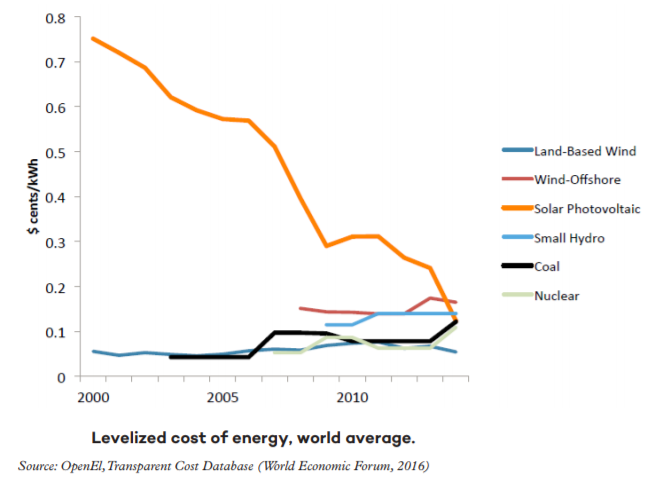
REALITY: This may have been true a decade ago, but not anymore. The cost of global renewables, (especially solar power) is plummeting (Figure 1) to the point where they now are on par with each other. Meanwhile, the cost of coal power is increasing around the world, as carbon pricing places a true cost on the pollution and health impacts from burning coal.
Figure 1: Levelized cost of energy, world average
Furthermore, the fossil fuel sector’s dirty secret is that it is massively subsidized, which is part of the reason why fossil fuels are cheap. In Canada alone, over CAD 3 billion in subsidies support the production of oil and gas (Figure 2). Without these subsidies, the true cost of fossil fuels is actually much higher. What’s worse: these subsidies are paid with public money coming out of your pocket that could be better used to support clean energy, hospitals, schools, or just given back to you in lower taxes.
MYTH #2: "Renewables will destabilize the electricity grid."
This argument holds that if there are too many intermittent renewables on the grid, utilities will be unable to meet demand—for example, during peak times, if the wind doesn’t blow or the sun doesn’t shine.
REALITY: While it is true that renewable energy is intermittent, the more you build across a wider area, the better your odds are of getting strong average production. The sun is always shining somewhere, and the wind is always blowing somewhere. Besides, there are also battery technologies to store energy, as well as more predictable renewables such as hydropower, where water can be held back to support times of peak production, and biomass, where as long as you secure supply, you can always keep the lights on. Hydroelectric systems dominate energy storage capacity worldwide.
MYTH #3: "Carbon pricing doesn’t work."
This myth takes one of two forms: either 1) carbon pricing doesn’t reduce emissions at all, or; 2) it only reduces emissions if a carbon price is several hundred dollars per tonne.
REALITY: Quite simply, this is wrong.
Multiple academic studies show that carbon pricing does work, even at relatively low levels. Several of these studies have looked at the carbon tax in British Columbia, Canada, and shown marked improvement in per capita fuel consumption and reduction in greenhouse gasses since the carbon price came in. In addition, the performance of the province’s economy has outpaced the Canadian average since the carbon price was instated, further busting the myth of the "job-killing carbon tax."
Facts are facts and the truth is that renewable energy is cheap and effective, and that carbon pricing is a smart way to control pollution and promote the shift to a strong, low-carbon economy.
Besides, saying we shouldn’t implement a carbon tax just because it will only be a low rate and have a small initial impact is akin to saying "I have to train for a marathon, so there is no point in running a 5k." We have to start somewhere.
MYTH #4: "A carbon tax is just another tax on everything."
The misconception here is that a carbon tax will just make everything more expensive.
REALITY: The truth is that a carbon tax is a progressive tax, and an avoidable one at that. You can avoid or reduce paying a carbon price by driving less or buying a more fuel-efficient vehicle or keeping your thermostat at 19°C instead of 23°C.
In many jurisdictions, such as British Columbia and Alberta, residents have benefitted from associated tax rebates and reductions to the point that the average person actually pays less tax than they did before the carbon tax came into place, and, as mentioned above, they can now control how much they pay.
In British Columbia, the government lowered income tax rates to offset the impact of the carbon tax. You can avoid a carbon tax by buying less gasoline—you can’t avoid paying your income tax. Finally, a carbon price also focuses on raising prices on things that are bad (pollution) and can make things that are good (income, jobs, renewable energy) more affordable, depending on how the revenue is spent.
Healthy Lives and Well-being for Everyone: Why SDG 3 matters and how we can achieve it
Creating a sustainable world—and reaching economic, environmental and social goals—depends on having a thriving and healthy human population. We explore how Sustainable Development Goal 3 plans to achieve that.
April 6, 2018
Creating a sustainable world—and reaching economic, environmental and social goals—depends on having a thriving and healthy human population.
However, even the most cursory glance at figures pertaining to human health reveals a world where grave inequalities result in massive disparities when it comes to access to basic health care, and where easily treatable diseases still claim far too many lives in many corners of the globe.
Let’s start at birth. In 2015, there were approximately 303,000 maternal deaths worldwide, most from preventable causes. Maternal health conditions were also the leading cause of death among girls aged 15-19 in that year.
Infant mortality rates—along with many other health-related issues—can also expose inequalities within nations. In Canada, for example, while the average mortality rate is around 5 deaths per 1,000 live births, it reaches as high as 16 deaths per 1,000 live births in Nunavut—a region where 85 per cent of the population is Indigenous.
In 2015, there were approximately 303,000 maternal deaths worldwide, most from preventable causes.
Around the world, more than 6 million children still die before their fifth birthday each year, with four out of five of those deaths occurring in sub-Saharan Africa and Southern Asia. Rates of poverty and the level of the mother’s education are key factors that affect the likelihood of a child making it past the age of five.
When it comes to communicable diseases, at the end of 2013, there were an estimated 35 million people living with HIV worldwide. In fact, 240,000 children were newly infected with the disease that year.
While the rates of malaria are falling globally, the recent resurgence of ailments such as measles and the Zika virus reminds us that there are always potential health crises around the corner for which we may not be equipped—with the Global South often most at risk.
A Global Approach to Worldwide Problems
When world leaders adopted the Sustainable Development Goals, they signed on to a goal (SDG 3) that aims to "ensure healthy lives and promote well-being for all at all ages."
The Millennium Development Goals (MDGs), which provided a global framework for development from 2000-2015, and dedicated a hefty 3 out of 10 goals to global health issues (child mortality; maternal health; HIV/AIDS, malaria and other diseases).
The targets under SDG 3 have an even greater scope than those three MDGs combined. Furthermore, given the integrated nature of the sustainable development approach, many of the other SDGs, such as Goal 1 (“end poverty”), Goal 2 (“end hunger”) and Goal 6 (“ensure access to water”), are strongly tied to—and have an impact on—human health issues.
The recent resurgence of ailments such as measles and the Zika virus reminds us that there are always potential health crises around the corner for which we may not be equipped—with the Global South often most at risk.
Many of the SDG 3 targets are dedicated to tackling pressing issues surrounding maternal health and child mortality rates, which continue to affect much of the Global South in particular. The ambition of those targets reflects the urgency of the work at hand, and the desire of the international community to continue their work on the unfinished business in the MDGs. By 2030, Target 3.2 aims to “end preventable deaths of newborns and children under 5 years of age,” and Target 3.1 is to “reduce the global maternal mortality ratio to less than 70 per 100,000 live births.”
Other targets reflect the universal nature of the SDGs. They touch on everything from universal health coverage and tobacco control to reducing the number of deaths due to road traffic accidents and substance abuse—issues that are widespread in countries at all stages of development.
Both developed and developing countries have work to do to ensure healthy lives and promote well-being for all of their citizens, including addressing policies on universal access to health coverage and populations’ relationships with alcohol and narcotics.
Towards a Healthier Future
The global community has already made significant progress in key areas of human health. Despite the still-high figures of maternal mortality, the United Nations reports it has actually fallen by almost 50 percent since 1990. In Northern Africa and Southern and Eastern Asia, maternal mortality has also been reduced by around two-thirds.
SDG 3's targets touch on everything from universal health coverage and tobacco control to reducing the number of deaths due to road traffic accidents and substance abuse—issues widespread in countries at all stages of development.
17,000 fewer children die each day than in 1990—some of which can be attributed to increased access to vaccinations. For example, since 2000, the United Nations reports that measles vaccines have prevented almost 15.6 million deaths globally.
When it comes to treating HIV, at the end of 2014, 13.6 million had access to antiretroviral therapy, and new HIV infections in 2013 were estimated at 2.1 million—38 per cent lower than in 2001.
These achievements point to the value of international goals—the MDGs—in focusing global efforts on shared objectives. The SDGs continue, and widen the scope of actors and efforts, in order to ensure that no one is left behind due to lack of access to health care and healthy lifestyle options.
Asbestos: How it endangers human health and why a worldwide ban is needed
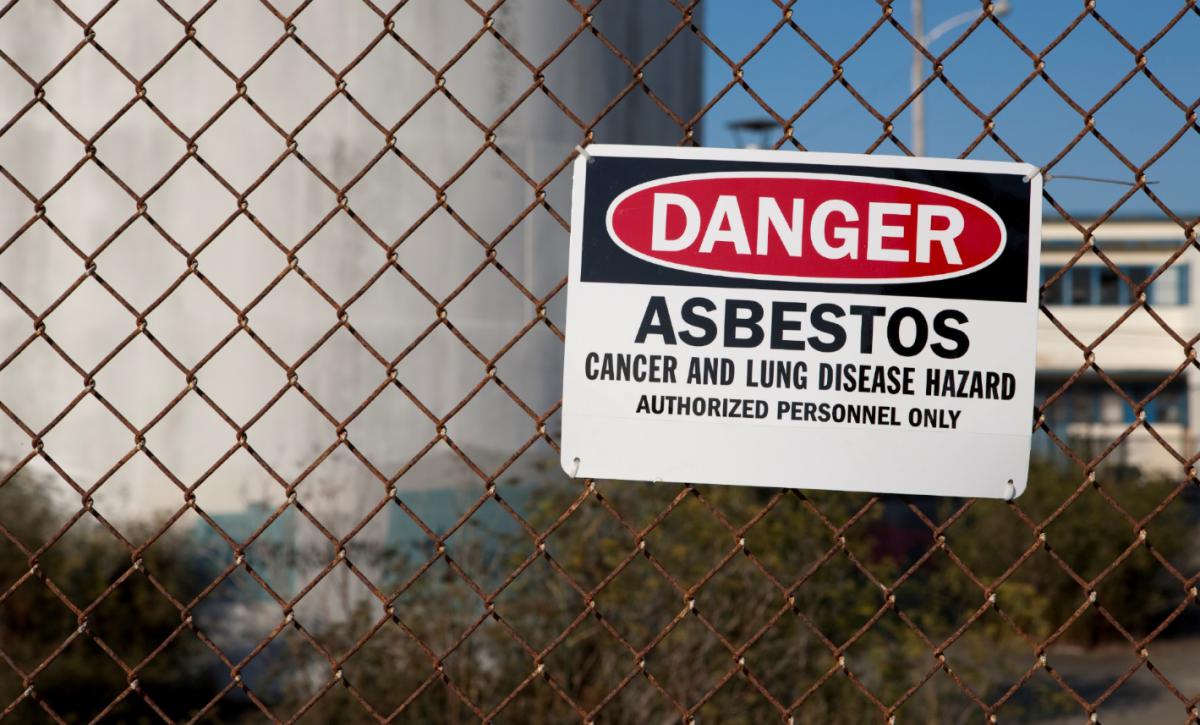
About 125 million people worldwide are exposed to asbestos at the workplace, resulting in roughly 107,000 occupational exposure deaths annually. In this guest article, Mesothelioma Cancer Alliance explores how it endangers human health and why a worldwide ban is needed.
April 2, 2018
According the World Health Organization, about 125 million people worldwide are exposed to asbestos at the workplace, resulting in roughly 107,000 occupational exposure deaths annually.
The numbers are staggering and hide the fact that mesothelioma, caused by asbestos exposure, is one of the world’s leading occupational cancers and is likely to stay that way in the near future.
Iceland was the first country to ban all uses of asbestos in 1983, and since then more than 60 countries have also taken action, preventing new applications and uses of the mineral. In the face of a slowly growing worldwide movement, there is a growing divide between countries still using the mineral and those that are not.
The Issue
Asbestos is a silicate mineral known for its high tolerance to heat and tensile strength. Although people have been mining the mineral for thousands of years, it wasn’t until the industrial boom of the late 1800s and early 1900s that asbestos use soared. In the years since, the mineral has been added to building materials and consumer goods that may come into contact with high heat.
But asbestos poses a variety of health burdens that countries are still dealing with today, despite some having bans in place for two decades or more. While prohibiting the mineral’s application has prevented future uses, it doesn’t do much of anything to address the millions of tons of asbestos still housed in building materials and other products around the world. It’s likely that the industrialized world still hasn’t seen a peak in cases, mainly due to the disease’s 10-50 year latency period.
According the World Health Organization, about 125 million people worldwide are exposed to asbestos at the workplace, resulting in roughly 107,000 occupational exposure deaths annually.
Worldwide Problem
Despite calls from asbestos producers that it be can mined and used safely and responsibly, their actions and words don’t address the underlying fact that mesothelioma is still a problem for the general public and for those working with the mineral. In the United States alone, where asbestos use has fallen to only about 300 tons in 2017, there are still an estimated 2,400 to 2,800 people who will be diagnosed with mesothelioma annually.
For countries still mining, producing and importing the mineral, the costs could be even more catastrophic. Russia, China, and Kazakhstan produced more than one million tons of asbestos in 2017, while other countries like China and India have increased imports due to the need for more infrastructure and buildings. These countries also tend to keep poor mesothelioma registries and may underreport the number of case they diagnose each year, providing inaccurate and incomplete data. While mesothelioma incidences are expected to peak before the year 2030 in developed countries, others still producing and using the mineral will see cases continue for much longer.
Sweden was one of the first countries to ban the use of asbestos in 1983, and as a result has seen mesothelioma rates decrease over time. The problem is that although the developed world has taken steps to limit the mineral’s use or discontinue it altogether, developing countries are relying on it in greater amounts to bolster their emerging infrastructure.
In the United Kingdom, where asbestos has been banned since 1999, the Health and Safety Executive cited more than 2,500 mesothelioma deaths in 2015. The number is expected to hold steady for several more years before dropping near the year 2030.
Future Steps
Last year, signatories for the Rotterdam Convention came together to discuss the future of chrysotile asbestos, the only form of asbestos not currently banned by the treaty. Although a resounding majority of countries involved with the treaty agreed to a full ban, several holdouts, including Russia and India vetoed the measure. Even with resounding support, a single veto is all it takes to derail a measure. The result is that producers and users alike will continue exposing workers and the general public to a known carcinogen, eventually leading to a disease for which there is no known cure.
Sustainable Development Goal 3 seeks to “ensure healthy lives and promote well-being for all at all ages” and target 3.9 looks to “by 2030, substantially reduce the number of deaths and illnesses from hazardous chemicals and air, water and soil pollution and contamination.”
An effective worldwide ban on asbestos would do a lot to achieve that goal.
There is no denying the fact that asbestos exposure isn’t good for human health, and we’ve known about the health risks it poses for decades, but with so many viable alternatives entering the market in recent years there is no real need to rely on it today. More countries are walking away from its use, including Canada, which has promised a full ban this year, and Brazil, which issued a full ban of its own late last year, removing two producers from the global market.
Sustainable Development Goal 3 seeks to “ensure healthy lives and promote well-being for all at all ages” and target 3.9 looks to “by 2030, substantially reduce the number of deaths and illnesses from hazardous chemicals and air, water and soil pollution and contamination.” An effective worldwide ban on asbestos would do a lot to achieve that goal.
There is a global need for some kind of action to protect our own well-being and the lives of future generations. Mesothelioma is likely to remain a leading cause of occupational cancer in the near future, but even if new applications of asbestos are prohibited the world will still have to contend with the countless tons of the mineral already in use. Although it’s unlikely a global ban of the mineral’s use will have an immediate impact on asbestos-related disease rates, as we move into the future the results will come into focus. Early adopters like Sweden are already seeing declines, and other countries are expected to see similar results in the coming years.
There are cost-effective alternatives on the market today having many of the same attributes as asbestos but are much safer to handle. The hope is that as more countries take action, pressure will mount on other developed and developing nations to do the right thing and be mindful of the dangers exposure causes. While it’s impossible to prevent all asbestos exposure in the environment, we can all take steps to drastically reduce the number of people dying from this rare and debilitating disease.
This is a guest article from the Mesothelioma Cancer Alliance—a trusted information resource for individuals who have been diagnosed with mesothelioma and for their families.
Ensuring Access to Water and Sanitation for All: What SDG 6 wants to achieve and why it matters
This World Water Day, we take a look at Sustainable Development Goal 6 ("ensure access to water and sanitation for all") and explain what it is meant to acheive, and why it matters.
March 21, 2018
Many of us take water—the world’s most essential element—for granted.
Sadly, a quick look at how Cape Town is coping with an ever-intensifying water crisis is a stark reminder of how critical this resource is to our daily lives.
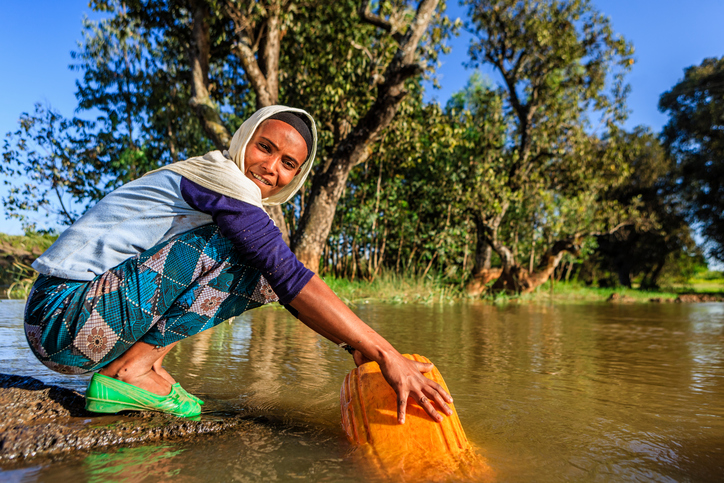
Water scarcity affects more than 40 per cent of the world, and that number continues to rise. In fact, a recent report from the UN warns that water shortages could affect 5 billion people by 2050.
Today, almost 2 billion people drink water contaminated by faeces, and even more people lack access to basic sanitation facilities such as toilets or latrines.
Oceans and lakes across the planet are plagued by challenges such as algal blooms, invasive species and pollutants like mercury, selenium and microplastics.
With forces such as climate change, population growth, pollution and competition for resources intensifying, the need to develop solutions to ensure clean and accessible water has never been more urgent.
Water and Sanitation for All
The Sustainable Development Goals (SDGs) aim to address these issues, not only with a focus on water and sanitation in SDG 6 but through related targets in many other goals. SDG 6 encompasses targets that seek to address everything from water quality issues, pollution and the efficiency of water usage to how water is managed, and the role of all players from international governments to local communities.
A recent report from the United Nations warns that water shortages could affect 5 billion people by 2050.
The Millennium Development Goals—the precursor to the SDGs—addressed water and sanitation as a subset of the goal to “ensure environmental sustainability.” The critical importance of clean and accessible water for health, productivity and the environment is demonstrated by the fact that has an SDG goal dedicated solely to its promotion.
The SDGs are also a universal agenda, applying to all countries regardless of income or development status. This means that it is critical for countries like Canada—the country with the greatest access to fresh water in the world—and the United States to consider how they manage and govern their water resources.
Water scarcity affects more than 40 per cent of the world, and that number continues to rise. In fact, a recent report from the UN warns that water shortages could affect 5 billion people by 2050.
Furthermore, SDG 6 calls for both developing and developed countries to consider access to water for their citizens. Notably, Canada, with its vast reserves of fresh water, still maintains boil-water advisories for some 100 Indigenous communities.
For example, Target 6.B calls for countries to “support and strengthen the participation of local communities in improving water and sanitation management.” Projects like empowering citizen science and working with Indigenous communities in northern Canada, give communities and individuals an opportunity to understand and protect their water supplies.
Similarly, Target 6.5 aims to “implement integrated water resources management at all levels, including through transboundary cooperation as appropriate.” An example of this is IISD’s work in the Lake Winnipeg basin, which spans provincial, state and international boundaries. We are working to integrate the process of watershed management, while addressing environmental and socioeconomic concerns in the basin through innovative landscape management, policies and programs—throughout the Canadian prairies and northern US states.
Researchers at IISD Experimental Lakes Area have been researching the effect of major pollutants on freshwater systems for the last 50 years.
Positive progress
Achieving the SDGs' water-related goals and targets is within reach. Recent statistics from the United Nations show that over 90 per cent of people worldwide use improved drinking water sources. However, these sources were not always managed safely, and sub-Saharan Africa and Oceania still bear the brunt of that inequality.
Plans for the integrated management of water resources are under way in countries in every region (65 per cent of 130 countries in 2012). Even so, implementation varies across regions, with western Asia, Latin America and the Caribbean, and sub-Saharan Africa still at the earlier stages.
The High-level Political Forum on Sustainable Development is the United Nations’ main platform on sustainable development, and regularly assesses and reports on the progress of the Sustainable Development Goals. It also encourages member states to do the same—known as “voluntary national reviews.” It next meets in July, where it will report on the status of several SDGs, including SDG 6.
Find more news and information on SDG6 at the SDG Knowledge Hub. Or learn more about IISD’s work to advance water policy and programming solutions.
Five Steps We Must Take to Protect Refugees in the Future
This year, a new reality, based on a new international paradigm regarding refugees futures, must emerge. Here are five steps that need to be set in motion to make this happen.
March 16, 2018
Climate change is already having a profound effect on global migration and displacement.
It could potentially create "the world's biggest refugee crisis," according to a recent study by the Environmental Justice Foundation. The study estimates that the number of climate refugees threatens to dwarf the number that has fled the Syrian conflict.
This year, a new reality, based on a new international paradigm regarding refugees, must emerge.
The result of climate impacts like floods, droughts and water shortages will be a series of retreats and movements to seek safety and better livelihoods. Those who find sanctuary inside their own land become internally displaced persons (IDPs). Those who cross borders to a different jurisdiction cannot claim refugee status as they are not fleeing political persecution, a definition given sacred rites that can be traced to the specific circumstances of post-World War II Europe.
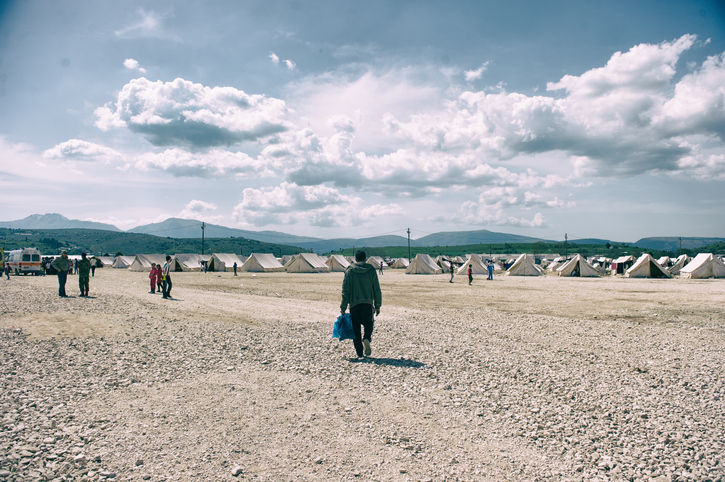
The system we currently have in place for dealing with migrants and refugees is under severe strain; it is struggling to address the needs of millions of people on the move. It is disturbing to note that efforts to draft a treaty or a protocol to cover this new surge are not a high priority among environmental organizations, like-minded governments and counterparts looking at reforms to the refugee and migration situations.
The system we currently have in place for dealing with migrants and refugees is under severe strain; it is struggling to address the needs of millions of people on the move
The United Nations has major negotiations underway, but the talks currently exclude the situation of IDPs or "crisis refugees." There is a fear that if the 1951 Convention definition of a refugee is opened up for discussion, the forces of anti-immigration and supra-nationalism that are so prevalent in many countries at the moment will lead to a deeper erosion of the existing system.
Some brave attempts are being made to offer global protection for the many millions deprived of any state standing. Michael Doyle of Columbia University has drafted a new treaty to include any and all seeking sanctuary. The New Zealand government is considering creating a visa category to help relocate Pacific peoples displaced by climate change. The World Refugee Council has put the plight of IDPs on its agenda for formulating a more substantive reform of the refugee system.
But so far such efforts lack critical political support. This further strengthens the case that environmentalists and those dedicated to fair refugee reform should urgently join efforts and create a political base to pursue a common-sense reform.
As the United Nations General Assembly prepares to vote on a draft Global Compact for Refugees, several steps need to be set in motion.
First, fix the financial gap in the UN system by changing the budgeting architecture of the UN Refugee Agency to be aligned with the other main UN agencies that deliver front-line services. Pledges are currently out of proportion to today's increasing refugee problems. The UN Refugee Agency needs a budget based on more predictable and binding assessed country contributions, in line with the World Health Organization or UN Environment.
Second, begin drafting a new legal treaty in which the definition of refugees reflects the reality of this century. This treaty must infer clear rights and obligations of countries to meet international security, human rights and other standards in their treatment of refugees. The new architecture of the Sustainable Development Goals shows that the UN can deliver a new generation of international agreements based on an inclusive, transparent and bottom-up approach.
Third, establish a robust review mechanism to hold countries accountable for their actions. The international environmental legal regime provides a useful model. The Montreal Protocol, the world's most successful environmental treaty, has saved millions of lives from cancer by coordinating the phase-out of harmful chemical pollutants. The review mechanism was never intended to name and shame, but instead to identify country non-compliance and provide scientific, technical and financial support to close gaps.
This year, a new reality, based on a new international paradigm regarding refugees, must emerge.
Fourth, make digital platforms and technologies like blockchain and digital money part of the solution. The UN and the World Bank are looking at how to provide digital IDs to over 1 billion people who currently lack basic identification. Companies such as Microsoft and Alibaba are creating new virtual systems so that refugees have immediate access to bank accounts and other identification. Banking apps in remote rural areas are enabling thousands who have never had a bank account, especially women, to set up accounts and find working capital. These examples show an innovative way forward.
Finally, as the multilateral trade system faces a deepening crisis, there is growing interest in embedding sustainability within global value chains—from fair trade coffee to palm oil that avoids deforestation and provides a fair return for small-scale farmers. This system needs to look at refugees beyond current remittances, to how a new generation of global value chains can support income to migrants.
As middle powers that have sponsored successful international reform efforts in the past, Denmark and Canada both need to take leading roles in reforming how the UN system supports refugees. As Denmark looks for its seat on the UN Human Rights Council in 2019, and Canada seeks a seat on the UN Security Council in 2020, both would be emboldened by taking common leadership on these issues.
Lloyd Axworthy, former Minister of Foreign Affairs for Canada and a member of the IISD Board, now chairs the World Refugee Council. Scott Vaughan is the president-CEO of IISD, and was previously Canada’s Commissioner of the Environment and Sustainable Development.