Building Back Better Is the Right Thing to Do. It Also Makes Good Economic Sense.
Canada must focus on building back better in order to set us on a path toward net-zero emissions and even greater economic growth.
May 4, 2020
Like its G20 peers, the Government of Canada has swiftly implemented significant relief measures in response to the COVID-19 pandemic. The initial wave of rescue spending has, as it rightly should, focused on keeping businesses and people alive.
Decision-makers in Ottawa have made smart decisions already, choosing to invest in environmental clean-up and emission reduction projects that put people to work while having a positive impact on the environment.
But what happens next, in the recovery phase of stimulus spending, could either lock us into a system from which there is no escape or set us on a path toward net-zero emissions and even greater economic growth, a finding reinforced by a new report released today.
A new study finds that "recovery packages that seek synergies between climate and economic goals have better prospects for increasing national wealth."
The study, released by leading economists including Nobel Prize winner Joseph Stiglitz and acclaimed climate economist Nicholas Stern, finds that “recovery packages that seek synergies between climate and economic goals have better prospects for increasing national wealth.”
Building back better makes economic sense
The researchers catalogued over 700 stimulus policies into groups and completed a survey of 231 experts from more than 50 countries, including senior officials from finance ministries and central banks. Based on the survey results as well as lessons from the 2008 financial crisis, the economists found that “green projects create more jobs, deliver higher short-term returns per dollar spend and lead to increased long-term cost savings, by comparison with traditional fiscal stimulus.”
The report zeroes in on five policies that can have a large return on investment, be enacted quickly, and have a strongly positive impact on climate. These are:
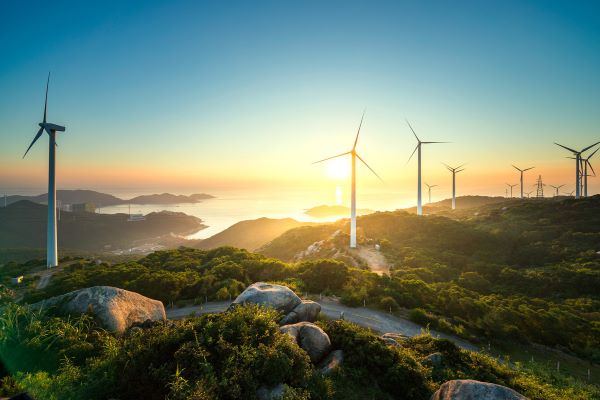
Investment in renewable energy production, such as wind or solar
Building efficiency retrofit spending
Clean research and development spending
Natural capital investment for ecosystem resilience and regeneration
Investment in education and training to address immediate unemployment from COVID-19 alongside unemployment from decarbonization.
For Canada, these findings are especially relevant, given the collapse in oil prices and the pressure from industry groups to loosen requirements on federal infrastructure spending. But as today’s report shows, a smarter economic recovery is one that delivers both immediate and long-term economic and environmental benefits.
Today’s report underscores the fact that governments can tackle the global economic shock of COVID-19 while simultaneously addressing climate change.
In addition to the substantially higher job-creation effects of investing in green infrastructure and renewable energy, the report notes that green economic recovery investments have stronger longer-term economic multiplier effects, notably in investing in high-productivity economies of the future.
Today’s report underscores the fact that governments can tackle the global economic shock of COVID-19 while simultaneously addressing climate change. It reinforces the recent economic advice of the International Monetary Fund that all governments should embrace a green economic recovery, as well as yesterday's statement by financial institutions about keeping a razor-sharp focus on scaling up investments in low- and zero-carbon pathways.
The choices we make now can set the course for a more prosperous and sustainable future. That choice is ours, Canada.
We Can Prevent a COVID-19 Hunger Crisis if We Look Back and Learn
The world now faces the risk of a dramatic rise in hunger, barely 12 years after the devastating food price crisis. What can be learned from the past?
May 4, 2020
With the global economy reeling from COVID-related measures, the world now faces the risk of another dramatic rise in hunger, barely 12 years after the devastating food price crisis of 2007–2008.
As societies prepare themselves for the next steps in this pandemic, it makes sense to ask what can be learned from the past and how we can do better.
The 2007–2008 food price crisis was the worst shock to food markets since the early 1970s. Soon after the rise in food commodity prices, the 2008 global financial crisis created a sharp economic recession. These events caused hunger rates to soar.
The hunger crisis then... and now
The hunger crisis now emerging differs both in its origins and its spread. The high and volatile food prices of 2007—2008 and resulting hunger spike was caused by poor harvests in major food exporters, low global stocks, surging energy prices, and an unexpected jump in demand caused by biofuel subsidies.
In contrast, the COVID-19 pandemic occurred at a moment when global food stocks are plentiful, harvests are expected to be large, and energy prices—particularly oil prices—are in free fall. Meanwhile, demand has been decimated by an economic freeze.
The measures put in place to slow the spread of the virus, while essential, have caused billions of people to lose their income. The widely predicted economic recession could last for years. For those employed in the informal sector—in other words, for most people already living in poverty in low- and middle-income countries—little or no formal support is likely to be forthcoming.
The International Food Policy Research Institute estimates that an extra 148 million people will fall into extreme poverty if the global economy shrinks by 5% this year. It is this population’s access to food that most urgently needs to be protected.
An extra 148 million people will fall into extreme poverty if the global economy shrinks by 5% this year. It is this population’s access to food that most urgently needs to be protected.
If loss of access to food is the biggest driver of immediate concern to food security during the pandemic, other threats are not far behind. Instability has shaken local, regional, and international supply chains. Locally, many places have seen panic purchases and empty shelves, coupled with significant waste due to abrupt market closures. In many places, farmers have been cut off from both their fields and their local markets due to physical distancing measures.
Other choke points have emerged at distribution and food processing centres where workers have gotten sick, at borders and ports where paperwork has increased and new protocols have been imposed, and at airports where grounded flights are no longer available to carry fresh produce to import markets. In richer countries, highly specialized food value chains suffered enormous losses and waste because their market in the foodservice sector shut overnight.
Both differences and similarities can offer important lessons
The differences between the two crises matter, but so do the commonalities. The panicked responses of markets and governments, while familiar, are also largely avoidable. For example, an increasing number of countries have enacted or are considering export restrictions, something that happened a lot in 2007–2008. The action destabilizes markets, provokes wealthier food importers into panic purchases, and punishes the poorest importing countries with higher prices.
Instead, several responses developed out of the 2007–2008 experience offer positive examples for today’s policy -makers. These include:
Extensive and innovative use of social protection programs, especially those that take into account gender-based differences.
The G20’s Agricultural Market Information System (AMIS), housed at the Food and Agriculture Organization of the United Nations (FAO) and charged with ensuring transparency and supply forecasting capacity for major cereal crops globally.
The revamped UN Committee on World Food Security, which provides a forum for food security debate and negotiation by engaging governments, civil society, philanthropic organizations, and the private sector.
Financial instruments that provide a voice in their decision-making to the communities affected by international financial project funding, such as the Global Agricultural Food Security Programme (GAFSP), whose funding is up for renewal in June.
These measures have had a significant positive effect on strengthening food systems and facilitating global coordination and action. Their demonstrated worth is highly relevant in this new crisis. Although export bans and restrictions have emerged, so far, they remain relatively limited. Many governments have also moved quickly to adapt and extend social protection programs, such as cash transfers, to keep money in people’s pockets.
Food security is realized when people are free from the fear of hunger, not just free from immediate need. A recent poll of 12 countries in sub-Saharan Africa shows that 80% of responders reported they had worried about not having enough to eat in the past seven days. To protect food security, we need to protect the next harvest, as well as the storage, processing, and distribution systems to bring that harvest to consumers. The climate crisis was already confronting us with the fact that dramatic change to our lives and work was coming, ready or not. The pandemic is a powerful taste of just how much change can happen in a very short time, with impacts that will extend for years.
Governments coordinated their actions in the aftermath of the 2007–2008 crisis and built institutions that have proven their worth. Facing urgent human need and equipped with unprecedented sums of public money, it is time to do more. Three principles should guide public action: redistribution that protects everyone’s access to a healthy diet; risk management that rebalances efficiency with greater diversity in food value chains; and smarter use of technology and knowledge to limit the harm food causes the environment and instead enhance its contribution to a healthy planet. This is how we can ensure public investment goes toward "building back better."
Canada’s Task to Leave No One Behind During COVID-19 Pandemic
In their COVID-19 responses, Canadian leaders are making public commitments to protect and prioritize vulnerable groups during the pandemic.
April 30, 2020
In their COVID-19 responses, Canadian leaders at all levels of government are making public commitments to protect and prioritize vulnerable groups during the pandemic.
Many are being praised for pledges that are both compassionate and—considering how coronavirus spreads—bluntly practical. At the same time, it’s hard to know exactly how they’re doing, with pandemic data on race, gender, and income largely hidden. That’s a huge problem since Canada is only as resilient to a pandemic as its least resilient people.
Some prominent voices—the Prime Minister, Montreal Mayor Valérie Plante, a major union—have landed on a particular promise to “leave no one behind” (“ne laisser personne pour compte”). The phrase has stirring battlefield allusions but also forms a pillar in the United Nations Sustainable Development Goals, which Canada and all United Nations member states adopted in 2015 as a blueprint to build a more just, sustainable world.
There are early wins in our country’s pandemic response that seem to match this vision. Compared with other developed countries, Canada has done relatively well in limiting the spread of coronavirus. Combined with economic relief that’s flowed more rapidly and generously than expected—and contrasted by the chaos of the American response—early polls understandably show Canadians pleased with how Prime Minister Trudeau and the premiers have handled the crisis.
The federal government’s best-known action—the Canadian Emergency Response Benefit of $2,000 per month for four months for those laid off by the Great Shutdown—has been widely praised for keeping the vast number of Canadians who barely break even each month from coming closer to losing their shelter. Weekly, the federal government includes new provisions for the CERB to support students who lost their summer jobs, musicians, and artists, offering a glimpse of how Universal Basic Income could take shape in Canada.
Isolation—the main weapon in efforts to flatten the curve of coronavirus infections—can be a double-edged sword.
But these actions aren’t reaching everyone equally and often carry unintended consequences. Isolation—the main weapon in our efforts to flatten the curve—is a double-edged sword. People living in long-term care homes are more completely at the mercy of an overstretched, underfunded system than ever before, with sometimes disastrous results. Canadians with disabilities are going without the support workers and programs that make life manageable, while support has not yet reached some women’s shelters whose bed space has been reduced for social distancing needs. Meanwhile, some advocates for people experiencing homelessness say the emergency shelters being newly offered fall far short of the need.
This is on top of a disease that spreads along fault lines of inequality; that threatens a healthcare workforce that’s predominantly female; that spreads easiest to transient people without easy access to handwashing; that holds particular menace for historically marginalized First Nations without access to clean water, adequate housing, and health care.
This is an unprecedented crisis. Government responses will not be perfect, even as they pivot quickly with economic relief and new regulations to protect the vulnerable. But a lack of precedent is more reason for strong, constructive criticism.
If we truly want to leave no one behind in the COVID-19 recovery process, Canada must take two steps.
First, in line with calls from the Ontario Human Rights Commission, the federal and provincial governments must collect and make available disaggregated data on those contracting COVID-19. Neither provincial nor federal governments are currently collecting robust disaggregated data, though the City of Toronto is taking a strong lead that others can follow.
Geographical data on infection rates currently being shared is essential to understanding community spread. However, it is equally important to understand the spread of COVID-19 by race, gender, age, and socioeconomic class if we want to curb its growth and impacts.
Any substantive recovery process must consult and collaborate with Canada's strong civil society organizations.
Second, any substantive recovery process must be consultative and collaborative. Canada has strong civil society organizations that understand the intersecting vulnerabilities of different groups. They must be meaningfully consulted—especially organizations at the frontline of anti-discrimination efforts—or this crisis and recovery could exacerbate existing inequalities that hinge on race, gender, and class.
In a crisis, quick action is needed. But the impacts of COVID-19, both socially and economically, will be felt for generations. Canada’s aspirational commitment to leave no one behind must inform our actions along this marathon, addressing inequality as a root cause of vulnerability if we ever hope to increase our resilience to disasters.
The pandemic has begun to show how brittle Canadian society can be, where our collective resistance to a virus is only as strong as the vulnerabilities we’ve long let sit on the shoulders of marginalized groups. Early praise for Canada’s response to the crisis is well-founded, but there’s more work to be done.
How COVID-19 Could Impact the Clean Energy Transition
Peter Wooders and Ivetta Gerasimchuk met virtually to discuss the impact that COVID-19 could have on the clean energy transition, from renewables to fossil fuel subsidies.
April 28, 2020
IISD experts Peter Wooders and Ivetta Gerasimchuk met virtually to discuss the impact that the COVID-19 pandemic could have on the clean energy transition, including renewable energy and consumer and producer fossil fuel subsidies.
Hear what they had to say about the potentially broad-spectrum effects this ongoing crisis might have on global energy systems, or read the highlights of the transcript below.
Peter Wooders (P.W.): Hello, everybody. I am Peter Wooders, director of Energy at the International Institute for Sustainable Development (IISD). We've been analyzing and discussing the impacts of COVID-19 and the crisis on clean energy transitions for some weeks now. Today, I'm joined by my colleague Ivetta Gerasimchuk, the lead of our Sustainable Energy Supplies pillar in the Energy program, for a discussion which I hope you will find useful as you look to define your responses to this ongoing crisis.
What have you been noticing that's happening on the energy supply chains from the COVID crisis?
Ivetta Gerasimchuk (I.G.): All energy is now experiencing a lack of demand. So it's hard for fossil fuels: oil prices have dropped by more than half. And it's also hard for renewables. There is now competition for investment, for buyers actually.
P.W.: It's a buyer's market, and one of my observations around the stimulus and the bailout packages people have been talking about now has been the heavy level of competition from all levels of and all types of energy production for government assistance. We're seeing that from oil, from gas, from coal, and I think one of the concerns here now is that decisions made by governments today in response to this crisis could fix us and lock us into the ways we produce and consume energy and emit carbon for years, and perhaps even decades, to come. Is that how you're seeing it too?
I.G.: Of course. It's a human tragedy, and the immediate response to the health crisis now is paramount. But also, everything we do now has profound effects on future generations. So the future is in our hands, and it's not only about washing them.
Supporting vulnerable people
P.W.: How do you feel that clean energy transitions can support those vulnerable people who are now suffering in the COVID-19 crisis?
I.G.: It's, in a way, the same vulnerable people that suffer from climate change and from a lack of energy access. It's people in poor households, in remote places, and also in not-so-remote places, in bad urban conditions, in developing countries. It's governments and countries with a lack of capacity on the whole. It's also elderly people because they suffer from air pollution from fossil fuel combustion, for instance; that makes them more vulnerable to COVID because air pollution causes non-communicable diseases: respiratory, cardiovascular, diabetes, and many, many other afflictions.
It's also very sad because some of the elements of this crisis could have been avoided, and it's true for both the climate and the health crisis. For instance, subsidies to fossil fuels, to coal power, have been causing some of these problems, but they were also wasted resources, and we know that if they had been used differently—for healthcare, for education—that would have made us more resilient.
P.W.: I couldn't agree more. And I think another opportunity we have that we’ve perhaps missed in the past but now have a chance to move back to, is the creation of jobs. We hear in all these stimulus packages: why not think about upscaling the performance of the buildings that we live in and that we work in through energy efficiency. But I think there are lots of other job creation opportunities and re-skilling opportunities through distributed renewables for more access, through the construction of low carbon infrastructure. We could also consider soil remediation and deal with some of the extractive sites that are heavily polluting, including orphan wells in Alberta, Canada, and other things.
A lot of these are so labour-intensive that they could help generate the jobs that all countries are now looking for as they think about the economic recovery once they start flattening the curve and moving through. It's also, I think, very instructive to look back at some of the previous crises and how countries reacted. For instance, South Korea’s stimulus package in response to the 2008–2009 financial crisis, where a lot of money went into river restoration, tourism sites, energy efficiency, and green transport, has been held up as one that was very successful.
Some of the work that IISD's Energy program has done with the Government of Denmark on energy swaps—taking savings and putting them into clean energy by, for example, moving money from kerosene subsidies to solar energy—has also been very effective. There are all these just transition opportunities. And I think as we look forward into economic recovery, a lot of it is going to be about jobs.
The future of renewables
P.W.: Something that's been very strongly on my mind, and I think we've discussed before and perhaps even disagreed on before, is renewables. Will the growth in renewables be positively affected by this crisis or negatively affected—or perhaps it's too early to say?
I.G.: I think there's going to be more growth in renewables, but slower than if we hadn't had the COVID crisis. We talked a little bit about the disruption of supply chains before, and a lot of renewable energy equipment has been provided by China (but of course also by some other countries: Germany, Denmark). We’ve also seen some countries even saying that renewables are not an essential service in this situation and curtailing renewables.
But I'm also thinking of the European examples, and in particular about the U.K. and Germany, wherein the first quarter of this year renewables provided the lion’s share of electricity. It was 45% in the U.K. in Q1, and it was 52% in Germany. So it's like a paradigm shift with the cost of renewables being so low now. Certainly, the growth will be smaller, but it won't be stalled.
Consumer fossil fuel subsidies
P.W.: We've seen incredibly quick reductions in the price of oil on the global market. And one of the things that we work on very strongly in IISD Energy, and have done for many years, is helping governments to identify where they give subsidies to their consumers of oil and gas products—to gasoline, to diesel, to liquefied petroleum gas, whatever—and then to help them reform those when the situation is right and when we are sure that they can be done politically well and for sustainable development reasons. How much change are we going to see in the level of consumption subsidies because of this oil price reduction?
I.G.: Consumption subsidies at this price, of course, are going to go down, and countries should use this opportunity to reform them. We've seen this scenario already in 2014 at the end of the year when oil prices collapsed the previous time, and a lot of countries—over 40 according to our estimates and the little map that we are doing—were cutting and reforming their consumption subsidies. Because, mostly in developing countries and emerging economies, they account for the difference between the higher international benchmark oil price and the lower domestic prices. Now, this difference is next to nothing, so our estimate would probably be, at the price of USD 30 per barrel, that consumption subsidies will go down from over USD 400 billion per year in 2018 to around USD 200 billion per year.
It's a very big cut, but the key is for countries to ratchet these reforms because we were also seeing in 2018, 2019, when the oil price was creeping up, that some countries started backsliding on fossil fuel subsidy forums and some countries started reintroducing those subsidies.
P.W.: Very interesting. I think there’s a great opportunity here for consumption subsidy reform for big savings. We saw in the past that India and Indonesia were both saving USD 15 billion a year when they came out of these low oil prices in 2014, 2015.
Producer fossil fuel subsidies
P.W.: The other side of this, in the subsidy world, is governments are either being asked for consumption subsidies when prices are high or they're being asked for production subsidies when prices are low. So are we now going to see in the stimulus packages, and then in other requests, lots of requests from companies and from corporations for production fossil fuel subsidies?
I.G.: Yes. It's happening: we've seen in Alberta, Canada, the government already injected equity and provided a loan guarantee to the Keystone XL pipeline. This is a classic example of what I would call zombie energy because zombie energy is only brought back to life by government subsidies; otherwise it's not viable—it should be dead and in the ground. We estimated that global fossil fuel production subsidies are around USD 100 billion per year, and with the goals that we hear from the industry and the signals from the governments, unfortunately, it looks like this number is going to considerably increase in 2020.
P.W.: Are there conditions that governments can put in if they're going to put stimulus packages together and help airline companies or help fossil fuel companies?
I.G.: Yes, absolutely. The first condition is, of course, no layoffs, because it's unacceptable for companies to get bailouts, pay dividends, and lay off people at the same time. But there are other things. The things you mentioned can be fuel-efficiency standards, can be diversification of business—and I think with government ownership and with state-owned enterprises, in a lot of developing and emerging economies, governments really have a lot of influence over how the energy sector is going to develop.
P.W.: Thank you for speaking with me today, Ivetta. Hopefully we're back in the Geneva office together sooner rather than later. It's pretty clear that whether these impacts on clean energy transition are going to be positive or negative is not yet set. We very much hope that they will be positive, and I think there's plenty of support for that case. The more evidence and views we can get out on that, the better.
I.G.: Thank you, Peter, and thank you everyone for listening. Keep safe and healthy.
The First Earth Day: A founder of the original teach-in remembers
Arthur J. Hanson helped to launch Earth Day in 1970. He reflects on how plans for a "relatively small event" exploded into a global movement.
April 21, 2020
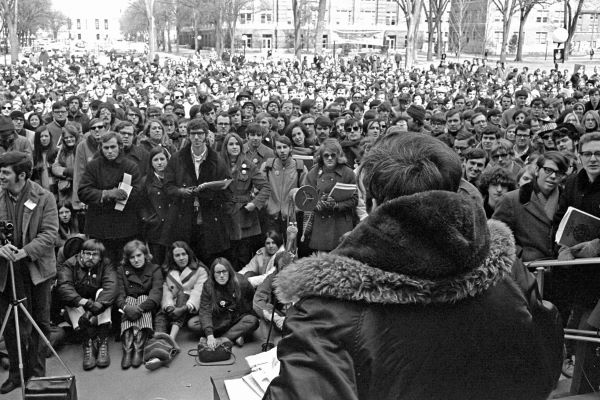
The original Earth Day took place on April 22, 1970, following on the heels of a teach-in on the environment, hosted by a handful of students and staff at the University of Michigan. Arthur J. Hanson, a former president of IISD, was one of them. Here, he reflects on how plans for a "relatively small event" exploded into a global movement.
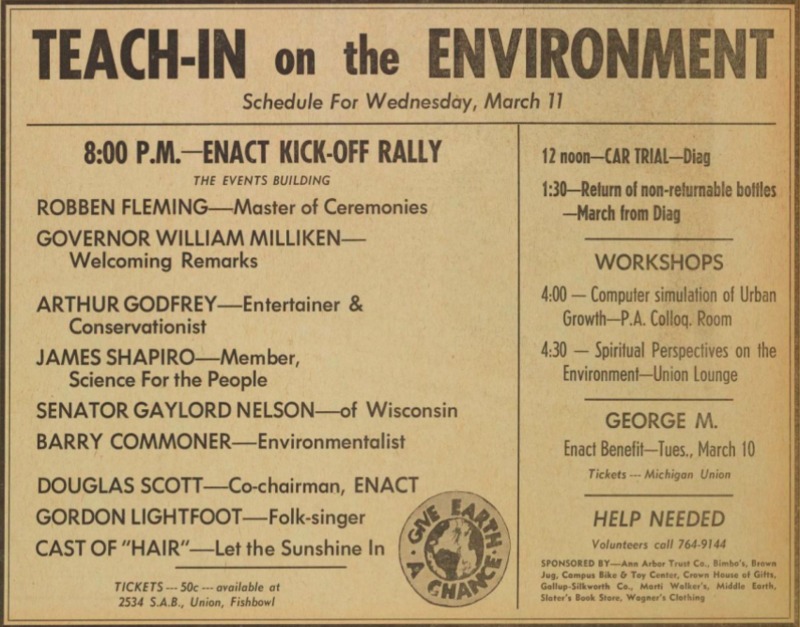
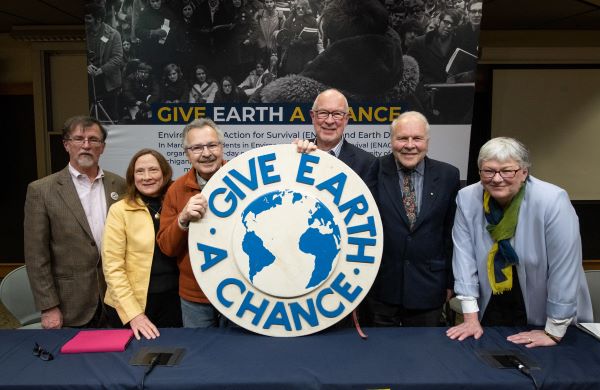
I spent five days at the University of Michigan this March, celebrating the 50th anniversary of the Teach-in on the Environment that was held there from March 11 to 14, 1970.
At the time, I was studying for my PhD in ecology. The teach-in concept was cooked up by a small group and led by three of us—at first independently of Senator Gaylord Nelson and his idea of Earth Day, though we ultimately joined forces after a great deal of cross-communication. We mutually agreed that the University of Michigan event in mid-March would be the testing ground for the first Earth Day on April 22, 1970.
We had in mind a relatively small event, perhaps a thousand people. Given the times in the United States, we envisioned patterning it after the recent teach-ins on the Vietnam War.
To our surprise, it became one of the largest events in the history of the university, involving the whole town of Ann Arbor, popular celebrities of the day such as Gordon Lightfoot and the cast of the musical Hair, and some 150 events spread over a week. By some estimates, 50,000 people participated. There were more than 13,000 attendees at the kick-off event, and we had to turn people away.
The inaugural Earth Day: "Four solid days of soul-searching"
Our theme was “Give Earth a Chance,” which saw great publicity across the nation. We attracted to the event all the major TV networks and reporters from all the big papers, including the New York Times, which described the event as “one of the most extra ordinary ‘happenings’ ever to hit the great American heartland: Four solid days of soul‐searching, by thousands of people, young and old, about ecological exigencies confronting the human race.”
Newsweek magazine ran an article with a picture of our button, and we were inundated with orders for buttons from groups across the country planning for Earth Day.
Our event was a huge success and launched subsequent teach-ins and community gatherings on a scale never seen before in the United States or perhaps anywhere.
"Teach-In on the Environment" Ad in The Michigan Daily, March 10, 1970 / Credit: Bentley Historical Library
The triumvirate of leaders included an undergrad student, Doug Scott; a Canadian PhD student, David Allan; and me. Doug and David were co-chairs and I was the finance chair, among other responsibilities (we raised about half a million dollars in today’s value plus untold amounts of in-kind contributions).
Preparations took six months, and we worked with an incredible team of hundreds of volunteers, a steering group of about 13 people—many of whom were from the community of Ann Arbor, including university professors and students—and expertise drawn from sources around the continent. We had the full support of the senior administration, from the U of M president down.
Many stories can be told, but what I discovered personally was the magnitude of what can be accomplished by a small group of people in the right place at the right time. We were riding a wave and, it seemed, could achieve the impossible. This was an experience never to be forgotten and, in some ways, never to be repeated. It helped shape the lives and careers not only of the three of us who started it but also of many others, as we discovered at the 50th anniversary celebration. For me, it changed my career goal from scientist to interpreter of science for new directions in public policy.
Many stories can be told, but what I discovered personally was the magnitude of what can be accomplished by a small group of people in the right place at the right time. We were riding a wave and, it seemed, could achieve the impossible.
We had some funds left over after the event and wanted the teach-in to leave a legacy for the City of Ann Arbor. So we invested these funds to start a non-governmental organization, for which I was one of five people who signed the inception papers and turned over the seed funds. We patterned this organization, The Ecology Center, after one started the year before in Berkeley, California. It took off from ENACT (Environmental Action Now!), the registered student organization we set up for the original teach-in.
Earth Day, ENACT, and The Ecology Center
The Ecology Center was an almost immediate success and became deeply involved in recycling initiatives. Since that time, it has undertaken many good efforts, not only in the city but elsewhere in Michigan and other places. Over the years, the Ecology Center has raised more than USD 200 million and has an annual budget of about USD 8 million. All from a starting investment of only USD 10,000.
In 1970–71, Dave Allan and I co-authored a book with articles by various speakers from the teach-in with the not-very-inspired title Recycle This Book. It is now out of print, but when I look at some of the articles, it seems they could have been written yesterday.
Adam Rome, now at Buffalo University, wrote a very thoughtful book in 2013 called The Genius of Earth Day: How a 1970 Teach-in Unexpectedly Made the First Green Generation. It starts with the University of Michigan event and runs through the beginning of the second decade of this century. He paints a picture that suggests a freshness to the U of M event that was hard to replicate later, despite the great success of some subsequent Earth Day events.
Matthew Lassiter, a history professor at the University of Michigan working with his students, university archivists, and others, is keeping alive the 1970 event and asking what has changed since then. He recently helped prepare an article on the U of M teach-in for the Smithsonian Magazine, which includes a half-hour video made at the time in 1970.
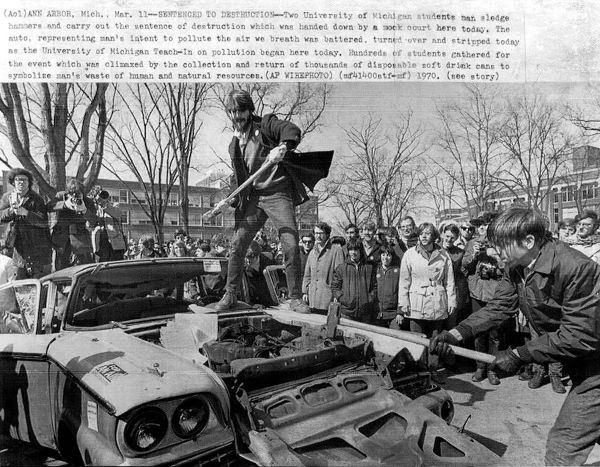
The automobile goes on trial and is sentenced to destruction at an Earth Day event in 1970 / Credit: Wystan
One event that happened during the teach-in that seems to be fascinating for many people is the trial of an automobile, leading to its execution on the University Quad. Brave, considering that, at the time, Detroit was the leading car manufacturer in the world.
We talk about “flattening the curve” to control the pandemic, but it is “bending the curve” for the environment that must happen to bring about harmony between people and nature.
The biggest difference between 1970 and today is our ability to communicate globally about everything. I have celebrated Earth Day in various parts of the world—Indonesia, China, and of course, Canada. Back in 1970, we were thrilled just to have a film crew show up from Japan. At that time, we talked about the Great Lakes dying; now, we talk about global warming, climate change, and the worldwide environmental crisis.
Until the COVID-19 pandemic came along, 2020 was expected to be the Super Year of the Environment. It is urgent that even as we “virtually” celebrate Earth Day 2020, we should make the coming years a Super Decade of the Environment. We talk about “flattening the curve” to control the pandemic, but it is “bending the curve” for the environment that must happen to bring about harmony between people and nature.
National Geographic magazine recently put out a special issue devoted to Earth Day 2070. They made it a flip issue, half devoted to a grim future and half to an optimistic view of what can be expected by Earth Day’s centennial birthday. For the sake of our children and our grandchildren, I hope reality will be the latter.
Speaking of children, it bears mentioning that, six years after the very first Earth Day, our daughter was born—on April 22, 1976. So we now have two excellent reasons to honour that day in our family!
Arthur J. Hanson is an Officer of the Order of Canada and a Distinguished Fellow with IISD following his term as President and CEO from 1991-98. For more information on the origins of Earth Day, see the Environmental Justice HistoryLab site.
COVID-19 Shows How Canada Needs to Prepare for the Next Crisis
As communities across Canada grapple with the deadly and damaging effects of the COVID-19 pandemic, we have a rare window right now into how important it is to prepare for a crisis.
April 20, 2020
As communities across Canada grapple with the deadly and damaging effects of the COVID-19 pandemic, we have a rare window right now into how important it is to prepare for a crisis.
Preparedness is the kind of thing you often think about only when it’s too late. Other, more immediate priorities always seem to steal our attention. But we are seeing up close what a difference advanced planning can make: it has been heartbreaking to see healthcare workers scrambling to find protective gear and equipment, including masks that cost less than a dollar.
As a nation, Canada can learn from this and do a better job of being prepared for the next shocks, especially the ones we know are coming from climate change: more severe floods, droughts, heatwaves, and hurricanes.
What types of advance planning matter most in Canada?
First, we need to know what’s coming and what’s at stake. We should act now to pull together accessible data and identify climate risk priorities across the country so that we have a roadmap in hand, one we can use to accelerate efforts to prepare ourselves. Many communities still need to better understand and analyze their risks and the investments they should be making. A 2019 study about preparedness in Manitoba municipalities showed that very few of them had brought climate change into their development plans.
Second, clear communication is essential. As we’ve seen during the COVID-19 crisis, people need to make quick and informed decisions to protect themselves and their loved ones. Taken early enough, these decisions can help prevent a crisis from escalating. But getting people to understand a threat and change their behaviours means communicating complex information—which can be riddled with uncertainty—in clear, timely, and accurate ways. It also means being coordinated and integrated; we must ensure cities, provinces, and the federal government have complementary messaging throughout the crisis.
Communications during a crisis must be coordinated and integrated to be effective; we must ensure cities, provinces, and the federal government have complementary messaging.
Looking ahead to climate impacts, we should act now to link our disaster risk reduction community—government departments like Public Safety and humanitarian organizations like the Canadian Red Cross—directly to the new Canadian Centres for Climate Services being set up across the country to better communicate with Canadian communities.
Third, we need to act. This pandemic has made it clear how important it is to continuously invest in protection against possible crisis scenarios. We’ve seen how not replacing expired stockpiles of medical masks has proven dangerous. There are various lists of priority infrastructure investments that Canada should address immediately to get prepared. Some are small and can be done quickly at home—such as installing backwater valves in new home construction to help avoid basement flooding. Some, like protections against seawater rise, are large enough to help with economic stimulus efforts. At the very least, all infrastructure projects should continue to be subject to the federal climate lens.
Infrastructure investments should also include nature-based solutions, where sustainably managing our landscapes helps us prevent future damage. Launching a massive effort to plant two billion trees or restore wetlands has the added benefit of replenishing the natural world that is so important to our physical and mental health in times of crisis.
Taking these steps requires collaboration. The final critical lesson we have learned over the past few weeks is how important strong social networks are in times of stress. Exchanging strategies for homeschooling, talking to loved ones in care homes, giving children a number to call if staying home is more dangerous than going to school—these have all been key to helping us do our part. And social distancing has shown us how critical, even life-saving, reliable Internet access is, reinforcing the need to address rural broadband issues and close the digital divide.
Sustainably managing our landscapes helps prevent further damage. Launching a massive effort to plant two billion trees or restore wetlands has the added benefit of replenishing the natural world that is so important to our physical and mental health in times of crisis.
Networks can also be useful in advance of a shock. In fact, they can be used to plan for one. For years, networks like C40 Cities have been sharing experiences and best practices for adapting to a hotter future. International networks of developing countries hardest hit by climate change are using innovative peer learning to make sure they mount effective defences. Inspired by an example in Vanuatu shared through a global climate adaptation network, Madagascar set up a specific national committee to coordinate it’s planning. And Grenada, informed by experiences in Albania, decided to involve the private sector and community organizations in their preparations for climate shocks. We should be investing in these preventative networks and opportunities for shared learning across Canada now.
If there’s one thing to take away from the events of the last month, it's that sometimes, to avoid the worst, we need to act in ways that seem disproportionate to our current reality. Let’s make sure the hard lessons we’re learning during this global pandemic don’t go to waste when the next crisis hits.
Doubling Down on Alberta's Oil and Gas Sector Is a Risk Canadians Can’t Afford to Take
There's no question that people across Alberta need urgent help. But is injecting tens of billions into oil and gas corporations the right kind of help?
April 9, 2020
In times of unprecedented crisis, government leadership means being bold. But as Canada and its provinces prepare to roll out record-breaking emergency responses to help the newly jobless and throw lifelines to drowning sectors, it’s becoming clear that not all support is created equal.
Alberta Premier Jason Kenney announced Tuesday that unemployment could rise to at least 25%, or upwards of 500,000 workers. To bolster Alberta’s economy, he called for the federal government to commit at least CAD 20 billion to CAD 30 billion in liquidity for oil and gas producers. This came on the heels of the province’s announcement last week of almost CAD 8 billion in equity infusion and loan guarantees for the Keystone XL oil pipeline. There have also been calls for the feds to purchase oil and gas sector accounts receivable at a discount. For its part, the federal government is finalizing the specifics of their promised emergency response package for the sector.
As Canada and its provinces prepare to roll out record-breaking emergency responses to help the newly jobless and throw lifelines to drowning sectors, it’s becoming clear that not all support is created equal.
There’s no question that people across Alberta need urgent help. In the accommodation and food service sector alone, nearly 100,000 workers have already lost their jobs, and similar numbers seem likely in retail trade. The oil and gas sectors have seen thousands of layoffs and postponed labour as the province’s companies limit production and shelve all plans for expansion, upgrades, and maintenance.
Two Key Features When It Comes to a Strategic Response
Is injecting tens of billions of dollars into oil and gas corporations the right kind of help? As well as addressing immediate needs, the strategic emergency response should have two critical features:
It should address the root causes of the crisis and reduce vulnerability to future crises.
It should take advantage of the dynamism that crisis creates to build back better and achieve important public policy goals that may have been harder to reach in more settled times.
Would the proposed assistance address the root causes of the crisis? Alberta’s economic crisis started well before COVID-19 and is rooted in overdependence on inherently cyclical commodities: oil and gas. But rather than pursue diversification that could shelter Albertans from the pain of future shocks, these sorts of investments double down on the status quo, hitching the wagon firmly to volatility and uncertainty.
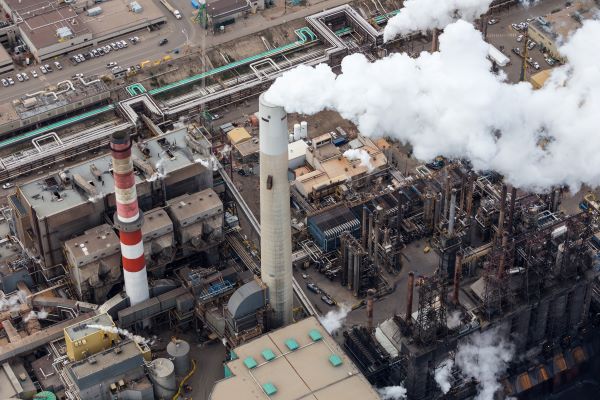
An oil refinery near Fort McMurray, Alberta / Credit: iStock
There will be future shocks, whether it’s another 2008-style financial crisis, a climate-induced crisis such as the 2016 Fort Mac fires, or—dare we say it—another COVID-19-style pandemic. Placing heavy bets on the oil and gas sector nearly guarantees we will be here again, with similar social and economic pain for people across the province.
Placing heavy bets on the oil and gas sector nearly guarantees we will be here again, with similar social and economic pain for people across the province.
Bets like these assume the oil and gas sectors will return to business as usual after COVID-19, that demand will be strong for decades in spite of increasing climate change mitigation efforts, that pipelines will be built despite sustained opposition or political delays, and that major producers like Saudi Arabia, Russia, and perhaps the U.S. can reverse course, defy history, and cobble together some sort of supply-limiting deal that makes the sector profitable for high-cost producers.
An Underlying Problem Isn't Being Addressed
Even if all those assumptions prove right and the bet pays off, that success doesn’t address the underlying problem of overdependence—it aggravates it.
Would the proposed assistance take advantage of the opportunity to build Alberta back better? We know that, whether through market forces or government policies, Canada’s oil and gas sector will eventually decline, hopefully, to be replaced by more diversified and sustainable economic drivers. As the head of the International Energy Agency, the UN Secretary-General, and others have recently argued, our response to the current crisis must accelerate this urgently needed transition. If Alberta is to rebuild its damaged house after this unprecedented crisis, why not build a stronger house?
For Alberta and the federal government, this should mean investing tens of billions of dollars in sectors that can bring long-term prosperity for Alberta’s workers and families, such as hydrogen, health sciences, renewable energy, clean transport, sustainable agriculture, innovation in oil and gas well reclamation, and prevention of fugitive methane emissions, building on the province’s world-class institutions and infrastructure and the strengths of its people. It’s frustrating to watch Alberta charge full steam away from that course, committing billions to support the Keystone XL pipeline after using austerity as a rationale to axe popular investment tax credits for high-tech entrepreneurs, and laying off tens of thousands of education workers—the foundation for future prosperity.
The coming economic downturn will swallow up the unprecedented torrents of financial support we’re assembling and still call for more. But let’s remember that this spending can be a historical force for positive change to ensure that when we come out the other end, our society is more equitable, sustainable, and resilient—ready for whatever the future might throw at us.
Economic Stimulus Should Reward Front Runners on Sustainable Development
How can we ensure COVID-19 stimulus packages include targets on environmental performance, social cohesion, and economic governance?
April 9, 2020
As governments around the world earmark billions of dollars in unprecedented stimulus packages and ask whether it will be enough to avoid a long and difficult recession, another important question comes to mind: how can we ensure these stimulus packages include targets on environmental performance, social cohesion, and economic governance?
In the short-term, it is correct to target stimulus spending on emergency responses, healthcare, food security, jobs, and keeping small businesses alive, as the humanitarian aspects of the pandemic are and will continue to be devastating. But as countries start to flatten the curve, not using this large injection of public spending to trigger better sustainability performance is a missed opportunity.
Trying to spend a lot of money quickly doesn’t leave much time for rigorous analysis of wise spending. Policy-makers and central banks have little space for systemic thinking on how to prioritize or where more spending can optimize value-for-money for society as a whole. Thankfully, evidence to this effect already exists. Our work on Sustainable Asset Valuation (SAVi) has shown that investments in sustainable infrastructure can increase labour income, productivity, and GDP.
Performance targets are useful, as they allow for human ingenuity and invite companies built around maximizing profits to be innovative in how they achieve the required performance. Passing a share of the performance challenge to those receiving public support may increase the likelihood that the post-COVID-19 recovery phase will benefit people and the planet alike.
What might such targets look like in practice? Here are a few suggestions:
Tie cash injections into airlines, shipping, and cruise lines to carbon targets.
As countries set up national health funds, target secondary health care services for lower-income communities and improve the handling of medical waste within national boundaries.
Require the automotive sector to step up sustainable mobility.
Ask banks to increase lending to green and sustainable enterprises through green and sustainability-linked loans.
Mandate public agencies to ensure spending on infrastructure is tied to sustainable design, energy efficiency, waste reduction, and green technological innovation.
Aim direct payments to farmers at performance on clean water and increased biodiversity.
Prohibit all market participants from using stimulus money to buy bonds issued by fossil fuel firms.
Reducing the immediate impact of disrupted supply chains and job losses is critical, especially as the pandemic begins to spread in lower-income countries and the full cost of the human and social catastrophe begins to reveal itself. In the long run, stimulus spending, the likes of which the world has never seen, will only make a difference if sustainable development is put front and centre.
In other words, as the initial crisis ebbs and the focus moves to propping up consumption, providing low-cost credit, and bailing out strategic industries, there must be no compromise on sustainability. Letting this emergency funding be used to trade off on climate, biodiversity, jobs, education, healthcare, and cybersecurity will be a grave mistake.
We Need a Global Stimulus Package to Avoid a COVID-19 Hunger Crisis
The loss of income for billions of people could be the most devastating effect of the COVID-19 pandemic, and it's directly connected to a pending hunger crisis.
April 6, 2020
COVID-19 has hit hard, fast and everywhere. It is, above all, a public health crisis and addressing it as such is today’s most critical challenge. But already the links to other crises are emerging, and none is as urgent as the pending hunger crisis.
Just over 10 years ago, global food security suffered a huge shock when prices of staples like wheat, rice, and maize entered a prolonged period of high and volatile prices. On the heels of the food price crisis came the 2008 financial crisis and a global recession. Meanwhile, the slower-acting but no less devastating effects of climate change continued unabated, associated with more frequent and intense floods, droughts, and extreme weather events. The combined effects of conflict, climate change, and economic recession have led to a steady rise in hunger worldwide over the past three years, after decades of abatement.
For most of the world, there is no public provision for lost income, and for far too many, each day’s income is needed for that day’s food.
Last year, a global economic slowdown was one of the main reasons an additional 20 million people were added to the hunger count. Hunger rose not because there was a shortage of food, but because people couldn’t afford to buy it.
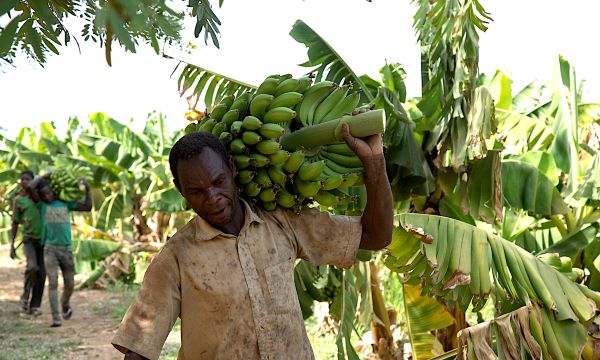
A labourer carries bananas at a farm in Burkina Faso / Credit: Annie Risemberg for IISD
The economic shutdown currently being imposed to fight coronavirus is unprecedented. India, home to the largest number of people affected by hunger (around 190 million people) has already shut down half its economy. Sub-Saharan Africa, with the highest proportion of people affected by hunger (20 percent of the population) is starting to shut down too.
The loss of income for billions of people could be the most devastating effect of the COVID-19 crisis. Over one million people filed for unemployment benefits in Canada last week alone. For most of the world, however, there is no public provision for lost income, and for far too many, each day’s income is needed for that day’s food.
Not all countries can afford the kinds of stimulus packages and safety nets coming into play in the rich world. In the United States, the government has allocated USD 2 trillion for the crisis—the equivalent of 10 percent of national GDP. The prime minister of Ethiopia, Abiy Ahmed, said in a letter to the Financial Times last week that African countries “lack the wherewithal to make similarly meaningful interventions.” He called for a strategy that is “global in design and application…global action guided by a sense of global solidarity.”
In short, we need a global stimulus package to fight a COVID-19 hunger crisis.
A global stimulus package must first and foremost provide social protection for the millions of people in low- and middle-income countries who have lost their income. Since the food supply is not currently in jeopardy, and as long as access to food markets is maintained, protection should be in the form of basic cash transfers or minimum income payments. School feeding programs must also be maintained even as schools are shut down, to continue the provision of nutritious meals to children.
School feeding programs must also be maintained even as schools are shut down, to continue the provision of nutritious meals to children.
Second, the package should support the public budgets of low-income countries that are dependent on food imports to make up shortfalls in the supply of basic foods. These net-food importing countries rely on foreign exchange earnings to pay for imports that are essential to the national food supply. With the economic shutdown, many countries may no longer earn sufficient foreign currency to pay for cereal imports.
Third, an effective global stimulus package also requires other countries to do no harm. That means curtailing export bans on food staples. For now, food supply chains are functioning and basic staples are well supplied. There is no immediate reason to fear shortages of basic staples. But restrictive trade measures, particularly export bans, destabilize markets and could exacerbate high and unstable prices as happened in 2007-08. The International Food Policy Research Institute (IFPRI) is tracking these measures and already some countries have imposed bans.
Fourth, we need a new type of public investment in the global food system, not just a return to the status quo. This means investing in food systems that not only support stable and sufficient calorie supplies but also improved nutrition, micronutrient availability, and reverses the rise in obesity and non-communicable diseases.
We need a new type of public investment in the global food system, not just a return to the status quo.
It means both reducing greenhouse gas emissions from agriculture and building resilient rural communities that can cope with the effects of climate change. And it means improving the income and livelihoods of small-scale producers, reducing their vulnerability to global shocks and crises.
Saving lives is paramount in a pandemic. But as governments take an unprecedented role in economies around the world, it is timely to remember that human health depends not just on protection from a virus, but also access to a sufficient and nutritious diet. Our public response must be bold and encompassing to match the scale of the challenge facing us all.
This article originally appeared in foodtank; it has been reprinted with permission.
Postponing Major Environmental Summits Is The Right Thing To Do
The decision to delay conferences in light of COVID-19 will not only protect public health, it may also lead to more equitable governance.
April 3, 2020
China and the UK must ensure all nations are involved in planning the delayed summits to protect biodiversity and to raise climate action.
This week, the 2020 UN climate change conference was postponed. Last week, the UN biodiversity conference was likewise put on hold. These decisions are disappointing: everyone expected 2020 to be an important year for environmental decision-making processes.
My colleagues and I recently wrote about our high hopes for 2020 to revive the momentum lost in 2019. But those hopes were penned weeks ago, before the deadly spread of coronavirus. The pandemic has disrupted everything.
These decisions to delay are the right ones, to protect public health and to ensure equity in environmental governance.
Gathering thousands of people from across the world into close quarters for two weeks during a pandemic before sending them back across the planet would risk lives.
Until coronavirus is under control, such Conferences of the Parties – COPs – risk becoming super-spreader events.
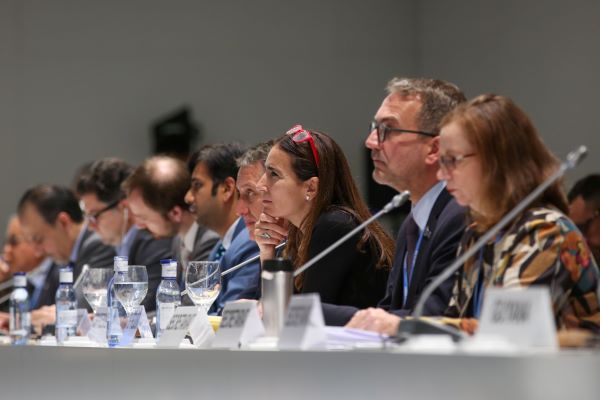
Delegates huddle in a hallway at COP 25 in Madrid, in December, 2019 / Photo by Kiara Worth, ENB
It is fair to worry these postponements mean delayed action on climate and biodiversity challenges. Some recent developments haven’t been encouraging.
The Paris Agreement is due for its first major review this year, but few countries have updated their 2015 pledges to turn aspiration to climate action. Norway and Japan are the only developed countries to put forward new pledges. The 2019 Madrid climate change conference left many worried about the future of climate action under the UN system.
Until coronavirus is under control, such Conferences of the Parties – COPs – risk becoming super-spreader events.
Biodiversity was to have a ‘super year’ in 2020. Delegates launched discussions on a post-2020 global biodiversity framework to follow up the 20 Aichi Biodiversity Targets. The working group negotiating these new targets squeezed in a meeting this year, pre-coronavirus.
While negotiators agreed the “zero draft” was a good start, it was clear much work remains to reach agreement on a new approach to protecting nature.
But there is movement on these issues in the midst of this crisis. The EU and other countries are already considering how their post-COVID responses can fuel a just transition to a low-carbon world.
China’s ban on consuming wild animals explicitly acknowledges our destruction of the natural world is partly what led to this pandemic.
We’re sharing stories of wildlife reclaiming streets and of cleaner waters and air, and people seem to have a new-found appreciation for nature. As the conferences reschedule, they can try to seize the momentum of these tangible changes.
The delayed summits means extra time to pre-resolve contentious issues
On the diplomatic side, there is extra time to pre-resolve potentially contentious issues in the post-2020 global biodiversity framework or to find traction for global climate action.
While the world is on various levels of lockdown, virtual discussions among diplomats can continue.
The incoming UK presidency for the climate summit can try to find a way to signal renewed momentum toward tangible climate action, in lieu of new pledges. The incoming Chinese COP president for the biodiversity summit can use this additional time to discuss difficult issues with interested parties and smooth the negotiations ahead.
Such efforts put considerable pressure on the incoming presidencies to ensure transparency.
Back room chats and informal one-on-ones are normal – this is diplomacy, after all – but there is usually a mechanism to keep all countries informed.
Transparency is now more crucial than ever: those who receive the Zoom invite have the key to global governance and those without are left on the margins.
During the Paris climate change conference, the French presidency held daily meetings with every coalition and some individual countries during the day and convened large, open invitation meetings in the evening. These were in person.
The British and Chinese incoming COP presidencies will have to innovate with a virtual format. To uphold transparency, they must find a way to keep countries informed and, crucially, engaged. Transparency is now more crucial than ever: who receives the Zoom invite has the key to global governance and those without are left on the margins.
A row of delegates at COP 25 in 2019 / Photo by Kiara Worth, ENB
A lack of transparency strongly contributes to a lack of equity in global environmental governance.
The powerful cannot make decisions for those with fewer resources to juggle a pandemic response and environmental action. When such inequities are apparent, negotiations break down.
When developing countries’ right to be involved is tossed aside, they can block the solutions powerful countries provide. We saw this at the Copenhagen climate change conference in 2009, when a few developing countries refused to adopt the Copenhagen Accord after being excluded from the discussions.
Developing countries may be on more equal footing with virtual summits
Postponing the 2020 climate and biodiversity conference means developing countries will have a say in global responses to climate and biodiversity crises.
The Coronavirus pandemic has yet to spread in some developing countries: they will face the onslaught later, when some of the meetings were originally to convene. International flights are already becoming rare and expensive.
Going ahead with these meetings would have excluded many voices, putting the legitimacy of any decisions on shaky ground.
Global environmental governance is for all. Some countries have greater responsibilities for the problems and others disproportionately experience the negative effects of ecosystem degradation and climate change. All must be part of the solution, or solutions will be fundamentally unsound.
This article originally appeared in Climate Home News. It has been reprinted with permission.