Insight

Disparities in COVID Impacts Underline the Importance of Racialized Data to Understand and Address Systemic Racism

Racialized data on risk exposure and health impacts can help understand inequities in the impact of COVID-19 and support preventive policy decisions, but collection to date has been haphazard. The federal government should build on provincial and non-governmental initiatives and be more deliberate in the collection and safe use of race-disaggregated data.


May 13, 2022

The COVID-19 pandemic has exposed the underlying racial inequalities that plague our society. Globally, wide disparities in infection and death rates by race and ethnicity reveal the true fault lines in our society. Racialized data on risk exposure and health impacts can help understand these inequities and support preventive policy decisions, but collection to date is haphazard. The federal government should take a cue from provincial and non-governmental initiatives and be more deliberate about collecting and safely using race-disaggregated data.

As evident in data compiled in the United States, racialized individuals are at a higher risk of contracting COVID-19 due to socio-economic factors and higher likelihood of occupying low-paid and precarious positions, such as work in the food, sanitation, transportation, and health sectors. Those positions took on even greater levels of risk than usual during the pandemic, as they were considered “essential,” meaning they were largely exempt from lockdowns and other safety restrictions. This effectively increased those individuals’ exposure to the virus.

Within Canada, data collected by the Public Health Ontario reveals that ethnoculturally diverse neighbourhoods experienced incidence rates of COVID-19 at a rate three times higher than the least diverse neighbourhoods. Death rates were twice as high. These rates point to the existence of systemic inequalities, but the available data cannot determine the causes of higher risk for more diverse neighbourhoods. Globally, studies have shown that social determinants of health, i.e., income, employment, and housing, vary vastly between racialized and non-racialized groups, which feeds into racial health disparities.

It is harder to get a clear picture of the depth of inequality across Canada as only a few efforts to collect racialized data exist. Despite increasing evidence that racialized peoples are disproportionately vulnerable to and affected by COVID-19, the Canadian data landscape remains ill equipped to relay the depth of this issue. Race-disaggregated data concerning COVID-19 was initially not considered worthy of collection outside of the elderly and individuals with underlying health conditions, as expressed by government representatives. But the widening knowledge gap, coupled with public calls for race-disaggregated data, invigorated the conversation. The topic has been brought back into the conversation with greater consideration of collecting race-based data in several Canadian provinces.

Over the course of the pandemic, the White population accounted for one fifth of the COVID-19 cases despite representing two thirds of the population.

Certain provinces have also taken concrete steps toward data collection. Since May 2020, Manitoba has started collecting race, ethnicity, and Indigeneity data from people who have tested positive for COVID-19. The results revealed that racialized persons, including people belonging to the Filipino, African, Indigenous, or South Asian communities, represented half of the total of COVID-19 cases despite only accounting for 35% of Manitoba's population. Racialized groups were also overrepresented in the manufacturing sectorthe sector with the highest number of COVID-19 cases.

Similarly, in Ontario, data on racialized groups with COVID-19 has been collected since June 2020 through a series of questions on race, income, and language. The data highlighted the wide disparities in COVID-19 cases and rates of hospitalization for COVID-19 between the White and racialized populations. Over the course of the pandemic, the White population accounted for one fifth of the COVID-19 cases despite representing two thirds of the population. In contrast, members of the Latino and Middle Eastern populations experienced nine times and seven times higher hospitalization rates compared to White individuals, respectively.

Both sets of data critically demonstrate the importance of collecting race-disaggregated data. The lack of statistical evidence of racialized and inequitable health outcomes inadvertently perpetuates systemic racism in Canada. In times of crisis, like the COVID pandemic, decision-makers lack critical information to take the measures needed to prevent disproportionate harm to racialized populations. Race-based data enables the necessary introspection into the wide disparities between members of our society.

Outside of government initiatives, communities are taking the reins in ensuring better representation in data, as evident in the case of the “Our Data Indigenous” app. The app, created by University of Manitoba researchers, enables community health directors to gather timely health data with the distribution of questionnaires. It is holistic in practice as it accounts for the social determinants of Indigenous health and well-being. This is particularly crucial as such factors largely account for the degree of racial and ethnic health disparities.

This app reflects an acknowledgment that Indigenous health data is limited and the legitimate fears that further isolation of these communities would create inequitable health outcomes. In addition, to ensure data ownership and transparency, communities stay in control of their data, including the final say about sharing their information.

But until the federal government and all provinces mandate the collection and dissemination of race-based data, marginalized groups will continue to face institutional barriers to equitable health care. To accurately assess racial disparities in health, it is necessary to understand the severity and intricacies of crises in view of varied experiences across regions. Without such an approach, policies are likely to be based on flawed conclusions.

The importance and usefulness of race-based data cannot be overstated when considering response efforts to health crises. Race-disaggregated data helps reveal systematic issues that would otherwise go unseen.

Case studies across the United States show evidence of how inclusive data contributes to the development of robust social and health protection for racial minorities. In Hawaii, race-disaggregated COVID-19 data revealed significant disparities in cases and mortality rates among Native Hawaiians, Pacific Islanders, White and Asian populations. For instance, despite only accounting for 5% of the population, Pacific Islanders represented 22% of COVID-19 cases in Hawaii. In response, the Hawaii State Department of Health created the Pacific Islander Priority Investigations and Outreach Team, featuring culturally and linguistically aware health workers and contact tracers. The team improved access to COVID-19 prevention information and related resources that incorporated cultural values and norms. It highlighted the value of race-based data in developing culturally and community-responsive effortskey to targeting racial and ethnic minorities.

Following analysis of race-disaggregated data, various states in the United States developed targeted COVID-19 response initiatives, cognizant of the racial disparities in health access. Government officials rolled out various new testing sites in Austin, Texas noting the communities’ particular challenges with access. Similarly, the cities of Baltimore, Maryland and Orange County, California created testing sites in specific communities that reported high incidences of COVID-19 and developed long-term partnerships with organizations to ensure other similar communities are covered as well.

But collecting COVID-19-related data on race should just be the start. The impacts of crises cut across all socio-demographic groups, and policy-makers need tools to understand the pathways and system structures that create racialized experiences. Across Canada, health profiles will vary based on several factors including race, and disaggregated data is the tool to reveal the true depth of disparities.

Despite the clear benefits of collecting racialized data, currently this knowledge is restricted within provincial jurisdictions. It must be extended federally.

Racialized data would help us contextualize the overrepresentations of certain racial groups in data sets on social outcomes including housing, employment, poverty, police-related deaths and more. Also, race-based data complements other types of data to provide a clearer picture of diverse experiences across Canada.

Objecting to race-based data or failing to collect it is a willfully neglectful choice against prioritizing health for all racial groups equally. What does this absence leave in its place? The semblance of colour-blind treatment, perpetuating systematic racism, and standing in the way of policies that could affect systemic change.

Even a patchwork approach to collecting race-disaggregated data in Canada comes at a disservice to racialized groups and their lived experiences. A nationwide system of data collection works for the benefit of policy-makers, researchers, public institutions, and communities alike.

To advance racial equity and the values Canada espouses, comprehensive race-disaggregated data is a critical and key step. 
Insight

Not Just Who, But Where: The need for geospatial data to achieve the Sustainable Development Goals

To improve data collection on those left behind, organizations are working to improve the availability of geospatial data and fill data gaps to determine not only who is being left behind, but where they are. 

May 13, 2022

The 2030 Agenda aims to ensure that no one is left behind in pursuit of a more just and sustainable world. To fulfill this commitment, it is necessary to first ask the question, "Who is currently being left behind?" While the question may seem simple, empirically answering it can be technically and methodologically difficult. This is because the data used to monitor and evaluate the impact of the SDGs come largely from National Statistical Offices (NSOs)national agencies responsible for the conceptualization, collection, and dissemination of statistics. NSOs typically operate using standardized approaches (e.g., censuses and surveys), and many populations experiencing marginalizationsuch as those experiencing homelessness or undocumented individualscan fall through the gaps. If NSOs are unable to collect information on those left behind, they also don’t know where those being left behind are. In this way, it is not just a question of who is being left behind, but where they are located. 

To improve data collection regarding those left behind, there is a push among the global statistical community to utilize georeferenced datadata that can be ascribed to a particular location. This type of data is also referred to as geospatial data, spatial data, or geographical information. The benefits of georeferenced data are obvious; you cannot implement policy to improve housing conditions if you cannot locate where inadequate housing exists. Therefore, data are most effective when information relates to location. However, bridging the gap between information and location can be difficult for NSOs for several reasons. This article explores efforts to improve the availability of geospatial data by NSOs and showcases how other organizations are filling data gaps. 

To promote the availability of georeferenced data among NSOs, the Partnership in Statistics for Development in the 21st Century (PARIS21) and Statistics Sweden released a comprehensive, eight-step guide for NSOs to integrate their statistics and geospatial data seamlessly across all geographic scales (PARIS 21, 2021). The guide was motivated by the realization that the NSOs of many low- and middle-income countries rely on outdated technology or lack the capacity required to develop the geospatial data necessary for effective and efficient decision making. The eight steps comprise a sequential process to guide NSOs from identifying the groups that need to be mapped and setting up a basic framework for geographies, all the way to the final step of making sure data is interoperable. In short, it supports countries in operationalizing the complex process of developing georeferenced data. By providing this guide, PARIS21 hopes to help achieve the 2030 Agenda by making available the data necessary to determine not only who is being left behind, but where they are. 

You cannot implement policy to improve housing conditions if you cannot locate where inadequate housing exists.

One significant barrier to NSOs’ ability to identify populations being left behind is the statistical method of enumerating households. To administer surveys, NSOs need a method to send and receive them. Traditionally this is done by mailing physical copies of the surveys to households, which excludes people who do not have an address. The World Bank estimates that in 2018 nearly 30% of the urban population lived in informal settlements and potentially without an address. Therefore, even if NSOs can georeference their data, these individuals would never be accounted for. 

Alternative approaches are arising to fill the data gaps left by this surveying method. IDEAMAPS was founded in 2020 with the aim of developing informed slum mapsgeoreferenced data about slums and their inhabitants. Inhabitants of slums are often underrepresented in both general information and georeferenced data due to their informal status, often unrecognized by governments. By combining community-based field mapping with digitized imagery and machine learning, IDEAMAPS has developed a "deprived area map" of slums that provides key georeferenced data for evidence-based decision making.  

The need to identify those left behind is not just a problem of informal settlements in low- and middle-income countries. In Canada, the method of enumeration used by Statistics Canada to conduct the census excludes the population experiencing homelessness. In Winnipeg, Canada, community organizations have initiated a way to address this gap, by conducting a Street Censusa point-in-time count of Winnipeg’s population experiencing homelessness. The survey asks questions similar to the national census and helps to identify service needs  

While surveying is one example where georeferenced data is important, surveys are typically conducted annually or even less frequently in the case of censuses. To achieve the SDGs, there is a need for georeferenced data that is up-to-date and available in real time. As part of its strategy for the prevention and control of snakebite envenoming, the World Health Organization launched the Snakebite Information and Data Platform. Using geospatial software built by Esri, the platform allows users to both identify the potential location of venomous snakes and upload geo-tagged sightings of venomous snakes. The availability of this data to the public not only helps educate individuals on the presence and identity of venomous snakes, but it also provides resources on how and where to treat potentially fatal bites. The tool puts geospatial data into the immediate service of those who may find themselves in desperate need. 

The World Bank estimates that in 2018 nearly 30% of the urban population lived in informal settlements and potentially without an address

Geospatial data can do more than just provide real-time information; it can also be used to analyze data for decision making. One of the earliest instances of geospatial data was compiled in 1854 by English physician John Snow. During this time, London was experiencing a cholera outbreak, and it was believed that pollution was causing the disease to spread. By mapping outbreak locations, Snow began to see patterns emerge and determined that the clusters of outbreaks were related to drinking water sources. This type of mapping, first conducted over 150 years ago, has become commonplace in how we present and analyze data, and it is once again proving important as we endure the most severe pandemic of our time.  

Using the same principle, in 2020, the government of Ontario launched the COVID-19 School Dashboard to track cases in schools across the province. The tool also tracks the percentage of low-income households and the number of immigrant families near the schools to help identify disparities in socio-economic exposure to COVID-19. This type of platform has become widely available since COVID-19 began, due to growing demand to identify cases and locate potential areas of transmission. Access to localized data has helped governments to make evidence-based decisions that have slowed the spread of the virus. One only needs to imagine how difficult it would be to plan for a pandemic if we could not locate outbreaks to understand the importance of georeferenced data.   

These case studies highlight the varied uses of geospatial data. While there are many applications, no single actor or agency is responsible for georeferencing data. Instead, data projects must pursue a marriage between information and location to identify and account for those who are left behind. Only when we know where those who are marginalized are located can we make the evidence-based decisions required to make sure they are no longer left behind. 

Insight

Leveraging the Linkages: How human rights data can advance SDG monitoring

To create opportunities for synergies between the "leave no one behind" principle and the "realize human rights for all" principle in implementation and improved monitoring, there is a need to properly leverage data and legal mechanisms. 

May 13, 2022

The 2030 Agenda principle to “leave no one behind” is closely tied to another principle: to realize human rights for all. By properly leveraging data and legal mechanisms, this close relationship creates opportunities for synergies in implementation and improved monitoring.       

The Universal Declaration of Human Rights and other core human rights instruments identify basic human needs that must be respected for everyone, everywhere, always. Realizing and protecting human rights are prerequisites for progress on many of the Sustainable Development Goals (SDGs). Data that has been collected to track developments in human rights implementation also yields important insights on progress toward related SDGs and can be used to complement other data sources for SDG monitoring. Moreover, legal overlaps could mean states can be held accountable for SDG implementation if they are linked to relevant human rights mechanisms where states have obligations under international human rights law.  

Linkages Between Human Rights and the SDGs  

Trends in human rights monitoring illuminate some of the benefits of linking data on human rights and the SDGs. According to a recent study conducted by Steven L. B. Jensen of the Danish Institute for Human Rights (DIHR), key UN human rights bodies are increasingly referencing the SDGs in their recommendations. There is strong motivation for this shift: human rights monitoring mechanisms consider the 2030 Agenda an opportunity to further realize human rights for all. As SDG monitoring is bolstered and expands in frequency and reach, states will receive feedback from the international community as progress is continually assessed at every step of the way regarding not only the SDGs, but on human rights as well.  

The connection between the SDGs and human rights is mutually reinforcing. As states have obligations under international human rights law, they can be held accountable for SDG implementation if these are linked to relevant human rights mechanisms. Linking up data on the SDGs, which are non-binding in nature, with data on international human rights and labour standards ensures SDG implementation increases the respect, protection, and fulfilment of human rights since these two concepts are deeply intertwined. Human rights linkages could also strengthen the ability of the annual UN High-level Political Forum on Sustainable Development (HLPF) to ensure accountability from governments to their SDG commitments (Feiring & König-Reis, 2020).  

International human rights mechanisms can advance the SDGs at the national level as well: their recommendations can help identify priority areas for individual countries’ SDG action plans, indicate the marginalized groups that require additional support, and suggest concrete measures to combat exclusion and discrimination.  

Scope of Human Rights Data for SDG Monitoring 

The SDG-Human Rights Data Explorer created by DIHR shows the extent of the opportunity to complement SDG monitoring with human rights data. The online tool uses artificial intelligence to evaluate monitoring information from international human rights mechanisms and maps their recommendations and observations to relevant SDGs and targets. Users can explore how recommendations from human rights monitoring bodies, such as the Universal Periodic Review (UPR), relate to the implementation of each SDG and the 169 targets around the globe.  

At present, the database allows users to explore 145,000 recommendations from 67 mechanisms across the international human rights system. Over half of these recommendations are directly linked to specific SDG targets, and therefore immediately relevant for national SDG implementation. (DIHR, n.d.). For example, following the third UPR cycle in 2018, it was recommended that Canada “continue to strengthen protection of the rights of Indigenous women and girls against violence, in particular by systematically conducting investigations and ensuring the collection and dissemination of data on violence against Indigenous women.” The tool linked this recommendation to SDG targets 17.18 (capacity building for disaggregated data) and 5.2 (end all forms of violence against women and girls). Although target 17.18 is aimed at developing countries, the need to increase Canada’s data collection capacity on the issues faced by Indigenous Peoples, especially women, is emphasized.  

For any country, knowing which SDG targets matter from a human rights perspective can boost political momentum for increased action.

A second tool developed by DIHR, The Human Rights Guide to the Sustainable Development Goals, allows users to determine which international human rights mechanisms have direct applications for each of the SDG targets. A simple example is to look at SDG 11 (Sustainable Cities and Communities) and contrast it with the Convention on the Elimination of All Forms of Discrimination Against Women (CEDAW). In total, five articles within the text are connected to six different SDG targets only relating to SDG 11. The data organized by this tool is immense and shows the strong connection between international human rights tools and the SDGs, considering more than 92% of the 169 SDG targets have a direct link to international human rights mechanisms, labour standards, and environmental agreements. 

A Look at Canada’s Human Rights Recommendations 

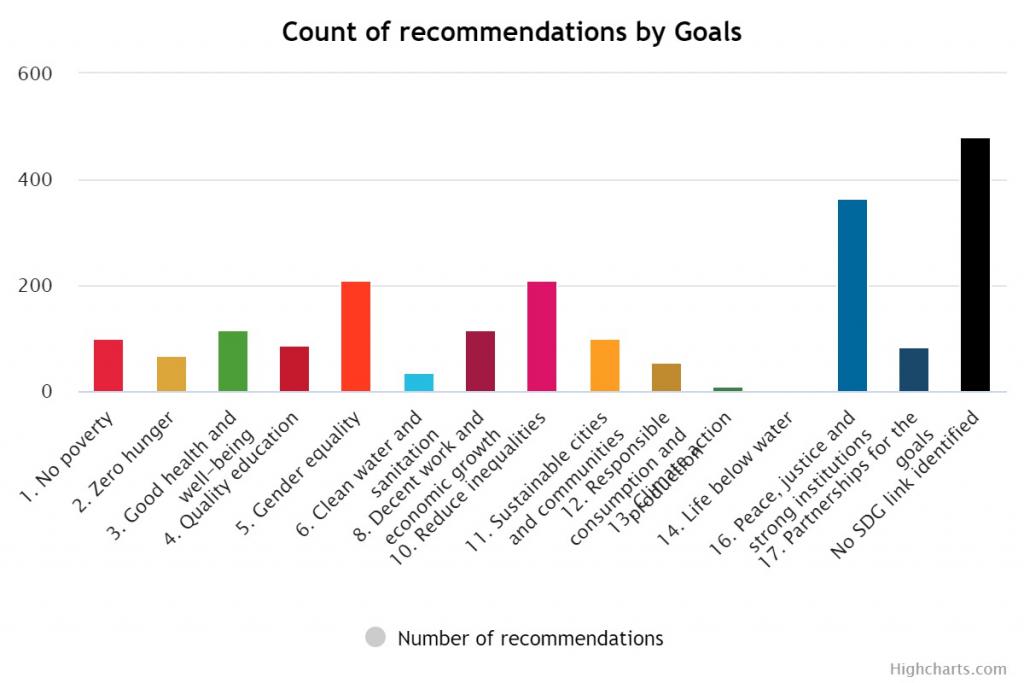
The SDG-Human Rights Data Explorer developed by the DIHR maps 145,000 human rights recommendations from 67 international human rights instruments to the SDGs. A search on recommendations addressing Canada shows that human rights issues in Canada most often relate to SDG 16 (peace, justice, and strong institutions), SDG 10 (reduced inequalities), and SDG 5 (gender equality). 

Count of human rights recommendations by SDG goals
Figure 1. Count of Canada’s human rights recommendations by SDGs (Source: SDG - Human Rights Data Explorer, The Danish Human Rights Institute)

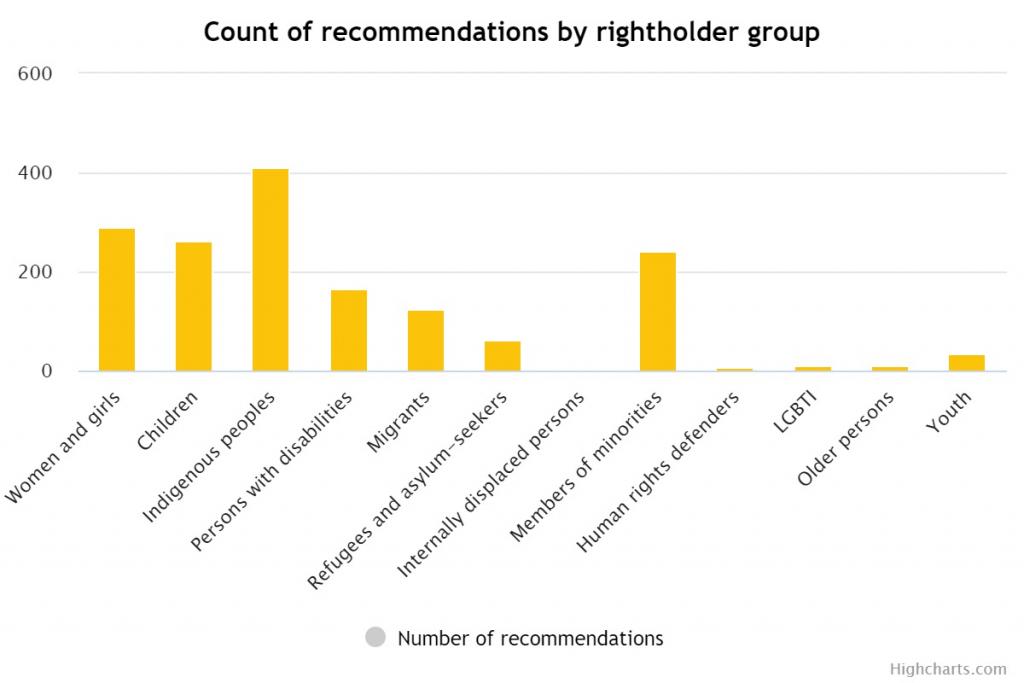
The database also allows searching for recommendations that relate to specific rightholder groups. For Canada, human rights recommendations most often address Indigenous Peoples, women and girls, and children. This can be used as an indication of the groups most affected by human rights issues in Canada. 

Count of human rights recommendations by rightsholder group
Figure 2. Count of Canada’s human rights recommendations by rightholder group (Source: SDG - Human Rights Data Explorer, The Danish Human Rights Institute)

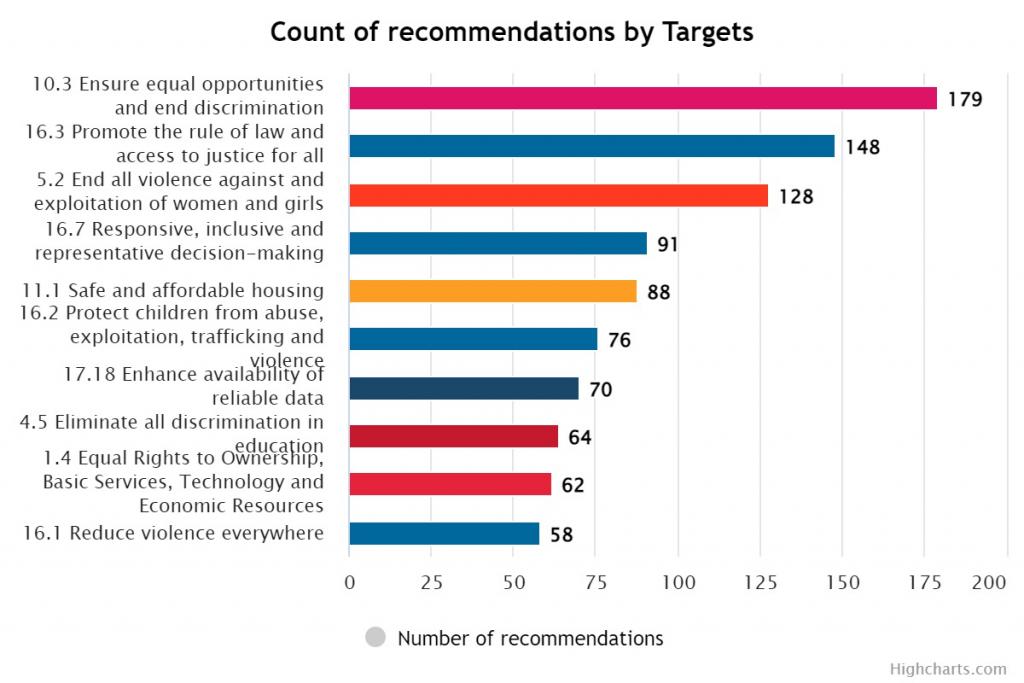
Digging deeper, a search focusing on recommendations relating to the human rights of Indigenous Peoples reveals the SDG targets most often addressed relate to: 

  • SDG target 10.3 (ensure equal opportunities and end discrimination) 
  • SDG target 5.2 (end all forms of violence against women and girls) 
  • SDG target 16.7 (responsive, inclusive, and representative decision-making)  
  • SDG target 16.3 (promote the rule of law and access to justice for all). 
Count of human rights recommendations by SDG Targets
Figure 3. Count of Canada’s human rights recommendations by targets (Source: SDG - Human Rights Data Explorer, The Danish Human Rights Institute)

This initial analysis facilitated by the DIHR tools reveals a strong link between safeguarding human rights for Indigenous Peoples, particularly Indigenous women and children, and progress on SDGs 5, 10, and 16 in Canada. Addressing the human rights obligations relating to discrimination of Indigenous Peoples and violence against Indigenous women and girls, would directly impact Canada’s performance on these SDGs.  

Taking a wider perspective, data on human rights recommendations underline the importance for Canada to address its colonial legacy. Reconciliation could be one of the most effective ways for Canada to make progress on many SDGs. Analyzing the content of the recommendations identified through the SDG-Human Rights Data Explorer provides insights into the need for SDG planning, implementation, and measurement to reflect the dimensions of reconciliation; these have clear impacts on Canada’s progress toward the SDGs.  

The Role of National Human Rights Institutions 

For any country, knowing which SDG targets matter from a human rights perspective can boost political momentum for increased action. It can also illuminate related aspects that should be monitored during implementation, as demonstrated in the case study above. In practice, this means building on the existing monitoring mandates of National Human Rights Institutions (NHRIs) to highlight SDG links in their work and to utilize the human rights monitoring mechanisms as an avenue to also review progress on the SDGs (Feiring & König-Reis, 2020).  

Nearly 50% of existing SDG indicators produce data that is directly relevant to the monitoring of human rights instruments. NHRIs are sure to find significant benefits from engaging with the SDGhuman rights relationship. 

Integrating Human Rights Data in SDG Monitoring  

An obvious recommendation arising from this discussion is to encourage closer collaboration between NHRIs and national statistics offices in SDG monitoring. But this is not a simple task.  

Much of the data collected by NHRIs stem from complaints about human rights violations and the investigations and legal pursuits that may follow. Such data are sensitive, and careful processing is needed to publish them safely. Interpreting these data may be difficult as they often refer to specific groups or situations, making analysis and generalization tricky.  

Nonetheless, examples from other countries suggest the effort is worthwhile. For example, Feiring showed a set of SDG targets addressing discriminatory legal frameworks and policies, inclusion, and policy coherenceSDG target 5.c, SDG target 10.2, SDG target 10.3, SDG target 10.4, SDG target 16.b, and SDG target 17.14can all be measured by a single indicator on the number of countries that have ratified and implemented international conventions on equality and non-discrimination. 

International collaboration can be another way to move forward. In Europe, the NHRIs of 40 countries have formed a network to enhance the promotion and protection of human rights across the region. Members have developed joint guides on topics such as measuring poverty reduction and advancing SDG 16 and benefit from frequent exchanges on evolving practices.  

Finally, the Government of Canada could establish a process or body dedicated to measuring reconciliation progress in the context of the SDGs. Such an initiative would bring together the data experts of Statistics Canada, the human rights experts of Canada’s Commission on Human Rights, and most importantly the Indigenous Peoples whose rights must be established and protected to make progress on key SDGs in Canada. Such an initiative would establish accountability around the Government’s commitment to prioritize reconciliation and, with some investment, provide an appropriate framework to measure progress toward this goal.  

Insight

Who Is Being Left Behind in Canada?

Achieving the principle of leaving no one behind implies that implementation should start with those furthest behind, and adequate monitoring must be in place to ensure the well-being of marginalized groups improves—and no new groups are harmed.

May 13, 2022

The 2030 Agenda and the Sustainable Development Goals (SDGs) place a special emphasis on ensuring no one is left behind in implementation, meaning the SDGs must be realized for all people in all places. Achieving this principle implies that implementation should start with those furthest behind, and adequate monitoring must be in place to ensure the well-being of marginalized groups improves—and no new groups are harmed. 

But who is being left behind in Canada? A prerequisite for action is clearly identifying those at risk of being left behind so their progress in achieving the SDGs can be monitored. 

In 2019, with the support of the Canadian government, IISD investigated who is being left behind in the country. Our team looked at available data sources to identify who is being marginalized, how marginalization happens, and how government interventions may be helping. We looked at measurement challenges with respect to marginalization in Canada and surveyed emerging international practices on measuring—and ultimately addressing—the situation and needs of those being left behind.  

Members of First Nations, Métis, and Inuit groups are not only more likely to be poor and to suffer from food insecurity in Canada, they also experience health inequalities that reduce their life expectancy.

The COVID-19 crisis has pushed many of these groups even further behind, often adding new pressures to existing factors of marginalization. In their study of household food insecurity, Tarasuk and Mitchell found that in 20172018, one in eight people living in Canada experienced food insecurity. Observers expect the pandemic shifted this number to one in seven Canadians. 

Before the pandemic, recent immigrants were three times more likely than average Canadians to be poor. The situation was even worse for newcomers who are lone parents or older than 65 years. Recent immigrants were among the groups most at risk of contracting COVID-19 because they often worked in jobs where social distancing was challenging and because of inadequate living conditions.  

COVID-19 has also severely impacted the health and economic well-being of people with disabilities. More people with permanent conditions reported losing their job during the pandemic and being affected by economic hardship than other Canadians. They also struggled to buy food, groceries, and masks. Even before the pandemic, people with disabilities were poorer and had lower levels of education than other Canadians.  

Members of First Nations, Métis, and Inuit groups are not only more likely to be poor and to suffer from food insecurity in Canada, they also experience health inequalities that reduce their life expectancy. Data on the early stage of COVID-19 confirm these inequities. A survey from Manitoba showed in 2020 Indigenous Peoples, who represented 13% of Manitoba’s population, accounted for 17% of provincial COVID-19 infections. Data from Ontario showed that racialized groups had a 1.7-to-7.1-fold higher rate of COVID infection and a 1.7-to-9.1-fold higher rate of COVID-19 hospitalization compared to white Ontarians.  

As these examples show, it is vital for countries to identify and measure the factors that marginalize people and push them behind. Marginalization puts people at disproportionate health, social, and economic risks when a disaster strikes—such as a pandemic or a major climate change impact.  

Our research also shows that, while Canada is a data-rich country, official statistics often do not reflect the diverse factors that contribute to marginalization. We found three distinct measurement challenges to inclusive SDG monitoring in Canada. 

First, it is difficult to capture all dimensions of marginalization appropriately in data. Some groups, such as homeless people or members of First Nations living on reserve, are difficult to include in large-scale surveys that use household addresses to identify respondents. Many of these groups remained invisible during the pandemic, and we lack essential information on how their well-being has been affected by COVID, social distancing, and the repeated lockdowns.  

Second, data alone cannot adequately reflect differences in perceptions, values, and priorities that shape the needs of marginalized groups and the actions needed to improve their situation. Different marginalized groups may feel equally poor but for different reasons. If these reasons are not captured, response measures will likely miss their mark. Most attempts to measure COVID-19 impact focus on how the pandemic has affected people’s health and their economic situation. We know far less about how the loss of social contacts affects groups with different cultures and how the inability to gather has disrupted their lives.  

Third, we learned that because of the need to reflect different perceptions, values, and priorities, ownership over data matters. To adequately communicate the situation of marginalized groups in a respectful and unbiased way, these groups must have control over the data used to describe them. This empowers communities to tell their own story of marginalization, which is important both for decision-makers designing interventions as well as for community members stimulating engagement. The OCAP principles (Ownership, Control, Access, and Possession) developed by the First Nations Information Governance Centre embody these findings and provide a starting point for the respectful use of data describing First Nations groups.  

Based on the findings of our original study, we recommended developing a complementary, bottom-up measurement approach where local communities and organizations working with vulnerable groups participate in gathering, governing, and using data to measure the state of their well-being in the SDG context. 

In the second phase of this work, we aim to lay the groundwork for such a participatory approach by reaching out to marginalized groups to learn what data they collect in their work, what data they need to support the groups they work with, and how data can be used in a respectful manner to describe the needs of marginalized groups.  

The past 24 months have delivered powerful reminders of how important it is to collect and use the right data to understand the impacts of a global pandemic on people. At the same time, the demonstrations sparked by the violent murder of George Floyd are raising awareness of how systemic racism and institutionalized inequalities continue to hold back marginalized groups. And as we are writing these words, the ongoing horrific discoveries of the victims of Canada’s residential school system remind us that some causes of marginalization cannot be captured in data.  

We recognize the societal discourse on marginalization is rapidly evolving and so is the language we use to frame the problem and its solutions. In our first report, we referred to specific groups as broadly "vulnerable." Using the phrase “vulnerable groups” has been increasingly critiqued for, at best, being vague, and at worst, further reproducing stereotypes and inequalities. In their study of inclusion, Hayes and Carria find using the phrase “vulnerable groups'' risks greater omission and exclusion of the people that projects like ours are intending to serve. Instead, researchers and practitioners recommend using the term “marginalized,” and to be specific about which groups one is referring to. We will continue to educate ourselves on evolving language to address structural inequality. 

We cannot approach the need for more inclusive and respectful monitoring of the well-being of marginalized groups in Canada with the expectation for fast answers. Rather, we seek to learn how to ask the right questions.  

Insight

Funding for Fossil Fuels Could Derail Canada's New Plan to Reduce Emissions

May 4, 2022

The following paragraphs are from an op-ed originally published in The Hill Times on May 4, 2022, and are reprinted below with permission. The full op-ed is available at The Hill Times' website.

Canadian climate news this past month has been a bit of a rollercoaster.

Just over a month ago, the federal government released the 2030 Emissions Reduction Plan, the most comprehensive Canadian climate plan to date, and the 2022 budget, scarcely a week apart. That same week the urgent call of the world’s top scientists reached a fever pitch with the latest IPCC report charting the narrow pathways available for action to avoid irreversible climate change impacts. Meanwhile, on the eve of the budget release came the federal approval of Bay du Nord, Norwegian oil company Equinor’s deep water drilling project off the coast of Newfoundland which has the potential to produce up to 300 million barrels of fossil fuel resources.

The government aims to use their recent climate plan and budget as the basis to tackle climate change over the next few critical years. However, subsidies to the fossil fuel industry and new production projects threaten to undermine progress towards climate goals. 

Read the full op-ed at The Hill Times.

Insight details

Insight

What the Invasion of Ukraine Means for Sustainable Development

As events continue to unfold in the region, three urgent areas of concern are emerging: global food security and the hunger crisis; risks to progress on the clean energy transition; and the state of multilateralism.

March 25, 2022

It’s been nothing short of staggering to watch a sovereign nation in Europe being attacked so forcefully and relentlessly by its neighbour. What’s happening in Ukraine is, on a political level, highly disturbing. On a human level, it’s abhorrent.

Many voices have started weighing in on what the war in Ukraine means for our collective future. As we speculate, let’s not lose sight of the fact that this is, first and foremost, a humanitarian crisis. Finding ways to protect all innocent civilians—both in Ukraine and in the streets of Russia, where protestors are risking their lives to take a stand—is of utmost importance, as is ensuring a compassionate response to refugees seeking to escape the devastation.

Let’s also keep in mind the bigger picture. The implications of this war extend far beyond Eastern Europe and touch on nearly every aspect of sustainable development. They also reinforce why multilateralism—the bedrock of international cooperation—must be part of the solution.

As events continue to unfold in the region, three urgent areas of concern are emerging: global food security and the hunger crisis; risks to progress on the clean energy transition; and the state of multilateralism, which is under increasing strain.

Preventing a global food security crisis

The COVID-19 pandemic undid years of progress toward ending hunger. Now, the Russia–Ukraine war has fuelled fears that an even greater crisis for global food systems is on the horizon. Even worse, governments are sending early signals that they may turn inwards to try to limit the damage, such as by banning exports of food staples, rather than working together to build more resilient food systems. If they start on this path, the results will be catastrophic.

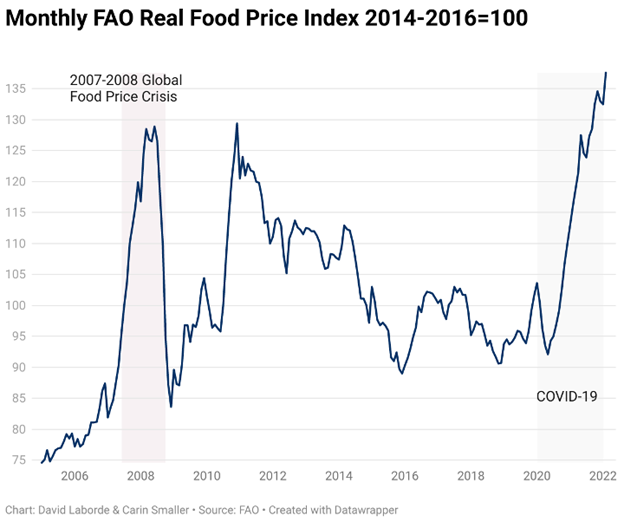
Russia and Ukraine are major exporters of crucial agricultural commodities, holding a significant share of the global market (about 30% of world wheat and barley exports, for instance). With food exports disrupted from both economies, prices are soaring, building on an already worrisome commodity price trend that brings back difficult memories of the 2008/2009 global food price crisis.

Governments must act now to diversify their agricultural and food markets at all levels, from local to global, rather than turning inward.

It gets worse. Russia and Belarus, both instigators of this war, also make up a major share of fertilizer production. Together, the nations accounted for more than 40% of global exports of potash last year. As well, the natural gas that Russia exports is not just an energy supply to its neighbours—it is also used as an input for chemical fertilizers, and we have not yet found viable alternatives.

The combination of high prices and scarce food and fertilizer would hit many lower-income countries hard, particularly in the Middle East and Africa, potentially pushing millions of additional people into hunger and poverty. To prevent a crisis of this nature from spiralling out of control, governments must act now to diversify their agricultural and food markets at all levels, from local to global, rather than turning inward and trying to meet all their needs from domestic production.

Governments also need to work together at the World Trade Organization (WTO) to reform global trade rules and prevent knee-jerk responses, such as export bans, that only hurt the very people they are trying to help. Not only will this limit the risk of a global food security crisis, but it could also spur much more ambitious reforms of the WTO’s agricultural rulebook, sending a strong signal that multilateral cooperation remains alive and well.

Speeding up the clean energy transition

The situation in Ukraine has brought to light just how precarious our energy security is when it’s tied directly to oil and gas. It’s understandable that some leaders, seeking to take immediate action, are signalling at least short-term support to the fossil fuel industry. But this isn’t a viable approach in the long run.

Building new oil and gas infrastructure, in the form of liquefied natural gas terminals or pipelines, would take years to complete, deepen our global dependence on fossil fuels, further empower Russia and other exporting countries, and all but crush our chances of meeting climate commitments in the Paris Agreement.

Recent analysis from the International Energy Agency, along with a statement from German Chancellor Olaf Scholz, make it clear that countries should continue to reduce their reliance on fossil fuel imports (and, in fact, are already pledging to do so). In the words of Chancellor Scholz:

"The events of recent days and weeks have shown us that responsible, forward-looking energy policy is not just crucial for our economy and our climate—it is also crucial for our security. This means that the faster we make progress with the development of renewable energies, the better."

Indeed, these options are cheaper, cleaner, and don’t rely on turbulent geopolitical power plays. Critical minerals will also play a role as we collectively transition to a net-zero economy; putting the right governance mechanisms in place will be essential to avoid abuses.

Another immediate priority for many countries is supporting vulnerable populations as fuel prices soar. That’s the right move—as long as those payments go directly into needy people’s pockets and not into a new fossil fuel subsidy that further delays the transition.

"The events of recent days and weeks have shown us that responsible, forward-looking energy policy is not just crucial for our economy and our climate—it is also crucial for our security."

German Chancellor Olaf Scholtz

Of course, progress on all of this can’t be made without cooperation—the proposed European Green Deal has made that clear. But there are promising signs that leaders in the region are ready to step up: Already, on March 8, the European Commission outlined a plan to make Europe independent from Russian fossil fuels well before 2030 and reduce gas imports by two thirds by the end of 2022.

We’ll need more of this collaborative leadership—and from countries outside of Europe, too. The recent Intergovernmental Panel on Climate Change report illustrated vividly what’s at stake if global warming is not limited to below 1.5°C. Our window to change course is closing, but research shows there is still hope. Ukrainian climate activists and scientists have made it clear that the world must not surrender in building a climate-resilient future.

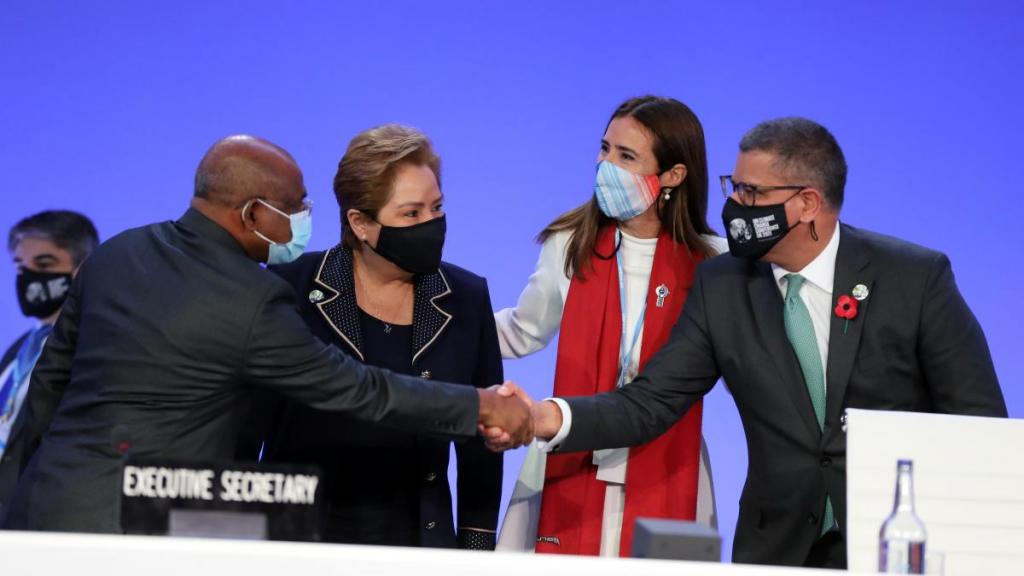
Opening Plenary of COP 26 - UNGA president, COP 25 and 26 presidents, and UNFCCC Executive Secretary

Drawing inspiration from decades of multilateralism

These challenges have reinforced long-held fears that our multilateral system may not be fit for the problems we’re facing now. The initial objective of multilateralism, established in the wake of two world wars, was to ensure countries settle their differences through cooperation rather than on the battlefield. Today, the capacity of such institutions to achieve this goal is being tested like never before.

There’s cause for optimism, though. As we saw last month at the United Nations Environment Assembly in Nairobi, Kenya, delegates from nearly 200 countries came together on a plastics treaty, effectively landing what Inger Andersen, executive director of the United Nations Environment Programme, called “the most significant environmental multilateral deal since the Paris accord (in 2015).” We’ll need to build on successes like this and continue to learn from missteps in order to create the future we want.

To show that multilateralism is a value worth protecting, leaders must also, finally, translate old pledges for policy reform into tangible results that usher in a fairer, more sustainable world. As the events of the past few weeks have shown us, only by coming together and proving we are greater than our differences will we stand any chance of ending this crisis—and preventing others.

Insight

Countries Must Phase Out Oil and Gas Production—and Quickly

But How Fast Is Fast Enough?

March 23, 2022

How fast do we need to phase out fossil fuels to achieve the goals of the Paris Agreement and safeguard our planet’s future? This question is central to planning effective climate action.

IISD commissioned climate scientists at the Tyndall Centre at The University of Manchester to help answer this question, especially in relation to oil and gas production. Their new report suggests a faster timeline than many governments are planning: an oil and gas production phase-out by 2034 for rich countries, and by 2050 for the poorest.

How Does This Tie Into Existing Knowledge?

On a global scale, the Production Gap Report tells us that governments collectively plan to extract twice the amount of fossil fuels than would be consistent with limiting average global temperature rise to 1.5°C. This report shows that global fossil fuel production must start declining immediately and steeply.

We also know from the International Energy Agency (IEA) that there is no room for new oil and gas fields or coal mines to be developed if we are to limit warming to 1.5°C: there is more than enough oil, gas, and coal in the fields and mines that are already in production or under development. Exploring the Intergovernmental Panel on Climate Change (IPCC) scenarios in the IPCC’s Special Report on 1.5°C, we find the same result. IISD will analyze new scenarios from the IPCC when they are released in April 2022 as part of the Sixth Assessment Report due later this year.

But how fast should different countries phase out production, taking into account their economic capacities, levels of development, and degree of dependence on fossil fuel revenues? The Paris Agreement is clear that the pace of countries’ efforts to mitigate climate change will vary according to the principle of “common but differentiated responsibilities and respective capabilities.” Furthermore, developed countries should provide finance and other support to enable developing countries to transition.

There is now a growing consensus that coal should no longer be used to generate power (its largest usage) after 2030 in developed countries and after 2040 or 2050 in developing countries. Starting with a scientific analysis in 2016, this differentiated timeline has been adopted by the Powering Past Coal Alliance and championed by UN Secretary-General António Guterres.

So What About Oil and Gas?

In the new Tyndall Centre report, Phaseout Pathways for Fossil Fuel Production, the researchers aim to shine a similar light on timelines for phasing out oil and gas production. The report’s core principle is that the pace at which countries phase out oil and gas production should be determined by their capacity to fund and enable a just transition for the workers and communities affected. The International Labour Organization describes a just transition as greening the economy in a way that is as fair and inclusive as possible to everyone concerned, creating decent work opportunities and leaving no one behind. This includes through effective social dialogue among all groups impacted, and respect for fundamental labour principles and rights.  

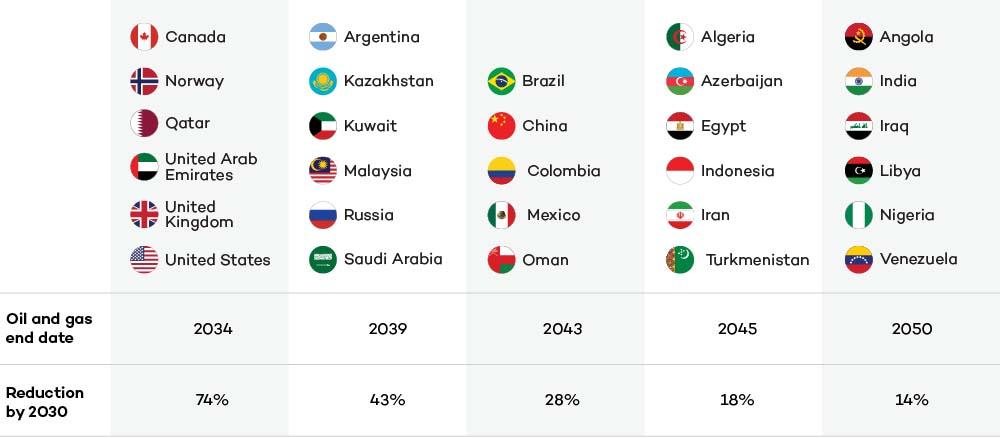
The Tyndall report echoes the IEA in finding that no new oil and gas fields can be developed: there is no room for any country, at any income level, to increase its oil and gas production. It further finds that limiting warming to 1.5°C requires the richest countries to phase out oil and gas production by 2034, to give lower income nations longer to replace their income from fossil fuel production. The poorest countries should be given until 2050 to end production, but they will also need significant financial support to transition their economies within that time frame. 

There is no room for any country, at any income level, to increase its oil and gas production.

Since the amount of global warming is determined by cumulative carbon dioxide emissions, it is also important that countries start reducing production right away. The richest countries must reduce their oil and gas production by 74% by 2030 compared to current levels, and the poorest by 14%. 

A table showing the timelines for different countries to phase out oil and gas production
Timelines for the largest oil and gas producers to phase out production to allow a 50/50 chance of limiting global warming to 1.5°C.

If these timelines seem extremely tight, that is because governments have left it so late to reduce greenhouse gas emissions: emissions have continued to grow for over 30 years since the UN Framework Convention on Climate Change was agreed in 1992, and in the 6 years since the Paris Agreement of 2015. As a result, the IPCC’s global carbon budget—the maximum cumulative carbon dioxide emissions we can afford in the future—for a 50% chance of limiting warming to 1.5°C amounts to just over 10 years of current emissions. 

One consequence of this urgency is that equity can no longer be addressed only by differentiating the level and speed of mitigation action between countries. Even while richer countries move faster, a major increase in climate finance will be needed for heavily oil-dependent lower income countries to transition their whole economies in less than 30 years. Consider a country like Angola, where more than 40% of government revenues come from oil—that means that 40% of public sector workers rely on oil too for their livelihoods. And it is just as important to enable a just transition for those health workers, civil servants, and others, as it is for oil workers.

What Does This Mean in Today’s Context?

This research was carried out before Russia invaded Ukraine, with tragic consequences for Ukrainians who have lost homes and loved ones. Away from that immediate suffering, the resulting high oil and gas prices have led some to call for replacing Russian supplies by increasing oil and gas production elsewhere. While rising fuel costs will cause economic pain for those that cannot afford to bear it, increasing fossil fuel supply isn’t an effective solution. 

Besides the grave environmental consequences, there is very limited potential to increase supplies in the short term, as developing new oil and gas infrastructure can take 5 years or more. To have a near-term impact on energy markets, it is much quicker to reduce demand—such as through insulating homes, improving energy efficiency, or incentivizing public transport—as many governments and the IEA have recognized. 

To create security and resilience, we need to accelerate the transition to renewable energy.

The wider lesson is that oil and gas play a destabilizing role in international politics and leave energy consumers exposed to volatile prices. To create security and resilience, we need to accelerate the transition to renewable energy. And we need to manage the process of transition today to support workers and communities who are affected by it and avoid the chaos of an even more rapid shift later on, or of a deteriorating climate. 

This new report helps us understand the level of ambition we need. Now it is up to governments to act.

Insight

Canadian Youth See a Different Future for Climate Policy

March 21, 2022

Youth are crucial advocates for climate action, but decisions being made on the future of climate policy can end up taking a different direction from the issues that matter most to younger generations. To better understand what issues are important for young climate activists in Canada, IISD teamed up with Youth Climate Lab’s Research, Activate, Deepen (RAD) cohort earlier this year to bring together 30 keen youth with science and policy experts for a “Policy Jam” to map out ideas for the future. 

Our 30 participants split into two groups: the first group looked at the nexus between climate change and health policy, while the second group focused on aspects of climate policy that intersect with economic well-being for Canadians. Both groups came up with valuable insights to share, with feedback that reinforced why including youth in policy-making processes is vital for tackling sustainability challenges effectively.

Climate and health

The top issue identified by our health-related focus group is a lack of understanding by decision-makers of how climate policy and health policy are so deeply intertwined that one cannot be addressed without addressing the other. This challenge exists not only in Canada: at the international level, IISD and the University of Edinburgh’s Global Health Academy have found that health experts need to be brought into environmental decision making to produce more robust outcomes.

Air pollution is one such example. Most of our Policy Jam participants live in cities where heavy traffic means higher emissions and air pollution. This urban air pollution raises the risk of serious adverse health outcomes, even following short-term exposure. 

Recent natural disasters in British Columbia have meant that some of our participants have experienced reduced access to food and other essential resources. These experiences have driven home how climate-induced natural disasters will mean greater food insecurity and vulnerability for many, particularly populations that are already underserved. For example, many Indigenous communities still lack basic access to resources like healthy food and clean water, which leads to a higher risk of serious health complications. Looking to the future, Indigenous communities need to be an integral partner in decision making for issues regarding the environment and health.

Looking to the future, Indigenous communities need to be an integral partner in decision making for issues regarding the environment and health.

Canada’s ageing population is another concern, our focus group found. Older adults are more vulnerable to many potential health problems, as exemplified by COVID-19. Scientists expect viruses to become a more frequent problem as our climate crisis becomes more severe, compounded by other climate-related challenges such as extreme heat, which killed hundreds of Canadians this past summer alone. Our focus group participants worried about what this situation meant for the health of their parents and grandparents, especially as COVID-19 already showed some of the vulnerabilities of our health systems when faced with compounding emergencies.

Our focus group recommended that governments tackle the issues that our health systems face through an environmental lens that is inclusive of Indigenous and minority voices. This includes better preventive measures, namely by acting now to prevent our climate crisis from worsening and therefore leading to these health problems. Climate change mitigation measures can help avert future pandemics, prevent deaths from extreme heat, and help reduce the risk of cardiovascular disease for many, in turn relieving pressures from the health system.

Climate and economy

Today’s job market also lacks the type of employment that young people seek, our economic-focused group found. The generation coming into the workforce is not concerned only about their livelihoods—they want their work to help make the world a better, kinder, and more sustainable place. 

For example, while some participants hope to work in the energy sector, they have seen limited job options in solar, wind, and other types of renewable energy, and they are reticent to apply for energy jobs at companies that prioritize fossil fuels. They argued that governments should shift investments away from fossil fuels and toward renewables while also prioritizing less carbon-intensive production, which will have climate benefits while creating the types of renewable energy jobs that the upcoming generation are seeking. This is a particularly valuable insight given the ongoing labour shortages in many parts of the country.

The group also raised concerns over why the polluter-pays principle is absent from many parts of the supply chain. While the implementation of the federal carbon tax in most places was a positive first step, they identified many production scenarios in which society ends up paying for the environmental damage that manufacturers can cause, with the worst impacts often affecting the most vulnerable members of society. 

Plastic packaging typifies this problem: they noted that when consumers buy groceries, their intention is to buy food, not packaging. However, currently, products packaged in plastic tend to be cheaper than products packaged in glass or compostable materials. Consumers face an unfair financial burden to pay a premium for a sustainably packaged product. Our focus group argued that if producers were forced to pay for the damage caused by plastic packaging, this would shift the cost of sustainable packaging away from consumers and enable them to make sustainable shopping choices.

Inclusion, social justice, and food systems

Over the course of the workshop, our participants noted that some issues are cross-cutting in nature, particularly the lack of inclusion of Indigenous voices in all aspects of planning and governance. The result has meant that Indigenous communities are at a disadvantage to other Canadians in all aspects of economics, health, and sustainability. Righting the injustices faced by Indigenous communities is intrinsically connected to tackling issues in sustainability. 

Inclusive decision making means making sure marginalized groups are heard and that community members are brought into the process, rather than limiting the debate solely to policy experts. As young people, our workshop participants are frequently excluded from political spaces due to the perception that they lack the experience or knowledge of older adults. Canada has many groups of people who are also frequently excluded from decision-making spaces, including BIPOC and other marginalized communities, whose voices would add invaluable insights to high-level conversations about climate and sustainability.

Inclusive decision making means making sure marginalized groups are heard and that community members are brought into the process, rather than limiting the debate solely to policy experts.

The problems inherent in the current Canadian food system were another major concern for participants. According to the Government of Canada, about half of the country’s food is wasted, leading to large quantities of greenhouse gas emissions. However, at the same time, many Canadians remain food insecure. These are just a few of the many sustainability challenges facing Canadian food systems, which have also faced the strain of the COVID-19 pandemic. Policy-makers and producers alike need to do more to incorporate equity and justice considerations.

Our Policy Jam participants suggested that distributing the Canadian food supply in a more efficient way throughout the various points in the supply chain before food reaches grocery store shelves could have positive impacts for climate mitigation, along with helping Canadians become more healthy and financially secure. Making the food system more efficient was an issue flagged for further research and discussion.

Our participants’ recommendations offer insights into how Canadian youth envision a sustainable future; but to make this future a reality, today’s decision-makers will need to be involved. The concerns raised by our focus group participants can serve as a jumping-off point for decision-makers to start thinking about how to put these concepts into action. Including young and marginalized voices in decision-making processes should always be a priority, given that they will live with the policies enacted today and will be those crafting policy solutions tomorrow.

Insight

Overcoming the Threats to Global Food Systems from Russia's Invasion of Ukraine

March 14, 2022

This article was first published on the International Food Policy Research Institute (IFPRI) website and is reprinted below with permission.

The Russian invasion of Ukraine has shocked the world, leading to terrible suffering. Harsh impacts are already being felt beyond the conflict zone. The war has the potential to spark a global food security crisis driven by two factors: skyrocketing food costs for consumers and fertilizer costs for producers. This crisis demands an immediate global response to provide relief in the short term, as well as policy changes to diversify the world’s food markets over the long term to build resilience and avoid future crises.

Commodity prices were rising steadily before the invasion, according to the FAO Food Price Index, and hit an all-time high in February before the full impacts of the invasion could be felt. Prices of cereals and vegetable oils are reaching levels higher than the 2008/2009 global food price crisis (see Figure 1).

Figure 1

The invasion has created two principal problems that will likely drive food prices higher. It is disrupting production and trade in Russian and Ukrainian cereals and vegetable oils, which command a significant share of the global market—about 30% of world wheat and barley exports, for example. It has also interrupted fertilizer exports from Russia and Belarus, which together account for a major share of global production.

If Russia were to ban exports of its important food crops in retaliation for sanctions and prices spike, a domino effect could result in countries imposing their own export bans and restrictions. This has been a common reaction to high grain prices: It happened during the 2008/2009 food price crisis and was considered briefly by Russia and others early in the COVID-19 pandemic. This would push food prices even higher and create even more scarcity. The combination of high prices and scarce food and fertilizer would hit many lower-income countries hard, particularly in the Middle East and Africa, and potentially push millions more people into hunger and poverty.

This is a dire situation. But responding to it can also be seen as an opportunity—to fix the problems that helped create it and to build long-term global resilience.

The Russian invasion of Ukraine comes on top of years of other crises that remain unresolved: the COVID-19 pandemic, climate change, biodiversity loss, and rising global hunger.

Part of the solution to the environmental crises we are facing is the inefficient use of chemical fertilizers, which results in runoff, depleted soils, and increased greenhouse gas emissions. Like food prices, chemical fertilizer prices were already rising before the war, an increasing drain on the budgets of governments providing fertilizer subsidies. Now the invasion is likely to drive them up still further. This could provide a greater incentive to improve efficiency in the application of fertilizers.

More importantly, shocks and crises have become the new norm, which calls for a fundamental reconsideration of how food is produced, traded, and consumed. The increased frequency and severity of shocks, whether as a result of extreme weather events, pandemics, or conflict, means the world needs to diversify where and how food, fertilizer, and energy needs are sourced. The concentration of production and trade in too few places, and by too few companies, is a real threat to global food security.

This does not mean countries should turn inward and seek to become self-sufficient in food production. That would be disastrous and make them even more vulnerable to local or national shocks. Take, for example, the Southern African drought of 2015–2016, which wiped out 30% of the region’s grain production and left 41 million people food insecure. If drought-stricken countries had not been able to import food, the situation would have been much worse. We need more choice, not less. Markets should be diversified at all levels—global, regional, national, and local—in order to build resilience and provide more choices for where affected populations can meet their needs when the next shock arrives.

Achieving such changes will require both short- and long-term action. In the short term, countries should address high prices by avoiding export bans of food staples, diverting food currently destined for biofuel production back to the food supply, and providing social safety nets to consumers and producers.

In the long term, three things are needed.

First, address the use of chemical fertilizers. Countries, international organizations, and private sector stakeholders should focus on improving the efficiency of the application of chemical fertilizers and on increasing public and private investment in innovation to promote more targeted plant nutrition and alternatives to chemical fertilizers. One important source of public investment could be redirecting government subsidies for chemical fertilizers—one of the most environmentally harmful forms of support given to farmers. Repurposing this support would not only reduce reliance on this commodity, but it would also be a huge win for human health and the environment.

Second, strengthen global trade rules to stop countries from banning or restricting exports of food staples unless they face their own food security crisis. This would require updating the World Trade Organization rulebook on agriculture but also improving the transparency of agricultural markets and rebuilding trust between countries through the Agricultural Market Information System (AMIS). These steps could help reassure countries concerned about food security so they do not panic and impose trade restrictions that harm other countries. The upcoming WTO Ministerial Conference in Geneva in June 2022 is an opportunity to advance these issues.

Third, increase the resilience of the global food system by reducing dependency on a few countries and a few companies for the bulk of agriculture and food needs. This means diversifying, strengthening, and improving the way agriculture and food markets function by making them less concentrated and disciplining excessive market power.

Russia’s war in Ukraine could lead to one of the worst food crises in decades. Every effort should be undertaken to avert and minimize the resulting human suffering happening now. But the broader message is clear: To safeguard itself from future crises, the world must also make the necessary longer-term investments in agriculture and food systems to ensure they are able to provide nutritious food for all people in a sustainable way.


Insight

Russia's War in Ukraine: Why doubling down on the Green Deal is the best strategy

As EU leaders meet in Versailles, energy is set to be a key topic. But leaders must ensure that the decisions they make to break away from Russian energy push the EU in the direction of sustainability, argue European sustainability think tanks.

March 10, 2022

This opinion piece by Think Sustainable Europe Executive Directors was first published on Euractiv on March 10, 2022 and is reprinted with permission. The commentary is co-signed by members of the Think Sustainable Europe network. The full list of signatories is both in the authors' list above and again at the end with their full affiliations.


The world has changed drastically in a matter of days, and in Europe, these changes are set to reshape the entire nature and ethos of the European project.

As Russia’s invasion of Ukraine continues to take a heavy toll, the heads of state and government gathering in Versailles today and tomorrow (10-11 March) will need to take actions that support Ukraine while also shoring up the bloc’s own strategic autonomy from Moscow.

The European Green Deal will be crucial for the success of this strategy.

The lasting impact of emergency decisions on the European Green Deal

Firstly, EU leaders are facing emergency decisions that stand to have lasting effects on the implementation of the Green Deal, especially when it comes to energy policy.

There is now a far greater need for the bloc to decarbonise its energy systems and reduce its reliance on imported oil and gas from Russia.

However, making this shift happen in the immediate future presents enormous risks. Short-term measures, such as finding alternative fossil fuel suppliers and products that can fulfil immediate energy needs, might create detrimental lock-in effects.

In this context, the call by European Commission President Ursula von der Leyen to accelerate the decarbonisation of the energy system is highly welcome.

To make Europe more independent and resilient, it will be key to proceed with Fit for 55 negotiations, accelerate industrial transformation, retain a focus on medium and long-term strategies and have clear phase-out clauses for emergency measures that might go against Europe’s carbon neutrality.

Green strategic autonomy embedded in the Green Deal objectives

The Green Deal was not originally conceived as a peace- and security-building instrument. But the growing consensus in Europe around the need to achieve a green strategic autonomy for Europe requires ending our dependence on foreign fossil fuels and increasing security of supply for green energy.

Such a change in direction will have major implications on several files, from the Fit for 55 package to the EU Sustainable Finance Taxonomy, and from the Circular Economy Action Plan to the Farm to Fork Strategy.

Having an evidence-based debate on what constitutes green strategic autonomy will be essential to prevent vested interests from capturing the debate to their advantage, as demonstrated by the current controversy on food security.

The need for a common energy strategy

The principled stance to heavily criticise Russia and welcome refugees that all Visegrad countries took on the invasion despite the vulnerability of their energy system could signal a shift in the traditional divide between East and West on energy issues.

It is now becoming very clear that national energy choices are no longer a mere domestic issue, leading to calls for much greater unity around Europe’s energy strategy, that would go beyond the Energy Union, with associated policy and funding instruments and a much greater emphasis on renewable energy, green energy storage, solidarity and demand-management as a key axis for energy security and decarbonisation.

The solidarity challenge

In the context of the Fit for 55 legislative package, heated debates have already been taking place between key stakeholders on intra- and inter-country equity challenges posed by its potential impact on consumer prices.

With the influx of refugees and the unequal and differentiated impact that a cut-off from Russian supplies will have on member states, the solidarity challenge will resurface at the centre stage of the debates.

Discussions ranging from the sharing of funds for new green investments to the design of the Social Climate Fund need to lead to much greater solidarity between countries and citizens of Europe.

Engaging citizens and companies

As policy choices will have almost immediate effects on the price of essential goods and services, governments will be faced with the need to engage with citizens and corporations.

Community ownership of green energy, energy efficiency and reducing energy demand (especially conventional fossil fuels) should be promoted amongst consumers.

This means having the courage to discuss the issue of sufficiency, a concept from which policymakers have so far shied away. A European-wide Green Deal Communication campaign focused on grassroots engagement is needed more than ever.

Promoting global cooperation

As the EU looks to build its strategic autonomy, what the bloc itself looks like is set to change. But these changes must not lead to Europe closing itself off from the wider world.

This is a moment for building deeper relationships with the Global South, particularly Africa, rather than allowing for further fragmentation between world regions. A stronger Green Deal diplomatic effort focused on cooperation can pave the way for these relationships to grow and deepen.

When they meet today and tomorrow, EU heads of state will need to make very tough decisions, many of which might redefine the European project.

Let’s make sure that the new European Union that will emerge fully contributes to European and global peacebuilding by accelerating its own green transition.

*While this editorial was being published, the European Commission proposed an outline of a plan to make Europe independent from Russian fossil fuels well before 2030 and a reduction of gas imports by 2/3 by the end of the year.

Signatories:

Céline Charveriat, Executive Director, Institute for European Environmental Policy (IEEP) 

Camilla Bausch, Scientific & Executive Director, Ecologic Institute

Sébastien Treyer, Executive Director, Institute for Sustainable Development and International Relations (IDDRI)

Måns Nilsson, Executive Director, Stockholm Environment Institute (SEI)

Alexander Müller, Managing Director, TMG – Töpfer Müller Gaßner Gmb

Nathalie Bernasconi-Osterwalder, Executive Director, IISD Europe

María José Sanz Sánchez, Scientific Director, Basque Centre for Climate Change (BC3)

Ioli Christopoulou, Policy Director, The Green Tank

Katarzyna Zwolak, Executive Director, WiseEuropa

Vít Dostál, Executive Director, AMO

Martina Méhes, Managing and Policy Director, EnergiaKlub

Raimondo Orsini, Director, Sustainable Development Foundation