Webinar

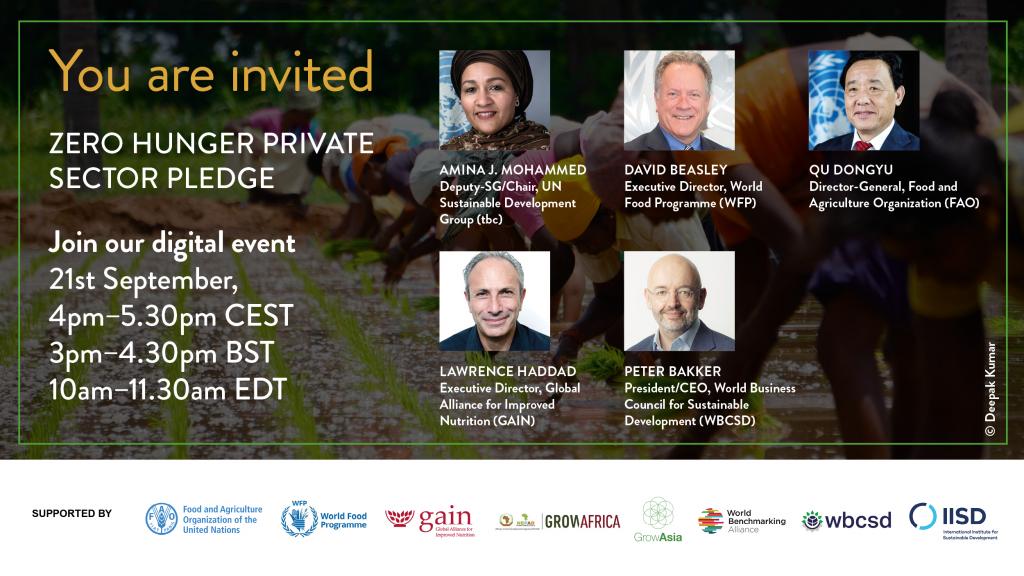
The Zero Hunger Private Sector Pledge Launch Event

We are launching the Zero Hunger Private Sector Pledge on Tuesday, September 21. This is a unique opportunity for companies and investment funds to align their investments with new evidence and commitments by donors, governments, and global institutions to end hunger and nourish the future by 2030.  

September 21, 2021 10:00 am - 11:30 am EST

(Open to public)

COVID-19 wiped out 15 years of progress in reducing hunger globally. Investing USD 33 billion more per year can reverse this trend and end hunger for good.

A world without hunger is possible, but it is time to take action! Governments cannot do it alone.

More private sector investment is needed, so we are looking to the private sector to do their part in contributing—and also inspiring other players to act. The ground-breaking Ceres2030 report—reinforced by the Program of Accompanying Research for Agricultural Innovation (PARI) and The State of Food Security and Nutrition in the World 2021 (SOFI) reports—emerged from the UN Food Systems Summit’s Coalition of Action for Zero Hunger and draws a 10-year roadmap to reverse the downward hunger spiral.

Scroll down to view the livestream
GAIN Zero Hunger Pledge Speakers

The Zero Hunger Private Sector Pledge Launch will welcome the first champions. We will hear how they are partnering with governments, donors, and global and local institutions to drive more effective private investments and how their pledges will contribute to national food systems pathways.

The pledge is being supported by a network of implementing organizations and partners, including the Global Alliance for Improved Nutrition (GAIN), Grow Africa, Grow Asia, the World Benchmarking Alliance, the World Food Programme, the International Institute for Sustainable Development (IISD), the Food and Agriculture Organization of the United Nations (FAO) and the World Business Council for Sustainable Development (WBCSD).

For further information on this initiative please consult the related project page.

WATCH - Livestream of the meeting.


Tentative Speakers:

  • Agnes Kalibata, President, AGRA and UN Secretary-General’s Special Envoy to the 2021 Food Systems Summit
  • David Beasley, Executive Director, WFP 
  • Peter Bakker, President and CEO, WBCSD 
  • Qu Dongyu, Director-General, FAO 
  • Caroline Keelings, CEO, Keelings 
  • Nnaemeka Ikegwounu, Cold hubs/The Smallholders Foundation 
  • H.E. Ambassador Josefa Sacko, Commissioner for Rural Economy and Agriculture of the African Union Commission (rep by Dr Godfrey Bahiigwa)
  • Thierry Nohasiarivelo, Coordinator, SBN Madagascar
  • HE Mr Désiré M’zinga Birihanze, Minister of Agriculture of DRC

Date / Time: Wednesday, September, 21 from 10:00 - 11:30 EST / 16:00 - 17:30 Geneva / CET / 15:00 - 16:30 UK time

Interpretation in English- French and Spanish will be available.

The event agenda can be found here


IISD in the news

AfDB to launch new initiative on integrating natural capital into finance in Africa

On 9 September, the African Development Bank Group, Green Growth Knowledge Platform (GGKP), and other partners will launch a new initiative on integrating natural capital into development finance in Africa.

September 3, 2021
IISD in the news

OPINION: Why African Countries should make this end of the line for harmful fishing subsidies

What drives fisheries subsidies in the coastal oceans of Africa? "Untackling the key issues of the World Trade Organisation (WTO’s) negotiations on fishing subsidies and the free flow of information in a global context is vital."

July 27, 2021

IISD in the news details

Topic
Subsidies
Region
Africa
Project
Fisheries Subsidies
Impact area
Nature
Report

Impacts of Climate Change Policies on Developing Country Export Markets

Climate change policies including net-zero commitments, green new deals, and circular economy plans often combine carbon-reduction objectives with a set of policy and market interventions needed to reach those goals. When implemented, these policies are likely to impact international trade, and potentially hamper the development of lower-income countries. This report takes stock of such potential impacts on goods exports of sub-Saharan African countries, least developed countries (LDCs) and low-income economies.

July 26, 2021
  • Most net-zero and circular economy plans foresee a drastic reduction of oil demand, which will affect exporters such as South Sudan, Angola, Nigeria, Chad, and Congo who rely on fossil fuels for more than 50% of their total exports—96% in the case of Chad.

  • While markets for fossil fuels will tighten, there is space for growth in markets for metals and minerals that are essential to the energy transition. The most important and valuable market is the one for non-ferrous metals such copper, aluminum, nickel, and zinc.

  • Regional trade, including intra-African trade, can offer new opportunities for diversification and is less likely to attract restrictions related to net-zero commitments or circular economy packages that are more prevalent in OECD countries or large emerging economies.

Overall, net-zero commitments and circular economy packages are likely to have significant impacts on exports of developing countries. The most immediate impact potential is on exports of fossil fuel products. The risks for agricultural products may not be as pronounced but will affect a much higher number of LDCs and African countries. Finally, countries relying on metals and minerals may benefit from increased demand associated with renewables and battery production, at least in the short to medium terms, but in the long term, demand for secondary raw materials and recycling requirements may affect export prospects.

These trends will force developing countries to accelerate their efforts to diversify their export basket and comply with new requirements in OECD countries and emerging economies. Besides technical assistance and capacity building for example under the Aid for Trade initiative, the promotion of South-South trade in the context of regional integration including the African Continental Free Trade Area offers significant prospects to offset the negative impacts associated with net-zero commitments or circular economy package and support economic diversification.

Participating experts

Webinar

Deep Dives Into the Nexus of Food Systems, Climate Change, and Nutrition

July 28, 2021 8:00 am - 8:50 am CEST

(Open to public)

The 2021 UN Food Systems Summit is taking place in the context of the climate crisis and exacerbated global food insecurity resulting from the COVID-19 pandemic. While the world is facing these challenges and a global response will be needed, developing countries—and in particular African countries—are dealing with an even more extreme situation. Their development dynamics and needs involve an increase in food consumption and production to address the nutritional requirements of their populations in an approach that also ensures the environmental sustainability and resilience of their agricultural practices. Based on developed country experience, there is no evidence that such a transition could be achieved by relying on market economic forces alone, especially if the social inclusiveness of the process has to be guaranteed. Therefore, policy pathways must be identified and implemented that favour synergies and limit trade-offs within the nexus between climate change, food systems, and nutrition.

Speakers

  • Francine Picard, Senior Policy Advisor and Partnerships Lead, IISD 
  • Carin Smaller, Director of Agriculture, Trade and Investment, IISD 
  • Dr. Andrew Kwasari, Senior Special Assistant to the President on Agriculture, Office of the Vice President of Nigeria
  • Christel Weller-Molongua, Director of Rural Development and Agriculture Division in the Global Department at GIZ 
  • Dr. Felix Phiri, Department of Nutrition, HIV and AIDS of the Ministry of Health in Malawi  
  • Willem Olthof, Deputy Head of Unit, DEVCO C1 - Rural Development, Food Security, Nutrition, European Commission  

This session explains how we can influence consumption patterns through policy interventions that will lead to better environmental and nutritional outcomes in three countries—Malawi, Ethiopia, and Nigeria—in order to identify policy roadmaps to sustainable food system transformation. Specifically, by building on the Ceres2030 literature review and cost modelling exercise, this research supports analytical work to strengthen the evidence base for climate-smart nutrition interventions in the context of a sustainable food system. This aligns with the overarching transformative theme of the UN Food Systems Summit.

The purpose of this parallel session is to present the results from the country case studies, together with country focal points from the three countries: the Office of the Vice President of Nigeria, the Ministry of Public Health in Malawi, and the Federal Ministry of Health in Ethiopia. We aim to develop joint ownership of the final recommendations and enhance the utilization of the research in the Food Systems Summit, dialogues, and long-term country-level strategies.

Deep Dives Into the Nexus of Food Systems, Climate Change, and Nutrition in Malawi, Ethiopia, and Nigeria will provide examples of how to develop a country-level roadmap for food systems transformation that could serve as a blueprint for other countries and that is based on the best available evidence, economic modelling, and a deep engagement with national-level stakeholders working together with experts.

This event is the result of a collaboration between the International Food Policy Research Institute (IFPRI), the International Institute for Sustainable Development (IISD), Deutsche Gesellschaft für Internationale Zusammenarbeit (GIZ), the European Union, the Malawi Ministry of Public Health, and the Office of the Vice President of Nigeria.

Interpretation in French and in English will be available.

Webinar

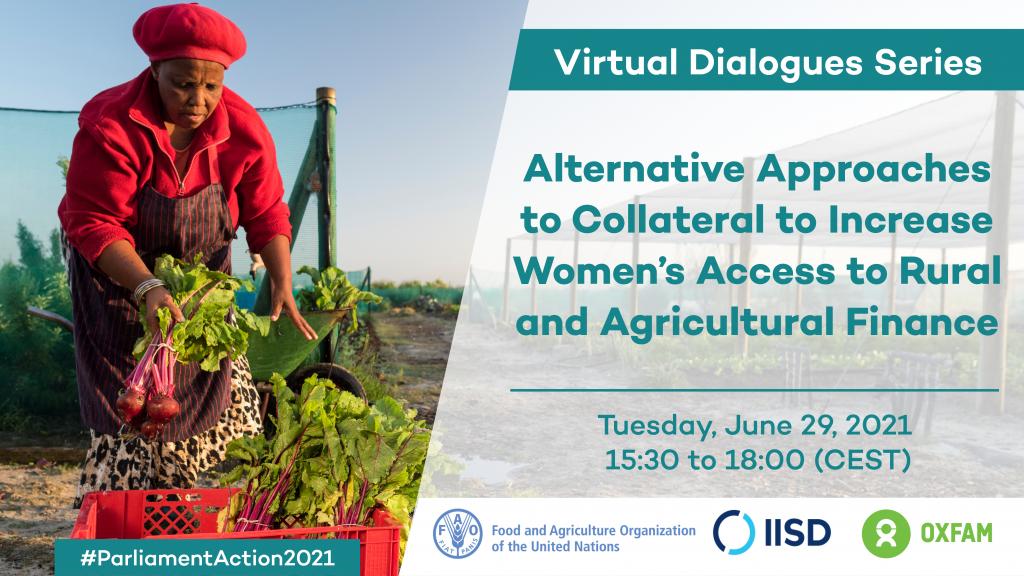
Parliamentarian Action #5 | Alternative Approaches to Collateral to Increase Women’s Access to Rural and Agricultural Finance

June 29, 2021 3:30 pm - 6:00 pm CEST

(Open to public)

Virtual dialogue series event details

Agricultural lending is considered "high risk" by formal financial institutions, as farmers are more vulnerable to changes in weather, rainfall levels, pests, and infestations, as well as price fluctuations. As a result of these perceived and actual risks, loans for smallholder farmers require high rates of collateral. This situation is exacerbated for rural women, who often do not inherit and possess assets or properties that can be accepted by formal financial institutions as conventional forms of collateral.

This virtual dialogue of the Parliamentarians Actions for Gender Equality and Resilient Food Systems in Response to Covid-19 series brought together parliamentarians, financial institutions, and other main stakeholders to discuss the importance of developing alternative approaches for risk sharing and management that can increase women’s access to finance through alternative collateral requirements.

This dialogue sought to:

1) Raise awareness on the specific constraints and challenges faced by rural women in accessing finance along with their interlinkages with rural poverty and food insecurity, as well as potential opportunities to ensure women’s financial inclusion.

2) Share existing public policies and strategies in the African region to develop nonconventional collateral approaches targeting rural areas, in order to enhance the capacity of parliamentarians to engage with financial institutions and other stakeholders to strengthen national financial markets through the promotion and adoption of regulatory and legislative frameworks.

3) Promote an exchange of knowledge, experiences, and good practices among parliamentarians, international organizations, financial institutions, women's organizations and other relevant stakeholders on specific measures and approaches to promote rural women’s access to finance.

This was the fifth virtual dialogue in the Parliamentarians' Actions for Gender Equality and Resilient Food Systems in Response to COVID-19 series. It was held on June 29, 2021, from 15.30 to 18.00 CEST.

It was part of a series of dialogues organized by the Food and Agriculture Organization of the United Nations (FAO), International Institute for Sustainable Development (IISD), Women in Law & Development in Africa (WiLDAF) and Oxfam as part of their policy support to the Economic Community of West African States (ECOWAS) Network of Parliamentarians on Gender Equality and Investments in Agriculture and Food Security. The objective of the series is to enhance the role of African parliamentarians in mitigating the gender-differentiated impacts of COVID-19 on food systems.

Watch the virtual dialogue's full recording

Assista à íntegra do diálogo virtual em língua portuguesa


Related resources 

Women and Finance: Enabling Women’s Economic Empowerment

Women's Financial Inclusion: Closing the Gender Gap

Financial Inclusion for Women's Economic Empowerment

In Uganda, Can Cows Help Close the Credit Gap? 

IISD in the news

Experimental Lakes Area to partner with African researchers in 2022

A new program in northwestern Ontario could bring up to a dozen young, female scientists, who usually conduct their research on the other side of the globe, to the Experimental Lakes Area (ELA).

June 10, 2021

IISD in the news details

Topic
Water
Region
Canada
Africa
Project
IISD Experimental Lakes Area
Impact area
Nature
Insight

Food Prices Are Soaring, Hunger Is Rising: Here are three ways to stop another crisis

The Food and Agriculture Organization of the United Nations (FAO) just announced that global food prices have hit their highest level in a decade, jumping 40% in May compared to the same period last year. The news comes on the heels of a devastating COVID-19 hunger crisis that the FAO projects will increase the number of hungry people by up to 130 million, taking us back to hunger levels not seen in half a century.

June 8, 2021

The Food and Agriculture Organization of the United Nations (FAO) just announced that global food prices have hit their highest level in a decade, jumping 40% in May compared to the same period last year. The news comes on the heels of a devastating COVID-19 hunger crisis that the FAO projects will increase the number of hungry people by up to 130 million, taking us back to hunger levels not seen in half a century.

The main causes are increased demand for grain and soybeans in China, severe drought in Brazil, and growing demand for vegetable oils for biofuels and biodiesel. The massive rise in food prices will hit food importers and low-income countries the hardest, as people struggle to pay to meet their basic food needs and countries fight to keep prices affordable. We have been here before.

We have been here before. The last times we saw prices spike this high were during the food price crises of 2008/2009 and 2010/2011. Some food exporting countries responded by restricting exports of food staples. Foreign investors responded by buying up large tracts of farmland to secure additional means of production for their domestic economies. The financial sector responded through further speculation on commodity markets. It created the perfect storm for a dramatic rise in global hunger.

But this time can be different. This time we know what needs to happen.

1) Change global rules on food trade

Our recent report on shocks to the food system lays out an ambitious agenda for trade policy reform to help governments respond to shocks like this price spike. Governments at the World Trade Organization (WTO) should agree to ban export restrictions on all food staples. At a minimum, they should conclude negotiations to exempt non-commercial humanitarian food aid by the World Food Programme from export restrictions or prohibitions.

There is also a pressing need to reform rules on domestic support to farmers to allow all countries to provide support to their farmer sector without harming producers in other countries (International Institute For Sustainable Development [IISD] & International Food Policy Research Institute [IFPRI], 2020). This would help improve the stability and predictability of food markets, as would an agreement to cut unusually high tariffs on key farm goods in major importing countries.

2) Double public investment in agriculture

An additional USD 33 billion per year of public investment is needed to end hunger and double the incomes of the poorest while at the same time maintaining greenhouse gas emissions in agriculture to the commitments made in the Paris climate agreement. This is the key finding from the work of 86 researchers from 23 countries and 53 organizations led by Cornell University, IFPRI, and IISD. In this study, published in Nature Research, we found that in the next decade governments must reverse the chronic under-investment in agriculture, particularly in Africa, and provide an additional USD 33 billion in public spending per year until 2030.

market place
iStock

The additional money should be spent on the farm, with a focus on extension services, irrigation, finance, infrastructure, research and development (R&D), and production subsidies; on food markets, with a focus on infrastructure, technical assistance for small and medium-sized enterprises, storage, sustainable energy, and refrigeration; and to empower the excluded, with a focus on strengthening farmer organizations, education for rural young people, and social protection. Social protection in particular needs to be ramped up urgently to ensure people’s access to sufficient food.

3) Large-scale agribusiness investment must be responsible and inclusive

One of the key drivers of the current spike in prices is the growing demand for vegetable oils for biofuels and biodiesel. This means more demand for palm oil and other oil that contribute to increased commercial pressures on land, and increase the risk of land grabbing.

In the past decade, a number of countries have improved their laws, regulations, and contracts governing foreign private sector investment, including Argentina, Burkina Faso, Chile, Colombia, Lao PDR, Mexico, Peru, Mali, Sierra Leone, and Sri Lanka. This has contributed to more responsible and sustainable outcomes from investment in agriculture.

market place
iStock

The ongoing reform of legal and policy frameworks must continue to be driven by national priorities and local needs, and informed by international norms, guidance, and best practices.  Governments should incentivize business models that require foreign investment to be integrated into local, national, and regional economies and that help diversify production, distribution, and consumption systems to expand markets and opportunities.

A perfect storm is on the horizon. But with the knowledge and evidence we have about available, effective solutions, we can weather this storm and emerge in a hunger-free, more equal global society that protects our fragile climate.

Workshop

Virtual Workshop for Government Officials Eastern and Southern Africa

June 28, 2021 3:00 pm - July 1, 2021 6:00 pm (GMT+3)

(By invitation)

The main goals of this virtual training workshop are to help government officials understand the legal and policy risks as well as potential benefits of different business models in agriculture, with a focus on large-scale agribusiness investments—while at the same time applying the Principles for Responsible Investment in Agriculture and Food Systems (CFS-RAI) to better analyze the legal tools used.

The regional focus of Eastern and Southern Africa will facilitate peer-to-peer learning and showcasing of champions in the region, as well as sharing of regional best practices for responsible agricultural investment. 

This training workshop will seek to enhance participants' awareness on:

  • The relationship between global, regional, and national legal frameworks for responsible investments in agriculture.
  • Situating the CFS-RAI as one possible best-practice framework to promote fair, balanced, and equitable legal tools in the agricultural sector, hence aligning national laws and policies with these principles to achieve national and regional development objectives.
  • The opportunities and risks posed by large-scale agribusiness investments and the role of foreign direct investment (FDI) in agriculture to promote responsible agricultural investment.
  • The opportunities, risks, and trade-offs from different business models and incentives for investment in agriculture. This includes agricultural growth poles, public-private joint venture agreements, concessions, public-private partnerships, and the use of voluntary sustainability standards to help smallholder farmers access global value chains.
  • Best practices to improve negotiation outcomes for responsible investments in agriculture and food systems, including national strategies, models and templates; institutional arrangements, and cost-benefit analysis to achieve development objectives.

It will be held from June 28 to July 1, 2021.

This event is made possible through guidance and support from the Food and Agriculture Organization of the United Nations (FAO). Support was also provided by IISD's programme on Promoting Sustainable Investment in Agriculture and Food Systems, the Swiss Agency for Development and Cooperation (SDC), the Common Market for Eastern and Southern Africa (COMESA) and the East Africa Community (EAC).

This meeting is by invitation only.