Stakeholders' perspectives in Brazil, Canada, Trinidad and Tobago, the United Kingdom, and Vietnam
This report contributes to the global BCA discussion by summarizing country-level reports reflecting dialogues conducted in Brazil, Canada, Trinidad and Tobago, the United Kingdom, and Vietnam. (Download PDF)
August 2, 2024
1.0 Introduction
As countries increase their climate change mitigation ambitions, they are considering establishing border carbon adjustments (BCAs), a mechanism through which the carbon emissions embedded in certain imports are taxed at the border. Efforts to price carbon domestically can result in displacing economic activity and, therefore, greenhouse gas (GHG) emissions to other jurisdictions with less ambitious climate policies—this is called carbon leakage. Implementing BCAs could complement domestic climate change mitigation measures to avoid leakage.
The European Union (EU) and the United Kingdom are first out of the gate. Under the EU Carbon Border Adjustment Mechanism's (CBAM's) transition period, since 2023, importing companies must report import-embedded emissions; starting in 2026, fees based on said emissions will apply. The United Kingdom will implement its CBAM starting in 2027 without a transitional phase.
In the United States, four proposed bills would impose carbon-related charges on imports: Three would impose a domestic carbon price and levy fees on imports. A fourth would impose border charges but no domestic carbon price. More generally, carbon leakage is becoming increasingly politically salient in the United States, as illustrated by the launch of the White House Climate and Trade Task Force.
Australia and Canada have consulted on a BCA. Such a system has also been mooted in Japan. Chinese Taipei's 2023 Climate Change Response Act includes a BCA, although its 2024 implementing regulation does not yet.
This report contributes to the global BCA discussion by summarizing country-level reports reflecting dialogues conducted in Brazil, Canada (Commission on Carbon Competitiveness, forthcoming), Trinidad and Tobago, the United Kingdom, and Vietnam. These dialogues gathered stakeholders' views from government, industry, finance, labour, academia, and civil society. The dialogues were conducted in 2023 and 2024 by IISD partner organizations: the Centre for Studies in Integration and Development (Brazil), the Commission of Carbon Competitiveness (Canada), the University of West Indies (Trinidad and Tobago), Chatham House (United Kingdom), and the Foreign Trade University (Vietnam).
Given their governments' policy objectives and the characteristics of their international trade, these countries illustrate different aspects of BCA opportunities and challenges. As discussed above, Canada is considering a BCA, while the United Kingdom is already designing specific elements of its system.
As shown in Figure 1, these five countries also exhibit varying levels of exposure to the EU CBAM and other jurisdictions adopting BCAs: Trinidad and Tobago and the United Kingdom appear to be the most exposed to the EU CBAM by share of exports in the covered goods.
Over the last 10 years, the share of CBAM goods exports to the EU has tended to increase for some of the countries covered there. The most recent increase for the United Kingdom was probably temporary: in 2022, lower power generation due to nuclear power plant maintenance in France induced higher British electricity exports. For Trinidad and Tobago, the trend can be linked to a sharp increase in overall EU imports of fertilizers since 2020. For Vietnam, higher iron and steel exports to the EU, which increased threefold between 2019 and 2022, drive this shift, possibly due partly to the 2020 European Union-Vietnam Free Trade Agreement. More broadly, though, the countries covered (except the United Kingdom) export their emissions-intensive products mostly to various markets outside the EU, indicating that regulatory divergence caused by the multiplication of BCAs might create additional challenges for their exports.
IISD-supported research shows that Canada faces a high risk of leakage by 2030 under announced climate policies in four sectors.
2.0 To BCA or Not to BCA? The quest to prevent carbon leakage
International differences in carbon pricing pose a carbon leakage risk: higher carbon prices in a given country induce imports from countries with less stringent environmental policies. Thus, the emissions of the former countries are partially displaced to the latter: they "leak."
Using the example of Canada, we show how BCAs are one of several policy options for addressing this risk.
IISD-supported research shows that Canada faces a high risk of leakage by 2030 under announced climate policies in four sectors (iron and steel, basic chemicals, fertilizers, and pulp and paper) and a medium risk for cement. Announced policies include an industrial carbon price of CAD 170/tonne by 2030. These policies are forecast to substantially impact costs incurred by industries. For the cement industry, announced climate policies, including the Canadian carbon price, will result in a carbon cost by 2030 that is 1.9% of sales value and 14.4% of operating profit margins. This is a substantial increase over 2023 (Figure 3). Note: The costs incurred are only part of the determinants of leakage risks. Trade exposure plays a significant role. Therefore, the most carbon leakage-exposed industries are not necessarily those incurring the highest costs.
BCAs can address this risk by equalizing carbon prices paid by domestic and foreign producers in the importing market: a fee is imposed on imported carbon emissions. A meta-analysis shows that "detailed numerical analyses using multisector, multi-region models consistently find significant potential for BCA to reduce leakage rates."
BCAs are not simple for the countries adopting them. They may increase consumer prices, be administratively complex, and should be carefully crafted to ensure World Trade Organization (WTO) compliance. Section 3 further explores potential drawbacks and discusses possible remedies. Given those challenges, the Canadian case study assessed the following alternatives to BCAs.
Output-based allocation is like free allocation in the EU's emissions trading system (ETS): Canada's output-based pricing system sets sectoral emissions intensity standards, and GHG-intensive firms must pay when emitting over the standard. They can also purchase credits from firms that emit below the standard. This policy keeps the average costs of carbon low, meaning less impact on prices and less leakage risk. However, it can also blunt the incentives to decarbonize, so the EU is abandoning free allocation and relying instead on the CBAM.
Green industrial policy support: Support for decarbonizing production processes can lower compliance costs with climate policies and thus lower the risk of leakage. However, this approach might be fiscally costly. It also requires strong capacity from policy-makers and institutions to target only specific market failures. In the Brazil dialogue, stakeholders feared that the possible increase in EU subsidies, as the EU is removing free allocation, could be detrimental to the bloc's trading partners.
Product-based GHG intensity standards: These standards would be a condition for sale on the domestic market and apply to domestic and imported goods, reducing leakage risk. Yet, if implemented in isolation by a mid-sized economy like Canada, this approach might create disincentives for trading partners to export there rather than improve their emissions intensities. The United Kingdom dialogue also expressed doubts about this policy's viability.
In summary, BCAs are not the only response to carbon leakage. While the stakeholder dialogues summarized below focus on BCAs as a policy option, other options exist.
3.0 How to BCA? Stakeholders' perspectives on principles and best practices in BCA design
3.1 What Goods/Sectors Should BCAs Cover?
Both the United Kingdom and EU CBAMs focus on upstream products. The EU CBAM covers aluminum, electricity, cement, fertilizers, iron and steel, and hydrogen. It also includes a few downstream products, such as iron screws and bolts. The UK CBAM is similar, except it also covers glass and ceramics but excludes electricity.
Both mechanisms may expand to other goods and sectors in the future. By the end of the CBAM's transitional phase (the end of 2025), the EU Commission will evaluate the need to expand it to additional goods and sectors covered by the EU ETS. In the United Kingdom, the public consultation concluded that UK CBAM should allow for coverage expansion in the future.
Some stakeholders fear that expanding the EU CBAM to other sectors covered by the ETS could impact some of their exports, particularly liquefied natural gas and methanol in Trinidad and Tobago, as well as plastics, glass, and ceramics in Vietnam. Stakeholders in Trinidad and Tobago recommend transparent criteria for adding new products subject to BCAs based on pre-defined factors such as emissions intensity and leakage risk.
3.2 Which Scopes of Emissions Should the BCA Cover?
BCAs can cover direct emissions from the production process (Scope 1); emissions from purchased electricity, steam, heat, and cooling (Scope 2); or various types of Scope 3 emissions (e.g., from purchased input goods or from transport). The EU CBAM currently covers Scope 1 emissions for all CBAM products. It also requires reporting Scope 2 emissions, specifically for fertilizers and cement. It covers specific Scope 3 emissions: emissions from precursors that are themselves CBAM-covered goods. The UK CBAM plans to cover some Scope 3 emissions on select precursors, like the EU CBAM, but all Scopes 1 and 2 emissions.
Some stakeholders oppose broader scope coverage. In particular, according to stakeholders in Trinidad and Tobago, reporting on Scope 3 emissions would be challenging and would require significant efforts from their government to build capacity among firms.
In other instances, scope expansion is seen favourably, as it may favour national competitiveness: Brazil has some of the cleanest electricity production in the world. If only direct emissions are considered, then the energy-intensive sectors may lose one of their main comparative advantages.
3.3 How Should Embedded Emissions Be Measured and Reported?
BCAs require emissions accounting at the product level. Accounting protocols under national carbon pricing typically measure emissions at the facility level, not the product level. Instead, BCAs inherently focus on the imported products themselves. This can be challenging. The CBAM has had to develop sui generis product-level methodologies. Product-level accounting is also inherently complex for installations that produce many covered products under one roof.
Stakeholders insisted that the EU CBAM should recognize multiple carbon reporting standards. The Brazilian National Confederation of Industry argued that the EU should also accept international reporting standards, such as the GHG Protocol and International Organization for Standardization (ISO) standards, as well as national measurement, reporting, and verification approaches. Stakeholders in Trinidad and Tobago recommended international cooperation to develop new, broadly recognized methodologies to measure and verify product-level emissions.
Brazilian stakeholders also criticized the EU CBAM for the stringency of the carbon measurement process. One of the three monitoring methodologies for direct emissions under CBAM is a measurement approach involving continuous monitoring that does not allow for in-house laboratory measurements. Stakeholders argued that this approach is extremely restrictive compared to the methodologies practiced by the Brazilian industry.
Default values can represent a practical alternative to costly and complex emissions measurement. In the EU CBAM's transition period, reporting can rely on default values estimated for each product and trading partner. Yet, from 2025, default values can only be used for input goods (precursors) and cannot represent more than 20% of embedded emissions. The EU CBAM default values are set relatively high to encourage the use of actual data. In the case of electricity, all emissions are estimated based on default values reflecting average intensity. Instead, the British government plans to give importers the freedom to choose between actual data and default values. This is in line with requests by most stakeholders at the government's consultation. The dialogue in Trinidad and Tobago highlighted that default values are an essential alternative to actual data, but some stakeholders worried that said default values might be set at a punitively high level.
3.4 How Should BCA Revenues Be Used, and How Can Those Negatively Affected Be Supported?
Several stakeholders in Brazil, Trinidad and Tobago, the United Kingdom, and Vietnam have advocated for BCA revenue to be allocated to decarbonization and mitigating the adverse side effects of BCAs. This contrasts with the current plans of the EU and the United Kingdom, which intend to allocate this revenue to their general budgets.
Yet, the question of repurposing funds for decarbonization also poses equity concerns. Stakeholders in Brazil feared that using revenues to decarbonize domestic industries in countries applying BCAs would increase the competitiveness gap vis-à-vis exporting companies from other jurisdictions.
3.5 How Should Foreign Action Be Credited?
Should the BCA charge be lowered to account for a carbon price paid in the country of export? With the EU CBAM and the UK CBAM, explicit carbon prices paid for in the origin country are deducted from the CBAM fees (i.e., any tax or ETS fee targeting carbon explicitly—but not excise fuel taxes).
Stakeholders in Trinidad and Tobago advocated for a broader recognition of decarbonization efforts, including those linked to non-price-based climate policies. Such policies included regulations that impose a cost on producers.
Brazilian stakeholders have also called for carbon capture, utilization, and storage (CCUS) to be accounted for when measuring and reporting emissions. CCUS consists of the on-site capture of emissions. Brazilian stakeholders argued that CCUS was necessary for hard-to-abate sectors. Under the EU CBAM, CCUS can be considered when calculating embedded emissions in CBAM goods, as long as specific criteria are satisfied. These criteria primarily require that the captured carbon dioxide is either used to manufacture products where it is permanently chemically bound or transferred to a long-term geological storage facility. Brazil’s National Confederation of Industry, in its submission to the European Commission's 2023 call for feedback on the EU CBAM implementing regulation, contended that provisions regulating CCUS may hinder the accounting of this technology. Note: One should note that, while this critic was aimed at the draft and not the official implementing regulation, the two versions are similar when it comes to CCUS provisions, as laid out in point B.8.2. of Annex 3.
Finally, the dialogues in Vietnam have revealed the importance of carbon offset mechanisms to the country’s decarbonization policies. Offsets consist of compensating emissions with reductions in emissions achieved by some entity outside the facility. Currently, the EU CBAM and the UK CBAM do not recognize offsets, as their respective ETSs do not recognize them either. While specific offsets could be used for EU ETS compliance until 2020, this is no longer the case due to concerns regarding their reliability.
3.6 Should Some Countries Be Exempted Based on Their Development Level?
There are no plans to exempt any countries, depending on their development level or other circumstances, from the EU CBAM or the UK CBAM.
Stakeholders across various countries' dialogues suggested exempting developing countries, specifically least developed countries. The dialogues in Vietnam highlighted that the principle of Common But Differentiated Responsibilities, enshrined in Paris Agreement Article 2, stipulates that development status should be reflected in each country's mitigation obligations. In Trinidad and Tobago, stakeholders argued that Small Island Developing States should receive specific exemptions.
The dialogues in Vietnam stressed that historical emissions should be considered when determining a given country's obligations under BCAs. They highlighted that the EU and the United Kingdom accounted for 22% of global historical emissions since 1751, whereas China was only responsible for 12.7% of the total.
Beyond these general design features, more specific aspects emerged in the dialogues in Canada and the United Kingdom: They relate to BCA phase-in (Box 1) and the possibility of imposing BCA fees from a given emissions intensity threshold (Box 2).
A transition period is seen as critical to operators. The EU CBAM has a transition period between 2023 and 2025, during which there are only reporting obligations but no fees to pay. Instead, the UK CBAM will directly enter into force in 2026. Some United Kingdom stakeholders have criticized this and proposed a "sandpit" for reporting importers to test out submissions and get feedback before UK CBAM enters into force.
Once the BCA enters full force, any remaining free allocations may require the border charge to consider the advantage given to domestic firms. BCA fees will only be imposed gradually in the EU and the United Kingdom as free allocation is phased out. In the EU, a single EU CBAM rate will be proportional to the remaining free allocations in the EU ETS—2.5% of the ETS price in 2026 and 100% in 2034. In the United Kingdom, the CBAM rates are set to be different for each covered sector, reflecting their respective level of remaining free allocations.
Imposing BCA fees only above a certain emissions intensity threshold has been proposed as a potential alternative to a BCA design that adjusts for a domestic carbon price. Some argue that this approach may offer advantages when the jurisdiction with the BCA has strong trade ties with a jurisdiction with very different carbon pricing policies. For example, Canada's economy is highly integrated with the United States', which does not have federal-level carbon pricing. Therefore, a BCA design that adjusts for a domestic carbon price would result in significant trade frictions.
The Canada dialogue has discussed a variation where the emissions intensity thresholds from which BCA fees are due are specific to each sector. The threshold would be set at each sector's average domestic emissions intensity. In other words, if the intensity of the imported product’s emissions is 50% greater than the Canadian sectoral average, the carbon price would only be charged on that 50%—producers with intensities at the Canadian level would pay nothing. This could prove particularly effective if implemented jointly with the United States.
According to some stakeholders in Vietnam, awareness raising remains a challenge and should be amplified.
4.0 How to React and Adapt to BCAs: Stakeholders' perspectives on policy responses from countries affected by their trading partners' BCAs
4.1 Raising Awareness
Participants in Trinidad and Tobago and Vietnam presented awareness raising as a cornerstone of preparing their trading partners' BCAs. Business associations played a crucial role in these efforts. Sometimes, they cooperated with international partners, such as the EU and the Caribbean Export Agency. According to some stakeholders in Vietnam, awareness raising remains a challenge and should be amplified.
Some stakeholders in Brazil, Trinidad and Tobago, and Vietnam consider developing or accelerating domestic carbon pricing as an effective policy response to BCAs. It has the advantage of lowering BCA fees incurred by exporters and retaining the revenue in the country of export. It also prepares firms by requiring them to measure and report their emissions. Vietnam plans to initiate an ambitious pilot carbon credit exchange in 2025.
4.3 Challenging BCAs Legally
There are concerns about BCAs' compatibility with international trade law.
According to the European Commission, the EU CBAM has been designed to be compatible with WTO rules. Similarly, the dialogue in the United Kingdom pointed out that legal analysis undertaken by the industry, particularly steel, concludes with the compatibility of EU CBAM and WTO rules. However, stakeholders in Trinidad and Tobago believe it may violate the General Agreement on Tariffs and Trade principles of non-discrimination by treating nations differently, particularly between EU member states, European Free Trade Association countries, and others. Moreover, in Vietnam, stakeholders suggested that the EU CBAM may also violate the EU-Vietnam Free Trade Agreement. Yet, stakeholders in Vietnam also pointed out that resolving those issues through dispute settlement might be lengthy and ineffective.
A radical response to BCAs can also be fully integrating pricing systems across countries. As this option is inherently politically challenging—it has only been achieved once between two particularly close trading partners—it is presented separately in Box 3.
Linking pricing systems such as ETSs across jurisdictions may eliminate trade frictions caused by BCAs: Any trade between the EU and Switzerland is exempt from EU CBAM fees, as the two jurisdictions have linked their respective ETSs and have, therefore, a common carbon rate. The agreement to link Swiss and EU ETSs, which entered into force in 2020, is the first of its kind.
Stakeholders have proposed linking ETSs between the United Kingdom and the European Union. Since the United Kingdom's exit from the EU, emission allowances have become cheaper under the British ETS than the EU's. This exposes British firms to EU CBAM fees, and being treated as foreign producers creates compliance issues that would be solved by re-linking the ETSs. It is worth noting that the EU–United Kingdom Trade and Cooperation Agreement indicates that the parties "shall give serious consideration to linking their respective carbon pricing systems."
5.0 The Way Forward
Dialogues with stakeholders across Brazil, Canada, Trinidad and Tobago, the United Kingdom, and Vietnam illustrate how BCAs can represent a response to carbon leakage risk. Yet many questions remain regarding their acceptability and fairness.
While BCAs are intrinsically unilateral measures, stakeholders have called for their implementation to be accompanied by multilateral discussions at international forums such as the WTO or the Organisation for Economic Co-operation and Development. Dialogues in Trinidad and Tobago and Vietnam highlighted the need for global coordination on reporting standards. Brazilian stakeholders advocated for partnerships with other developing countries to face BCA related challenges.
In this context, technology transfers are sometimes seen as a central aspect of international cooperation. Stakeholders in Trinidad and Tobago described technology transfers as the most critical aspect of the BCA debate. Vietnamese participants stressed its role in decarbonizing power generation and improving the energy efficiency of industrial processes.
The dialogues across all five countries reflect that BCAs are increasingly seen as an inevitable trend one needs to get right rather than oppose. Developing common principles to guide the design and implementation of BCAs will ensure they achieve their objective of mitigating carbon leakage without causing unnecessary trade frictions.
How Fossil Fuels Drive Inflation and Make Life Less Affordable for Canadians
The Bottom Line: Unpacking the future of Canada's oil & gas
Re-Energizing Canada is a multi-year IISD research project envisioning Canada's future beyond oil and gas. This policy brief is a part of the The Bottom Line series, which digs into the complex questions that will shape Canada's place in future energy markets. (Download PDF)
July 17, 2024
Summary
Fossil fuel prices are volatile and impact not only the price of energy services but also many non-energy items. Energy prices are a key driver in determining the inflation rate but are also the most volatile component of Canada’s overall inflation. From February 2021 to June 2022, energy prices accounted for a third (33%) of Canada’s overall inflation.
Oil and gas price shocks are not new, and energy-driven inflation will keep occurring if Canada continues to be dependent on fossil fuels. Fossil fuel price volatility will continue, driven by geopolitical conflicts, climate-related disruptions impacting both supply and demand, and increased integration of regional natural gas markets with global liquified natural gas (LNG) markets.
At the same time, the levelized cost of electricity from renewable energy has now dropped below that of fossil fuels, indicating a clear cost savings alongside improvements in efficiency. Recent analysis has estimated that Canada could save up to CAD 15 billion per year in total energy costs by transitioning its electricity grids to net-zero by 2050, saving most Canadian households an average of CAD 1,500 annually in energy costs.
Policies that discourage the use of oil and gas (e.g., carbon pricing) and encourage fuel switching and improved efficiency (e.g., funding electric vehicles and heat pumps) will help Canadians save money and insulate the economy from fossil-fuel-driven inflation. Creating favourable investment conditions for renewable energy and enhancing the capacity and flexibility of the electricity grid should be a priority for federal and provincial governments, as these investments are crucial to support electrification and reduce dependency on fossil fuels.
Contrary to arguments that climate policy makes life less affordable, it is fossil fuels that keep consumers stuck on an energy price rollercoaster. There will be regional differences in costs for consumers during the transition from fossil fuels to clean energy. It is imperative for governments to recognize this and take measures to mitigate impacts on access and affordability in regions negatively impacted by price changes. The federal government can play a role in helping minimize any potential cost increases for consumers in regions where there is currently strong reliance on fossil fuels for electricity.
Introduction
Public discourse in Canada is currently dominated by concerns about affordability. Canadians have experienced historic inflation and price increases in the most essential areas of life—food, shelter, and energy. However, there is a key element to price inflation that often gets overlooked: the significant impact of oil and gas prices. Canada’s energy use is highly dependent on fossil fuels, meaning that the price of energy services, such as transportation, home heating, and power, are impacted by international fossil fuel markets. Non-energy items, such as food and various durable goods and services, are all impacted by oil and gas price changes.
Price spikes for oil and gas are nothing new, but as climate change worsens, risks to fossil fuel assets and supply chains increase. As global demand for fossil fuels declines, market responses, geopolitics, and possible imbalances in supply and demand could all potentially increase oil and gas price volatility. Transitioning energy systems away from fossil fuels can not only insulate against volatile fossil fuel prices and energy-driven inflation, but it can also reduce energy use and overall emissions. Well-designed climate policy can be a win–win for Canadians, supporting affordability while also building a net-zero economy. Given the importance of energy to price stability, governments should enact policies and foster investment climates that support a transition away from fossil fuel energy dependence.
The Fuel Price Rollercoaster
Fossil fuel prices are known for volatility (see Figure 1). This volatility is largely unavoidable as oil and gas are subject to the boom-and-bust commodity cycle. International conflicts further contribute to this volatility, as demonstrated by ongoing conflicts in the Middle East and Russia’s invasion of Ukraine.
Figure 1. Oil and gas price volatility over time
Historically, natural gas markets have been regional and, as a result, better insulated from global price shocks. However, this is changing due, in part, to the growth of transcontinental and international pipelines for exporting natural gas resources. Increased integration between regional natural gas markets and the global liquified natural gas (LNG) market also means that fluctuations in the latter can impact regional prices. For example, a surge in demand for LNG exports elsewhere in the world (e.g., extreme weather event, geopolitical conflict) could create a price spike in North American gas prices as domestic supply drops to meet export demand. This would mirror the experiences in the United States and Australia, both of which have seen domestic energy bills climb after natural gas exports increased.
In Canada, consumer reliance on fossil fuels magnifies the impact that price spikes and supply disruptions have on the economy. In 2022, the main sources of primary energy consumed in Canada were natural gas (38.1%), refined petroleum products (35.0%), followed by electricity (23.5%). Many provinces still rely heavily on fossil fuels for their power production. While provincial policy and market design drive electricity rates, fossil fuel prices also directly influence the cost of electricity generation.
Mirroring global markets, fossil fuel prices in Canada are susceptible to large fluctuations (Figure 2). Canada’s energy reliance on fossil fuels means that energy prices are the most volatile component of overall inflation in the country by a significant margin, noting it far outstrips goods, foods, services, and shelter by a wide margin both in terms of positive and negative influence on inflation (Figure 3). The impact of energy price volatility is also evident in United States and European Union inflation data, where natural gas, oil, and petroleum products account for approximately 70% of total energy consumption.
Figure 2. Fossil fuel price volatility in Canada
Figure 3. Energy price changes compared to overall inflation in Canada
Fossil fuel price volatility is expected to continue and worsen as climate-related disruptions impact infrastructure, supply, and demand. For example, the polar vortex of 2021 that reached as far south as Texas and the Gulf of Mexico brought winter storms to regions not equipped to manage sustained freezing temperatures. Texas’s electricity grid relies heavily on natural gas, but due to frozen equipment, gas transmission was restricted while extreme cold shut down 25 refineries in the Gulf of Mexico region. Increased demand and reduced supply led to gas price spikes in Texas and throughout North America, including Canada.
The Canadian wildfires of 2016 and 2023 also abruptly impacted North American oil prices. In both years, oil prices (West Texas Intermediate) surged due to lowered production levels, although prices fell again when production came back online. Wildfires that disrupt the oilsands can also create price volatility in the other direction. Alberta oilsands operations account for more than 25% of Canadian natural gas demand, and when that demand is disrupted, intra-Alberta natural gas prices drop. For example, the month prior to the 2016 wildfires, intra-Alberta gas traded at CAD 1.08 per gigajoule (G); in May, it dropped to a record low of CAD 0.58 per G before rebounding to CAD 2.77 per G when production recovered.
Alongside the growing risks of climate events, as global demand for fossil fuels declines, market responses and potential imbalances in supply and demand could increase price volatility. Similarly, ongoing geopolitical tensions and lower levels of global cooperation increase the risk of market disruptions and price shocks. Shoring up investment in reliable, efficient, and low-cost energy sources is essential to mitigate the impact of inevitable global fossil fuel price fluctuations.
Consumers can benefit from lower fossil fuel prices during periods of decline, but abrupt price drops can also disrupt the economy, leading to uncertainty and affecting businesses, employment, and productivity. When prices rebound, consumers are often left unprotected, exacerbating difficulties for businesses and households that are unable to hedge against fluctuating energy prices. Another challenge with volatility is that ongoing and repeated fossil fuel price shocks can trigger self-perpetuating price increases. Increasing energy prices causes inflation in other sectors of Canada’s economy that are sensitive to energy inputs, such as food and homeownership costs, where prices are slower to fall once elevated.
The ripple effect of high energy prices should not be underestimated. With ongoing energy price fluctuations and persistent higher prices amongst other key goods and services, central banks look to strategies to counter inflation, typically through interest rate hikes. Higher interest rates, in turn, put a further squeeze on affordability as mortgage and rental costs increase. This highlights the disproportionate and escalating effect that energy price hikes can have on consumers.
The economic impact of Canada’s reliance on fossil fuels was particularly evident during the post-pandemic recovery phase. As COVID-19 restrictions lifted in 2021 and economies started recovering, energy demand grew rapidly. However, supply-side challenges arose due to sluggishoil production in key OPEC-plus countries, unexpected outages in LNG supply, and Russia’s invasion of Ukraine, exacerbating already tight oil and gas markets. This combination of demand-side and supply-side pressures led to skyrocketing international oil and gas prices. Global energy consumption expenditures were 20% higher in 2022 than the average from the previous 5 years. By June 2022, Canadians were paying on average CAD 2.07 per litre for gasoline, up 55% from a year prior—while diesel fuel prices soared more than 80% in certain regions over the same period. It is worth noting that although carbon prices in Canada also rose during this period, with a CAD 0.73 year over year increase on gasoline prices, only CAD 0.03/litre was attributed to the increase of the carbon tax. The remaining CAD 0.70/litre impact was driven by international pricing dynamics (Figure 4).
Figure 4. Year over year price increase of regular unleaded gasoline (Canadian average retail price)
Canadian inflation analysis has determined the majority of Canada’s high inflation during the pandemic recovery period stemmed from three specific items: energy, food, and shelter costs (Figure 5). These items contributed more than 60% of Canada’s overall inflation in June 2022 and played an even more substantial role in the acceleration observed in the previous year. From February 2021 to June 2022, energy prices alone accounted for a third (33%) of Canada’s overall inflation. And when energy costs spike, a wide range of other items are impacted.
Items that are energy intensive contributed nearly three full percentage points to Canada’s overall inflation in Q3 2022. The costs of these items rise and fall with oil and gas prices. Up to 25% of non-energy items within the consumer price index are sensitive to oil prices (including most food categories and various durable goods), accounting for nearly 60% of Canada’s non-energy inflation in July 2022 and over 85% of the increase since February 2020. These spillover effects accelerate inflation across the board and become difficult to reverse once they have taken hold.
Figure 5. Key drivers of consumer price inflation in Canada
As “fossil-flation” drove up prices, the Bank of Canada responded by raising interest rates, starting in March 2022, after 2 years of holding its key interest rate at 0.25%. By July 2023, the Bank of Canada had increased the rate 10 times to reach 5.0%. This represents the fastest and largest interest rate increase in over four decades, with serious implications for mortgage holders. In 2024 and 2025, approximately 2.2 million outstanding mortgages (roughly 45%), will be facing interest rate shock—mortgage holders could see a 30%–40% increase in their average monthly payment.
Recognizing the systemic importance that energy plays in maintaining price stability, it is imperative to consider and monitor its price volatility and factor it into monetary policy considerations. To combat inflation, interest rate hikes have been the preferred policy of central banks. This approach is meant to curb consumer cash flows in demand-driven inflation scenarios (i.e., excess consumer spending). But when supply-side inflation mounts (i.e., rapidly rising energy prices), interest rate changes have little immediate effect on inflation, and raise loan and mortgage payments for consumers already facing higher prices for energy, goods, and services. In this way, the consequences of combined higher energy prices and higher interest rates are quite costly for consumers. Higher interest rates can also increase the upfront costs of clean energy projects in a feedback loop that slows the energy transition.
Box 2. Carbon tax impact on inflation
Carbon pricing has a minimal (less than 0.3%) impact on the cost of most goods and services and, according to the Bank of Canada, contributes only 0.15 percentage points to energy price inflation. This is before accounting for rebate payments that households receive.
In order to provide some immediate energy price relief for consumers, Ontario, Alberta, and Manitoba have provided gasoline tax “holidays” from their provincial fuel taxation programs, temporarily lowering gasoline costs by CAD 0.057/litre, CAD 0.13/litre, and CAD 0.14/litre respectively (Government of Alberta, 2024; Government of Manitoba, 2024; Government of Ontario, 2024). Carbon price “carveouts” for specific consumers have also been attempted, with questionable results, including higher emissions and lower rebates. This ad hoc price relief is temporary by design, doing little to reduce energy costs in the long term and depriving federal and provincial governments of important tax revenue. These blanket responses are easily deployed but are ultimately expensive and inefficient ways to protect the consumers who are most in need. Subsidizing fuel costs keeps prices artificially low, reducing incentives for energy efficiency and fuel switching, and keeps consumers stuck on the fuel price rollercoaster.
Increasing Affordability With Clean Energy Transition
Canada can mitigate future inflation and help make life more affordable for Canadians by supporting a transition away from fossil fuels. In fact, putting the global energy system on a path to net-zero by 2050 could reduce energy operating costs by more than half by 2035. There is opportunity to lower energy costs by reducing the overall amount of energy used through more energy efficient technologies or by changing behaviour (e.g., driving less). Electrification of transportation, heating, and cooling can also save money. This is in part because electric vehicles and heat pumps provide significant efficiency gains over their fossil fuel counterparts—they use less energy to provide the same service. Therefore, government policies that support and incentivize fuel switching, energy efficiency, and changes in behaviour will help smooth and accelerate the transition away from fossil fuels.
Options for cheaper and cleaner energy are reliant on the availability of infrastructure and services such as efficient public transportation, electric vehicle charging infrastructure, and clean, reliable electricity supply. Although significant investment is required to build supportive infrastructure and services, it is a long-term investment that can both boost Canada’s economy and lower the costs that Canadians pay for the services they need. It is also a prudent investment as the costs of clean energy are falling below the costs of fossil fuel energy and are expected to continue falling.
While only 18% of Canada’s electricity generation is from fossil fuels, there is considerable variation across the country. Provinces with the highest amounts of fossil fuel-generated electricity are Nunavut (99%), Alberta (81%), Saskatchewan (79%), Nova Scotia (59%), Yukon (32%), and New Brunswick (30%). Although coal use has dropped, natural gas use for electricity generation has increased significantly from 3% of total generation in 1996 to 16% in 2022.
Expanding natural gas generation increases the entire system’s exposure to volatile energy sources and risks higher costs for producers and higher prices for consumers. For example, between 2020 and 2022, the amount of natural gas used for electricity generation in Canada increased by 5%, generating 16% more electricity (due to more efficient technology), but the cost ballooned by 151%, from CAD 1.9 billion in 2020 to CAD 4.7 billion in 2022. These higher operating costs are ultimately covered through electricity rates. When looking at the long-range operating costs of gas-powered electricity, the picture is even more grim. A 2021 study of electricity generation facilities in the EU, United Kingdom, and United States found that due to the volatility of fuel prices and other factors, the economics of gas-fired power generation are growing more fragile. Roughly 31% of U.S. and 22% of European gas-fired power generation facilities are already estimated to be unprofitable, while others are facing increasing risk of becoming stranded assets.
Conversely, the cost of renewables has dropped dramatically in the last decade (as shown in Figure 6), making it the lowest-cost form of electricity production in most jurisdictions. The levelized cost of electricity (LCOE) dropped 89% for solar and 69% for onshore wind, falling below the fossil fuel cost floor. The cost of these renewables is projected to continue trending downward and will fall nearly 60% below the cost of natural gas production by 2030. In 2023, more than 95% of new utility-scale solar installations and new onshore wind capacity had generation costs lower than new coal and natural gas plants.
Figure 6. Global LCOE from newly commissioned utility-scale renewable energy
Power generation from renewables, specifically wind and solar, can lower and stabilize electricity prices. This is in part because wind and solar electricity does not rely on input fuel to operate. Once built and connected to the grid, renewable energy costs do not fluctuate based on fuel prices. Long-term price stability can be locked in through power purchase agreements that guarantee a price for renewables decades into the future. As a result, integrating renewables can lower electricity prices for consumers. Modelling in Alberta, New Brunswick, and Nova Scotia shows that clean energy portfolios can provide the same electricity services as natural gas generation but at a lower cost.
Concerns about the variability of renewable sources can be managed—through storage as well as demand-side and grid-side measures—to ensure capacity is there when needed. Modelling has shown that Canada’s electricity capacity can grow to the required levels through additional wind, solar, energy storage, and interprovincial transmission without compromising reliability.
Nevertheless, Canada will require 2.6 to 2.9 times its current electricity capacity to meet increased demand by 2050. A build-out of this scale will require significant upfront investments. Roughly double the rate of current capital expenditure is required, but the savings to Canadian households of transitioning to a net-zero grid by 2050 is estimated at CAD 15 billion annually and roughly CAD 1,500 annually per household. Investments in transmission infrastructure and interconnectors, flexible generation, and specialized forecasting and planning tools, as well as ensuring access to regional electricity markets, are critical (Eriksen, 2018). Fortunately, Canada is well-placed to perform in all four categories including a high percentage of legacy hydroelectric power that can provide firm, dispatchable power to complement variable generation from wind and solar.
Canada’s energy system is diverse, and jurisdictional authority over electricity systems and pricing is largely a provincial matter. Provinces and territories with a large share of fossil fuel generation will face the highest costs in the energy transition. These costs may, to an extent, be passed on to consumer ratepayers, and, in some cases, higher prices will result for some, despite longer-term trends that favour affordability and price stability. Policies and incentives can and should be designed to address these regional challenges, including supports for consumers directly through measures on energy efficiency as well as initiatives such as inter-jurisdictional cooperation on transmission interties. Detailed analysis of who will be impacted by the clean energy transition both positively and negatively should also be a priority to understand the nature of the issue and develop regionally focused responses. With this said, delaying the clean energy transition will only lead to higher production costs and price volatility down the road as fossil fuel-based energy systems become less attractive compared to renewable energy technologies.
Regional challenges have been acknowledged to an extent through the federal government’s announced financial supports for provinces to grow their clean electricity grids. The supports were designed so that provinces with emissions-intensive grids would receive the most support relative to the scale of their existing grid, roughly 33% more than hydro-rich provinces. Through these financial incentives, along with its Clean Electricity Regulations, the federal government is aiming to achieve a net-zero electricity grid by 2035. In addition, policies that provide a level playing field for renewable energy technology and investment will ensure that clean energy industries can remain competitive against fossil fuel incumbency.
Household energy consumption in Canada is largely reliant on fossil fuels (Figure 7), primarily for heating, exposing consumers to fossil fuel price volatility. Switching away from fossil fuels will lead to more household electricity use in Canada, but an overall reduction in average energy costs of 12% is expected between now and 2050. Additional analysis predicts households could save as much as CAD 1,500 annually. One of the most direct ways to improve affordability for Canadians is by lowering household energy costs through fuel switching, efficiency upgrades, and electrification.
Figure 7. Household energy consumption by type (excluding transportation), 2021
Electric air-source heat pumps offer better efficiency and significant cost savings as compared to gas furnaces. Research by the Canadian Climate Institute found that, on average, the lifetime costs of a standard heat pump with electric backup are 13% less than a gas furnace with air conditioning and can cut approximately CAD 55 off the monthly bill of a detached family home in Ontario. Clean Energy Canada has concluded that air-source heat pumps “are the cheapest option for many Canadian households, even when the costs of installation are included.” Furthermore, an average of CAD 328 could also be saved per year by eliminating a home’s natural gas hook-up.
Federal and provincial initiatives exist to help consumers offset the upfront cost of home energy retrofits through rebates as well as low-interest or no-interest financing. The Government of Canada’s Greener Homes Grants Program, which was launched in 2021, provided homeowners with up to CAD 5,000 for energy efficiency retrofits (e.g., insulation, windows and doors, heat pumps, and solar panels) and up to CAD 600 to help with the cost of home energy evaluations. The CAD 2.6-billion program was slated to run until 2027, or until funds were depleted, but in spring 2024, the program was paused, citing high demand (especially for heat pumps) and signalling a program redesign. With Natural Resources Canada reporting more than half a million applications over 3 years, it is clear that there is high demand and anticipation for the program to continue.
Reducing fossil fuel reliance through targeted home energy retrofit programs improves energy efficiency and can protect consumers from price volatility. Consumer demand for these programs is strong, and the retrofit industry has generated jobs across the country. The Pembina Institute has modelled that up to 200,000 long-lasting, well-paid jobs would be created over 20 years should Canada choose to invest in addressing carbon emissions from homes and buildings through deep energy retrofits. Energy savings, job growth, and lower emissions mean a win for both the climate and affordability.
Personal transportation is another area where fossil fuel-free alternatives provide improved affordability for consumers. Transportation costs accounted for 15% of household spending in Canada in 2021, second only to food (15.4%) and shelter (31.4%). According to a recent report, Canadian car owners spend an average of CAD 200 per month on gasoline, whereas a comparable electric vehicle (EV) would cost CAD 23–54 per month to power. Clean Energy Canada compared the lifetime costs (10 years of ownership, 20,000 km per year) between various categories of EVs and comparable internal combustion engine vehicles, and found that EVs cost less in all scenarios across Canada, even without a provincial rebate. The Honda Civic, for example, cost an additional CAD 36,000 over its lifetime than a comparable EV (Nissan Leaf S Plus) (Figure 8). Similar savings were found for hatchback, SUV, and crossover car models as well (based on the average retail gasoline price in 2022—CAD 1.73/litre).
Figure 8. Ownership and fuelling costs for comparable EV and gas-powered vehicle (sedan model)
Source: Clean Energy Canada, 2023.
A 2022 study calculated how much it would cost to charge an EV from zero to full in every province in Canada. The cost of charging the Chevy Bolt ranged from CAD 5.46 in Quebec to CAD 12.61 in P.E.I., but in all cases, was significantly cheaper per kilometre than gasoline. That adds up to significant savings over a vehicle’s lifetime. As the manufacturing costs of EVs come down over time, retail prices will fall, making the switch to electric even more attractive.
Access to EV options is limited to those who can pay the upfront costs, making them still out of reach for many. Innovation and scaling up of manufacturing will lower retail costs over time. Meanwhile, rebates and incentives can make EV purchases more affordable, and governments can further support EV adoption through the development of charging infrastructure. The federal government’s CAD 5,000 rebate on EVs, as well as rebates available from provincial governments in the Yukon, British Columbia, Manitoba, Quebec, and all the Atlantic provinces, have been helping consumers make the switch. More consumers can be reached by ensuring used EVs are eligible for rebates, as they are in many provinces.
While infrastructure investments are necessary, they require sufficient demand to make the investments worthwhile. EV market momentum can be built by better supporting low- and middle-income households through a progressive rebate program that is income-tested, ensuring higher-income households are not the primary beneficiaries. Making clean transportation accessible is essential to help lower costs for everyone, not just those who can afford to buy an EV. Supporting clean, reliable, and affordable public transportation also increases low-cost options for Canadians while simultaneously reducing transportation-related emissions.
Conclusion
Overdependence on fossil fuels, which are volatile and tend toward high costs, is a problem for Canadian consumers, inflation, and affordability. Record inflation has been driven in large part by oil and gas price increases that have spilled over into other areas of the economy sensitive to energy inputs. By reducing its dependence on fossil fuels, Canada can fight climate change and inflation in a way that supports affordability, shielding consumers from energy price fluctuations by transitioning toward the use of clean and efficient energy sources that have lower and more stable prices.
Governments have a role to play to strategically discourage the use of fossil fuels through policies such as carbon pricing, fuel taxation, and fossil fuel subsidy reform. By doing so, they can generate revenue to further support efforts that enhance affordability and incentivize cost-saving by switching away from fossil fuels and the resulting energy price fluctuations. Contrary to arguments that climate policy makes life less affordable, it is fossil fuels that keep consumers stuck on an energy price rollercoaster. Renewable and electrified energy sources are not only good for the climate, but they also save people money through lower costs and improved efficiency. It is incumbent on governments to champion policies that expedite the transition to more affordable, efficient, and clean energy in a way that focuses on affordability for Canadians, now and for the future.
Re-Energizing Canada is a multi-year IISD research project envisioning Canada's future beyond oil and gas. This publication is a part of The Bottom Line policy brief series, which digs into the complex questions that will shape Canada's place in future energy markets.
How Can We Work With Nature to Tackle Drought and Desertification?
Drought is one of the most devastating and pervasive challenges exacerbated by climate change. However, we can work to reduce its effects through nature-based solutions for land restoration and climate-smart agriculture.
June 14, 2024
Drought and Desertification
Drought has affected more people than any other natural disaster over the last 40 years, by drastically reducing both water quality and quantity, increasing the risk of disease and illness, and severely impacting livelihoods and nutrition through land degradation and food scarcity.
Extreme weather patterns, exacerbated by climate change, have resulted in some areas receiving a whole season’s rainfall in a single day, followed by an entire season with no rainfall at all. This variability is disastrous for communities, as it impacts soil health, agriculture, biodiversity, and hydropower, and often damages vital infrastructure. Such extremes leave land damaged through desertification: a form of land degradation in which drylands lose moisture and nutrients, becoming arid. This process can also be sparked through human activities, including agricultural factors like overgrazing and tilling, urban expansion and deforestation. Globally, more than 2 billion hectares of previously productive land has been degraded through desertification. That is an area twice the size of the United States!
Drought affects 1.84 billion people globally—that’s one in eight people
Currently, drought affects 1.84 billion people globally—that’s one in eight people. And it is set to get worse. The duration and frequency of droughts have increased by 29% since 2000, compared with the previous two decades. With further global warming, the latest Intergovernmental Panel on Climate Change (IPCC) report found that every region is projected to experience more frequent heatwaves and droughts. By 2040, one in four children will be living in areas with extreme water shortages, with far-reaching impacts for future generations.
Drought is one of the most devastating and pervasive challenges exacerbated by climate change. However, we can work to reduce its effects by learning from nature.
As intense weather worsens, droughts increase in intensity and frequency and the Earth heats up, there will be devastating impacts on communities, people's livelihoods, food security, and global economies.
Drought: A global problem
Drought is a global concern. The greatest impact is on low- and middle-income countries, where 85% of people affected by drought reside, according to the World Bank. Agriculture is at the heart of these economies and is the sector most affected by drought, absorbing up to 80% of all direct impacts. Nearly 1.3 billion people rely on agriculture as their main source of income. As intense weather worsens, droughts increase in intensity and frequency and the Earth heats up, there will be devastating impacts on communities, people's livelihoods, food security, and global economies.
Even the areas currently not affected by water scarcity will soon feel its effects due to climate-related migration. By 2030, an estimated 700 million people will be at risk of displacement from drought alone. More people will lose their livelihoods. They will be forced to flee their homes. Food will become harder to come by, as millions of hectares of land dries up and becomes uninhabitable. Drought has the potential to be a silent tsunami, sweeping across great swathes of our landscape over the next decade, with developing and least developed countries set to be the worst affected.
By 2030, an estimated 700 million people will be at risk of displacement by drought alone
Nature-based solutions—an antidote to drought
Nature is a resilient teacher. By employing nature’s own checks and balances for environmental extremes like drought and desertification, we can adapt the landscape to absorb some of the impacts of climate change.
Lessons found in nature are implemented through nature-based solutions (NbS) that help protect, restore, and sustainably use ecosystems while simultaneously providing human well-being, resilience, and biodiversity benefits. Examples of NbS include planting trees to improve air and soil quality, retain water, and provide wildlife habitats, or restoring wetlands to create buffer zones for flooding and to support erosion protection. This green approach to infrastructure services can complement—and sometimes replace—traditional grey infrastructure, such as concrete drains, seawalls, or breakwaters. Known as nature-based or natural infrastructure, this type of NbS can be employed to reduce the impacts of drought and desertification.
By 2040, one in four children will be living in areas with extreme water shortages, with far-reaching impacts for future generations.
Combatting extreme droughts in Burkina Faso
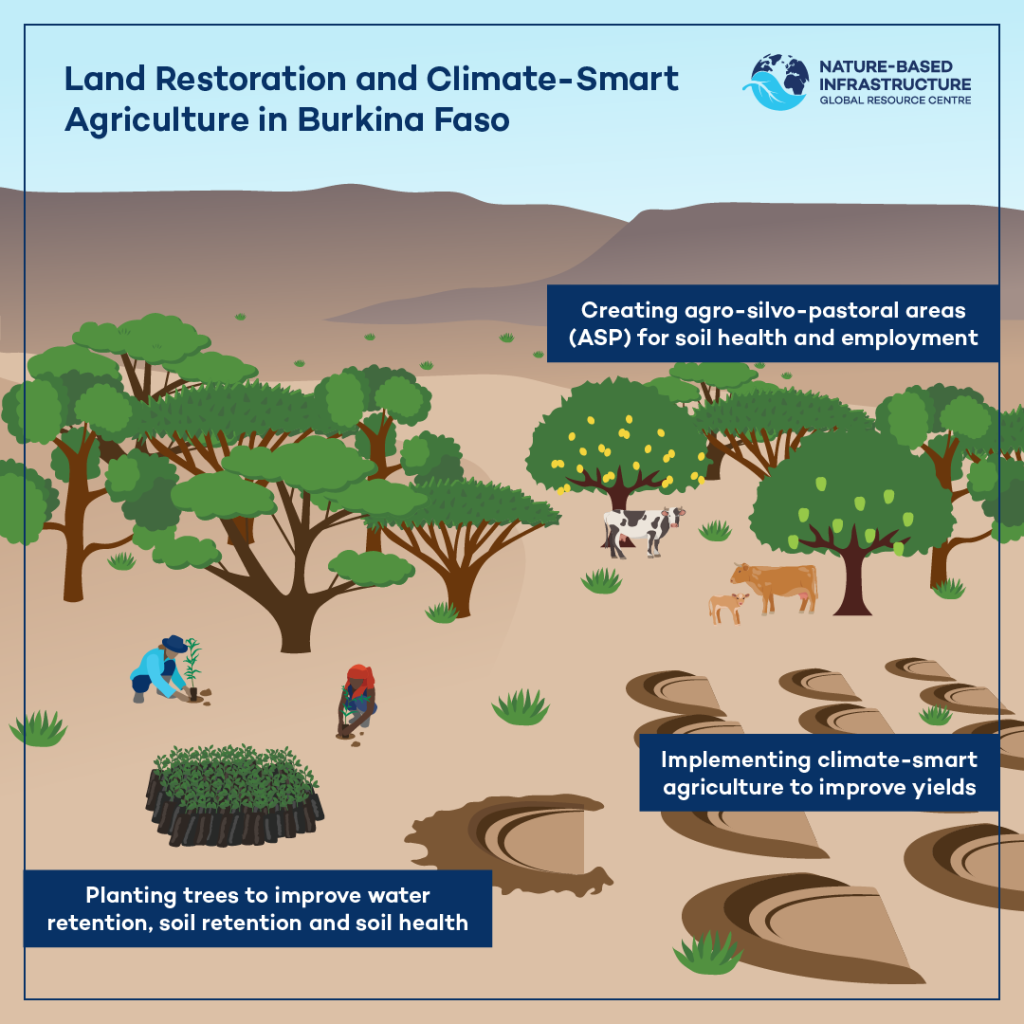
In West Africa, Burkina Faso is experiencing severe impacts of climate change in the form of increasingly extreme rainfall and flooding events coupled with prolonged droughts. As a result, 46% of the country's arable land is now degraded. 80% of the population relies on agriculture for income, so drought and heat stress have detrimentally affected livelihoods and resulted in food scarcity.
To combat this, the government has proposed a new land restoration project that aims to regenerate over a third of the country’s total land cover. Through the Nature-Based Infrastructure (NBI) Global Resource Centre, an initiative aiming to demonstrate the investment case for nature-based approaches to climate change adaptation, IISD assessed three potential methods for land restoration: nature-based, hybrid and traditional grey infrastructure. Working with Burkina Faso’s Ministries of Finance and Agriculture, and supported by the NDC Partnership, the NBI Global Resource Centre developed financial and economic models, calculating that the nature-based approach performed better than traditional grey infrastructure, to the tune of USD 1.7 billion in added benefits to the community over 30 years.
Consisting of tree planting, climate-smart agriculture, regenerative agriculture practices, and the establishment of agro-silvo-pastoral areas (which integrate agriculture, grasslands, fruit crops, and livestock farming), the combined methods reduce land erosion, enhance water retention, and improve soil quality, thereby helping to restore the degraded land and boost agricultural productivity. This modelling demonstrates the remarkable potential of nature in restoring land and reversing desertification while creating a wealth of environmental, social, and economic benefits for rural communities.
At least 100 million hectares of healthy land, an area the size of Egypt, is lost every year.
Nature-based solutions are like a Swiss Army knife. They can help us tackle many problems in a single project: drought, flooding, climate-related migration, food scarcity, nutrition, public health, rural livelihoods and the economy, CO2 emissions, heat stress, biodiversity protection—and even social inequality. Because of its inherent resilience, working with nature—rather than against it—effectively reduces the impacts of drought and stops desertification in its tracks. But we need to deploy nature urgently; at least 100 million hectares of healthy land, an area the size of Egypt, is lost every year.
By 2030, an estimated 700 million people will be at risk of displacement from drought alone.
Three ways to include nature in climate adaptation
Increase awareness to demonstrate the diverse returns on investment
The first critical step for the successful implementation of NbS is to increase awareness of how nature can deliver these benefits by engaging with local communities, farmers, policymakers, and investors.
IISD has worked on a variety of projects doing just that all over the world. The Nature for Climate Adaptation Initiative developed an online course to raise awareness of the benefits of ecosystem-based adaptation and equip learners with transferable and replicable skills in designing and implementing these initiatives. Furthermore, in Manitoba, Canada, our Natural Infrastructure for Water Solutions team worked with the Seine Rat Roseau Watershed District to demonstrate the financial and economic benefits of their Water Retention program to local farmers and communities. The program helps protect farms from floods and drought, conserves habitats, and improves water quality downstream. David Wiens, a dairy producer in the district, said of the program: “My initial concern was about having the pastures flooded for a period of time. But when I understood the design, it became clear that it would actually be win–win.”
Collaboration is key—consider drought as part of a wider problem
Drought and degraded land are not isolated issues. They have far-reaching impacts and implications for all areas of society, including public health, agriculture, the economy, and migration. An intersectional, unified approach between local communities, farmers, and policy-makers is crucial to gaining investment. Government ministries must come together to find solutions for climate change adaptation and mitigation. Local governments need to work with farmers and communities to support projects on the ground. Non-governmental organizations and governments can align with private investors to encourage financial flows to land restoration projects that sequester carbon and improve agricultural yields. Overall, stakeholders must break out of their silos and work together with an intersectional and coordinated approach to the problem.
Encourage and implement climate-smart and regenerative agricultural practices
In areas worst affected by drought, raising awareness, and funds and providing training for agricultural communities on implementing climate-smart and regenerative agricultural practices is crucial to maintaining land-restoration progress. Depending on the location, these practices can include reduced- and no-tilling techniques, “half-moons” or “earth smiles” (a traditional method of rainwater collection and soil restoration in the Sahel), keeping soil covered to prevent erosion, increasing crop diversity to boost soil health, nature-based water retention methods like channel rehabilitation, planting agroforests, creating agro-silvo-pastoral areas, and many more. These strategies are necessary to both recover already degraded land and prevent further desertification as droughts worsen with climate change.
Drought has been a concern for agriculture around the globe. Even in areas that are not directly affected to the extreme levels seen in low- or middle-income countries, action needs to be taken. By implementing NbS and making changes now to agricultural practices, farmers, communities, and policymakers can do their part to lessen future impacts of the climate crisis.
Learning more about how nature can help
With drought intensifying in five of seven continents, as well as the other climate crisis effects we are facing globally, it can feel a bit hopeless. However, if we collaborate on solutions, using nature as our example, we can improve our climate adaptation strategies locally and globally.
Here at IISD, we have a number of ways for you to explore solutions, learn from case studies, and discover more about working with nature for climate adaptation.
Why Liquefied Natural Gas Expansion in Canada Is Not Worth the Risk
The Bottom Line: Unpacking the future of Canada's oil & gas
Re-Energizing Canada is a multi-year IISD research project envisioning Canada's future beyond oil and gas. This policy brief is a part of the The Bottom Line series, which digs into the complex questions that will shape Canada's place in future energy markets. (Download PDF)
June 4, 2024
Summary
New liquefied natural gas (LNG) facilities will undermine Canada’s domestic and international climate commitments through increased upstream and midstream emissions and—more critically—by diverting scarce financial and clean energy resources toward fossil fuel production and away from more cost-efficient decarbonization efforts.
The possibility of coal-to-LNG switching abroad should not be used to justify the inevitable increase in domestic emissions associated with expanding LNG production. While proponents argue that LNG exports will decrease global emissions by replacing coal consumption overseas, this climate benefit is uncertain and often overstated, in part because of LNG’s potential to crowd out investment in renewable energy.
The economics for new LNG production are weakening, as demand is estimated to have already peaked in advanced economies such as Europe and South Korea; LNG demand growth in emerging Asian markets is also projected to slow.
By the time Canadian LNG from most new facilities reaches markets near the end of the decade, global LNG supply is expected to have already outpaced demand, deflating global prices. As a result, Canadian LNG projects may struggle to compete with cheaper and incumbent producers—such as Qatar and the United States—without substantial public subsidies.
To limit the risks to taxpayers, the economy, and the climate, Canadian governments should avoid issuing project approvals and export licences to new LNG projects while phasing out subsidies and other forms of public support for approved projects.
Introduction
Canada produces more natural gas than is necessary for domestic demand, with over 40% of production exported between January 2020 and July 2023. To support the expansion of export markets beyond the United States, there are several active projects and proposals to construct liquefaction facilities in Canada that would convert feedstock gas into liquefied natural gas (LNG) to be exported overseas. While some of Canada’s gas has recently been sold to operators of liquefaction terminals in the United States—indirectly expanding Canadian export markets—the proposed domestic terminals are intended to enable Canadian gas to be exported overseas directly.
Following an analysis of the most recent evidence, however, this brief concludes that plans to produce LNG in Canada carry excessive economic and environmental risks. Most prominently, Canadian LNG from most new facilities is at risk of entering the market during a global glut in supply, hampering the potential for export investments to be profitable and ultimately leaving investors at risk of losses from stranded assets. Meanwhile, excess LNG on the global market threatens to drive down prices and undercut the expansion of renewables abroad. Moreover, a Canadian LNG industry will come at the cost of increased domestic emissions that threaten to undermine Canada’s climate obligations. Accordingly, Canadian governments should limit exposure to such risks by refraining from issuing new construction and export permits while phasing out subsidies and other forms of financial support currently allocated to LNG projects.
Other countries are also beginning to acknowledge the risks of LNG expansion. Earlier this year, the Biden administration announced a pause on granting new LNG export licences to non-free trade agreement countries. The rationale was the need to better integrate economic and environmental risks into the approval process, following "an evolving understanding of the market need for LNG, the long-term supply of LNG, and the perilous impacts of methane on our planet." While this policy development in the United States will not directly affect Canadian producers, it does acknowledge the need to examine the overall costs and benefits of LNG expansion in a rapidly changing global market.
Reconsidering Canadian LNG Projects
Canada currently does not have any major LNG export facilities. However, eight projects are in various stages of consideration or construction, according to the federal government. Most of these are in British Columbia (BC), with one under consideration in Newfoundland and Labrador (see Table 1). West Coast LNG projects generally aim to supply Asian markets while the Newfoundland LNG projects would target sales to Europe. The largest and most advanced project is LNG Canada’s Phase 1, which is scheduled for completion in 2025. Woodfibre LNG, the only other project in Canada that has begun construction, is expected to be complete in 2027. Most other projects are scheduled for completion by or around 2030, though all are awaiting final investment decisions, environmental impact assessments, and/or export licences (Table 1). If approved, these pending LNG projects could have projected lifespans ranging from 20 to 60 years, depending on the project. As such, decisions on LNG expansion must be taken with a balanced view of their associated economic and environmental risks in the long term.
Table 1. LNG export projects proposed or under construction in Canada
LNG Production Would Threaten Canadian Climate Goals
LNG production emits greenhouse gases (GHGs) at all stages of the value chain (Figure 1), posing an inherent challenge to aligning Canada’s plans for LNG expansion with domestic climate goals. Indeed, Clean Energy Canada calculates that just the six most advanced LNG projects in BC could add 13 Mt of carbon dioxide equivalent (CO2e) annually to Canada’s emissions by 2030. The Pembina Institute estimates that these upstream and midstream emissions would result in BC's oil and gas sector emitting a total of 30 Mt CO2e in 2030. This is more emissions than every gas-powered passenger car in Canada emitted in 2021 (25 Mt CO2e) and would breach BC’s sector-specific emissions target by 200%. This long-term fossil fuel infrastructure risks becoming stranded before the end of its economic life cycle if Canada reaches net-zero emissions by 2050. New LNG infrastructure may also create a fossil fuel lock-in effect by increasing the economic and political costs of meeting Canada’s climate commitments relative to a scenario where excess fossil fuel infrastructure is not developed.
Figure 1. Illustrative life-cycle emissions of LNG5
Recognizing the emissions entailed by LNG expansion, both LNG proponents and the BC government have often suggested that LNG production in new facilities could be net-zero by 2030. However, significant resource constraints will make it difficult to fully decarbonize all planned LNG facilities. Indeed, for most LNG facilities, decarbonization would entail a massive demand for clean electricity that is proposed to come primarily from hydroelectric power sources, such as BC Hydro’s Site C dam, which is currently under construction at an estimated cost of CAD 16 billion. This new dam, however, will be far from sufficient to decarbonize BC’s planned LNG projects, as 2.5 times the hydroelectricity output of Site C would be required just to align LNG Canada Phase 1 and Woodfibre LNG with BC’s oil and gas sector emissions target. It is unclear how BC would produce enough clean electricity by 2030 to align all new LNG facilities in the province with 2030 climate targets.
Even if new LNG facilities could be fully decarbonized, doing so would indirectly undermine Canada’s domestic climate targets by drawing excessively from clean energy supplies. That is, the massive amount of clean electricity required for LNG facilities could otherwise be used to decarbonize existing industries, such as the transport sector, or facilitate alternative growth strategies in low-carbon industries, such as renewable power generation. LNG expansion would therefore commit Canadian governments to the opportunity cost of using clean electricity to reduce future emissions associated with highly energy-intensive LNG facilities instead of reducing current emissions in other sectors. To put this opportunity cost in perspective, Clean Energy Canada estimates that importing the equivalent electricity produced by just one Site C dam would cost approximately CAD 600 million annually.
LNG expansion would therefore commit Canadian governments to the opportunity cost of using clean electricity to reduce future emissions associated with highly energy-intensive LNG facilities instead of reducing current emissions in other sectors.
New LNG Is a Risk to Global Emissions Reductions
Acknowledging the reality of increased domestic emissions driven by LNG expansion, proponents argue that Canadian LNG exports would reduce emissions abroad, thereby generating a net benefit for the climate globally. This is suggested to occur because of coal-to-LNG fuel switching, as Canadian LNG displaces coal use for power generation in target export markets. However, recent studies suggest that this relationship between coal-to-LNG fuel switching and aggregate emissions reductions is more complicated than previously assumed and thus should not be relied on to justify the inevitable increase in domestic emissions associated with domestic LNG production.
Part of this complicated picture is that rates of fugitive methane emissions—those that are unintended and typically unmeasured—are much higher throughout the natural gas supply chain than previously believed. For example, methane emissions from oil and gas production in Canada have been consistently underestimated, with two recent studies estimating methane emissions to be 50% and 90% above official reported figures, respectively, at sites under evaluation. While the exact magnitude of methane emissions will differ by project, and the forthcoming federal methane regulations would reduce emissions in Canada, it is unlikely that methane emissions will be eliminated entirely from LNG value chains—especially in parts of the value chain that operate beyond Canada’s jurisdiction. When accurately accounted for in life-cycle emissions comparisons, these higher-than-assumed methane emissions can weaken or even reverse the assumed climate advantage of coal-to-LNG fuel switching.
Moreover, multi-decade LNG expansion projects may create international energy market conditions that undermine the transition from fossil fuels to zero-emission power sources. That is, infrastructure lock-in and deflated natural gas prices caused by excess supply would create long-term incentives for more natural gas consumption than would otherwise occur. While proponents argue that this increase in supply may displace coal as an energy source, others highlight that lower gas prices may also disincentivize investments in renewable power generation and thus slow the clean energy transition in emerging economies. Indeed, increased LNG supply in the international market will make it more competitive relative to alternatives generally. That includes both coal and renewables. The extent to which switching occurs between LNG and either of these alternatives will ultimately depend on contextual factors—such as policy support—that will differ across importing countries. Accordingly, new long-term LNG projects will incentivize higher global LNG consumption, which may, in turn, displace coal, renewables, or both depending on economic and policy contexts across importing countries. Proponents, therefore, cannot argue with certainty that new LNG exports will reduce global emissions by displacing coal use abroad. Rather, the risk of displacing renewables instead must be fully acknowledged in decisions to support LNG going forward.
Canadian LNG Is a Risk to Global Climate Goals
Given these direct and indirect impacts on global emissions, new LNG production is widely recognized as incompatible with science-aligned emissions trajectories for keeping the average global temperature rise to 1.5°C. The International Energy Agency, United Nations Environment Programme, Intergovernmental Panel on Climate Change, and others have all concluded that there can be no new long-term oil and gas projects—including Canada’s planned LNG expansion—if the 1.5°C temperature target is to be achieved. This conclusion remains true even if LNG is assumed to be less emissions intensive than coal. Moreover, the IEA’s modelling suggests that emissions from oil and gas sector operations must decline by 60% (relative to 2022) by 2030. This modelling does not leave room for the rising emissions expected from LNG expansion projects, as outlined above in the case of BC, for example. New LNG projects, therefore, pose a substantial long-term risk to global climate goals.
Canadian LNG expansion could also have a more immediate chilling effect on global climate ambition. Prioritizing industrial expansion over internationally recognized climate commitments would suggest that Canada is not committed to transitioning away from fossil fuels in line with the Paris Agreement, thereby sending a non-cooperative signal to other countries that may be facing a similar dilemma over fossil fuel expansion. This move is especially risky given Canada’s outsized historical contribution to climate change and the implications that this has for international discussions regarding a just distribution of the remaining global carbon budget. In a time where global cooperation on climate change is critical to implementing the Paris Agreement, the non-cooperative signal that would be sent by Canada prioritizing LNG expansion over its own climate commitments should not be overlooked.
Economic Risks of LNG Expansion
Market Fundamentals Are Increasingly Unfavourable for New LNG Exports
The economics of LNG development are weakening. Even with an optimistic 3–5-year time frame for construction, most Canadian projects would not begin exporting until the end of the decade. By this time, forecasted supply from incumbent producers is already expected to outpace demand. The United States, for example, already the world’s largest LNG exporter, is expected to double its current export capacity, with 102 billion cubic metres (bcm) of new capacity currently under construction. Russia and Qatar also have significant projects underway. Altogether, the IEA estimates that LNG projects under construction and those that have been awarded a positive final investment decision will add 250 bcm per year of liquefaction capacity by 2030—the equivalent of half of today’s global LNG supply. More than half (60%) of this increase is expected to come from the United States and Qatar.
At the same time, medium- and long-term natural gas demand forecasts are being consistently revised downward (Figure 2). Renewable energy capacity has expanded far more quickly than expected—despite growing fossil fuel subsidies—due to falling technology costs and increased climate ambition. Meanwhile, energy demand growth in key markets such as China is expected to slow relative to previous forecasts. LNG imports in Japan also fell by 8% in 2023—to their lowest level since 2009—following the restart of several nuclear power stations and growing renewable power generation. South Korean LNG imports similarly fell almost 5% in 2023, with demand expected to fall through the mid-2030s as new renewables and nuclear power plants come online. In the European Union, natural gas demand is in “structural decline” following a rapid expansion of renewables. Indeed, despite a short-term increase in European LNG demand following Russia’s invasion of Ukraine, the European Union Agency for the Cooperation of Energy Regulators recently confirmed that Europe’s LNG demand is expected to peak in 2024. Finally, volatile LNG prices and delays to import infrastructure projects in emerging markets in South and Southeast Asia are expected to continue dampening future demand.
Figure 2. IEA forecasts for global natural gas demand by year based on current climate policies
This slowing demand and growing supply will likely lead to an LNG market glut by the time most Canadian export capacity would come online toward the end of this decade. This expectation of a near-term supply glut for LNG is supported by recent market analyses from Morgan Stanley, S&P Global, and the Oxford Institute for Energy Studies. In the medium to long term, moreover, data from the IEA’s most recent modelling suggests that with current climate policies, there is sufficient LNG capacity in operation and under construction globally to meet projected natural gas demand all the way to 2040 (Figure 3). When announced climate policies are modelled, LNG projects under construction today are expected to result in more than twice the necessary capacity required to meet forecasted demand in 2050 (Figure 3).
As a result, the IEA warns that LNG’s market fundamentals are shifting, "[raising] questions about the long-term profitability of projects." The most recent market analysis from the Institute for Energy Economics and Financial Analysis reaches the same conclusion, even when the United States’ recent pause on LNG export licences is accounted for. Indeed, it is precisely this concern for an imminent oversupply of LNG that informed the U.S. government’s decision to pause future LNG export licensing. In the longer term, demand is harder to predict due to a range of uncertainties, including policies across importing and exporting countries. As such, long-term forecasts of LNG demand vary wildly. What is highly likely, however, is that LNG demand in certain advanced, high-consuming economies like Europe and South Korea has peaked. It is clear that high-demand projections in the long term are less compatible with global climate goals, and as such, investment decisions today that bet on the former are likely to materially undermine the latter. The business case for new LNG capacity is therefore already weak for the near and medium terms, and this trend will likely continue into the longer term as global climate ambition increasingly aligns with the Paris Agreement.
Figure 3. Global LNG capacity versus demand under three IEA scenarios
Note: Scenarios are based on current climate policies (Stated Policy Scenario), announced climate policies (Announced Pledges Scenario), and a trajectory consistent with the Paris Agreement’s 1.5°C global warming target (net-zero emissions).
Source: IEA. CC BY 4.0.
Canadian LNG May Struggle to Compete in a Crowded Global Market
The economic viability of Canadian LNG, specifically, will be directly affected by these worsening market fundamentals. Low demand and high supply will deflate global market prices, leaving marginal producers and new projects that have yet to repay their capital investments at risk of being priced out of the market. Canada’s intended importers in emerging Asian markets are price-sensitive and can therefore be expected to choose low-cost producers over more expensive ones—regardless of green credentials. Canadian LNG’s competitiveness and economic viability, therefore, will depend mostly on its production, transportation, and liquefaction costs relative to alternatives—notably from Qatar and the United States.
It will be difficult for Canadian producers to compete on cost against these two alternative exporters. Qatar is by far the world’s lowest-cost LNG producer, which is unlikely to change. Qatar can produce LNG for as little as USD 0.03 per million British thermal units (mmBtu)—compared to the global average of USD 3–5/mmBtu—due to its abundant and easily accessible feedstock natural gas reserves, efficient co-production with natural gas liquids, and low labour costs. When directly compared to U.S. LNG exporters on the Gulf Coast, LNG Canada is estimated to have double the production costs per unit of capacity.
LNG Canada’s comparatively high costs are mostly driven by high capital costs for infrastructure development, as well as transport of natural gas feedstock—and these costs have only increased over time. The result is an LNG project with "razor-thin" margins, ultimately dependent on extremely cheap feedstock gas and a relatively high LNG market price. As discussed above, however, such an economic forecast is unlikely in the near-to-medium term due to the expected oversupply of natural gas globally. Similar cost increases and economic feasibility concerns have also been raised regarding Woodfibre LNG. Meanwhile, all other Canadian LNG projects are awaiting final investment decisions (Table 1). The case for Canadian LNG’s economic competitiveness in a crowded global market therefore remains unconvincing.
Canadian LNG Assets May Become Stranded—With Taxpayers Carrying Much of the Risk
To navigate this challenging economic landscape for new LNG exports, Canadian LNG projects rely heavily on subsidies and public funding. The LNG Canada project, for example, has already received at least CAD 275 million in direct investments from the federal government, alongside approximately CAD 1 billion in steel tariff exemptions. Provincial data also show that the BC government has provided LNG Canada with at least CAD 5.4 billion in various forms of financial incentives. In addition, provincial and federal governments have funded specialized infrastructure projects such as the CAD 16 billion Site C dam and the Coastal Gaslink pipeline that will be used to transfer feedstock gas to LNG facilities, including LNG Canada. Similar subsidies—including steel tariff exemptions and reduced rates for electricity consumption—are also expected to apply to Woodfibre LNG.
The precarious business case for Canadian LNG, in turn, generates economic risk for private investors, public taxpayers (who are contributing through subsidies), participating Indigenous partners, and the local economies in which these projects are being developed. Indeed, the unfavourable market conditions forecast above could result in significant losses for Canadian LNG projects, creating a risk of assets being closed prematurely—thereby becoming stranded. The result would not only be losses for public and private investors but also major economic shocks for the workers and communities that become economically dependent on these projects. In addition, the physical assets themselves would require decommissioning to avoid local environmental damage—the costs of which may ultimately fall on the taxpayer. The Canadian economy is already at significant risk of widespread asset stranding in the oil and gas sector; new LNG projects will add further risk to that portfolio, with much of it carried by taxpayers.
The financial exposure of taxpayers, moreover, may increase over time. If market conditions develop as expected and Canadian LNG projects become at risk of being stranded, then governments may be incentivized to expand subsidies in an attempt to delay the economic and political costs of asset stranding described above. In a competitive international market, LNG producers are likely to rely on substantial government subsidies and public investment to align their production activities with domestic climate targets. The Site C hydroelectric project, for example—electricity from which is essential for decarbonizing LNG Canada—has an estimated project cost of CAD 16 billion that is funded primarily by the Government of British Columbia and increased prices for both residential and industrial BC Hydro consumers. Meanwhile, LNG Canada’s proponents have already suggested that even more government support will be required to fully electrify Phase 2 of the project while maintaining its economic viability.
Implications for Canadian Decision-Makers
Given market uncertainties and known climate constraints, the risks of LNG expansion far outweigh the suggested benefits. Environmentally, Canadian LNG is at odds with domestic climate obligations. Even in a less ambitious climate scenario, there are significant risks that LNG exports will not drive the net reduction in GHG emissions that its proponents claim. Rather, LNG risks either locking in decades more fossil fuel extraction and consumption (displacing investment from renewables in the process) or leaving multi-billion-dollar assets stranded. Economically, the business case for LNG expansion in Canada is tenuous. Consistent downward revisions of LNG demand forecasts in key Asian and European markets, alongside a supply of cheaper exports from Qatar and the United States, suggest that Canadian LNG may be priced out of the market soon after exports begin. The result would be major economic losses for investors, taxpayers, and local communities alike. Considering these risks, public and private investment should instead be driven toward green industries such as renewable power generation and decarbonized transport systems.
Importantly, there is still time for Canadian governments to correct course. Large-scale LNG production in Canada has not yet begun, and construction has only advanced significantly for LNG Canada’s Phase 1. The Woodfibre LNG project has begun site preparation activities, but construction is not expected to begin in earnest until later in 2024. All other LNG export facilities are still awaiting various approvals—whether from provincial and federal governments or private investors. This delay allows Canadian governments to re-evaluate the economic and environmental risks of LNG expansion based on the most recent evidence. Beyond approvals, provincial and federal governments also have decisions to make regarding the financial support that they may offer these projects—including those already under construction. Governments and investors should reconsider whether spending billions on projects that jeopardize Canada’s economic and environmental security is an efficient use of public funds. The substantial risks associated with new LNG facilities suggest that LNG expansion in Canada is simply not viable from a long-term perspective.
Re-Energizing Canada is a multi-year IISD research project envisioning Canada's future beyond oil and gas. This publication is a part of The Bottom Line policy brief series, which digs into the complex questions that will shape Canada's place in future energy markets.
Concise definitions of key terms and acronyms used in the United Nations Framework Convention on Climate Change (UNFCCC) climate change negotiations and beyond.
May 31, 2024
0 to A
1.5°C: One of the temperature goals of the Paris Agreement. Specifically, parties committed to pursuing efforts to limit the global average temperature increase to 1.5°C above pre-industrial levels (Article 2.1.a). The Intergovernmental Panel on Climate Change published a Special Report on Global Warming of 1.5ºC and showed that climate impacts increase with every increment of warming. (more info)
2°C: One of the temperature goals of the Paris Agreement. Specifically, parties committed to holding the increase in the global average temperature to well below 2°C above pre-industrial levels (Article 2.1.a). (more info)
AAU or Assigned amount unit: The total amount of greenhouse gasses (GHGs) each Annex B country is permitted to emit during the initial commitment period of the Kyoto Protocol is the country’s assigned amount. This amount is divided into units called AAUs.
ABU or Argentina, Brazil, and Uruguay: One of the negotiation blocks in the climate negotiations.
AC or Adaptation Committee: The AC is a constituted body that was established in 2010. Its functions are providing technical support to parties; considering adaptation information communicated by parties; providing recommendations for consideration by the COP; sharing information; and promoting synergy and strengthening engagement with national, regional, and international organizations. (more info)
Accreditation: The process through which an organization is officially admitted to the UNFCCC process as an observer organization.
ACE or Action for Climate Empowerment: A process aimed at empowering all members of society to engage in climate action. It builds on climate change education and public awareness, training, public participation, public access to information, and international cooperation on these issues. In 2022, parties adopted a 4-year ACE action plan that sets out short-term and time-bound activities. The process offers the broader climate community and actors in various sectors an opportunity to discuss strategies for mainstreaming climate action in society. (more info)
Young activists hold an "action" as delegates enter the grounds of Expo City Dubai at UNFCCC COP 28. (Photo by IISD/ENB Mike Muzurakis)
Action: Another term for civil society protests or demonstrations.
Ad hoc: A Latin term that means “for this purpose.” It is usually used to designate a committee or working group created to address a specific issue in a time-bound rather than open-ended manner. Ad hoc working groups in the climate negotiations have, for example, been tasked with discussing future commitments under the Kyoto Protocol, developing what would become the Paris Agreement, preparing for the Paris Agreement’s entry into force, and developing a new collective quantified goal on climate finance before 2025.
Adaptation: The process of adjusting to actual or expected climate change impacts. It most often aims to minimize potential damage but can also serve to leverage beneficial opportunities. Within the UNFCCC, there are a number of workstreams and constituted bodies that address matters related to adaptation. (more info)
AF or Adaptation Fund: The AF was established in 2001 under the Kyoto Protocol to finance adaptation projects in developing countries that are parties to the Protocol and are particularly vulnerable to the adverse effects of climate change. It is financed largely by developed countries and private donors. It also gets a share of the proceeds of the Protocol’s Clean Development Mechanism amounting to 2% of the Certified Emission Reductions issued under the Mechanism. Since 2019, the AF has also been serving the Paris Agreement. Parties decided that once the share of proceeds from the Paris Agreement’s Article 6.4 mechanism become available, the AF shall exclusively serve the Paris Agreement. (more info)
Agenda item: An agenda item is a distinct matter to be considered at a meeting. Some agenda items are very narrow in focus, while others can encompass many sub-items.
AGN or African Group of Negotiators: One of the negotiation blocks in the climate negotiations.
AILAC or Independent Association of Latin America and the Caribbean: One of the negotiation blocks in the climate negotiations. Its members include Chile, Colombia, Costa Rica, Guatemala, Honduras, Panama, and Peru. (more info)
AIM or Arrangements for Intergovernmental Meetings: An agenda item in the climate negotiations that addresses process-related questions, such as streamlining meeting agendas and fostering the participation of observers from developing countries.
ALBA or Bolivarian Alliance for the Peoples of our America: One of the negotiation blocks in the climate negotiations. Its members are Antigua and Barbuda, Bolivia, Cuba, Dominica, Grenada, Nicaragua, Saint Kitts and Nevis, Saint Lucia, Saint Vincent and the Grenadines, and Venezuela.
Annex I parties: Countries listed in Annex I to the UNFCCC. These include all the developed countries that were members of the Organisation for Economic Co-operation and Development (OECD) in 1992 and a number of countries with economies in transition (the Russian Federation, the Baltic States, and several Central and Eastern European states). Under Articles 4.2 (a) and 4.2 (b) of the UNFCCC, Annex I parties commit to returning individually or jointly to their 1990 levels of GHG emissions by the year 2000. (more info)
Annex II parties: Countries listed in Annex II to the UNFCCC. These are the OECD member countries listed in Annex I to the UNFCCC, excluding those countries with economies in transition (as of 1992). Annex II parties are required to provide financial resources to enable developing countries to undertake emissions reduction activities under the UNFCCC and to help them adapt to the adverse effects of climate change. They also have to promote the development and transfer of environmentally friendly technologies to parties with economies in transition and developing countries.
AOSIS or Alliance of Small Island States: One of the negotiation blocks in the climate negotiations. Its members are Antigua and Barbuda, the Bahamas, Barbados, Belize, Cabo Verde, Comoros, the Cook Islands, Cuba, Dominica, the Dominican Republic, the Federated States of Micronesia, Fiji, Grenada, Guinea Bissau, Guyana, Haiti, Jamaica, Kiribati, the Maldives, Mauritius, Nauru, Niue, Palau, Papua New Guinea, the Marshall Islands, Saint Kitts and Nevis, Saint Lucia, Saint Vincent and the Grenadines, Samoa, Saõ Tomé and Príncipe, Seychelles, Singapore, theSolomon Islands, Suriname, Timor Leste, Tonga, Trinidad and Tobago, Tuvalu, and Vanuatu. (more info)
Arab Group: One of the negotiation blocks in the climate negotiations. Its members are Algeria, Bahrain, Comoros, Djibouti, Egypt, Iraq, Jordan, Kuwait, Lebanon, Libya, Morocco, Mauritania, Oman, Palestine, Qatar, Saudi Arabia, Somalia, Sudan, Syria, Tunisia, the United Arab Emirates, and Yemen.
Article 2.1.c: One of the objectives of the Paris Agreement. The Paris Agreement aims to strengthen the global response to the threat of climate change, in the context of sustainable development and efforts to eradicate poverty (Article 2). To do so, it aims to limit the increase in global average temperature (Article 2.1.a) to strengthen adaptive capacity (Article 2.1.b) and make finance flows consistent with a pathway to low-GHG emissions and climate-resilient development (Article 2.1.c). In 2022, parties launched a dedicated dialogue process to exchange views on and enhance understanding of the scope of Article 2.1.c and its complementarity with Paris Agreement Article 9 (which, among other things, specifies that developed countries shall provide financial resources to assist developing countries and encourages other parties to provide or continue to provide such support voluntarily). (more info)
Article 6: The Paris Agreement article that recognizes that some parties choose to pursue voluntary cooperation in the implementation of their nationally determined contributions (NDCs). (more info)
Article 6.2: The Paris Agreement article that provides a framework for direct cooperation between countries and involves the use of internationally transferred mitigation outcomes (ITMOs) whereby the emission reductions achieved in one country are accounted toward the NDC of another country. Parties are still negotiating the exact modalities for this process, especially how to avoid double counting and ensure overall mitigation of global emissions. In doing so, they build on experience with market mechanisms established under the Kyoto Protocol.
Article 6.4: The Paris Agreement article that establishes a new international carbon crediting mechanism to be overseen by a dedicated Supervisory Body. Various kinds of actors can request for their projects to be included in the mechanism’s registry, provided the projects are approved by the country in which they are being implemented and by the Supervisory Body. The emission reduction credits resulting from these projects can, in turn, be bought not only by countries but also by businesses and other actors, including individuals. A share of proceeds of 5% of these credits will flow to the Adaptation Fund, and 2% of the credits will be cancelled rather than sold in order to deliver overall mitigation of global emissions. Parties are still negotiating the exact modalities that will govern the mechanism. In doing so, they build on experience with market mechanisms established under the Kyoto Protocol and also lessons learned from the voluntary carbon market. (more info)
Article 6.8: The Paris Agreement article that relates to cooperative approaches to implementing mitigation and adaptation actions and where the outcomes of the actions, such as emission reductions achieved, are not traded. Parties established a dedicated work programme to discuss what measures would be considered non-market approaches and how to support their funding and facilitate their replication. (more info)
Article 9.5: The Paris Agreement article stipulating that developed countries shall biennially communicate indicative quantitative and qualitative information related to the provision of financial resources to assist developing countries with respect to mitigation and adaptation. It also states that other parties that provide resources are encouraged to voluntarily communicate such information biennially. This is commonly referred to as ex-ante reporting on climate finance and aims to enhance predictability. (more info)
Assigned Amount: Total amount of GHGs each Annex B country is permitted to emit during the initial commitment period of the Kyoto Protocol. This total amount is divided into AAUs.
B to D
Badge: Only registered participants can attend climate conferences. When they first arrive at the venue, they are given a badge that they have to wear at all times. The badges feature bar codes that are scanned when participants enter and exit the venue. The badges also feature a colour line that indicates whether the participant is from a party (pink), intergovernmental organization (dark blue), non-governmental organization (yellow), media (orange), or the Secretariat (light blue). Parties’ heads of delegation have a red line on their badge.
BASIC or Brazil, South Africa, India, and China: One of the negotiation blocks in the climate negotiations.
BINGO or Business and Industry Non-Governmental Organizations: One of the UNFCCC’s nine observer constituencies.
Blue zone: A phrase that refers to the UN-organized conference space in which the negotiations, official side events, and press conferences take place. Only accredited and registered participants can enter this space.
Delegates make notes on draft text, including sections in brackets that are not yet agreed upon. (Photo by IISD/ENB Mike Muzurakis)
Brackets: A typographical symbol to indicate parts of a negotiation text that have yet to be agreed on. Square brackets can be put around individual letters, words, sentences, or paragraphs; sometimes an entire decision text is put in square brackets to signal that nothing has yet been agreed. There can be multiple square brackets nested within each other when individual parts of an un-agreed sentence are still up for discussion. There can also be consecutive square brackets within a sentence that signal the various alternatives for an individual word or section of the sentence.
Bridging proposal: A suggestion that aims to overcome diverging positions in the negotiations.
BTR or Biennial Transparency Reports: A key element of the Paris Agreement’s Enhanced Transparency Framework. BTRs include information on national inventory reports, progress toward NDCs, and financial, technical, and capacity-building support provided/received, among others. Parties are required to submit BTRs every 2 years, with the first submission due December 31, 2024, except for Small Island Developing States (SIDS) and least developed countries (LDCs), who may submit BTRs at their discretion. The submitted BTRs will go through a technical expert review process, and a facilitative, multilateral consideration of progress will also be conducted for each party. (more info)
Bunker fuels: A phrase that refers to emissions from fuel used for international aviation and maritime transport. Cooperation with the International Civil Aviation Organization (ICAO) and the International Maritime Organization (IMO) is channelled through the Subsidiary Body for Scientific and Technological Advice. (more info)
Bureau of the COP, CMP, and CMA: The Bureau provides advice and guidance regarding the ongoing work under the UNFCCC, the Kyoto Protocol, and the Paris Agreement, including on the organization of their sessions and the operation of the Secretariat. During meetings, the Bureau is mainly responsible for assisting with process management, including by examining parties’ credentials, reviewing requests for observer accreditation, presiding over sessions, and undertaking consultations on behalf of the President. (more info)
CAN or Climate Action Network: A large network of civil society organizations. It publishes a daily newsletter (ECO) during UNFCCC meetings, commenting on the negotiations. It also speaks on behalf of the ENGO Constituency alongside the Global Campaign to Demand Climate Justice. (more info)
Capacity building: The process of developing the skills and structures needed to implement an agreement or specific measures. In the climate context, the focus lies on supporting capacity building in developing countries. The importance of capacity building is, for example, recognized in Paris Agreement Article 11, and there are various bodies and processes under the UNFCCC that focus on capacity building. (more info)
Cartagena Dialogue: A regular dialogue process established in the aftermath of COP 15 in Copenhagen to offer a space for candid discussions among various developed and developing countries that support ambitious multilateral climate action.
CBDR-RC or Common but differentiated responsibilities and respective capabilities: A principle that asserts countries’ common responsibility for addressing climate change while at the same time acknowledging different levels of responsibility depending on the extent to which countries have contributed to the problem and their capacity to take action. This is a key principle in the climate change negotiations but is also recognized in other multilateral environmental agreements.
CDM or Clean Development Mechanism: A mechanism established under the Kyoto Protocol that allows Annex B parties (developed countries) to finance mitigation projects in developing countries in exchange for certified emission reduction credits that count toward meeting their emission reduction targets under the Protocol. The idea is that this allows for more cost-effective mitigation while still delivering overall mitigation results. A share of 2% of the proceeds from the credits flows into the Adaptation Fund. Lessons learned from the CDM inform the operationalization of market approaches under the Paris Agreement’s Article 6, particularly the mechanism established under Article 6.4. (more info)
CfRN or Coalition for Rainforest Nations: One of the negotiation blocks in the climate negotiations. Its members are Argentina, Bangladesh, Belize, Bolivia, Botswana, Brazil, Cambodia, Cameroon, Central African Republic, China, Costa Rica, the Democratic Republic of the Congo, Dominica, Dominican Republic, Ecuador, Equatorial Guinea, Fiji, Gabon, Ghana, Guatemala, Guyana, Honduras, India, Jamaica, Kenya, Lao People’s Democratic Republic, Lesotho, Liberia, Madagascar, Malawi, Malaysia, Mali, Mozambique, Namibia, Nicaragua, Nigeria, Pakistan, Papua New Guinea, Paraguay, the Republic of Congo, Indonesia, Saint Lucia, Samoa, Sierra Leone, Singapore, Solomon Islands, South Africa, Sudan, Suriname, Thailand, Uganda, Uruguay, Vanuatu, Vietnam, and Zambia. (more info)
CGE or Consultative Group of Experts: A constituted body established in 1999 to support developing countries in fulfilling their reporting requirements under the UNFCCC and now also under the Paris Agreement’s Enhanced Transparency Framework. The CGE also provides technical advice to the Secretariat on training implementation for technical expert review teams. Its current mandate runs until the end of 2026. (more info)
Chair: The person that leads a meeting.
Chapeau: Another word for the preamble/introductory provisions of a decision. It provides context, points to previous related decisions and principles, and guides the interpretation of the substantive parts/body of the text.
Closed-door meeting: A meeting to which access is restricted, usually to parties only.
CMA or Conference of the Parties serving as the meeting of the Parties to the Paris Agreement: The CMA is the governing body of the Paris Agreement. It is where all parties to the agreement come together to review its implementation and adopt decisions that aim to promote its effective implementation. The CMA meets every year alongside the COP and the CMP. (more info)
CMP or Conference of the Parties serving as the meeting of the Parties to the Kyoto Protocol: The CMP is the governing body of the Kyoto Protocol. It is where all parties to the Protocol come together to review its implementation and adopt decisions that aim to promote its effective implementation. The CMP meets every year alongside the COP and the CMA. Parties to the UNFCCC that are not parties to the Kyoto Protocol are able to participate in CMP meetings as observers but cannot engage in decision making. (more info)
Coalition: A group of like-minded parties that make joint statements in the negotiations.
Co-Chair: In the climate negotiations, contact group discussions are moderated by two Co-Chairs, one from a developing country and one from a developed country. This role also exists in various work programmes and dialogue processes.
Compliance: Whether and to what extent countries meet their commitments.
Consensus: The mode through which most decisions are adopted at the UNFCCC. It is up to the presiding officer to determine whether there is consensus. In practice, consensus is understood as broad agreement, but not necessarily unanimous support. Presiding officers may determine there is consensus unless a party registers a formal objection.
Constituencies: Many non-state actors engage in the UNFCCC process as observers. Over time, they have organized themselves into groups and the UNFCCC has officially recognized nine such constituencies: business and industry NGOs (BINGO), environmental NGOs (ENGO), farmers and agricultural NGOs (Farmers), Indigenous Peoples organizations (IPO), local government and municipal authorities (LGMA), research and independent NGOs (RINGO), trade union NGOs (TUNGO), the women and gender constituency (WGC), and children and youth NGOs (YOUNGO). Constituencies have their own focal points that facilitate the exchange of information with the Secretariat. Constituencies get to make statements in Plenary (usually after statements by party coalitions and individual parties), get special consideration in the allocation of seats in meetings with restricted access, and are invited to intersessional meetings, such as those of constituted bodies. The UNFCCC’s constituency system mirrors the nine Major Groups identified as stakeholders in the outcome of the Rio+20 Summit. (more info)
Contact Group: A group established to conduct negotiations on a specific agenda item or sub-item. All parties may attend, and meetings are open to observers. At times, contact groups decide to convene informal consultations to advance the negotiations. In this case, usually only the first and last negotiation session on the respective agenda item is convened in a contact group setting while the bulk of the negotiations happens in informal consultations, which may be restricted to parties only. However, the distinction between a contact group and informal consultations is increasingly blurred, as observers have been allowed to join the vast majority of informal consultations in the past few years. Contact group discussions are led by two Co-Chairs, one from a developing country and one from a developed country. When discussions continue in informal consultations, these same representatives are referred to as Co-Facilitators.
Convention: The UN Framework Convention on Climate Change. (more info)
Coordination meeting: Individual delegations and coalitions usually meet once a day to discuss progress in the negotiations and coordinate their negotiation strategy.
COP or Conference of the Parties: The COP is the decision-making body of an international agreement—in this case, the UNFCCC. It is where all parties to the UNFCCC come together to review its implementation and adopt decisions that aim to promote its effective implementation. Unless decided otherwise, the COP meets once a year for two weeks, typically in November/December. By default, the COP would meet in Bonn, Germany, where the UNFCCC Secretariat is located, but in practice, it takes place in the country that presides over the specific COP meeting. (more info)
Greta Thunberg speaks at the 25th Conference of the Parties—or COP 25—in Madrid, Spain in 2019. (Photo by IISD/ENB Kiara Worth)
COP Presidency: Typically, the COP Presidency is the country that hosts a COP. It is responsible for much of the logistics related to the meeting venue, liaising with governments and other stakeholders to facilitate a successful outcome to the meeting (both ahead and during the COP), chairing much of the negotiations, and ensuring the rules of procedure are upheld. The COP Presidency rotates among the five UN regional groups (Africa, Asia-Pacific, Eastern Europe, Latin America and the Caribbean, and Western Europe and Others). Regional groups hold consultations to determine which country from their region will make an offer to host a conference, and the COP ultimately decides to accept such hosting offers. (more info)
Cover decision: A decision not tied to any specific agenda item that is drafted without a mandate. They can span any sort of issue that parties want to address. COP 25, COP 26, and COP 27 each adopted such a cover decision (the Chile Madrid Time for Action, the Glasgow Climate Pact, and the Sharm El Sheikh Implementation Plan, respectively).
Credentials: Document certifying a participant’s affiliation to a specific organization.
CRP or Conference Room Paper: A type of in-session document containing new proposals or provisional outcomes that is usually only available during the specific meeting rather than being permanently archived on the UNFCCC website.
CTCN or Climate Technology Centre and Network: The UNFCCC Technology Mechanism’s “implementation arm.” It provides technical assistance at the request of developing countries and fosters access to information and collaboration among climate technology stakeholders. The CTCN is located in Copenhagen, Denmark, hosted by the UN Environment Programme in collaboration with the UN Industrial Development Organization, and supported by 11 partner institutions with expertise in climate technologies. (more info)
DCJ or Global Campaign to Demand Climate Justice: Network of climate and human rights organizations that speaks on behalf of the ENGO Constituency alongside the Climate Action Network. (more info)
Declaration: In addition to the outcomes of the multilateral negotiation process, governments and other stakeholders often use climate change conferences as a platform to launch and mediatize political declarations on issues such as deforestation, methane, health, or food systems. These are not official UNFCCC outcomes and there typically is no process to track the extent to which stakeholders follow through with the commitments set out in these declarations. They nevertheless serve to coalesce actors around issues of common interest and raise the profile of these issues.
Delegate: A member of a delegation participating in a given meeting. The term is used for party representatives and representatives of observer organizations.
Delegation: A team of people representing the same party or observer organization.
Developed country: A term used in the Paris Agreement to differentiate between countries with different types of commitments, especially in terms of support. Unlike the UNFCCC and the Kyoto Protocol, which featured specific lists (as annexes) to distinguish countries with specific commitments, the Paris Agreement does not specify a definition for or provide a list of countries that would be considered to be “developed.” This leaves much room for interpretation and relies on countries’ self-identification. In practice, only Annex B countries have so far engaged in the Paris Agreement process as developed countries, irrespective of development indicators such as GDP per capita.
Developing country: A term used in the Paris Agreement to differentiate between countries with different types of commitments, especially in terms of support. Unlike the UNFCCC and the Kyoto Protocol, which featured specific country lists to distinguish countries with specific commitments, the Paris Agreement does not specify a definition for or provide a list of countries that would be considered “developing.” This leaves much room for interpretation and relies on countries’ self-identification. In practice, non-Annex B countries have so far engaged in the Paris Agreement processes as developing countries, irrespective of development indicators such as GDP per capita.
Draft decision: Decisions are only adopted in plenary. Before that point, they are considered to be “draft” decisions as changes could still be made in plenary.
Drafting group: An informal group established to develop concrete textual proposals; it is usually restricted to parties only.
E to H
ECO: A civil society newsletter published daily at UNFCCC events that reflect the Climate Action Network’s perspective on the negotiations. (more info)
EIG or Environmental Integrity Group: One of the negotiation blocks in the climate negotiations. Its members are Mexico, Liechtenstein, Monaco, the Republic of Korea, Switzerland, and Georgia. It is the only coalition comprising both developed and developing countries.
ENB or Earth Negotiations Bulletin: An independent reporting service that covers various environmental processes. The ENB provides daily coverage of UNFCCC negotiations and publishes a summary and analysis after each meeting. It is the de facto record of multilateral environmental negotiations since 1992, and its reports are available for free on the ENB website. ENB also provides photographic coverage that is free to reuse with appropriate citation. (more info)
ENGO or Environmental NGOs: One of the UNFCCC’s nine observer constituencies. In practice, two groups take the floor on behalf of the ENGO constituency: the Climate Action Network and Demand Climate Justice.
ETF or Enhanced Transparency Framework: The Paris Agreement’s reporting framework. Reporting requirements under the ETF are more fine grain than under the UNFCCC. The transition to reporting under the ETF is therefore challenging, especially for developing countries that lack institutional and monitoring capacity. In recognition of this, the ETF provides flexibility to those developing countries that need it. In 2024, parties to the Paris Agreement have to submit their first biennial transparency reports, which are the cornerstone of the ETF. This will be an important milestone and provide an opportunity to reflect on lessons learned. (more info)
ETS or Emissions trading scheme: A market-based system to reduce GHG emissions. A “cap” (or limit) is put on the amount of GHGs that can be emitted in a given year. Actors subject to this system have to ensure they stay below a certain emission threshold or buy emission rights from others who have managed to emit less than their threshold. The price for these emission rights is thus determined on the basis of supply and demand, which is why this is also called a “cap and trade system.” Typically, this cap is lowered over time, making emission rights scarcer and thus leading to an increase in their price so as to progressively incentivize low-GHG innovation.
Executive Secretary: The head of the UNFCCC Secretariat.
Farmers: One of the UNFCCC’s nine observer constituencies.
Flag: A plastic tag featuring a delegation’s name. In plenary, there is a fixed, alphabetical seating arrangement, and flags indicate which seats are reserved for specific delegations. In other negotiation rooms, delegates can decide themselves where to sit and have to pick up their flag upon entering the room. Flags are used to signal a delegate’s wish to take the floor/speak. There are no actual flags or logos of any kind.
FM or Financial Mechanism: The UNFCCC established a Financial Mechanism to provide financial resources to developing countries to implement climate action. The FM also serves the Kyoto Protocol and the Paris Agreement. Its operating entities are the Global Environment Facility (GEF) and the Green Climate Fund (GCF), and it also includes the Special Climate Change Fund (SCCF), Least Developed Countries Fund (LDCF), Adaptation Fund, and, once it is operationalized, a fund for responding to loss and damage. (more info)
FoC or Friends of the Chair: An informal group invoked by a Chair to advance negotiations on a thorny issue.
Focal point: A designated contact person for a specific delegation or issue.
Fossil fuels: Hydrocarbon-containing materials such as coal, oil, and natural gas. Typically burned for energy production, they release large quantities of GHGs into the atmosphere and are, by far, the largest contributor to climate change.
FWG or Facilitative Working Group of the Local Communities and Indigenous Peoples Platform: A constituted body established in 2018 to implement the functions of the Local Communities and Indigenous Peoples Platform. Half of the members of the FWG are representatives of parties and half are representatives from Indigenous Peoples organizations. (more info)
G-77/China: One of the negotiation blocks in the climate negotiations. Established in 1964 in the context of the first session of the United Nations Conference on Trade and Development, it represents all developing countries. Typically, developing countries first make a joint statement through the G-77/China and then the smaller negotiation blocks take the floor. (more info)
COP 27 President Sameh Shoukry (Egypt) passes the gavel to COP 28 President Sultan al-Jaber (UAE). (Photo by IISD/ENB Mike Muzurakis)
Gavel: A little hammer with which presiding officers officially declare adoption of a decision or call delegations to order.
GCF or Green Climate Fund: Established in 2010 with a view to being the main channel for the delivery of USD 100 billion per year in climate finance. It is one of the operating entities of the UNFCCC’s Financial Mechanism and also serves the Paris Agreement. The GCF is mandated to invest 50% of its resources into mitigation and 50% into adaptation in grant equivalent terms. At least half of its adaptation resources must be invested in the SIDS, LDCs, and African States. (more info)
GEF or Global Environment Facility: The GEF was established in 1991. Various multilateral environmental agreements use it to channel finance to support developing countries in implementing environmental protection measures. It is one of the operating entities of the UNFCCC’s Financial Mechanism. (more info)
GGA or Global Goal on Adaptation: The Global Goal on Adaptation (GGA) was established through Paris Agreement Article 7.1 as enhancing adaptive capacity, strengthening resilience and reducing vulnerability to climate change, with a view to contributing to sustainable development and ensuring an adequate adaptation response in the context of the 2°C/1.5°C temperature goals. To make the GGA more actionable and facilitate monitoring, evaluation, and learning on adaptations, parties launched a 2-year work programme that led to the adoption of the GGA Framework in 2023, which includes thematic and dimensional targets. Building on this, parties launched another 2-year work programme to advance outstanding work on indicators. A challenge in this endeavour is ensuring that the set of indicators adequately captures the targets, is manageable in practice (including in resource-constrained countries), and balances the need to fit varying local contexts with the need to gain a global overview. (more info)
GHGs or Greenhouse gases: Gases that trap infrared radiation from the Earth’s surface, contributing to global warming. Carbon dioxide is the most abundant GHG, but others are methane, nitrous oxide, ozone, chlorofluorocarbons, hydrochlorofluorocarbons, hydrofluorocarbons, perfluorocarbons, and sulphur hexafluoride.
Governing body: A decision-making body of an agreement. In the climate process, there are three governing bodies: the COP for the UNFCCC, the CMP for the Kyoto Protocol, and the CMA for the Paris Agreement. (more info)
Green zone: A phrase that refers to the conference space managed by the host country (as opposed to the blue zone managed by the UNFCCC Secretariat), which serves as a platform to engage with civil society and the private sector.
Grupo Sur: One of the negotiation blocks in the climate negotiations. Its members are Argentina, Brazil, Ecuador, Paraguay, and Uruguay.
GST or Global Stocktake: A process for taking stock of collective progress made in implementing the Paris Agreement and reaching its objectives. The exercise, which combines a technical and a political phase, takes place every five years. The first GST concluded in 2023, and its outcome is intended to inform the next round of nationally determined contributions to be put forward by 2025. The finding is unequivocal: we are not on track to limit global warming to 1.5°C, and the window for meaningful change is closing. (more info)
An artist captures key points during a UNFCCC Global Stocktake roundtable at COP 27. (Photo by IISD/ENB Mike Muzurakis)
HAC or High Ambition Coalition: An informal group convened in 2014 by Marshall Islands with the aim to ensure that what would become the Paris Agreement was as ambitious as possible. The HAC is not a negotiating group, but it issues joint statements, convenes press conferences, and liaises with other countries to broker agreements in the negotiations. (more info)
High-Level Climate Champions: Each COP Presidency appoints such a Champion to spearhead non-state actor engagement in the implementation of the Paris Agreement. At any given time, two High-Level Champions support the Marrakech Partnership for Global Climate Action. (more info)
High-level segment: The part of a meeting during which the heads of state and ministers make statements.
HoD or Head of Delegation: The person that leads a delegation. When progress is slow or stalled at the technical level, the Presidency typically ends up convening individual meetings at the HoD level to try to reach an agreement.
Huddle: A group of people that come together in a circle to informally discuss something, such as a coalition’s common position or a proposal that could bridge different groups’ positions.
I to L
Implementation: Taking the necessary actions to accomplish something.
INF doc or Information document: A non-negotiation document that is usually published before a meeting to provide background information.
Informal consultations: A group established to conduct negotiations on a specific agenda item or sub-item. All parties may attend and unless a party objects, the meetings are also open to observers. In the past, this was rarely the case, but for the past few years, the vast majority of informal consultations in climate meetings have been open to observers. Informal consultations are led by two Co-Facilitators, one from a developing country and one from a developed country. If there is also a contact group convened for the agenda item, the Co-Facilitators will be the same people that co-chair the contact group discussions.
Informal note: A type of document that aims to support the negotiation process. Oftentimes, the Co-Facilitators of negotiations on a given agenda item will prepare an informal note under their own authority to capture progress in the negotiations.
Informal-informals: Negotiation format that is even more informal than informal consultations, is restricted to parties, and where Co-Facilitators only have a role to play at the parties’ request. Parties report back on progress made in informal-informals when discussions reconvene in a more formal setting.
Interpretation: Simultaneous oral translation of statements made during meetings. Typically, this is only available for plenary sessions and only for the official languages of the UN, which are Arabic, Chinese, English, French, Russian, and Spanish. Participants need to use headsets, which they grab from tables at the back of the plenary room, to access the different interpretation channels. The quality of the interpretation varies. In some instances, negotiators will signal when their statements are misrepresented through the interpretation.
IPCC or Intergovernmental Panel on Climate Change: A science-policy body jointly established by the WMO and UNEP in 1998 to provide decision-makers with policy-relevant but not policy-prescriptive scientific information that supports the development of climate action. The IPCC publishes assessment reports for which experts volunteer their time to assess thousands of scientific papers and provide a comprehensive analysis of what is known about the drivers of climate change, its impacts and future risks, and how adaptation and mitigation can reduce those risks. (more info)
IPLCs or Indigenous Peoples and Local Communities: A term used in multilateral environmental governance to refer to people and groups who self-identify as Indigenous or members of distinct local communities. There are debates around the conflation of Indigenous Peoples, who have distinct rights, with local communities.
IPO or Indigenous Peoples Organizations: One of the UNFCCC’s nine observer constituencies.
Iteration: A revised version of a document.
ITMO or Internationally Transferred Mitigation Outcome: A label for the emission reduction units transferred between parties cooperating under Paris Agreement Article 6.2.
JI or Joint Implementation: A mechanism established under the Kyoto Protocol that allows Annex B countries to earn emission reduction credits from emission-reduction projects in another Annex B country. (more info)
Joint item: An item jointly considered by two bodies, such as both Subsidiary Bodies.
JTWP or Just Transition Work Programme: Established in 2022 to foster discussion of pathways to achieving the goals of the Paris Agreement outlined in Article 2.1 (on temperature limits, adaptive capacity, and finance flow alignment), in the context of Article 2.2 (on equity and the principle of CBDR-RC, in light of different national circumstances.).
KCI or Katowice Committee of Experts on the Impacts of the Implementation of Response Measures: The constituted body that supports the work on response measures. It addresses issues related to economic diversification and transformation; just transition of the workforce and creation of decent work and quality jobs; assessing and analyzing the impacts of the implementation of response measures; and facilitating and building capacity on the identification, development, customization, and use of tools and methodologies to assess the impacts of the implementation of response measures. (more info)
KP or Kyoto Protocol: The protocol that operationalizes the UNFCCC by committing 37 industrialized countries and countries with economies in transition to limit and reduce GHG emissions in accordance with agreed individual targets. It was adopted in 1997 and entered into force in 2005. For the KP’s first commitment period (2008–2012), these targets added up to an average 5% emission reduction compared to 1990 levels. In 2012, parties adopted the Doha Amendment that defined a second commitment period for 2013–2020. The amendment only entered into force on December 31, 2020, the last day of the commitment period. During the second commitment period, parties committed to reducing GHG emissions by at least 18% below 1990 levels. (more info)
L docs: A document format in which draft decisions are published.
LCIPP or Local Communities and Indigenous Peoples Platform: Established in 2015, the Platform has three functions: promoting knowledge exchange; building capacity to support IPLCs in engaging in the UNFCCC process and support parties and other stakeholders in engaging with IPLC; and facilitating the integration of diverse knowledge systems, practices, and innovations in the design and implementation of climate action. (more info)
LDCs or Least developed countries: One of the negotiation blocks in the climate negotiations; also one of the groups of countries that get special recognition in the climate process and are provided with flexibility to implement certain commitments, such as reporting requirements. The LDCs are a group of countries that the UN recognizes as being in a situation of underdevelopment based on criteria such as per capita income, school enrolment, nutrition levels, and economic and environmental vulnerability. The list of LDCs is reviewed every 3 years and, over time, seven countries have graduated from their previous status as an LDC. There are currently 45 LDCs: Afghanistan, Angola, Bangladesh, Benin, Burkina Faso, Burundi, Cambodia, Central African Republic, Chad, Comoros, the Democratic Republic of the Congo, Djibouti, Eritrea, Ethiopia, Gambia, Guinea, Guinea-Bissau, Haiti, Kiribati, Lao People’s Democratic Republic, Lesotho, Liberia, Madagascar, Malawi, Mali, Mauritania, Mozambique, Myanmar, Niger, Nepal, Rwanda, Saõ Tomé and Príncipe, Senegal, Sierra Leone, Solomon Islands, Somalia, South Sudan, Sudan, Tanzania, Timor-Leste, Togo, Tuvalu, Uganda, Yemen, and Zambia. (more information)
Madeleine Rose Diouf Sarr, Senegal, on behalf of LDCs at the 2022 Bonn Climate Conference. (Photo by IISD/ENB Kiara Worth)
LDCF or Least Developed Countries Fund: Established in 2001 by the COP to specifically assist LDCs in undertaking adaptation action. The LDCF is operated by the GEF and now also serves the Paris Agreement. (more info)
LEG or Least Developed Countries Expert Group: A constituted body established in 2001 to provide technical guidance and support to LDCs, especially in the formulation and implementation of national adaptation plans. (more info)
LGMA or Local Governments and Municipal Authorities: One of the UNFCCC’s nine observer constituencies.
Lima Work Programme on Gender: The UNFCCC’s workstream on matters related to gender. It was complemented in 2017 by the adoption of the first gender action plan, which defined activities to advance women’s full, equal, and meaningful participation in the UNFCCC and promote gender-responsive climate policy and the mainstreaming of a gender perspective in implementing the UNFCCC. In 2019, parties adopted the 5-year Enhanced Lima Work Programme on Gender and its gender action plan, which will be reviewed in 2024. While there has been progress on gender-related issues, gaps remain. Only 50% of NDCs include gender-related adaptation actions. On average, women occupied 38% of constituted body positions in 2023. At COP 27, women represented 37% of party delegates and 29% of heads and deputy heads of delegation. (more info)
LLDCs or Landlocked Developing Countries: One of the coalitions through which countries make joint statements in the climate negotiations, although such joint statements are relatively rare. Its members are Afghanistan, Armenia, Azerbaijan, Bhutan, Bolivia, Botswana, Burkina Faso, Burundi, Central African Republic, Chad, Eswatini, Ethiopia, Kazakhstan, Kyrgyzstan, Lao People’s Democratic Republic, Lesotho, North Macedonia, Malawi, Mali, Mongolia, Nepal, Niger, Paraguay, Moldova, Rwanda, South Sudan, Tajikistan, Turkmenistan, Uganda, Uzbekistan, Zambia, and Zimbabwe.
LMDCs or Like-Minded Developing Countries: One of the negotiation blocks in the climate negotiations. The coalition does not have a (publicly available) formal list of members, but includes countries such as Algeria, Bolivia, China, Ecuador, Egypt, India, Iran, Malaysia, Nicaragua, Pakistan, Qatar, Saudi Arabia, Venezuela, and Vietnam.
Loss and Damage: Climate change impacts that are not or cannot be avoided through mitigation and adaptation. Within the UNFCCC, there are a number of workstreams and constituted bodies that address matters related to loss and damage, including the Warsaw International Mechanism, Santiago Network, and a dedicated fund that is currently being operationalized. (more info)
LULUCF or Land use, land-use change, and forestry: Jointly considered as a sector to address in climate change mitigation. (more info)
M to P
Mainstreaming: Ensuring that an issue is always taken into account in broader decision-making processes and activities. A key endeavor for climate policy is gender mainstreaming.
Maladaptation: Action intended to enhance climate resilience which inadvertently increases vulnerability, including in geographical regions and communities not directly targeted by the intervention or with negative side effects manifesting with a temporal delay.
Mandate: The purview of a person, meeting, or negotiation group. The scope of things they are supposed to address.
Mandated Events: Events such as workshops and high-level roundtables whose conduct has been decided in previous decisions. The number of mandated events in the climate process has drastically increased in the past few years.
Market-based mechanisms: Approach whereby emission rights or certified emission reductions are traded between countries or other types of actors. Examples include emissions trading systems, the Joint Implementation mechanism and the Clean Development Mechanism (CDM) established under the Kyoto Protocol, and the mechanisms established under the Paris Agreement’s article 6.2 and 6.4. (more info)
Marrakech Partnership for Global Climate Action: Framework that supports non-state actor engagement in the implementation of the Paris Agreement. A key objective is to ensure greater accountability of voluntary initiatives. (more info)
Mitigation: Efforts aimed at reducing GHG emissions and enhancing GHG sequestration. Key aspect of climate action. There are a number of processes and workstreams that address matters related to mitigation. (more info)
MoI or Means of implementation: Phrase that refers to finance, technology transfer, and capacity building.
MoU or Memorandum of Understanding: Document that lays out the modalities for cooperation between two or more organizations.
MRV or Measurement, reporting, and verification: Key elements of transparency provisions under the UNFCCC. (more info)
Mutatis Mutandis: Latin phrase used to specify that a decision text should be copied for use in another context, applying only those changes necessary to adapt it to said context. This is the case when decisions on a given issue are adopted under different governing bodies: the CMA might adopt a decision that is substantively the same as a decision adopted by the COP, only replacing references to the UNFCCC with references to the Paris Agreement.
MWP or Mitigation ambition and implementation work programme: Workstream established in 2021 to urgently scale up mitigation ambition and implementation in this critical decade in a manner that complements the Paris Agreement’s Global Stocktake. The key features of the work programme are global dialogues and associated investment-focused events. (more info)
NAP or National adaptation plans: Document that outlines the adaptation action required and prioritized in a country for a given time frame, typically five years. In 2010, parties established a process to enable least developed countries to formulate and implement NAPs with a view to identifying medium- and long-term adaptation needs, as well as developing and implementing strategies to address those needs. Other developing countries are also invited to employ the guidelines formulated to support NAPs. Progress assessments showed that one of the key challenges for countries was accessing funding for formulating and implementing NAPs. (more info)
NCQG or New collective quantified goal on climate finance: Parties are supposed to define, prior to 2025, a new collective quantified goal on climate finance (NCQG) from a floor of USD 100 billion per year, taking into account the needs and priorities of developing countries. An ad hoc work programme was convened for that purpose, which builds on technical expert dialogues and high-level ministerial dialogues. (more info)
NDCs or Nationally determined contributions: NDCs are the climate plans that parties bring forward to implement the Paris Agreement. The Agreements stipulates that all parties shall prepare and communicate progressively more ambitious NDCs every five years and developed countries should continue taking the lead by undertaking economy-wide absolute emission reduction targets, with developing countries encouraged to move over time towards economy-wide emission reduction or limitation targets in light of different national circumstances. Research, assessments by the Intergovernmental Panel on Climate Change, and the first Global Stocktake showed that current NDCs and their level of implementation do not put the world on track to meeting the objectives of the Paris Agreement. The next round of NDCs is to be submitted by 2025. (more info)
Net zero: A state where anthropogenic CO2 or, more broadly, GHG emissions are balanced globally by removals over a specified period. Net-zero CO2 emissions is also referred to as carbon neutrality.
NMA or Non-market approaches: Type of climate action that does not involve a trade in emission reduction credits. Currently addressed in discussions related to Article 6.8 of the Paris Agreement. (more info)
Non-Annex I parties: By default all countries not listed in Annex I to the UNFCCC. (more info)
Non-paper: Informal document intended to facilitate progress in the negotiations.
NWP or Nairobi Work Programme: Workstream launched in 2005 that aims to assist parties in improving their adaptation knowledge. It, among other things, led to the development of the Adaptation Knowledge Portal. (more info)
Objection: When a delegation lodges its formal opposition to something, such as the adoption of a decision or the proposed way to conduct negotiations. Objections can be made orally or in writing.
Observer: Type of actor that can participate in a process but has no decision-making power.
OMGE or Overall mitigation in global emissions: Concept that emerged in the Article 6.4 negotiations. The idea is to cancel a portion of emission credits instead of selling them, which would ensure that the market mechanism not only serves to offset emissions but delivers an actual reduction in overall emissions.
OPEC or Organization of the Petroleum Exporting Countries: Organization enabling the co-operation of leading oil-producing countries. Sometimes issues joint statements to influence the climate negotiations.
Operative paragraph: Body/substantive part of a decision text, as opposed to the preamble/chapeau.
Package: Set of issues on which a decision has to be taken as a whole. Parties often strategically link agreement on one agenda item/issue to agreement on another as a way to push for certain trade-offs.
PAICC or Paris Agreement Implementation and Compliance Committee: Constituted body established in 2015 to facilitate implementation of, and promote compliance with, the provisions of the Paris Agreement. It shall function in a manner that is transparent, non-adversarial, and non-punitive, and paying attention to parties’ respective national capabilities and circumstances. The Committee annually reports to the CMA and its first review is scheduled for 2025. (more info)
Celebrating the adoption of the Paris Agreement at UNFCCC COP 21 in Paris, France. (Photo by IISD/ENB Kiara Worth)
Paris Agreement: International treaty on climate change adopted in 2015. It entered into force in 2016 and has 195 parties. Its key objective is to hold the increase in the global average temperature to well below 2°C above pre-industrial levels and pursue efforts to limit the temperature increase to 1.5°C above pre-industrial levels. (more info)
Party-driven: The state of being led or shaped by parties. The UNFCCC is a party-driven process, which means parties—rather than the Presidency, Secretariat, or other officials such as contact group co-chairs—drive the process and determine the outcome of the negotiations.
Parties: The countries that ratified a specific agreement and can thus engage in decision making for its implementation.
Pavilion: Dedicated space rented by individual delegations during COP meetings. Typically, pavilions are adjacent to each other, forming a relatively continuous space in the venue.
PCCB or Paris Committee on Capacity-building: The PCCB is a constituted body established in 2015 to address current and emerging gaps and needs in implementing and further enhancing capacity building in developing countries. CMA 2 decided the PCCB shall serve the Paris Agreement, in line with its mandate and terms of reference established under the COP. COP 25 extended the PCCB until 2024 and COP 30 (November 2025) is supposed to conclude its second review and decide on the need for a further extension.
Petersberg Climate Dialogue: Annual event convened since 2010 by (and in) Germany, typically in May. Fosters discussions among high-level representatives of various governments to prepare the ground for the climate negotiations. Every year, the respective incoming COP Presidency co-hosts the event.
Placeholder: Oftentimes there are interlinkages between agenda items, so there may be elements of a draft decision prepared under one agenda item that depend on agreement found in discussions under another agenda item. In such cases, parties resort to inserting “placeholders” that will be replaced once agreement is unlocked elsewhere.
Plenary: Term that refers to both the (in principle) congregation of all conference participants and to the room in which this plenum meets.
Iceland raises a point of order at UNFCCC COP 27 in Sharm El-Sheikh, Egypt. (Photo by IISD/ENB Mike Muzurakis)
Point of order: When a delegate questions, in a specific instance, whether rules of procedures are adequately upheld. If a delegate raises a point of order, the presiding officer has to interrupt the discussion to address the matter. Delegates signal a point of order by forming a T with their forearms held up in front of them or by raising their flag high above their heads.
Preamble: Introductory provisions of a decision. It provides context, points to previous related decisions and principles, and guides the interpretation of the substantive parts/body of the text.
Pre-COP: Short meeting that provides a space for countries to exchange views ahead of the annual COP meeting. Usually takes place about four weeks before the COP. Oftentimes the pre-COP does not take place in the COP’s host country, but rather in another country in the host region.
Presidency consultations: During the second week of a COP, the Presidency usually launches more political-level discussions to make progress on thorny issues. The Presidency can for example decide to conduct consultations with negotiating coalitions or appoint ministers, one from a developing country and one from a developed countries, to co-facilitate consultations on its behalf.
Q to S
Quantum: Term used to refer to the quantitative level of the new collective quantified goal on climate finance to be defined prior to 2025.
Quorum: The minimum number of parties that has to be present during a meeting so that it can formally open and/or adopt decisions. The UNFCCC’s draft rules of procedure specify that for meetings of the governing and subsidiary bodies, the quorum required to declare a meeting open and permit debate to proceed is at least one-third of the parties to the UNFCCC, the Kyoto Protocol, or the Paris Agreement. Subsequently, the presence of two-thirds of the respective parties are required for any decision to be taken. Ensuring quorum is met can become a challenge when the meeting goes over time, since some delegations might no longer be present.
Rapporteur: Member of the Bureau in charge of preparing the report of the meeting.
Ratification: Process through which a government becomes a party to an agreement and becomes bound by its provisions. The ratification process differs among countries, in some it is up to the executive while in others a parliamentary decision is needed.
Red line: Issue on which a delegation is not willing to comprise on.
Response measures: Within the climate change negotiations, discussions on “response measures” address the side-effects of climate action, mainly in terms of negative side-effects of mitigation measures.
RINGO or Research and independent NGOs: One of the UNFCCC’s nine observer constituencies. (more info)
RSO or Research and Systematic Observation: This is the SBSTA agenda item related to science. Research is usually considered in June and systematic observation is addressed in November-December. (more info)
Rule 16: Element of the UNFCCC’s draft rules of procedure that specifies that any item of the agenda of an ordinary session, whose consideration has not been completed at the session, shall be automatically included in the agenda of the next ordinary session, unless otherwise decided by the COP. This means that Rule 16 is applied when delegates cannot reach agreement. Its application is thus a sign of stalemate in the negotiations.
Rules of Procedure: Set of rules that govern how a process is conducted and decisions are made. Parties to the UNFCCC were supposed to adopt their rules of procedure at COP 1, but could not agree on the matter of voting. Up until now, parties start every meeting by agreeing to apply the draft rules of procedure from 1995 with the exception of rule 42 on voting.
Santiago Network: Established in 2019, the Network is the “implementation arm” of the WIM and aims to catalyze demand-driven technical assistance for the implementation of relevant approaches to averting, minimizing, and addressing loss and damage in developing countries that are particularly vulnerable to the adverse effects of climate change. The ToRs for the Network were adopted in 2022 and the host for the Network’s Secretariat was identified in 2023. (more info)
SBI or Subsidiary Body for Implementation: The SBI is one of two permanent Subsidiary Bodies to the UNFCCC. It supports the work of the COP, CMP, and CMA through the provision of information and recommendations on the implementation of the UNFCCC, Kyoto Protocol, Paris Agreement and their related work programmes. The SBI adopts conclusions and recommends draft decisions for consideration and adoption by the governing bodies. The Subsidiary Bodies meet twice a year, once in a smaller, dedicated meeting in June in Bonn, Germany, and once in the context of the larger meeting of the COP, CMP, and CMA in November-December. (more info)
SBSTA or Subsidiary Body for Scientific and Technological Advice: The SBSTA is one of two permanent Subsidiary Bodies to the UNFCCC. It supports the work of the COP, CMP, and CMA through the provision of information and recommendations on scientific and technological matters. The SBSTA adopts conclusions and recommends draft decisions for consideration and adoption by the governing bodies. The Subsidiary Bodies meet twice a year, once in a smaller, dedicated meeting in June in Bonn, Germany, and once in the context of the larger meeting of the COP, CMP, and CMA in November-December. (more info)
SCCF or Special Climate Change Fund: Established in 2001 by the COP to finance activities in developing countries related to: adaptation; technology transfer; energy, transport, industry, agriculture, forestry and waste management; and economic diversification. The SCCF is operated by the GEF and now also serves the Paris Agreement. (more info)
Scenario note: Document in which the Chairs of the Subsidiary Bodies lay out their expectations regarding the conduct of negotiations.
SCF or Standing Committee on Finance: Constituted body established in 2010 to improve coherence and coordination in the delivery of climate finance, mobilize financial resources, rationalize the Financial Mechanism, and assist with measuring, reporting, and verifying the support provided to developing countries. Among other things, the SCF prepares draft guidance to the Green Climate Fund and the Global Environment Facility. The idea is that this helps speed up the process: instead of starting from scratch and spending valuable face-to-face time collecting views, parties use the draft guidance as a basis for their negotiations. (more info)
Secretariat: The Secretariat facilitates the intergovernmental climate change negotiations. It provides technical expertise, engages in communication work, and supports the bodies that serve to enhance the implementation of the UNFCCC, Kyoto Protocol, and Paris Agreement. The Secretariat is located in Bonn, Germany, and employs over 400 staff members. (more info)
Side event: Relatively short issue-specific panel discussion type of events, which can be organized by a variety of organizations, including non-state actors. The UNFCCC Secretariat grants organizations slots for side events, free of charge. Due to high demand, not all requests can be accommodated. Some side events also take place in so-called pavilions, which are not administered by the Secretariat. (more info)
Moriana Philip of the Marshall Islands—a Small island developing state—covers her tears at the close of COP 28. (Photo by IISD/ENB Mike Muzurakis)
SIDS or Small island developing states: One of the groups of countries that get special recognition in the climate process and are provided with flexibility to implement certain commitments, such as reporting requirements. Its members are: Antigua and Barbuda, Bahamas, Barbados, Belize, Cabo Verde, Comoros, Cook Islands, Cuba, Dominica, Dominican Republic, Fiji, Grenada, Guinea-Bissau, Guyana, Haiti, Jamaica, Kiribati, Maldives, Marshall Islands, Mauritius, Federated States of Micronesia, Nauru, Niue, Palau, Papua New Guinea, Saint Kitts and Nevis, Saint Lucia, Saint Vincent and the Grenadines, Samoa, São Tomé and Príncipe, Singapore, Seychelles, Solomon Islands, Suriname, Timor-Leste, Tonga, Trinidad and Tobago, Tuvalu, and Vanuatu. (more info)
Speakers’ list: List of delegates that ask for the floor during a specific meeting. The list is maintained by the presiding officer. Delegates are taken up on a first-come-first-served basis in the order in which they make their requests. Delegations who have yet to take the floor are usually taken up before others can make a repeat statement. At some point towards the end of the meeting, the presiding officer announces they will “close the list of speakers” to give delegates a last chance to ask for the floor before the list closes. If time runs out before all speakers on the list can take the floor, the next session will resume with the outstanding statements from the previous session’s list of speakers.
Stakeholder: Actor with an interest in a given matter.
Stocktaking plenary: During the second week of a COP, the Presidency typically convenes such plenaries to provide all delegates an overview of progress made across negotiation items and provide an indication of the next steps in the process. It is a practice that helps deliver transparency and maintain trust.
Submissions: To pave the way for the negotiations and make the best use of limited face-to-face time, the Secretariat is often tasked with compiling submissions on parties’ and other stakeholders’ views of certain issues. These can be ideas for topics to address in specific workshops and dialogues, or elements for inclusion in draft decisions. The Earth Negotiations Bulletin has compiled a database of current calls for submissions. (more info)
Subsidiary Bodies: The UNFCCC has two permanent Subsidiary Bodies that support the work of the COP, CMP, and CMA: one focused on scientific and technological advice (SBSTA) and one focused on implementation (SBI). The Subsidiary Bodies meet twice a year, once in a smaller, dedicated meeting in June in Bonn, Germany, and once in the context of the larger meeting of the COP, CMP, and CMA in November-December.
T to Z
Taking the floor: Making a statement during a meeting. Delegates have to signal their wish to take the floor, either by pressing a button on their respective microphone or by holding up their flag/plastic tag featuring their delegation’s name.
TEC or Technology Executive Committee: Policy arm of the UNFCCC’s Technology Mechanism. Consists of a group of experts that meets at least twice a year to provide policy recommendations aimed at enhancing climate technology development and transfer. (more info)
TED or Technical Expert Dialogue: Discussion series convened under the ad hoc work programme on the new collective quantified goal on climate finance. (more info)
TM or Technology Mechanism: Established in 2010, the Mechanism’s purpose is to facilitate enhanced action on technology development and transfer to developing countries in support of climate change mitigation and adaptation. It consists of the Technology Executive Committee and the Climate Technology Center and Network.
To align yourself with: Phrase used by delegates to associate themselves with a previous statement. It signals support for another delegation’s position, without necessarily clarifying exactly which points of that delegation’s position are supported.
Transparency: Refers to the reporting provisions in the climate change process. (more info)
Troika: Group of three. The United Arab Emirates, Azerbaijan, and Brazil, as the Presidencies of the UNFCCC’s COP 28, COP 29, and COP 30, decided to form a troika to facilitate continuity in the negotiations.
TUNGO or Trade Union NGOs: One of the UNFCCC’s nine observer constituencies.
Umbrella Group: One of the negotiation blocks in the climate negotiations. The Group is made up of Australia, Canada, Iceland, Israel, Japan, Kazakhstan, New Zealand, Norway, Ukraine, the US, and, since 2023, the UK. The Russian Federation and Belarus were members of the coalition until 2022.
UNFCCC or UN Framework Convention on Climate Change: The UNFCCC, through which countries coordinate the global response to climate change, was adopted in 1992 and entered into force in 1994. It has 198 parties. The objective of the UNFCCC is to stabilize greenhouse gas concentrations at a level that would prevent dangerous anthropogenic interference with the climate system, whereby such a level should be achieved within a time-frame sufficient to allow ecosystems to adapt naturally to climate change, to ensure that food production is not threatened, and to enable economic development to proceed in a sustainable manner. The governing body of the UNFCCC is its Conference of the Parties (COP, also called the UN Conference on Climate Change), which meets once a year in November-December. (more info)
UNSG or UN Secretary-General: The UN Secretary General is the head of the UN. UNSGs use their power to mobilize commitment towards climate action. In his UNSG position, António Guterres has, for example, convened several Climate Summits at UN headquarters and also makes regular appearances at UNFCCC meetings.
USD 100 billion commitment: Developed countries committed themselves to jointly mobilize USD 100 billion per year by 2020 for climate action in developing countries. The goal was not met in 2020 and 2021. Preliminary data indicates it was met in 2022. (more info)
Venue: The delimited perimeter in which the conference takes place and to which access is restricted.
Verbatim: Latin phrase that means “word-for-word.”
Vienna Setting: Negotiation format in which a limited number of representatives conduct negotiations on behalf of their coalitions.
WEOG or Western European and Others Group: One of the UNFCCC regions among which the COP Presidency rotates. It is not a negotiation coalition. It covers: Andorra, Australia, Austria, Belgium, Canada, Denmark, Finland, France, Germany, Greece, Iceland, Ireland, Israel, Italy, Lichtenstein, Luxembourg, Malta, Monaco, the Netherlands, New Zealand, Norway, Portugal, San Marino, Spain, Sweden, Switzerland, Türkiye, the UK, and the US.
Gina Cortés Valderrama, Women and Gender Constituency, at UNFCCC COP 27. (Photo by IISD/ENB Mike Muzurakis)
WGC or Women and Gender Constituency: One of the UNFCCC’s nine observer constituencies.
WIM or Warsaw International Mechanism for Loss and Damage: Established in 2013, the WIM aims to assist developing countries that are particularly vulnerable to the adverse effects of climate change by: enhancing knowledge and understanding of comprehensive risk management approaches to address loss and damage; strengthening dialogue, coordination, coherence, and synergies among relevant stakeholders; and enhancing action and support, including finance, technology and capacity-building. (more info)
WIM ExCom or Executive Committee of the Warsaw International Mechanism for Loss and Damage: The constituted body tasked with implementing the functions of the WIM, with the support of thematic expert groups. (more info)
YOUNGO or Youth NGOs: One of the UNFCCC’s nine observer constituencies.
Youth delegates delivering their statement at UNFCCC COP 28. (Photo by IISD/ENB Mike Muzurakis)
What Is the UAE Framework for Global Climate Resilience, and How Can Countries Move It Forward?
With the introduction of the new framework for the Global Goal on Adaptation (GGA), COP 28 marked a milestone for adaptation. We unpack key outputs and set out how countries can move forward by strengthening their national monitoring, evaluation, and learning (MEL) systems.
February 15, 2024
With the introduction of the new framework for the Global Goal on Adaptation (GGA)—now snappily named the UAE Framework for Global Climate Resilience—the 28th UN Climate Change Conference (COP 28) marked a milestone for adaptation.
While there were several disappointing outcomes, the UAE Framework for Global Climate Resilience (UAE FGCR) emerged as welcome progress. The COP 28 decision represented a turning point that cemented the framing on adaptation, providing a critical and robust basis for all forthcoming discussions and actions.
But what next? COP 28 didn’t mark the end of discussions on the GGA—rather, it underlined the need for countries to implement actions now to progress the GGA and the UAE FGCR.
This deep dive highlights the framework’s key outputs, plus five ways countries can act on the UAE FGCR by strengthening their national monitoring, evaluation, and learning (MEL) systems for adaptation.
What is in the COP 28’s UAE Framework for Global Climate Resilience?
The UAE FGRC is the culmination of the 2-year Glasgow-Sharm el-Sheikh (GlaSS) work program on the GGA. The GGA was established in 2015 under the Paris Agreement, but progress was slow in the first 6 years after the conference. Dynamics changed late in the second year of the GlaSS program, when we started to see countries concretely exchanging positions for the GGA framework to advance how we track, assess, report on, and learn from global progress on adaptation.
What the UAE FGRC is missing is the inclusion of means of implementation—namely finance, capacity building, and technology transfer—as part of the framework to assess adaptation progress. This means there is no strong incentive for countries to track, report, and assess support for adaptation in the GGA decision text, even if the importance of scaling up finance to achieve the GGA in developing and vulnerable contexts is acknowledged.
While disappointing, this outcome is not surprising, given the opposing views between developed and developing countries on the inclusion of finance in the GGA framework. Despite this, the final framework confirms foundational decisions for advancing action on adaptation and related MEL efforts.
Firstly, the new GGA framework finally provides an overarching statement that expands and complements the high-level definition of the GGA of “enhancing adaptive capacity, strengthening resilience and reducing vulnerability to climate change” included under article 7.1 of the Paris Agreement. This is now completed with a statement that details a long-term vision for achieving the “collective well-being of all people, the protection of livelihoods and economies, and the preservation and regeneration of nature.”
Secondly, the COP decision establishes a total of 11 targets to frame the GGA and its assessment: four related to the adaptation process and seven based on key themes.
The seven thematic targets highlight global priorities for adaptation, namely in the sectors of water, food and agriculture, health, ecosystems and biodiversity, poverty and livelihoods, infrastructure, and cultural heritage. However, while these sectors are important globally, their relevance varies across the world. Countries need to contextualize if and how these themes apply in their geographies . For example, water-related hazards may cause floods in Pakistan, whereas semi-arid states are experiencing increasing water scarcity.
This is why the four process targets are critical. These targets reflect the four dimensions of the iterative adaptation cycle, which themselves are aligned with the National Adaptation Plan (NAP) process. They point to the process countries must undertake for effective adaptation: conduct impact, vulnerability, and risk assessments; plan for adaptation; implement adaptation plans and actions; and establish MEL systems for adaptation.
Thirdly, the COP 28 decision also includes cross-cutting considerations for countries to drive adaptation and implement the framework, including gender-responsive, participatory, and fully transparent approaches. However, the specification that countries should take cross-cutting considerations into account only “where possible” dilutes their weight.
Finally, it sets out further work on MEL for climate change adaptation, such as a new UAE–Belém work program to develop indicators for the targets. Modalities for the work program and potential new mandates for advancing the GGA are vague and will be discussed at SB60, the UN Climate Conference in Bonn this June. This deferral was likely a strategic move to pass a decision at COP 28. However, this means countries must prepare and push for more at SB60.
Five Actions Countries Can Take Now to Advance Work on the UAE FGCR
The new UAE FGCR will frame the United Nations Framework Convention on Climate Change’s next global stocktake, with a new cycle starting in 2026. This means countries have less than 3 years to implement and generate much-needed evidence on adaptation that will inform the next comprehensive assessment of the Paris Agreement.
While specific, measurable, achievable, relevant, and time-bound (SMART) indicators are useful to drive MEL of adaptation, they are not essential. In fact, most countries already have MEL systems and sets of indicators, even if at early stages, that can be used for MEL for adaptation. It is rare for countries to have nothing at all; therefore, building on the efforts countries have made to date on national MEL systems is essential to progress quickly on the GGA and UAE FGCR. Countries do not need to wait until the development of indicators—regardless of the status of their MEL systems, they can act now to strengthen their MEL for adaptation by:
Taking stock of progress against the four dimensions of the iterative adaptation cycle using the UAE FGCR. The UAE FGCR confirms these dimensions as core to advancing effective and inclusive adaptation action. Countries can assess the status of the adaptation progress through progress reporting. Countries do not need an advanced MEL system to do progress reporting; however, it enables stakeholders to reflect strategically on a country’s adaptation goals and where and how they are being achieved. Understanding their current status, potential gaps, and needs will help accelerate actions. It will also determine what MEL processes are needed to inform the UAE FGRC and the second global stocktake.
Aligning, but not replacing, national and local MEL systems. Several countries are currently preparing NAP documents, in which they set national targets and define their MEL system for adaptation. Several countries also already have early or advanced MEL systems for adaptation. Existing national MEL systems, even if nascent, hold valuable context and data. Countries should see the UAE FGCR as complementary to their existing system rather than use it for top-down application. As countries set or review their targets as part of the NAP process and other strategies, they can create a coherent MEL system that reflects both local priorities and global commitments. This ensures that national efforts contribute to the GGA and can easily inform the UAE FGCR through reporting. Aligning frameworks helps with the sharing of good practices, enhances reporting efficiency, and ensures that national efforts are recognized in the global picture.
Not over-emphasizing the need for global indicators. Adaptation is contextual. This is partly why the GGA involved such complex decisions and the UAE GFCR mostly includes high-level targets. Defining globally relevant targets and indicators that apply to all places and people is neither possible nor desirable. To be effective, adaptation should be locally led, gender responsive, and socially inclusive. The MEL system tracking those actions must equally be so. This approach to defining indicators and MEL systems ensures that UAE FGCR and other global frameworks serve as guiding principles rather than rigid templates. This fosters effective and locally meaningful MEL practices, embedding the cross-cutting considerations that the UAE FGCR highlights.
Convincing decision-makers of the need for increased resources and leadership on MEL for adaptation. All countries must make trade-offs when resourcing different national development priorities. The UAE FGCR sends a clear signal about the importance of MEL for adaptation, with the need for informing the next round of the GST in less than 3 years. National governments, especially teams involved in NAP processes and adaptation strategies, can leverage the COP 28 decision to highlight the urgent need for better data and evidence on adaptation progress. Countries should think about the skills and capacities they need to strengthen their MEL systems, what tools and technologies they can use, and the finance needed to design, implement, and sustain their MEL system. Grounding these efforts in the globally recognized framing of the UAE FGCR can also make it easier to get support and resources internationally.
Fostering multistakeholder engagement for data sharing. The UAE FGCR emphasizes the importance of inclusive participation. Countries can use the recent COP decision to start conversations and collaborations with actors that are involved in MEL for adaptation. This includes civil society, the private sector, and local communities, ensuring diverse perspectives are considered to inform national and global processes. Engaging in collaborative learning about how best to contextualize the UAE FGCR to national circumstances can also inspire innovative solutions, ensuring the MEL systems remain adaptable and effective in the face of evolving needs.
Ultimately, COP 28’s UAE FGCR marks the beginning of the real work on MEL for adaptation. In the next months, countries should contribute to the UAE–Belém work program on indicators by March 31, 2024, including their perspectives on its modalities, organization of work, timelines, inputs, and outputs.
There is also a critical need to keep calling for mandates that advance work on the GGA that weren’t included in the COP 28 decision and to make linkages between the UAE Framework and upcoming key negotiations at SB60 in Bonn and COP 29 in Azerbaijan. That includes the forthcoming decision on the new collective quantified goal (NCQG) for climate finance—especially in terms of creating the accountability mechanism for adaptation finance that was omitted at COP 28.
Some might see the wrapping up of the GlaSS work program as the end of a journey, yet now is not the time to stop and rest!
Will International Carbon Markets Finally Deliver?
The Paris Agreement’s rules and processes for a public international carbon market, Article 6, were approved at the 26th UN Climate Change Conference (COP 26) 2 years ago. But since then, few government-to-government deals have been sealed. Meanwhile, media have exposed alarming deficiencies in the flailing voluntary private carbon markets while companies are increasingly facing legal challenges for their offset claims. Can Article 6 help the public carbon market to finally deliver for climate and nature?
December 14, 2023
Article 6 of the 2015 Paris Agreement details how countries can cooperate to achieve their greenhouse gas emission reduction targets, as set out in their nationally determined contributions (NDCs).
While the majority of climate mitigation action is expected to take place within countries’ jurisdictions, Article 6 recognizes that these efforts can be effectively complemented through cooperation among governments and others to cut emissions and support credible carbon offset projects.
After years of negotiations, at the 2021 COP 26 in Glasgow, the Parties to the UN Framework Convention on Climate Change agreed to a detailed set of rules for these carbon credit transfers, essentially creating a fledgling international public carbon market.
Baby steps toward a public carbon market under Article 6.2
Article 6.2 covers government-to-government carbon credit deals where the credits—known as Internationally Transferred Mitigation Outcomes—are reported to a central registry.
To date, there have been three bilateral Article 6.2 deals, each with Switzerland as the buyer. These deals support low-carbon rice cultivation in Ghana, electric buses in Thailand, and solar panels in Vanuatu, respectively. They resemble bilateral government cooperation agreements rather than market-level deals: Switzerland has published the general terms of the agreement, including dispute mechanisms through bilateral processes, but does not mention a carbon price.
Compared with the roughly 260,000 voluntary carbon deals since 2010, it is an understatement to say that public carbon deals under Article 6.2 are off to a slow start. The good news is that close to 130 bilateral pre-feasibility projects are now up and running. Most involve bilateral agreements between a developed and a developing country on energy efficiency and renewable energy projects. A few explore issuing carbon credits between developed countries for carbon capture and storage (CCS).
While nature-based carbon solutions like forest or peatland carbon offsets have barely featured under Article 6.2 until now, in September 2023, Suriname became the first country to announce plans to sell forestry-based Internationally Transferred Mitigation Outcomes under Article 6.2 (at USD 40 per tonne).
Private carbon markets in disarray
It is too early to determine whether Article 6.2 will help create an international carbon exchange that contributes significantly to climate mitigation efforts. What we do know is that the reputation of international carbon markets is at a low ebb; the backdrop to the Article 6.2 efforts is troubling.
The reputation of voluntary private carbon markets has been tarnished by recent media revelations and academic reports, as well as lawsuits based on companies’ carbon offsetting and “carbon neutrality” claims—such as the USD 1 billion suit facing Delta Air Lines. Economist John Maynard Keynes deemed unregulated international financial markets a “parody of an accountant’s nightmare.” Today’s international carbon markets appear to match this characterization rather too well.
Earlier this year, an investigation by The Guardian concluded that 90% of carbon credits for land-based removal of carbon dioxide approved by Verra—among the world’s leading carbon offset certifiers—were “useless.” Similarly, a Goldman School assessment said that voluntary carbon credits have been “exaggerated across all quantification factors.”
While projecting that global carbon offset trading will grow 15-fold by 2030 and 100-fold by 2050, the United States’ Fifth National Climate Assessment, published earlier this year, politely noted “concerns” about carbon markets.
Developed countries are slowly addressing this regulatory deficit in private carbon markets. A new European Union (EU) carbon removal certification framework proposes a verification system for all EU-based carbon credit claims, while the European Parliament and Council recently reached a provisional agreement on new rules to ban misleading environmental claims and “greenwashing” advertisements. Canada plans to release federal carbon offset regulations in 2024. That said, even if these initiatives turn out to be impactful, they will only cover a small part of the global carbon credit market.
What is a true carbon credit—and what is greenwashing? Article 6.4 expert body to deliver key guidance
All of this leads us to the second pillar of Article 6: Article 6.4. When the Paris Agreement’s international carbon market rules were adopted, Article 6.4 was initially considered the part of the rulebook with the greatest potential.
Tasked with developing standards, guidance, and methodologies for carbon markets and credits, Article 6.4 and its Supervisory Body have spent the last 2 years doing just that. The successor to the older Clean Development Mechanism, under which some 3,300 projects were approved, Article 6.4 is due to come into force in 2024 or 2025.
To date, the 12-person Supervisory Body to Article 6.4 has advanced some welcome standards, notably setting out under what conditions carbon removals from forests, grasslands, peatlands, and other natural ecosystems can be counted toward a carbon credit.
The same guidance concludes that all CCS projects should be disqualified from Article 6.4. The expert body excluded natural carbon uptakes that are “not directly caused by human activities” in its definition of carbon dioxide removals and has deemed engineered CCS projects as outside of its scope, which created a predictable backlash from the CCS industry.
One consequence of this definition could be that more CCS projects will instead be advanced between governments (under Article 6.2) in the future. Indeed, several of the provisional government-to-government agreements mentioned above already refer to CCS projects.
The additionality dilemma
Many specific rules await the finalization of the Supervisory Body; of these rules, guidance around additionality is among the most urgent.
A lightning rod for much of the criticism of carbon credits and the offset industry, additionality refers to the need to demonstrate that the reduction or removal of carbon emissions was created by the specific carbon credit project and would not have occurred without it.
The Supervisory Body’s current definition of additionality includes revenues from carbon credits (financial additionality), the impacts of regulations (impacts of laws and industry standards), changes in practices (common practice additionality), and performance against industry or sector benchmarks (performance additionality).
Since the concept is based on comparisons against a hypothetical counterfactual, it is likely that the carbon market rules on additionality will emerge from evolving practices, as well as the Supervisory Body’s guidance.
For example, while carbon credits from solar and wind projects are an important focus of Article 6.2 projects, most experts argue that since the price of renewable energy is at parity with fossil fuels, the case for renewables’ additionality will become increasingly limited.
Upcoming guidance on the amount of time carbon must be stored for it to be a valid carbon credit—“permanence” in carbon market jargon—and how to ensure that carbon stored in one place is not lost somewhere else—known as “carbon leakage”—is also much anticipated.
Article 6.8 to help tackle the triple crises of debt, climate, and nature?
The third pillar of Article 6 (Article 6.8), which covers non-market forms of international cooperation for emission reductions, is the least examined to date.
This is likely to change, as Article 6.8 is beginning to explore several important—and innovative—forms of international climate cooperation. One of them is technology transfers, which was identified as a key part of the pillar already in the 2015 Paris Agreement.
Already, 2023 is set to see a record USD 1.7 trillion investment in low-carbon technologies like solar, wind, heat pumps, and electric vehicles. Article 6.8 opens up new opportunities for major technology producers to export clean technologies to developing countries below market cost in exchange for carbon credits.
More recently, governments have identified debt-for-climate swaps as another topic for Article 6.8. Earlier this month, leading multilateral development banks launched a task force that will help developing countries get additional access to climate finance, including through debt-for- climate swaps.
Led by the Inter-American Development Bank and the U.S. International Development Finance Corporation, this task force is an important opportunity to align public financing and Article 6.8 to address the triple crises of crippling public debt, climate change, and nature loss. One World Bank project that aims to tackle this triple crisis innovation can be found in Uruguay, where interest rate payments on loans for the livestock sector are reduced if the country achieves methane emission reduction targets below those in the country’s NDC.
Can Article 6 turn into an asset for climate action? Three things to focus on
The discussion of carbon markets has been dominated by revelations of their pitfalls, a lack of oversight, and an inability to contribute to climate mitigation and nature protection efforts in a meaningful way. And with good reason.
Both earlier attempts at international public carbon markets and current voluntary carbon markets have overpromised and under-delivered. Investors are now walking away, with voluntary markets contracting by 19% between 2020 and 2021.
Yet rather than scrapping them, it is more important than ever to make international cooperation on emission reductions and nature protection work in ways that yield long-term climate benefits while supporting sustainable development and global equity.
To make Article 6 and its pillars deliver on its potential, vital lessons can be learned from a growing portfolio of multilateral development bank (MDB) projects that have managed to improve country-based carbon credit projects, make such projects comparable between countries, and provide standardized rules around transparency, reporting, and accountability throughout the lifespan of these carbon offset programs.
These MDB efforts include support for clarifying uncertain land rights in forest carbon offset projects, work at jurisdictional levels to reduce the risk of carbon leakage, and the development of benefit-sharing schemes.
While its progress so far has been too slow and marred by the persistent dark clouds hovering over global carbon markets, Article 6 and its three pillars can play an important role in guiding both public and private carbon markets out of their current malaise. To do so, its policy-makers need to accelerate their work and deliver on three main areas in the coming 12 months.
Rule Completion: Article 6.4 is due to become operational in late 2024 or early 2025. While the Supervisory Body has been busy examining different possible rules, it now needs to accelerate this work and complete a clear, concise, and workable set of standards in the next 12 months. Important rules for additionality, leakage, permanence, and safeguards—as well as processes for appeals and grievance—need to be completed soon to enable a functioning public carbon market to grow.
Coherence: While Article 6 mandates three distinct approaches, it is important to ensure some overarching rules and principles across the three pillars, particularly those rules that determine the approach to additionality, permanence, and leakage. Contradictory approaches—for example, the inclusion of CCS in Article 6.2 but its exclusion from 6.4—will undermine the integrity of the whole system.
Blended Finance: With voluntary carbon markets still reeling from damaging media stories, private investment in carbon markets has dropped by nearly 20% since 2021. One option to address this decline is to expand recent work among MDBs, led by the World Bank, in de-risking Article 6 international deals with the aim of crowding in private investors.
How Can Sustainability Standards Do More to Ratchet Up Smallholder Farmers' Incomes?
Sustainability standards and other value chain actors need to get better at recognizing, measuring, and sharing the social and environmental costs of producing food and goods so the burden to pay doesn’t fall on smallholder farmers.
December 4, 2023
Agrifood systems generate a whopping USD 10 trillion in hidden costs to our health, the environment, and society—this is according to new estimates from the Food and Agriculture Organization of the United Nations.
It’s time we start recognizing these costs in the prices we pay for food and goods.
Over the past 2 years, we have taken a deep dive into sustainable market trends and price dynamics for eight key agricultural commodities, from cotton to coffee. We found that many smallholder farmers in developing countries are paying more than their fair share of the costs of production. And yet, they receive a meagre share of the value their products capture through the value chain.
What role can voluntary sustainability standards (VSSs) play in helping farmers secure a fair and stable income? Can they help to identify and quantify the hidden costs of production so farmers are adequately rewarded for using more sustainable practices?
The answer is yes—but we’re not there yet.
What are the main issues affecting farmers’ livelihoods in developing countries?
Price volatility is putting farmers under increasing financial pressure.
As the world grapples with conflict, extreme weather events, and the lingering effects of the pandemic, agricultural commodity markets are getting more volatile.
More than four out of five people reliant on food and agriculture for their livelihoods live in Africa and Asia. This means that high volatility in crop prices is having a disproportionate impact on developing countries that rely on agriculture for economic growth and food security.
Unsurprisingly, smallholder farmers are getting hit hardest. Not only do they receive low and unstable prices for their products, but they are also battling with other financial challenges—from unpredictable yields due to increasingly erratic weather patterns to rising production costs and a lack of access to financial help.
They are living on a knife’s edge. Investing in more sustainable practices could give them greater stability, but doing so often comes with a price tag they can’t afford.
Farmers are at the “wrong end” of the value chain.
Part of the issue for farmers is that the economic value of agricultural products is much greater downstream in the value chain once a product hits the processing, manufacturing, and retail stages. Farmers tend to receive the lowest share of all and have little power to negotiate when up against large multinational companies and retailers. For example, a recent study estimated that just over half the value of palm oil gets captured in the retail and fast-moving consumer goods sectors, while oil palm farmers get just 6%.
In addition, farmers shoulder an unfair share of the environmental, social, and financial risks of producing our food and goods. For instance, it is estimated that price volatility is three to five times lower when a product reaches the consumer compared to when it is imported. Producers in developing countries also face greater risks from climate change—and more barriers to adapting to them.
Something must be wrong for smallholder farmers to be paying the price for risks beyond their control when they are the least equipped to deal with them.
What role do VSSs play in supporting farmers’ livelihoods?
Voluntary sustainability standards (VSSs) set requirements for producers and other actors to meet to help make value chains more sustainable. They have grown over the past 3 decades to cover a wide range of metrics—from respect for human rights to environmental impacts.
Some VSSs in the agricultural sector seek better financial outcomes for farmers. They may offer direct monetary benefits aiming to increase farmers’ incomes and protect them from receiving low prices. For example, Fairtrade International has fixed minimum prices and premiums for most certified products. Rainforest Alliance, on the other hand, offers sustainability differential payments to reward farmers for using more sustainable practices and distribute the costs of such action more evenly across value chains.
Even where VSSs do not offer direct financial support, helping farmers to get better prices and incomes can be a consequence of other parts of VSSs’ work. For example, VSSs can train farmers to improve their agricultural practices or provide them with higher quality inputs, with the aim of increasing farmers’ production capacity and yields—and, in turn, their profits.
Are VSSs reaching their potential?
Farmers associated with VSSs tend to be more protected and receive higher prices.
According to our analysis, in most commodity sectors, farmers associated with one or more VSS are usually more protected from price volatility than farmers selling conventional products. While not always the case, VSS-compliant farmers also tend to receive higher prices, provided they can sell their products as compliant. This price ranges from 15% to 50% above the conventional market price. However, VSS-compliant prices are often reported at the point of export, so knowing how much of this price is actually received by the farmer can be difficult.
There are a number of reasons that could explain why VSS-compliant farmers can fetch higher prices. In some cases, it could be a direct result of the minimum prices and premiums some VSSs have in place. In other cases, it could be because farmers using more sustainable practices may produce greater quality goods that fetch better prices. VSS-compliant farmers also tend to have more solid relationships with buyers, so they may be able to better secure their markets. Complying with VSSs can also lower production costs—for example, by reducing the need for fertilizers and other expensive inputs.
However, there is huge variability across VSSs, commodities, and countries. For example, our research suggests that a VSS-compliant cotton farmer is more likely to obtain higher prices than a VSS-compliant sugarcane farmer. Similarly, a farmer who complies with a VSS that has defined minimum prices and premiums is more likely to get higher prices than one without. And finally, a farmer living in a country with institutional or financial support also stands a better chance of earning a decent income.
VSSs’ impact is limited by a lack of demand, certification costs, and market dynamics.
One of the main challenges VSSs face is a lack of demand for VSS-compliant products, particularly outside of Europe and North America. Only when we are willing to recognize and pay for the social and environmental costs associated with the food and goods we consume can those costs be distributed more fairly throughout value chains.
The same can be said about the costs of certification. Currently, the price a farmer pays for certification can sometimes counteract the potential profits or benefits of being certified. These costs should be more evenly spread between farmers and retail and manufacturing companies, especially given that the latter receive the highest share of profits. Buyers need to start recognizing the value of sustainability so the burden to pay doesn’t fall on the farmer—or the consumer. Only then will we see real change.
Perhaps the most complex challenge that VSSs need to overcome when it comes to farmers’ livelihoods is the fact that international market prices for conventional products are still being used as the benchmark to inform the prices of VSS-compliant counterparts. VSSs have zero control over the market economy, so unless they design a new model for calculating prices, their ability to substantially increase farmers’ prices and incomes is limited.
What do VSSs need to do to stop missing the mark for smallholder farmers?
VSSs should rethink the design and implementation of price models and other supporting measures.
To make minimum prices and premiums for VSS-compliant products more competitive, they need to more accurately reflect the social and environmental cost savings of adopting more sustainable agricultural practices. For this to happen, a strong emphasis on data is needed to measure the results achieved by VSS-compliant farmers, as well as the costs accrued along a given value chain when sustainable practices are used versus when they are not.
Until this is possible, VSSs and other actors should work toward increasing monetary incentives for sustainable growing practices, such as payment for ecosystem services or loans linked to sustainability outcomes. Farmers should be rewarded based on their results and their commitment to continuous improvement.
It is not just a question of how, but how much. Most VSSs have not even established formalized minimum prices and premiums yet, so most traders or buyers take the international market price as a reference to set premiums for certified products. We need collective commitment to scale up these types of pricing models across the board.
All VSS-setting bodies should implement measures to ensure the price that farmers receive is transparent.
We need stronger efforts to obtain and share data on prices from the export level back to the farm gate to ensure that premiums received for adopting more sustainable practices and investing in VSSs are reaching farmers. This could also give them an opportunity to negotiate prices.
Data and access to information are crucial for empowering smallholder farmers to make informed decisions about their business and farm practices. VSSs and other actors, such as buyers, traders, and processors, can also help by committing to price transparency and publishing formal sourcing reports. Furthermore, promoting direct trade mechanisms can help farmers negotiate prices directly with buyers and have greater access to market information.
VSSs have work to do, but they cannot do it alone. We need action from all actors throughout value chains, from governments to retailers, to stop farmers from shouldering the burden of hidden production costs—and ultimately improve their livelihoods.
__
If you would like to learn more about prices in each commodity market, please visit our market coverage page. We also discuss these issues in depth in our webinar on sustainability standards and commodity prices.
Why Supporting Food Systems and Protecting Biodiversity Need to Go Hand in Hand
Phasing out or repurposing incentives harmful to biodiversity is critical for sustainable development. What can we learn from existing efforts in the United Kingdom, India, and Brazil?
November 6, 2023
In December 2022, signatories to the United Nations (UN) Convention on Biodiversity adopted the Kunming-Montreal Global Biodiversity Framework (GBF). Target 18 of this framework requires signatories to identify, phase out, or repurpose subsidies harmful to biodiversity by 2025.
This article explains why phasing out or repurposing incentives harmful to biodiversity is critical for achieving global objectives on climate, the environment, and sustainable development. It draws on existing knowledge to offer suggestions for how state and non-state actors can begin to operationalize target 18 of the GBF.
Food systems rely on biodiversity yet drive biodiversity loss
Biodiversity is the bedrock of the global economy and millions of lives and livelihoods, yet we do not invest enough in protecting it. The World Economic Forum estimates that around USD 44 trillion in economic value generation—representing more than half of global GDP—is dependent on natural capital, such as soil, air, and water. Around USD 22 trillion of this is classed as moderately or highly dependent on nature.
Financial markets, trade, and economic systems have so far failed to conserve, invest in, and sustainably manage the natural capital upon which our lives and livelihoods depend.
In particular, the production of cheap food through large-scale, industrial agriculture and associated practices fuels biodiversity loss and degradation. For example, it can lead to the loss of natural habitats due to agricultural expansion and land conversion, soil degradation and water contamination from the overuse of chemical pesticides and fertilizers, and reduced soil health and biodiversity due to practices such as intensive tillage and monocropping. A radical overhaul of food systems is necessary if we are to reverse current trends and meet climate, biodiversity, and development challenges head-on.
Repurposing agricultural support is crucial for protecting biodiversity
Much of the USD 700 billion in domestic support provided by governments annually to their agricultural sectors incentivizes these harmful practices. Subsidies that incentivize increased agricultural production, including those for inputs such as chemical fertilizers and pesticides, can be environmentally damaging and have been linked to increased land conversion, deforestation, and loss of biodiversity and ecosystems. Fertilizer subsidies, for example, have been linked to both direct negative impacts, such as groundwater pollution and depleted soil health, and indirect harm through increasing carbon dioxide emissions. Pesticide subsidies have likewise contributed to groundwater, surface water, and soil contamination and negatively impacted populations of birds, insects, and soil and aquatic organisms. With public support to the agriculture sector projected to increase to USD 1.8 trillion by 2030, it is imperative that the harmful impacts of current financial support are addressed swiftly.
The current financial support can and should be examined and, where appropriate, repurposed or reallocated to policies and practices that better conserve biodiversity. That process can help decouple food systems from biodiversity loss and contribute to closing the USD 700 billion annual nature financing gap.
It is imperative that the harmful impacts of current financial support are addressed swiftly.
The GBF, agreed at the 15th meeting of the Conference of the Parties to the Convention on Biological Diversity (CBD COP 15) in December 2022, complements existing international frameworks and processes, such as the UN Sustainable Development Goals and the Paris Agreement. It presents a target for signatory governments to redirect existing domestic support and, in turn, contribute to closing the global biodiversity financing gap. Demonstrating strong domestic commitment to the GBF and biodiversity outcomes supports an environment that fosters leveraging private sector investment to close the remainder of the financing gap.
Several governments have already begun exploring how to better support biodiversity outcomes within their agricultural sectors.
Funding for farmers to deliver environmental goods and services in the United Kingdom
In 2021, the British government introduced the Environmental Land Management Schemes (ELM) to replace the European Union Common Agricultural Policy, under which British farmers had previously received direct payments based largely on the amount of acreage farmed. Under the ELM, from 2024 to 2027, untargeted direct payments linked to land are being phased out, and farmers will instead receive funding for delivering environmental public goods, such as habitat restoration, improved soil health, and animal welfare.
The ELM constitutes a suite of three complementary funding instruments:
the Sustainable Farming Incentive (SFI), which pays farmers for adopting and maintaining sustainable practices to conserve and enhance the environment alongside food production;
Countryside Stewardship, which provides funding for farmers and other land managers who are protecting and enhancing nature; and
Landscape Recovery, which provides financial incentives for landowners wishing to undertake more radical, longer-term work to restore habitats and deliver climate and environment outcomes.
ELM piloting is scheduled to end in 2024, after which all three funding instruments will be fully available. Direct payments will continue to be gradually phased down and eventually phased out by 2027. By 2028, farms should be well placed to produce food by means that deliver on climate, environment, and biodiversity outcomes and are economically viable without subsidy. From 2028 onward, public support will be targeted exclusively at delivering environmental and animal welfare outcomes that buttress the sustainability and profitability of farmland.
Although the piloting phase is still underway, there are several lessons we can draw from the United Kingdom experience to date. Policies have been co-designed with the farmers who interact with them to ensure that the ELM responds to their needs and is sustainable in the longer term. Across this 7-year transition period, these policies are continually piloted, reviewed, and adjusted as necessary to ensure that they are a good fit for farmers and that instruments are delivering on intended outcomes. Support for training and business planning is provided to help farmers plan and adjust to new policies, as well as to support farmers investing in the necessary research and development throughout the transition period.
Support for organic farmers to improve soil health in India
Launched in 2015, Paramparagat Krishi Vikas Yojana (PKVY) functions as an extension of the Soil Health Management (SHM) program and is part of a package of programs intended to promote organic agriculture under the overarching umbrella of the National Mission of Sustainable Agriculture. PKVY aims to incentivize efforts to improve soil health by providing support to farmers to group themselves into organic “clusters” and offering up to USD 612/ha over 3 years to support access to relevant training, Participatory Guarantee Schemes certification, and the marketing of produce. Just over 60% of this support is targeted at organic inputs, which should also help reduce India’s agricultural dependency on chemical fertilizers.
Climate adaptation and mitigation support for Brazil’s agricultural sector
The Brazilian Agricultural Policy for Climate Adaptation and Low Carbon Emission (ABC) was launched in 2010 to increase Brazil’s agricultural productivity sustainably. Building on phase one, the second phase—known as ABC+—runs from 2020 to 2030 and aims to build the adaptive capacity of Brazil’s agriculture sector to mitigate climate impacts, reduce greenhouse gases from the sector, and improve both the efficiency and resilience of production systems. To this end, support is targeted at three main pillars of work:
integrated landscape management, incentivizing environmental compliance and linking production with conservation on agricultural lands;
interlinkages between mitigation and adaptation efforts, with a focus on conservationist policies (e.g., intercropping) that restore, recover, and preserve natural resources; and
the promotion and adoption of sustainable production systems, practices, products, and processes, including, for example, integrated crop-livestock-forestry systems, agroforestry, and reclaiming degraded pastures.
ABC+ is national in scope yet designed to be both inclusive and flexible to account for the breadth of both farming practices in Brazil—family, commercial, indigenous—and the diversity of the Brazilian biomes. State and municipality ABC+ Plans bring together local and national governments to ensure that support is targeting policies and practices that are context-specific.
The plan is also iterative, and biannual reviews and updates are conducted to review the technologies, practices, and goals set out under ABC+ and respond to societal changes and demands on an ongoing basis.
What is needed to support countries in efforts to repurpose or phase out subsidies harmful to biodiversity?
The case for repurposing for biodiversity is clear, and the timeline for doing so is tight. While certain governments are already taking steps to repurpose their public support of agriculture in ways that promote the conservation and enhancement of biodiversity, much remains to be done to encourage such efforts. Two areas of action stand out.
The case for repurposing for biodiversity is clear, and the timeline for doing so is tight.
First, policy-makers need practical guidance on which types of subsidies are most harmful to biodiversity—and in which contexts—and on promising repurposing approaches.
Relevant evidence, including data and analysis generated through dedicated national assessments, is essential for targeted and effective repurposing efforts. It can aid in identifying which subsidies to repurpose and how, as well as which indicators to use in monitoring and evaluating the progress and impact of repurposing efforts on biodiversity. In turn, documenting repurposing efforts and their impacts, as well as continuing to build up existing databases of case studies, can be used to inspire and generate lessons and examples of good practice for policy-makers elsewhere.
Much research has been done on the impacts of agricultural practices on biodiversity loss, but navigating this research and identifying the specific impacts of subsidies can be onerous. Further efforts are needed by the research community to produce and disseminate relevant evidence in a way that is easily accessible. These efforts should include knowledge products and activities specifically tailored to policy-makers working on repurposing for biodiversity and continuing to refine online platforms that assemble data, analysis, and case studies that are particularly relevant to this topic. Making such targeted evidence more readily accessible can also help facilitate informed engagement between different stakeholders in repurposing efforts.
Second, greater coherence on biodiversity is needed across relevant international governance frameworks and processes.
For example, ongoing World Trade Organization negotiations on domestic support for agriculture could be a key pillar in efforts to advance biodiversity goals at the multilateral level. Revamping international rules on agricultural support, such as on the use of coupled subsidies, can promote biodiversity goals by disciplining the use of domestic support that has been shown to be particularly environmentally harmful. In this way, World Trade Organization rules could help support the GBF goal of eliminating, phasing out, and reforming incentives that are harmful to biodiversity. They can also provide appropriate flexibility for governments to repurpose their agricultural support to achieve better environmental and biodiversity outcomes. In this regard, they could advance the GBF goal of scaling up positive incentives for the conservation and sustainable use of biodiversity.
Promoting synergies between global objectives on biodiversity and climate within international processes and forums is also vital if we are to achieve the pace and scale of action required to meet the targets, not only of the GBF but also of the Paris Agreement and the Sustainable Development Goals. The forthcoming UN Climate Change Conference (COP 28) must acknowledge and build on progress made at the CBD COP 15. Both negotiated and non-negotiated outcomes on agriculture and food systems should reflect the critical need to address climate and biodiversity together.
This acknowledgment could include a strong signal of the importance of the role of nature and biodiversity for climate mitigation and adaptation as part of the global stocktake, highlighting the vital role that prioritizing biodiversity and ecosystem conservation and restoration in food systems will play in achieving the goals of the Paris Agreement and limiting warming to below 1.5°C.
It could also include agreement among parties that at least one of the workshops under the Sharm el Sheikh Joint Work on Implementation of Climate Action on Agriculture work plan should explore the synergies between climate and biodiversity in food production—including how practices such as agroforestry and agroecology can enhance biodiversity, improve soil health, increase the adaptive capacity of food systems, and reduce climate-related food losses.
The future of our food systems, food and nutrition security, and billions of livelihoods worldwide depend on our ability to better value and invest in nature’s goods and services. Target 18 of the GBF has the potential to help catalyze the transition of our economies away from a focus on short-term profit generation and toward long-term value creation and investment in natural capital.
Why the Cost of Carbon Capture and Storage Remains Persistently High
The Bottom Line: Unpacking the future of Canada's oil & gas
Re-Energizing Canada is a multi-year IISD research project envisioning Canada's future beyond oil and gas. This policy brief is a part of The Bottom Line series, which digs into the complex questions that will shape Canada's place in future energy markets. (Download PDF)
September 7, 2023
Summary
Carbon capture and storage (CCS) costs depend on the process type, capture technology, carbon dioxide (CO2) transport, and storage location. CO2 capture costs are projected to range from CAD 27–48/tCO2 for processes with concentrated CO2 streams to CAD 50–150/tCO2 for diluted gas streams. The actual cost of CCS projects in Canada indicates that costs are in the upper range of what is predicted in the literature.
The persistent high costs of CCS are attributed to high design complexity and the need for customization that limits the deployment of CCS.
Comparing the experience rates—or the decrease in cost with increased development and deployment—of CCS with other energy technologies, such as solar and wind, shows that CCS cost reductions have been slow, despite being in use commercially for more than 50 years.
The economic viability of CCS for the oil and gas sector continues to rely heavily on federal and provincial government financial support. This is in contrast to renewable technologies, which have generally required government subsidies only in the initial development phases.
CCS may play an important role in hard-to-decarbonize industrial sectors such as cement and steel, where substitute materials or fully matured decarbonization technologies are not yet available or fully developed.
Carbon capture and storage (CCS) technology aims to reduce emissions by capturing carbon dioxide (CO2) and either burying it underground or utilizing it in other industrial processes. Unlike direct air capture and storage, which is a negative emissions technology that captures CO2 directly from the atmosphere, CCS captures CO2 from point sources, such as industrial facilities or fossil fuel power plants. Some CCS technologies have been commercially used for several decades and were initially developed for capturing CO2 from natural gas production for enhanced oil recovery—a process in which CO2 is injected into aging oil wells to increase oil production and extend the life of wells.
In Canada, there are seven commercial CCS projects currently operating—five in the oil and gas sector, one in coal-fired electricity generation, and one in the agricultural sector—capturing only 0.05% of national emissions. Despite the small number of operational projects and the limited efficacy of CCS in reducing emissions in Canada to date, Canada’s climate plan emphasizes the potential of CCS in the oil and gas sector to develop the technology and reduce emissions from production. The oil and gas sector is also foregrounding CCS as the primary solution for the sector to reduce emissions. The largest proposal has come from the Pathways Alliance, a coalition of Canada’s six largest oil sands producers, with a plan to build a CCS network in Alberta that proposes a combination of technologies to capture, transport, and store CO2 emissions from over 20 oil sands facilities. The coalition hopes to use this network to reduce 22 MT of CO2 by 2030. The Alliance has indicated that the CAD 16.5 billion project would be contingent on substantial government subsidies, noting the need for funding levels to be competitive with countries such as Norway that cover two-thirds of project costs and all operating costs for a decade.
Advocates for CCS implementation in Canada’s oil and gas sector envision it as a viable emissions reduction strategy that will see costs decrease with increased investment. However, the likelihood of substantial cost reductions remains uncertain. This brief explains the persistent high costs of CCS.
Calculating the Costs of CCS
Calculating the costs of CCS is complex, given the different approaches to measuring costs as well as varying applications of the technology and contexts in which it is used.
CCS technology requires significant inputs of energy to operate, and if that energy is provided by a fossil fuel, it produces emissions. There are two ways of measuring the costs of CCS per tonne of CO2 sequestered—CO2 captured and CO2 avoided—and only the latter accounts for the extra energy and emissions required to operate the CCS. CO2 captured refers to the total amount of CO2 collected by the CCS technology within a specific time frame, disregarding the extra emissions generated by the CCS process itself, whereas CO2 avoided is calculated by subtracting the increased CO2 emissions from the energy required to operate the CCS plant from the total CO2 captured (as illustrated in Figure 1). Therefore, the cost of CO2 avoided (per tonne of CO2) is the more appropriate measure to evaluate the cost of CCS, though estimates using this measure are limited and may only be available for some processes and sectors using CCS.
Figure 1. Two ways of measuring upstream emissions reductions from CCS for oil and gas: CO2 captured vs. CO2 avoided
Note: The amount of CO2 avoided is less than CO2 captured, as CO2 avoided accounts for the energy required to operate the CCS technology. This does not include downstream emissions that are produced when the oil or gas is combusted.
The costs of CCS technologies, as projected in the literature globally, vary significantly depending on the type of capture process employed, the means of CO2 transportation, and the storage location. Costs also vary depending on the CO2 concentration in the emissions stream: the lower the CO2 concentration in the gas, the higher the energy demand required for separating out the CO2, resulting in higher costs. Industrial applications like natural gas processing and ammonia production already have a high degree of CO2 concentration, leading to lower CCS costs. According to the literature on estimated costs for CCS in various industries, the cost of CCS processes with concentrated CO2 streams, such as from natural gas processing, ranges from CAD 27 to 48/tCO2 captured. By comparison, more diluted gas streams, such as coal-fired power plants, steel, cement, and some hydrogen production, are higher cost: cement production is estimated at CAD 50–150/tCO2 captured (CAD 45–205/tCO2 avoided), and coal-fired power plants range from CAD 26 to 173/tCO2 captured (Figure 2). These estimates do not include the added costs of transportation and storage. A recent study estimates a cost of CAD 111–144/t CO2 for a CCS retrofit on a natural gas-fired power plant at an oilsands facility.
Given the limited number of operational commercial CCS facilities, these cost estimates are predominantly based on modelling studies that employ various assumptions to forecast costs for theoretical facilities. This is a key reason for the broad variability in cost ranges, which may not accurately indicate the costs of actual projects.
Figure 2: Estimates of carbon capture costs by industry and category of capture technology (2021 CAD)
In the Canadian context, there is very limited data on the actual costs of CCS projects to date, but the few that are reported are at the higher end of the modelled cost ranges. For example, the Quest project, which captures CO2 for use in upgrading oil extracted from oil sands, costs around CAD 200/tCO2 up to 2021 (Globe and Mail Editorial Board, 2021). Meanwhile, the estimated lowest cost of capturing CO2 from the Boundary Dam project, a coal-fired power plant, is CAD 100–120/tCO2, but the project has repeatedly faced cost overruns and delays. CCS projects require a substantial initial investment, which is amortized over time. Thus, the eventual cost of CO2 captured and avoided is contingent upon the facility’s lifespan, production rate, and the effectiveness of permanent CO2 storage, all of which exhibit considerable variability.
The Persistent High Costs of CCS
The cost of CCS is currently high and varied, yet CCS proponents speculate that costs will decline as more investment drives innovation and learning. While this logic applies to many technologies, whether it applies to CCS is questionable due to its complex functional requirements and constraints.
Typically, the costs of a technology tend to increase during its initial phases, spanning from research and development to its demonstration. However, as the technology reaches commercial maturity, these costs often start to decline. This downward trend is captured through an experience rate, a metric commonly used to project how costs will reduce as a technology is more widely deployed.
CCS has a relativelylowexperience rate. This is due, in part, to characteristics inherent to CCS technology—including high design complexity and the high need for customization—which present obstacles to technological advancement. Design complexity refers to the large number of technical components in a technology and the extent to which they are interrelated. As in the case of CCS, high design complexity involves multiple interactions between the components, which makes technological innovation more difficult, leading to a highly iterative process with a high risk of bottlenecks and dead ends. CCS also has a high need for customization to specific applications, making it challenging to achieve large-scale deployment, limiting innovation acceleration, and, therefore, impeding cost reductions. While the overall process of CCS technologies is projected to be standardized, some components will need to be tailored to specific applications, geological conditions, and local supply chains, indicating a medium to high need for customization (Stephens & Jiusto, 2010).
Finally, CCS application in the oil and gas sector will have limited opportunities for learning by doing, since there are only a small number of operations in which it would be used. The specific applications of CCS in Canada’s oil and gas sector currently are hydrogen production for use in refineries and bitumen upgrading and one recent project using natural gas combustion. The three Canadian projects that capture carbon in hydrogen production are among the only commercial projects of this application in the world—the first of which came online less than a decade ago. Natural gas combustion applications of CCS are even more nascent, with the only existing commercial project coming into operation in 2022, even though some have indicated this would be the primary application of CCS in oil sands production. Although the Pathways Alliance coalition of oil sands producers has not disclosed details of the technologies to be used in their proposed CCS network, their announcement foregrounds “piloting next generation technologies” that are not yet commercially viable. Given that these technologies are in the early stages of development, and given the weak learning and experience rates exhibited in other CCS applications, the costs of CCS as applied in the oil sands may similarly fail to come down. This reality also prevents CCS in oil and gas from benefiting from the kinds of economies of scale that have accrued from the mass manufacturing of solar panels and wind turbines.
CCS for Oil and Gas Outcompeted by Renewable Energy
CCS is a technology to reduce greenhouse gas (GHG) emissions, and so it must be judged against other such technologies, including the use of solar photovoltaic (PV) and wind turbines to lower emissions by substituting for gas- and coal-fired electricity generation. Compared to solar and wind, CCS has had a low experience rate (Figure 3). Reported experience rates for CCS used with a natural gas combined-cycle plant range from 2% to 7%, compared to a 23% median experience rate for solar PV since 1976. This means that the cost of solar PV modules decreases by 23% every time the global installed capacity doubles.
Figure 3. Experience rates for various technologies globally
Note: Boxes are shown for categories with more than five data points. Vertical lines indicate the minimum and maximum data point in the respective category.
As these experience rates suggest, renewable energy technologies have undergone significant cost reductions in recent years. This trend makes the financial viability of CCS deployment, particularly in the electricity production sector where it directly competes with renewables, increasingly questionable. Solar PV and wind power are notable examples of renewable technologies that have been developed more successfully. These renewable sources have generated revenue through electricity sales, enabling them to achieve cost competitiveness through increased deployment.
While CCS is likely to be outcompeted in the energy industry, its potential use in other sectors should be evaluated separately, particularly for hard-to-abate industries such as steel and cement that have limited alternatives for emissions reductions. Notably, the Intergovernmental Panel on Climate Change identifies CCS as a vital mitigation tool in the cement industry, given that two thirds of emissions from cement production stem from chemical reactions when heating limestone. In other cases, alternative decarbonization options may be more efficient and cost-effective, such as scrap steel recycling or the use of green hydrogen to produce direct-reduced iron in the steel industry. Due to its high costs and the complexity of the technology, CCS should be reserved for challenging industrial processes, such as those involving carbon-intensive chemical reactions and high-heat processes, where electrification and other decarbonization alternatives are not readily available. More research and development are needed to confirm whether the technology can be made effective and competitive in these sectors.
CCS in Oil and Gas Is Expensive, and Public Investment Is Better Directed at Cost-Effective Solutions
In contrast to technologies such as solar PV and wind that require subsidies only initially as the technologies scale up, CCS in oil and gas production requires substantial, ongoing government support and regulations. To date, in Canada, stubbornly high costs of CCS in the oil and gas sector have been offset by extensive government subsidies and tax advantages. For example, CCS projects in Alberta—the country’s largest oil and gas-producing province, where most CCS projects are proposed—are eligible for credits under the provincial Technology Innovation and Emissions Reduction regulations and may also be eligible for support from the new federal CCS investment tax credit and clean fuel regulations. While oil and gas sector representatives argue that additional public funding is needed for CCS, independent analysis reports that these and other significant credits are sufficient and are indeed more generous than American CCS incentives under the Inflation Reduction Act.
The pursuit of CCS in the oil and gas sector should involve weighing CCS against all other options for reducing GHG emissions. Given the relatively high costs of CCS per tonne of GHG emissions reduced, CCS for oil and gas is an inefficient and risky use of public funds. Faster, more effective options for significant GHG mitigation in the sector—such as the reduction of methane emissions, electrification, and efficiency measures—should be pursued by the industry.
It is not likely that the costs of CCS in Canada’s oil and gas sector will decline significantly over time: the technology is too complex, it demands too much customization with each application, and it is unlikely to capture the benefits of mass manufacturing in the way technologies like solar PV have. Industry calls for additional public support for CCS should be closely evaluated to ensure any public dollars are directed to sectors that have a viable 1.5°C trajectory. The oil and gas sector has yet to demonstrate that CCS can achieve this.
Re-Energizing Canada is a multi-year IISD research project envisioning Canada's future beyond oil and gas. This publication is a part of The Bottom Line policy brief series, which digs into the complex questions that will shape Canada's place in future energy markets.