Webinar

Building Bridges: Border carbon adjustment and the multilateral trading system

September 28, 2021 3:05 pm CET

(Open to public)

This session was organized by IISD and brought together leading policy experts to look at border carbon adjustments (BCAs), otherwise known as carbon border adjustment mechanisms (CBAMs). This climate policy tool, which has a profound impact on international trade, has increasingly drawn public attention in recent months. This session sought to look beyond the headlines to examine the possibility of building common ground and best practices in the design and implementation of BCAs. Panellists considered what elements are good candidates for common ground, asked where discussions might take place, and considered what prospects there are for this common ground to act as a bridge between the objectives and principles of climate change action and the multilateral trading system, with particular attention to the principles of special and differential treatment and common but differentiated responsibilities and respective capabilities.

Panellists:

  • Aaron Cosbey, Senior Associate, IISD
  • Susanne Dröge, Senior Fellow, Stiftung Wissenschaft und Politik
  • Arunabha Ghosh, Founder/CEO, Council on Energy, Environment and Water
  • Professor Xiankun Lu, Founder and Managing Director, LEDECO Centre Swiss

Moderator:

  • Alice Tipping, Lead, Sustainable Trade and Fisheries Subsidies, IISD
Webinar details

Topic
Trade
Webinar

Shining a Light on the Social Dimension of Sustainable Finance

Join a virtual conversation with the SDG Lab and the International Institute for Sustainable Development as they identify and share the challenges they face in ensuring that sustainable investments contribute to all three dimensions of the Sustainable Development Goals - the social, environmental, and economic dimensions.


September 22, 2021 9:00 am - 10:30 am

(Open to public)

Sustainable investing has experienced impressive growth in recent years. However, as the focus on the environmental dimension of sustainable finance is increasingly consolidating, also referred to as “green finance”, the social dimension of sustainable finance is lagging behind. How do we change that?

A panel of experts from the  SDG Lab and the International Institute for Sustainable Development will identify and share the challenges they face in ensuring that sustainable investments contribute to all three dimensions of the Sustainable Development Goals - the social, environmental, and economic dimensions. The event will also briefly touch upon questions of how to measure impact and advance quality data for the social dimension of sustainable finance.


Welcome and setting the scene:

  • Ms. Nadia Isler, Director of SDG Lab, United Nations
  • Mr. Nathan Sussman, Professor and Pictet Chair in Finance and Development, International Economics, The Graduate Institute Geneva.

Panel discussion:

  • Ms. Sandrine Salerno, Director Sustainable Finance Geneva
  • Mr. Jacques Ducrest, Federal Council Delegate for the 2030 Agenda, Switzerland
  • Mr. Bruno Roche, Founder and Executive Director, Economics of Mutuality
  • Ms. Patricia Richter, Senior Technical Officer at the International Labour Organization (ILO)
  • Ms. Dorothee Baumann-Pauly, Director, Geneva Center for Business and Human Rights

Moderator:

  • Ms. Trine Schmidt, Policy Analyst, International Institute for Sustainable Development (IISD)
Webinar

UNGA 76 | General Debate Final Curtain Meeting

Join a virtual conversation with Cepei, the International Institute for Sustainable Development, civil society leaders, and sustainable development colleagues from around the world for a live discussion and Q&A on what went well at the 76th Regular Session of the United Nations General Assembly (UNGA), when did action falter, and where do we go next.

October 5, 2021 10:00 am - 11:00 am EDT

(Open to public)

The UN General Assembly General Debate will provide an opportunity to hear directly from top-level representatives of UN member states about their priorities, policy positions on immediate challenges, and possible commitments against a backdrop of interwoven, urgent issues.


Join Javier Surasky (Program Officer, Cepei), Faye Leone (Senior Policy Advisor, Tracking Progress, IISD), Peter Doran (Team Leader, Earth Negotiations Bulletin, IISD) civil society leaders, and sustainable development colleagues from around the world for a live discussion and Q&A on what went well at UNGA 76, when did action falter, and where do we go next.

Webinar

UNGA 76 | General Debate Warm-up Meeting

Join a virtual conversation with CEPEI, the International Institute for Sustainable Development, and sustainable development leaders from around the world as we consider the essential elements of the 76th Regular Session of the United Nations General Assembly (UNGA) and what to watch for.

September 14, 2021 10:00 am - 11:00 am EDT

(Open to public)

UNGA 76 will meet against a challenging backdrop—the ongoing COVID-19 pandemic, the planning of Build Forward Better, a growing discussion on the value of multilateralism, the need to make global governance more effective, unfolding UN reforms, the urgency of responding to climate change, the definition of new biodiversity targets, insufficient progress towards the SDGs...

Join María Fernanda Espinosa (former Minister of Foreign Affairs, Ecuador, and former President, UN General Assembly 73rd Regular Session), Javier Surasky (Program Officer, CEPEI), and Lynn Wagner (Senior Director, Tracking Progress, IISD) as they take your questions, prompt discussion, and offer their expert insights on what to expect as the nations of the world meet.

Webinar

Fisheries Subsidies Refresher Sessions | Understanding the Chair’s Text: Balances of obligations and exceptions

September 6, 2021 8:00 am - 9:00 am EST

(By invitation)

Fisheries Subsidies Refresher Sessions, Session I

Understanding the Chair’s Text: Balances of obligations and exceptions

This session helped participants understand the key elements and most important outstanding questions in the Chair’s latest draft text for a World Trade Organization (WTO) fisheries subsidies agreement of June 30, 2021. It is informed by a short presentation of the key decisions in the text and expert presentations of a selection of data points to help illustrate the possible impact of new rules. 

Webinar details

Webinar

Linking Adaptation and Mitigation: Addressing Climate Change Through Integrated Responses

Unprecedented mitigation efforts are required to meet the global goal of keeping global warming below 2C pre-industrial levels. At the same time, this must be underpinned by robust adaptation strategies to anticipate and cope with the already unavoidable impacts of climate change.

September 24, 2021 9:00 am - 10:00 am EDT

(Open to public)

Linking Adaptation and Mitigation: Addressing Climate Change Through Integrated Responses

Climate change mitigation and adaptation efforts have traditionally been approached as separate endeavours. However, there are compelling benefits to integrating them, including by using solutions that simultaneously reduce GHG emissions and enhance climate resilience. Without integrated and proactive strategies, project managers risk spending time and money on adaptation efforts that miss energy efficiency opportunities and/or emissions reduction goals.

In this Climate Week NYC event, we will revisit why integrating adaptation and mitigation is needed, and explore how to identify and plan integrated and holistic actions that address climate change adaptation and emissions reduction for a healthy, resilient zero carbon future.

Participants will have the opportunity to hear from experts on designing and implementing integrated strategies. The discussion from this event will inform the development of a short joint policy brief on strengthening the links between mitigation and adaptation at the policy development and implementation level.

Panel speakers include:

  • Neranda Maurice-George, Green Climate Fund
  • Florian Eickhold, Factor - Ideas for Change
  • Dana Yermolyonok, Programme Advisor, GIZ Kazakhstan
  • George Wamukoya, Lead Negotiator on Agriculture, African Group of Negotiators Experts Support (AGNES)
  • Diego Arguedas Ortiz, Climate Change Directorate, Government of Costa Rica
  • Mikaela Rambali, Organisation for Economic Co-operation and Development (OECD)

Webinar details

Topic
Climate Change Adaptation
Region
Global
Impact area
Climate
Webinar

Webinar: Climate Resilience through Collaboration Across Scales

Empowering local climate action through greater integration, coordination, and collaboration across layers of governance is essential to strengthening the climate resilience of human and natural systems.

September 16, 2021 10:00 am - 11:30 am EDT

(Open to public)

Empowering local climate action through greater integration, coordination, and collaboration across layers of governance is essential to strengthening the climate resilience of human and natural systems.

The NAP Global Network and the Organisation for Economic Co-operation and Development (OECD) hosted a joint webinar on vertical integration for locally led climate adaptation action. This webinar facilitated exchanges on the valuable lessons learned from collaborating across layers of governance and with non-state stakeholders in the design, development, and implementation of National Adaptation Plans (NAPs) and sector-specific development plans that focus on climate resilience.

National governments have a key role in the development of just and inclusive climate policies, and in overseeing their implementation. Local actors—such as sub-national governments, communities, local businesses and their networks, as well as civil society and research institutions—are not only at the forefront of implementing measures on the ground: they should also contribute to designing and prioritizing these measures.

A more consultative and multilevel approach to the governance of climate action can help overcome technical, financial, and political challenges in aligning adaptation goals and visions across levels. This approach also enables the integration of climate risks and opportunities into local development strategies.

The webinar included speakers from governments and development partners who shared their experiences in implementing multilevel collaboration. Representatives of the OECD and the NAP Global Network also provided perspectives from their latest projects.

This webinar launched the briefing note Progress and Challenges in Achieving Vertical Integration in Adaptation Processes. The objective of this publication is to reflect on the experiences of several countries with vertical integration. The NAP Global Network reflects on what is working well, what is proving particularly difficult, and how to move forward.


Webinar

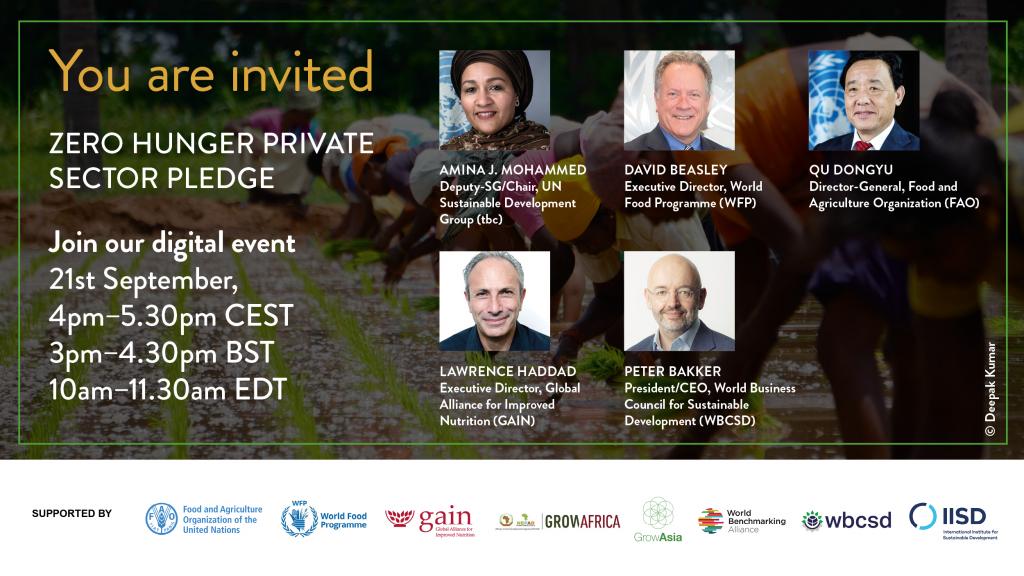
The Zero Hunger Private Sector Pledge Launch Event

We are launching the Zero Hunger Private Sector Pledge on Tuesday, September 21. This is a unique opportunity for companies and investment funds to align their investments with new evidence and commitments by donors, governments, and global institutions to end hunger and nourish the future by 2030.  

September 21, 2021 10:00 am - 11:30 am EST

(Open to public)

COVID-19 wiped out 15 years of progress in reducing hunger globally. Investing USD 33 billion more per year can reverse this trend and end hunger for good.

A world without hunger is possible, but it is time to take action! Governments cannot do it alone.

More private sector investment is needed, so we are looking to the private sector to do their part in contributing—and also inspiring other players to act. The ground-breaking Ceres2030 report—reinforced by the Program of Accompanying Research for Agricultural Innovation (PARI) and The State of Food Security and Nutrition in the World 2021 (SOFI) reports—emerged from the UN Food Systems Summit’s Coalition of Action for Zero Hunger and draws a 10-year roadmap to reverse the downward hunger spiral.

Scroll down to view the livestream

GAIN Zero Hunger Pledge Speakers

The Zero Hunger Private Sector Pledge Launch will welcome the first champions. We will hear how they are partnering with governments, donors, and global and local institutions to drive more effective private investments and how their pledges will contribute to national food systems pathways.

The pledge is being supported by a network of implementing organizations and partners, including the Global Alliance for Improved Nutrition (GAIN), Grow Africa, Grow Asia, the World Benchmarking Alliance, the World Food Programme, the International Institute for Sustainable Development (IISD), the Food and Agriculture Organization of the United Nations (FAO) and the World Business Council for Sustainable Development (WBCSD).

For further information on this initiative please consult the related project page.

WATCH - Livestream of the meeting.


Tentative Speakers:

  • Agnes Kalibata, President, AGRA and UN Secretary-General’s Special Envoy to the 2021 Food Systems Summit
  • David Beasley, Executive Director, WFP 
  • Peter Bakker, President and CEO, WBCSD 
  • Qu Dongyu, Director-General, FAO 
  • Caroline Keelings, CEO, Keelings 
  • Nnaemeka Ikegwounu, Cold hubs/The Smallholders Foundation 
  • H.E. Ambassador Josefa Sacko, Commissioner for Rural Economy and Agriculture of the African Union Commission (rep by Dr Godfrey Bahiigwa)
  • Thierry Nohasiarivelo, Coordinator, SBN Madagascar
  • HE Mr Désiré M’zinga Birihanze, Minister of Agriculture of DRC

Date / Time: Wednesday, September, 21 from 10:00 - 11:30 EST / 16:00 - 17:30 Geneva / CET / 15:00 - 16:30 UK time

Interpretation in English- French and Spanish will be available.

The event agenda can be found here


Webinar

Fossil Fuel Subsidy Reform for Green Recovery and Greater Climate Ambition

September 15, 2021 8:00 am - 9:30 am EST

via Zoom

(Open to public)

Fossil fuel subsidy reform is a necessary prerequisite to green recovery and a key tool for increasing climate ambition and motivating clean energy transition. This virtual event, organized by the Friends of Fossil Fuel Subsidy Reform (FFFSR) in collaboration with the International Institute for Sustainable Development's Global Subsidies Initiative (GSI) and with support from the Deutsche Gesellschaft für Internationale Zusammenarbeit (GIZ) GmbH, highlighted the critical role that fossil fuel subsidy reform plays in these pathways.

During this session, IISD-GSI researchers present recent modelling results that show how much greenhouse gas emissions can be reduced by consumer fossil fuel subsidy reform, and how much money countries can save at the same time. Speakers also share guidance for achieving a fossil-free recovery as well as government and civil society perspectives on green recovery.

Agenda

Call to Order

Philip Gass, Lead, Transitions, International Institute for Sustainable Development (IISD)

Opening Remarks

Dr. Hinrich Thölken, Ambassador, Director Climate and Energy Policy and Digital Transformation, Federal Foreign Office, Germany

Keynote Address

The Potential for FFSR to Contribute to NDC Ambition and Green Recovery
Dr. David Walker, Ambassador and Permanent Representative to the WTO, Government of New Zealand

Session 1: IISD’s Fossil Fuel Subsidy Related Research and Updates

GSI Report Modelling Potential for FFSR to Contribute to GHG Mitigation
Jonas Kuehl, Junior Policy Analyst, IISD

IISD Flagship Report on Fossil-Free Recovery and Fossil Fuel Subsidy Tracker
Lourdes Sanchez, Senior Policy Advisor and Lead, Indonesia, IISD

Session 2: Government Responses

Indonesia’s Experience with FFSR
Dr. (HC) Ir. H Suharso Monoarfa, Minister of National Development Planning, Republic of Indonesia

Session 3: Civil Society Perspectives

Egypt’s Experience with FFSR
Dr. Mohamed El Sobky, Professor, Cairo University; Past CEO, Egyptian New and Renewable Energy Authority (NREA)

Enabling Clean Energy Transition in Indigenous Communities
Freddie Campbell, Global Hub Program Coordinator, Indigenous Clean Energy (ICE)

India’s LPG Subsidy Reform
Shruti Sharma, Associate and Energy Specialist, IISD

Q&A

Moderated by Philip Gass

Closing

Webinar

Report Launch: Advancing Climate and Disaster Risk Finance and Insurance (CDRFI) in National Adaptation Plan (NAP) Processes

At a time when climate related disasters are predicted to push an additional 132 million people into extreme poverty by 2030, there is a need for concerted effort to strengthen adaptation and resilience building mechanisms.

September 1, 2021 9:00 am - 10:15 am EDT

(Open to public)

Climate and disaster risk finance and insurance (CDRFI) solutions can play an essential role in climate change adaptation, enabling governments, businesses, and individuals to protect their financial security in the event of shocks, and providing information and incentives for improved management of risks.

National Adaptation Plan (NAP) processes will guide investments in adaptation over the coming years, whether from domestic budgets, the private sector, or international climate finance. Having CDRFI solutions better reflected in NAP processes will not only increase awareness of the role of these financial tools in a country’s adaptation journey, but also provide a basis for quickly and effectively scaling up such solutions.

This event launched a new report, analyzing the ways in which countries are integrating CDRFI solutions in their efforts to formulate and implement NAPs–as well as the missed opportunities. The analysis is a result of collaboration between the NAP Global Network and the InsuResilience Global Partnership (IGP).

Prepare for the discussions by first exploring the analysis:
Opportunities for Strengthening Resilience by Integrating Climate and Disaster Risk Finance and Insurance (CDRFI) in National Adaptation Plan (NAP) Processes