Webinar

Taking Stock of 2021: A to-do list for the WTO in the circular economy transition

December 10, 2021 2:00 pm - 3:00 pm CET

via Zoom

(Open to public)

Momentum for trade and environmental sustainability has strengthened significantly over the past couple of years at the World Trade Organization (WTO). This is evident in the structured discussions on trade and environmental sustainability (TESSD) launched in November 2020 as well as the three environment-related Ministerial Statements due to be launched in December 2021.

As the WTO considers when to hold the Twelfth Ministerial Conference, which was delayed by the pandemic, it is time to take stock of the progress achieved and look at the necessary next steps for trade and trade rules to better support the transition to a circular economy.

This virtual event examines various concrete actions and future workstreams that could be taken at the WTO to better support members and companies in their actions supporting carbon neutrality and the transition to a circular economy. The webinar focuses on the following questions:

  1. What are the concrete trade-related actions needed to better enable and advance the transition to a circular economy?
  2. What can the WTO do to support and enable the transition to a circular economy?
  3. How could this work complement the work being done in other international organizations? 

Speakers

Webinar

Sustainable Implementation of PM-KUSUM and Solar Irrigation in India

December 16, 2021 3:30 pm - 4:30 pm IST

Virtual, via Zoom

(Open to public)

This webinar, corresponding with the launch of the Guidebook for State Policy-Makers on Maximizing the Social and Environmental Benefits from Solar Pump Schemes on December 16, provided participants with a first look at the guidebook's findings, presenting key takeaways and recommendations.

Through a panel discussion with a diverse range of experts on the topic of a water–energy–food nexus approach for maximizing the potential of the PM-KUSUM scheme in India, participants engaged with the research and provided inputs for further strengthening the implementation of solar irrigation schemes at the state and regional levels.

The webinar and related guidebook were developed by IISD and research partners, The Energy and Resources Institute (TERI), the Council on Energy, Environment and Water (CEEW), and the Initiative for Sustainable Energy Policy (ISEP) as part of a project supported by the Deutsche Gesellschaft für Internationale Zusammenarbeit (GIZ) GmbH.

Agenda

Welcome Address

Shalu Agrawal, Senior Programme Lead, CEEW

Presentations

Findings from the Guidebook on PM-KUSUM and Solar Irrigation and Introduction to the CEEW Solar Pumps Tool

Siddharth Goel, Senior Policy Adviser, IISD

Anas Rahman, Programme Associate, CEEW

Panel Discussion

Chair

Debajit Palit, Director, Rural Energy and Livelihoods, TERI

Speakers

  • Rupali Thakur, CEO, Himachal Pradesh Energy Development Agency (HIMURJA)
  • Aditi Mukherji, Lead Researcher, International Water Management Institute (IWMI)
  • A.V. Manjunatha, Director, Karnataka Evaluation Authority
  • Surinder Makhija, Strategic Advisor and Senior Vice-President, Jain Irrigation Systems

Closing Remarks

Nilanjan Ghose, Senior Advisor, Indo-German Energy Programme, GIZ

Florian Postel, Junior Advisor, Indo-German Energy Programme, GIZ

Webinar

National Oil Companies and Climate Change: Insights for advocates

December 6, 2021 9:00 am - 10:00 am GMT

Virtual, via Zoom

(Open to public)

National oil companies (NOCs) are the “hidden half” of the global oil industry. Climate and development advocates who seek to reduce fossil fuel supply and promote sustainable economies must engage with these state-owned companies, many of which are based in countries with high levels of poverty. At each of these sessions, we present NRGI and IISD’s new briefing paper that proposes five insights on how advocates can influence NOCs, followed by reactions from leading experts who are engaging with NOCs in their countries to spark a discussion among participants.

To support participation from different time zones, this webinar was offered at two different times on December 6. Both one hour sessions follow a similar agenda, so please select the session that works best for you. Participants may also view both sessions if they so choose.

Session One: 9 a.m. GMT (Asia/Pacific and Africa-time friendly)

Speakers

Valérie Marcel (moderator), Associate Fellow, Environment and Society Programme, Chatham House

David Manley, Senior Economic Analyst, Natural Resource Governance Institute (NRGI)

Meena Raman, Head of Programmes, Third World Network

Aisha al-Sarihi, Research Fellow, Middle East Institute, National University of Singapore, and Non-Resident Fellow, The Arab Gulf States Institute in Washington

Benjamin Boakye, Executive Director, Africa Center for Energy Policy
 

Register for Session One here »
 

Session Two: 4 p.m. GMT (North and South America-time friendly)

Speakers

Diego di Risio (moderator), Regional Manager Latin America & Caribbean, Global Gas and Oil Network (GGON)

Patrick Heller, Chief Program Officer, Natural Resource Governance Institute (NRGI)

Rosanety Barrios, Independent Analyst on Energy

Andrés Gómez O., Researcher, CENSAT Agua Viva (Friends of the Earth Colombia)

Register for Session Two here »
 

Webinar details

Webinar

Canadian Prairie Agriculture Under Climate Change: How can we chart a resilient path?

Join us for a discussion about the future of farming in the Canadian Prairie provinces.

December 2, 2021 11:00 am - 12:30 pm Central Standard Time

(Open to public)

The impacts of a warming climate are already being felt on the Canadian Prairies amid extreme weather events ranging from floods to droughts to wildfires. The past summer was particularly hard on many agricultural producers. On Thursday, December 2, 2021, IISD and ClimateWest held a webinar featuring Prairie-based producers and experts to hear about what these climate challenges mean for agriculture, with an open Q&A and discussion about the road ahead.

This webinar followed the release of a new IISD report, Farming the Future: Agriculture and Climate Change on the Canadian Prairies, which provides an extensive overview and analysis of:

  • The climate risks that Prairie producers face
  • How on-the-farm practices can help producers build resilience, improve their bottom line, and reduce environmental impacts
  • The critical role of federal and provincial policy in supporting producers, their livelihoods, and their competitiveness for international markets. 

The webinar provided an overview of this latest research, along with panellists' perspectives. It also examined the current policy state-of-play and considered lessons learned for the future. IISD’s new report is the first of a two-part series, and this webinar helped lay the groundwork for the upcoming second report about policy solutions.

Speakers included:

  • Ian McCreary, Grain and livestock farmer, McCreary Land & Livestock Ltd. (Saskatchewan)
  • Duncan Morrison, Executive Director, Manitoba Forage & Grasslands Association
  • Debra Davidson, Professor of Environmental Sociology, University of Alberta
  • Lara Ellis, Senior Vice-President, Policy and Partnerships, ALUS

Moderation and opening and closing remarks were provided by:

  • Jane Hilderman, Executive Director, ClimateWest
  • Vanessa Corkal, IISD Policy Advisor
  • Aaron Cosbey, IISD Senior Associate

Watch the webinar video below:

Webinar

New Tools for Tax Treaty Negotiation

Join us for two webinars on tax treaty practice launching two new tools for policy-makers and negotiators.

November 30, 2021 9:00 am - December 1, 2021 11:00 am EST (GMT -5)

(Open to public)

The use of tax treaties by developing countries is controversial, to say the least. Best case scenario? Tax treaties help to attract foreign direct investment by reducing the risk of double taxation. Evidence for this is weak. Worst case scenario? They become a vehicle for multinational tax avoidance leading to huge revenue losses for developing countries.

Despite the uncertain benefits and widely recognized risks, developing countries continue to sign tax treaties. In such cases, an understanding of good treaty practice–how countries in a similar position have negotiated, reviewed, or modified their treaties to better protect their tax base–can help lay the foundations for fairer and more sustainable tax treaties.

We are pleased to announce two webinars on tax treaty practice, which will launch two new tools:

  1. A new practice note Protecting the Right to Tax Mining Income: Tax Treaty Practice in Resource-Rich Countries (draft available here), hosted by the Intergovernmental Forum on Mining, Minerals, Metals and Sustainable Development (IGF).
  2. The Tax Treaties Explorer, an interactive data visualization website created by the International Centre for Tax and Development (ICTD) with support from the World Bank’s Global Tax Program.

Join us for these webinars, and finish 2021 with a deep dive into groundbreaking research and practical guidance on tax treaty practice in developing countries!

Webinar 1 | Protecting the Right to Tax Mining Income: Tax Treaty Practice in Resource-Rich Countries

Register for the IGF webinar

  • Tuesday, November 30 at 09:00–10:30 ET (14:00–15:30 GMT)
  • Includes simultaneous interpretation for participants in English, French, and Spanish

Mining involves finite, non-renewable resources. Countries that host such resources only get one chance to tax the income arising from their extraction. This fact, and the prevalence of investment from foreign multinationals, makes the impact of tax treaties on mining revenue collection of critical importance to resource-rich developing countries.

IGF’s new practice note aims to equip governments of resource-rich developing countries to decide if tax treaties are necessary and, if they are, to design them in a way that safeguards their right to tax mining income at all stages of the mining value chain.

Moderator

  • Michael Lennard, Chief of International Tax Cooperation and Trade, Financing for Development Office, United Nations

Speakers will include

  • Amadou Abdoulaye Badiane, Director of Legislation and International Cooperation, Directorate General of Taxes and Customs, Senegal
  • Carlos Protto, Director of International Tax Relations, Ministry of Treasury, Argentina
  • Alexandra Readhead, Lead, Tax and Extractives, IGF
  • Tugsjargal Sereenendorj, Head of Large Taxpayers Office, General Department of Taxation, Mongolia
  • Jaqueline Taquiri, Policy Advisor, Tax and Extractives, IGF

Register here to attend this webinar hosted by the IGF.


Webinar 2 | The Tax Treaties Explorer: New data for better negotiation

Register for the ICTD-World Bank webinar

  • Wednesday, December 1 at 09:00-11:00 ET (14:00-16:00 GMT)
  • Includes simultaneous interpretation for participants in English, French, and Spanish

The new Tax Treaties Explorer website provides a means to compare and contrast tax treaties in ways that complement analysis of the legal wording.  It is based on a new dataset of almost every treaty signed by developing economies. For non-specialist policymakers and others with a stake in tax policy, this is an accessible entry point to understand treaties in comparative context.

This event, jointly hosted by the ICTD and the Global Tax Program of the World Bank, will introduce the Tax Treaties Explorer and demonstrate how it can be used by practitioners and researchers. It will feature a brief presentation of the Toolkit on Tax Treaty Negotiations from the Platform for Collaboration on Tax, as well as presentations of three research studies that use the Explorer data:

This event will include simultaneous interpretation for participants in English, French, and Spanish.

Register here to attend this webinar hosted by the ICTD and the World Bank.

Webinar

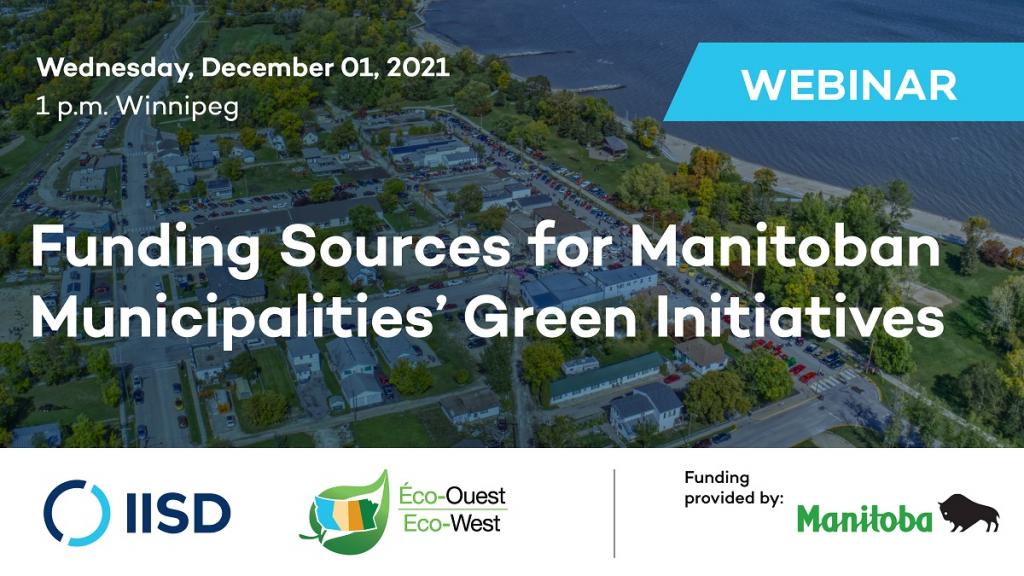
Funding Sources for Manitoban Municipalities’ Green Initiatives

This webinar event provided Manitoban municipalities with an overview of the funding sources available to advance the implementation of their planned green priorities. The panellists reviewed funding from Federal government departments, the Federation of Canadian Municipalities, and other sources. They also provided participants with key considerations when applying for available funding.

December 1, 2021 1:00 pm - 2:00 pm CST

(Open to public)

Social Media card over image of a Manitoba's rural landscape

The number of opportunities for Manitoban Municipalities to access funding to implement their planned green initiatives is growing. Many new sources have been announced in recent months—and may provide the opening needed to move the municipality’s priority actions forward. 

The Government of Manitoba has provided financial support to Eco-West Canada and the International Institute for Sustainable Development (IISD) to help municipalities in Manitoba understand the changing funding landscape.  

Thanks to this funding, Eco-West Canada and IISD hosted an informational webinar on December 1st, 2021 to share more information about available funding opportunities.  

Examples of projects that could be supported through the available funding include: 

  • Climate-proofing critical infrastructure 

  • Retrofitting community buildings to be more energy efficient 

  • Greening your transportation sector, upgrading your fleet vehicles, or expanding active transportation networks 

  • Updating your wastewater systems 

Watch webinar's the full recording

Check out the webinar's presentations slides


Webinar

Fisheries Subsidies Refresher Sessions | November Update

November 12, 2021 3:42 pm - 5:00 pm

(Open to public)

The International Institute for Sustainable Development organized a series of two webinars on the WTO negotiations on fisheries subsidies, that took place online, on Wednesday 10 November and Friday 12 November 2021.

Session I: Walk Through the New Fisheries Subsidies Text

The first session walked participants through the new version of the Chair’s draft consolidated text circulated on Monday 8 November. In doing so, it identified the most important decisions in front of WTO Members with respect to the proposed disciplines and highlighted the changes made in this new text.

Session II: Stakeholders Perspectives on the New Fisheries Subsidies Text

In the second session, a number of stakeholders offered participants a range of different views on the negotiations and the new draft consolidated text from a conservation, sustainable development, and industry perspective. Speakers included experts from academia, the conservation community, fishers and fish workers organizations, and the fish retail sector.

Webinar

Green Recovery: Putting principles into practice—planning and policy to support green jobs and transition

November 22, 2021 3:00 pm - 4:30 pm WIB

Virtual, via Zoom

(Open to public)

Indonesia will play a leading role in 2022, as it holds the presidency of the G20. Green recovery and the promotion of social and economic development are expected to be key pillars of the presidency. This virtual Sweden-Indonesia Sustainability Partnership (SISP) Week session, organized by IISD in collaboration with the Swedish Embassy in Jakarta, discusses how the Indonesian G20 Presidency can address these pressing topics and advance the international agenda in that aspect.

On November 22, Day 1 of SISP Week commenced with an opening ceremony at 2:00 p.m. WIB, followed by the Green Recovery session at 3:00 p.m. WIB.

Green Recovery Session Agenda

Welcome and Opening Remarks

Handing Over by MC
Erik Odar, Trade Commissioner of Sweden to Indonesia

Opening Remarks
Philip Gass, Lead of Transitions at IISD

Green Transition, Green Jobs, and G20

Amalia Widyasanti, Deputy Minister for Economic Affairs, Ministry of BAPPENAS (National Development Planning), Republic of Indonesia

Satu Kahkonen, Country Director for Indonesia at World Bank

Mattias Frumerie, UNFCCC lead negotiator for Sweden

Q&A

Questions from the audience.

Closing Remarks

Marina Berg, Swedish Ambassador to Indonesia

Webinar

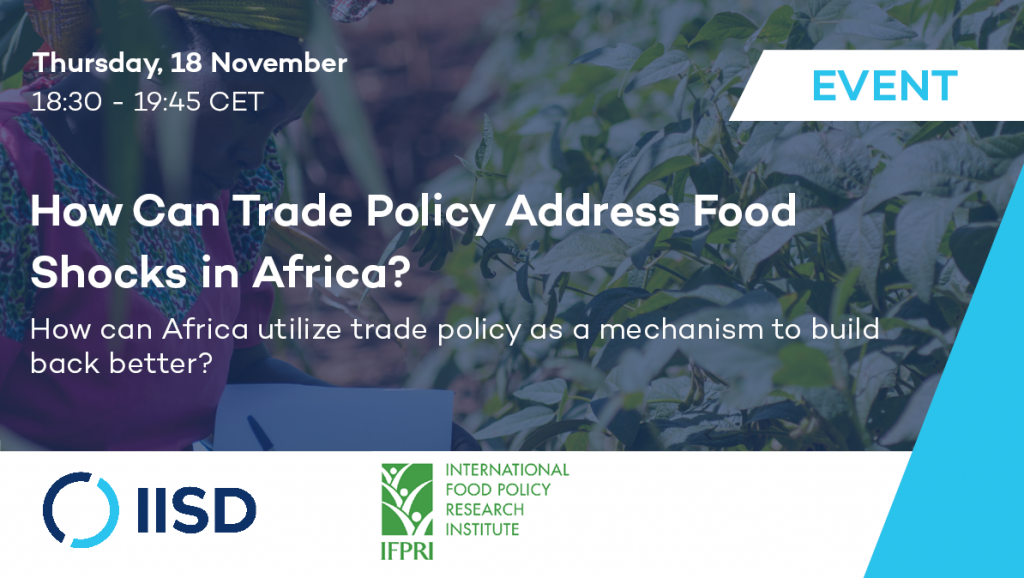
How Can Trade Policy Address Food Shocks in Africa?


November 18, 2021 12:30 pm - 1:45 pm CET

(By invitation)

Event-card-WTO-agriculture

Recent climate, political, and health shocks like the COVID-19 pandemic have exposed some of Africa’s greatest trade vulnerabilities but also highlighted the continent’s greatest opportunities for using trade policy as a mechanism to build back better.  This dialogue among trade experts and World Trade Organization (WTO) negotiators will weigh trade policy options in light of the findings from the recent 2021 Africa Agriculture Trade Monitor (jointly published by AKADEMIYA2063 and IFPRI) and IISD’s report on trade policies for food shocks. The dialogue will also explore the trade policy concerns of WTO negotiators representing African constituencies for the Twelfth WTO Ministerial Conference (MC-12). 

This is a joint event organized by the International Institute for Sustainable Development (IISD) and and the International Food Policy Research Institute (IFPRI). 

Date and time: Thursday, November 18, 2021, 18:30–19:45 CET 

Interpretation in English and French will be provided during the event  


Webinar

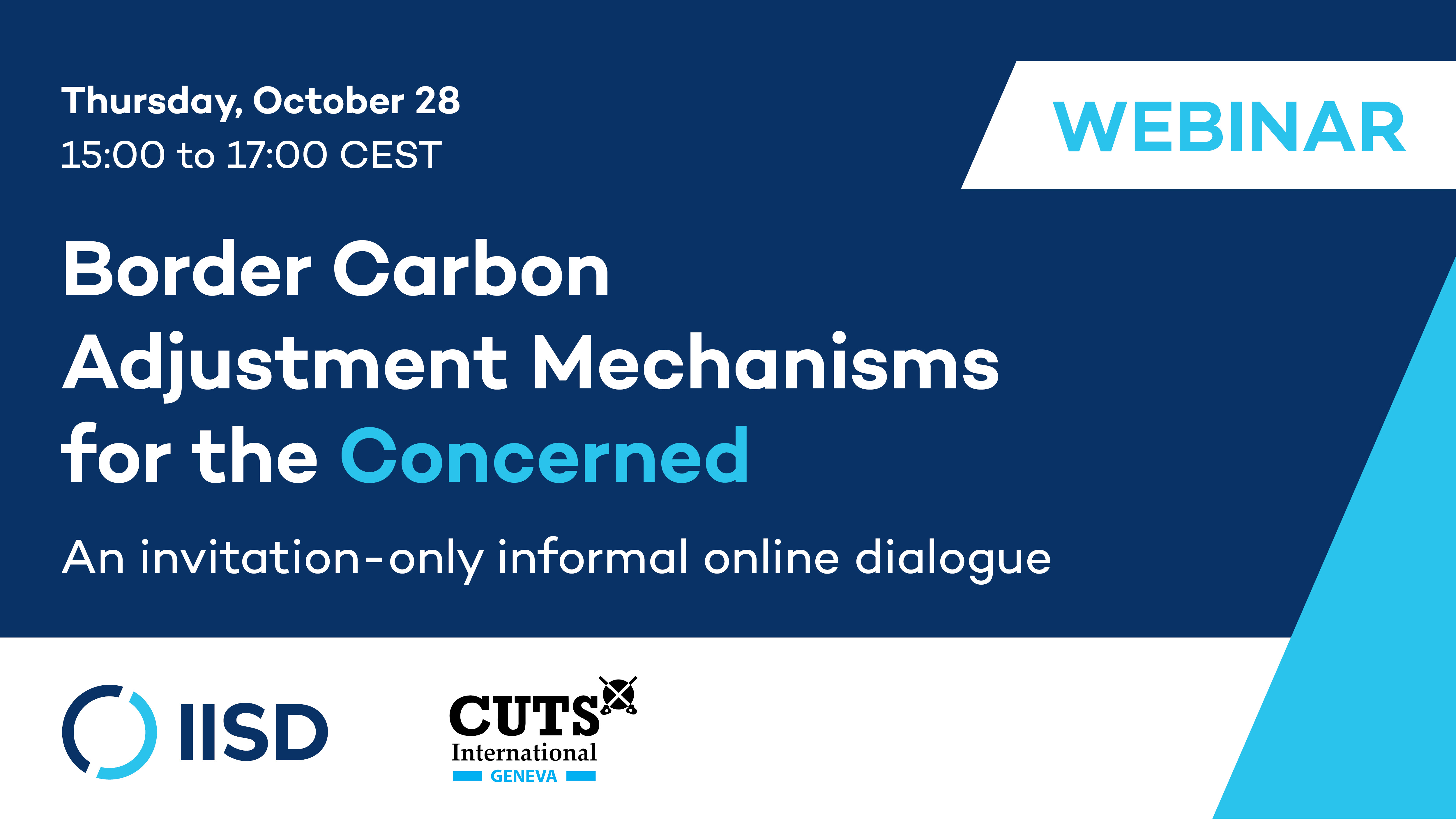
Border Carbon Adjustment Mechanisms for the Concerned

October 28, 2021 3:00 pm CET

(By invitation)

This dialogue aimed to foster an informal discussion on Border Carbon Adjustment (BCA) policy design between trade and environment/climate change officials from countries likely to be directly affected by BCAs. The dialogue discussed the extent of understanding among participants about BCA proposals and the extent to which consultation is taking place with trading partners.

Participants were encouraged to share their concerns regarding BCA proposals, how concerns regarding the design of BCA from an affected country perspective could be addressed, and what can be the features of an effective development dimension.

This discussion was be held under the Chatham House Rule.


AGENDA

  • 15:00 – 15:10
    • Welcome Remarks: Nathalie Bernasconi, Senior Director, Economic Law and Policy, IISD and Rashid Kaukab, Executive Director, CUTS International, Geneva
  • 15:10 – 15:30
    • Scene-setting: Aaron Cosbey, Senior Associate, IISD
  • 15:30 – 16:00
    • Expert perspective: Carlos Razo, Chief, Office of the Director, Division on International Trade, UNCTAD and Aaron Cosbey, Senior Associate, IISD
  • 16:00 – 17:00
    • Presentations and interventions from participants: Moderator: Alice Tipping, Lead, Sustainable Trade and Fisheries Subsidies, IISD
  • 17:00
    • Closing remarks Alice Tipping, Lead, Sustainable Trade and Fisheries Subsidies, IISD

Webinar details