Webinar

Aligning Investment and Climate Goals: Where does the Energy Charter Treaty modernization stand?

This webinar, hosted in partnership with the Centre for International Environmental Law and ClientEarth, discussed the progress achieved so far in the Energy Charter Treaty modernization process and the implications for climate change and clean energy transition goals.

April 28, 2022 3:00 pm - 5:00 pm CET

(Open to public)

The Centre for International Environmental Law (CIEL), ClientEarth, and the International Institute for Sustainable Development (IISD) hosted this webinar to discuss the Energy Charter Treaty modernization process and assess the progress achieved so far. 

The Energy Charter Treaty (ECT) has faced strong criticism in recent years. Initially designed in the 1990s to enable multilateral cooperation in the energy sector, it is the investment treaty that has generated the highest number of investor–state arbitrations—leading to record-breaking damages awards that have cost governments millions of dollars. The ECT contains outdated investment protection standards that have been interpreted in a far-reaching manner and have therefore allowed foreign investors to challenge a wide range of public policy measures.

Most recently, foreign investors have used the ECT to directly challenge the implementation of climate change policies, confirming previous fears that the fossil fuel industry might rely on the treaty to prevent governments from taking ambitious climate action or to seek compensation for their stranded assets. 
 
Amid widespread recognition that the ECT is outdated and constitutes an obstacle to the transition to a low-carbon economy, the treaties' contracting parties started negotiations to “modernize” the treaty. Since this “modernization" process started in July 2020, the ECT Modernization Group has held 11 rounds of negotiations, with two more rounds planned for April 19–22 and May 17–20, 2022. The contracting parties aim to conclude the negotiations and reach an agreement in principle in June 2022 at the ad hoc Energy Charter Conference. 
 
This webinar discussed the progress achieved so far by the European Union (EU) to meet the objectives set in its negotiation mandate: 

  1. To bring the ECT provisions on investment protection in line with the modern standards of recently concluded agreements by the EU and its member states.
  2. To reflect climate change and clean energy transition goals and contribute to the achievement of the objectives of the Paris Agreement. 

The webinar also reflected on issues of the ECT’s compatibility with EU law, with regard to both the intra-EU situation (following the landmark rulings Achmea and Komstroy by the EU’s Court of Justice) and in relation to third countries (applying the test set out in CJEU Opinion1/17). 

Speakers

Moderators

  • Nathalie Bernasconi-Osterwalder, Executive Director, IISD Europe; Senior Director, Economic Law & Policy, IISD
  • Anaïs Berthier, Senior Lawyer and Head of EU Affairs, ClientEarth

Keynote speaker

  • George Kahale III, Leading International Arbitration Lawyer, Chairman and Partner, Curtis, Mallet-Prevost, Colt and Mosle LLP

Panelists

  • Laurens Ankersmit, Assistant Professor of European Law, University of Amsterdam
  • Lucía Bárcena, Project Officer, Transnational Institute
  • Helionor De Anzizu, Staff Attorney, Environmental Health Program, CIEL
  • Martin Dietrich Brauch, Senior Legal and Economics Researcher, CCSI
  • Christina Eckes, Professor of European Law, University of Amsterdam
  • Jan Gerrit Westerhof, Lead Negotiator for the ECT, DG Trade, European Commission
  • Nicolaj Kuplewatzky, Référendaire, Court of Justice of the European Union
  • Lukas Schaugg, International Law Analyst, IISD

 

CIEL, ClientEarth, IISD

Webinar details

Webinar

Fossil Fuel Subsidy Reform at the G20: How to achieve the post-pandemic recovery

March 16, 2022 4:00 pm - 6:00 pm WIB

via Zoom

(Open to public)


As part of its G20 Presidency in 2022, Indonesia aims to accelerate the speed of global energy transitions. For this purpose, its inter-ministerial Energy Transition Working Group (ETWG) has defined three G20 energy priority issues:

  1. Securing energy accessibility
  2. Scaling up smart and clean energy technologies
  3. Advancing energy financing.

To what extent fossil fuel subsidy reform (FFSR) can and must play a role in achieving these three priorities under Indonesia’s G20 Presidency, however, has not yet been widely discussed.

Against this background, one week prior to the first meeting of the ETWG (March 24-25, 2022), a panel of both Indonesian and international experts will explore how FFSR can be driven forward in the post-pandemic recovery. First, the webinar will explore how the Indonesian government plans to implement FFSR. IISD’s Lourdes Sanchez will then give a keynote address on how exactly FFSR supports the three energy transition priority issues of Indonesia’s G20 Presidency. Finally, the high-profile panellists will discuss how FFSR correlates with the three priority issues of the Indonesian G20 Presidency’s grand theme: “Recover Together, Recover Stronger.”

Agenda

Opening Remarks

Febrio Kacaribu, Head of Fiscal Policy Agency, Ministry of Finance, Republic of Indonesia 

Keynote Address

How Can Fossil Fuel Subsidy Reform Support the Three Pillars of Energy Transition in the G20?
Lourdes Sanchez, Senior Policy Advisor and Lead, Indonesia, International Institute for Sustainable Development

Panel Discussion

Moderator

Adhityani Putri, Global Strategic Communications Council

Panellists

  • Wahyu Utomo, Head of State Budget, Ministry of Finance, Republic of Indonesia
  • Edi Wibowo, Director of Bioenergy, Ministry of Energy and Mineral Resources, Republic of Indonesia
  • Pekka Morén, Senior Ministerial Adviser, Ministry of Finance, Finland
  • Aldo Ravazzi, Chief Economist, Ministry of Ecological Transition, Italy

Closing Statements

Webinar

Mine Closure Readiness: Are governments and industry prepared?

March 2, 2022 10:00 am - 1:00 pm ET

(Open to public)

Mine closure is a complex, multidisciplinary undertaking requiring several years of planning and a coordinated effort from government and industry stakeholders, ideally beginning at the earliest stages of mine planning.

For mining to be truly sustainable, the sector must provide the valuable minerals and metals needed by society and transition to a low-carbon economy without compromising the integrity of the environment or the well-being of local communities. Well-planned and executed mine closure is essential in achieving this desired outcome. While there are only a few global examples where mines have been relinquished, both government and industry are making progress to be better prepared to manage mine closure throughout the mining life cycle.

On Wednesday, March 2, we hosted a webinar presenting recent work on mine closure from the Intergovernmental Forum on Mining, Minerals, Metals and Sustainable Development (IGF) and the International Council on Mining and Metals (ICMM). Presenters shared assessments on the status and profile of mine closure in industry, as well as how prepared governments are for the significant number of mine closures that are expected in the coming years. The event also outlined the ICMM’s and IGF’s activities to support their industry and government members and presented the recommended steps they can take to be mine closure ready. Panellists also took questions from attendees.

Opening Remarks

• Greg Radford, Director, IGF

Speakers
• Dawn Brock, Senior Manager, ICMM
• Rob Stevens, Consultant, IGF

Visit the IGF Website to view the recording and presentations

Webinar

Global Launch of the 2021 Progressing National SDGs Implementation Report

The Progressing National SDGs Implementation report series provides independent analyses of how UN Member States share progress at the annual High-level Political Forum on Sustainable Development (HLPF). Supported by a global coalition of civil society organizations and prepared by Cooperation Canada, the 2021 report examines trends and best practices amid the ongoing COVID-19 pandemic.

February 23, 2022 2:30 pm - 4:00 pm UTC

(Open to public)

The review of the 42 Voluntary National Reviews (VNR) submitted by countries to the HLPF last year—as well as the analysis of 17 VNR-related civil society reports—show both positive and concerning trends. The report covers all aspects of 2030 Agenda implementation through an examination of governance arrangements, institutional mechanisms, and stakeholder engagement, policies, means of implementation, and reporting. Key findings, good practice case studies, emerging best practices and recommendations are presented throughout this edition.

Some highlights include:

  • In terms of a whole-of-society approach, fewer countries reported on the inclusion of non-state actors in governance arrangements for implementation than in previous years. Although more countries referred to formal processes for stakeholder engagement, there have been backslides in reporting on non-state actors’ engagement in the VNR process, consultations to define national priorities, and the effects of the COVID-19 pandemic on stakeholder engagement.
  • The VNR reports continue to be silent on shrinking civic space globally and ongoing attacks on human rights defenders and environmentalists. Conversely, several civil society reports highlight how this has been an issue.
  • There has been a positive trend in reporting on leaving no one behind, with increases around the identification of left-behind groups, the incorporation of the LNOB principle in national policies and plans, and the impacts of COVID-19 on the most vulnerable. However, challenges remain in terms of data availability, and level of detail and quality of information provided around LNOB.

Webinar details

Webinar

Climate Resilience through Solar Irrigation

February 18, 2022 2:45 pm - 4:15 pm IST

(Open to public)

The International Institute for Sustainable Development (IISD), The Energy & Resources Institute (TERI) and the Consumer Unity & Trust Society (CUTS International) are hosting a thematic track on Climate Resilience through Solar Irrigation as part of the World Sustainable Development Summit (WSDS) 2022 organized by TERI. The 21st edition of WSDS, entitled Towards a Resilient Planet: Ensuring a Sustainable and Equitable Future, will be held from February 16-18 in a virtual format. 

The thematic track on solar irrigation, which will take place on February 18 at 2:45–4:15 PM IST (GMT+5.30), is being organized as part of a Deutsche Gesellschaft für Internationale Zusammenarbeit (GIZ) supported project to provide guidance to state policymakers in India on sustainably implementing solar irrigation schemes. The research consortium will present the findings from a recently published guidebook on solar pumps, and invite experts from South Asia and East Africa to discuss how solar irrigation can help advance climate resilience in the agriculture sector. Participants will find out how to maximize the economic benefits of solar irrigation while supporting marginalized farmers and addressing sustainability concerns, such as groundwater depletion in water-stressed regions.

Agenda

Welcome Address

Nilanjan Ghose, Senior Advisor, GIZ India

Keynote Address

(TBC)

Setting the Context, Pathways for Effectively Operationalizing Solar Irrigation

Siddharth Goel, Senior Policy Advisor, IISD

Panel Discussion, Climate Resilience through Solar Irrigation

Moderator
Priya Jadhav, Indian Institute of Technology Bombay (IITB)

Panellists

  • J.K. Jethani, Director Scientist-F, Ministry of New and Renewable Energy (MNRE), Government of India
  • Lucie Pluschke, East Africa hub manager for Water and Energy for Food, GIZ Kenya
  • Shilp Verma, Senior Researcher, Water-Energy-Food-Policies, International Water Management Institute (IWMI) (TBC)
  • Dipal Barua, Chairman, Bright Green Energy Foundation & President, Bangladesh Solar & Renewable Energy Association (BSREA)

Concluding Remarks

Debajit Palit, Director, Rural Energy and Livelihoods, TERI

Webinar

Developing a Call to Action: Small-scale farmers’ policy priorities

February 10, 2022 6:00 am - 8:00 am CET

(Open to public)

Over the last several months, the SDG2 Advocacy Hub and partners including IISD have been exploring the idea of a call to action or a "new policy consensus," crafted and signed by smallholder farmers organizations, civil society, governments, and international organizations. The call-to-action could contribute to and build on the momentum of the 2021 global summits, align policy priorities, and drive decision making and investment.

The proposed Food Systems Dialogue aims to create a space for smallholder farmers around the world and their organizations to share their insights and priorities. The outcomes of this dialogue will help to inform the new policy consensus.

Panellists:

  • Elizabeth Nsimadala – President, EAFF, former President PAFO

  • Mr. Kolyang Palebele – President, PAFO, PROPAC (Central Africa), CNCRPT (Chad)

  • Theo de Jager – President, WFO

  • Paul Newnham – Director, SDG2 Advocacy Hub as a Moderator  

The dialogue is organized by the East African Farmers Federation (EAFF), the International Institute for Sustainable Development (IISD), the Pan-African Farmers’ Organization (PAFO), the SDG2 Advocacy Hub and the World Farmers’ Organization (WFO).

Webinar

Fisheries Subsidies: State of play and where to next

February 3, 2022 2:00 pm - February 7, 2022 3:00 pm CET

(Open to public)

The International Institute for Sustainable Development, organized on February 3rd, 2022 an online session on the topic of Fisheries Subsidies: State of play and where to next?

After the postponement of the World Trade Organization’s (WTO) Twelfth Ministerial Conference (MC12) in late 2021, this session provided a clear overview of the state of play and key questions remaining in WTO negotiations on fisheries subsidies, based on the draft text prepared for Ministers by the Chair of the Rules Negotiating Group on 24 November 2021.

The session benefited from expert perspectives from external stakeholders on the balances struck in the draft agreement and their views on directions that further work could take to achieve an effective agreement that contributes to sustainable fishing.

Webinar

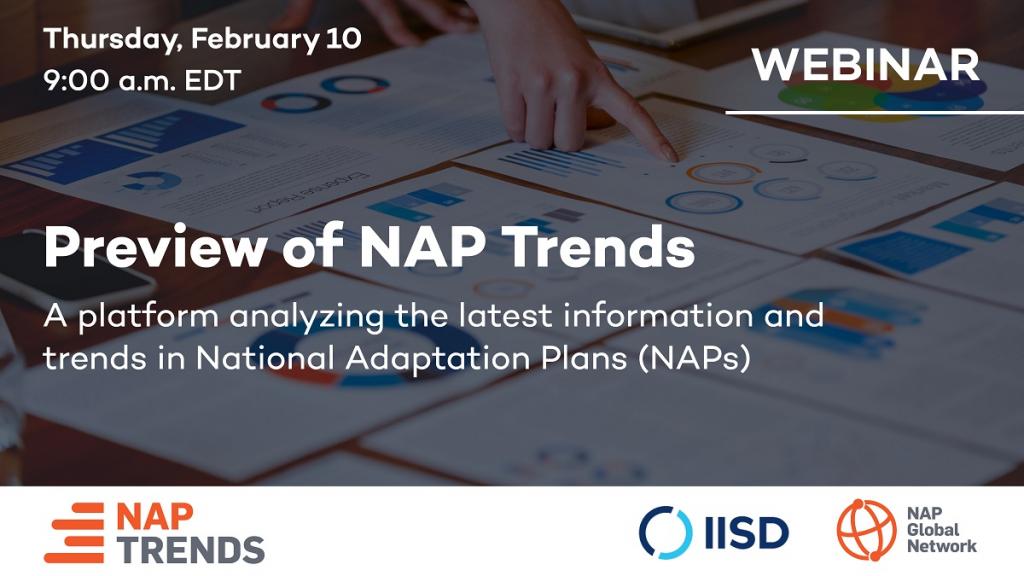
Preview of NAP Trends: A platform analyzing the latest information and trends in National Adaptation Plans (NAPs)

NAP Trends is a brand-new platform that makes key information on National Adaptation Plans (NAPs) easily accessible and digestible for the adaptation community! On February 10, join the NAP Global Network’s soft launch of the platform and test your knowledge on NAP themes and key statistics by participating in our NAP Trends quiz. 

February 10, 2022 9:00 am - 10:00 am EST

(Open to public)

Card - Sof launch of the NAP Trends platform


NAP Trends, an initiative of the NAP Global Network, aims to share key information on NAPs to make it easy to access for the adaptation community. The platform provides concise summaries of key information in NAP documents, as well as analysis of trends across countries. It is based on systematic reviews of NAP documents submitted to NAP Central, the portal for NAPs communicated to the United Nations Framework Convention on Climate Change (UNFCCC).

A total of 129 developing countries have initiated their NAP process. As more NAPs are submitted to the UNFCCC, we are systematically reviewing them, compiling summaries, and tracking trends in how countries are approaching different aspects of the NAP process. 

On February 10, join the NAP Global Network’s soft launch of the platform and test your knowledge on NAP themes and key statistics by participating in our NAP Trends quiz. 

Webinar details

Webinar

South Africa’s Energy Fiscal Policies

January 31, 2022 11:00 am - 1:00 pm SAST

via Zoom

(Open to public)


This webinar, organized in partnership with Trade and Industrial Policy Strategies (TIPS), provided participants with a first look at findings from the International Institute for Sustainable Development (IISD) report South Africa’s Energy Fiscal Policies: An inventory of subsidies, taxes and policies impacting the energy transition, presenting key takeaways and recommendations.

The report explores the extent to which South Africa’s current energy fiscal policies are aligned with its goal to develop a robust domestic energy system that can provide low-carbon energy at a fair cost to all. It provides clear recommendations for the government to align its fiscal energy policies with its climate and energy objectives.

Through a panel discussion and a Q&A session, participants engaged in debate on carbon tax, bailouts, and what international moves to phase out fossil fuel financing and oil and gas exploration mean for South Africa.

Agenda

Welcome From the Moderator
Richard Bridle, Senior Policy Advisor, IISD

Opening Remarks
Sharlin Hemraj, Director: Environment and Fuel Taxes, National Treasury

Launching IISD Report South Africa’s Energy Fiscal Policies
Chido Muzondo, Policy Advisor, IISD

Panel Discussion
Gaylor Montmasson-Clair, Senior Economist: Sustainable Growth, TIPS
Jesse Burton, Senior Associate, Third Generation Environmentalism (E3G)

Q&A

Close

Webinar

Fossil Fuel Subsidy Reform: Moving from commitments to action in 2022

February 1, 2022 2:00 pm - 3:30 pm CET

via Zoom

(Open to public)


Despite long-standing commitments in international forums, governments around the globe continue to spend hundreds of billions each year to subsidize fossil fuels, further encouraging the wasteful consumption of fossil fuels and slowing the uptake of clean alternatives. 2022 must be the year that governments shift from commitments to action. 

This virtual event, organized by the Friends of Fossil Fuel Subsidy Reform (FFFSR) in collaboration with the International Institute for Sustainable Development’s Global Subsidies Initiative (IISD-GSI), provides an update on the state of fossil fuel subsidy reform and what to expect in 2022; a pivotal year in international climate change diplomacy.  

During this session, government representatives from the 2022 G7 and G20 presidencies present how fossil fuel subsidy reform and the clean energy transition fit into their agendas. A representative from the 2021 Asia-Pacific Economic Cooperation (APEC) presidency also outline achievements made last year and the necessary next steps. Researchers from IISD-GSI and other partners then highlight the latest estimates of global fossil fuel subsidy spending. They also look back at the outcomes of the G7, G20, and UNFCCC processes in 2021, including the milestone Glasgow Climate Pact commitment to phase out inefficient fossil fuel subsidies. Finally, speakers look at what to expect from the G7, G20, and UNFCCC in the year ahead. 

Agenda

Call to Order

Peter Wooders, Senior Director, Energy, IISD

Opening Remarks

HRH Prince Jaime de Bourbon de Parme, Climate Envoy of the Netherlands

Government Perspectives

Fossil Fuel Subsidy Reform (FFSR) at the G7 in 2022
Birgit Schwenk, Director General for Climate Policy, Federal Ministry for Economic Affairs and Climate Protection, Germany

FFSR at the G20 in 2022
Andi Novianto, Deputy Minister, Assistant Deputy for Oil and Gas, Mining, and Petrochemical at the Coordinating Ministry of Economic Affairs, Indonesia

FFSR at the APEC in 2021 and Next Steps
Vangelis Vitalis, Deputy Secretary Trade and Economic, New Zealand Foreign Affairs and Trade, and APEC 2021 Senior Officials Meeting Chair

Civil Society Perspectives

FFSR Outcomes at the G7 and G20 in 2021 and Expectations for 2022
Ipek Gencsu, Senior Research Fellow, Climate and Sustainability, Overseas Development Institute (ODI)

FFSR Outcomes at COP26 and Expectations for 2022
Jennifer Allan, Strategic Adviser and Team Leader, Earth Negotiations Bulletin, IISD

Update of the Fossil Fuel Subsidy Tracker
Lourdes Sanchez, Senior Policy Advisor and Lead, Indonesia, IISD

Q&A

Moderator: Peter Wooders, IISD

Closing