Webinar

Enabling Women Leaders in Building Equitable, Inclusive, and Climate-Resilient Cities

SUNCASA presented its gender equality and social inclusion (GESI) approach and achievements at the NGO CSW 70 Forum in New York.
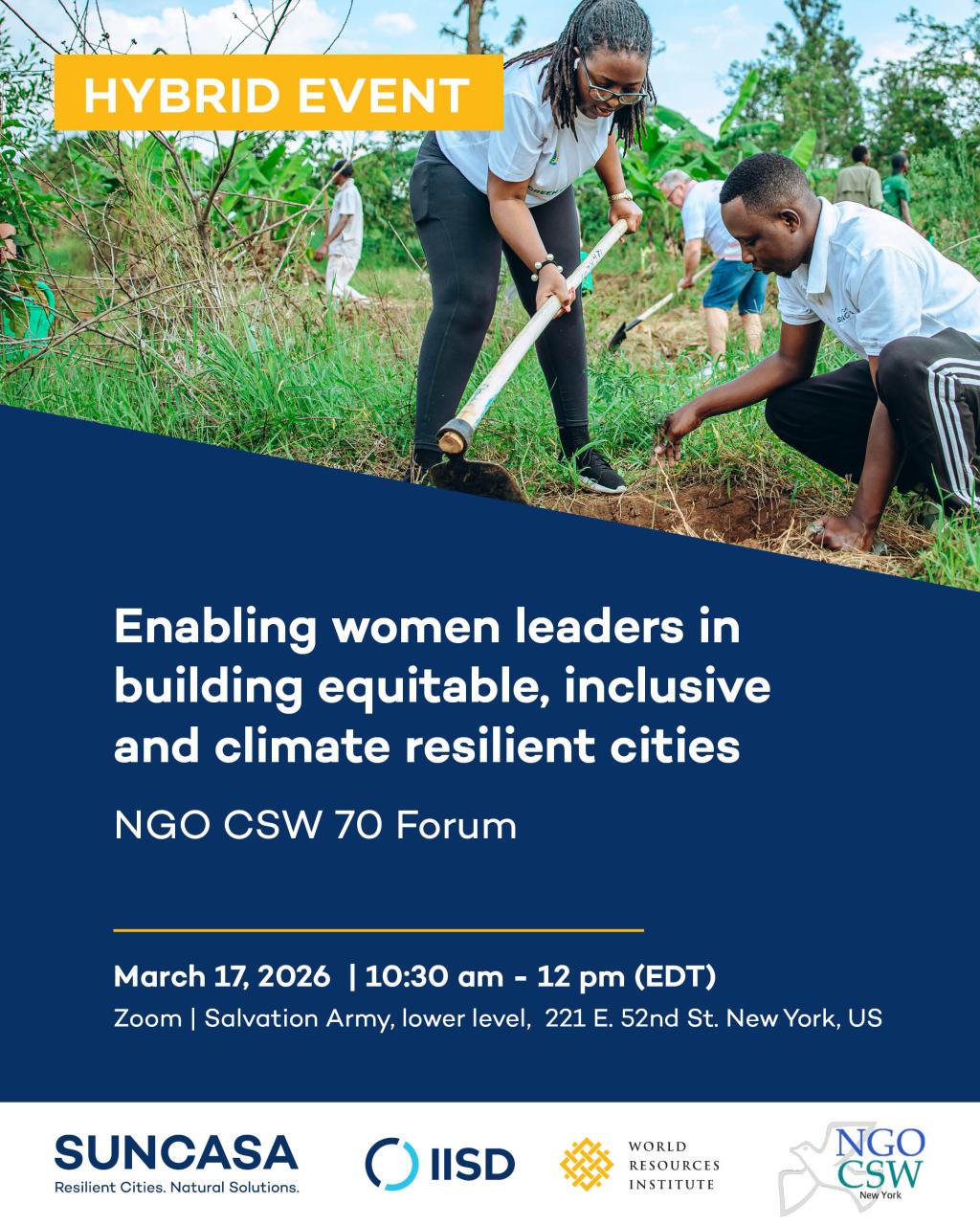
March 17, 2026 10:30 am - 12:00 pm EDT

Salvation Army, lower level, 221 E. 52nd St., New York, NY 10022

(Open to public)

SUNCASA | NGO CSW 70 Forum


The NGO Committee on the Status of Women (NGO/CSW) Forum celebrates 70 years in 2026. Held annually in New York, the Forum connects global civil society, non-governmental organizations (NGOs), and feminists with the official United Nations Commission on the Status of Women (UN CSW) process.

This year, the Forum featured a dedicated hybrid session highlighting the gender equality and social inclusion (GESI) approach and outcomes of the Scaling Urban Nature-based Solutions for Climate Adaptation in Sub-Saharan Africa (SUNCASA) Project.


Two thirds of African cities face extreme climate risks, with impacts falling hardest on the most vulnerable urban populations. Nature-based solutions (NbS) offer a cost-effective pathway to reduce climate vulnerabilities while enhancing biodiversity. However, women and other underrepresented groups are often excluded from shaping these interventions, despite their central role in stewarding natural resources.

The SUNCASA project addresses this gap by advancing gender responsive, socially inclusive NbS in Dire Dawa (Ethiopia), Kigali (Rwanda), and Johannesburg (South Africa). By responding to locally identified priorities, SUNCASA strengthens community resilience to climate change impacts such as flash floods, landslides, urban heat, and water scarcity, through NbS approaches that intentionally integrate gender equality and social inclusion.

At NGO/CSW 70, SUNCASA’s GESI experts and local GESI partners highlighted the project’s commitment to elevating women’s leadership within urban NbS. Discussions explored the project’s climate adaptation and GESI strategy.

A panel featuring women’s rights and community organizations from all three cities further explored how they are shifting norms, designing inclusive practices, and expanding opportunities—from engaging women in restoration work in Dire Dawa, to establishing a GESI code of conduct and supportive services in Kigali, to facilitating community dialogues on gender norms and intersecting vulnerabilities in Johannesburg. Together, these stories underscore the essential role of gender-responsive NbS in building more equitable and climate-resilient urban futures. 

PANEL

Moderators:

  • Ayushi Trivedi, SUNCASA GESI Lead, World Resources Institute
  • Meghan Stromberg, SUNCASA Project Manager, World Resources Institute

Panellists:

  • Bertha Chiroro, GenderCC, Johannesburg, South Africa
  • Hadas Temesegen, Harraghe Catholic Secretariat, Dire Dawa, Ethiopia
  • Theogene Niyirora, Avega Agahozo, Kigali, Rwanda


ABOUT SUNCASA

SUNCASA is a 3-year project enhancing resilience, gender equality, social inclusion, and biodiversity protection in urban communities in Ethiopia, Rwanda, and South Africa. It is delivered by the International Institute for Sustainable Development and the World Resources Institute, funded by the Government of Canada, and implemented with a wide range of local organizations and communities.

SUNCASA restores urban watershed areas through gender-responsive NbS such as agroforestry, afforestation, reforestation, buffer zone creation, and urban tree planting, ultimately strengthening the resilience of 2.2 million people.

 

Webinar

Industrial Policy and Trade: Key developments to watch

This webinar took stock of current debates on industrial policy and trade, highlighting the key issues to watch in 2026. Ahead of the World Trade Organization’s (WTO) 14th Ministerial Conference (MC14), panelists explored how industrial strategies are reshaping trade relations and cross-border spillovers. 

March 13, 2026 2:00 pm - 3:30 pm CET

(Open to public)

About the Event

Industrial policy has returned to the center of global economic and trade debates. Governments are using a range of tools not only to drive economic development, but also to support green transformation, industrial decarbonization, supply chain resilience, and new technologies. While these strategies aim to advance environmental and digital transitions, they also raise concerns about trade distortions, geopolitical fragmentation, and unequal access to green value chains, particularly for developing and least developed countries. 

This webinar explored the intersection of industrial policy and trade ahead of MC14. Panelists reviewed key policy trends in major economies, examined how industrial strategies are reshaping trade relations, and assessed the implications for international trade rules and cross-border spillovers.

Key questions for discussion included:

  • What is driving the renewed use of industrial policy?
  • Which sectors are currently most affected by industrial policy tensions, and which may face challenges next?
  • How are developing and least developed countries affected by the new wave of industrial policies?  
  • What key developments in industrial policy and trade can we expect in 2026, at the WTO and beyond?  

Panel

Moderator:

Kick-off remarks:

Panelists:

For background reading, see the IISD report, An Industrial Policy Renaissance: The challenges and opportunities of going green, which analyzes the resurgence of green industrial policies, their drivers, and their economic, environmental, and trade impacts. 

Webinar

Shaping the Global Data Economy: Trade rules, policy space, and development

As data becomes central to digital trade and economic growth, governments must balance openness with regulatory control. This webinar examined emerging trade rules on cross-border data flows, their impact on development and economic opportunities, and the unique challenges faced by developing countries.

March 6, 2026 2:00 pm - 3:15 pm CET

(Open to public)

About the Event

Data has become a key driver of the global economy, powering digital trade, artificial intelligence, and innovation. At the same time, complex policy debates have emerged around privacy, security, and economic development in the digital age. Governments now face a central challenge of how to enable trusted cross-border data flows to harness the benefits of the digital economy while preserving the regulatory space needed to pursue domestic priorities. 

These debates are also shaped by geopolitics. Digital services are highly concentrated in a few large companies based in the United States and China, and governments are seeking greater control over the technologies and platforms driving global digital transformation. Trade agreements are increasingly at the forefront of this debate, as they shape the evolving rules and norms of the global data landscape. 

This webinar explored the interplay between data governance and trade policy, focusing on emerging trade rules for cross-border data flows. It highlighted the perspectives of developing countries, exploring structural challenges such as value-capture imbalances, capacity constraints, and how to navigate an increasingly complex geopolitical environment. Participants gained insights into policy approaches that can help ensure that data governance frameworks support inclusive and sustainable development.

Panel

Moderator:  

  • Alice Tipping, Director, Trade and Sustainable Development, IISD  

Speaker:

Discussants:

  • Henry Gao, Professor of Law, Singapore Management University
  • Neha Mishra, Assistant Professor, Graduate Institute Geneva 

Webinar details

Topic
Trade
Project
Digital Trade
Impact area
Sustainable Economies
Webinar

Climate Finance: From negotiations to implementations

February 26, 2026 4:00 pm - 5:20 pm India Standard Time (IST)

Virtual via Zoom

(Open to public)

Climate finance remains a critical enabler of global climate ambition, yet the current finance flows still fall short of developing countries’ needs. Developing economies require trillions of dollars annually to meet mitigation and adaptation goals. India alone is estimated to need around USD 170 billion per year to achieve its climate targets, while global public climate finance remains below agreed targets. The 30th UN Climate Change Conference (COP 30) prioritized operationalizing the New Collective Quantified Goal on Climate Finance (NCQG), with the Baku–Belém roadmap aiming to mobilize USD 1.3 trillion for developing countries through public and private finance. Adaptation finance also gained renewed focus, including calls to scale support by 2035 and improve tracking. However, concerns remain on credibility, delivery, and access to funds.

Beyond the United Nations Framework Convention on Climate Change process, the G20 Johannesburg Summit underscored the need to move “from billions to trillions,” highlighting the importance of multilateral development bank (MDB) reform, concessional finance, and risk-sharing instruments to unlock capital at scale.

This webinar, hosted jointly by the International Institute for Sustainable Development and the Indian Institute of Management – Calcutta, will unpack what COP 30 and G20 outcomes mean for the future of climate finance, including progress on the NCQG, MDB reforms, and scaling finance for mitigation and adaptation.

Bringing together policy-makers, researchers, and civil society, this webinar will examine

  • the credibility of global climate finance commitments,
  • MDB reform and blended finance opportunities,
  • access and equity in climate finance for the Global South.

Agenda

Welcome Remarks

Shruti Sharma, Lead, Renewable and Affordable Energy, IISD

Panel Discussion

Moderator: Mritiunjoy Mohanty, Professor, Indian Institute of Management Calcutta (IIM Calcutta)

Dhruba Purkayastha, Advisor to the Standing Committee on Finance, United Nations Climate Change

Dipak Dasgupta, Distinguished Fellow, Earth Science and Climate Change, The Energy and Resources Institute

Vivek Sen, India Director, Climate Policy Initiative

Swati Dsouza, Climate change specialist, Asian Development Bank 

Swasti Raizada, Senior Policy Advisor, IISD

Q&A

Closing Remarks

Runa Sarkar, Professor, IIM Calcutta

Webinar

Designing Better and Fairer Border Carbon Adjustments

This webinar featured a panel discussion aiming to advance global discussions on key design challenges and opportunities related to border carbon adjustments, with a focus on building a common understanding of trade-offs, risks, and possible areas of convergence among policy-makers, civil society, and other stakeholders.

February 25, 2026 2:00 pm - 3:30 pm CET

(Open to public)

About the Event

Border carbon adjustments (BCAs) are moving from policy discussion to implementation. With the European Union's Carbon Border Adjustment Mechanism (CBAM) entering its definitive phase in 2026, there is an urgent need for global guidance on BCA design. If designed well, BCAs have the potential to curb carbon leakage and accelerate global decarbonization. If not, they risk adversely affecting trading partners, triggering geopolitical tensions, and creating significant administrative burdens, disproportionately affecting developing countries.

This webinar aims to advance global discussions on key design challenges and opportunities related to BCAs, with a focus on building a common understanding of trade-offs, risks, and possible areas of convergence among policy-makers, civil society, and other stakeholders.

The session explored questions, such as:

  • What guardrails are needed to ensure BCAs advance climate goals rather than protectionism?
  • How can BCAs and related policies reduce the burden on developing countries and smaller exporters?
  • What opportunities exist for international cooperation to prevent fragmented or inconsistent standards?

The discussion drew on the IISD-facilitated Guidance on Border Carbon Adjustments, which provides concrete recommendations for designing BCAs that are effective, fair, and aligned with international standards.

Panel

Moderator:

Speakers:

  • Aaron Cosbey, Senior Associate, IISD
  • Aparna Sharma, Program Lead, Council on Energy, Environment and Water (CEEW)
  • Åsa Ekdahl, Head of Environment and Climate Change, World Steel Association
  • Michael Mehling, Deputy Director, Center for Energy and Environmental Policy Research at Massachusetts Institute of Technology (MIT) 
Webinar

Leave It to Beavers: Building resilience with beaver dam analogues

March 5, 2026 10:00 am - 11:30 am CT

(Open to public)

Beavers are increasingly recognized as powerful partners in watershed resilience. Their dams slow water, store it on the landscape, reconnect floodplains, reduce erosion, improve habitat, and help buffer both floods and droughts—when built in the right places.

Beaver dam analogues (BDAs) replicate these benefits by mimicking natural beaver dams using simple, permeable structures that slow flows and jump-start riparian recovery. BDAs can restore key ecological functions and even encourage beavers to recolonize, amplifying long-term benefits.

This two-part webinar series explores BDAs from both a big-picture and hands-on perspective. Part 1 covers how BDAs work, where they’re most effective, and the range of hydrologic and ecological benefits they provide. Part 2 dives into implementation, including design basics, materials, site selection, and key considerations for success.

Whether you’re new to BDAs or considering them as a nature-based solution, this series offers both inspiration and practical guidance.

February 26 and March 5, 2026; 10:00 – 11:30 am CT  

Virtual, via zoom 

Moderator: Elizabeth Shearer, ClimateWest

Part 1: Lessons from the Field, features:

  • Lesley Peterson & Elliot Lindsay, Freshwater Conservation Canada;
  • Stephen Bennett, Anabranch Solutions; and
  • Jay Wilde, Rancher from Idaho.  

Part 2: From Ideas to Installation, features:

  • Amy Berlando, Cows and Fish;
  • Deanna del Valle, Freshwater Conservation Canada; and
  • Alvin First Rider, Blood Tribe Land Management.
Webinar

Tax Dispute Resolution Under the UN Convention on Tax: Lessons from investment arbitration

IISD hosted a side event on the margins of the 4th Session of the Intergovernmental Negotiating Committee on the UN Framework Convention on Tax, happening in New York. The event brought together government officials, civil society, and experts to examine lessons from Investor‑State Dispute Settlement, a mechanism originating in international investment law, drawing lessons from associated risks as a baseline to inform current discussions on the Convention’s protocol on tax dispute prevention and resolution.

February 11, 2026 1:15 pm - 2:15 pm Eastern Time (New York)

(Open to public)

The negotiation of a UN Framework Convention on Tax represents a defining moment for international tax governance. The Convention aims to address long-standing coordination gaps in the global tax system through a multilateral framework under the UN. One of the most sensitive aspects of the negotiations is the proposed Protocol on the prevention and resolution of tax disputes.

No comprehensive tax dispute settlement mechanism currently exists. Negotiators are weighing different options, from state-to-state mechanisms like the Mutual Agreement Procedure (MAP) to various forms of arbitration, including mandatory binding arbitration (MBA). ISDS, a mechanism originating in investment law, has entered discussions by analogy. Some states have cited negative experiences with ISDS to argue against arbitration, notably MBA. This raises important questions about the extent to which ISDS and MBA are comparable.

Drawing on over a decade of IISD experience with ISDS reform at UNCITRAL, this event presents our new policy brief, which explains why ISDS is ill-suited for tax disputes and provides a framework for evaluating other arbitration options under the Protocol, including MBA.

The launch was followed by a roundtable with experts and government officials, as well as a Q&A session. For negotiators, policymakers, organizations, or anyone involved in shaping the second Protocol, this session offers more clarity to navigate the choices ahead—and help ensure the Convention gets the Protocol right.

Our speakers

  • Alexandra Readhead, Director, Tax and Sovereign Debt Program, IISD
  • Frederik Heitmuller, Associate Postdoctoral Fellow - International Centre for Tax & Development
  • Lise Johnson, Partner, Curtis, Mallet-Prevost, Colt & Mosle LLP
  • Anthony Munanda, Head of Domestic Resource Mobilization, African Tax Administration Forum
  • Gian Sandri, Senior Policy Advisor and Tax Treaty Negotiator, Swiss Federal Department of Finance


Webinar details

Webinar

The Political Economy of Carbon Pricing

February 19, 2026 9:00 am - 11:00 am GMT

Virtual, via Zoom

(By invitation)

In 2025, there were 80 carbon pricing instruments in operation around the world covering around a quarter of greenhouse gas emissions—a huge increase from only a few years ago. However, in many jurisdictions, particularly those in the Global South, carbon prices are very low; globally, only 3.2% of emissions are priced at the level recommended by the High Level Commission on Carbon Prices.

There has long been criticism by some of the effectiveness of carbon pricing due to the political economy challenges of implementation. This webinar will provide a forum for leading researchers, practitioners, and policy professionals to engage with the latest thinking about these challenges, to share lessons learned from real-world implementation, and to identify opportunities for politically feasible solutions.

Speakers

  • Michael Lerner, Assistant Professor of Political Science and Public Policy, London School of Economics and Political Science
  • Kuki Soejachmoen, Executive Director, Indonesia Research Institute for Decarbonization
  • Philip Gass, Director, Energy Program, Just Transitions and Canada, International Institute for Sustainable Development
  • Mai Duong, Policy Advisor, Tax, Climate, and Nature, International Institute for Sustainable Development
Webinar

From Policy to Practice: Scalable clean cooking solutions for Indonesia

December 18, 2025 9:00 am - 12:30 pm Jakarta, Indonesia (GMT+7)

Gedung Widya Graha, Room 701, Jl. Gatot Subroto Kav.10, Jakarta.

(Open to public)

Indonesia’s subsidized 3-kg LPG cylinder program has expanded clean cooking access, but it now faces growing pressures with subsidies used by households across all income groups, rather than being targeted to the poorest. As a result, the fiscal burden is rising, driven by growing LPG imports. and many low-income and remote households still struggle with unreliable access and continued reliance on firewood use.

The Government of Indonesia has been exploring a range of pathways, including induction stoves, dimethyl ether, and city gas. Each comes with its own economic, fiscal, and environmental implications. Drawing on national data, detailed subsidy modelling, and fieldwork with 100 households in Bali and Solo, a new study by the International Institute for Sustainable Development and the National Research and Innovation Agency (BRIN), finds that induction cooking is the strongest non-fossil option for on-grid households, while DME and city gas face major cost, infrastructure, and long-term sustainability constraints.

Join us for a focused discussion on how these findings can transform Indonesia’s clean-cooking transition. Co-hosted by IISD and BRIN, this event will bring together policymakers, experts, civil society, and media to explore the policy reforms, investment needs, and implementation strategies required to deliver scalable, sustainable clean-cooking solutions for all.

Agenda

Opening Remarks

Agus Eko Nugroho, Head of the Research, Organization for Governance, Economics, and Public Welfare, National Research and Innovation Agency

Achmad Zacky Ambadar, Lead Electric Mobility and Indonesia Energy, IISD

Presentation of Study Findings

Maxensius Tri Sambodo, Senior Researcher, The National Research and Innovation Agency (BRIN)

Discussion on Study Findings

Maxensius Tri Sambodo, Senior Researcher, BRIN

Herman Darnel Ibrahim, Chairman of the Expert Council, Indonesian Renewable Energy Society

Ririn Rachmawardini, Executive Vice President, Commercial Product Development, PT PLN (Persero)

Shruti Sharma, Lead, Affordable Energy & India Program, IISD

Q&A 
Closing Remarks

Umi Karomah Yaumidin, Head of the Research Center for Behavioral and Circular Economics, National Research and Innovation Agency

Webinar

Powering NDC 3.0: India's next-gen public finance reforms for the energy transition

This webinar will provide a first look at new research examining India's energy policies and the role of public financial flows in the clean energy transition.

December 16, 2025 3:00 pm - 4:30 pm India Standard Time (IST). UTC +5:30

(Open to public)

India’s energy policies are undergoing an important shift. Driven by the triple imperatives of energy security, affordability, and sustainability, the Government of India is gradually using structural policy reforms to align public financial flows with its clean energy goals—and the results are beginning to show:

  • Clean energy subsidies have led to a fivefold growth in renewable capacity since 2014.
  • The non-fossil share of India’s electricity capacity crossed 50% in 2025—a key milestone under India’s updated nationally determined contribution (NDC) 2.0.

This shift toward renewables places India among a select group of countries that have achieved one of their NDC targets 5 years ahead of schedule.

Government support—or public financial flows—through subsidies, state-owned enterprises, and public financial institutions plays a decisive role in shaping the direction of India’s energy system. At the same time, the energy sector is a major source of revenue for both the central and state governments.  

In a new report, IISD examines India’s energy policies and the public financial flows that support and underpin them. This webinar provides a look at key findings from the report and explores the role budgets play in the clean energy transition.

Bringing together policy-makers, researchers, civil society, and industry leaders, this webinar examines

  • the current scale of government support for energy in India, and how is it is divided between fossil and clean energy sources;
  • policy, fiscal, and institutional reforms needed to steer subsidies, budgets, and public investments toward a more sustainable energy future; and
  • pathways to maximize the social and economic benefits of the clean energy transition.

Agenda

Welcome
Saumya Jain, Policy Analyst, IISD

Setting the Context
Christopher Beaton, Director, Energy Program, Public Financial Flows, IISD

Keynote Remarks
Harsha Vardhana Singh, Former Deputy Director General, WTO

Presentation of Findings
Swasti Raizada, Senior Policy Advisor, IISD

Panel Discussion
Moderator: Shruti Sharma, Lead, Affordable Energy, India Lead, IISD
Vibhuti Garg, Director, South Asia, Institute for Energy Economics and Financial Analysis
Dipak Dasgupta, Distinguished Fellow, The Energy and Resources Institute
Neha Kumar, Head, South Asia, Climate Bonds Initiative
Raj Pratap Singh, State Election Commissioner of Uttar Pradesh, former Chairperson, Uttar Pradesh Electricity Regulatory Commission

Q&A

Closing Remarks
Christopher Beaton, Director, Energy Program, Public Financial Flows, IISD