Conference

Critical Minerals, Responsible Supply Chains, and Sustainable Governance—China and Indonesia in Focus

June 4, 2026 1:00 pm - 4:00 pm WIB

Pullman Jakarta Central Park

(Open to public)

Global demand for critical minerals is projected to quadruple by 2040, largely driven by green and digital technologies. This shift is accelerating mining and processing projects worldwide while increasing environmental and social pressures on supply chains. As countries seek to maximize benefits from their mineral resources, strengthening environmental, social, and governance (ESG) practices must be a priority.

China dominates global critical mineral refining with an average 70% market share, meaning its overseas corporate operations significantly shape global ESG outcomes. At the same time, Indonesia has emerged as the world’s leading nickel producer, drawing substantial international investment to its processing sector.

This two-part side event at the Indonesia Critical Minerals Conference 2026 examines these dynamics through two complementary lenses: 

  1. the governance frameworks needed to ensure Indonesia's mineral wealth translates into sustainable development
  2. the ESG practices of Chinese companies in global supply chains.

Part 1: Advancing Indonesia’s Critical Minerals Strategy for Sustainable Growth

1:00 pm – 2:35 pm WIB

This session presents findings from IISD’s upcoming report on Indonesia’s critical minerals strategy, focusing on the nickel value chain, mining governance and ESG implementation, and the country’s evolving EV battery manufacturing policy. However, for growth to be sustainable, it must be inclusive and equitable.

The discussion will examine how Indonesia can align industrial development and growing critical mineral demand with stronger sustainability standards, governance frameworks, and inclusive economic development.

Part 2: ESG Standards and Practices of Chinese Companies in Critical Minerals Supply Chains

3:00 pm – 5:00 pm WIB

The session presents new research on how Chinese enterprises operating across global critical mineral supply chains approach ESG management, using Indonesia’s nickel sector as a case study. It compares China’s ESG frameworks with international sustainability standards and explores challenges related to responsible business conduct and supply chain due diligence abroad. 

The session also features a panel discussion with representatives from Harita Nickel; the China Chamber of Commerce for Metals, Minerals and Chemicals Importers and Exporters (CCCMC); the Association of Indonesian Mining Professionals; and Publish What You Pay Indonesia.

Attendance is free of charge. Participants must register as visitors through the Indonesia Critical Minerals Conference & Expo 2026 to access the venue.

Conference

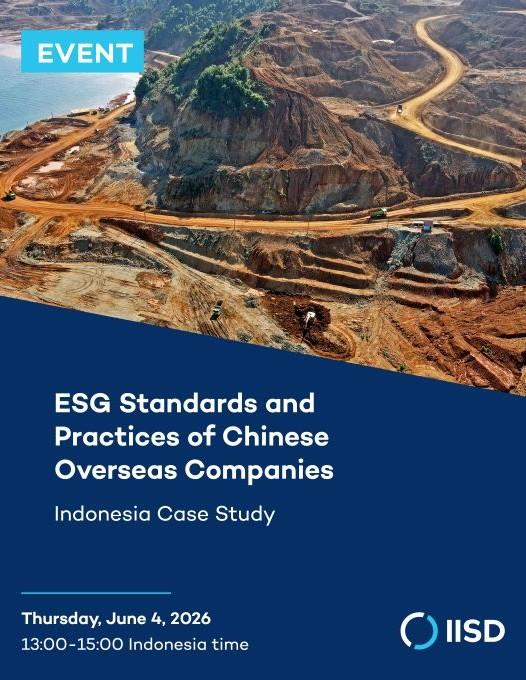
Environmental, Social, and Governance Standards and Practices of Chinese Overseas Companies: Indonesia case study

This IISD side event featured a panel discussion where findings from IISD's latest study on the environmental, social, and governance (ESG) management practices of Chinese enterprises in global mineral supply chain were presented, and which takes the case study of Indonesia and the nickel supply chain.

June 4, 2026 1:00 pm - 3:00 pm Western Indonesian Time

Drexler Room, Hotel Pullman Jakarta Central Park, Jakarta, Indonesia

(Open with a conference pass)

As demand for critical minerals rises, so, too, do expectations for responsible business practices. As a global leader in the mining sector, improving China’s sustainability standards and performance in critical minerals supply chains could translate into significant social and environmental improvements across the entire sector. At the Indonesia Critical Minerals Conference, IISD hosted an official side event where findings from our latest report on Chinese ESG standards and practices were presented and discussed alongside an expert panel.

The study outlines the evolution of the Chinese national ESG framework in mineral value chains and compares Chinese and international voluntary sustainability standards. Through interviews with stakeholders in the nickel supply chain in Indonesia, the study provides an overview of the main challenges Chinese companies face in implementing ESG practices, including supply chain due diligence. It highlights key areas and measures that could contribute to enhancing ESG standards among Chinese mining and processing companies operating overseas.
 

ESG standards and practices of Chinese overseas companies social card with event details

Conference details

Topic
Mining
Region
China
Webinar

Environmental, Social, and Governance Standards and Practices of Chinese Companies in Critical Minerals Supply Chains

This webinar explored IISD’s latest study on the ESG management practices of Chinese enterprises within global critical mineral supply chains, discussing the challenges of sustainable mineral processing through a case study of Indonesia’s nickel industry and host a panel of experts to share cross-sector perspectives.

May 29, 2026 10:00 am - 11:30 am CEST (in English with Chinese interpretation available)

(Open to public)

Critical minerals are essential components of the technologies driving the energy and digital transitions. The International Energy Agency (IEA, 2022) projects that to reach the goals of the Paris Agreement, global demand for minerals critical to renewable energy production facilities and associated technologies may quadruple by 2040 compared to 2020.

This growth in demand, which is already boosting new mining and mineral processing projects across the globe, will also significantly increase the sector’s environmental and social footprint, particularly in resource-rich countries seeking more added value to raw material extraction by attracting smelting and refining industries. There is a commensurate need to strengthen sustainable management practices and promote more responsible corporate behaviour across critical mineral supply chains.  

China maintains a dominant position across critical mineral processing value chains as well as in the manufacturing of key technologies for the energy and digital transition. It is the dominant refiner for 19 of the 20 critical minerals tracked by the IEA and holds an average market share of around 70% (IEA, 2025)—the exception being nickel, for which Indonesia is the world’s leading refiner, in part largely thanks to Chinese investment and technology. By strengthening and upholding ESG performance standards, Chinese companies can make significant positive contributions to the overall sustainability of the minerals sector globally. 

In this new study, IISD analyzes management practices of Chinese enterprises in global mineral supply chains from a sustainability perspective. It outlines the Chinese ESG management framework that exists across both government and voluntary standards in China, and examines how these compare to international voluntary sustainability standards.

Moreover, using interviews from stakeholders in the Indonesian nickel supply chain as a case study, it provides an overview of the main challenges Chinese companies face in implementing ESG practices, including supply chain due diligence, abroad. Finally, the study highlights key areas and measures that could contribute to enhancing ESG standards among Chinese mining and processing companies operating overseas.  

This webinar presented the main findings of the report, and featured a panel discussion with some key stakeholders to share the perspective from the private sector, industry association, and civil society.  

Speakers
  • Nathalie Bernasconi-Osterwalder, Vice-President, Global Strategies and Managing Director, Europe, IISD (moderator)
  • Hans Baumgarten, Strategic Advisor, IISD
  • Jun Ma, Director of the Institute of Public & Environmental Affairs
  • Tiantian Li, Director of the International Development Department at CCCMC
  • Grita Anindarini, Senior Strategist at Indonesian Center for Environmental Law

Webinar details

Workshop

Industrial Policy Roundtable on Battery Value Chains

A high-level roundtable in Geneva that brought together World Trade Organization delegates and experts to discuss industrial policy in the electric vehicle (EV) battery value chain, drawing on case studies from Indonesia, Morocco, and China.

May 8, 2026 1:00 pm - 3:00 pm CEST

(By invitation)

About the Event

Industrial policy is shaping the global transition to clean energy, with EVs and batteries sitting at the intersection of trade, climate, and development. Governments are using industrial policy tools like subsidies, export restrictions, investment facilitation, and local content rules to build domestic capacity across the EV battery value chain.

While these policies can support industrialization and decarbonization, they also have cross-border effects on trade, investment, technology flows, and access to value chains, particularly for developing countries.

This high-level roundtable brought together World Trade Organization delegates and experts to explore these issues, drawing on three case studies from Indonesia, Morocco, and China. The discussion aimed to deepen understanding of emerging policy trends, their global implications, and opportunities for international cooperation.

Key questions included:

  • Which policy tools are countries using, and why?
  • How do these policies affect trade, investment, and access to technology?
  • What challenges do developing countries face in moving up the value chain?
  • What can we learn from country experiences to improve policy design?
  • Where could international cooperation reduce tensions and maximize positive spillovers?

Speakers

  • Alice Tipping, director, Trade and Sustainable Development, IISD – Opening and closing remarks
  • Poppy Winanti, professor, Universitas Gadjah Mada – Case study, Indonesia
  • Poorva Karkare, senior policy analyst, the European Centre for Development Policy Management – Case study, Morocco
  • William Davis, economic advisor with the Secretariat to the Intergovernmental Forum on Mining, Minerals, Metals and Sustainable Development – Case study, China
  • Aaron Cosbey, senior associate, IISD – Key takeaways

Insights from this dialogue will inform an upcoming policy brief on industrial policy and the EV battery value chain. 

Deep Dive

Decoding the Belt and Road Initiative’s Legal Architecture

From "soft law" to hard obligations

Together with investment treaties and contracts, “soft law” instruments—such as political understandings, policy guidance, and memoranda of understanding (MoUs)—form a key part of the legal architecture of the Belt and Road Initiative, China’s flagship overseas investment and development programme. In the second article in IISD’s new series on Chinese overseas investment, we unpack the architecture—covering hard law, soft law, and the unique role of state-owned enterprises (SoEs)—and set out recommendations for host country policy-makers on how to navigate this hybrid legal environment.

May 7, 2026

While China has concluded investment treaties and other international investment agreements with the vast majority of its Belt and Road Initiative partners, political understandings, policy guidance, and MoUs frequently continue to shape the on-the-ground legal architecture of many projects. This creates a hybrid environment where informal diplomatic mechanisms and formal legal frameworks operate in parallel and where the interactions between them can create real legal risk for host countries. To navigate it well, governments need to understand all three layers: the hard law foundation, the soft law overlay, and the distinctive role played by Chinese SOEs. 

The Hard Law Ecosystem: Treaties and contracts

Traditional international investment governance is anchored in investment treaties, domestic investment laws, and binding contracts. For host countries participating in the Belt and Road Initiative, it is important to understand these instruments before layering on the soft law features of the Initiative.

Investment treaties are binding international agreements that set out the rules governing investment flows. They typically grant investors substantive protections—such as through contentious fair and equitable treatment clauses, provisions protecting against expropriation without compensation, and national treatment, which requires host states to treat foreign investors no less favorably than their own. They also grant procedural rights to foreign investors, including the right to bring claims directly against host states through investor-state dispute settlement (ISDS) for introducing measures impacting their investment. This includes for introducing general laws or policies, such as new labor laws or environmental standards. 85 to 90% of the investment treaties currently in force are considered “old-generation” and are at urgent need for reform. Encouragingly, we see a growing number of reform initiatives across national, regional, and international levels. However, the powerful vested interests who profit from keeping the status quo, together with reform coherence challenges, remain significant obstacles to lasting, positive change. 

Many investment treaties with China were concluded in earlier waves of treaty-making—some dating to the 1980s and 1990s—when states had less awareness of how broad investor protections could constrain public interest regulation.

Governments participating in the Belt and Road Initiative would benefit from reviewing these investment treaties and, where appropriate, pursuing reform or renegotiation to bring them into line with more recent treaty practice, including clearer carve-outs to secure space for economic, social, climate, and other public interest policies. Even where domestic frameworks are strong, an outdated treaty can still expose a host state to unexpected claims after it has adopted new regulations.

Investor-state contracts are another binding “hard law” layer at the project level, where financing, construction, and operation terms are formally agreed. A construction contract for a bridge project, for instance, might specify payment milestones, construction schedules, and a dispute resolution forum—terms that are legally enforceable regardless of what any earlier MoU said. Getting these contracts right matters enormously, and governments should not wait until the contracting stage to start thinking about their terms.

The Soft Law Ecosystem: MoUs, policy frameworks, and creeping obligations

What makes the framework for the Belt and Road Initiative distinctive is its combination of a hard law “overcoat” and a layered hierarchy of soft law instruments, rather than a single, unified legal code. This ecosystem typically includes two main types:

  • Non-binding MoUs: Broad political commitments that signal intent but lack specific enforcement mechanisms. A “Statement of Intent” to cooperate on a bridge project may contain no price tag, feasibility requirements, or timeline—and yet it can create a political expectation that the project will proceed with Chinese partners who are already informally identified. These documents may set the stage for more binding commitments downstream.
  • Guiding principles and policy frameworks: High-level Chinese policy documents—such as the 2021 Guidance on Overseas Investment, Cooperation and Green Development—set expectations for SOEs without being legally binding on host states. An SOE might, for instance, reference the Green Investment Principles when presenting an environmental management plan, even though compliance with those principles is not contractually required. The result is a kind of soft accountability that does not translate into hard legal obligations—unless the host state later acts in reliance on those commitments.

A central challenge for developing countries engaging with large-scale infrastructure projects is what has been termed “creeping obligations”—the phenomenon by which early, non-binding political commitments gradually harden into binding commercial obligations. This dynamic is not unique to any single investment partner, but it is a structural risk whenever soft law instruments such as MoUs are used as the entry point for major projects. In the context of the Belt and Road Initiative, this risk is heightened where the host state also has concluded investment treaties with China. Without strong legal oversight at the MoU stage, governments may find themselves effectively committed to specific contractors, financing terms, or project structures before they have completed feasibility studies or environmental assessments.

That said, this dynamic is not unique to the Belt and Road Initiative. It mirrors patterns seen in investment contract negotiations more broadly. Governments should therefore set up early-stage internal coordination mechanisms, such as inter-ministerial committees that bring together ministries and agencies responsible for finance, planning, sectoral regulation, and project oversight. Such committees help consolidate negotiating positions, avoid contradictory signals to investors, and ensure that technical, financial, and legal considerations are aligned from the start.

The Multifaceted Identity of Chinese SOEs

The Belt and Road Initiative also stands out for the central role of Chinese SOEs, which often operate in multiple capacities at once: commercial actors seeking profit and market share, policy instruments executing industrial and strategic objectives of the Chinese government, and diplomatic tools strengthening bilateral relationships. A Chinese state-owned port operator might function as a commercial partner today, while its strategic decisions are shaped by state-level directives to prioritize specific trade routes over local profitability.

This multifaceted identity can create asymmetries in bargaining power. When a host government negotiates with a Chinese SOE, it may be unclear whether it is engaging a commercial partner or effectively be negotiating with the Chinese state itself. An SOE negotiating a power plant contract might simultaneously reference its commercial track record and its alignment with China’s national development strategies, making it difficult for the host government to distinguish corporate from state-backed motivations
 

The Belt and Road Initiative also stands out for the central role of Chinese SOEs, which often operate in multiple capacities at once: commercial actors seeking profit and market share, policy instruments executing Beijing’s industrial and strategic objectives, and diplomatic tools strengthening bilateral relationships.


For instance, most of China’s centrally administered, non-financial SOEs are supervised by the State-owned Assets Supervision and Administration Commission of the State Council (SASAC). SASAC performs the state-investor function on behalf of the State Council, the Chinese government’s highest decision-making body, and is mandated to preserve and increase the value of state capital. Senior leadership appointments at central SOEs are primarily handled by the Chinese Communist Party's Central Organization Department. However, even where central SASAC supervision applies, SOEs also retain separate legal personality and are not automatically equated with the Chinese state. 

In short, these SOEs have a dual identity which poses distinct practical legal implications. Consider a hypothetical: a Chinese SOE builds a major highway in a developing country. The SOE later falls short of the environmental standards agreed in the contract. The host government seeks to enforce those standards and withhold payment. At that point, a fundamental legal question arises: is the SOE acting as a commercial entity subject to the contract terms, or does its relationship with the home state, China, alter the legal analysis?

How this question is resolved has direct consequences. If the SOE is treated as a commercial actor, the host state’s remedies are primarily contractual—suing the SOE for breach of the project agreement. But if the SOE’s conduct is attributable to the Chinese state under international law, the same facts may also trigger state responsibility under international law. Conversely, where a host state takes action against an SOE whose conduct could be attributed to China, it may itself face counterclaims under an applicable investment treaty, brought by the SOE or China directly, or more generally, face other diplomatic repercussions. 

Above all, these pathways are not mutually exclusive, and the same facts may give rise to parallel contractual and investor-state proceedings. The legal pathway available depends entirely on how the SOE’s role has been characterized in the project documents—and whether state approvals, guarantees, or directives have been recorded.

The practical upshot for host states is straightforward: project documents should clearly specify the legal role of the SOE—whether it is acting in a sovereign or commercial capacity—and any state approvals, guarantees, or directives that could create or support treaty-level attribution should be carefully documented and reviewed before signature. This is not a mere technical housekeeping; it is a fundamental element of managing legal exposure in Belt and Road Initiative projects.

The Transparency Gap

The challenge posed by the opacity of agreements between the parties is common to other forms of cross-border investment, just as it is to investments under the Belt and Road Initiative. However this challenge carries heightened governance implications here given the scale of the Belt and Road Initiative and the wide variation in host-country regulatory environments.

Many contracts under the Belt and Road Initiative contain expansive confidentiality clauses, a pattern documented in research on Chinese overseas lending. They include “silent clauses” that prohibit the host country from disclosing the existence, terms, or even the amount of the loan, and "No Paris Club" clauses that prohibits the borrowing country from including that specific debt in any Paris Club restructuring. This lack of transparency has several practical consequences:

  • Erosion of oversight: Legislatures and audit institutions cannot fully assess the scale of sovereign guarantees or contingent liabilities.
  • Limited participation: Civil society and local communities are side-lined from environmental and social impact processes.
  • Debt governance risks: Hidden fiscal exposures can accumulate and later manifest as debt crises.

What Host Countries Can Do

The hybrid nature of the Belt and Road Initiative creates unique governance challenges that cannot be addressed through any single instrument. It is the combination of soft political commitments, opaque contracting practices, and the multifaceted role of SOEs that can leave host countries exposed. What makes the Belt and Road Initiative distinctive—and what requires a response going beyond general investment advice—is this layered interaction between instruments that were designed to be non-binding and those designed as binding legal frameworks.

Domestic law remains the most powerful safeguard. As IISD’s Rethinking Investment Treaties and Rethinking National Investment Laws reports both emphasize, strong domestic frameworks form the foundation of sustainable investment governance. The Belt and Road Initiative context only confirms this: host states cannot rely on the non-binding character of MoUs or the goodwill of SOEs to protect them from hard legal consequences.

The hybrid nature of the Belt and Road Initiative creates unique governance challenges that cannot be addressed through any single instrument.


General recommendations (applicable to all investment):

  1. Robust pre-investment assessments: Require technical, financial, and legal assessments before MoUs are signed—not after. This matters especially in the Belt and Road Initiative context, where early political commitments can harden into binding obligations faster than governments anticipate.
  2. Standardized contracting tools: Develop or adopt sector-specific model contract clauses for use across investor-state agreements. This means leveraging existing model frameworks and adapting them to the specificities of Belt and Road Initiative projects—not reinventing the wheel, but ensuring that standard protections on transparency, local content, labour rights, environmental safeguards, and dispute resolution are built in from the start.
  3. Cross-sectoral alignment: Ensure that every Belt and Road Initiative project is legally tied to national development plans, environmental statutes, and fiscal frameworks. Inter-ministerial committees that coordinate early and consistently—across finance, planning, sectoral regulation, and legal affairs—are essential to avoiding the contradictory signals and overlooked linkages that can create legal exposure later.
  4. Review and reform investment treaties: Outdated investment treaties with China can expose host states to investment claims even where domestic frameworks are robust—because investors can rely on treaty protections regardless of domestic law. Governments should audit their treaty portfolio, identify provisions that unduly restrict their space to regulate in the public interest, and pursue reform or renegotiation where needed. Termination should also be considered as an option where reform is not feasible.

Recommendations specific to the Belt and Road Initiative:

  1. Review MoUs for potentially binding language: Governments should conduct a systematic review of existing and proposed MoUs for the Belt and Road Initiative, screening for language that creates expectations, commits to specific partners or financing arrangements, or could later be relied upon as the basis for legal claims. Where possible, MoUs should include standard clauses explicitly clarifying that they create no binding legal obligations and do not constitute consent to investor-state arbitration. Legal counsel should be involved before signature, not after.
  2. Clarify SOE status in contracts: Project contracts with Chinese SOEs should include express language specifying whether the SOE is acting in a sovereign or commercial capacity, and should document any state-level approvals, guarantees, or directives that connect the SOE’s actions to the Chinese state. This record-keeping matters for managing legal exposure in both directions: it protects the host state if it needs to establish state attribution, and it manages the risk of the SOE later claiming state immunity from contractual claims.

The flexibility of the Belt and Road Initiative can be a significant asset for developing countries—but only when paired with strong domestic systems that prevent creeping obligations and ensure transparent outcomes aligned with sustainable development. By reinforcing domestic legal frameworks, institutionalizing early-stage coordination across ministries, standardizing contracting practices, and taking specific steps to manage the distinctive risks of MoUs and SOE involvement, host states can strengthen their negotiation power and ability to engage with the Belt and Road Initiative on their own terms.
IISD Insight Series on the Belt and Road Initiative

Through this series, IISD examines the evolving landscape of the Belt and Road Initiative (BRI). Each insight explores key dimensions of the initiative’s shifting priorities, policies, and legal architecture, with a focus on how policymakers in emerging and developing economies can maximize the benefits of BRI investments.

The first insight in the series, published in February 2026, explores the growing diversification of BRI investments and highlights why host countries may wish to adapt their approaches, placing greater emphasis on public participation, transparency, and rigorous pre-investment assessments.

The second insight delves into the BRI’s legal architecture, unpacking its range of instruments, from “soft law” mechanisms such as political understandings, policy guidance, and Memorandums of Understanding, to more binding commitments.

Additional insights in the series examine topics including the greening of the BRI, investor–state dispute settlement in the BRI context, and other emerging issues.

Supporting Independent Research and Policy Development on the BRI

Building on IISD's long-standing work on investment, IISD is deepening its research and policy engagement on Chinese overseas investment, with a particular focus on how BRI-related projects can better align with sustainable development objectives in host countries. This includes analytical work on investment governance, legal frameworks, and environmental and social safeguards, as well as direct engagement with policymakers and practitioners.

IISD works closely with policymakers across developing countries, including through its Investment Policy Forum community, providing a platform for peer learning and policy dialogue. IISD also hosts the Secretariat International Support Office (SISO) of the China Council for International Cooperation on Environment and Development (CCICED), supporting international cooperation on environment and development issues linked to China’s global footprint.

If you are interested in supporting independent research and policy development on Chinese overseas investment and its impacts in host countries, we would welcome the opportunity to connect. Please contact [email protected] or [email protected]

Project details

Insight

Navigating the Belt and Road Initiative: Why host-country agency is the key to success

As China's Belt and Road Initiative, a global infrastructure and development drive, shifts focus toward more renewables, technology, and small-scale projects, IISD provides research and technical advice to policy-makers in host countries to inform investment policy-making. This includes ensuring alignment with national development priorities and integrating environmental and social safeguards into domestic law so that all investors—Chinese or otherwise—operate under clear, predictable rules

February 12, 2026

The priorities of the Belt and Road Initiative, China’s flagship international infrastructure and economic development program, are shifting. To make the most of this new phase of investment, to ensure alignment with national development objectives, host countries should place public participation, transparency, and robust pre-investment assessments at the forefront of their approach.

Chinese policy-makers will soon gather for the 2026 "Two Sessions"—the annual meetings of the National People’s Congress and the Chinese People’s Political Consultative Conference (CPPCC)—where they will review early progress under China's 15th Five-Year Economic Plan, covering 2026-2030. Against the backdrop of new data showing record-high Belt and Road Initiative engagement in 2025 (engagement defined as both investments by Chinese companies and the value of contracts awarded to them), the sessions are set to reaffirm China’s commitment to the Belt and Road Initiative, while also signalling a clear evolution in priorities.

Since its launch in 2013, the Belt and Road Initiative has been synonymous with large, debt-heavy infrastructure projects. Today, China is diversifying its overseas investment, increasingly focusing on renewables, technology, and manufacturing, as well as more small-scale projects.

This shift places greater responsibility on host countries because the new “small and beautiful” projects rely far more on domestic regulatory quality—covering areas such as permitting; environmental, social, and governance (ESG) standards; land governance; and technology integration—than the earlier state‑to‑state megaprojects, where the primary host obligation was debt repayment. Host countries should pay attention to these shifts and adapt their investment governance and institutional frameworks accordingly to make the most of this new phase of Chinese investment.

As with all foreign investment, the benefits of these projects are never automatic. Project success depends on the strength, clarity, and coherence of domestic legal and policy frameworks, including those that take account of the distinctive features of Chinese financing and project delivery. Our message to host country policy-makers is clear: the real leverage point lies within their own systems, institutions, and regulatory choices.

From Megaprojects to Future Industries

For years, Chinese overseas investment was defined by multi-billion-dollar bridges, railways, and ports. A prominent example is the Addis Ababa–Djibouti Railway, a USD 4.5‑billion project financed largely by the Export–Import Bank of China and constructed by Chinese state‑owned enterprises. This project became emblematic of the early Belt and Road Initiative model: large, capital intensive, and heavily reliant on sovereign lending.

However, rising concerns about debt sustainability among partner countries—as well as changes in China’s economic priorities, with more onus on energy, advanced manufacturing, and green technologies (“modern productive forces” in Chinese policy speak)—have prompted a strategic diversification of the program. The new Belt and Road Initiative prioritizes

  • digital infrastructure, including building the "Digital Silk Road" through telecommunications and data centres;
  • renewable energy, with a shift away from coal toward wind, solar, and hydro projects; however, oil and gas investment under the Belt and Road Initiative remains significant; and
  • "small yet smart" projects, such as smaller-scale, high-impact livelihood projects that are commercially viable and provide immediate social benefits.

Project success depends on the strength, clarity, and coherence of domestic legal and policy frameworks.


The Gap Between Opportunity and Reality

As the world’s largest sovereign creditor for around a decade, China’s footprint across Africa, Southeast Asia, Latin America, and Central Asia remains unmatched. The Belt and Road Initiative has the potential to break infrastructure bottlenecks, drive green energy access, and accelerate the United Nations Sustainable Development Goals. China’s shift toward smaller, greener, and more commercially viable projects also creates opportunities for host countries to advance priorities such as renewable energy, digital connectivity, local manufacturing, and regional integration—areas that often align more closely with national development plans than earlier megaprojects.

However, this scale and ambition alone also bring challenges that require more than just diplomatic goodwill to manage; they demand strong domestic governance and regulatory oversight. In short, host countries can only maximize the potential of these projects when they are anchored in legal frameworks that are transparent, inclusive, and aligned with national priorities.

When governance frameworks are poorly enforced, the costs of large-scale infrastructure projects can create tensions, and the results can be costly. The Mombasa–Nairobi Standard Gauge Railway is a case in point: while it is an engineering feat that is transformative for transport, the project faced hurdles due to weak environmental safeguards, resettlement controversies, and limited public participation. These challenges were not inevitable; they stemmed from a mismatch between ambitious economic goals and the domestic capacity to oversee them.

It Is Not the Investment—It Is the Governance

The "governance challenges" often associated with Chinese overseas investment, including confidentiality clauses, ESG risks, and debt vulnerabilities, are frequently cited as typically associated with Chinese lending and outward investment.

Part of an upcoming series looking at key aspects of the Belt and Road Initiative, this article argues otherwise: these risks are most acute where domestic systems are fragmented, opaque, or under-resourced. Opaque contracts and limited public oversight do not just hide debt; they erode the social licence needed for a project to succeed in the long term. Strengthening domestic governance, rather than focusing solely on the identity of the investor, is the most effective way to mitigate risk. By improving pre-investment assessments and contract negotiation, host countries can transform Chinese overseas investment into a genuine engine for sustainable growth.

In short, to get the most out of their engagement with the Belt and Road Initiative as the project develops, investment policy-makers in host countries should

  • strengthen domestic pre-investment assessments to ensure that Belt and Road Initiative Phase II projects align with national development priorities, avoiding the misalignment and feasibility challenges seen in some earlier projects.
  • improve transparency and public participation in Belt and Road Initiative investor–state contracts, especially for large infrastructure projects.
  • build negotiation capacity—including through regional cooperation and peer learning—across project terms, financing arrangements, risk allocation, and ESG safeguards, so that host countries can secure balanced investor-state contracts, treaties, Memoranda of Understanding, and other instruments within the Belt and Road Initiative’s legal architecture.
  • integrate ESG safeguards into domestic law and strengthen enforcement capacity so that all investors—Chinese or otherwise—operate under clear, predictable, and consistently applied rules rather than voluntary standards.

These approaches are not prescriptive. They are tools that countries can adapt to their own political, economic, and institutional contexts.

Unpacking the Belt and Road Initiative

Over the coming months, IISD will further explore key aspects of China’s overseas investment and how host country policy-makers can best navigate them, including the Belt and Road Initiative’s unique legal architecture, dispute settlement system, and the greening of the scheme.  

Each article will conclude with a forward-looking analysis of how developing countries can strategically engage with the Belt and Road Initiative to ensure the investments genuinely drive a greener, more transparent, and prosperous future.


IISD works closely with the developing-country investment policy-making community, including through our Investment Policy Forum community. IISD hosts the Secretariat International Support Office (SISO) of the China Council for International Cooperation on Environment and Development (CCICED). If you want to support more extensive independent research and policy development on Chinese overseas investment and its impact in host countries, we would be delighted to engage. Please reach out to [email protected] or [email protected]

IISD in the news

Heatwaves to hit China once every 5 years as global extreme weather events multiply, study finds

Record-breaking heatwaves that have scorched North America, Europe and China are set to worsen in future unless the world stops burning fossil fuels, according to a study by the World Weather Attribution (WWA) academic initiative.

July 25, 2023
Policy Analysis

Can China Contribute to Climate Action in Latin America?

China is an investor, creditor, and trading partner to Latin America, but what can be done to contribute to climate action within the region? Sisi Tang, a trade lawyer, explores crediting mechanisms for clean energy, debt-for-climate swaps, and a greener free trade agreement as initiatives that could transition China’s focus from economic expansion to sustainable development.

September 26, 2022

Latin America has strengthened its commercial ties with China over the last decade. Besides its vast investment potential, Latin America can meet Chinese market needs for raw materials such as soybeans and lithium. Trade volume between Latin America and China reached USD 451.6 billion in 2021, up 41.1% from 2020. As of 2020, Latin America had also attracted USD 94.09 billion of Chinese investment in the infrastructure sector, including clean energy projects.

Some Latin American countries form part of China’s Belt and Road Initiative (BRI). As of March 2022, 20 BRI economies were in Latin America and the Caribbean region, the most recent being Argentina. China has also started to shift its focus from economic expansion to sustainable development, as reflected in the Global Development Initiative and China–CELAC (Community of Latin American and Caribbean States) Joint Action Plan for Cooperation in Key Areas (2022–2024).

Besides its vast investment potential, Latin America can meet Chinese market needs for raw materials.

As an investor, a creditor, and Latin America’s trading partner, can China improve its current economic practices and explore new methods to contribute to climate action in Latin America? This article seeks to provide some food for thought on three climate change-related aspects of trade between China and Latin America: (i) a crediting mechanism for clean energy projects, (ii) debt-for-climate swaps, and (iii) a greener free trade agreement.

Crediting Mechanism for Clean Energy Projects

Clean energy is essential to decarbonize the energy sector—which contributes about 40% of global emissions of carbon dioxide (CO2). China can contribute to saving 256 million to 768 million tonnes of oil equivalent annually by investing in wind power and photovoltaic projects in countries along the Belt and Road. Examples in Latin America include a photovoltaic power station in Jujuy province and wind power projects in the Patagonia region in Argentina.

Proper measurement, reporting, and verification should be in place to ensure that these projects deliver climate benefits. Moreover, green technology transfers to host countries are indispensable to improving energy efficiency. China recognized the importance of these enablers in its recent Guidance for Promoting Climate Investment and Finance.

The Joint Crediting Mechanism (JCM), a market-based mechanism developed by Japan, could serve as a reference for China. The JCM encourages the transfer of low-carbon technologies by allowing credits to be issued to project participants for emission reductions. In line with Article 6 of the Paris Agreement, the JCM uses “internationally transferred mitigation outcomes toward nationally determined contributions” (NDCs). In doing so, the mechanism quantifies emission reductions of JCM projects in host countries.

JCM credits are in the form of an emission reduction target. For instance, a project that used an advanced process control solution in the hydrogen production unit in Indonesia resulted in reductions of about 22,000 tonnes of CO2 equivalent (tCO2e) per year. In return, the investor received a credit of 2,734 tCO2e, which could count for the home country’s NDC. Approved methodologies, validations, and verifications ensure accurate calculation and avoid double counting.

Debt-for-Climate Swaps

Another way to fund climate action is through debt-for-climate swaps, which enable the creditor to relieve debt in exchange for ecological protection. Since its introduction in 1984, this model has been used to protect the Amazon rainforest and the barrier reef in the Caribbean. In 1987, foreign creditors forgave USD 650,000 of Bolivia’s debt in exchange for the government’s pledge to set aside 4 million acres of Amazon rainforest for conservation. Rainforest conservation could help mitigate climate change via forest carbon sequestration.

Debt-for-climate swaps bring triple gains: a good reputation for the creditor, financial relief for the debtor, and capital to tackle climate change. They are attractive to heavily indebted countries with rich natural resources. Some Latin American countries are interested. Among them, Ecuador appears promising.

Debt-for-climate swaps bring triple gains: a good reputation for the creditor, financial relief for the debtor, and capital to tackle climate change.

China’s debt exposure in Ecuador amounts to USD 18.37 billion, which equals 17.1% of Ecuador’s GDP. If China agrees to swap this debt for climate action, Ecuador could reduce CO2 emissions by 39 million tonnes per year, which would otherwise cost USD 12.65 billion, or 11.78 % of Ecuador’s GDP. These figures add to Ecuador’s debt swap potential.

One proposal is for China to forgive USD 440 million of Ecuador’s debt in exchange for 200,000 hectares of Amazon rainforest conservation, which would avoid 117 million tCO2 emissions. A less ambitious plan suggests repurposing USD 19.2 million in debt to support university research and expand the Colonso Chalupas Biological Reserve.

The challenge is on the ground. Reducing deforestation requires designing a conservation program and monitoring joint implementation, possibly over the long term. High transaction costs for negotiation, the risk of fading political support when administrations change, and the need for long-term financial commitments can discourage creditors from the swap talks.

The solution should focus on specifying a clear scope of conservation measures. Enhanced transparency can also help handle the risk of waning support when a new administration takes office. Openness to third-party participation, including private actors, could strengthen long-term financial commitments. A successful story is Belize’s conservation of coral reefs using blue bonds, wherein a private sector underwriter and a government agency insurer played critical roles in securing finance.

China has reasons to take on the debt-for-climate swap talks with Ecuador.

China has reasons to take on the debt-for-climate swap talks with Ecuador. To start with, Ecuador’s debt swap potential with China is high: it is a country heavily indebted but with rich natural resources. In addition, Ecuador demonstrates the political will to pursue the swap talks with credible proposals. It is also in China’s interest to help untangle Ecuador from a debt dilemma, especially in light of the volume of Chinese outbound investment and a looming debt crisis overseas. Being a large patent holder, China can contribute to addressing Ecuador’s climate and debt crises by transferring green technologies. For China, the reward would be more than a reputation gain: it would help bring Beijing a step closer to its carbon neutrality target by 2060.

A Greener Free Trade Agreement

The costs of climate change are growing steadily, especially as heat, drought, and hurricanes intensify. Trade can help lower the cost of eco-friendly goods, services, and technologies to tackle the climate crisis. For instance, access to affordable drought-resistant seeds could build resilience in the agriculture sector. Disseminating low-carbon technologies to low- and middle-income countries could reduce about 600 million tCO2e by 2040.

Trade barriers to environmental goods remain high in some countries. In Brazil, average tariffs on environmental goods exceed 10%, with levies on wind turbine blades and hubs up to 14%. Bilateral investment treaties between China and some Latin American countries such as Argentina and Uruguay do not reflect the current environmental considerations as they date back to the early 1990s. Uruguay is trying to clinch a new trade deal with China, but the prospect is uncertain given the lack of support from other Southern Common Market (Mercosur) members.

Given Latin America’s vulnerability to climate change, diversifying risks geographically also appears imperative.

Trade liberalization through free trade agreements (FTAs) is essential to secure affordable solutions to the climate crisis. Greener FTAs can bring more than climate benefits. They can improve export opportunities, ameliorate living quality, and create business and employment. A trade deal between Ecuador and China is expected to add nearly USD 1 billion in export opportunities to the Ecuadorian market. Given Latin America’s vulnerability to climate change, diversifying risks geographically also appears imperative.

Three elements are vital for a climate-friendly FTA: the inclusion of environmental services, clear definitions of “green” goods and services, and the use of environmental provisions. First, services are indispensable for transferring and implementing low-carbon technologies. Renewable energy projects rely on a group of services to develop and function. In terms of mode of provision, cross-border supply (mode 1) is gaining relevance due to technological development, which is also significant for transforming into a low-carbon, digital economy. Environmental services are the “software” to address the climate crisis.

Second, clear definitions of “green” goods and services are fundamental to an eco-friendly FTA. Opinions differ on whether solar panels or nuclear power generation services are green. The lack of consensus on definitions could lead to a fruitless negotiation. Countries should consider consulting recent amendments to the Harmonized System Codes that improved environmental goods classification and helped clear doubts. As for services, a study has listed specific environmental services under United Nations Central Product Classification using “ex-outs,” a technique familiar to Environmental Goods Agreement negotiators.

Finally, environmental provisions, including voluntary sustainability standards and forest conservation provisions, are relevant to climate change mitigation. Enforcing sustainability standards could help avoid or reduce the negative impacts of economic activities on the environment. Eco-labelling mechanisms could meet consumers’ increasing preference for environmentally friendly products. Incorporating multilateral environmental agreements such as the Paris Agreement in the FTA preamble could also strengthen trade partners’ environmental commitments and set a tone for further cooperation in climate action.


Sisi Tang is a Geneva-based trade lawyer and climate policy consultant with the World Bank. The views expressed are those of the author and do not reflect the opinions or views of the World Bank.

Policy Analysis details

Topic
Trade
Region
China
Latin America
Impact area
Sustainable Economies
IISD in the news

Transition from fossil fuels to renewable energy can pose fiscal challenges for India: study

The global transition away from fossil fuels to renewable energy sources could trigger financial challenges for India and major developing countries such as Russia, Brazil and China because of their high dependence on revenues from fossil fuel, according to a study by the International Institute for Sustainable Development (IISD).

July 10, 2022

IISD in the news details