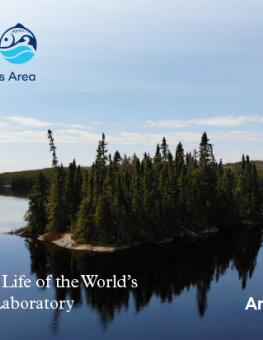
Want to spend a year at the world's freshwater laboratory in beautiful northwestern Ontario from the comfort of your very own sofa/footstool/seating vessel of choice?
IISD Experimental Lakes Area's 2018-2019 annual report is a handy wall calendar for 2020 that takes you through a year in the life of our research—from braving the freezing January temperatures to monitor lakes to welcoming visitors and students in the summer and throughout the year.
Way to Go Winnipeggers, on Getting Us Even Closer to Protecting Lake Winnipeg!
Winnipeg is getting even closer to increasing the protection of Lake Winnipeg from harmful algal blooms. And it's thanks to Winnipeggers of all stripes!
December 6, 2019
Winnipeg is getting even closer to increasing the protection of Lake Winnipeg from harmful algal blooms. And it's thanks to Winnipeggers from all walks of life!
This week, the Province of Manitoba announced that it will be setting a clear deadline (February 1, 2020) for the City of Winnipeg to implement an interim phosphorus reduction strategy for its North End Water Pollution Control Centre (NEWPCC) to bring the amount of phosphorus it releases into Lake Winnipeg down to legal limits.
As research at the IISD Experimental Lakes Area has taught us, phosphorus needs to be reduced to limit the spread of those harmful algal blooms that plague Lake Winnipeg every year.
This is exciting news because it means that we are inching ever closer to ensuring that the NEWPCC—the largest known single point source of phosphorus to Lake Winnipeg—has an interim solution to tide itself over while long-term biological solutions to the removal of phosphorus (and other nutrients and contaminants) are in the works. (Those biological solutions are currently slated to be implemented around 2034.)
This is exciting newsbecause it means that the International Institute for Sustainable Development, along with our partners the Lake Winnipeg Foundation, will continue to be part of the process on which we have collaborated and worked for so long, as we take on roles as advisors on the soon-to-be-formed project advisory committee to determine the best interim solution to take forward.
And this is exciting news because this milestone demonstrates the power of collaboration. It is thanks to all the interested citizens and members of the Lake Winnipeg Foundation, prominent members of Winnipeg's business community, governments and municipalities across the province and significant media coverage that has kept the issue alive.
Congratulations to all the many Winnipeggers who have demonstrated their concern and are anxiously awaiting an efficient and effective interim solution for the NEWPCC’s phosphorus emissions.
The AquaHacking Lake Winnipeg 2020 Challenge concluded in October 2020 with a two-part final event.
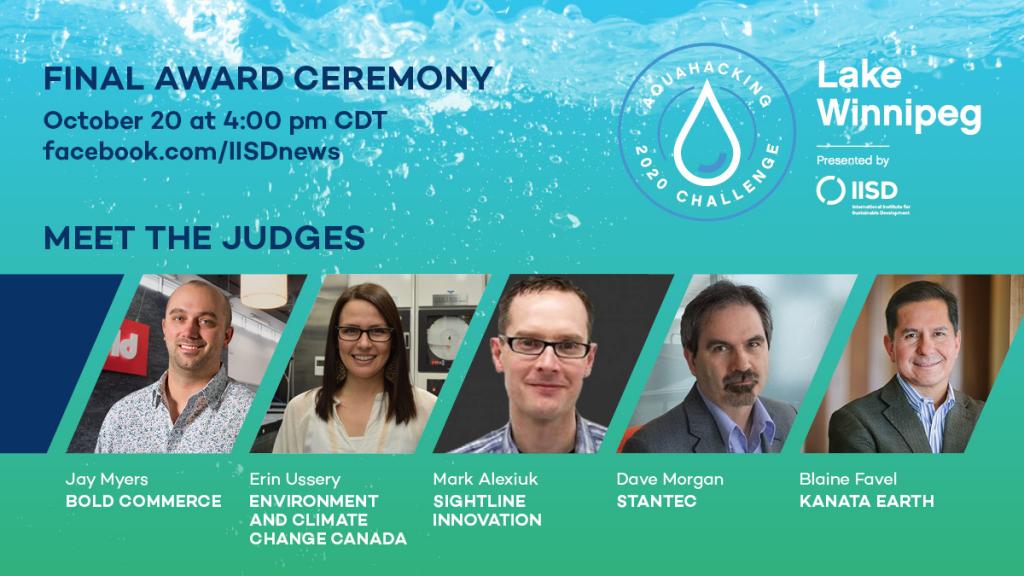
On October 17th, the teams presented their solutions in a Dragon’s Den-style pitch competition. The teams did not make it easy on our judges, a panel of five experts who graciously took on the unenviable challenge of evaluating each team’s solution.
On October 20th, we held our virtual awards ceremony to announce where each team placed and celebrate their success. A recording of the final event is available here and see our final digital program book here.
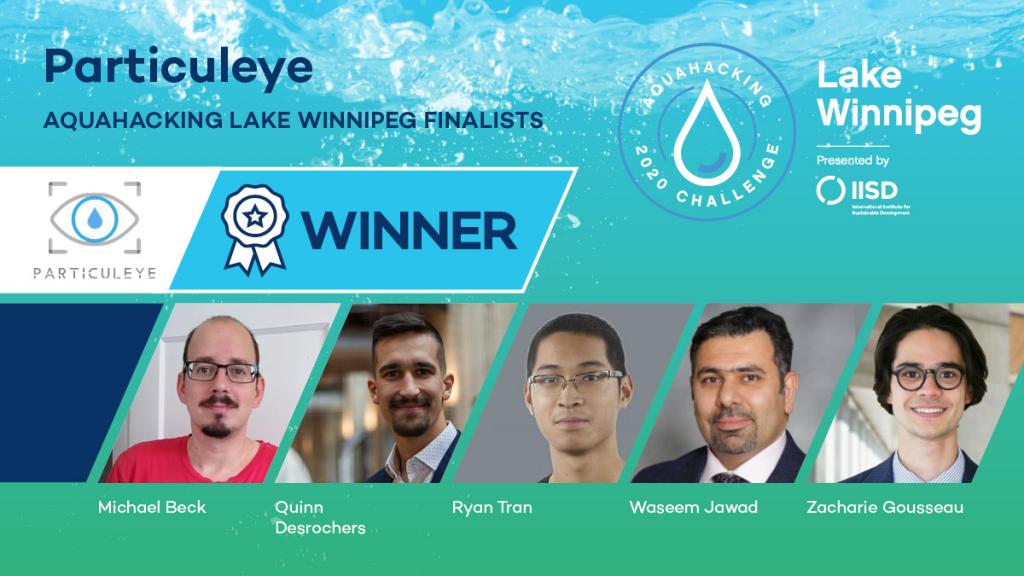
Particuleye Technologies won first place, earning $20,000 in seed funding for their smart camera device capable of quantifying and classifying microplastic particles in real-time in running water using machine learning. Learn more about Particuleye Technologies here and watch their pitch here!
The remaining teams and their rankings are:
LasIR Nutrient Technologies took 2nd place and $15,000 in seed funding for their portable soil analysis device to help farmers more efficiently and accurately measure phosphate concentrations in soil. Watch their pitch!
Typha Co. won 3rd place and $10,000 in seed funding for their eco-packaging products made from extracted cattail fibers. Watch their pitch!
Water Secure won 4th place and $2,500 in seed funding for their localized testing hubs and live water map for tracking drinking water quality in remote communities. Watch their pitch!
AbbaTek took 5th place and $2,500 in seed funding for their software-as-a-service package, CompoundConnect, a machine learning tool for microplastics research. Watch their pitch!
Follow the AquaHacking Alumni Network for updates on all the teams as they continue working to solve freshwater issues.
We are challenging students, water researchers, developers, designers, scientists, programmers, engineers, technology enthusiasts and entrepreneurs to show us what they're made of and save one of Canada's most beloved lakes with our 2020 Lake Winnipeg AquaHacking Challenge!
AquaHacking is an exciting new tech competition where young innovators across Canada team up to develop new and innovative solutions to tackle urgent freshwater issues.
Meet water sector experts. Work on the tech. Start your business. Be part of the change.
First things first, what is AquaHacking?
AquaHacking is a start-up competition designed to support technology and business development addressing environmental problems related to fresh water. Launched by the de Gaspé Beaubien Foundation, the AquaHacking Challenge has been running in the Great Lakes and St. Lawrence region since 2015 resulting in 18 new start-ups.
This year, the International Institute for Sustainable Development (IISD)—an independent think tank home to world-class experts in freshwater science and policy—is hosting one of three regional AquaHacking initiatives which will focus on Lake Winnipeg and its watershed.
Between January and October 2020, AquaHacking will challenge students and young professionals to team up and develop innovative solutions to problems plaguing the Lake Winnipeg watershed, such as algal blooms, pharmaceuticals and microplastics.
With guidance and support from expert mentors in water, tech, and business, the multidisciplinary teams will compete to win $50,000 in cash prizes and incubator space.
So, how does it work?
AquaHacking will provide young innovators all the support and mentorship solutions to develop sustainable solutions for Lake Winnipeg. We want to create solutions that have a viable market and answer a genuine need.
We therefore engage with key stakeholders, such as environmental NGOs and water experts, to define the water issues and ensure the solutions developed are directly connected to implementing agencies and will have measurable results.
AquaHacking will challenge students and young professionals to team up and develop innovative solutions to problems plaguing the Lake Winnipeg watershed, such as algal blooms, pharmaceuticals and microplastics.
The Challenge kicks off by providing all participants with webinars led by experts in the field outlining the science, relevant data and end-users for each water issue. Throughout the challenge, teams have access to a variety of workshops and resources, as well as a dedicated group of mentors to help them develop their solutions and refine their pitches. The top five teams will be determined at the AquaHacking semi-final in June 2020, after which they will continue working on their solutions and go on a team-building expedition to IISD Experimental Lakes Area in northwestern Ontario.
The winning team will then be announced at the Dragon’s Den-style final in October 2020 in Winnipeg.
What are the challenges?
There are five main challenges focused on five of the major opportunites to improve the health of Lake Winnipeg
Water and Land Management
How can we provide agricultural producers with cost-effective solutions for water and land management? Learn more here.
Fish Health
How can we better assess fish health and populations without having to kill them? Learn more here.
How can we ensure that remote, northern communities have access to clean drinking water?Learn more here.
Watershed Investment
How can we create systems that make it easy for people to invest in the health of Lake Winnipeg? Learn more here.
Why does the Lake Winnipeg watershed matter?
Lake Winnipeg is no small fish.
It is the 11th-largest lake in the world—and sixth largest in Canada—and provides homes, sustenance and recreation for millions.
Its watershed spans four Canadian provinces (Alberta, Saskatchewan, Manitoba and Ontario) and three U.S. states (North Dakota, South Dakota, and Minnesota). That watershed is nearly 1,000,000 km2 and is home to more than seven million people.
What are the major issues threatening Lake Winnipeg today?
Lake Winnipeg often suffers from algal blooms—those green, sticky layers you sometimes see on lakes—especially during the summer, which are caused by too much phosphorus leaching into the lake and its watershed. There are also many other emerging pollutants and contaminants, such as microplastics, that enter that watershed—many of which we still don't fully understand.
It is also subject to invasive species, such as zebra mussels, that impact the lake's health and can clog up its infrastructure.
And like all freshwater lakes across the globe, Lake Winnipeg continues to experience the ever-intensifying impacts of climate change and the resulting declining water levels.
Locked In and Losing Out: British Columbia’s fossil fuel subsidies
British Columbia's fossil fuel subsidies reached CAD 830 million in 2017–2018, and new subsidies continue to be introduced. This report identifies provincial subsidies and calls on the province to undertake subsidy reform.
#BC’s fossil fuel subsidies reached CAD 830 million in 2017–2018. New subsidies continue to be created, including significant support for the liquefied natural gas (LNG) industry.
#BC's provincial fossil fuel subsidies undermine the CleanBC plan introduced by the government in 2018 and hold the province back from meeting its #GHG emissions reductions targets.
#BC is on the front lines of #climate change, experiencing the impacts of coastal erosion, sea level rise, and record-breaking wildfires. Fossil fuel subsidy reform must be a part of BC's climate efforts.
BC’s fossil fuel subsidies reached CAD 830 million in 2017–2018. New subsidies continue to be created, including significant support for the liquefied natural gas (LNG) industry.
Provincial fossil fuel subsidies undermine the CleanBC plan introduced by the government in 2018 and hold the province back from meeting its targets for greenhouse gas emissions reductions.
This IISD report calls on British Columbia to phase out fossil fuel subsidies and ensure policy coherence to maximize climate action.
British Columbia (BC), which has a reputation as the most environmentally friendly Canadian province, is in fact one of the nation’s biggest supporters of the fossil fuel industry. Each year, the province provides hundreds of millions of dollars in subsidies for fossil fuels.
The majority of BC's fossil fuel subsidies go to fossil fuel producers, with hundreds of millions provided each year in royalty credits. Since not all royalty credits are used in the year they are granted, the province has amassed at least CAD 2.6 billion to CAD 3.1 billion in outstanding royalty credits from fossil fuel producers.
BC is also providing significant support for the liquefied natural gas (LNG) industry. The new BC-LNG Canada Agreement is just one example of support that serves to lock in high-carbon investments at the expense of sustainable energy alternatives.
BC is on the front lines of climate change. The past few years have been record years for wildfires, and the province is already seeing the impacts of coastal erosion and sea level rise. Though the province has introduced policies such as the CleanBC plan and carbon pricing regime, fossil fuel subsidy reform must be part and parcel of BC's efforts to address climate change.
Partners in Climate Action: How Beardy's and Okemasis' Cree Nation is addressing flood-related risks through knowledge sharing and collaboration
This case study outlines Beardy’s and Okemasis’ Cree Nation’s climate change adaptation planning process and the tool that supported it, the Pathways to Climate Change Resilience Guidebook.
By undertaking an adaptation planning process guided by the Pathways to Climate Change Resilience Guidebook, Beardy’s and Okemasis’ Cree Nation in Saskatchewan has gained a better understanding of climate-related risks and opportunities and has prioritized adaptation actions based on local climate projections.
Validating past climate and current changes using Traditional Knowledge was a powerful way to engage community members in adaptation initiatives and ongoing monitoring.
Establishing a wide network of partners helped Beardy’s and Okemasis’ Cree Nation access the tools, resources and information required to demonstrate the shortcomings of existing infrastructure and resulting impacts on community members, leading to funding and support for longer-term solutions.
First Nations communities are increasingly becoming concerned about the risks posed by climate change, such as impacts from more frequent and extreme flooding events. For the area between the North and South Saskatchewan Rivers, where Beardy’s and Okemasis’ Cree Nation is located, climate projections anticipate greater variability in precipitation, warmer winters, more frequent windstorms and longer periods of extreme heat. These changes underscore the need for communities to prepare.
Beardy’s and Okemasis’ Cree Nation undertook an adaptation planning process to identify key risks and vulnerabilities as well as to prioritize adaptation actions following repeat flooding in 2005, 2007 and 2011 that damaged infrastructure and created health and safety concerns. They used the Pathways to Climate Change Resilience Guidebook to guide this process. The Pathways to Climate Change Resilience Guidebook is designed to help rural Canadian forest-based communities undertake climate change adaptation planning. It is a trail map of how small communities can learn more about climate change and identify what its impacts might be in their unique geographic, social, cultural and economic situations.
Following a community meeting, the chief, a councillor, several band staff members and other community members identified, assessed and evaluated climate-related risks and opportunities and created a ranked list of actions. Adaptation planning has led Beardy’s and Okemasis’ Cree Nation to implement a number of actions, including drinking water quality research in partnership with the University of Saskatchewan and the Saskatchewan Research Council, and installation of an expanded drainage ditch with larger culverts to secure community road access and prevent future flooding. This case study presents the process used by Beardy’s and Okemasis’ Cree Nation and highlights key insights for other communities.
Submission to Environment and Climate Change Canada's Consultation on Non-Tax Fossil Fuel Subsidies
As part the G20 peer review of fossil fuel subsidies, Environment and Climate Change Canada opened a consultation on their review of non-tax subsidies. IISD developed this written submission in response.
As part of Canada's participation in the G20 peer review of fossil fuel subsidies, Environment and Climate Change Canada opened a consultation on their review of non-tax subsidies.
The G20 review process is a critical opportunity to scale up climate change action, maximize policy efficiency and ensure public funding is allocated to areas that matter most to Canadians.
IISD developed a written submission to support the review with recommendations to ensure a thorough analysis of all fossil fuel subsidies and for an action plan for their reform. With the urgency of climate change, the time to act is now.
Subsidizing fossil fuels undermines Canada’s transition to a low-carbon economy. These subsidies lock in the pollution that causes climate change and reduce money available for issues that matter to Canadians, such as healthcare, long-term job creation and education. The good news is that the Government of Canada is undergoing a peer review of fossil fuel subsidies with Argentina as part of its commitment to phasing out inefficient fossil fuel subsidies under the G20.
As part of the review, the government is reviewing two types of subsidies:
Tax measures, where government revenue is foregone because of tax breaks given to fossil fuel producers. This part of the review is being handled by Finance Canada.
Non-tax measures, where the government actively spends money on programs that support the production or consumption of fossil fuels. This part of the review is being handled by Environment and Climate Change Canada (ECCC).
In spring 2019, ECCC opened a consultation to receive feedback on how they should review non-tax subsidies. IISD provided feedback and wrote a submission with recommendations on how to make sure the review is as thorough and effective as possible, building on longstanding experience and the work of our Global Subsidies Initiative.
Here’s what we recommended:
Use ambitious criteria for defining subsidies. The G20 commitment is to address “inefficient” fossil fuel subsidies, so IISD recommends that Canada take a serious look at whether existing subsidies are truly the most efficient way to achieve policy objectives, with consideration of economic, social and environmental costs. If not, they should be reformed.
Strive for maximum transparency. Canada should publicly release data on existing subsidies so Canadians know how much is being spent. The government should also keep Canadians updated on the process and results of the G20 review.
Engage the provinces and territories. As Canadians know, what happens federally impacts the provinces and territories. The government should invite the provinces and territories to take part in this federal review. Provinces and territories should also be encouraged to do their own subsidy reviews.
Reaffirm Canada’s G7 commitment to reform fossil fuel subsidies by 2025. To achieve Canada’s commitments, including emission reduction targets under the Paris Agreement, the government needs to make sure the review process is timely (i.e., completed within 12–18 months) and include a detailed action plan of how Canada will carry out subsidy reform.
Each year, #Ontario provides nearly CAD 700 million in public subsidies for fossil fuels at the expense of investing in other policy areas that matter to Ontarians.
Each year, Ontario provides nearly CAD 700 million in public subsidies for fossil fuel consumption at the expense of investing in other policy areas that matter to Ontarians.
The highest subsidies in Ontario fall into three categories: tax exemptions for aviation and railway fuels, tax exemptions for coloured fuel (e.g., fuel used in agriculture) and direct spending on natural gas expansion.
Ontario has an opportunity to lead the charge on provincial fossil fuel subsidy reform. As a first step, Ontario should undertake a transparent self-review of the subsidies listed in this report to determine their efficiency and effectiveness.
IISD has documented the billions of public dollars that support fossil fuel production and consumption by the Canadian government. But fossil fuel spending is also a problem among Canadian provinces and territories.
Ontario spends nearly CAD 700 million each year in public subsidies for fossil fuel consumption. These subsidies represent large amounts of foregone public revenue that could be invested in everything from good jobs to education and healthcare. Spending money on fossil fuel encourages their use and contributes to the pollution that causes climate change. Ontario's largest subsidies include CAD 320 million in 2018/19 in tax exemptions for fuels used by the aviation and rail industry, CAD 225 million in 2018/19 in tax exemptions for coloured fuel (commonly used in agriculture) and at least CAD 100 million in direct spending on natural gas expansion in Budget 2018.
How can Ontario move away from fossil fuel spending to facilitate good fiscal management and a transition to a clean economy? The report recommends the following action areas for the province:
Undertake a transparent self-review of all fossil fuel subsidies and identify potential areas for improved policy efficiency from economic, environmental and social perspectives.
Develop an action plan to phase out subsidies to ensure responsible budgetary management, increased support for sustainable energy and support for affordable energy access for Ontarians.
Establish clear guidelines to make sure that no new fossil fuel consumption or production subsidies are introduced without a thorough analysis, to ensure that they are absolutely essential, time limited, consistent with a long-term low-carbon economy, and that they are the only way to ensure policy objectives such as lowest-cost energy access.
Proactively engage with the Government of Canada as they complete their G20 peer review of fossil fuel subsidies.
Plastic Waste in Canada: A daunting economic and environmental threat or an opportunity for sustainable public procurement?
This commentary explores how sustainable public procurement can play a crucial role in advancing environmental and economic sustainable development in Canada's waste sector.
July 18, 2019
Key Messages
The unsustainable management of plastic waste negatively impacts our ecosystems, with only 9 per cent of plastic waste recycled back into the economy since 1950.
Canada’s current plastic waste management system proves to be a lost economic opportunity—86 per cent of plastic waste goes to landfills, representing a loss of nearly CAD 8 billion, which is expected to increase to over CAD 11 billion by 2030.
To work toward a circular economy and address environmental pollution as well as economic inefficiencies, Canada must conduct an integrated assessment of waste management infrastructure.
Canada is facing a growing plastic waste challenge, and calls to action on plastic waste reduction have gained traction over the past years.
We use plastics every day: it is found in our electronics, we package our food in it, construction elements are born from it, children’s toys are built with it, and more.
However, currently plastics are not kept in closed-loop systems. This means most plastic material produced ends up in landfills after its designated lifetime. Since 1950, a mere 9 per cent of plastic waste was recycled back into the economy, whereas 12 per cent had been incinerated and 79 per cent discarded. Plastic waste management thus far has been unsustainable, and the world faces a growing problem.
Our commentary explores how sustainable public procurement can play a crucial role in advancing environmental and economic sustainable development in Canada's waste sector.
This country study and accompanying data sheet compiles publicly available information on G20 subsidies to the production and consumption of coal (including coal-fired power) in Canada in 2016 and 2017.
Canada has pledged CAD185 million to support the transition away from coal.
This country study and accompanying data sheet compiles publicly available information on G20 subsidies to the production and consumption of coal (including coal-fired power) in Canada in 2016 and 2017. It is a background paper to the report G20 Coal Subsidies: Tracking Government Support to a Fading Industryand provides a baseline to track progress on the phase-out of such subsidies as part of a wider global energy transition.
Zooplankton are critical parts of freshwater ecosystems, but often get forgotten. Scientist Mike Paterson explains what zooplankton are, and why they matter.
June 26, 2019
Whenever I speak to the public as a researcher on water quality, I often hear four big questions:
Can I drink the water?
Can I safely swim in the water?
Will I be able to catch fish?
Can I safely eat the fish?
Conspicuously absent from these questions is any mention of zooplankton; in fact, I suspect most people don’t know what they are.
Given that I have spent so much of my research career studying them, I want to explain what zooplankton are and why they matter.
What are zooplankton?
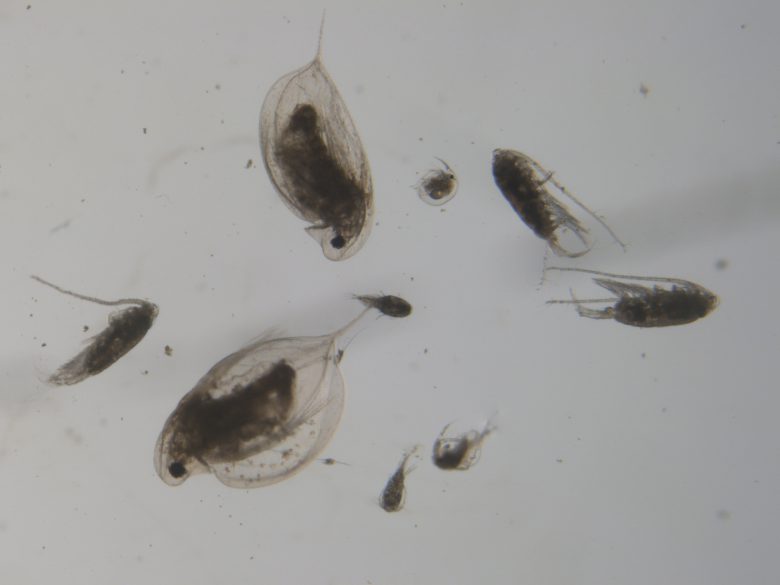
Zooplankton are small animals that live in the water column of almost all water bodies, including oceans, lakes and ponds, although they mostly cannot survive in rivers and streams.
They range in size from a few millimetres down to a few microns (one micron is equal to 1/1000 of a millimetre) and may include the larval stages of larger animals such as mussels and fish.
Zooplankton are small animals that live in the water column of almost all water bodies, including oceans, lakes and ponds, although they mostly cannot survive in rivers and streams.
In lakes and ponds, the most common groups of zooplankton include Cladocera and Copepods (which are both micro-crustaceans), rotifers and protozoans. Most lakes will have 40 or more species of zooplankton common to them.
Zooplankton occupy the centre of the open-water food web of most lakes. They eat bacteria and algae that form the base of the food web and, in turn, are heavily preyed upon by fish, insects and other zooplankton. Many zooplankton have clear shells to avoid being seen by visual feeders, such as fish.
In keeping with their taxonomic diversity, zooplankton use a variety of feeding strategies, and they may eat bacteria, algae, other zooplankton and can even be parasites. Some zooplankton, like many Cladocera, are indiscriminate grazers, using their feeding appendages like rakes to filter particles from the water. Other zooplankton, such as many Copepods, are more selective and pick out individual particles or zooplankton prey based on their size, shape and taste.
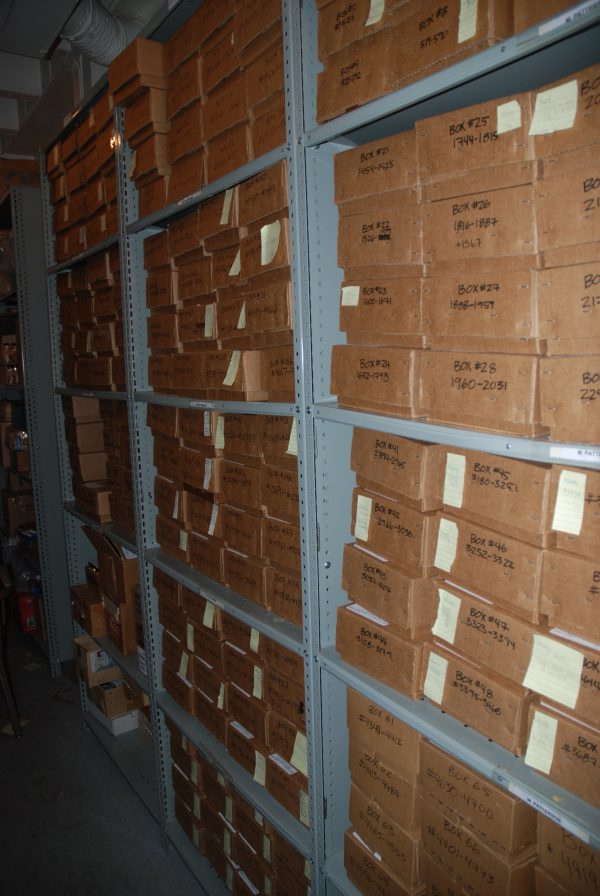
At IISD Experimental Lakes Area, our zooplankton collection now exceeds 30,000 samples.
Why are zooplankton important?
As a result of their central position in lake food webs, zooplankton can strongly affect water quality, algal densities, fish production, and nutrient and contaminant cycling.
Zooplankton are commonly included in biomonitoring programs because their densities and species composition can be sensitive to changes in environmental conditions.
In recent years, many species of zooplankton have been accidentally introduced to Canadian lakes and rivers from Europe and elsewhere, including the spiny water flea (Bythotrephes) and the larval stages of zebra mussels. Occasionally, some species of zooplankton, such as Mysis, have been deliberately introduced to lakes to enhance fish production.
Learning more about the importance and role of zooplankton
Because of the important role that zooplankton play in freshwater food webs, we have been collecting and studying them at IISD-ELA for our entire 51-year history—in fact, our zooplankton collection now exceeds 30,000 samples.
Let’s take a look at some examples from the last half a century that illustrate the importance of zooplankton.
CAN INCREASING ZOOPLANKTON POPULATIONS TACKLE ALGAL BLOOMS?
ELA was originally founded in 1968 to address problems associated with excessive algal blooms, which are unsightly, may cause fish kills and can result in the development of toxins. This process, known as eutrophication, is caused by high inputs of nutrients and plagues millions of lakes globally.
Because zooplankton eat algae, it has been proposed that it may be possible to control algal blooms by increasing zooplankton grazing. This method is called “biomanipulation” and is usually done by reducing predation on zooplankton by planktivorous fish either by directly removing these fish or adding a fish predator such as pike.
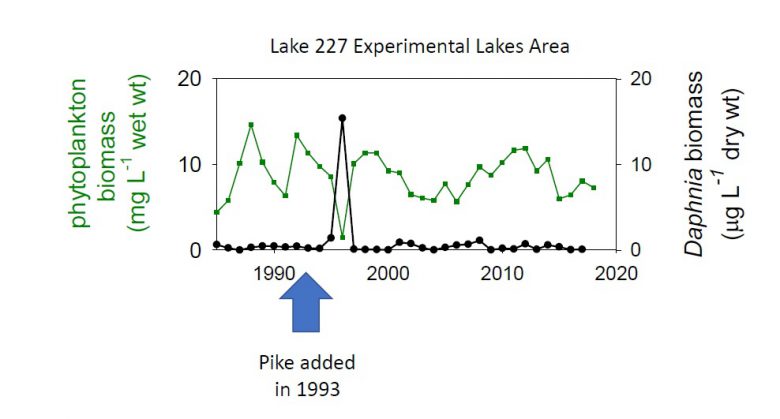
We tested the effectiveness of the latter method (commonly used in Europe) in the 1990s by adding pike to eutrophic Lake 227. Following the pike introduction, minnows were extirpated, densities of a zooplankton called Daphnia increased dramatically and algal densities decreased considerably. Unfortunately, algal densities remained low for only one year and the lake rapidly rebounded to its former eutrophic state.
To reduce algal blooms, we tested the effectiveness of adding a predator fish to the system in the 1990s by adding pike to eutrophic Lake 227. Following the pike introduction, minnows were extirpated, densities of a zooplankton called Daphnia increased dramatically and algal densities decreased.
This research, in conjunction with other studies, suggested that biomanipulation can effectively reduce algae in the short term, but may be less effective as a long-term solution for eutrophication. Ultimately, biomanipulation is most effective when combined with nutrient reduction strategies.
HOW DO CHANGES IN ZOOPLANKTON CAUSED BY ACID RAIN AFFECT FISH POPULATIONS?
In the 1960s and 70s, we set our sights on exploring how acid rain was affecting freshwater lakes and fish.
Following additions to Lake 223 of sulphuric acid to mimic acid rain, numbers of Mysis diluviana, a common zooplankton taxon, declined dramatically and were eventually eliminated from the lake. Mysis are important food for lake trout and the trout subsequently starved and their numbers and growth rates declined.”
In Lake 223, the toxic effects of lake acidity were not directly responsible for the declines in trout; instead, trout declined because of indirect effects mediated through the food web. Recognition of the importance of these indirect effects is one of the reasons why whole-ecosystem manipulations that incorporate intact food webs are so important. Although researchers stopped adding acid to Lake 223 after 1993 and the lake has fully recovered chemically, Mysis have still not reestablished and trout numbers and growth rates remain low.
HOW DOES ZOOPLANKTON AFFECT THE AMOUNT OF MERCURY IN FISH?
Mercury (especially methylmercury) is by far the most important contaminant of freshwater fish and high exposures can have harmful effects on humans who consume it. Consequently, considerable research at IISD-ELA has explored this important contaminant.
In the 1990s, research at the site and elsewhere demonstrated that fish get almost all their methylmercury from their food, similar to humans. Because zooplankton are important prey for many fish, it is therefore important to follow and understand changes in methylmercury in zooplankton.
For example, in a series of artificially created reservoirs at the site, we found that concentrations of methylmercury in zooplankton increased by five times or more following impoundment. These increases were most strongly affected by increases in methylmercury in water but were also affected by changes in water chemistry and zooplankton species composition.