On a sweaty Friday afternoon, a few hours delayed, and with one suitcase fewer than when I set off, I finally landed down in the 'Peg after a 20-hour journey from my homeland of Kenya. For years, I had been aching to visit the province of 100,000 lakes. While, lamentably, I won’t be able to visit them all on this trip, seeing Lake Winnipeg in person was an unbridled delight, as was jumping in an SUV and heading over to another famed freshwater must-see of the region—the IISD Experimental Lakes Area.
CCS Can't Compete with Renewables, Won't Deliver by 2030, Report Finds
Carbon capture and storage may have an important role to play in hard-to-decarbonize sectors like iron and steel, but won't pay off for oil and gas companies without continuing government subsidies, the International Institute for Sustainable Development (IISD) concludes in an analysis released this week.
Report finds carbon capture's 'stubbornly high' prices are likely here to stay
Canada's oil and gas industry says costly technology it plans to use to reduce its climate footprint requires more investments from the federal government. If governments lend a hand now, the industry maintains the technology will become more affordable over time as more projects proceed, but a new analysis casts doubt on that claim. "Carbon capture and storage is expensive, and the costs are not likely to come down in the timeframe needed to meet our climate targets," said Laura Cameron, one of the report's three authors and a policy adviser for the International Institute for Sustainable Development.
Carbon capture projects are too costly, have ‘questionable’ benefits, report finds
Technology the oil industry is counting on to reduce emissions–carbon capture and storage–is too expensive and difficult to deploy quickly enough to help Canada meet its climate commitments, a global environmental think tank says. Relying on carbon capture and storage to cut greenhouse gases from oil and gas production will mean large public subsidies for projects that are unable to compete on costs against expanding renewable energy sources, rendering the benefits "questionable," the International Institute for Sustainable Development said in a report released Thursday.
Why the Cost of Carbon Capture and Storage Remains Persistently High
The Bottom Line: Unpacking the future of Canada's oil & gas
Re-Energizing Canada is a multi-year IISD research project envisioning Canada's future beyond oil and gas. This policy brief is a part of The Bottom Line series, which digs into the complex questions that will shape Canada's place in future energy markets. (Download PDF)
September 7, 2023
Summary
Carbon capture and storage (CCS) costs depend on the process type, capture technology, carbon dioxide (CO2) transport, and storage location. CO2 capture costs are projected to range from CAD 27–48/tCO2 for processes with concentrated CO2 streams to CAD 50–150/tCO2 for diluted gas streams. The actual cost of CCS projects in Canada indicates that costs are in the upper range of what is predicted in the literature.
The persistent high costs of CCS are attributed to high design complexity and the need for customization that limits the deployment of CCS.
Comparing the experience rates—or the decrease in cost with increased development and deployment—of CCS with other energy technologies, such as solar and wind, shows that CCS cost reductions have been slow, despite being in use commercially for more than 50 years.
The economic viability of CCS for the oil and gas sector continues to rely heavily on federal and provincial government financial support. This is in contrast to renewable technologies, which have generally required government subsidies only in the initial development phases.
CCS may play an important role in hard-to-decarbonize industrial sectors such as cement and steel, where substitute materials or fully matured decarbonization technologies are not yet available or fully developed.
Carbon capture and storage (CCS) technology aims to reduce emissions by capturing carbon dioxide (CO2) and either burying it underground or utilizing it in other industrial processes. Unlike direct air capture and storage, which is a negative emissions technology that captures CO2 directly from the atmosphere, CCS captures CO2 from point sources, such as industrial facilities or fossil fuel power plants. Some CCS technologies have been commercially used for several decades and were initially developed for capturing CO2 from natural gas production for enhanced oil recovery—a process in which CO2 is injected into aging oil wells to increase oil production and extend the life of wells.
In Canada, there are seven commercial CCS projects currently operating—five in the oil and gas sector, one in coal-fired electricity generation, and one in the agricultural sector—capturing only 0.05% of national emissions. Despite the small number of operational projects and the limited efficacy of CCS in reducing emissions in Canada to date, Canada’s climate plan emphasizes the potential of CCS in the oil and gas sector to develop the technology and reduce emissions from production. The oil and gas sector is also foregrounding CCS as the primary solution for the sector to reduce emissions. The largest proposal has come from the Pathways Alliance, a coalition of Canada’s six largest oil sands producers, with a plan to build a CCS network in Alberta that proposes a combination of technologies to capture, transport, and store CO2 emissions from over 20 oil sands facilities. The coalition hopes to use this network to reduce 22 MT of CO2 by 2030. The Alliance has indicated that the CAD 16.5 billion project would be contingent on substantial government subsidies, noting the need for funding levels to be competitive with countries such as Norway that cover two-thirds of project costs and all operating costs for a decade.
Advocates for CCS implementation in Canada’s oil and gas sector envision it as a viable emissions reduction strategy that will see costs decrease with increased investment. However, the likelihood of substantial cost reductions remains uncertain. This brief explains the persistent high costs of CCS.
Calculating the Costs of CCS
Calculating the costs of CCS is complex, given the different approaches to measuring costs as well as varying applications of the technology and contexts in which it is used.
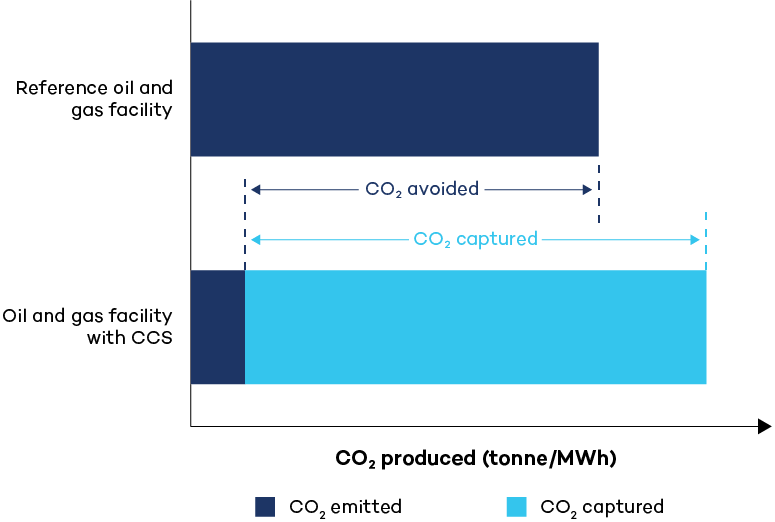
CCS technology requires significant inputs of energy to operate, and if that energy is provided by a fossil fuel, it produces emissions. There are two ways of measuring the costs of CCS per tonne of CO2 sequestered—CO2 captured and CO2 avoided—and only the latter accounts for the extra energy and emissions required to operate the CCS. CO2 captured refers to the total amount of CO2 collected by the CCS technology within a specific time frame, disregarding the extra emissions generated by the CCS process itself, whereas CO2 avoided is calculated by subtracting the increased CO2 emissions from the energy required to operate the CCS plant from the total CO2 captured (as illustrated in Figure 1). Therefore, the cost of CO2 avoided (per tonne of CO2) is the more appropriate measure to evaluate the cost of CCS, though estimates using this measure are limited and may only be available for some processes and sectors using CCS.
Figure 1. Two ways of measuring upstream emissions reductions from CCS for oil and gas: CO2 captured vs. CO2 avoided
Note: The amount of CO2 avoided is less than CO2 captured, as CO2 avoided accounts for the energy required to operate the CCS technology. This does not include downstream emissions that are produced when the oil or gas is combusted.
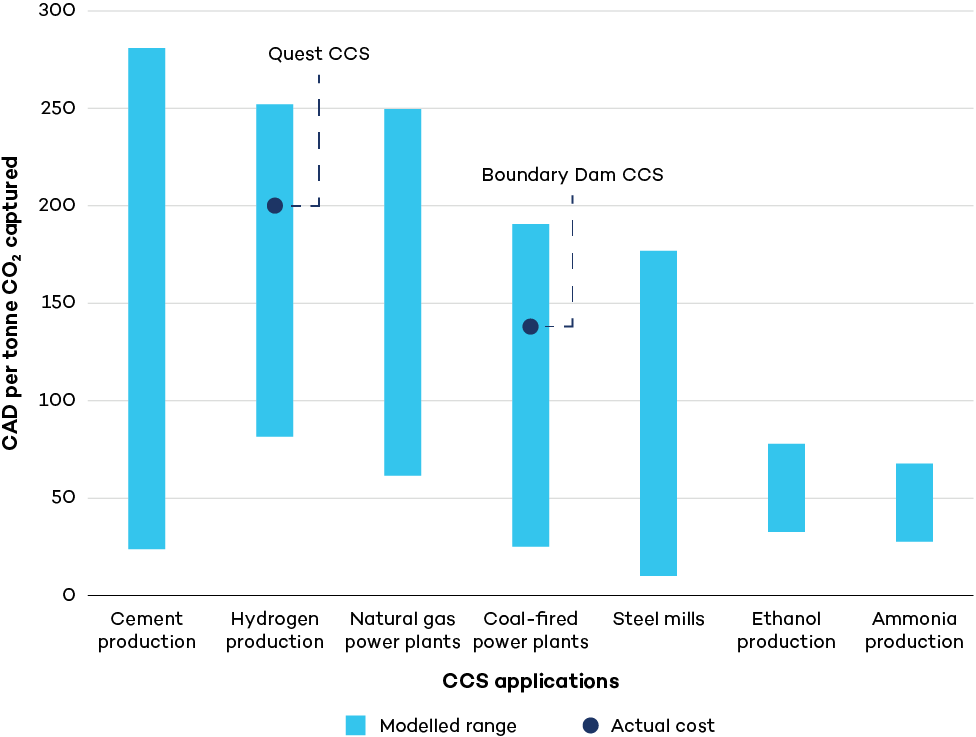
The costs of CCS technologies, as projected in the literature globally, vary significantly depending on the type of capture process employed, the means of CO2 transportation, and the storage location. Costs also vary depending on the CO2 concentration in the emissions stream: the lower the CO2 concentration in the gas, the higher the energy demand required for separating out the CO2, resulting in higher costs. Industrial applications like natural gas processing and ammonia production already have a high degree of CO2 concentration, leading to lower CCS costs. According to the literature on estimated costs for CCS in various industries, the cost of CCS processes with concentrated CO2 streams, such as from natural gas processing, ranges from CAD 27 to 48/tCO2 captured. By comparison, more diluted gas streams, such as coal-fired power plants, steel, cement, and some hydrogen production, are higher cost: cement production is estimated at CAD 50–150/tCO2 captured (CAD 45–205/tCO2 avoided), and coal-fired power plants range from CAD 26 to 173/tCO2 captured (Figure 2). These estimates do not include the added costs of transportation and storage. A recent study estimates a cost of CAD 111–144/t CO2 for a CCS retrofit on a natural gas-fired power plant at an oilsands facility.
Given the limited number of operational commercial CCS facilities, these cost estimates are predominantly based on modelling studies that employ various assumptions to forecast costs for theoretical facilities. This is a key reason for the broad variability in cost ranges, which may not accurately indicate the costs of actual projects.
Figure 2: Estimates of carbon capture costs by industry and category of capture technology (2021 CAD)
In the Canadian context, there is very limited data on the actual costs of CCS projects to date, but the few that are reported are at the higher end of the modelled cost ranges. For example, the Quest project, which captures CO2 for use in upgrading oil extracted from oil sands, costs around CAD 200/tCO2 up to 2021 (Globe and Mail Editorial Board, 2021). Meanwhile, the estimated lowest cost of capturing CO2 from the Boundary Dam project, a coal-fired power plant, is CAD 100–120/tCO2, but the project has repeatedly faced cost overruns and delays. CCS projects require a substantial initial investment, which is amortized over time. Thus, the eventual cost of CO2 captured and avoided is contingent upon the facility’s lifespan, production rate, and the effectiveness of permanent CO2 storage, all of which exhibit considerable variability.
The Persistent High Costs of CCS
The cost of CCS is currently high and varied, yet CCS proponents speculate that costs will decline as more investment drives innovation and learning. While this logic applies to many technologies, whether it applies to CCS is questionable due to its complex functional requirements and constraints.
Typically, the costs of a technology tend to increase during its initial phases, spanning from research and development to its demonstration. However, as the technology reaches commercial maturity, these costs often start to decline. This downward trend is captured through an experience rate, a metric commonly used to project how costs will reduce as a technology is more widely deployed.
CCS has a relativelylowexperience rate. This is due, in part, to characteristics inherent to CCS technology—including high design complexity and the high need for customization—which present obstacles to technological advancement. Design complexity refers to the large number of technical components in a technology and the extent to which they are interrelated. As in the case of CCS, high design complexity involves multiple interactions between the components, which makes technological innovation more difficult, leading to a highly iterative process with a high risk of bottlenecks and dead ends. CCS also has a high need for customization to specific applications, making it challenging to achieve large-scale deployment, limiting innovation acceleration, and, therefore, impeding cost reductions. While the overall process of CCS technologies is projected to be standardized, some components will need to be tailored to specific applications, geological conditions, and local supply chains, indicating a medium to high need for customization (Stephens & Jiusto, 2010).
Finally, CCS application in the oil and gas sector will have limited opportunities for learning by doing, since there are only a small number of operations in which it would be used. The specific applications of CCS in Canada’s oil and gas sector currently are hydrogen production for use in refineries and bitumen upgrading and one recent project using natural gas combustion. The three Canadian projects that capture carbon in hydrogen production are among the only commercial projects of this application in the world—the first of which came online less than a decade ago. Natural gas combustion applications of CCS are even more nascent, with the only existing commercial project coming into operation in 2022, even though some have indicated this would be the primary application of CCS in oil sands production. Although the Pathways Alliance coalition of oil sands producers has not disclosed details of the technologies to be used in their proposed CCS network, their announcement foregrounds “piloting next generation technologies” that are not yet commercially viable. Given that these technologies are in the early stages of development, and given the weak learning and experience rates exhibited in other CCS applications, the costs of CCS as applied in the oil sands may similarly fail to come down. This reality also prevents CCS in oil and gas from benefiting from the kinds of economies of scale that have accrued from the mass manufacturing of solar panels and wind turbines.
CCS for Oil and Gas Outcompeted by Renewable Energy
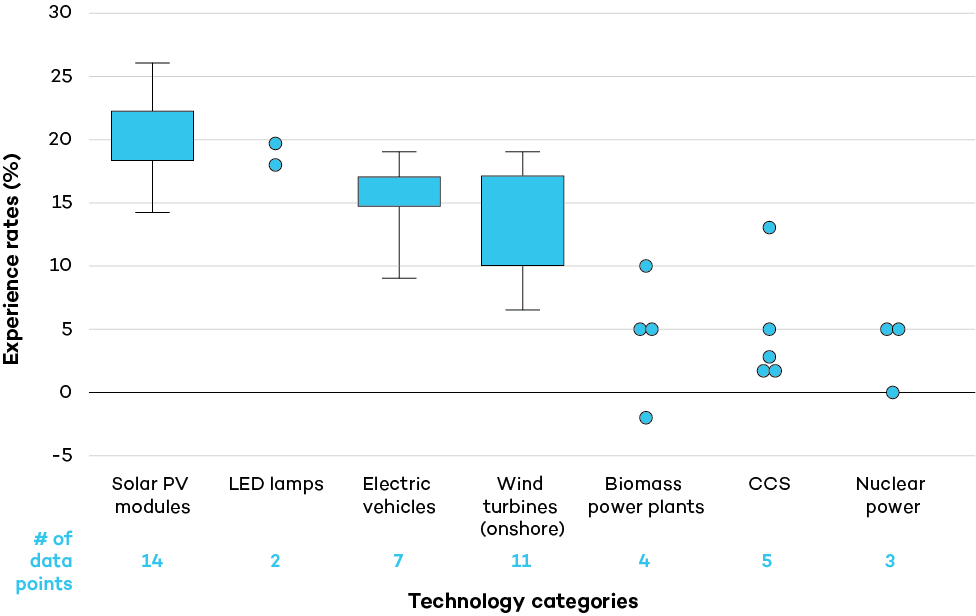
CCS is a technology to reduce greenhouse gas (GHG) emissions, and so it must be judged against other such technologies, including the use of solar photovoltaic (PV) and wind turbines to lower emissions by substituting for gas- and coal-fired electricity generation. Compared to solar and wind, CCS has had a low experience rate (Figure 3). Reported experience rates for CCS used with a natural gas combined-cycle plant range from 2% to 7%, compared to a 23% median experience rate for solar PV since 1976. This means that the cost of solar PV modules decreases by 23% every time the global installed capacity doubles.
Figure 3. Experience rates for various technologies globally
Note: Boxes are shown for categories with more than five data points. Vertical lines indicate the minimum and maximum data point in the respective category.
As these experience rates suggest, renewable energy technologies have undergone significant cost reductions in recent years. This trend makes the financial viability of CCS deployment, particularly in the electricity production sector where it directly competes with renewables, increasingly questionable. Solar PV and wind power are notable examples of renewable technologies that have been developed more successfully. These renewable sources have generated revenue through electricity sales, enabling them to achieve cost competitiveness through increased deployment.
While CCS is likely to be outcompeted in the energy industry, its potential use in other sectors should be evaluated separately, particularly for hard-to-abate industries such as steel and cement that have limited alternatives for emissions reductions. Notably, the Intergovernmental Panel on Climate Change identifies CCS as a vital mitigation tool in the cement industry, given that two thirds of emissions from cement production stem from chemical reactions when heating limestone. In other cases, alternative decarbonization options may be more efficient and cost-effective, such as scrap steel recycling or the use of green hydrogen to produce direct-reduced iron in the steel industry. Due to its high costs and the complexity of the technology, CCS should be reserved for challenging industrial processes, such as those involving carbon-intensive chemical reactions and high-heat processes, where electrification and other decarbonization alternatives are not readily available. More research and development are needed to confirm whether the technology can be made effective and competitive in these sectors.
CCS in Oil and Gas Is Expensive, and Public Investment Is Better Directed at Cost-Effective Solutions
In contrast to technologies such as solar PV and wind that require subsidies only initially as the technologies scale up, CCS in oil and gas production requires substantial, ongoing government support and regulations. To date, in Canada, stubbornly high costs of CCS in the oil and gas sector have been offset by extensive government subsidies and tax advantages. For example, CCS projects in Alberta—the country’s largest oil and gas-producing province, where most CCS projects are proposed—are eligible for credits under the provincial Technology Innovation and Emissions Reduction regulations and may also be eligible for support from the new federal CCS investment tax credit and clean fuel regulations. While oil and gas sector representatives argue that additional public funding is needed for CCS, independent analysis reports that these and other significant credits are sufficient and are indeed more generous than American CCS incentives under the Inflation Reduction Act.
The pursuit of CCS in the oil and gas sector should involve weighing CCS against all other options for reducing GHG emissions. Given the relatively high costs of CCS per tonne of GHG emissions reduced, CCS for oil and gas is an inefficient and risky use of public funds. Faster, more effective options for significant GHG mitigation in the sector—such as the reduction of methane emissions, electrification, and efficiency measures—should be pursued by the industry.
It is not likely that the costs of CCS in Canada’s oil and gas sector will decline significantly over time: the technology is too complex, it demands too much customization with each application, and it is unlikely to capture the benefits of mass manufacturing in the way technologies like solar PV have. Industry calls for additional public support for CCS should be closely evaluated to ensure any public dollars are directed to sectors that have a viable 1.5°C trajectory. The oil and gas sector has yet to demonstrate that CCS can achieve this.
Re-Energizing Canada is a multi-year IISD research project envisioning Canada's future beyond oil and gas. This publication is a part of The Bottom Line policy brief series, which digs into the complex questions that will shape Canada's place in future energy markets.
IISD Welcomes Canada’s Contribution to the Historic Global Biodiversity Framework Fund
August 24, 2023
VANCOUVER – The International Institute for Sustainable Development (IISD) welcomes Canada's CAD 200 million pledge to the newly ratified Global Biodiversity Framework Fund, announced today at the Seventh Assembly of the Global Environment Facility (GEF) by Ahmed Hussen, Canada's Minister of International Development, and Steven Guilbeault, Canada's Minister of Environment and Climate Change.
Today's announcement makes Canada one of the first movers in providing the necessary support to translate the Kunming-Montreal Global Biodiversity Framework into action. The United Kingdom also pledged GBP 10 million to this fund.
"IISD applauds Canada for stepping up with this pivotal financial commitment, which will help to ensure the framework’s successful implementation," said IISD Interim Co-President and Co-CEO Nathalie Bernasconi-Osterwalder at the GEF Assembly in Vancouver. "But this is just a beginning, and we'll need to see more countries taking action to confront the interwoven challenges of biodiversity degradation and climate change in order to leave a sustainable future for generations to come."
The Global Biodiversity Framework Fund was launched today at the GEF Assembly. The new fund will help countries implement the historic Kunming-Montreal Global Biodiversity Framework, reached at the Convention on Biological Diversity COP 15 summit in Montreal last year. Canada’s contribution will support countries' efforts to achieve the new goals on conservation, restoration, and the sustainable use of biodiversity and ecosystems by 2030.
IISD is committed to supporting governments and all stakeholders to advance nature-positive outcomes. Through various programs and initiatives, IISD is advancing nature-based solutions in Canada and around the world to protect biodiversity, strengthen resilience, and reduce vulnerabilities.
Climate change serves as a threat multiplier, amplifying biodiversity loss and ecosystem degradation globally. As a result, advancing climate solutions that preserve and restore ecosystems is critical. Actively conserving our forests, wetlands, oceans, and coasts will help communities become more resilient to the impacts of climate change. Nature-based solutions (NbS) for climate change adaptation can be a cost-effective way to increase resilience while generating multiple benefits (or co-benefits) for nature and society. But achieving measurable gains for biodiversity functioning that also deliver wins for society and adaptation often proves to be challenging.
The International Institute for Sustainable Development’s (IISD’s) recent report, Enhancing Biodiversity Co-Benefits From Nature-Based Solutions, provides recommendations to help plan, design, and implement NbS for adaptation that enhance biodiversity and ecosystem integrity. These recommendations range from incorporating Traditional Knowledge of biodiversity and ecosystem services and using cost-effective indicators for monitoring, evaluation, and learning to integrating local values that will help ensure that benefits address the needs of local community members.
Concrete examples of biodiversity co-benefits achieved through the implementation of NbS exist. From India to Ethiopia to Canada, we explored some of them at a recent event hosted by the Aga Khan Foundation Canada, IISD (under the Nature for Climate Adaptation Initiative), and Global Affairs Canada. These three case studies provide valuable examples of NbS’ potential while showing the versatility of NbS for different contexts.
Enhancing the Resilience of Coastal Communities in India
In recent years, natural hazards on the Saurashtra coast of Gujarat in India have become increasingly frequent. Exacerbated by climate change, phenomena such as cyclones, storms, coastal erosion, sea level rise, heat waves, floods, and extreme rains have been intensifying. To adapt to these changes, 20 coastal villages in the Porbandar district have partnered with the Aga Khan Agency for Habitat and technology company Ericsson to enhance their resilience through an ecosystem-based and community-centred approach.
Community members are planting 100,000 mangroves and other plant species to restore the coastal ecosystem and protect against coastal erosion adjacent to villages and nearby areas. Mangroves have proven efficient in mitigating the effects of storm surges, soil erosion, and salinity, as well as soaking up the carbon dioxide that contributes to climate change. Furthermore, cloud-based artificial intelligence monitoring sensors used in the project generate real-time data on the mangroves and coastal restoration efforts. With this project, new climate-resilient livelihood opportunities will arise for local communities—for example, they will plant 20,000 fruit-bearing trees across 10 villages to help increase biodiversity and reduce local heat waves.
Anita Miya, Head, Knowledge Management and Partnership, Aga Khan Agency for Habitat, provides more information in her presentation.
Improving the Health, Profitability, and Adaptability of Ethiopian Coffee Farmers
Ethiopia is one of the most climate-vulnerable countries in the world due to its strong reliance on rain-fed agriculture and natural resources and its limited ability to adapt to the changing climate. As explained by Anil Gupta, Senior Environment Specialist at Global Affairs Canada, a quarter of the population (mostly small-scale female farmers) derive their livelihoods from the production, processing, and marketing of coffee. However, with increasing temperatures and high inter-annual and intra-seasonal rainfall variability, areas suitable for wild coffee production could shrink by 40% to 90% by 2040.
Another issue, specific to the Sidamo region in southern Ethiopia, is how to deal with coffee processing wastewater. According to an early case study presented by Gupta and Paul Stewart, TechnoServe, 2 billion litres of hazardous wastewater is produced annually, overflowing into rivers and impacting human and animal health. The Sidamo project took different NbS measures to tackle this problem, including
composting the waste pulp from coffee processing,
installing over 100 vetiver grass restoration initiatives around wetlands, and
planting over 1 million indigenous shade trees on 28,000 smallholder coffee farms (to protect the soils and the coffee trees from heat and retain soil moisture).
(Through the project) I learned that coffee trees have a shorter lifespan when grown under full sun and reduce the coffee yields. That is why I loved to plant trees on my farm, as it, in turn, leads me to live a comfortable life.
Birtikuan Debeko, beneficiary of the program in Aleta Wondo (Sidamo, Ethiopia)
As a result, both the river water quality and the climate resilience of small-scale coffee farmers in the Sidamo region have improved over the past 10 years.
Restoring, Protecting, and Connecting Natural Landscapes Across Southern Canada
Southern Ontario contains the highest diversity and density of species in Canada, explained Janet Sumner, Executive Director, Wildlands League. The region is home to approximately 200 endangered species—out of a total of 500 endangered species in the country—and 80% of the species at risk in the province. To address both the extinction crisis and the climate emergency, the Nature Connectivity Project brings together protected area initiatives on both public and private lands under the Southern Ontario Nature Coalition and aims to integrate these parcels of land into the Rouge National Urban Park, enlarging it by 30%.
An important piece of the connectivity puzzle is the Ontario Greenbelt, which is composed of 800,000 hectares of farmland and natural areas around the Greater Toronto Area that are currently protected from urban sprawl. It provides multiple benefits, such as offering spaces for outdoor activities, alleviating the impacts of climate change, and countering biodiversity loss. But a rapidly growing population and their housing and transportation needs are threatening the integrity of this space. It will only endure if we find ways to recognize and preserve viable ecological connections among a web of green spaces—namely for fauna to safely migrate to and from larger protected areas.
The Nature Connectivity Project enables just that as it aims to achieve an interconnected network of protection and ecological corridors across Southern Ontario, with positive mitigation and adaptation benefits for 12 million people. Among the multiple benefits, the project will create jobs, protect communities from flooding, and deliver on biodiversity co-benefits, including protecting a rare Carolinian forest that hosts over 1,700 species of plants and animals—23 of which are at risk.
Working Together to Scale Up NbS for Adaptation
If our communities and ecosystems are going to work together to survive these modern crises, we will need to increase evidence-based, inclusive, impactful, and gender-inclusive NbS for adaptation and biodiversity worldwide. This is what the Nature-Based Solutions (NbS) for Climate and Biodiversity Community of Practice aims to do by allowing organizations across the world to share their insights, expertise, and networks—as seen with the case studies above that were presented in the same meeting to cover a variety of perspectives and NbS practices.
Nicholas Macfarlane, International Union for Conservation of Nature, also introduced to the Community of Practice the Species Threat Abatement and Recovery (STAR) metric, which measures the potential of “particular actions at specific locations to contribute to global sustainability targets, supporting science-based targets for species biodiversity.” It is a spatially explicit and standardized way of measuring biodiversity that allows a range of stakeholders, from policy-makers to NbS project teams, to compare the potential biodiversity impacts of specific actions.
Any organizations interested in NbS for adaptation and biodiversity are welcome to join the Community of Practice and can email [email protected] for more information.
The initial work plan of the NbS for Climate and Biodiversity Community of Practice was co-developed by Global Affairs Canada, members of the Canadian Coalition on Climate Change and Development, and other organizations in Canada.
Microplastics now pervasive in Great Lakes, with 90% of water samples surpassing safe levels for aquatic wildlife: new studies
Data spanning the last ten years reveal that the Great Lakes basin is widely contaminated with microplastics, with potentially dangerous consequences for the wildlife that live within.
August 23, 2023
However, if Canada and the United States act together soon, we can develop systems to monitor and reduce the risks that these pollutants pose to the health of these critical ecosystems.
This is all according to two new studies conducted by researchers from the Rochman Lab at the University of Toronto, in collaboration with IISD Experimental Lakes Area, published in the Canadian Journal of Fisheries and Aquatic Sciences.
Both studies reveal widespread contamination of microplastics across the Great Lakes basin—nearly 90% of the water samples collected from the Great Lakes basin surpass at least one threshold for risk—and suggest appropriate next steps for monitoring contamination and risk, as well as mitigation.
The first study identifies a need for a coordinated monitoring strategy for microplastics, which would necessitate developing standardized methods for measuring, characterizing, and reporting microplastics in the region – a need also recently emphasized by the Auditor General of Ontario in their recently published State of the Environment in Ontario report.
The second study identifies a need to develop an ecological risk assessment and management framework for the region, where different levels of microplastics present in the water and sediment would trigger specific management actions.
“It’s clear that microplastics in the Great Lakes are a problem for both Canada and the United States, and that their management should reflect this,” said Eden Hataley, Ph.D. Student, Department of Physical & Environmental Sciences, University of Toronto Scarborough.
“One way forward to address the issue could be via the Great Lakes Water Quality Agreement – the longstanding commitment between the two countries that outlines binational priorities and actions to resolve transboundary environmental problems in the Great Lakes.”
In the first study, the research team sought to understand where, how much, and what type of microplastic pollution exists in the Great Lakes and what methods researchers typically use to measure it. Existing research efforts clearly show that microplastics are pervasive throughout the Great Lakes and associated rivers in water, sediments, and wildlife (including different species of fish, birds, frogs, and mussels). In general, levels of microplastics in the Great Lakes are comparable or relatively high compared to other water bodies.
In the second study, the research team sought to understand the present risk of microplastics to species living in the Great Lakes. The research team found that reported levels of microplastics in nearly 90% of the water samples collected from the Great Lakes basin surpass at least one threshold for risk, however, all of the sediment samples collected from the Great Lakes basin remain below safe levels.
The Rochman Lab, in the Department of Ecology and Evolutionary Biology at the University of Toronto, is a large research laboratory with a focus on pollution in aquatic ecosystems. The primary focus of Dr. Rochman and her trainees is on plastic pollution – aiming to better understand sources, fate and effects in rivers, lakes and oceans.
IISD Experimental Lakes Area is the world’s freshwater laboratory. A series of 58 lakes and their watersheds in northwestern Ontario, Canada, IISD-ELA is the only place in the world where scientists can research on and manipulate real lakes to build a more accurate and complete picture of what human activity is doing to freshwater lakes. The findings from over 50 years of ground-breaking research have rewritten environmental policy around the world—from mitigating algal blooms to reducing how much mercury gets into our waterways—and aim to keep fresh water clean around the world for generations to come.
-30-
For more information, please contact:
Sumeep Bath, Editorial & Communications Manager, IISD Experimental Lakes Area
Get Ready to Hack the World's Freshwater Laboratory
We are inviting all students and young professionals (ages 18 to 30) with coding experience and an interest in freshwater science, data science, or web and software design to join us in an exciting new hackathon.
October 23, 2023 12:00 am - November 6, 2023 11:55 pm Central Standard Time
You will work alongside like-minded peers to use a dataset that has been tracking the health of Canada’s fresh water for over 50 years to build solutions to real environmental issues—and help protect Canada’s precious fresh water supplies.
You will learn how to build a data product from start to finish, collaborate with a team, and work with established experts in the field who spend their days tackling issues from pollution and biodiversity loss to climate change.
The feminist agenda at the grassroots: Advocates tell of experiences
For decades, women-led organizations have worked in communities to build women's resilience to the fallout from climate change, promote girls' access to education, and support victims of gender-based violence. We speak with the young and old activists on their experiences working with women.