Insight

How Can the G20 Effectively Address Migration?

We make the case for how the upcoming G20 summit's core focus—how to strengthen economic resilience and further integrate global financial markets—can help address both hunger and migration.

July 4, 2017

Addressing poverty, hunger and the current refugee crisis are among the stated priorities for the G20 summit that will convene in Hamburg, Germany on July 7–8, 2017.

Our research has found that the meeting’s core focus—how to strengthen economic resilience and further integrate global financial markets—can help address both hunger and migration.

IISD and the International Food Policy Research Institute (IFPRI) conducted an econometric analysis to assess how international migration is affected by economic growth, hunger and increased agricultural productivity. The goal was to determine whether investments to reduce hunger had any impact on migration levels.

Close to 90 million people migrated from their country of birth between 1990 and 2015.[1] There was a significant acceleration in migration from 2005 to 2010. The number of migrants from Africa and the Middle East more than doubled when comparing the period from 2000–2005 to the period of 2010–2015.

We analyzed changes in these migration flows and measured the impact of three variables: hunger levels, agricultural productivity and per capital gross domestic product (GDP.)

Our research has found that the meeting’s core focus—how to strengthen economic resilience and further integrate global financial markets—can help address both hunger and migration.

We found that economic growth was the strongest driver for lowering levels of migration, both at a global level and in Africa. In most cases, the African countries that experienced an increase in GDP of more than 25 per cent saw an absolute decrease in the number of migrants. In countries with no or very little increase in GDP there was increased migration.

We found no discernible relationship between hunger levels and migration after controlling for economic development and political stability, two key drivers for food security. This is a significant finding since it means that solving the hunger problem alone will not directly impact international migration. Instead, it depends on how we invest in reducing hunger and how multiple drivers are addressed.

Close to 90 million people migrated from their country of birth between 1990 and 2015.

We also found no discernible relationship between increased agricultural productivity (measured in terms of value of production at the farm level or in physical yields) and migration. In fact, increased productivity can actual lead to increased migration because less labour is required on farms.

The three findings together are important. They unlock the answer to the mix of interventions needed to simultaneously end hunger and provide economic opportunities for people in their country of birth. Focusing on a few SDG 2 targets in isolation, such as reducing hunger or increasing agricultural productivity, will not reduce migration levels. The key is to link investments in reducing hunger and increasing productivity to broader economic growth. In other words, it is critical to generate enough economic opportunities to enable people to remain in their country of birth.

We conclude that donors should focus on investing in agriculture and food systems beyond the farm level. Transforming agriculture along the whole value chain, improving market integration and developing rural economies are key to addressing migration. Global leaders gathering for the July 2017 G20 meeting should incorporate this integrated focus into their deliberations and follow-up actions.   

Insight

How to Implement Strategic, Smart, Sustainable Public Procurement

Public procurement is “not a back-office function anymore, but a crucial pillar for delivering government services, and a strategic one for tackling climate change.” 

June 29, 2017

Public procurement is “not a back-office function anymore, but a crucial pillar for delivering government services, and a strategic one for tackling climate change.”

That was the message from EU Commissioner for Internal Market, Industry, Entrepreneurship and SMEs Elżbieta Bieńkowska and Organisation for Economic Co-operation and Development (OECD) Secretary-General Angel Gurría at a joint high-level event on strategic public procurement in Paris on June 2, 2017.

This high-level support is welcome in a time where governments have to strategically rethink the way they are spending taxpayers’ money. It gives them a mandate to reform public procurement laws, policies and processes towards delivering value for money across the life cycle of the goods, services and assets they purchase.

Public procurement represents, on average, 12 per cent of the GDP in OECD countries, corresponding to 29 per cent of government expenditures (OECD, 2017). This illustrates that public procurement is a powerful tool for driving markets towards more sustainable production patterns, and for creating markets for sustainable goods, services and infrastructure. Despite the changes in recent years to international frameworks governing public procurement, the instrument is not yet being utilized to its full potential.

The EU Public Procurement Directive (2014), the OECD Working Party on Leading Practitioners on Public Procurement (LPP) and the World Bank New Procurement Framework (2015), among others, all emphasize the strategic function of public procurement and shift the meaning of value for money away from lowest price at the point of purchase to overall value for money across the life cycle, encompassing total cost of ownership and quality aspects of the good, service or asset.

For example, the OECD LPP Working Party approved a recommendation in 2015 that refers to public procurement as a tool to deliver secondary policy objectives such as “sustainable green growth, the development of small and medium-sized enterprises, innovation, standards for responsible business conduct or broader industrial policy objectives.”

The World Bank New Procurement Framework’s vision emphasizes that the objective of procurement is "to achieve value for money with integrity to deliver sustainable development":

The focus now is on implementation: how governments can use public procurement to its full potential in order to deliver broader policy objectives. This requires ensuring that public procurement laws, processes and practices are designed to contribute to the implementation of the Sustainable Development Goals.

IISD is working with the Smart Procurement Valuation Tool (for goods and services) and the Sustainable Asset Valuation Facility (for infrastructure) to assist governments with monetizing the environmental, social, economic and financial multiplier benefits and demonstrate that the sustainable option is the only way forward.

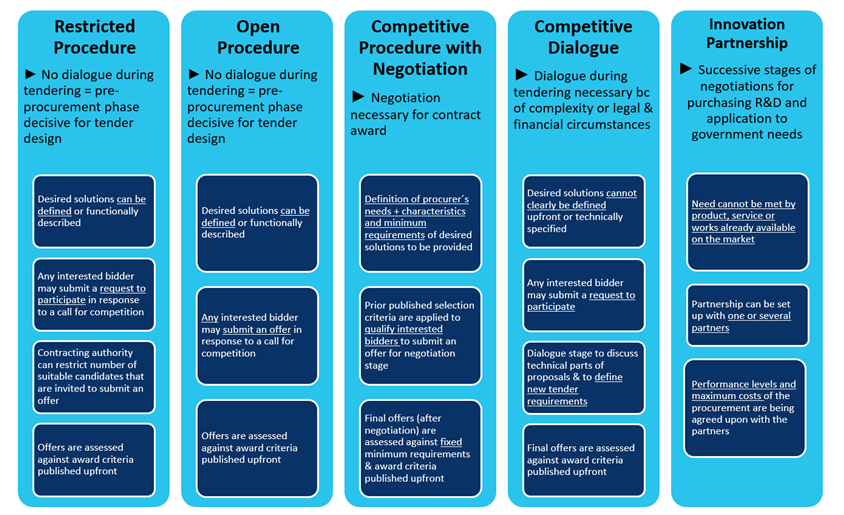
The challenges that were identified and discussed during the Paris event focused on the risk-aversion of public procurers, as well as thinking strategically, rather than administratively. More strategic public procurement requires a change in mindset. It demands a professionalization of the procurement workforce. It also calls for more transparency and information on what the market can deliver in terms of solutions for the needs of governments. One important way forward therefore is to provide more certainty to public procurers and policy-makers on the best available technologies to meet society’s needs for mobility, education, healthcare and clean energy, among others. Clear procedures on how to engage with suppliers in a transparent manner are therefore key. For example, the EU Directive on Public Procurement (2014) outlines various possible procurement procedures that can be used (see Figure 1).


Figure 1: Various procurement procedures derived from the EU Directive on Public Procurement (2014). Source: IISD (2017)

In addition to procedural certainty, more data and monitoring tools on the impact of public procurement are needed. This will in turn help make the business case for sustainable public procurement. It will legitimize a potentially higher capital cost at the point of purchase of a good, service or asset because, over the life cycle, the multiplier benefits of buying sustainably far outweigh those initial costs to the procuring agency, and to society at large.


Insight details

Insight

Une nouvelle loi pour sécuriser les terres au profit des paysans maliens

Le 11 avril 2017, le Président malien a promulgué la loi foncière agricole (LFA) adoptée par l'Assemblée nationale 10 jours plus tôt. C'est la première fois dans l'histoire législative du Mali qu'une loi est spécifiquement adoptée pour traiter des terres agricoles.

June 27, 2017

Le 11 avril 2017, le Président malien a promulgué la loi foncière agricole (LFA) adoptée par l'Assemblée nationale 10 jours plus tôt. C'est la première fois dans l'histoire législative du Mali qu'une loi est spécifiquement adoptée pour traiter des terres agricoles.

Ce type de terre a toujours été régi par les coutumes et le droit étatique, y compris le Code domanial et foncier, les lois de la décentralisation et la Charte pastorale. La nouvelle loi représente donc un moment crucial pour les communautés rurales au Mali.

Je suis un juriste malien qui travaille avec l'IIDD et suis également professeur adjoint à l'Université des sciences juridiques et politiques de Bamako. Le processus de préparation de cette loi a débuté par l'élaboration d'un document de politique. J’ai activement participé à l’élaboration de cette politique qui a ouvert la voie à la loi. En outre, avec d’autres collègues, nous avons fourni une assistance technique et juridique aux organisations d'agriculteurs tout au long de la phase de consultation. La politique et la loi ont été adoptées dans le cadre de la loi d'orientation agricole (LOA), qui a été adoptée en septembre 2006, et qui est maintenant le document de référence pour l'élaboration des politiques agricoles au Mali.

J'ai été chargé d'analyser le cadre juridique et politique des terres agricoles au Mali pour le document de politique, qui a été adoptée en décembre 2014 après une consultation avec les principales parties prenantes dans toutes les régions administratives du Mali. J'ai voyagé dans certaines de ces régions pour expliquer la politique et recueillir les commentaires et les contributions de ces acteurs.

Cette expérience m'a montré l'importance d'inclure toutes les parties prenantes dans la rédaction et la conception de nouvelles lois et politiques applicables à l'agriculture et du sentiment d'autonomisation que les poplutions rurales ressentent lorsqu'ils sont inclus dans la législation.

La politique et la loi foncière agricoles sont parmi les innovations clés pour fournir une solution durable à l'insécurité foncière des communautés rurales. Cette insécurité est due à de nombreux facteurs abordés par la nouvelle loi, y compris entre autres la coexistence de la tenure coutumière et de celle issue des lois écrites, une gouvernance faible, la marginalisation des droits des femmes, des procédés d’officialisation trop lourds et le manque de connaissance des lois et des processus au niveau des citoyens.

Nous avons réussi à créer un nouveau cadre juridique qui renforce les droits fonciers coutumiers, améliore la gouvernance, renforce les droits des femmes et facilite la compréhension des lois et des processus par les populations rurales. Qu'avons-nous atteint concrètement?

Des droits coutumiers plus solides

Tout d'abord, les lois précédentes considéraient les terres coutumières non enregistrées comme des terres de l'État, ce qui permettait au gouvernement de prendre ces terres au besoin. La nouvelle loi stipule clairement, comme le soutenaient les agriculteurs dans leurs campagnes, qu'aucune terre détenue en vertu des lois coutumières ne sera incluse dans les terres de l'État. Deuxièmement, la loi prévoit la documentation des droits fonciers coutumiers en créant deux nouveaux types de titres, les attestations de détention coutumière et les attestations de possession foncière. Les deux certificats ont une grande valeur juridique pour les agriculteurs et les communautés rurales, car elles peuvent être transmises aux héritiers, vendues et utilisées comme garantie pour les prêts. Enfin, la loi reconnaît le droit aux communautés rurales de posséder collectivement certaines terres, y compris des espaces reconnus comme vitaux pour les communautés et leurs familles. Ces terres sont gérées par les coutumes et les traditions en vigueur dans les communautés concernées.

Une gouvernance améliorée

Deux nouvelles institutions seront créées. La première est la commission foncière villageoise et de fraction, qui facilitera les concertations sur les problèmes fonciers et l’officialisation des droits fonciers coutumiers. Les conflits fonciers feront désormais l’objet d’une procédure de conciliation devant ces commissions avant d'être soumis aux tribunaux. La seconde institution créée est l'observatoire national des terres agricoles. L'observatoire documentera les problèmes fonciers et assurera le suivi de la loi foncière agricole et des pratiques foncières en milieu rural. L’observatoire publiera régulièrement des informations sur l'évolution de la situation des terres agricoles dans le pays et les meilleures pratiques et alertera le gouvernement sur les risques potentiels.

La loi renforce également la décentralisation dans la gestion des terres agricoles en attribuant un rôle clé aux municipalités, appelées « communes » dans le système malien, dans l'enregistrement des droits fonciers. Il existe deux nouveaux registres qui seront gérés par les autorités municipales, notamment le maire : le registre de la possession foncière et le registre des transactions foncières. Gérer toutes ces questions au niveau local apportera une stabilité dans la gestion des terres et créera une approche ascendante pour intégrer les systèmes coutumiers au système de droit écrit.

Les droits des femmes

Malgré une constitution interdisant la discrimination fondée sur le genre, il est traditionnellement très difficile pour les femmes de posséder des terres au Mali. Elles ont généralement des droits temporaires d'utilisation des terres, qui peuvent leur être retirés à tout moment. Pour contourner cette situation et améliorer leur sécurité foncière, les femmes forment souvent des associations pour demander des terres pour leur usage collectif. La nouvelle loi s'inspire de cela pour renforcer l'accès des femmes aux terres en exigeant que 15% des terres publiques soient allouées aux associations de femmes (et à d'autres groupes vulnérables comme les jeunes).

Cependant, la disposition qui reconnaît le droit aux communautés rurales de posséder collectivement certaines terres sur la base du droit coutumier et la tradition, présentée plus haut, pourrait perpétuer la discrimination fondée sur le sexe. Les femmes sont désavantagées par le caractère discriminatoire inhérent à certaines de ces coutumes et traditions, de sorte que ces droits fonciers collectifs pourraient porter entrave à la sécurité foncière des femmes. La loi devrait inclure des dispositions pour protéger les femmes dans ces cas. Nous avons essayé plusieurs fois de répondre à cette question, mais en fin de compte, le projet final a été adopté sans inclure des dispositions interdisant la discrimination fondée sur le genre dans la gestion coutumière des terres, ce qui aurait amélioré les coutumes selon les normes actuelles sur ces questions.

La formation et la sensibilisation

S'il y a des leçons à tirer de l'adoption de la nouvelle loi et de la politique foncière, la principale sera l'importance d'inclure toutes les parties prenantes dans la préparation d'une politique de développement rural en général et de la réforme foncière en particulier. Les agriculteurs ont joué un rôle important lorsqu'ils ont été consultés et ont contribué à façonner la loi lorsqu'ils ont reçu les formations et participé aux activités de sensibilisation que nous avons organisées pour eux.

En fin de compte, toutes les parties prenantes ont eu l'occasion d'exprimer leurs points de vue et les préoccupations à prendre en compte dans le cadre de l’élaboration de la nouvelle loi. Malgré que la nouvelle politique soit plus complète et comprend beaucoup de ces points de vue et préoccupations, la loi est cependant plus concise et tient mieux compte des actions concrètes  possibles en ce moment. Il y a encore des choses à préciser et à clarifier dans les mesures de mise en œuvre, mais il y a également des lacunes que les agriculteurs et les communautés rurales continueront à chercher à améliorer.

Nous continuerons d'aider à résoudre ces problèmes et ces faiblesses dans le cadre de la mise en œuvre.

This blog is also available in English here

Insight details

Topic
Food and Agriculture
Region
Mali
Insight

Strengthening the Ties Between Gender and Resilience? Canada’s Feminist International Assistance Policy

Canada’s new feminist international assistance policy provides a bold and exciting approach to address international development challenges in contexts where inequality and exclusion of women and girls still prevail. 

June 27, 2017

For millions of women and girls living in poverty around the world, each day starts with struggles that are unimaginable for most of us.

They face continuous discrimination in access to education, health care and employment, lack of control over productive and financial resources, and marginalization from decisions that affect their livelihood and well-being. These are just a few of the challenges that make women and girls extremely vulnerable to the impacts of climate change, violent conflict, economic and political insecurity.1

In cases of climate-induced drought, for example, there is an increase of work-burden for women, who are primarily responsible for water collection, as well as more time and energy spent on water provision for household and agricultural needs. In situations of food insecurity, women’s health tends to deteriorate, as they are expected to feed other family members first, while in conflict situations women and girls are the primary victims of gender-based violence.2

Despite this vulnerability, women and girls play a vital role in unlocking the transformative potential of development assistance and in achieving long-term change. They are key in the capacity of households and communities to cope with, adapt and potentially transform in the face of shocks and stressors—what we know as “resilience.”  

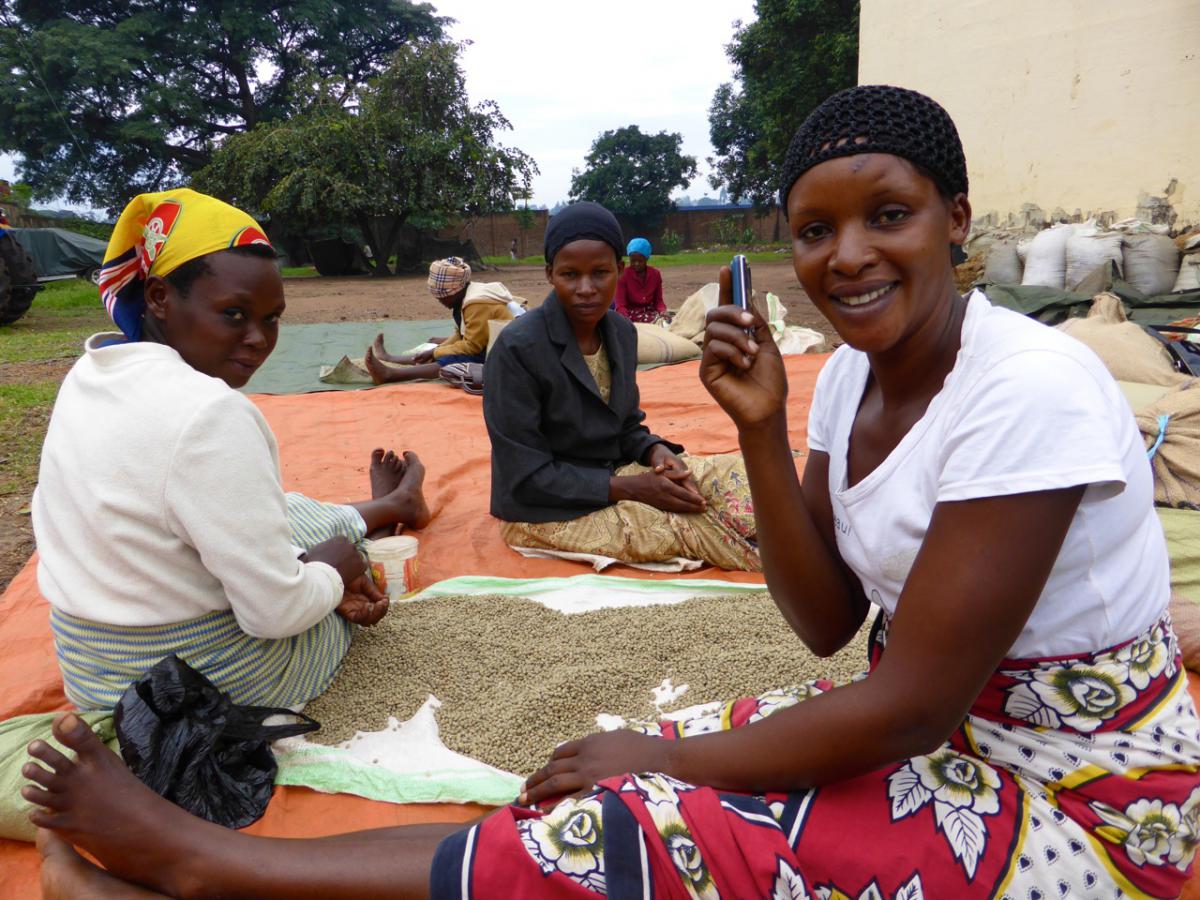
Three women in Uganda sort coffee to sell at market. Photo: Angélica V. Ospina.

Gender equality and inclusion are not only contributing factors to more resilient societies, but prerequisites to achieving them. However, the nexus between gender and resilience in development practice remains weak. 

Could Canada’s feminist international assistance policy strengthen this link and help us build resilience?

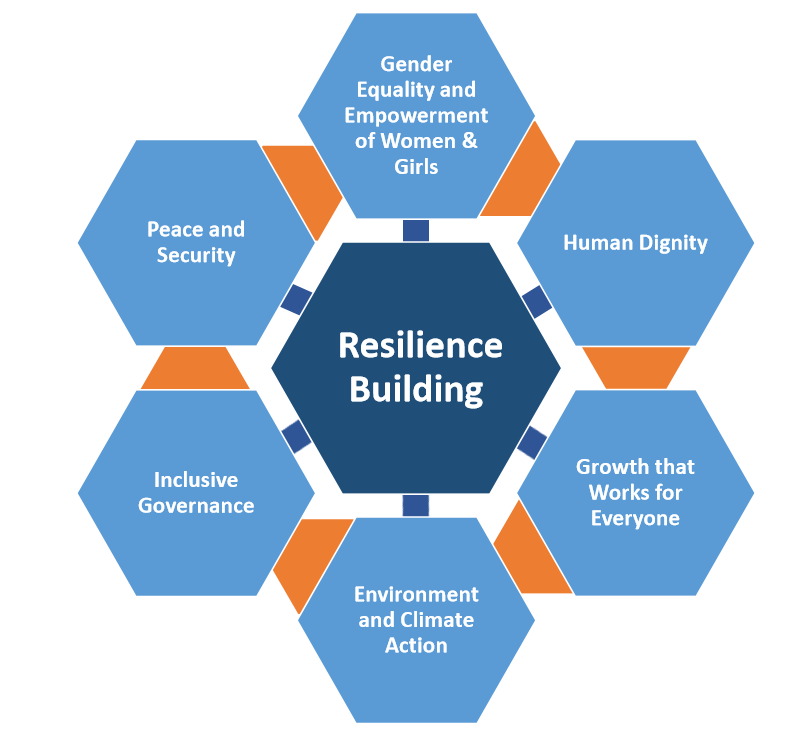
Canada’s progressive policy approach places women’s and girls’ needs and potential at the centre of its international assistance, which constitutes a step in the right direction. By prioritizing the empowerment of women and girls as agents of change, Canada’s new policy provides a unique opportunity to strengthen resilience-building processes and raise awareness on the gender-resilience nexus across its six action areas.

But having a new policy won’t automatically translate into more gender-sensitive resilience building. Canada must now embark on a long-term process that will require continuous reflection, monitoring and learning among diverse stakeholders, as well as a frank dialogue about what works and what doesn’t in each context. Realizing this long-term commitment is essential to empowering women and girls amidst a complex and uncertain global context.

The following are some of the key gender-resilience linkages to watch for as Canada advances in the implementation of its new foreign assistance policy.

Action area 1: Gender equality and the empowerment of women and girls 

  • Strengthening women’s organizations and movements contributes to self-organization, one of the main attributes of resilient societies. Improving the government’s provision of services to women and girls helps achieve equality and inclusion, and increases the robustness of local institutions.

Action area 2: Human dignity

  • Ensuring that humanitarian assistance addresses the needs and potential of women and girls is crucial to build effective coping and adaptive capacities.  Access to health care, nutrition and education is a cornerstone of inclusion, needed to sustain long-term change. 

Action area 3: Growth that works for everyone

  • Increasing women’s access to economic resources and opportunities is essential for livelihood diversification, as well as to ensure that women have the flexibility and the autonomy needed to adapt to changing circumstances. It can also create new opportunities to engage the private sector in resilience building, by integrating women/women-owned enterprises into supply chains. 

Action area 4: Environment and climate action

  • Advancing women’s leadership and decision making is crucial for innovative responses to the challenges posed by climate change. Fostering women’s entrepreneurship and women-led initiatives to address environmental challenges—including the use of renewable energy—can strengthen experimentation and learning, which are essential for resilience. 

Action area 5: Inclusive governance

  • The protection and promotion of human rights, the rule of law and political participation are fundamental attributes of resilient societies, and are necessary for the empowerment of women and girls. The participation of women in positions of influence can act as a precursor of change across scales—community, regional, national—and improve institutional robustness. 

Action area 6: Peace and security

  • Effective participation of women in peacebuilding and post-conflict reconstruction is the basis for long-lasting prosperity. Ensuring that women help shape the design and implementation of security strategies is important for empowerment, as well as to achieve more comprehensive solutions to the root causes of conflict. 

Canada’s new feminist international assistance policy provides a bold and exciting approach to address international development challenges in contexts where inequality and exclusion of women and girls still prevail. But the true test of the policy’s effectiveness will be our ability, as a society, to engage in a long-term process of change that requires seeing gender integration not as a novelty but as the new normal—as an absolute prerequisite to building resilience both in Canada and abroad. 

Notes

1. USAID (2013). Feed the future learning agenda literature review: Improved gender integration and women’s empowerment”,. Washington DC: Feed the Future Program, Washington DC; Mercy Corps. (2014). “ Rethinking resilience: Prioritizing gender integration to enhance household and community resilience to food insecurity in the Sahel”., Portland, Oregon. 

2. Le Masson, V., Norton, A., & Wilkinson, E., (2015). Gender and Rresilience (BRACED Working Paper),. Overseas Development Institute (ODI). Retrieved from, BRACED Working Paper, available online: https://www.odi.org/sites/odi.org.uk/files/odi-assets/publications-opinion-files/9890.pdf

Insight details

Insight

Big Data: What is it? How Can It Help Advance Sustainable Development?

What is big data and how could it help advance sustainable development? We sat down with Geoff Gunn from our Water Program to learn more.

June 26, 2017

What is big data and how could it help advance sustainable development? We sat down with Geoff Gunn from our Water Program to learn more.

First things first. What is big data?

There are so many different streams of data that are being continually collected and processed. "Big data" has one or more of the following:

  • High volume (there is a lot of it)
  • High velocity (it is collected at a fast rate)
  • High variety (it measures a lot of different things)

Can you give us some examples of big data?

There are so many examples and uses in your daily life that you may not recognize every instance as big data, including data collected from satellites, Internet searches, mobile phones, remote sensing and more. It is often used to reveal patterns, trends and associations, especially relating to human behaviour and interactions.

Think about when you log into Twitter. Twitter develops a feed of "trending" topics for your given location, detailing what are the most popular searched and posted-about topics in your location at the current time. In order to populate that list, Twitter will have used some big data. It will have collected data from millions of Twitter users (high volume), every second (high velocity), about what people are searching, clicking on and posting about (high variety). All this data is processed at a very fast rate in order to come up with the real-time "trending" list.

Just because data is tracked over a long period of time does not mean that it is big data. For example, at IISD Experimental Lakes Area, researchers have maintained vast datasets as they have monitored lakes over the last 50 years. Even though this data is unique and highly valuable, it would not count as big data, as it is collected periodically (once every few weeks) and measures only a few variables. It is also relatively small—you could fit it all on a USB stick.

Just because data is tracked over a long period of time, does not mean that it is big data. 

What are some of the challenges that we face when dealing with big data?

One of the most pressing concerns regarding big data is storage and processing. Imagine collecting data from every citizen in Canada, every second. That is going to result in large amounts of big data that need to be stored in large data centres requiring a lot of space and money to maintain.

Then there are also the questions of privacy and security. How do people feel about some of their perceived private data being stored, shared, and potentially analyzed and used without their knowledge or consent? Both proponents and critics of big data need to discuss how we can use it to help society while addressing these concerns.

Are there potential applications for sustainable development?

Given that one of the major uses for big data is to track and analyze human populations and movements, there are certainly many possible applications for the sustainable development agenda.

A recent survey from the United Nations Statistics Division looked at how existing non-governmental organizations are using big data to implement and report on the progress of the Sustainable Development Goals (SDGs). In fact, they have set up a whole task team to determine how big data can help us achieve the SDGs. Among many of the interesting findings is that non-governmental organizations are primarily using big data from mobile phone use, ubiquitous in many developing countries, to inform their work. They don’t go into detail about what that information is used for, but we might expect that it could be used to track the movement of refugees, for example, to determine where large groups of people are moving to, so that there can be adequate preparation.

The United States Geological Survey is currently working on technology that would glean big data from smart phones and mobile devices in order supplement existing earthquake detection systems. This technology could serve regions of the world that cannot afford higher quality, but more expensive, conventional earthquake early warning systems, or could complement those systems.

This is somewhat related to the big data used to determine the locations of current traffic jams and update programs such as Google Maps in real time. This information can then be used to improve the design of road infrastructure, thus making driving less carbon intensive and safer for everyone involved.

We look at big data from both sides: at the global scale so we may discover more about the complexity of the physical and human features of our world, and at the human scale to ensure it is meaningful, helpful and representative of the seven billion people on Earth.

How is IISD and its Water Program already using big data?

There are many ways we are already using big data to develop work and access information that we would otherwise not be able to access. For example, when I was working on developing the Manitoba Bioeconomy Atlas, I needed a clear picture of the whole province over the last 10 years in order to determine where biomass can be found, and how its availability had changed over time. Thanks to public domain satellite data, I was able to access satellite images of the whole province for the last 10 years free of charge. I then used Google Earth Engine to process that data, to give me a full picture of what the province has looked like over the last decade to be able to accurately track biomass availability. Moreover, I could remove cloudy pixels and analyze the data in a fraction of the time that it would have taken on my desktop.

At IISD Experimental Lakes Area, we are actually helping to verify, or "ground-truth" data taken by satellites. Working with Natural Resources Canada (NRCan), we have set up cameras on some of our lakes to compare to the (big) data that NRCan is collecting with its satellites about when the lakes freeze over and melt. It is exciting stuff, and just goes to show that big data has its limitations, which can be somewhat mitigated by on-the-ground work.

We look at big data from both sides: at the global scale so we may discover more about the complexity of the physical and human features of our world, and at the human scale to ensure it is meaningful, helpful and representative of the seven billion people on Earth.

Insight

Making the International Trade System Work for Climate Change: Five Ways to Address Fossil Fuel Subsidies through the WTO and International Trade Agreements

Can the international trade system be a catalyst for reforming fossil fuel subsidies (FFSs) to help relieve the burden on the public purse, reduce local and global air pollution, improve energy security and tackle climate change? 

June 20, 2017

Can the international trade system be a catalyst for reforming fossil fuel subsidies (FFSs) to help relieve the burden on the public purse, reduce local and global air pollution, improve energy security and tackle climate change?  

This was the theme of a recent workshop set at the World Trade Organization (WTO) in Geneva and organized by Climate Strategies, the Stockholm Environment Institute and the International Institute for Sustainable Development. The event forms part of a broader conversation on how the international trading system can be made compatible with the UN Sustainable Development Goals (SDGs) and the goals of the Paris Agreement on climate change. 

Participants found there is significant scope for the WTO and international trade agreements to complement and strengthen reform efforts already being supported under a range of international forums, including the 2030 Agenda for Sustainable Development, the G20 and Asia-Pacific Economic Cooperation.


Five Ways to Address Fossil Fuel Subsidies at the WTO
  1. Promote Capacity Bulding
  2. Enhance Transparency
  3. Introduce, Pledge, Report and Review
  4. Provide Interpretation of Rules
  5. Change Existing Rules

Fossil Fuel Subsidies and the WTO: “A Missed Opportunity”

Owing to its wide membership, its central role in disciplining trade-distorting subsidies across economic sectors and its well-established dispute settlement system, the WTO is well equipped to take the FFS reform agenda forward.

To date, however, the WTO’s involvement in FFS has been limited. In notable contrast with the various disputes against renewable energy subsidies that have been launched at the WTO over the past decade, no FFSs have been disputed thus far. In part, this is because many WTO Members do not fully notify on their FFSs, whether because of a lack of data and understanding of energy subsidies and their trade effects, current shortfalls in the Agreement on Subsidies and Countervailing Measures’ (ASCM) notification questionnaire or a lack of mechanisms to enforce notification. In the absence of case law and targeted research, there is also a lack of legal clarity on the extent to which different types of FFSs can be disciplined by the ASCM to begin with.

And yet addressing this topic falls squarely within the WTO’s mandate. FFSs can have a range of distorting impacts on trade and investment, including by affecting the rate and timing of development of new fields or mines.      

Moreover, the WTO was established with a view to ensuring economic progress is achieved in accordance with the objective of sustainable development, and the SDGs explicitly identify trade as a critically important means of implementation. As such, trade should be viewed as an enabler for achieving the SDGs and targets, including the objective of reducing FFSs set out under SDG 12.  

Although parallels should not be overstated, it is also worth noting the WTO’s continued engagement on reducing environmentally harmful fisheries subsidies as part of the Doha Round. Observing the discrepancy in how the two subsidies were treated in the WTO, the former Director-General Pascal Lamy characterized the absence of FFS from the WTO’s agenda as a “missed opportunity.”   

What Can Be Done?

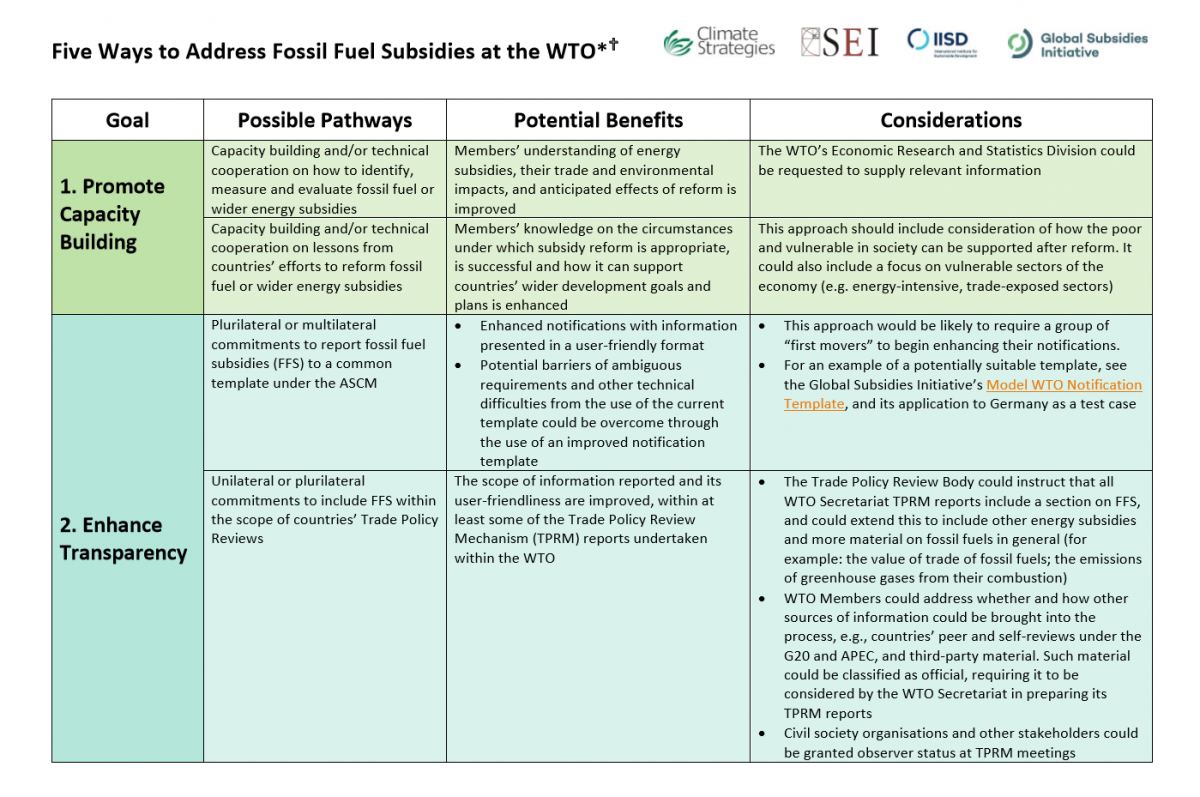
During the Geneva workshop, participants identified multiple avenues to address FFSs within the international trading system. While not purporting to be exhaustive, the table below identifies five key categories of action available to WTO Members: 1) promoting capacity building and technical cooperation; 2) enhancing transparency; 3) adopting subsidy reform pledges and ensuring credible follow-up through reporting and review; 4) clarifying the interpretation of existing rules; and 5) making changes to existing rules. Several concrete pathways to help realize these goals are also identified.


Table 1: Five Ways to Address Fossil Fuel Subsidies at the WTO

It is important to note that these pathways are not mutually exclusive, and many are likely to be particularly effective if adopted together. A pledge, report and review system, for instance, would benefit from parallel efforts to improve transparency.       

All approaches would necessarily be led by WTO Members. They range from those that are purely voluntary to those that are binding and embedded in the WTO’s dispute settlement mechanism. This provides scope for gradual enhancements of ambition.

In a similar vein, many approaches can either be taken forward plurilaterally (by a coalition of the willing) or multilaterally (involving all WTO Members). As illustrated by references to fossil fuel subsidy reduction in the EU-Singapore Free-Trade Agreement (which is awaiting formal approval), bilateral and regional trade agreements may form an effective platform to pioneer cooperative approaches to FFS reform.

The workshop also made clear that any successful effort to address FFSs through the international trade system will need to adequately address the special circumstances of developing countries. That might involve special and differential treatment provisions, including potential exemptions and carve-outs for development, energy access and other reasons.

With the WTO’s 11th biennial Ministerial Conference coming up in Buenos Aires in December 2017, creative thinking, constructive debate and further research on the various options on the table are needed to help ensure the promise of Paris and the SDGs is fulfilled.     

Insight details

Insight

IISD Experimental Lakes Area's Lake 626 Climate Change Diversion Project

IISD-ELA's Lake 626 Diversion project has been exploring the effects of climate change on water since 2008. How does it work? And what have we discovered so far?

June 16, 2017

The ground shakes as dynamite blasts through the earth of a mining site, creating a channel to redirect water from a nearby lake. The roar of a bulldozer fills the air. It moves along, pushing dirt and rocks to build a dam at the lake’s original outflow. How will the lake downstream respond to reduced water inputs?

A lake trout swims in the middle layer of a boreal lake, its dark green body with yellow spots moving along, looking for food. The year is 2040, and the effects of climate change are becoming more evident, including in this lake. There has been less precipitation, and the lake is getting warmer each year. But what will this mean for this lake trout in search of food?

These two scenarios, both involving a decreased amount of water entering lakes, are exactly what researchers at IISD Experimental Lakes Area (IISD-ELA) are currently investigating.

The Lake 626 Diversion Project started in 2008 with scientists from IISD-ELA—or the Experimental Lakes Area, as it was known before 2014—conducting background research on both Lake 626 and a reference lake, Lake 373. Lake 626 was a fourth-order lake (three lakes upstream of it) with a watershed area of 388 ha and water residence time (that is, how long a drop of water stays in the lake) of 2.1 years.

In 2010, the researchers built a 200-metre diversion channel, redirecting water from Lake 627, which is the lake upstream of 626, to a wetland area. They blocked the flow of water from Lake 627 to 626 by building a dike. Lake 626 became a first-order lake (no lakes upstream of it) with a watershed area of 74 ha and water residence time of 10.9 years. The diversion and the dam reduced water inputs to Lake 626 by 80 per cent, mimicking an industrial diversion or decreased precipitation due to climate change.

Image removed.

This part of the experiment itself—reducing how much water enters a lake through redirection—was a first of its kind, says Christopher Spence, a hydrologist with Environment and Climate Change Canada who has been involved with the Lake 626 Diversion Project since the beginning.

“The lake hydrometeorology crowd, we go in and we watch lakes for a few years, and then try to find relationships that way,” Spence says. “But we don’t do experimental manipulations.”

Until now, that is.

Creating the Channel

Ken Beaty started working at IISD-ELA in 1969. Though he has been retired for six years, “they keep calling me in,” he says with a laugh. But he’s happy to help—the site has been a big part of his life.

“There are some things that I remember that none of these people know,” Beaty says, for example, how certain data were collected.

He is a hydrologist and helped identify a suitable lake for the Lake 626 Diversion Project. He had to find a lake that met all the criteria the other researchers needed—the right fish population, water chemistry and so on. He consulted maps and air photos, completed land surveys, and ran a general profile of the area. Once he found a suitable site, he designed the diversion channel. Contractors came in to construct it. They cleared the trees, scraped the dirt and used dynamite to blast through the bedrock. It took about two weeks to complete.

Though this was the first time Beaty had designed a diversion channel, he has altered lakes and wetlands at IISD-ELA before. He has flooded land. He has lowered a lake by 10 feet using a siphon system. He has pumped water with sulphuric and nitric acid over a wetland to mimic acid rain.

And after each experiment is complete, the researchers at IISD-ELA restore the land. For example, once the Lake 626 Diversion Project is done, they wiill fill in the channel and plant trees in the area.

Image removed.

Surface Water Layer Extending Deeper

The researchers working on the Lake 626 Diversion Project monitored Lake 626 for a few years and discovered significant changes in the amount of dissolved organic carbon (DOC) found in the lake, light penetration and surface water temperature.

Reducing water inputs evidently reduced the amount of DOC, which comes from decomposed plant and animal material, in a lake. DOC is what makes lakes brown. Sunlight bleaches the DOC, and since minimal additional DOC is coming into the lake, the lake gets clearer. Sunlight travels deeper, which warms the lake.

Lake trout, a cold water species, spend their time in the middle layer of a lake. They prefer water high in oxygen that is less than 15°C. The surface layer of the lake is too warm for trout, and the bottom layer doesn’t have enough oxygen.

Since the Lake 626 Diversion Project started, the warm surface layer of Lake 626 is extending deeper, squeezing the lake trout’s habitat. Fish biologists at IISD-ELA are studying how this affects the behaviour of the trout to ultimately understand what drives variations in fish populations among years and among lakes.

“It’s a very basic question,” says Michael Paterson, IISD-ELA’s Senior Research Scientist who has been involved with the diversion project since the start. “People have been looking at that for a long time, but we still don’t have very good answers.”

Image removed.

How Fish Respond

To observe fish behaviour, the biologists implant a tag about the size of a double-A battery into the gut cavity of an adult fish by performing a basic surgery. The tag lasts between 3 and 3.5 years. About 10 to 12 fish are tagged at any given time in both Lake 626 and the reference lake, Lake 373, which are home to up to 350 and up to 300 fish, respectively.

These tags send signals through the water to receivers that record the fish’s depth and spatial position. The researchers can see where the fish spend their time, and how the decreasing habitat size affects them.

The research is ongoing, but there have been some subtle changes in behaviour. For example, lake trout have been spending more time in the water with less than their ideal amount of oxygen.

“It’s still the kind of thing that we’ll have to take a couple years to see if that pattern is consistent or to see how that continues,” says Lee Hrenchuk, a biologist working on the Lake 626 Diversion Project.

Image removed.

Why It Matters

So why should people care about the decreasing size of a coldwater fish’s habitat?

Well, people like fish, and specifically, they like lake trout, as multiple Lake 626 Diversion Project researchers say.

“There will be an impact to fish populations from climate,” says Paul Blanchfield, a former ELA scientist who now works at the Department of Fisheries and Oceans. “We can have an idea of not only how sensitive lake trout are to those changes, but also people can really form the basis for understanding how future changes in our climate will impact these lakes.”

Plus there is the industry side of the project and its results, which can help set guidelines and make judgements on industrial projects, like mines and hydroelectric dams.

Image removed.

Monitoring Continues

Last year, all the scientists—biologists, chemists, hydrologists—working on the project met to discuss where the research is at so far. They decided to continue with the study but to sample the lake minimally with more intensive sampling every third year.

After the researchers built the diversion in 2010, the experiment has pretty much run itself, Hrenchuk says. They don’t need any additional infrastructure, so as long as they have the proper permits and monitor the lake, it can be a long-term study.

Like other studies at IISD-ELA, the Lake 626 Diversion Project has many facets—there is research on not only fish behaviour and habitat, but also on fish bioenergetics, zooplankton, aquatic colonization of diversion channels, and whatever else the scientists come up with.

“There are lots of side pieces that come out of the experiment regardless of what the main overarching goal of the original study design was,” Hrenchuk says.

The researchers will continue monitoring the Lake 626 Diversion Project, with the next intensive year of sampling in 2019.

Image removed.Click here to download this infographic of the Lake 626 Diversion Project.
Insight details

Topic
Water
Region
Canada
Insight

Historic New Law Secures Land for Malian Farmers

Farmers in Mali have gained critical new rights to their traditional land—and rural communities have gained much-needed economic stability—as a result of a historic new law. 

June 15, 2017

Farmers in Mali have gained critical new rights to their traditional land—and rural communities have gained much-needed economic stability—as a result of a historic new law.

This is the first time in the legislative history of Mali that a law was specifically enacted to deal with agricultural land. This type of land has always been governed by customs and statutory law, including the Land Code, the decentralization laws and the Pastoral Charter (charte pastoral). The Agricultural Land Law (loi foncière agricole – LFA), which was adopted by the National Assembly on March 31, 2017 and enacted by the President 10 days later, represents a critical moment for rural communities in Mali.

I am proud to have played a part in helping make this law a reality.

I am a lawyer from Mali working with IISD and an assistant professor at the University of Bamako. The process of drafting and developing this law started with a policy document. I actively participated in the drafting of this policy that paved the way for the law. Working with colleagues from civil society and the legal profession, we provided technical and legal assistance to farmers’ organizations throughout the consultation phase. Both the policy and the law were adopted in the context of the Agricultural Orientation Law (Loi d’Orientation Agricole – LOA, adopted in September 2006), which is now the reference document for agricultural policy-making in Mali.

I was assigned the task of analyzing the legal and policy frameworks of agricultural lands in Mali for the policy document, which was adopted in December 2014 after a consultation with key stakeholders in all administrative regions of Mali. I travelled to some of those regions to explain the policy and collect stakeholders’ feedback and inputs. This experience showed me the importance of including all stakeholders in the process of drafting and designing new laws and policies in agriculture, and of the sense of empowerment that rural people feel when they are included in lawmaking.

The agricultural land policy and law are among the key innovations to provide a durable solution to land tenure insecurity of rural communities. This insecurity is due to many factors that the new law addresses, including, inter alia, the coexistence of customary and statutory tenures, weak governance, marginalization of women’s rights, cumbersome formalization procedures, and lack of awareness of laws and processes.

We have succeeded in creating a new legal framework that strengthens customary land rights, improves governance, strengthens the rights of women, and makes it easier for rural people to understand laws and processes.

Stronger Customary Land Rights

First, the previous laws classified unregistered customary lands as state lands, thereby allowing the government to take land when needed. The new law clearly states, as supported by farmers in their campaigns, that no land held under customary laws shall be included in state lands. Second, the law provides for the documentation of customary land rights by creating two new types of title, customary land certificates (attestation de detention coutumière) and certificates of land possession (attestation de possession foncière). The two certificates have great legal value for farmers and rural communities as they can be transmitted to their heirs, sold and used as collateral for loans. Finally, the law recognizes the right for rural communities to collectively own some lands, including spaces recognized as vital to the communities and their families. These lands are managed by customs and traditions in force in the concerned communities.

Improved Governance

Two new institutions will be created. The first one is the village land commission to facilitate consultations on land issues and the formalization of land rights. They will also set up a forum to submit land disputes for conciliation prior to going before tribunals. The second is the national farmland observatory. The observatory will document land issues and monitor the implementation of the law and land management practices in rural areas. It will regularly publish information on the evolution of the farmland situation in the country, current best practices and alert the government on potential risks.

The law also reinforces decentralization in farmland management by assigning a key role to municipalities (“communes” in the Malian system) in the registration of land rights. There are two new registers established that will be managed by municipal authorities, namely the mayor, the land possession registry and the land transaction registry. Governing all these issues at the local level will bring stability in land management and create a bottom-up approach to integrating customary systems with the statutory one.

Women’s Rights

Despite a constitution forbidding gender-based discrimination, it is traditionally very hard for women to own land in Mali. They typically get temporary land use rights, which can be taken from them at any time. To circumvent this situation and improve their land tenure security, women often form associations to request land for their collective use. The new law builds upon this to strengthen women’s access to land by requiring that 15 per cent of public land be allocated to women’s associations (and other vulnerable groups like the young).

One downside of the provision discussed above—which recognizes the right for rural communities to collectively own some lands based on custom and tradition—is that it could perpetuate gender discrimination. Women are disadvantaged by the inherent discriminatory nature of some of these customs and traditions, and so these collective land rights could entrench women’s land insecurity. The law should have included provisions to protect women in these cases. We tried a number of times to address this, but ultimately the final draft was adopted without including provisions prohibiting gender discrimination in customary land management, which would have upgraded the customs to the current standards on such issues.

Education and Awareness-Raising

If there are any lessons to learn from the adoption of the new land law and policy, the main one will be the importance of including all stakeholders in the preparation of a rural development policy generally, and land reform in particular. Farmers have played a significant role when they have been consulted and have continued to contribute to shaping the law when they were provided training and awareness-raising activities we organized for them.

In the end, all stakeholders had the opportunity to express their views and concerns to be considered in the final drafts of the policy and the law. While the policy is more comprehensive and includes many of those views and concerns, the law is more concise and concrete on what is currently possible. There are still things to clarify and detail in implementation measures, but there are also shortcomings that farmers and rural communities will continue to seek to improve.

We will continue to assist in addressing those implementation issues and weaknesses.

Ce blogue est aussi disponible en Français ici.


Insight

Why We Need a "Comprehensive and Inclusive" Investment-Related Dispute Settlement Mechanism

If investment-related dispute settlement mechanisms at the international level were to be built anew, what should they look like?

June 14, 2017

Transnational companies and other investors have been challenging a wide range of policy measures—including public health and environmental as well as measures involving significant impacts on local communities—by suing states using investment treaties and investor–state contracts.

With public policy issues at stake, and in light of the fact that states are often made to pay multimillion-dollar awards, public awareness and opposition against investor–state arbitration has significantly increased in recent years.

As a response, efforts have been made to address some of the concerns with the existing investment arbitration regime. However, the focus has been primarily on procedural aspects, such as the lack of transparency of the proceedings and arbitrators’ independence, impartiality and accountability. Meanwhile, some of the more systemic issues in the existing system have remained largely unaddressed:

  • Limiting legal remedies to only one group of economic actors: the foreign investor
  • Limited opportunity for intervention by other stakeholders
  • Circumvention of domestic judicial processes
  • Negative impact on states’ policy space and their rights to regulate

Taking a step back to broaden the discussions, IISD examined the question:

“If investment-related dispute settlement mechanisms at the international level were to be built anew, what should they look like?”

A process involving a wide range of experts with different backgrounds, including investment arbitrators and human rights lawyers, identified as the main challenge the imbalance in the rights and obligations of different stakeholders and their access to remedies. An alternative mechanism or court on investment would need to address this imbalance and be more inclusive and comprehensive.  

The rebalancing of rights and obligations will depend on the applicable substantive rights and obligations. However, any new procedural framework must be designed to support their implementation. Accordingly, the mechanism should accommodate a range of investment-related rights and obligations set out in treaties, contracts, and standards and should be flexible enough to serve as a dispute settlement mechanism adapted to international instruments as they develop and evolve.

A new mechanism should also not be limited to formal and binding adjudication, but should include so-called accountability mechanisms (e.g., modelled on the Accountability Office of the International Finance Corporation or the World Bank Inspection Panel), as well as provide for multi-party mediation. It should be a mechanism where various parties can access justice, including states and affected communities, apart from the traditional economic actors.

Ultimately, the access to remedies would depend on the scope of substantive rights and obligations so negotiated or set out in other legal instruments, including but not be limited to investment treaties or chapters.

IISD Law Advisor Joe Zhang presented this argument at a side event held in conjunction with the 35th Session of the Human Rights Council on June 14, 2017.

Further Reading: 

IISD Investment Program. (2017, July). United Nations Commission on International Trade Law (UNCITRAL), Fiftieth Session, Vienna, July 3-21, 2017: Submission by IISD regarding the reform of investment-related dispute settlement. Geneva: IISD

IISD Investment Program. (2017, March). Reply to the European Commission’s Public consultation on a multilateral reform of investment dispute resolution. Geneva: IISD. 

Brauch, M. D. (2017, January). Exhaustion of local remedies in international investment law. Geneva: IISD. 

International Institute for Sustainable Development (IISD). (2016). Investment-related dispute settlement: Towards an inclusive multilateral approach. Geneva: IISD. 

Bernasconi-Osterwalder, N. (2015, May). Rethinking investment-related dispute settlement. Investment Treaty News, 6(2), 6–8. 

Bernasconi-Osterwalder, N. (2014, October). State–state dispute settlement in investment treaties. Geneva: IISD. 

Rosert, D. (2014, July). The stakes are high: A review of the financial costs of investment treaty arbitration. Geneva: IISD. 

International Institute for Sustainable Development (IISD). (2014). Investment-related dispute settlement: Reflections on a new beginning. Geneva: IISD

Insight details

Insight

The Message of the Brundtland Commission Continues to Resonate, Thirty Years On

Mark Halle explores why the Brundtland Commission, which first articulated the notion of sustainable development back in 1987, still manages to inspire 30 years later. (UN Photo)

June 13, 2017

History is a juggernaut that crushes everything in its path. Yesterday’s heroes are forgotten today, and those of today will soon slip from memory. The world moves on and changes.

It follows that the triumphs of international cooperation enjoy their moment in the sun, only to fade and slip from sight. How many strategies, global declarations and agendas, independent commissions and panel reports, and goal sets have become the stuff of archaeology departments?

The truth is, all of these things have a shelf life—a bracket in time in which to achieve their impact, to push the chess pieces of international cooperation forward on the board, following which they are of interest principally to academic researchers and those nostalgic for past glories. That shelf life is rarely over 10 years. More often it does not exceed three or four.

It is therefore noteworthy that the Brundtland Commission, which 30 years ago, in 1987, articulated the notion of sustainable development, has had an impact that has lasted three decades so far. Who remembers the findings of the Brandt Commission (on development issues, 1980), the Carlsson Commission (on global governance, 1995), or the literally tens of others that have met, inquired, opined and published advice to humanity over the past few decades?

And yet, the notion of sustainable development that served as the principal outcome of the Brundtland Commission went on to serve as the intellectual foundation of the Earth Summit in 1992 and, more recently, for the 2030 Agenda for Sustainable Development and its Sustainable Development Goals, currently the leading global framework for international cooperation. Indeed, sustainable development as the goal towards which all of our efforts must strive has achieved as close to a consensus as is possible to reach internationally. Few would publicly dispute it as the final destination towards which humanity must orient itself.

What accounts for the lasting power of this particular commission’s message amid a raft of others in the last two decades of the past century and the first of this century?

The answer must lie in the fact that its message is timeless. The Brandt Commission worked within a paradigm of development and North-South relations that has fundamentally altered over the years and would be largely unrecognizable today. The Carlsson Commission responded to the obsession with governance that dominated the mid-1990s. It appears wholly inadequate today.

It is important to underline that the alternative to sustainable development is, well, unsustainable development. It is a form of development that carries the seeds of its own destruction, either because it pursues a failed economic model, because it alienates large segments of the population, or because it impoverishes the natural resource and ecosystem service foundation on which development depends. Or more usually, a combination of these three. That option is familiar—indeed, it is the one we have deliberately or inadvertently chosen ever since human societies began to organize.

The generosity of the planet, the resilience of natural systems, advances in technology, and the sheer human capacity to adapt and accommodate have pushed back the date at which these systems would begin seriously to unravel. That date, however, looms on the horizon and grows ever more menacing.

We have reached the time when it is no longer acceptable to regard sustainable development as merely a navigational direction—as a distant destination towards which we should gradually move—but instead as a new reality that must be pursued systematically and with determination.

Happily, in working out how that can be done in practice, we have the roadmap in the form of the 2030 Agenda for Sustainable Development, its 17 Sustainable Development Goals and their 169 targets, the Addis Ababa Action Agenda and the Paris climate change agreement, to name only these. For once, it is a roadmap built from the bottom up, through a participatory process unparalleled in the history of development. It is the one set of targets that we really must achieve if we are to hold out a chance for a decent life for all humanity.

The good news is that the targets are genuinely achievable within the budgets and timelines set out. Achieving the target of ending world hunger—a stunning achievement for humanity if realized—would require no more than the judicious annual expenditure of a mere $11 billion over business as usual, or a fraction of what a single country (Saudi Arabia) allocates from its public budget in subsidies to carbon-based transport fuel and electricity. Even the estimates for what it would take fully to fund the 17 SDGs—between $1.9 and $3 trillion per year—represent a target that is fully attainable with the right leadership, political will and determination. It could, indeed, be paid for by withdrawing funding from activities that are unsustainable and redeploying them behind the 2030 agenda.

The Brundtland Commission scored a historic hit by setting out a positive, upbeat narrative for the planet’s future. Thirty years later, the message resonates still with a freshness few would have expected at the time of its formulation. The commission did us a huge favour by asking: what is the end purpose for our development endeavours; by spelling out what success might look like; and by providing a broad framework into which all the pieces of the development puzzle could fit. We owe Gro Harlem Brundtland, then Prime Minister of Norway, a large debt of gratitude for providing us the end goal and direction. We owe it to her vision to demonstrate—30 years on—that we can honour her courage and clarity with tangible success in achieving sustainable development and thereby offering a decent future for our children and our children’s children.