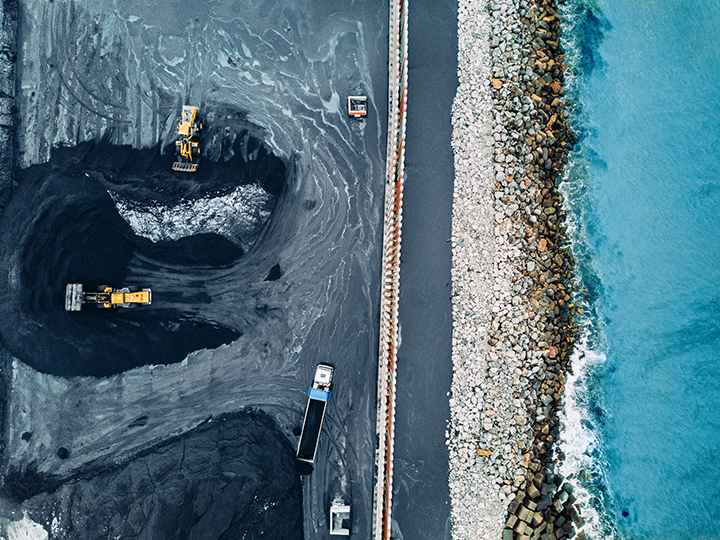
Five Ways to Promote Mitigation and Adaptation in the Mining Sector
In the face of the climate crisis, there is an urgent need for the mining sector to adapt to the impacts of climate change.
June 5, 2019
Climate change is altering where rain falls, how much of it falls, and when it falls, with consequent impacts on where many of us can live and work.
We’re battling more frequent and intense hurricanes and wildfires, while rising sea levels threaten the long-term viability of coastal communities. It’s affecting ecosystems, bleaching coral reefs, threatening fish populations, melting glaciers and displacing species.
Greenhouse gas emissions are the principle culprit, and the mining sector—as a significant user of energy resources—is a key industry contributor. In Australia, for example, the mining sector consumes 500 petajoules of energy per year, which amounts to approximately 10 per cent of the country’s total energy use. Most of this energy is supplied by diesel (41 per cent) and natural gas (33 per cent), and the total amount of energy used in Australia each year is growing with increasing mining volumes.
Mining companies may lack the technical capacities needed to adapt their operations in the face of a changing climate and to reduce their emissions.
Many companies are responding to the climate challenge by investing in efforts to reduce their greenhouse gas emissions, contributing to global efforts to mitigate climate change. Glencore’s Raglan nickel mine in Quebec and Rio Tinto’s Diavik diamond mine in Northwest Territories—both in Canada—have installed on-site wind turbines to offset some of their reliance on diesel. Newcrest’s Lihir gold mine in Papua New Guinea draws a significant portion of its energy from geothermal sources. IAMGOLD’s Rosebel gold mine in Suriname and B2Gold’s mine in Namibia have installed solar grids on site, which will be transferred to local communities to meet their energy needs once the mine closes. Goldcorp is pursuing full electrification at its Borden Lake deposit, and plans to make the mine Canada’s first all-electric operation, and the world’s first diesel-free hard rock mine. Much more needs to be done, but these are encouraging steps in the right direction.
In the face of the climate crisis, there is an equally urgent need for the mining sector to adapt to the impacts of climate change, for a number of reasons. The sector is a significant user of local water and energy resources, both of which will be impacted by a changing climate. Operations and supply chains are exposed to extreme weather events, including cyclones, flooding and drought. Employee health and safety could be threatened by rising temperatures. Sea levels and storm surges could challenge the viability of coastal and offshore mining. Investments in climate change adaptation in and around mine sites will help the mining sector manage the risks that climate change poses to operations and supply chains. Such investments can also help to build the adaptive capacities of communities adjacent to mine sites.
Generate and share climate change information: Governments can play a crucial role in generating and sharing information on climate change with private sector stakeholders to address knowledge gaps and promote best practices.
Develop supportive institutional arrangements: Governments can establish institutional arrangements that involve the private sector in national-level planning and action on climate change, including the country’s National Adaptation Planning (NAP) process and its Nationally Appropriate Mitigation Actions (NAMAs).
Build capacities: Mining companies may lack the technical capacities needed to adapt their operations in the face of a changing climate and to reduce their emissions. Governments can provide private sector actors with capacity building and training to better equip them to understand and act on climate change information.
Establish a supportive policy and regulatory framework: Governments should develop policies, laws and regulations that encourage and support investments in mitigation and adaptation within the mining sector, including through the permitting process.
Finance adaptation: Financial barriers can prevent mining companies from engaging in mitigation and adaptation processes. Governments can use financial incentives as motivation for the private sector to invest in new products or operational methods that lower their emissions or increase their climate resilience.
Governments have a crucial role to play in supporting the transition toward a low-carbon economy and increased climate resilience in the sector. They must ensure that enabling conditions are in place within their jurisdictions that allow and encourage mining and mineral exploration companies to invest in renewable energy and adaptation activities. Well-planned and implemented mitigation and adaptation actions from the mining sector, as well as from the private sector more broadly, will help countries achieve a number of their international commitments, including Sustainable Development Goals 7 and 13, the Nationally Determined Contributions agreed upon under the Paris Climate Agreement, and the Sendai Framework for Disaster Risk Reduction.
What is the Business Case for Private Investment in the NAP Process?
May 29, 2019
Businesses around the world—big and small, from large-scale banks to smallholder farmers—invest in climate change adaptation every day.
They may not label it as such, but as they respond to droughts, recover from floods, or plan ahead for the next cyclone season, many are strengthening their operation’s resilience to current and future climate change.
In order the make these investments, which include time, capacities and money, there must be a strong business case for doing so. Fishers, farmers, miners, bankers and others will weigh the costs and risks of the investment against its expected returns—returns that can include more certainty in their operations, a more secure supply chain or a new market opportunity.
While investment in adaptation may seem like good business practice, it is not always an easy argument to make.
While investment in adaptation may seem like good business practice, it is not always an easy argument to make: the risks associated with climate change may be unknown or misunderstood by investors; the cost of action may be high; returns on investments may be uncertain; adaptation options may be unclear; or indicators of success may be difficult to define. This is particularly the case for small business owners in developing countries; for them, resources are often already stretched, and investments in immediate day-to-day operations take precedence over concerns far down the road.
This will be a key challenge as developing country governments formulate and begin to implement their National Adaptation Plans (NAPs). Achieving the ambitious and necessary adaptation pathways and goals contained in the NAPs will not be possible without the participation of the private sector, among other actors. They are key engines of economic growth and will be relied on to create the jobs needed to support adaptation, to develop the products and services needed for societies to become more climate-resilient, and to finance— directly or indirectly—many adaptation actions.
To enable the strategic and well-informed engagement of the private sector in climate change adaptation activities—including as designers, implementers, financers or evaluators— governments will need to establish and communicate the business case for investing in adaptation. Doing so will help to incentivize much-needed support and investment for the NAP process.
Adapting to the impacts of climate change cannot be the responsibility of national governments alone.
So what is the business case for private sector actors—from multinational corporations to smallholder farmers—to invest in the NAP process?
For one, direct losses from natural disasters between 1998 and 2017 cost morethan USD 2.9 trillion—77 per cent of which were climate-related. In 2018 alone, natural disasters led to more than USD 225 billion in economic damages globally, according to a report from the National Oceanic and Atmospheric Administration. As climate change continues to increase the frequency and severity of extreme weather events, adaptation action will be necessary to maintain international business continuity and growth.
Moreover, at the most basic level, adapting to the impacts of climate change—whether at the national, subnational or community level—cannot be the responsibility of national governments alone. While public financing is crucial, particularly during the development phases of the NAP process, it will not be enough to address all adaptations needs.
The process of establishing a business case for adaptation investment often needs to be context- and company-specific. In this sense, threatening numbers about global catastrophe—however pertinent—may not be enough to effectively engage the private sector in a country’s NAP process.
Despite the aforementioned challenges, many companies have been able to establish this business case and have initiated support for and investments in adaptation, through the NAP process and otherwise. Private sector actors have done so for three key reasons.
To manage risks for business continuity and reputation.
Climate change can pose serious risks to the activities of businesses. Physical risks—including drought, floods and severe weather events—can damage relevant property and disrupt trade. As a result, some companies are investing in adaptation to climate-proof their supply chains, protect their operations and avoid future loss.
In Madagascar, for example, companies including Danone, Mars, Firmenich and Veolia are providing EUR 2 million to help local farmers—representing more than 6,000 hectares of vanilla production—use more sustainable farming practices. In doing so, these partners are helping to increase the adaptive capacity of smallholder farmers, while managing climate risks in the supply chains of their products.
To capitalize on new markets and business opportunities.
A 2015 survey by AXA Group and UN Environment found that 53 per cent of businesses in developed and emerging markets believed that climate change represented an opportunity for their businesses. Developing and distributing new goods and services that respond to local threats posed by climate change—climate-resilient seeds, for example, or equipment for early-warning systems—represents a key opportunity to simultaneously profit and help local populations adapt.
To comply with policies, regulations, and investors’ interests.
Finally, some financiers and enterprises are investing in adaptation in response to ongoing or upcoming policies, regulations or investor interests. EU-registered pension funds, for example, are now required to consider and disclose climate risks in their investment decisions. This disclosure requirement is pushing companies to make smarter investments in adaptation in order to reduce their exposure to climate risks.
***
Governments have to work with a range of partners—from civil society and private sector actors to bilateral and multilateral development agencies—as they embark on the NAP process. To engage with the private sector in particular, governments must understand and communicate the business case for investing in adaptation; doing so effectively will mean working with partners in the media, as well as business associations and chambers of commerce. This is a good starting point, but more will also need to be done; policy-makers and practitioners will have to put in place key enabling factors to encourage and facilitate private sector engagement in all phases of the NAP process.
Over the next month, the NAP Global Network will be taking a closer look into these key enabling factors. In our next blog, we will explore how effective and meaningful information-sharing can enable private sector engagement in the NAP process. We look forward to sharing it with you.
To engage with the private sector, governments must understand and communicate the business case for investing in adaptation.
This post is the first of our five-part blog series on engaging the private sector in national adaptation planning processes.
Our oceans and fish stocks—and the populations that depend on them—all suffer from the consequences of overfishing. We share a glimpse of the current WTO push to end harmful fisheries subsidies by 2020.
May 29, 2019
Our oceans and fish stocks—and the populations that depend on them—all suffer from the consequences of overfishing.
According to the Food and Agriculture Organization of the United Nations, 33 per cent of the world's assessed fish stocks are considered overexploited, while 60 per cent are exploited at their maximum sustainable level. Perhaps even more worrying, despite a growing global awareness of the problem, the trend is not improving. The share of overexploited stocks is steadily increasing: it has tripled since the 1970s.
The share of overexploited fish stocks has tripled since the 1970s.
In addition to serious environmental impacts, there are social, economic and even cultural costs to this alarming trend. Of course, many fisheries are also well-managed, but as we witness this general decline of the health of fish stocks, the time has come for concrete actions.
Fisheries subsidies are a major contributing factor. By artificially reducing the costs of fishing, capacity- and effort-enhancing fisheries subsidies allow vessels to take ever more fish on longer trips, ever further from land. Unfortunately, the amount of fish in the ocean does not extend in the same way. That is why the International Institute for Sustainable Development (IISD) has chosen to support the current World Trade Organization (WTO) negotiations to effectively discipline harmful fisheries subsidies, in support of Sustainable Development Goal target 14.6. Along with the Pew Charitable Trusts, IISD is delivering analysis and convening support to WTO members to help them reach their goal of an agreement on fisheries subsidies by December 2019.
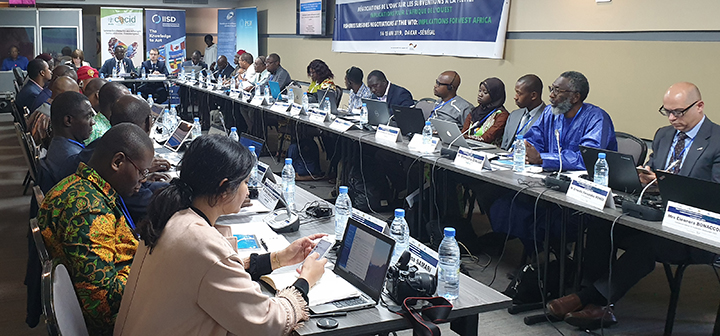
In parallel with activities in Geneva to support and inform the negotiating process more directly, a series of workshops have taken the conversation to the negotiators’ home regions. In a non-negotiating setting, we have brought together policy-makers, experts and stakeholders from academia, the fisheries sector and civil society for an in-depth discussion of WTO fisheries subsidies negotiations. Like the Caribbean and Latin American workshops, our recent session in Senegal on West African issues offered invaluable insights, illustrating the spectrum of concerns these negotiations raise for the region.
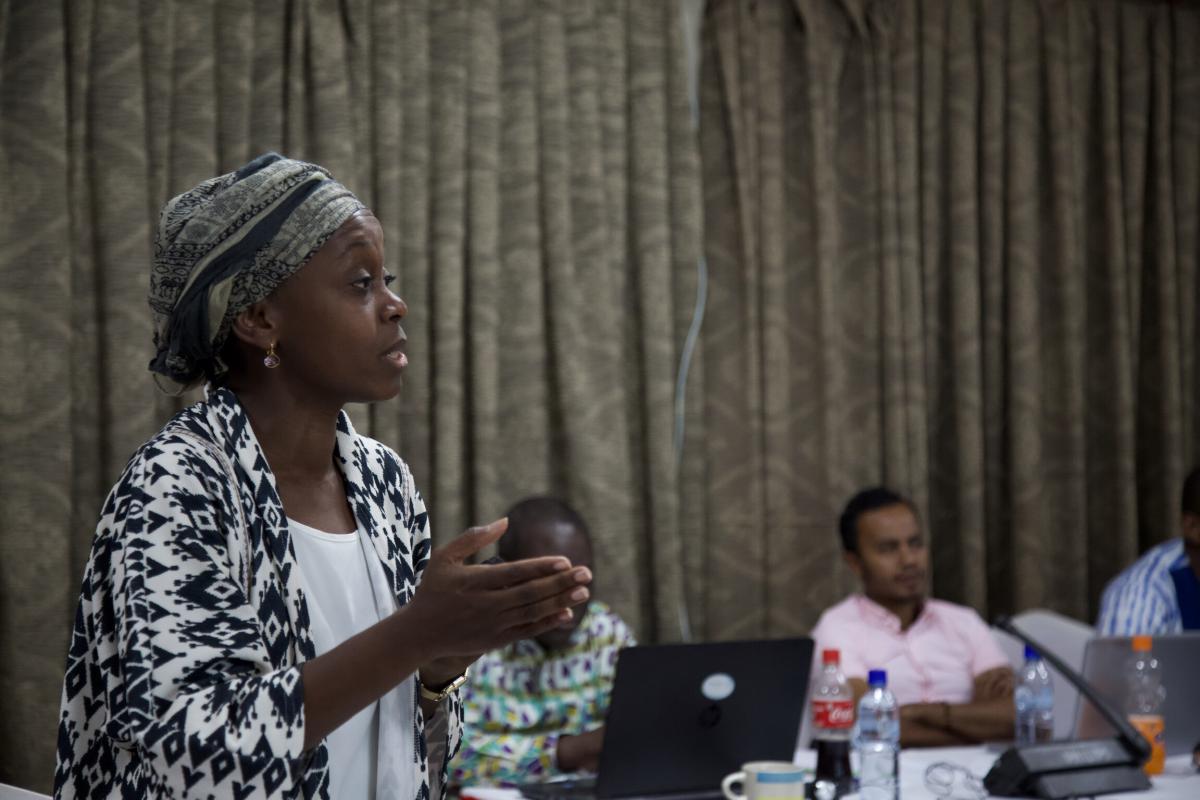
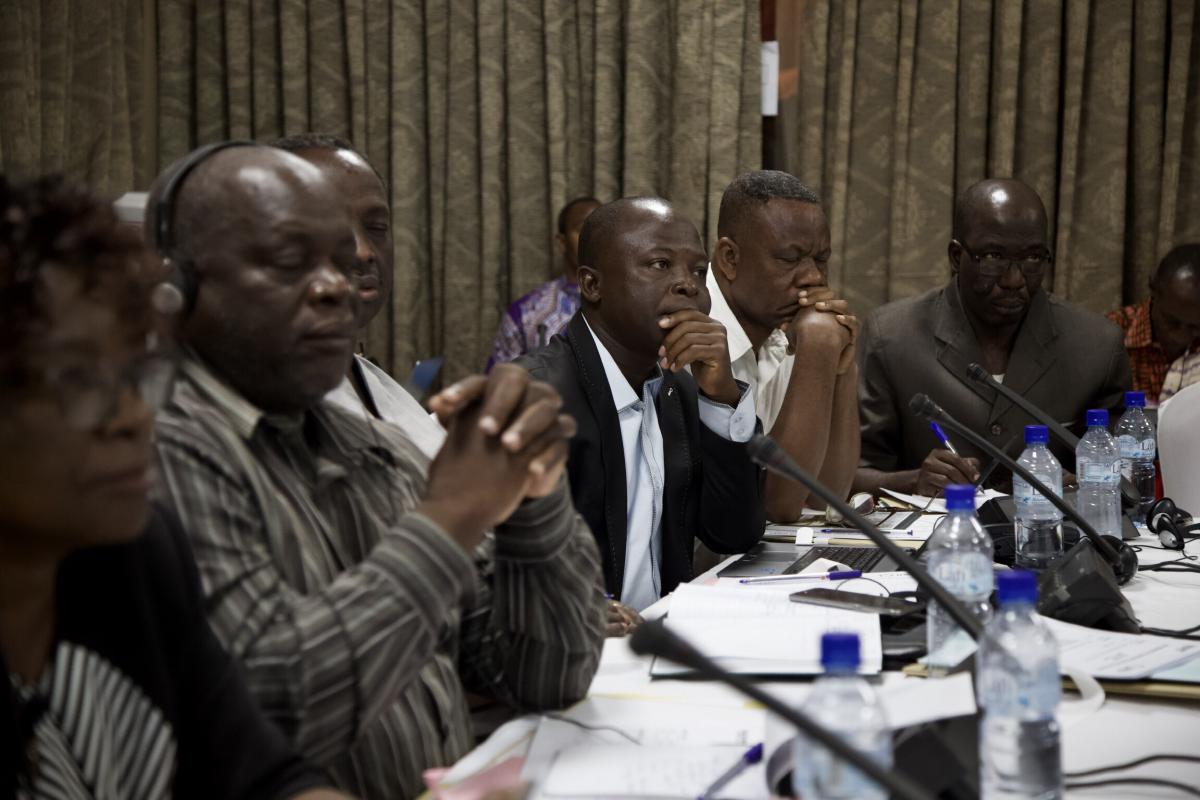
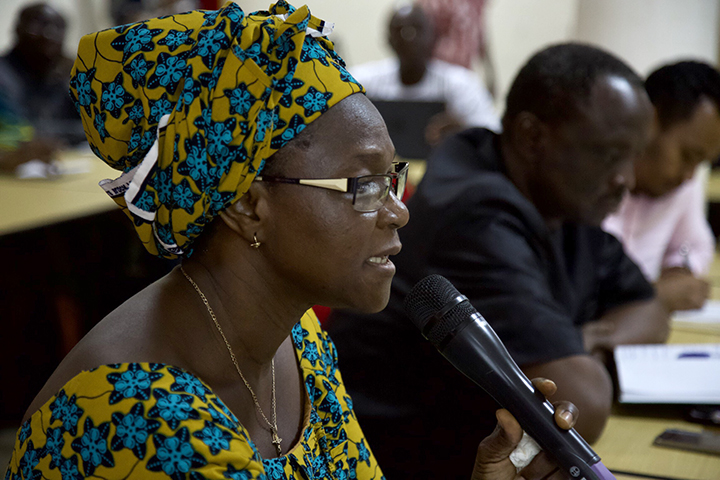
Policy makers, academics, and fisheries sector and civil society experts gathered in Dakar, Senegal for an in-depth discussion of WTO fisheries subsidies negotiations and their implications for West Africa.
Illegal, unreported and unregulated fishing, overfished stocks, as well as overfishing and overcapacity more broadly all pose real challenges in West Africa. The magnitude of fishing by foreign fleets in West African waters and the fundamental importance of artisanal fishing for people in the region (with a special nuance for women active in the processing sector) highlight both the relevance of WTO negotiations and the variety of issues at play. The event also offered stakeholders two new tools for considering subsidy reform: a draft case study commissioned by IISD on the Sardinella fishery off the coast of West Africa gave participants a real-world model of the possible impacts of new WTO rules, while an interactive toolkit developed by Pew let attendees consider the larger biological and economic implications of prohibitions being negotiated at the WTO.
Throughout the workshop, the message crystalized that something must change because the current situation is not tenable over the long term. The WTO negotiations are a real opportunity to not only rethink industrial and artisanal fisheries subsidies, but to take meaningful action that renews the health of our oceans and supports the livelihoods of the fishing communities and populations who depend on them.
One Step Forward, Two Steps Back: Fossil fuel subsidies and reform on the rise
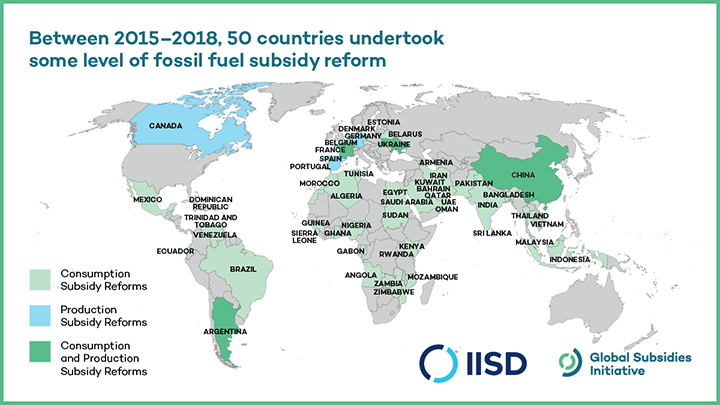
Between 2015 and 2018, 50 countries undertook some level of fossil fuel subsidy reform. That doesn't mean consumer subsidies are decreasing, however.
May 27, 2019
During the past decade, there has been widespread agreement about the benefits of reforming subsidies to fossil fuels, as endorsed by international commitments and discussions within international forums.
Encouragingly, between 2012 and 2016, fossil fuel subsidies (FFS) to consumers almost halved, from USD 504 billion to USD 260 billion. This reduction was due to a combination of reform efforts alongside a decrease in international prices for crude oil, which provided a window of opportunity for action and allowed governments to implement long-awaited reform plans.
In a review of reform efforts, the Global Subsidies Initiative (GSI) has mapped countries implementing some level of FFS reform between 2015 and 2018. The map traces policy changes that have contributed to declining fuel subsidies. Some fifty countries implemented some level of policy change, from fuel price changes and deregulation to energy tariff reforms. While this map is not an exhaustive picture of all subsidy policy change and does not cover all subsidies within a country, it does illustrate the broad engagement of countries, at a national level, in tackling the FFS issue.
Figure 1. Between 2015 and 2018, 50 countries undertook some level of fossil fuel subsidy reform. Source: GSI
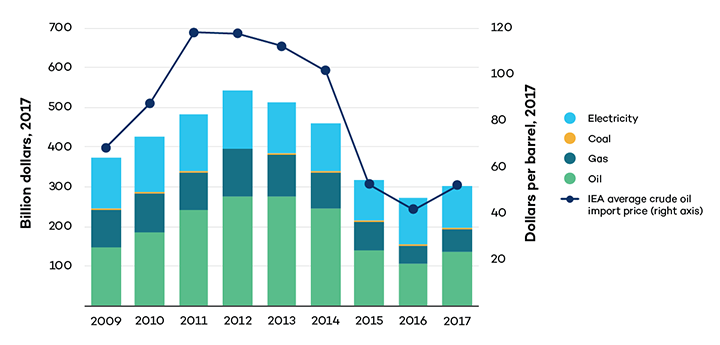
Despite these reforms, the International Energy Agency (IEA) found that consumer price support for subsidies increased slightly in 2017, reflecting pressure on previously implemented reforms due to the rise of oil prices in the international market (Figure 2). The IEA finds that consumer FFSs (price-gap methodology) increased from USD 270 billion in 2016 to USD 302 billion in 2017. The increase is linked to a change in the average oil price from USD 42 (2016) to USD 52 (2017) per barrel. However, the 12 per cent increase in consumption subsidies was considerably less than the 25 per cent increase in oil price; this indicates that there is still a level of ongoing reform that has taken place and is being maintained. In this context, governments will need strong encouragement and support to maintain existing, and introduce additional, energy sector reforms, enabling domestic prices to reflect changing international ones. Reforming FFSs and shifting to renewable energy and increased energy efficiency offers governments protection from the volatility of international oil prices.
Figure 2. Global fossil fuel consumption subsidies – IEA estimation. Source: IEA. (2018). World energy outlook 2018. Paris: IEA. Reprinted with permission.
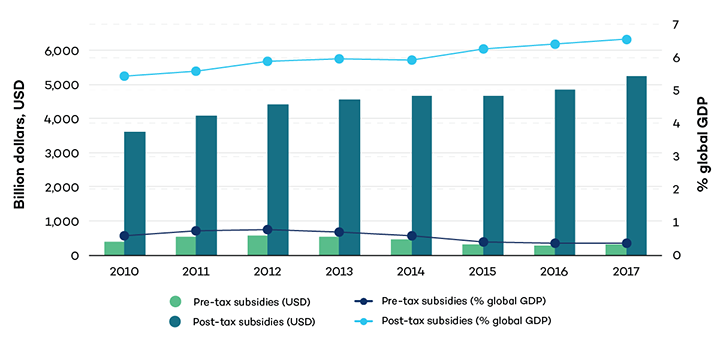
Moreover, the IMF recently released a working paper with updated global estimates of consumer price support for FFS estimates using pre-tax and post-tax subsidies approaches. The latter differs from the IEA method since it includes un-priced externalities arising from fossil fuel usage, such as GHG emissions and emissions of air pollutants, as well as social costs associated with driving (e.g. traffic congestion). According to the authors, these costs are 15–20 times larger than pre-tax subsidies, which stood at USD 296 billion in 2017. They reached USD 5.2 trillion in 2017, up from USD 4.7 trillion in 2015, illustrating starkly the far broader negative costs and impacts from fossil fuels on the environment and the economy as a whole. Furthermore, the research highlights that there has not been a sharp increase in the pricing of environmental costs at the global level, despite the 2015 Paris Agreement and implementation of reforms in several countries (see Figure 3).
Yet, even without including huge externalities, GSI estimates that the scale of subsidies to fossil fuels is still significant, at around USD 400 billion in 2017 (USD 300 billion per year for consumer subsidies and between USD 70 billion and 100 billion for producer subsidies which are consistently underreported).
Implementing and acknowledging the importance of both FFS reform and the correct pricing of fossil fuels are crucial, even more so when the world is made aware of the high costs that fossil fuels imply. When envisioning next steps, countries can look at successful reforms and pricing efforts from other countries around the globe, for example, from research and networks that allow for knowledge exchange and provide important lessons for governments pursuing FFS reform.
India, for instance, has been succeeding in many different aspects when phasing out FFSs. Between fiscal year (FY) 2014 and FY 2017, the country cut subsidies to oil and gas by 76 per cent, from USD 26.1 billion to USD 5.5 billion, thanks to various reform efforts combined with a decrease in international oil prices. During the same period, the government support to renewable energy grew almost six times—from INR 2,608 crore (USD 431 million) in FY 2014 to INR 15,040 crore (USD 2.2 billion) in FY 2017. Meanwhile, in 2015, liquefied petroleum gas subsidies begun to be redirected straight to the consumers’ bank accounts, putting in place the world’s largest benefit transfer scheme as a way to avoid diversion and eliminate duplicate connections and non-existent users. Moreover, the country has also implemented communication campaigns to assess consumers’ views, which is a key part of delivering successful reforms.
On the other hand, some countries have been struggling to maintain efforts to phase out FFSs for many different reasons. In 2015, Indonesia completed its reform of gasoline and diesel subsidies, saving up to USD 15.5 billion. However, the country has not implemented fuel price changes in a consistent and regular manner, with gaps between when prices are adjusted growing over time. Prices were last locked in 2019 in the leadup to recent presidential elections. More importantly, the island country has continued to invest in coal power plants, going against the current global trend to move toward cleaner sources of energy.
Whatever the case, the importance of FFS reform is clear and unanimous: FFSs are socially regressive, failing as a social welfare policy tool and potentially preventing government funding of more sophisticated social security nets, including investment in health and education. Furthermore, such subsidies lock us into a high-carbon future and their elimination could contribute to reducing carbon emissions, as stated in the Paris Agreement. Despite considerable efforts to reform FFSs, the absolute value of subsidies increased in 2017, both in subsidies captured within the economy and those yet unpriced, which brings massive broader costs to society (the externalities). It is therefore crucial that countries persist with efforts to phase out subsidies to fossil fuels and usher in more efficient social welfare and sustainable energy systems, and that they are supported strongly in their endeavours to do so by the international community.
What We Can Measure, We Can Manage: Methodology for global fossil fuel subsidy reporting launched
A new report provides the first internationally agreed upon methodology to help countries increase transparency on fossil fuel subsidies.
May 27, 2019
On the verge of climate catastrophe, we are still investing in unsustainable energy resources that distort our markets, speed up global warming and cause us to breathe contaminated air.
“Stop subsidizing fossil fuels,” urged UN Secretary General António Guterres during his recent trip to New Zealand. He went on further to assert: “Taxpayer money should not be used to boost hurricanes, spread droughts and (fuel) heat waves.”
Experts underline that policy change in the area of fossil fuel subsidies is an essential condition within a sustainable future. A new UN Environment report, drafted in close collaboration with the International Institute for Sustainable Development’s (IISD) Global Subsidies Initiative and the Organisation for Economic Co-operation and Development (OECD), provides the first internationally agreed-upon methodology that will help UN countries increase transparency on fossil fuel subsidies.
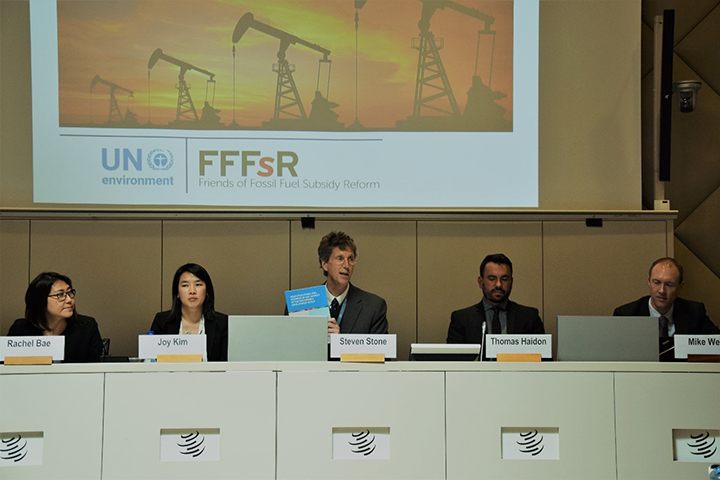
“A methodology is crucial to help drive through the reform of fossil fuel subsidies,” stated Thomas Haidon, opening the report launch event on May 14. Organized by the Friends of Fossil Fuel Subsidy Reform, the event at the World Trade Organization in Geneva was widely attended by UN country delegates and the expert community. The report findings were presented by UN Environment representatives Steven Stone, Chief of Resources & Markets Branch, and Joy A. Kim, Senior Economic Affairs Officer, along with Rachel Bae, Senior Counsellor in the OECD Trade and Agriculture Directorate.
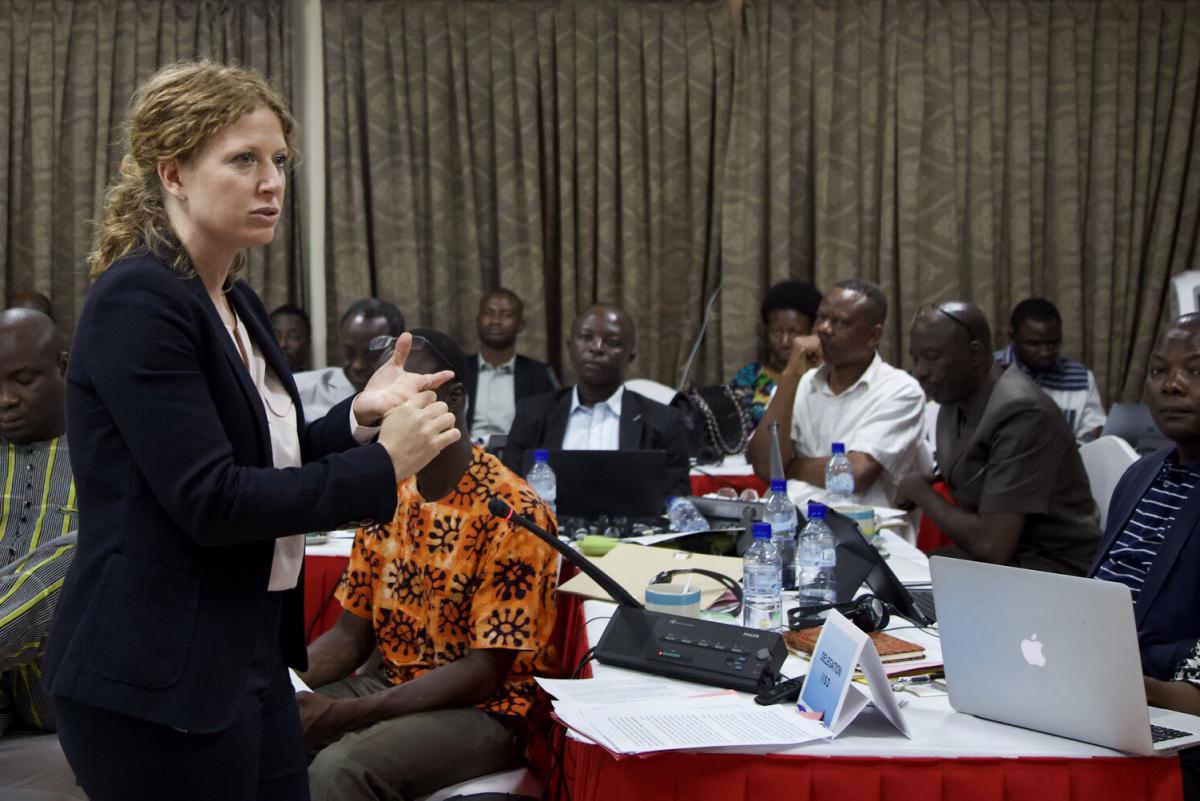
Measuring Fossil Fuel Subsidies in the Context of the Sustainable Development Goals report launch.
“The lights are blinking on the dashboard of the car,” warned Steven Stone, alluding to climate change and the related impacts of fossil fuels. “There’s been 16 of the 17 hottest years on record since 2001; carbon concentrations in the environment have not been as high as they are now for 8 million years and 90 per cent of the air we breathe is unfit for human consumption. How can we continue to subsidize something bad for our health?” he alerted. “Fossil fuel subsidies are environmentally harmful, socially inequitable and inefficient,” continued Rachel Bae.
Transition toward clean energy is crucial to achieving the goals of the UN 2030 Agenda on Sustainable Development. The importance of measuring fossil fuel subsidies has been recognized in the Sustainable Development Goal (SDG) process with a dedicated indicator [12.c.1 – “Amount of fossil fuel subsidies per unit of GDP (production and consumption)”]. However, until this report, there was no agreed methodology to report on fossil fuels subsidies, and consequently their reform has been held back by a lack of consistent and comprehensive data.
The new methodology is the first agreed upon globally. It has been developed by three expert organizations with three case studies from Egypt, India and Zambia with reference to 30 technical experts.
The first step to providing a consistent approach was establishing definitions that would enable a common understanding of fossil fuel subsidies. The price-gap approach, which compares domestic energy prices to the international market, though very effective, was considered too narrow as it reflects only subsidies to consumers. The main discussion among the experts concerned how to include producer subsidies; while they may not affect the price of the product immediately, they incentivize extra exploration and production.
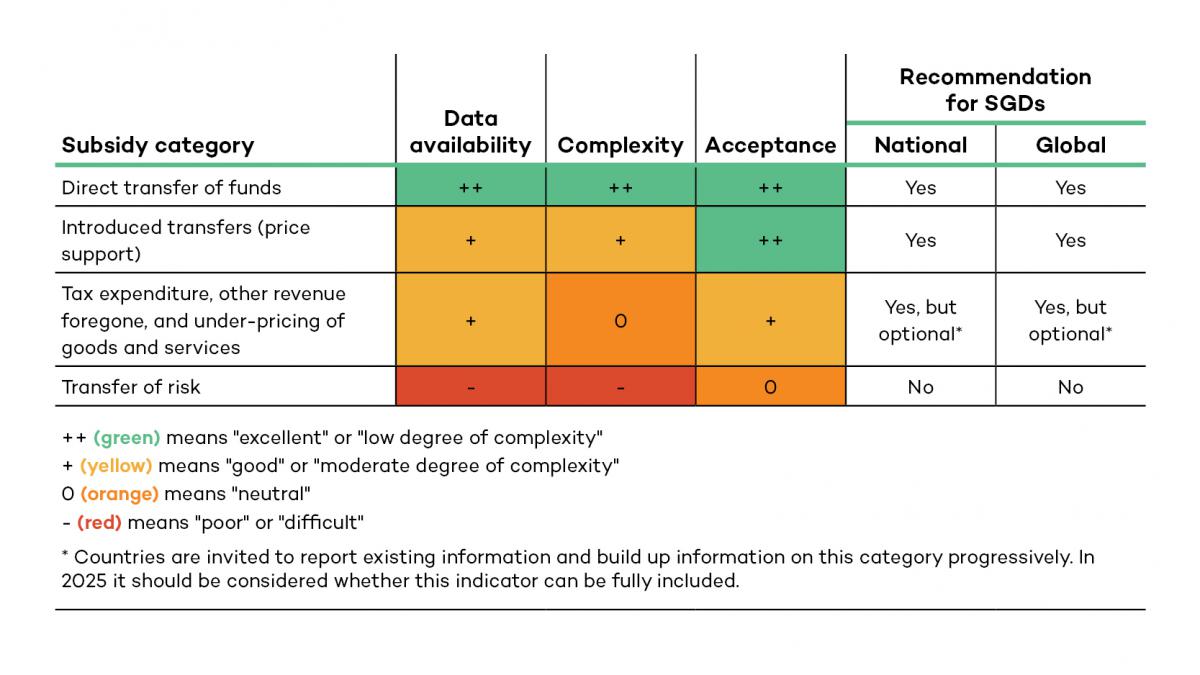
The proposed methodology includes all fossil fuel subsidies and splits them into four categories:
Direct transfer of funds – payments made by governments to individual recipients
Induced transfers – energy prices regulated by government
Tax expenditure, other revenue foregone, and under-pricing of goods and services – for example, tax reductions, allowances, rebates or credits
Risk transfers – direct involvement of a government in the fossil fuel industry, by taking on risks on behalf of parts of the industry
The categories listed above were examined against data availability, their complexity and their acceptance. The methodology asks countries to identify, measure and report against three of the aforementioned categories: direct transfers, induced transfers and tax expenditures. For the first category, the methodology argues for a phased approach, moving gradually from global to national datasets. Recognizing the complexity and data availability issues around the third category in many countries, the methodology recommends that countries report against it progressively. The fourth category—transfer of risks to a government—presents serious issues on data availability and complexity. The methodology therefore concludes that reporting against this should be optional.
Source: Measuring Fossil Fuel Subsidies in the context of the sustainable development goals, (UNEP 2019)
In common with all SDG indicators, UN members are asked to report annually, from next year (2020) to 2030. Many organizations are available to help countries complete the vital task of identifying, measuring and reporting their fossil fuel subsidies. Sharing experiences between countries, potentially at a regional level, appears valuable.
“We have seen that shining the light on the scale of fossil fuel subsidies leads to informed and constructive debate, encouraging reform of inefficient fossil fuel subsidies,” comments Laura Merrill, IISD’s Global Subsidies Initiative Manager and Senior Policy Advisor. “This new, globally agreed methodology will allow all countries to examine the subsidies they give to consumers and producers of fossil fuels and to reform those that are acting against sustainable development. A comprehensive international database will make a huge contribution to subsidy phase-out and, hence, to a safer climate,” she concludes.
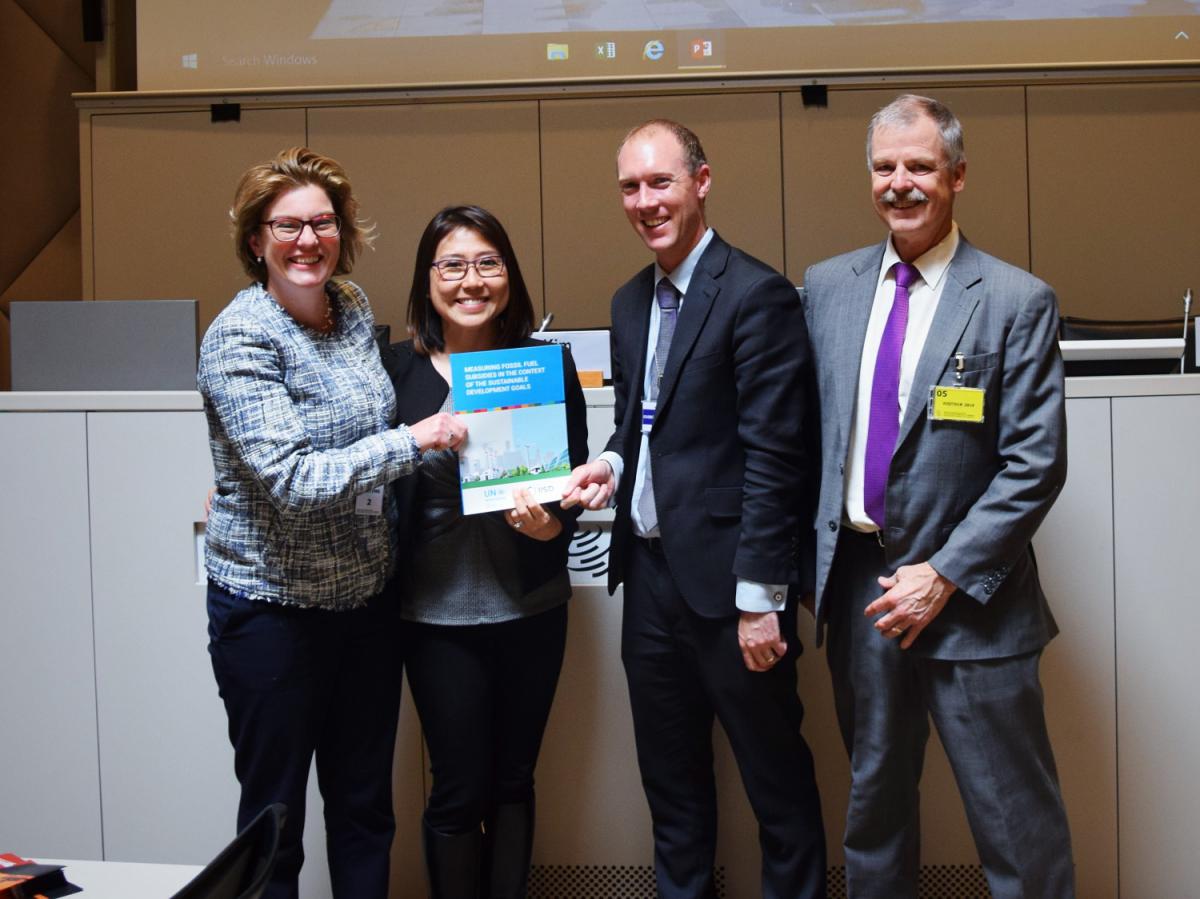
Measuring Fossil Fuel Subsidies in the Context of the Sustainable Development Goals, report launch event.
Laura Merrill (GSI), Rachel Bae (OECD), Michael Webb, (New Zealand), Ron Steenblik (GSI).
The Measuring Fossil Fuel Subsidies in the Context of the Sustainable Development Goals report has been prepared by the United Nations Environment Programme (UN Environment) in close collaboration with the International Institute for Sustainable Development’s (IISD) Global Subsidies Initiative (GSI) and experts from the Organisation for Economic Co-operation and Development (OECD). The process also involved the establishment and convening of an international expert group that provided advice on the methodology and on the operationalization of the methodology.
How Can Technology in Mining Protect the Environment?
Rapid advances in technology innovation, including automation, digitization and electrification, are fundamentally changing how the mining sector operates.
May 23, 2019
Rapid advances in technology innovation, including automation, digitization and electrification, are fundamentally changing how the mining sector operates.
These new technologies reshaping the sector include autonomous vehicles, remote operating centres, automated drilling and tunnel-boring systems, machine learning and more.
In mining, green technology refers to technology that will reduce carbon emissions in operations and mitigate adverse environmental impacts.
How can these new technologies help the mining sector become more environmentally sustainable? This was the focus of our event, New Technologies: The future of mining in the Americas. Marina Ruete, IGF’s coordinator for the Latin America and Caribbean region, explains more below.
What is green technology?
Green technology refers to technology that limits or reverses the effects of human activity on the planet.
In mining, green technology refers to technology that will reduce carbon emissions in operations and mitigate adverse environmental impacts. It includes the use of minerals and metals that support a transition to low-carbon technologies such as solar panels or wind power.
How does technology impact mining operations?
Technology can have a number of impacts on mining operations, including safety and productivity, environmental protection and opportunities for women.
Safer working conditions through improved underground communication, automation, more sophisticated mineral and metal transportation, and emergency response measures are achieved by integrating technology into mining projects.
Technology in mining also helps eliminate the excuse of this sector being too dangerous for women.
Innovation also supports environmental conservation. Through improved waste management efforts, tailings are being processed more efficiently. The mining sector will also play an important role in the circular economy. Using renewables such as solar energy to power vehicles will also ensure a more sustainable mining sector.
Adoption of new technology in mining could help address the sector's struggles with lack of diversity.
Technology in mining also helps eliminate the excuse of this sector being too dangerous for women, since more jobs will be operated at a distance from the rock face. We hope to see employment gender gaps reduced thanks to technology.
What should mining companies keep in mind when adopting new tech?
The mining sector should carefully consider new trends in traceability and collaboration when adopting innovative technologies.
Mining companies are under a magnifying glass. Consumers are demanding sustainability, not only from manufacturers but along the entire supply chain, from the moment the mineral or metal is found to when it appears in the products they are purchasing.
Inclusive work with different sectors and actors within those sectors is key to implementing technology in mining responsibly.
Collaborating with other sectors, such as universities, governments and civil society, is also important. Companies are realizing that universities can bring valuable research and insight, government can provide incentives, suppliers can provide innovative offers, and buyers can explain their needs.
Countries such as Chile are using the cluster method of grouping multi-sectoral organizations together—such as a university, mining company and government department—to achieve the benefits of technology. Inclusive work with different actors within those sectors is key to implementing technology in mining responsibly.
Mining companies also need to consider the social impacts of new technologies—particularly those, like automation, that replace low- and medium-skilled workers. Typically filled by locals, those jobs are an important part of the social license to operate. The mine of the future will probably have fewer total jobs, and the new jobs created will probably be less beneficial for communities impacted by mining activity. IGF is working on these issues with its New Tech, New Deal project.
How can developing countries improve environmental sustainability through tech in mining?
Developing countries often receive foreign direct investment for large-scale mining operations. This foreign investment is arriving with more technology to increase productivity during the mining concession period. Governments need to remain up to date in the latest innovations and changes brought to their jurisdictions to ensure that increased productivity comes with balanced with economic and social benefits over the life of the mine.
On a positive note, governments will be able to ensure high environmental standards within mining operations by incentivizing certain technology. This can include giving targeted tax incentives to mining companies, creating research and education opportunities for their local workforce on the technology, and facilitating the achievement of local intellectual
How Could China’s New Foreign Investment Law Impact Trade Debate?
Negotiators from the United States and China have met repeatedly in recent weeks to reach an agreement to resolve some of the trade irritants between them, including the high-profile issue of forced technology transfers.
April 30, 2019
Negotiators from the United States and China have met repeatedly in recent weeks to reach an agreement to resolve some of the trade irritants between them, including the high-profile issue of forced technology transfers.
As these talks press toward a conclusion, questions remain over how a new Chinese foreign investment law with explicit provisions barring mandatory technology transfers may affect the bilateral economic relationship, as well as how they may factor into a broader debate on potentially developing new international trade rules in this area.
Forced technology transfer—or the requirement to share or surrender technology to gain access to a market—has been a key sticking point in U.S.–China relations.
The new investment legislation in question was approved by Chinese lawmakers this past March and will govern how foreign investment is conducted in mainland China. The law would take effect from 2020 onward and includes among its 42 articles a prohibition on the forced transfer of technologies through administrative measures.
Technology transfer has traditionally been used by many countries, including China, as a performance requirement imposed on foreign investors to foster the competitiveness of local enterprises. However, there have been growing efforts in recent years by some developed economies to prohibit this practice, as witnessed in some of the recently concluded international investment treaties and trade agreements with investment chapters.
In the past, Chinese governments at both central and local levels allowed, and in some instances encouraged, foreign investors to make in-kind capital contributions in the form of technology licensing or transfer. Beijing has long held that this does not constitute a formal requirement for foreign businesses to transfer technology in exchange for being able to operate in China, though the United States, the European Union (EU) and private sector actors have argued that these practices have that effect.
Looking back: The Section 301 probe and trade disputes on tech transfers
The process to finalize the new Chinese legislation advanced quickly in the early months of 2019, which observers credit partly to the current tenor of the trade conversation between China and various key partners, particularly the United States.
The subject of forced technology transfers has been one of the primary issues fuelling the high-profile U.S.–China trade row over the past two years, given that Washington considers these types of requirements to be a way of creating market barriers for U.S. companies looking to do business abroad.
As a result, the United States launched a Section 301 investigation in August 2017 into “whether China’s acts, policies, and practices related to technology transfer, intellectual property, and innovation are unreasonable, unjustifiable, or discriminatory and burden or restrict U.S. commerce.” Section 301 refers to a provision in the U.S. Trade Act of 1974 that sets out the terms under which the U.S. Executive Branch can conduct investigations into allegedly unfair trade practices and what actions it can take in response.
Following the investigation, the Trump Administration endorsed a series of proposed Section 301 actions in March 2018, including the first round of tariffs on products from certain Chinese sectors, initially focusing on aerospace, information and communication technology, and machinery. It also foresaw the possibility of ratcheting up these tariffs if the issues raised were not adequately addressed.
Concurrently, the Office of the U.S. Trade Representative filed a request for consultations at the World Trade Organization (WTO) on one specific aspect of the Section 301 investigation’s findings, specifically on allegedly discriminatory technology licensing practices that Washington says violates certain articles of the WTO’s intellectual property rules. In January 2019, that dispute advanced to the panel stage.
The EU submitted its own WTO consultations request on China’s laws and regulations on the transfer of foreign technologies in June 2018; it has since revised its consultations request in a series of areas. That process is still at the consultations phase.
Prior to filing the consultations request, the EU repeatedly raised its own concerns over the issue of forced technology transfers, including in a 2018 Commission Staff Working Document on intellectual property rights protections and enforcement. At the time, the EU said “stakeholders report that many Chinese procurement proceedings require technology transfers or know-how disclosure from foreign companies,” though those concerns were not limited to China.
The provision on banning forced technology transfers in the new investment law may be a concession from China to address such concerns, though it is not yet clear how the new law will eliminate or affect existing practices. The Chinese government is slated to release rules on the new law’s implementation later this year, which may provide some clarity on the subject.
Continuing China–U.S. trade tensions have wide-ranging impacts on global trade and investor confidence.
As U.S.–China tensions have escalated over the technology transfer issue and other trade irritants, such as industrial overcapacity, the two countries have each spent the past year imposing hefty tariffs on the vast bulk of goods traded between them. The situation has fuelled concerns within their countries and among their trading partners that the continued use of these trade restrictions will significantly hamper global trade and economic growth, along with increasing costs for U.S. and Chinese consumers and harm to domestic producers in both countries.
As fears over the health of the global economy persist, the new Chinese foreign investment law could also have implications for high-level debates on systemic reforms to international trade rules. Those discussions have continued in various country configurations over the past 18 months.
For example, the subject of whether and how to negotiate new rules to address forced technology transfers is part of the agenda of the U.S.–EU–Japan “trilateral” process, amid a wider discussion on industrial subsidies, state-owned enterprises, and WTO notifications and the functioning of the organization’s regular bodies.
Those trade ministers are conducting their work on forced technology transfers on the basis of a joint statement adopted in May 2018, where they examined “the need to establish and share best practices, coordinating where useful, on mechanisms to stop” such practices by governments. They also announced plans to collaborate with “like-minded partners” on the subject, with the goal of finding “effective means to stop harmful forced technology transfer policies and practices, including, where appropriate, dispute settlement proceedings at the WTO.”
Subsequent statements have referred to rulemaking in this area, as well as enforcement. The next minister-level trilateral meeting is planned for this spring, according to the Office of the U.S. Trade Representative.
Separately, leaders from the EU and China discussed the subject of forced technology transfers at their summit in Brussels, Belgium, in early April. Notably, their joint statement included shared language stating: “both sides agree that there should not be forced transfer of technology.” They also referred to the wider discussions being held by vice ministers within an EU–China Joint Working Group on WTO reform, established in July 2018. What impacts these discussions among the major players may have on the situation of developing countries desperately in need of technology transfer remains unclear at this time.
A new map of sustainable finance players in Geneva could be a vital tool to scaling up funding for the Sustainable Development Goals.
April 29, 2019
One of the greatest challenges to achieving the Sustainable Development Goals (SDGs) is paying for them.
Mobilizing the estimated USD 5 trillion to 7 trillion per year needed to achieve the 17 comprehensive goals requires more than a concentration of government funding or an increase in corporate generosity. Sustained investment on this scale requires a system shift in the fiscal policies, private incentives, aid mechanisms and trade networks that underpin almost every aspect of human life.
It requires aligning the work of every organization exploring sustainable finance… no matter how different those organizations may be.
I live in Geneva—one of the world’s recognized financial hubs. The city is known for having two distinct “sides of the lake.” There’s the right bank, made up primarily of international Geneva actors, such as United Nations entities and non-governmental organizations (NGOs), who work on sustainable development, humanitarian responses and human rights. The left bank is the home of private sector players in finance, biotech and luxury goods, among others.
Organizations can speak different languages—figuratively and literally—when it comes to sustainable finance in Geneva.
My work at the Geneva 2030 Ecosystem is to build collaboration between those sides. The network enhances connections between Geneva-based financial actors, government representatives, NGOs and community leaders, mobilizing their skills and expertise in service of the SDGs.
Choosing “ecosystem” as our title was deliberate. In a biological ecosystem, interactions between organisms matter just as much as the individual entities themselves. It is not enough for a single species to thrive—the entire complex system must be interconnected and well linked to function as effectively as possible. Likewise, in Geneva, the relationships between organizations must be healthy for community members and the wider world to progress.
This is a fundamental principle of the 2030 Agenda, which paints an integrated, systemic picture of sustainable development and reinforces the notion that people, prosperity, peace, partnerships and the planet are intrinsically linked.
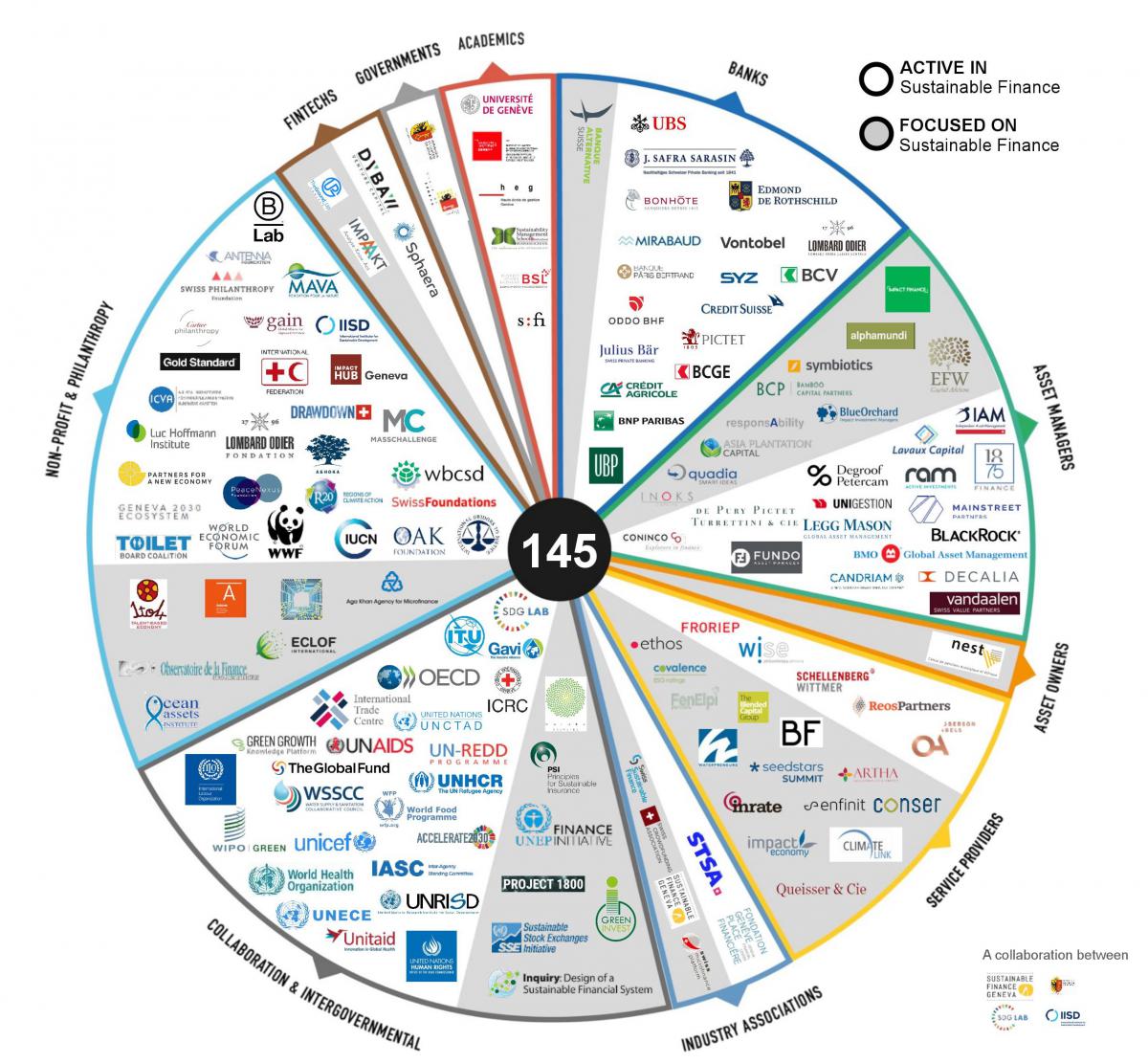
Recently, IISD and its partners Sustainable Finance Geneva, the SDG Lab and the Canton de Genève launched an interactive mapping to better understand the organizations working on sustainable finance in and around Geneva. This is the vital first product in a broader collaboration around sustainable finance.
The Geneva 2030 Ecosystem map identifies 145 organizations working on sustainable finance in some way.
This comprehensive map identifies 145 organizations on both sides of the lake working on sustainable finance in some way. These organizations span all major sectors, from private sector players (banks, asset managers, etc.) to academic institutions, international organizations, collaborations and industry associations. Even the local government, the Canton of Geneva, launched a green bond! The organizations listed on the map also have unique and varied approaches. Sustainability is core business for some organizations; for others, it is a growing business segment they are starting to understand and develop products/projects around.
The map also defines the roles and activities the entities play. Some directly offer financial products and services, but there is also a range of intermediaries, capacity builders, and service providers that support the overall system to make this “ecosystem” work.
Developing this map has been a long process. It started with interviews and research before sharing several versions with the partners to make sure categorizations were appropriate and resonated with the private financial community as well as the international community. The Canton de Genève then converted the data into an interactive portal using Esri’s ArcGIS technology.
Now we’ve opened a public consultation to ask the ecosystem directly if we have gotten it right.
Why put all this effort into a map? Strengthening an ecosystem starts with a comprehensive understanding of who is doing what. This is how potential synergies can be identified and innovative financial vehicles built. The two sides of Lake Geneva speak different languages (literally and figuratively in some cases) and are driven by different incentives and priorities. This map helps make sense of those differences and the vast amount of activity underway. Most importantly, it provides a road map for identifying and reaching out to potential collaborators.
Closing the funding gap for the SDGs will only be possible if we are able to innovate and find new ways of driving capital to sustainable development. It’s a big challenge, but it has a huge potential reward: opening the doors to the fairest, most prosperous future humanity has ever articulated.
American artist Mark Jenkins said, “Maps encourage boldness.” With our new map in hand, the Geneva 2030 Ecosystem partners agree.
Further reading
Blog: Davos, Sustainable Development and an Open Mind
Blog: Cleaning up Toxic Soils in China: A trillion-dollar question
Report: Leveraging Sustainable Finance Leadership in Canada: Opportunities to align financial policies to support clean growth and a sustainable Canadian economy
Notre voyage prend fin et nous avons voulu recueillir les impressions et les leçons apprises par un de nos compagnons de voyage, Nicolas Kobiane, Secrétaire général de Bagrépôle. Selon lui les deux étapes de la mission au Burkina Faso et en Tanzanie étaient nécessaires pour mieux comprendre la complexité des approches des agropoles et des couloirs agricoles.
« Il est essentiel que ce type d’initiative repose sur un engagement politique. Celui-ci doit être permanent et soutenir tout le processus, » dit dit-il. « Les deux initiatives sont des expériences en cours de développement qui doivent être analysées sur le long terme. Et bien que différents, il existe plusieurs similarités entre la SAGCOT et Bagrépôle en ce qui concerne leurs objectifs et leurs enjeux. Il nous faut en tenir compte et bien les maîtriser pour permettre un investissement réussi. »
Les deux approches visent la croissance agricole, la réduction de la pauvreté et l'ouverture des zones enclavées en s’appuyant sur les politiques agricoles qui reposent sur des investissements dans l'industrie agroalimentaire et le développement des infrastructures, nous fait-il remarquer. Selon M. Kobiane, les agropoles, tout comme les couloirs agricoles sont conçus pour être une réponse viable et pérenne aux problèmes structurels. Ils visent à faire de l’agriculture un moteur de la stimulation de l’économie rurale.
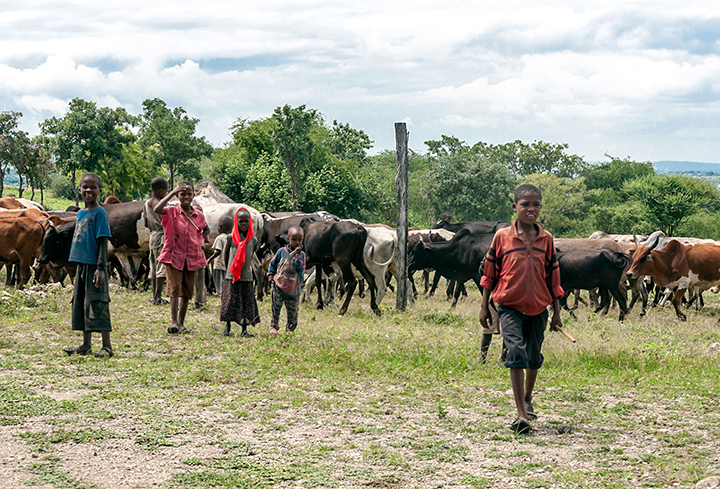
Un troupeau de bovins est amené pour la nuit près de Mto wa Mbu, en Tanzanie. L'utilisation des terres est une question clé dans les agropoles.
M. Kobiane reconnait les grands défis liés à ce type de projet dont notamment les déplacements des populations, les conflits sociaux et la sauvegarde de l’environnement. Pour lui, la régularisation foncière consiste à réussir une allocation des terres qui puisse intégrer les petits et grands producteurs aux projets d'agropoles et promouvoir une agrégation agricole.
« Les terres représentent un capital essentiel de l’agropole, » nous fait-il remarquer. « Il ne faut pas négliger l’importance des mécanismes de compensation des personnes affectés par le projet ainsi que l’adhésion des bénéficiaires au projet. À Bagrépôle, en plus des indemnisations pour la perte de récoltes et de la compensation "terre contre terres," nous avons prévu des mesures d’accompagnement pour faciliter la mise en valeur économique des terres allouées aux personnes affectées par le projet sur le périmètre irrigué. »
Ces deux expériences que sont Bagrépôle et la SAGCOT reposent sur des projets d’aménagement du territoire, note M. Kobiane. « L’identification de la zone et le respect du plan national d’aménagement directeurs sont des éléments d’attention pour valoriser les potentialités de ces approches. » De plus, « le défi est d'avoir une entité qui assure aussi bien le rôle d’animation que de coordination entre des acteurs et qui facilite des liens entre les entreprises. Le mandat de ces entités, tout comme leur ancrage institutionnel doivent être cohérents aux vues des objectifs poursuivis. »
Les investisseurs privés restent prudents face au renforcement des capacités financières des projets d’infrastructure destinés à soutenir l’expansion agricole.
« L' investissement public structurant est l’épine dorsale de la réussite des agropoles, mais le problème c’est le financement : ces initiatives sont couteuses et nécessitent des moyens importants. Il faut des stratégies de financement telles que les partenariats publiques-privés. » La mise en place des infrastructures, c’est-à-dire l’énergie, les routes, les aménagements hydroagricoles, barrages, et même la question sécuritaire contribuent, selon lui, à l’établissement d’un climat propice des affaires afin de mieux mobiliser le secteur privé.
Il est attendu des investisseurs privés qu’ils transforment ces opportunités en entreprises dynamiques et rentables, créatrices de richesses et d’emplois durables. Les pays ont procédé à des réformes portant sur des mesures incitatives spéciales, dont un régime fiscal et douanier favorable ou un guichet unique pour faciliter l’accomplissement de toutes les procédures d’exercices des activités économiques. Ce sont tous des instruments pour attirer un secteur privé qui reste cependant bien timoré.
Jour dix : Tournesol et haricots verts : femmes, faites le pari sur l’avenir !
Anjelina Kitime est veuve. Elle vit à Iringa dans le village de Mgama. A la mort de son époux, elle s’est retrouvée seule à élever leurs enfants. Pour subvenir à leurs besoins elle dépend de la parcelle de 2 hectares héritée de son mari. Jusqu’à son acceptation au programme de l’Initiative Clinton pour le développement, il y a dix mois, elle dédiait la totalité de sa parcelle à la production de tomates, maïs et pommes de terres dont une partie servait à la consommation du ménage et comme donations pour les frais de scolarité de ses enfants. L’autre partie était revendue au marché. Aujourd’hui, 80% de son champ accueille une nouvelle production : le tournesol. Anjelina est enthousiaste : « Les semences sont moins chers que les autres produits que je peux planter ici. Et vous voyez, comme mes plantes sont belles et grandes. La fondation m’a montré comment préparer le sol et planter des semences plus robustes et utiliser les engrais au bon moment ».
« La fondation m’a montré comment préparer le sol et planter des semences plus robustes et utiliser les engrais au bon moment » - Anjelina Kitime
Anjelina, comme les six femmes, membres de la banque de la communauté villageoise (Village Community Bank) de Kitowo que nous avons rencontrées, ne connaissent pas le Centre SAGCOT et encore moins son rôle. Elles ont été sélectionnées par l’Initiative Clinton suivant des critères tels que « avoir quelques notions en lecture, mathématiques, et technologie, être en possession d’un certificat de propriété du terrain sur lequel il ou elle exerce son activité…», nous explique Monsiapile Kajimbwa, le directeur agribusiness au niveau pays de la Fondation.
Clinton Development Initiative est l’un des intervenants dans la région de la SAGCOT qui promeut des investissements dans la chaîne de valeur socialement inclusifs et écologiquement durables. L’organisation a développé un programme qui vise l'autonomisation économique des petits exploitants agricoles à Iringa par une approche dite de l'agro-industrie communautaire. Celle-ci permet à la communauté de gérer son propre approvisionnement en semences, de la commercialiser et de gérer son accès au financement.
Les femmes nous disent avoir été convaincues par l’Initiative de planter des haricots secs et reconnaissent le mérite aux personnels de l’Initiative de les avoir formées, donner des semences et des engrais à des conditions préférentielles pour l’introduction de cette nouvelle culture. « Je suis au champ de 6 heures à 14 heures tous les jours », nous dit l’une d’entre elles. « Augmenter les rendements c'est assez simple, surtout avec les bonnes techniques que l’on nous a transmises », ajoute une autre. Les haricots secs sont une nouvelles variétés que la fondation promeut. Toutefois, l'une des principales tâches des agents de l’initiative sur le terrain consiste à les persuader qu'elles seront rémunérées, et qu’il existe bien un marché pour les nouveaux produits. Mais une inquiétude demeure cependant quand une d’entre elles dit « mais où sont les clients ? Où et à qui allons-nous vendre ces haricots ? ».
« Augmenter les rendements c'est assez simple, surtout avec les bonnes techniques que l’on nous a transmises. »
Il a été donné aux femmes une « liste » de potentiels acheteurs et les femmes semblent ne pas savoir ou se trouve le centre de collecte dont les agents de l’initiative nous parlent. « Elles trouveront à vendre les produits, le marché est là, il existe bien » confirme Thobias Mville, gestionnaire du développement agricole à la Fondation. Cependant les femmes n’ont pas encore rencontré d’acheteurs et aucune promesse n’a encore été faite aux paysannes sur les quantités qui leur seront achetées et à quel prix.
Nous apprenons du personnel du centre de la SAGCOT et du représentant du Bureau du Président à l’autorité locale qu’aucun système n’a été créé pour limiter les risques pris par les petits producteurs. Ils assument eux-mêmes les risques de cette transformation voulu par le pays. Ils n’existent en effet pas de système d’assurance sur les produits agricoles, nous dit-on et encore moins d’aides ou de système de protection pour les petits paysans.
L’actif de Anjelina est son terrain. Que fera-t-elle en cas de mauvaises ventes, de mauvaises récoltes ? Il est fort probable que les plus vulnérables seront tenté de vendre leur source de revenu.
Aujourd’hui, nous avons rencontré un entrepreneur inspirant qui incarne la transformation agricole, un aspect du développement économique qui consiste à passer de l’agriculture de subsistance à l’agriculture commerciale. Felix Mpiluka est producteur laitier. Il possède 250 vaches et habite dans le village d’Ilandutwa dans les hautes terre du sud de la Tanzanie. Il parcourt régulièrement 60 kilomètres jusqu’à Iringa, la ville la plus proche, afin de livrer sont lait frais à l’usine laitière ASAS, que nous avons aussi visitée.
« La clé de notre succès est la simplicité, » dit le producteur laitier Felix Mpiluka (au centre)
Sa ferme n’a ni électricité ni eau courante. Les conditions routières difficiles entre Ilandutwa et Iringa rendent son travail encore plus compliqué. Mais ces obstacles ne le découragent pas : pour lui, ce sont plutôt des occasions lui permettant continuellement d’innover et de se renouveler.
M. Mpiluka nous a guidés à travers chacune des innovations qui lui ont permis d’entretenir et d’accroître son entreprise laitière. Tous les soirs, il entrepose son lait dans un bain en brique afin de le garder au frais en attendant la livraison quotidienne à Iringa. Cet exemple d’innovation lui permet de gagner 12 heures de plus avant que le lait ne soit avarié.
Il se sert aussi d’un four en argile pour nettoyer les bidons en métal dans lesquels il transporte son lait. Cette méthode lui permet d’assurer que son lait satisfait les plus hauts critères de salubrité et d’innocuité. « C’est une technique empruntée d’Europe, » dit-il. « Je brûle une bûche de bois tous les deux jours. C’est très écoénergétique. »
« La clé de notre succès, c’est la simplicité. Nous utilisons des technologies simples. Rien de trop élaboré ou sophistiqué. Nous arrivons quand même à produire une bonne quantité de lait de haute qualité, » nous a-t-il dit.
L’an dernier le gouvernement local a envoyé une lettre aux gens de la région leur avisant d’occasions croissantes de vente de lait. En même temps, le gouvernement a annoncé qu’ils allaient électrifier la région.
M. Mpiluka a tout de suite flairé la bonne affaire. Il s’est préparé à l’arrivée de l’électricité. Il a premièrement obtenu un prêt de la Banque de développement agricole de la Tanzanie, qui a été mise sur pied en 2015 afin de financer les fermiers et des projets agricoles divers. Avec son prêt, il a acheté deux cuves de refroidissement pouvant contenir 3 000 litres de lait chacune.
L’innovation a permis l’entrepreneur Felix Mpiluka d’accroître la portée et le rendement de son entreprise laitière.
« Les deux cuves permettent de conserver le lait pendant trois ou quatre jours. Nous pouvons maintenant livrer le lait à l’usine ASAS une ou deux fois par semaine plutôt que chaque jour. Nous gagnons ainsi beaucoup de temps tout en épargnant les coûts de transport ! » dit-il.
« De plus, » poursuit-il, « j’ai établi un centre de collecte du lait et j’offre aux producteurs laitiers des huit villages environnants un service d’entreposage et de transport. »
Malgré l’électrification de la région, les pannes sont fréquentes. M. Mpiluka a donc acheté une génératrice seconde-main et s’en sert en cas de panne. « J’ai appris que l’ambassade du Royaume-Uni en Tanzanie vendait sa vieille génératrice. Je me suis rendu à Dar Es-Salaam pour en apprendre plus. Je l’ai acheté sur le champ. C’est la meilleure marque ! »
De tels exemples d’innovation et de sens des affaires, il aurait pu nous en raconter pendant des heures. « Vous êtes une source d’inspiration pour nous et pour tous les habitants de notre pays, » a dit M. Nicolas Kobiane de Bagrépôle au Burkina Faso. « Merci d’avoir partagé avec nous votre incroyable parcours de transformation de l’agriculture de subsistance à l’agriculture commerciale. »
Au terme de notre rencontre avec M. Mpiluka, nous nous sentions tous épuisés, mais remplis d’admiration et surtout d’humilité. Nous avons fait la connaissance d’un producteur laitier infatigable, dévoué à son travail et dont la créativité est sans fin.
Jour huit : Saisir le potentiel de l’irrigation en Tanzanie
Un thème important qui a émergé lors de notre première journée en Tanzanie est l’importance de développer des plans d’irrigation efficaces qui soutiennent les petits producteurs. Priscila de Andrade, nouvelle associée de l’IISD, s’est jointe à nous en Tanzanie. Elle a aussi contribué à cet article de blogue. Ensemble nous avons rencontré des représentants de la National Irrigation Commission (NIC) de la Tanzanie, l’autorité responsable de l’irrigation au pays. Nous avons aussi discuté avec des membres de l’Agence de coopération internationale du Japon (JICA), dont l'aide publique au développement se concentre depuis sa création en 1974 sur l’amélioration des réseaux d’irrigation et la productivité rizière.
L’évaluation des réseaux d’irrigation en Tanzanie suscite des opinions partagées. « L’investissement est faible, le secteur privé y participe peu et le taux de réinvestissement dans l’entretien des plans d’irrigation est insuffisant, » dit Doris Sendewa, économiste avec la NIC.
Doris Sendewa (au centre) décrit les entraves auxquelles fait face le réseau d’irrigation en Tanzanie.
Malgré ces défis, quelques représentants gouvernementaux ont quand même relevé des avancements importants. Mais il y a encore beaucoup de travail à faire afin que le réseau d’irrigation atteigne son plein potentiel.
« Nous avons fait beaucoup de progrès et la productivité rizière s’est améliorée de façon importante, » a dit M. Fumihiko Suzuki, représentant principal de la JICA en Tanzanie. « Mais il demeure que trois facteurs sont essentiels au succès du secteur : premièrement, il faut assurer la qualité des matériaux. Deuxièmement, il faut assurer une alimentation en eau saine et stable en bien gérant la compétition avec les utilisateurs en amont. Troisièmement, il faut renforcer les rapports avec les paysans qui utilisent l’irrigation afin d’assurer le bon fonctionnement des réseaux à long terme. »
Les représentants gouvernementaux de la Green Belt Authority (GBA) au Malawi ont aussi partagé leurs expériences de développement de plans d’irrigation à grande échelle. « La meilleure façon de réussir est de s’assurer que le développement de l’irrigation soit basé sur la demande des utilisateurs. Le développement d’un plan d’irrigation ne doit pas être imposé à l’aide d’une approche descendante, » a dit Alex Nthonyiwa, ingénieur en irrigation avec la GBA. « Il est tout aussi important de soutenir et de renforcer les capacités des bénéficiaires afin d’assurer la bonne gestion des plans d’irrigation, » a ajouté Catherine Wandale, directrice des ressources humaines chez la GBA.
Une discussion de groupe à propos des plans d’irrigation efficaces qui soutiennent les petits producteurs.
Nous avons aussi visité GBRI, une compagnie privée nationale établie dans le Southern Agricultural Growth Corridor (SAGCOT) qui est dirigée par une jeune entrepreneure, Hadija Jabiry. GBRI fourni des produits horticoles tels que des haricots verts, des mini épis de maïs et des tomates au marché local et les exporte aussi à l’étranger. La compagnie maintient un réseau d’agriculture contractuelle d’environ 240 petits producteurs, dont 40 sont des femmes.
« Nous existons depuis près de trois ans et malgré que nous ne réalisions pas encore de bénéfices, notre équipe est dévouée et nos partenaires, dont la SAGCOT, nous soutiennent et contribuent à notre succès, » explique Chacha Magige, qui dirige l’exportation et les opérations chez GBRI.
GBRI se trouve dans la grappe agricole d’Ihemi, une des agglomérations d’entreprises phares du SAGCOT. Selon le SAGCOT, fort de sa population de 1,64 millions d’habitants, l’agriculture vivrière de la grappe agricole d’Ihemi « pourrait soutenir l’alimentation de plusieurs régions, et ce au cours de l’année entière. »
Le temps est venu de quitter le Burkina Faso, pays qui nous a permis de mettre le projet d’agropole en perspective. Cette expérience d’échange et de partage sur les modèles des agropoles, réponse d’une vision africaine pour transformer le secteur agricole, a été riche et intense sur le plan humain. Les représentants des pays africains (République démocratique du Congo, Madagascar, Malawi, Mali, Sénégal et Togo) ont appris de l’expérience du Burkina Faso et ont initié un réseau sur les meilleures pratiques en investissement agricole.
Bagrépôle est-il un modèle de succès ? Les sentiments sont partagés parmi les représentants des gouvernements qui nous accompagnent.
Arrivé à la fin du voyage d’étude, les sentiments des participants sont partagés à savoir si Bagrépôle est un bon modèle de projet de développement. (Photo : Annie Risemberg pour l’IISD.)
« Ils ont pensé à tout ! » admire M. Pyaabalo Alai du Togo. « Il n’y pas que les aménagements. Le volet social (écoles et hôpitaux) a aussi été pris en compte et intégré au projet. Tous les dispositifs sont là : électricité, irrigation, barrages, aménagement, inclusion des petits producteurs… même une banque. Il y a aussi un cadre institutionnel et législatif, le partage de responsabilité entre les différents acteurs et des outils comme des cahiers de charge. Nous au Togo, nous avons encore beaucoup de chemin à parcourir. »
Les responsables de Bagrépôle, quant à eux, ne reconnaissant pas en Bagrépôle un modèle de succès mais plutôt un travail encours.
« Nous sommes au point de départ, » dit Joseph Martin Kaboré, Directeur Général de Bagrépôle. (Photo : Annie Risemberg pour l’IISD.)
« Il faut donner du temps à ces types de projet. L’agropole n’est pas un simple projet agricole et nous ne sommes qu’à la phase de démarrage. Si nous voulons transformer l’agriculture, il faut intégrer des aspects importants qui ne peuvent généralement pas être couverts ou pleinement exploités par une stratégie sectorielle ou une mesure d'infrastructure unique, » nous dit M. Joseph Martin Kaboré, Directeur Général de Bagrépôle.
Lors du dernier jour de notre voyage d’étude, nous avons rencontré des représentants de ROPPA, une association d’organisations paysannes de l’Afrique de l’Ouest.
« Nous sommes pour l’investissement, » nous dit son secrétaire général, M. Ousseini Ouedraogo. « Mais tout investissement qui n’est pas dirigé vers l’agriculture familiale n’est pas un bon investissement. »
Ousseini Ouedraogo explique pourquoi quelques organisations paysannes opposent la façon dont Bagrépôle a été conçu et développé. (Photo : Annie Risemberg pour l’IISD.)
M. Ouedraogo reproche à Bagrépôle le fait de n’avoir pas été conçu à travers un processus de consultation nationale. Il regrette que les paysans n’aient pas été impliqués lors de la concertation et lors du développement de l’initiative. Les membres de ROPPA rejettent Bagrépôle et lui préfèrent l’ECOWAP (la politique agricole des états de la Communauté Économique des États de l’Afrique de l’Ouest) notamment parce que cette politique exprime une vison régionale consensuelle.
Que l’initiative de Bagrépôle soit critiquable ou non, qu’il soit pour certains un modèle à dupliquer ou à éviter, chacun partira avec ses convictions. Mais une chose est certaine : les hommes et les femmes qui travaillent sur le projet pilote de Bagrépôle forment une équipe fortement dédiée à voir ce projet prendre l’ampleur qu’il mérite. Nous admirons ces gens qui nous ont fait voyager et nous ont permis de vivre un enthousiasme collectif.
« Le projet n’a pas fonctionné comme nous l’aurions voulu, » nous explique Mr Roger Kabongo, chargé de mission à l’agropole de Bukanga Lonzo en République Démocratique du Congo. « Nous nous sommes précipités ; par conséquent, nous n’avons pas donné tout le sérieux nécessaire aux procédures et à la planification. Les études de faisabilité et les études d’impact l’environnemental et le social n’ont pas été concluantes et peu de considération a été portée sur les enjeux du fonciers. Nous aurions pu aussi mieux intégrer la société civile dans le processus. »
Roger Kabongo partage les leçons tirées du projet agricole de Bukanga Lonzo. (Photo: Annie Risemberg pour l’IISD)
Ce constat fait écho au récent rapport de l’Institut Oakland. « Mais nous n’abandonnons pas. Nous voulons essayer encore. Nous voulons corriger nos erreurs et nous réussirons à faire mieux. » M. Kabongo nous plarle de la mise en place de quatre agropoles à travers le pays.
Augustin Mpoyi Mbungu, Directeur du CODELT et associé à l'IISD demeure pour sa part optimiste : « L’expérience de Bukanga Lonzo aura au moins permis à la RDC de tirer des leçons du processus en cours de la réforme foncière, et plus spécialement dans le premier projet du Document de Politique Foncière Nationale, qui attend d’être validé. »
Augustin Mpoyi Mbungu explique comment la RDC a modifié sa politique foncière suivant l'expérience de Bukanga Lonzo. (Photo: Annie Risemberg pour l'IISD)
« L’un des éléments importants de ce document est la référence aux sauvegardes sociales pour limiter les effets pervers des projets sur les droits et intérêts locaux des populations. Ils permettront de prémunir les parties prenantes locales contre les risques éventuels d’éviction, » précise-t-il.
Au nombre des sauvegardes qui sont envisagées dans le projet du Document de Politique Foncière Nationale figurent ceux-ci:
Les titres fonciers collectifs qui reposent sur le droit coutumier avec la possibilité ouverte aux membres des communautés de prétendre à des titres délivrés localement.
Le droit au consentement libre, préalable et informé des communautés et personnes susceptibles d’être affectées par un projet d’investissement foncier.
Le droit à la compensations pour les pertes ou les modifications subies par les communautés et/ou les personnes affectées, y compris celles de réinstallation en cas de déplacement.
Le droit à la participation aux processus de prise des décisions.
Le droit au recours à l’accès à la justice simplifiée, qui est une réponse aux contraintes, à la lourdeur et aux délais qu’impose le système judiciaire moderne.
Les processus de la réforme foncière en RDC jettent les jalons d’un système foncier plus égalitaire. Nous sommes conscients que la loi à elle seule ne suffit pas à garantir les droits des communautés, mais nous gardons espoir que la loi congolaise devienne de plus en plus progressiste et qu’elle reconnaîtra le droit formel de tous les usagers légitime des terres, peu importe s’ils sont enregistrés ou non. Ceci représente le fondement d’un investissement responsable et durable.
Nous avons axé nos visites d’aujourd’hui sur l’éducation et les projets de formation. Nous avons eu la chance de rencontrer des étudiants et enseignants et d’en apprendre plus sur les communautés dans lesquelles ils vivent. Nous avons premièrement visité la Training Institute for Rural Development (IFODER), qui enseigne à des jeunes de 18 à 25 ans de meilleures techniques agricoles, de commercialisation et de marketing. Plusieurs de ces jeunes étudiants ont de la difficulté à trouver du travail une fois leur formation terminée à cause d’un manque d’occasions économiques dans leurs régions.
Des étudiants en apprennent plus au sujet de techniques agricoles, de commercialisation et de marketing. (Photo: Annie Risemberg pour l’IISD)
« Peu d’étudiants issus du premier cours ont trouvé de l’emploi. Nous avons besoin que plus d’investisseurs privés s’établissent ici et créent des occasions d’emploi, » dit Laurent Kiwallo, le directeur de l’institut. Il se sent cependant rassuré par le fait que ces jeunes gens sont motivés et veulent contribuer au secteur agricole. Ils ont développé des compétences essentielles et ont même obtenu leurs permis de conduire.
Laurent Kiwallo, directeur de l’institut de formation, dit que sa communauté a besoin de plus d’investisseurs privés qui créeront de l’emploi. (Photo: Annie Risemberg pour l’IISD)
Le directeur entrevoit établir des incubateurs d’entreprises agricoles dans la région. Ces incubateurs sont des mécanismes visant à faciliter la croissance et l’innovation au sein de compagnies agricoles, entre autre en leur donnant accès à des services financiers. Les incubateurs servent ultimement à stimuler l’innovation et créer de nouveaux emplois.
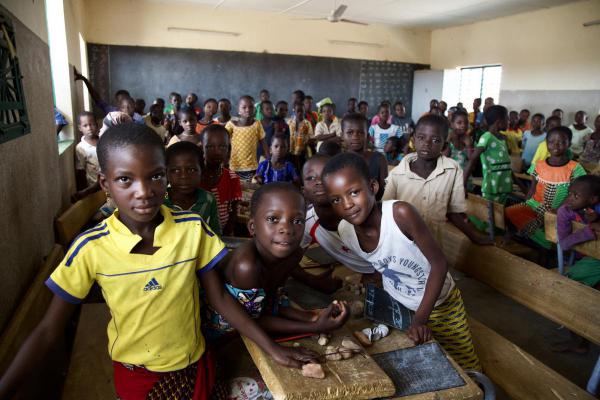
Plus tard, nos avons visité une école primaire de 220 élèves établie par Bagrépôle grâce à des ententes avec le Ministère de l'Éducation Nationale et de l'Alphabétisation du Burkina Faso. Ces ententes ont permis d’assigner du personnel enseignant à la nouvelle école. « L’école comprends présentement trois classes pour les six à huit ans. C’est un bon début, mais nous espérons obtenir du Ministère la possibilité de passer à une école primaire complète qui comprend toutes les classes, » nous a dit un jeune enseignant devant sa classe.
De jeunes étudiants à l’école primaire de Bagrépôle. (Photo: Annie Risemberg pour l’IISD)
Dans cette région, fournir une éducation de base, créer de l’emploi et développer des occasions économiques durables sont des défis de taille. Même si Bagrépôle a déjà mis en place plusieurs projets de formation, de renforcement des capacités et de soutien, améliorer les marchés afin d’assurer que ces jeunes étudiants se trouvent du travail une fois adultes sera le prochain obstacle à surmonter.
Les images par satellite de l’agropole de Bagré, dessinent une vaste tache verte en aval du barrage posé sur le fleuve Nakambé qui contraste avec l’aridité du reste du territoire. Nous voici pour ce second jour à visiter l’un des ouvrages phare du pays : le barrage de Bagré.
C’est sur cet infrastructure majeur que le gouvernement s’appuie pour transformer son agriculture en se concentrant notamment sur les changements de pratiques agricoles.
« Bagrépôle nous a fourni l'irrigation afin que nous puissions maintenant planter deux ou trois fois par an, ce qui a considérablement amélioré nos revenus, » explique Halidou Dabré (centre), riziculteur. (Photo: Annie Risemberg pour l’IISD)
Nous rencontrons Halidou Dabré, petit exploitant familial qui possède une riziculture de d’un hectare. Il nous parle de son rendement et dévoile son chiffre d’affaire annuel. Que penser de ces performances ? Une étude menée par Global Water Initiative et Bagrépôle indique que les périmètres aménagés sont à l’origine de 50 pourcent à 90 ppourcent des revenus des producteurs et reconnaît que ce système participe au développement économique local et à la sécurité alimentaire. Toute proportion gardée, le rapport précise que seuls quelques producteurs bénéficiant de plus d’un hectare se situent au-dessus de seuil de pauvreté.
Les périmètres aménagés associés aux grands barrages sont des ouvrages coûteux dont les redevances payées de manière aléatoire par les usagers évoquent la question de la durabilité des infrastructures. Par ailleurs, étant donné que la demande d’eau va augmenter de manière exponentielle au regard de superficies en cours d’aménagement, le financement de l’usage de l’eau doit être pérenne.
Cependant, les aléas climatiques régulièrement constatés en Afrique de l’ouest et qui conduisent à craindre de l’instabilité alimentaire et nutritionnelle chronique et poussent aussi à réfléchir à la manière dont ce type d’infrastructure doit être optimisée d’un point de vue économique et écologique.
Des représentants du gouvernement et des membres de l’équipe de l’IISD à Bagrépôle. (Photo: Annie Risemberg pour l’IISD)
Nous avons passé les deux premiers jours du voyage d’étude dans la capitale du Burkina Faso à rencontrer les représentants gouvernementaux du pays et à entendre leurs réactions au sujet des régimes et droits fonciers. Aujourd’hui nous avons visité l’agropole à Bagré dans le sud-est du pays.
Mais avant de nous rendre à Bagré, nous avons fait le point avec une participante au voyage afin de savoir ce qu’elle a appris et ce qu’elle souhaite encore savoir.
Lié Maminiaina de Madagascar nous a raconté que le point fort du voyage d’étude est l’importance d’établir des priorités spécifiques lors du développement d’un agropole, surtout parce que ces priorités aideront à guider le projet du début à la fin. Par-dessus tout, dit-elle, tout projet d’agropole doit être guidé par un objectif principal : « éliminer la pauvreté et assurer la sécurité alimentaire. »
« Les régimes fonciers doivent être gérés prudemment afin qu’ils ne fassent de mal à personne, » dit Lié Maminiaina. (Photo: Annie Risemberg pour l’IISD)
Les projets d’agropoles doivent aussi être inclusifs à la base. Ils doivent s’assurer que la société civile, les petits producteurs et le secteur privé local participent au projet dès la planification et jusqu’à sa mise en œuvre. Bagrépôle, par exemple, compte parmi ses partenaires la Chambre de commerce locale et la Maison de l’Enterprise. Il est aussi important de considérer l’agriculture contractuelle, rajoute Lié.
Lié a aussi remarqué à quel point il est important de s’assurer que les populations affectées par les agropoles soient régulièrement informées et impliquées dans le projet. Les populations locales doivent avoir la chance de partager leurs opinions et expériences. Lié a cité l’ouverture de Radio Bagré et sa diffusion en plusieurs langues comme exemple à suivre.
Afin de réussir, les agropoles doivent bénéficier d’un soutien politique, d’une infrastructure et d’investissement publique, mais il y a plusieurs autres facteurs essentiels au succès d’un tel projet. Le projet ne doit pas s’arrêter à la transformation de la production agricole à cours-terme ; celui-ci doit atteindre des objectifs de développement durable et ne doit pas créer de nouveaux problèmes, ni d’aggraver les problèmes auxquels font déjà face la population locale.
Selon Lié, « les régimes fonciers doivent être gérés prudemment afin qu’ils ne fassent de mal à personne. » Ce principe a été fréquemment mentionné lors de nos discussions avec les représentants gouvernementaux mardi. Avant de lancer un project d’investissement agricole, il est essentiel de bien mener des études de faisabilité et d'impact environnemental et social de grande qualité.
Trois femmes travaillent dans un champs de riz frais près d’Ambalavao au Madagascar.
Il doit y avoir un contrôle suivi du processus d’agropole, dit Lié, à travers un mécanisme institutionnel et l’implication du ministère approprié.
Au terme de notre conversation avec Lié, nous nous sommes sentis inspirés. Lié a saisi tous les enjeux importants : l’inclusion, les considérations environnementales et sociales et les rôles variés de personnes clés. Nous avons hâte de partager avec vous ce que nous observerons demain sur le terrain.
Jour deux : Les agropoles sont-ils des outils adéquats pour atteindre l’objectif de développement poursuivi ?
À Ouagadougou, première escale avant de prendre la route pour Bagré, une question essentielle est soulevée : les agropoles sont-ils des outils adéquats pour atteindre l’objectif de développement poursuivi? Pour les nombreuses personnes avec lesquelles nous avons discuté, il ne fait aucun doute. Les agropoles sont conçues comme des instruments stratégiques permettant d’atteindre la croissance et la réduction de la pauvreté. Ils portent l’ambition d’être ce levier de transformation tant voulu par les gouvernements.
Pour les nombreuses personnes avec lesquelles nous avons discuté, les agropoles sont conçues comme des instruments stratégiques permettant d’atteindre la croissance et la réduction de la pauvreté. (Photo: Annie Risemberg pour l’IISD)
Aussi grandes que soit l’ambition des objectifs de développement durable que poursuivent ces modèles, ils comportent aussi des écueils. Plusiers facteurs augmentent les risques et réduisent les effets positifs recherchés.
Comment assurer ces ambitions lorsque l’investissement étranger est difficile à attirer? L’une des approches mise de l'avant par Bagrépôle est de baser le modèle de développement de l’agropole sur le secteur privé domestique. Le secteur privé a été impliqué dans la conception du projet dès le début, notamment lors de la définition de la vision sur laquelle repose l’agropole.
Le modèle répandu est de considérer l’agropole comme un outil d’attraction de l’investissement étranger, arguant que ce dernier pourrait assurer la transformation agricole tant désirée. Mais ne serait-il pas plus pertinent pour les pays de mettre en avant leurs secteurs privés? Bagrépôle vient de faire le pari d’une réussite par le national pour le national. Une alternative qui mérite d’être exploré.
Une participante prend la parole lors de la deuxième journée du voyage d’étude sur les outils d’investissement agricole en Afrique. (Photo: Annie Risemberg pour l’IISD)
Premier jour de notre voyage d'étude. Il y a de cela un an, dirigés par Madagascar, des responsables gouvernementaux de toute l'Afrique qui s'efforcent d'attirer des investissements privés dans les zones rurales ont lancé cette initiative. Influencés par une tendance croissante issue d’ Asie, ils considèrent que les zones agricoles, les agropoles, les parcs et les couloirs représentent des outils de valorisation de la production agricole primaire et de développement de l’agro-industrie. Ces instruments ont pour but ultime de renforcer la sécurité alimentaire et de réduire la pauvreté.
Francine Picard prend la parole lors d'une réunion de groupe au Burkina Faso. (Photo: Annie Risemberg pour l’IISD)
Cependant l'expérience des agropoles et des couloirs en Afrique jusqu'à présent a été largement négative (FMI et al, FAO, Banque mondiale) et fait l'objet de vives critiques. Les agropoles et couloirs sont accusés d’exclure les petits producteurs, de miner la sécurité alimentaire et de favoriser l’accaparement des terres. Certains préconisent leur arrêt total (ROPPA, Oxfam, Oakland Institute).
Alors pourquoi entreprenons-nous un tel voyage ? Et qu'espérons-nous en tirer ?
Depuis plus d'une décennie, l'IISD conseille les gouvernements et les parlementaires sur la façon d'attirer des investissements responsables pour atteindre le développement durable. Lorsqu'il est bien conçu, l'accroissement de l'investissement privé peut contribuer à stimuler la production, à créer des emplois, à accroître les revenus et à promouvoir le développement économique. Cependant, lorsque ce n’est pas le cas, il peut exacerber la pauvreté et les inégalités, violer les droits fonciers, miner les moyens d'existence des petits producteurs et plus particulièrement avoir de graves répercussions pour les femmes et appauvrir les terres, l'eau, le sol et les autres ressources naturelles. Les personnes qui nous accompagnent sont bien conscientes de ces risques et travaillent à limiter leur ampleur, voire à les éviter entièrement.
Carin Smaller explique comment des cadres juridiques sont nécessaires pour que les avantages des investissements agricoles atteignent les populations qui en ont le plus besoin. (Photo: Annie Risemberg pour l’IISD)
Compte tenu de ces risques importants, l'IISD ne fait pas la promotion ni ne plaide en faveur des agropoles, des couloirs ou de tout autre outil spécifique pour attirer l’investissement responsable dans l'agriculture.
Cependant nous croyons que l'investissement privé est nécessaire pour parvenir à un développement durable ; c'est pourquoi nous travaillons avec les gouvernements pour élaborer des cadres juridiques et politiques solides qui maximisent les avantages et minimisent les risques de l'investissement privé.
Au cours des deux prochaines semaines, nous espérons que les représentants des pays qui nous ont rejoints trouveront réponse à certaines de leurs questions et préoccupations sur les agropoles et les couloirs agricoles. Nous espérons en apprendre plus sur ce qui fonctionne, ce qui ne fonctionne pas et comment les choses peuvent être améliorées. Nous partagerons les histoires des personnes que nous avons rencontrées et de celles que nous rencontrerons lors de ce voyage d'étude des agropoles et des couloirs agricoles du Burkina Faso et de la Tanzanie.
- Francine Picard et Carin Smaller
Marquez cet article de blog et vérifiez les mises à jour.
Cependant, l'expérience des agropoles et des couloirs en Afrique jusqu'à présent a été largement négative.
Our journey is coming to an end and we wanted to gather the impressions and lessons of our fellow traveller, Nicolas Kobiane, the Secretary General of Bagrépôle. He says that the two stages of the mission in Burkina Faso and Tanzania were necessary to better understand the complexity of the approaches entailed in agropoles and agricultural corridors.
"It is essential that this type of initiative be based on political commitment. This must be permanent and support the entire process," he says. "Both initiatives are ongoing experiences that must be analyzed over the long term. And although different, there are several similarities between SAGCOT and Bagrépôle with regard to their objectives and challenges. We must take this into account and manage them properly in order to ensure a successful investment."
A cattle herd being brought in for the night near Mto wa Mbu, Tanzania. Land use is a key issue in agropoles.
Both approaches aim at agricultural growth, poverty reduction, and the opening up of landlocked areas based on agricultural policies that rely on investments in agribusiness and infrastructure development, he points out. According to Kobiane, agropoles, like agricultural corridors, are designed to be a viable and sustainable response to structural problems and to make agriculture a driving force for stimulating the rural economy.
He acknowledges the major challenges associated with this type of project, including population displacement, social conflicts and environmental protection. He suggests successful land management needs to allocate land in such a way as to integrate both small and large producers into agropole projects, as well as to promote agricultural aggregation.
"Land is an essential capital of the agropole," he points out. "The importance of compensation mechanisms for people affected by the project and the commitment of beneficiaries to the project should not be overlooked. In Bagrépôle, in addition to compensation for crop loss and land-for-land compensation, we have planned accompanying measures to facilitate the economic development of the land allocated to the people affected by the project in the irrigated area.”
These two experiences, Bagrépôle and SAGCOT, are based on spatial planning projects, notes Kobiane. "The identification of the area and compliance with the national master planning scheme are priority elements to enhance the potential of these approaches.” In addition, he says, "the challenge is to have an entity that plays both the role of facilitator and coordinator between actors and facilitates links between companies. The mandate of these entities and their institutional anchoring must be consistent with the objectives pursued.”
Private investors remain cautious of adding financial muscle to infrastructure projects that support agricultural expansion.
He adds: "Structuring public investments is the backbone for the success of agropoles, but the problem is financing: these initiatives are expensive and require significant resources. Financing strategies such as public–private partnerships are needed." The development of infrastructure, which is to say energy, roads, hydro-agricultural developments, dams and even the security issue, contributes to the establishment of a favourable business climate in order to better mobilize the private sector.
Private investors are expected to transform these opportunities into dynamic, profitable companies that create wealth and sustainable jobs. Countries have implemented reforms with special incentives, including a favourable tax and customs regime or a single window to facilitate the completion of all procedures for carrying out economic activities. These are all instruments to attract a private sector that is, Kobiane notes, still very cautious.
Day Ten: Sunflowers and green beans: Women bet on the future!
Anjelina Kitime is a widow. She lives in Mgama, in the Iringa region of Tanzania. When her husband died, Anjelina found herself raising their children alone. To support them, she depends on the two-hectare plot she inherited from her husband.
Until recently, she dedicated her entire plot to the production of tomatoes, corn and potatoes. She used some of the vegetables to feed her family and as donations toward her children's school fees. The rest was sold at market.
“The seeds are cheaper than the other products I can plant here,” says Anjelina Kitime, who revised her farming strategy through a project supported by the Clinton Development Initiative.
Ten months ago, she was accepted into a project supported by the Clinton Development Initiative, a program set up by the Clinton Foundation to “help support smallholder farmers and families in Africa to meet their own food needs and improve their livelihoods.”
Today, 80 per cent of Anjelina’s field is used to grow a new crop: sunflowers. “The seeds are cheaper than the other products I can plant here,” she says enthusiastically. “And you see how beautiful and tall my plants are. The foundation showed me how to prepare the soil, plant stronger seeds and use fertilizers at the right time.”
Like the six other women members of the Kitowo Village Community Bank we met, Anjelina is not familiar with the SAGCOT Centre and even less so with its role. The women were selected by the Clinton Development Initiative according to criteria such as “having some knowledge of reading, mathematics, and technology, being in possession of a certificate of ownership of the land on which he or she operates,” explains Monsiapile Kajimbwa, the foundation’s agribusiness director at the country level.
The Clinton Development Initiative is one of the stakeholders in SAGCOT, which promotes socially inclusive and environmentally sustainable value chain investments. The organization has developed a program that aims to empower smallholder farmers in Iringa through a community-based agro-industry approach. This allows the community to manage its own seed supply, market it and manage its access to financing.
The women tell us that they have been convinced by the project to plant dry beans. They give credit to the Initiative's staff for training them and donating seeds and fertilizers on preferential terms for the introduction of this new crop.
Concerns exist around the risks small producers are being encouraged to take in Tanzania.
“I am in the field from 6 a.m. to 2 p.m. every day,” one says. "Increasing yields is quite simple, especially with the techniques that we have been shown,” adds another.
Dry beans are a new variety promoted by the foundation. However, one of the main tasks of the initiative’s field officers is to persuade the farmers they will be paid, and that there is a market for new products. Concerns remain, however. One farmer asks: “But where are the customers? Where and to whom are we going to sell these beans?”
Women were given a “list" of potential buyers and seem not to know where the collection centre is located. “They will sell their products. The market is there; there is a market,” confirms Thobias Mville, Manager of Agricultural Development at the Foundation. However, the farmers have not yet met with buyers and no agreement has been made about the quantities that will be purchased from them and at what price.
We learned from the staff of SAGCOT and the representative of the President's Office to the local authority that no system has been created to limit the risks taken by small producers. They themselves bear the risks of this transformation desired by the country. We are told that there is no insurance system for agricultural products and even less aid or protection for small farmers.
Anjelina's assets are her land. What will she do in the event of poor sales or poor harvests? It is very likely that the most vulnerable will be tempted to sell their main source of income.
Today we met an inspiring entrepreneur who embodied the concept of agricultural transformation, which involves the economic development from subsistence to commercial agriculture. This dairy farmer, Felix Mpiluka, owns 250 cows and lives in the village of Ilandutwa, in Tanzania’s Southern Highlands. Sixty kilometres away lies the nearest town, Iringa, where he transports fresh milk regularly to the ASAS dairy factory, which we also visited.
"Our secret to success is to keep it simple," says dairy farmer Felix Mpiluka (centre).
His farm has no electricity or running water, and the challenging road conditions between Ilandutwa and Iringa make his work even harder. But none of this deters him: rather than seeing these as barriers, he tells us that these are opportunities to innovate throughout the process.
During our visit, he walked us through each of the innovations that allow him to sustain and grow his dairy business. For example, he uses a brick tub filled with water to keep the milk cool at night before delivering it to the factory in Iringa the next morning. This gives him an extra 12-hour window before the milk spoils.
To clean his metal milk cans, he uses a clay oven, which ensures that the milk he stores and transports meets the highest levels of hygiene and food safety. “This technology was borrowed from what they used to use in Europe,” he said. “We use one log of wood every two days. It is very energy efficient.”
“Our secret to success is to keep it simple. We use simple technologies. Nothing fancy or sophisticated. But we are still able to produce good volumes and high-quality milk,” he told us.
Last year, the local government sent a letter to people in the area saying that opportunities for milk sales were expanding. At the same time, the government announced that they were bringing electricity to the region.
Mr. Mpiluka saw opportunities everywhere and started preparing for the arrival of electricity. He first obtained a loan from the Tanzania Agricultural Development Bank (TADB), which was set up in 2015 to fund farmers and a range of agricultural projects. The loan was used to purchase two cooling tanks that can hold up to 3,000 litres of milk.
Innovation has enabled entrepreneur Felix Mpiluka to expand his dairy's reach and profit.
“If we keep the milk in these tanks, it stays fresh for three or four days. That means we can now deliver milk to ASAS once or twice a week rather than every day. That is a huge saving in time and transport costs!” he said.
“More importantly, I can now set up a milk collection centre and provide storage and transport service for dairy farmers from the surrounding eight villages,” he continued.
Despite the efforts to bring electricity to the region, there are frequent blackouts. He therefore acquired a generator as a backup system. “I found out that the British embassy [in Tanzania] was selling their old generator, so I went to Dar Es Salaam to find out more. I bought it from them. It is the best brand out there!”
His stories of innovation and entrepreneurship went on and on. “You are a source of inspiration to us and to the people of our countries,” said Nicolas Kobiane from Bagrépôle in Burkina Faso. “Thank you sharing this incredible journey of transformation from subsistence to commercial farming.”
We finished the day exhausted but filled with admiration, humbled by this farmer with his indefatigable spirit, his devotion to his work and his boundless creativity.
Day Eight: Harnessing irrigation's potential in Tanzania
On our first day in Tanzania, a key theme was the importance of developing effective irrigation schemes to support small-scale producers. We were joined by our new IISD Associate, Priscila de Andrade, who contributed to this blog. We met with the National Irrigation Commission of Tanzania (NIC), the central authority responsible for irrigation. We also spoke to officials from the Japan International Cooperation Agency (JICA), the government aid organization that has focused on improving irrigation systems and productivity in the rice sector since it was established in 1974.
The assessments we heard of Tanzania’s irrigation sector were mixed. “There is insufficient investment, weak participation of the private sector and insufficient investment in the maintenance of irrigation schemes,” said Doris Sendewa, an economist at the National Irrigation Commission.
Doris Sendewa (centre) shared the significant obstacles in Tanzania's irrigation sector.
Despite these challenges, some officials noted that there have been some notable advances, though realizing irrigation’s full potential will require further work.
“We have made good progress and seen important improvements in productivity in the rice sector,” said Mr. Fumihiko Suzuki, Senior Representative of JICA in Tanzania. “But three things are essential for success: first, ensuring good quality materials, second a secure and stable supply of water by managing competition with upstream users, and third, strengthening associations of farmers that use irrigation to ensure proper maintenance and functioning in the long term.”
Government officials from the Green Belt Authority in Malawi also shared their experiences in developing large-scale irrigation schemes. “The best way to avoid failure is to ensure that irrigation development is driven by the demand of the users and not imposed from above,” said Alex Nthonyiwa, an irrigation engineer for the Green Belt Authority. “Equally important is ongoing support and capacity-building activities for the beneficiaries to ensure proper management of the schemes,” added Catherine Wandale, Green Belt Authority’s human resources manager.
Group discussion on effective irrigation schemes to support small-scale producers.
We also visited GBRI, a company based in the Southern Agricultural Growth Corridor (SAGCOT). GBRI is a domestic private company run by a young female entrepreneur, Hadija Jabiry, that supplies horticultural products such as French beans, baby corn and tomatoes to the domestic market and for export. They have an outgrower scheme that contracts with around 240 smallholder farmers, about 40 of which are women.
“We have been running for three years now and, while we are not yet running a profit, we have a dedicated team and strong partners like SAGGCOT supporting us to success,” said Chacha Magige, Export and Operations Manager.
GBRI is in the Ihemi cluster, which is one of SAGCOT’s flagship clusters. SAGCOT describes this cluster, with its population of 1.64 million people, as having “the potential to produce food crops for almost all seasons,” spanning multiple districts.
As we prepared to leave Burkina Faso, we took the chance to think back on our time there. The days on the study tour were rich and intense. Government officials from Democratic Republic of the Congo, Madagascar, Malawi, Mali, Senegal and Togo had a chance to learn from Burkina Faso and share their own vision of using the model of an agricultural growth pole to transform their agricultural sector.
As to the question of whether Bagrépôle is a good model of development or not, we heard mixed views.
By the end of the study tour, participants had mixed views on whether or not Bagrépôle is a good model of development. (Photo: Annie Risemberg for IISD)
“They thought of everything,” said Pyaabalo Alai, a participant from Togo. “Not just physical planning, but social infrastructure—like schools and hospitals. It is all there. Integration of small-scale producers, dams, irrigation, electricity, roads… even a bank. There is an institutional framework, a legal framework and a clear sharing of roles and responsibilities. We in Togo are still a long way away.”
Those in charge of Bagrépôle recognize that they haven’t achieved full success yet but see the project as a work in progress.
“We are only at the start,” said Joseph Martin Kaboré, Director General of Bagrépôle. (Photo: Annie Risemberg for IISD)
“This project needs time. We are only at the start,” said Joseph Martin Kaboré, Director General of Bagrépôle. “This is not just a simple agricultural project. If we want to transform agriculture, there are so many factors to consider that go beyond a narrow sectoral focus or a single infrastructure project.”
On our last day, we also met with a network of West African farmers’ organizations called ROPPA.
“We are in favour of investment,” said the organization’s Executive Secretary, Ousseini Ouedraogo. “But any investment not directed to family farmers is not good.”
Ousseini Ouedraogo discusses why some farmers' organizations take issue with the way Bagrépôle was designed and developed. (Photo: Annie Risemberg for IISD)
He strongly criticized Bagrépôle for not having emerged from a broad national consultation process and for not involving farmers’ organizations in its concept development or design. ROPPA rejects Bagrépôle and instead calls for the implementation of the ECOWAP (the agricultural policy adopted by the Economic Community of West African States), which they support because it reflects a region-wide vision with broad-based support.
Whether you consider Bagrépôle a model to be replicated or avoided, one thing is certain: the men and women who work for Bagrépôle are a highly dedicated team who work hard and want results. They have earned our admiration and treated us to a journey filled with enthusiasm and ambition.
“The project did not work,” said Mr. Roger Kabongo, reflecting on an agricultural project he was involved with in his native Democratic Republic of Congo (DRC). “We went too fast and did not respect the procedures. We did not plan effectively. There were no proper feasibility studies or environmental and social impact assessments. No proper consideration of land issues. And we should have integrated civil society from the start.”
Roger Kabongo shares lessons learned from the Bukanga Lonzo agricultural project. (Photo: Annie Risemberg for IISD)
Kabongo is in charge of administration and finance at Bukanga Lonzo, an 800-square-kilometre agricultural growth project about 250 kilometres from the capital of Kinshasa. The project was launched in 2014 and was to be administered by Africom Commodities Pty Ltd, a private company based in South Africa. Bukanga Lonzo was the first in what was meant to be a series of parks in DRC, intended to spur increased agricultural production, address local food shortages and attract increased investment in the agricultural sector.
The concerns Kabongo raised with us echo some of the criticisms made in a recent report by the Oakland Institute, a U.S.-based think tank, which cites problems with a number of aspects of the Bukanga Lonzo project and warns against continuing with the project to build other agricultural growth parks in the country. Others who know the project offer a more tempered assessment, arguing that the significant challenges DRC faces with the project do not invalidate the effort.
For Kabongo, the next steps are clear: “We are not giving up. We want to try again. We want to correct our mistakes. We want to do better.” He told us the government is currently considering establishing four agropoles around the country.
Augustin Mpoyi Mbungu is an Associate at IISD and head of Conseil pour la Défense Environnementale par la Légalité et la Traçabilité (CODELT), a civil society organization headquartered in DRC. He is optimistic: “The experience of Bukanga Lonzo has at least allowed DRC to draw lessons that will support the ongoing process of land reform, starting with the first draft of the national land policy document, which is currently waiting to be validated,” he said.
Augustin Mpoyi Mbungu shares how the DRC is modifying land policy after the Bukanga Lonzo experience. (Photo: Annie Risemberg for IISD)
“A key feature of the draft land policy is social safeguards to limit adverse effects on local rights and interests of the population,” he said. “That will protect local tenure rights holders from the risks of evictions.”
The safeguards currently under discussion in DRC’s draft national land policy document will be binding. They include:
Collective land titles, based on customary law and with the possibility for individuals to claim title.
The right to Free, Prior and Informed Consent (FPIC) of the communities and persons likely to be affected by a land investment project.
The right to compensation for losses or changes to communities and/or individuals, including resettlement.
The right to participate in decision-making processes.
The right to resort to more accessible and streamlined justice mechanisms in response to the long delays and heavy procedures in the existing justice system.
DRC’s land reform process is a step in the right direction. We know that the law does not capture every aspect of this challenge and that people need a lot more than laws to protect their rights. Nevertheless, there is some hope that DRC is taking a step toward land systems that recognize all legitimate tenure rights holders, whether formally recorded or not. These systems, when designed and implemented appropriately, provide an essential foundation for responsible investment and sustainable development.
Today’s visits were devoted to education and training projects, giving us a chance to meet students and teachers and learn more about the communities in which they live. We first went to see the Training Institute for Rural Development (IFODER), which teaches improved agricultural techniques, commercialization and marketing to young people, aged 18–25. But many of these students struggle to find work after their training is complete, due to a lack of economic opportunities in the area.
Students at a training centre learn about agricultural techniques, commercialization and marketing. (Photo: Annie Risemberg for IISD)
"Few students from the first class have found a job. We need more private investors to arrive to create employment opportunities," said the director, Laurent Kiwallo. He is nevertheless comforted to know that these young people are motivated to contribute to the agricultural sector and have developed vital skills, including getting their driver's licences.
Laurent Kiwallo, the director of the training institute, says more private investors are needed to create employment opportunities. (Photo: Annie Risemberg for IISD)
The director envisions setting up agricultural incubators in the region, which are mechanisms meant to make it easier for small agriculture-focused companies to grow and innovate, such as by providing them with financial services. These incubators would, in turn, help stimulate innovation and create jobs.
We later visited a primary school for 220 students set up by Bagrépôle, which has agreements in place with Burkina Faso’s Ministry of Education for getting teaching staff assigned to the school. "We currently have three grades at the school, for six- to eight-year-olds. It's a good start, but we hope to obtain from the ministry the possibility of having a complete primary school with all the grades," said a young teacher we met, speaking in front of his students.
Some of the young students at the primary school in Bagrépôle. (Photo: Annie Risemberg for IISD)
The challenges of providing basic education, creating jobs and developing lasting economic opportunities in this area are significant. While Bagrépôle has already set up several training, capacity-building and support projects, improving markets to ensure these students have job opportunities as adults will be one of the next hurdles to face.
Day Four: At Bagrépôle, steps forward but still more to do
Today we visited Bagrépôle, a pilot agricultural investment project launched in 2012. There we met farmers, the project team, company representatives and the many other actors who count this project as part of their daily lives.
Bagrépôle representatives told us that, while there have been some notable advances over the past seven years, there have also been some tough setbacks along the way and the project has moved more slowly than planned. They said more work remains to realize their vision.
For example, they told us how they are still trying to build the supporting infrastructure and that only a handful of domestic companies have invested—far fewer than the 108 domestic and international companies that Bagrépôle identified at an international conference years ago.
While it has achieved some success, Bagrépôle hasn't reached its full potential in empowering farmers in Burkina Faso. (Photo: Annie Risemberg for IISD)
The feasibility studies done when the project began were not of sufficiently high quality. They could have done more to identify the complex land issues, environmental challenges and technical problems that have come up during implementation. Officials also told us the land cost more to develop than originally anticipated, making it harder to move as quickly as they had hoped.
Their message to other countries interested in building agricultural investment hubs is that they require time, resources, political buy-in and a clear long-term vision. Any investment project of this magnitude, they stressed, requires a strong foundation, one that actively engages small-scale producers and affected communities.
We spent much of the day meeting some of those local farmers and visiting projects set up under Bagrépôle to support them.
Halidou Dabré is a rice farmer we met. He has 1 hectare of land, is supported by an extension worker and gets subsidized inputs from Burkina Faso’s Ministry of Agriculture. He says he is grateful for the support given by Bagrépôle, but told us he hopes to see more.
"Bagrépôle has provided us with irrigation so we can now plant two or three times a year, which has greatly improved our revenue," he said. But he also noted the high costs of inputs and fees for using water infrastructure.
"Bagrépôle has provided us with irrigation so we can now plant two or three times a year, which has greatly improved our revenue," says Halidou Dabré (centre), a rice farmer. (Photo: Annie Risemberg for IISD)
Dabré is part of a cooperative and therefore benefits from the collective negotiations and sales to a nearby miller. Over 100 farms like his exist, though the representatives from Bagrépôle told us that it is not yet enough. Many other farmers have been promised land but are still waiting for their parcels.
We also met Xavier Zidouemba, a banana farmer with a 4-hectare plot. He’s also part of a cooperative with 19 other farms. Bagrépôle has facilitated the cooperative’s access to technical support through a project funded by the German government, which made it easier for them to get credit from a local bank. “They help facilitate access to extension workers, inputs and credits, which helps," he said.
He too hopes more support will come. For instance, he told us he’s struggling with the “insufficient availability of training programs and an absence of improved varieties of banana.”
Xavier Zidouemba, a banana farmer, has gained some benefits through Bagrépôle but would like greater support. (Photo: Annie Risemberg for IISD)
We then met a few domestic companies providing seeds, inputs, credit and access to regional markets in Liberia, Sierra Leone, Senegal and Côte d’Ivoire, trying to open up opportunities for trade. We learned about a range of activities trying to provide access to credit for farmers and set up value-added industries, with a strong focus on women, including five centres for making cloth and a tomato pulp factory.
We saw an impressive irrigation system connected to a pre-existing dam, which provides water to small farms through a series of canals. Bagrépôle includes small-, medium- and large-scale farms ranging in size from less than 5 hectares to over 50.
The officials on the tour from other countries are listening attentively. Bagrépôle is not the success story they hoped to find. But we met an incredibly dedicated and committed group of people who enjoy strong political support and buy-in across multiple ministries, and who are working in a coordinated way to make this investment work for the people of Burkina Faso.
There are no magic solutions, but the rich experiences shared today offer much for others to learn from as they think of what their own countries need.
Government officials and IISD team members at Bagrépôle. (Photo: Annie Risemberg for IISD)
Our first two days were spent in Burkina Faso’s capital, meeting with government officials from this country and hearing their feedback on land tenure issues and land rights. Today we headed out to visit the agropole in Bagré, in the southeastern part of the country.
But first we checked in with some of the people on the tour to find out what they have learned so far and what they wish to learn more about in the days to come.
Lié Maminiaina from Madagascar told us that one of her greatest takeaways so far is the value of setting specific priorities when establishing an agropole, which could then help guide the project from start to finish. Above all, she said, the development of any agropole project must be driven by the core objectives of “eliminating poverty and ensuring food security.”
“Land issues must be managed carefully so that no-one is harmed,” Lié Maminiaina. (Photo: Annie Risemberg for IISD)
These projects also must be inclusive from the outset, ensuring that civil society, small-scale producers and the domestic private sector are involved from conception to implementation. Bagrépôle, for example, has among its partners the local Chamber of Commerce and the Maison de l’Enterprise. Also critical is exploring contract farming models when setting up these growth projects, she said.
Lié remarked on how important it is to make sure the populations affected by these projects are kept informed and engaged throughout, making sure they have a chance to provide feedback. She flagged the establishment of Radio Bagré, with broadcasts planned in multiple languages, as an example worth exploring.
For agropoles to be successful, they also need supporting infrastructure and related public investments, along with political will. Yet there are a few other key components to agropoles’ success, making sure these projects go beyond the singular goal of transforming agricultural production. These considerations will help ensure that agropoles support the achievement of sustainable development objectives and do not create new problems—or exacerbate existing ones.
“Land issues must be managed carefully so that no one is harmed,” Lié said. That point came up repeatedly during our discussions on Tuesday with government officials. Also essential is making sure “high-quality” feasibility studies, as well as environmental and social impact assessments, are conducted before any decision is taken to launch an agricultural investment project.
Three woman work on green fields with fresh rice near Ambalavao, Madagascar.
Project oversight is also key, and that will require the right institutional framework in place, as well as the involvement of the relevant ministry, she said.
Discussing these core issues with Lié—inclusiveness, environmental and social considerations, and the different supporting roles that key actors can play—left us feeling inspired. We look forward to updating you all tomorrow with what we’ve seen from the field.
On our second day, the challenge of land rights and land tenure systems came up often. For almost all of the government officials on this tour, land is the primary and most pressing challenge. Identifying and protecting the rights of local landowners and users within existing land tenure systems continues to be a source of difficulty and tension. All agree that these land rights, whether formal or informal, must be clearly identified and respected.
But how to do that?
The challenge of land rights and land tenure systems is a key issue in agricultural investment in Africa. (Photo: Annie Risemberg for IISD)
First, most of the countries on this tour have either recently completed or are in the process of reforming their land laws to strengthen tenure rights for those with insecure or informal rights: Burkina Faso, the Democratic Republic of the Congo, Madagascar, Malawi, Mali and Senegal. That’s a good sign.
Second, international standards now exist that provide guidance on responsible land governance, including the Voluntary Guidelines on the Responsible Governance of Tenure of Land, Fisheries and Forests in the Context of National Food Security and the Framework and Guidelines on Land Policy in Africa.
And third, when land is acquired for investment, affected people must have a say. The principle of Free, Prior and Informed Consent represents an important tool for local communities. It requires proper information and consultation for the communities as well as the possibility to reject a project.
The principle is enshrined in international law only for Indigenous peoples at the moment, but its application is also expanding to local communities more broadly and is reflected in some of the International Finance Corporation’s operational frameworks.
We will use this blog to share stories of the people we meet and those who are joining us on the tour, with the aim of exploring the pros and cons of this growing trend.
Francine Picard speaks to a group meeting in Burkina Faso. (Photo: Annie Risemberg for IISD)
The idea was born a year ago: government officials across Africa, spearheaded by Madagascar, asked for an in-depth look into how agricultural investment projects were performing in practice. Many of these governments are struggling to attract private investment into rural areas, and are curious to learn more about economic zones, agropoles, parks and corridors, which are already being seen in Asia.
These projects are being tested as possible tools for adding value to primary agricultural production and developing agro-industries, with the ultimate goal of strengthening food security and reducing poverty. However, the experience in Africa has largely been negative. Projects have been drawing heavy criticism for excluding small-scale producers, undermining food security and land grabbing. These problems have been well documented by the IMF, FAO, and the World Bank, among others. Some have even called for the projects to be stopped altogether, including ROPPA, Oxfam and the Oakland Institute.
So why are we taking this trip and what do we hope to achieve?
For over a decade, IISD has been advising governments and parliamentarians on how to attract responsible agricultural investment to achieve sustainable development. Increased private investment, when conducted responsibly, can boost agricultural production, generate employment, raise incomes and promote economic development. But when done badly, this investment can exacerbate poverty and inequalities, violate tenure rights, undermine small-scale producers’ livelihoods, with particularly damaging implications for women, and significantly deplete natural resources. The government officials with us during this tour are aware of these risks and want to mitigate or avoid them.
Carin Smaller shares how legal frameworks are needed to ensure the benefits of agricultural investment reach the people who need it most. (Photo: Annie Risemberg for IISD)
Given the grave risks, IISD does not promote or advocate in favour of agropoles, corridors, or any other specific tools for attracting responsible agricultural investment. But we do believe that private investment is needed to achieve sustainable development, so we work with governments to develop robust legal and policy frameworks that maximize the benefits of this investment, while minimizing its risks.
We hope the government officials joining us on this tour will be able to get answers to some of their questions and concerns about agropoles and corridors. We also hope to develop greater insights into what works, what doesn’t, and how things can be done better.
- Francine Picard and Carin Smaller
Bookmark this blogpost and check back for updates.
Ideally, agricultural investment should strengthen food security and reduce poverty.