In the sixth chapter of The Wonk’s Survival Guide to the European Green Deal, POLITICO looks at the EU’s ambition to serve as a model for the rest of the world in the fight against climate change.
European Regional Consultation on International Investment Agreements and Human Rights to Support the UN Working Group on Business and Human Rights
This regional consultation was convened by the UN Working Group on Business and Human Rights and hosted jointly by the International Institute for Environment and Development (IIED), the International Institute for Sustainable Development (IISD), and the Essex Business and Human Rights Project in the University of Essex School of Law and Human Rights Center.
December 10, 2020 10:00 am - 1:00 pm CET
(Open to public)
This consultation is part of a regional series, which will feed into the Working Group's forthcoming report to the UN General Assembly on how to improve the negotiation of international investment agreements (IIAs) so they are compatible with human rights.
The event featured a plenary discussion, which considered options for improving existing treaties in line with human rights, as well as reform options for future agreements. The plenary also addressed the gender and racial impacts of IIAs, as well as how they may interact with the Legally Binding Instrument (LBI) that is being negotiated.
This LBI aims to "regulate, in international human rights law, the activities of transnational corporations and other business enterprises,” as set out in the mandate for these negotiations under the UN Human Rights Council's Open-Ended Intergovernmental Working Group on Transnational Corporations and Other Business Enterprises with Respect to Human Rights.
The European regional consultation took place on December 10, 2020, from 10 a.m. to 1 p.m. CET over Zoom. The event was held under the Chatham House Rule. Further details on how to engage with the UN Working Group are available here.
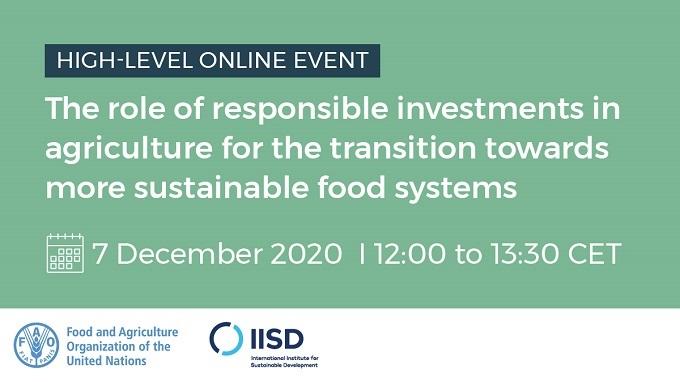
This event will be held under the auspices of the European Parliamentary Alliance against Hunger.
Sustainable investments throughout the agricultural value-chain can play a huge rule in achieving the 2030 agenda, supporting countries mitigating the impacts of climate change and environmental degradation and addressing rural poverty and inequalities.
Parliamentarians hold a strategic position to promote the enhancement of public responsible investments into the agricultural sector, and to put in place the conditions to increase private responsible investments, while ensuring well-defined safeguards are in place to prevent damages to the environment and communities. They can put in place actions that facilitate complementarity between different kinds of investments, and thus contribute to sustainable development.
The Green Deal is at the core of the EU’s COVID-19 recovery package and is an integral part of the European Union’s strategy to implement the Agenda 2030 and the Sustainable Development Goals (SDGs). Sustainable and responsible investments should be at the heart of the COVID-19 recovery to build community resilience, generate jobs, empower women and youth, invest in small-holder family farmers, and improve their access to agricultural assets, land, finance, knowledge. Interpretation will be available in English, French and Spanish.
The event is specifically targeted to Members of the European Parliament, parliamentary advisors and those who work within parliamentary contexts; participation is opened to all interested stakeholders, including parliamentarians and advisors from other regions.
A Step in the Right Direction: The EU's revised directives on public procurement
The revised EU directives on public procurement provide welcome leadership on sustainable public procurement. The question that remains is how it can be implemented.
March 1, 2016
After many years of toil in advocating that governments seek value-for-money across the asset life cycle when procuring goods, services and infrastructure, we were delighted to welcome, from the European Union (EU), the revised Directive 2014/24/EU on Public Procurement and the Directive 2014/25/EU on Procurement by Entities Operating in the Water, Energy, Transport and Postal Services Sectors.
These revised EU directives on public procurement provide welcome leadership on sustainable public procurement. The question that remains is how it can be implemented.
Biofuels—At What Cost? A review of costs and benefits of EU biofuel policies analyzes a range of costs and benefits associated with European Union (EU) conventional biofuel policies.
The study provides a comprehensive overview of economic and non-economic costs and benefits of the EU, quantifying them where possible using estimates available from public accounts, state-of-the-art literature and author calculations. The paper identifies the main cost of the industry as subsidy schemes, which in 2011 were estimated to be EUR 9.3 - 10.7 billion. The study examines the key benefits generated by the industry, including rural development, greenhouse gas emissions reductions, and improved energy security, concluding that the social benefits of EU biofuel policies in meeting these policy objectives has, in many instances, been marginal, unclear, or in need of greater monitoring and elaboration. The European Union's proposed tightening of the current emission standard for passenger vehicles is discussed as an alternative, viable low-cost policy measure to achieve the public policy objectives for which biofuels are subsidized. The report provides recommendations to EU policy-makers on reforming subsidy policies and improving data recording in order to enhance the policy formulation process.
The Global Subsidies Initiative published an addendum to the report in August 2013. The Addendum corrects estimates of the size of EU subsidies to biofuels in 2011. It also presents the calculations in full.
Accompanying this report is a Technical Annex that contains supporting research material and data.
Government support for biofuels has soared in recent years as policy makers have sought ways to reduce reliance on fossil fuels, especially petroleum.
However, up to now the full extent of this support has not been documented. Yet informed public debate over the cost-effectiveness and impacts of biofuel policies is impossible without such information. Biofuels - both ethanol and biodiesel - benefit from large financial support in almost all European Union Member States. This report aims at quantifying all support measures provided in the European Union. It is one of several studies undertaken for or by the Global Subsidies Initiative (GSI) examining subsidies and support measures in various countries. This report in particular focuses on the years since 2007 and repre-sents an update of the 2007 report on biofuel support measures in the EU, carried out by Kutas et al. (2007).