Conference

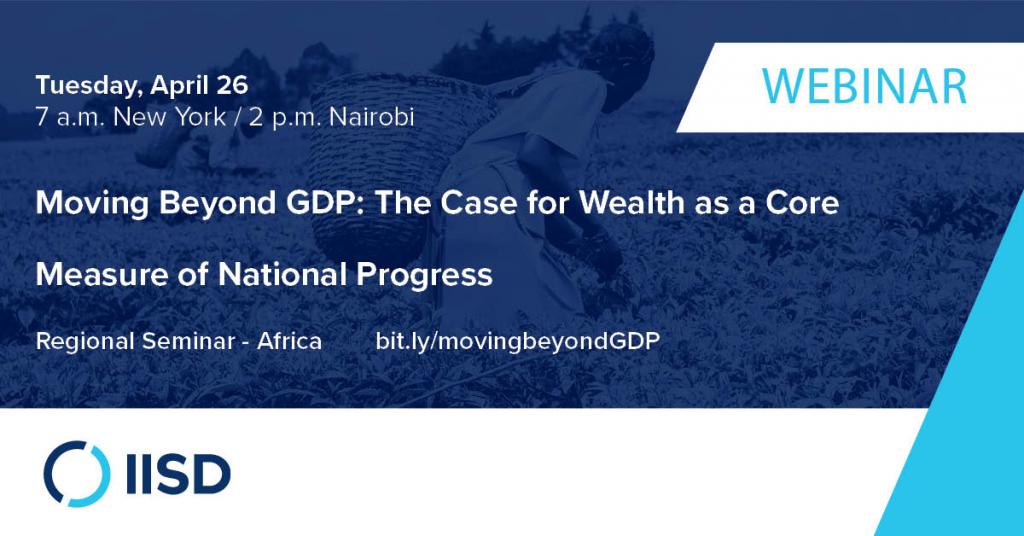
Moving Beyond GDP: The Case for Wealth as a Core Measure of National Progress

This regional seminar, with a focus on Africa, will explore the case for wealth as a core measure of national progress with discussions on the shortcomings of GDP, the benefits of using expanded wealth measures to guide decision-making, and the steps necessary for countries to embrace this new approach to ensure the sustainability of development. 

April 26, 2022 7:00 am - 8:15 am EDT

(Open to public)

For more than 70 years, GDP has been the most frequently cited and influential indicator of national progress. Yet GDP narrowly focuses on short-term economic growth while ignoring the costs of this growth, including environmental degradation, loss of societal trust, mounting debt, and growing inequality. Decision-making focused on GDP is biased toward short-term economic benefits, overly concerned about what happens in the market economy, and not concerned enough about the consequences of economic growth on other determinants of well-being—especially the environment and community.

But measuring wealth in the broad sense—considering human, natural, social, produced, and financial capital—would give countries new and important insights into the sustainability of their policies.

This seminar will explore the case for wealth as a core measure of national progress. Discussion will focus on the shortcomings of GDP, the benefits of using expanded wealth measures to guide decision-making, and the steps necessary for countries to embrace this new approach to ensure the sustainability of development.

Moderator: Dominique Charron, Vice-President, Programs and Partnerships (International Development Research Centre, IDRC)

Speakers

  • Njuguna Ndung’u, Executive Director, African Economic Research Consortium (AERC)
  • Jim Cust, Senior Economist, Office of the Chief Economist (Africa Region) - World Bank
  • Kevin Urama, Acting Chief Economist and Vice President for the Economic Governance and Knowledge Management Complex, African Development Bank
  • Jane Mariara, Executive Director, Partnership for Economic Policy
  • Lebohang Liepollo Pheko, Senior Research Fellow at Trade Collective & Wellbeing Economy Alliance (WEAll) Ambassador
Moving Beyond GDP Seminar
Conference

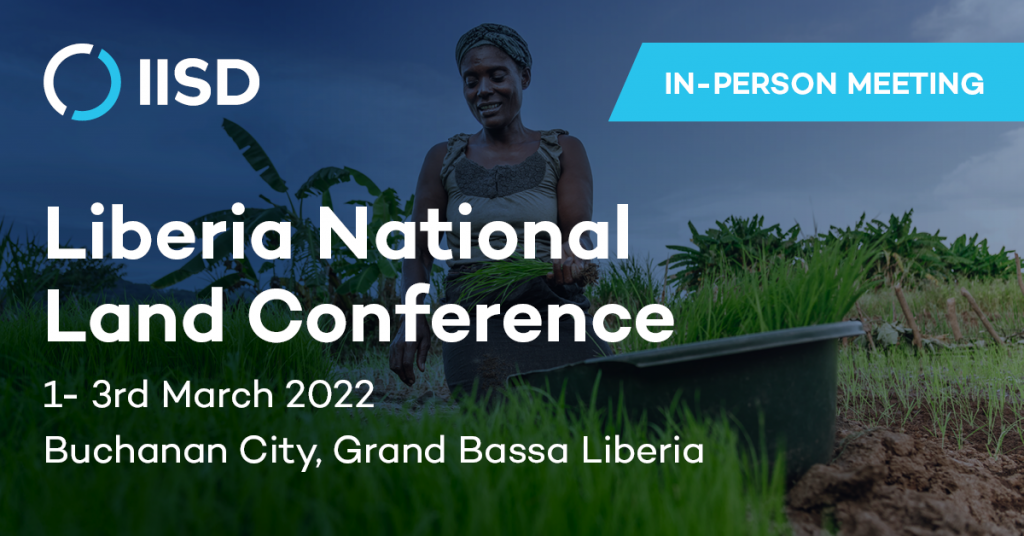
Liberia National Land Conference

March 1, 2022 3:00 am - March 3, 2022 11:00 am

Buchanan City, Grand Bassa, Liberia

(Open to public)

Event card

To help address some of the historical injustices of Liberia, a set of reforms was instituted by the post-war government of H.E. Ellen Johnson Sirleaf, who served as the 24th President of Liberia from 2006 to 2018. Among these reforms was the reform of the land sector. After a 5-year land reform process, in 2013, a policy framework called the Land Rights Policy (LRP) was adopted; 5 years later, the hailed Land Rights Act (LRA) was enacted in 2018. Within the context of inherited widespread food and land tenure insecurity, the historic passing of the LRA is the first step in a long and complex process ahead. Against this background, the National Land Conference will take stock of successes achieved so far, analyze and highlight challenges, identify opportunities, and generate recommendations and commitments for the way forward.  

IISD and the FAO will co-present a Policy Brief on Linkage of Tenure Rights to Responsible Agricultural Investment (RAI) and Food Security during this event.

IISD in the news

Exxaro, China's CNIC vie with AIIM for $2 bln African power firm Lekela - sources

South African miner Exxaro (EXXJ.J) and Chinese state fund CNIC are among potential buyers admitted to the final round of bidding for African renewable energy firm Lekela Power - a company worth around $2 billion, a number of sources familiar with the deal told Reuters.

February 18, 2022

IISD in the news details

IISD in the news

Experts call for Improved Protection of African Fisheries

With subsidies of global fisheries back on the World Trade Organization's agenda, experts are calling for African governments to upscale the protection of the sector long plagued by activities that continue to threaten the continent's blue economy.

November 11, 2021

IISD in the news details

Press release

Gabonese Parliamentarians Learn About Responsible Investment in Agriculture and Food Systems

November 8, 2021

November 8, 2021, Libreville - The Food and Agriculture Organization of the United Nations (FAO) and the International Institute for Sustainable Development (IISD) are launching a capacity-building program on responsible investment in agriculture and food systems for members of the Parliament of the Gabonese Republic. This initiative, conducted by the Gabonese Parliamentary Alliance for Food and Nutritional Security (APGSAN), aims to support members improve public policies that tackle hunger and malnutrition in the country. It is part of a series of trainings organized by the FAO for Gabonese parliamentarians.

Parliamentarians play an important role in guiding public investments, particularly in the agricultural sector, as they are responsible for passing laws, approving government budgets, and overseeing government action. Investing in agriculture is one of the most effective strategies for ending poverty and hunger. However, experience shows that not all investments are equally beneficial, and some carry risks for people and the environment.

The Principles for Responsible Investment in Agriculture and Food Systems (CFS-RAI Principles) is the world's leading policy instrument for defining how to achieve investments that generate long-term sustainable benefits. The instrument also outlines how agricultural investments should respond to development challenges such as food insecurity, climate change, and gender inequality.

The training program will provide Gabonese parliamentarians with the knowledge they need to optimize potential investments in the agricultural sector. Promoting transformative change at the national level to ensure responsible investment requires the right legal, institutional, and policy frameworks, which parliamentarians can help facilitate. The training is based on the handbook "Responsible Investments in Agriculture and Food Systems: A Practical Handbook for Parliamentarians and Parliamentary Advisors,, which was developed by FAO and IISD with inputs from parliamentarians and parliamentary advisors from different countries. The guide, which is also available in an interactive format, gives practical tools and concrete examples for parliamentarians to improve the legal and policy environment promoting responsible investment in agriculture. 

Following the launch of the handbook in Africa in December 2020, parliamentarians from different countries requested technical support to become more familiar with the tool and begin using it to improve and strengthen national legal and policy frameworks. Gabon has been chosen, along with the Republic of Congo, to benefit from such trainings, considering the priorities identified by the two national parliamentary alliances for food and nutrition security.  The Gabonese Parliamentary Alliance for Food and Nutritional Security (APGSAN) was created in October 2019 with the support of the FAO sub-regional office for Central Africa, and its office was opened on October 25.

For the French version of this press release, visit the FAO website. (Pour la version française de ce communiqué de presse, visitez le site de la FAO.)

 
Contact:

Patrice Etong-Oveng
Communications Consultant
Tel : +241 07331741
Email: [email protected]

Webinar

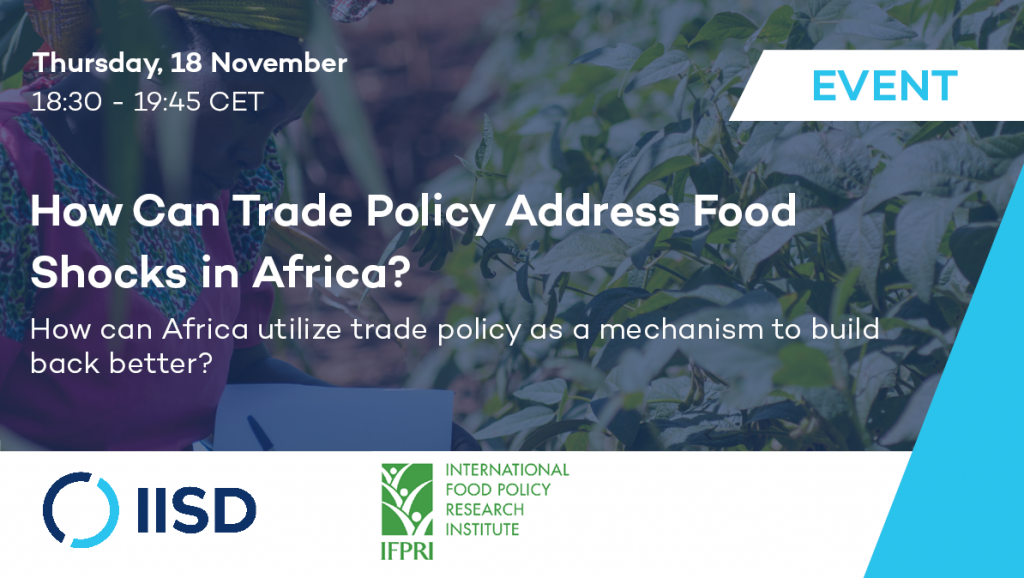
How Can Trade Policy Address Food Shocks in Africa?


November 18, 2021 12:30 pm - 1:45 pm CET

(By invitation)

Event-card-WTO-agriculture

Recent climate, political, and health shocks like the COVID-19 pandemic have exposed some of Africa’s greatest trade vulnerabilities but also highlighted the continent’s greatest opportunities for using trade policy as a mechanism to build back better.  This dialogue among trade experts and World Trade Organization (WTO) negotiators will weigh trade policy options in light of the findings from the recent 2021 Africa Agriculture Trade Monitor (jointly published by AKADEMIYA2063 and IFPRI) and IISD’s report on trade policies for food shocks. The dialogue will also explore the trade policy concerns of WTO negotiators representing African constituencies for the Twelfth WTO Ministerial Conference (MC-12). 

This is a joint event organized by the International Institute for Sustainable Development (IISD) and and the International Food Policy Research Institute (IFPRI). 

Date and time: Thursday, November 18, 2021, 18:30–19:45 CET 

Interpretation in English and French will be provided during the event  


IISD in the news

In a first, 4 West African countries commit to cooperate on Senegalo-Mauritanian Aquifer Basin

The Senegalo-Mauritanian Aquifer Basin is the largest in West Africa; Four countries have now agreed to cooperate on sharing it peaceably, setting a template for the world.

September 30, 2021

IISD in the news details

Webinar

Parliamentarian Action #6 | Gender equality action for climate resilient food systems: parliamentarians' perspectives

September 29, 2021 2:00 pm - 4:00 pm CEST

(Open to public)

Worldwide, the climate crisis is accelerating faster and more severely than previously anticipated. The Intergovernmental Panel on Climate Change Sixth Assessment Report predicts that the world will reach 1.5°C of warming in two decades, much earlier than anticipated. As the UN Climate Change Conference (COP 26) approaches and as leaders make new and ambitious commitments at the UN Food Systems Summit, it has become clear that collective action is necessary for enhancing gender-responsive and climate-resilient food systems. 

While the link between gender and climate change is not always obvious, evidence increasingly demonstrates that women and men experience climate change differently, that climate change increases women’s vulnerabilities, and that gender inequality worsens women's coping capacities. How do international policies and legal frameworks address the gender, climate change, and agriculture nexus? How does gender inclusion in climate change policies and the international debate improve the effectiveness of climate action? These are some of the questions that we explored during this event.

The sixth virtual dialogue of the Parliamentarians Actions for Gender Equality and Resilient Food Systems in Response to COVID-19 series, was  held on September 29, 2021, 14:00–16:00 CEST, and focused on the nexus of climate change, food systems, and gender equality.

Watch the recording of the event in English

Watch the recording of the event in French

Moderator: Kulthoum Omari-Motsumi, Gender and Climate Change Expert, IISD

Panellists

  • Sekou Sangaré, ECOWAS Commissioner for Agriculture, Environment and Water Resources
  • Zitouni Ould Dada, Deputy Director, FAO
  • Angie Daze, NAP Global Network, IISD
  • Hon. Joseph Kamano, MCA Maela and Chairman of the Sectoral Committee in Water, Sanitation, Environment, Energy and Natural Resources at Nakuru County Assembly
  • Pacome Guiraud, Gender Expert, UNDP, Cote d’Ivoire
  • Hon. Marie-Virginie Kouassi, President of the Caucus of Women Parliamentarians of Côte d'Ivoire
  • Colette Benoudji, Co-ordinator, LEAD, Chad
  • Hon. Barthelemy Kassa, Member of Parliament in Benin
  • Tasila Banda, National Project Coordinator, Zambia Integrated Forest Landscape, Government of Zambia
  • Nisreen Elsaim, UNFCCC constituency of Youth Non-Governmental Organizations (YOUNGO)

This virtual meeting is the sixth in a series of dialogues organized by the Food and Agriculture Organization of the United Nations (FAO), IISD, and Oxfam as part of their policy support to the Economic Community of West African States (ECOWAS) Network of Parliamentarians on Gender Equality and Investments in Agriculture and Food Security. The objective of the series is to enhance the role of African parliamentarians in mitigating the gender-differentiated impacts of COVID-19 on food systems.

Event hashtag: #ParliamentAction2020

IISD in the news

Jacqueville : des journalistes formés sur les questions "genre et climat" (in French)

L'atelier de renforcement des capacités des journalistes pour une meilleure prise en compte des questions "genre et climat", initié par le Réseau des femmes Journalistes et des Professionnelles de la Communication (ReFJPCI), avec l’appui du PNUD à travers le projet NDC Support Programme et l’Institut International pour le Développement Durable (IISD) du Réseau Mondial de PNA, s'est tenu du mercredi 08 au vendredi 10 septembre 2021 dans la cité balnéaire.

September 11, 2021

IISD in the news details

IISD in the news

AfDB to integrate natural capital into African finance

This week, the African Development Bank (AfDB) Group, Green Growth Knowledge Platform, and other partners will launch a new initiative on integrating natural capital into development finance in Africa.

September 6, 2021