Conference

COP 30 Side Event | Aligning Nationally Determined Contributions (NDCs) and NAPs: Coordinated climate governance across sectors, actors, and scales

November 17, 2025 2:00 pm - 3:00 pm BRT

(Open with a conference pass)

Effective implementation of climate actions requires more than ambitious commitments and plans—it demands coordinated governance across sectors, actors, and levels.

This side event will explore how countries in the Global South are addressing institutional fragmentation by strengthening multilevel, multi-sectoral, and multi-actor coordination mechanisms to support NAPs and nationally determined contributions (NDCs). Through Brazilian COP Presidency’s agenda inputs, country experiences, policy insights, and moderated discussion, this session will

  • examine approaches to enhance sectoral and vertical coordination;
  • foster inclusive participation across actors—from national governments, civil society, to the private sector, academia and Indigenous Peoples; and
  • align planning and budgeting frameworks.

Panelists will also highlight enabling conditions for effective coordination, including political leadership, institutional arrangements, and engagement of non-state actors, with a focus on how coordinated governance can support climate resilience, equity, and coherence between NDCs and NAP processes. 

Hosted by Brazil, Maldives, Peru, and NAP Global Network.

Conference

COP 30 Side Event | Island and Inland Voices: Advancing inclusive adaptation in Grenada and Eswatini

November 13, 2025 2:00 pm - 3:00 pm BRT

(Open with a conference pass)

This side event will bring together representatives from Eswatini and Grenada to reflect on their adaptation journeys and the lessons learned in advancing inclusive, country-driven national adaptation planning processes. The event will also highlight inclusive approaches, institutional leadership, and lessons learned from the countries' respective Small Island Developing State and a Landlocked Developing Country contexts. 

Hosted by the Government of Grenada and NAP Global Network.

Conference details

Conference

COP 30 Side Event | Demand-driven Support for Implementable Adaptation Plans

November 13, 2025 10:00 am - 11:15 am BRT

(Open with a conference pass)

Almost all countries now have a NAP process underway. The focus for the coming years, and thus the upcoming UNFCCC COP30, will be on accelerating the shift from planning to implementation of adaptation measures.

This side event will showcase lessons learned and invite reflections on opportunities to accelerate adaptation through collaboration, political support, and peer learning for implementable adaptation plans. 

Hosted by Netherlands' Ministry for Infrastructure and Water and NAP Global Network.

Conference details

Conference

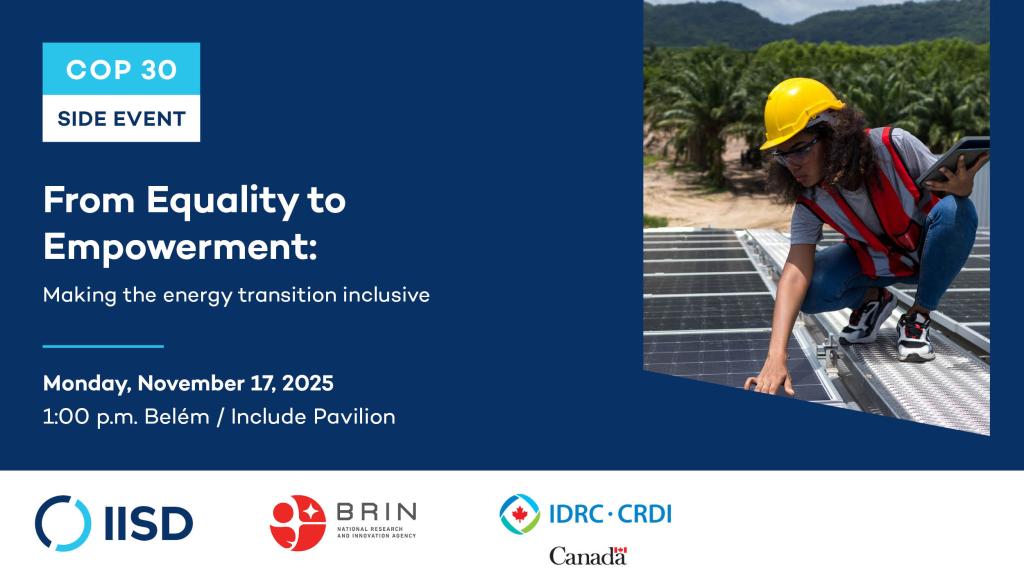
COP 30 Side Event | From Equality to Empowerment: Making the energy transition inclusive

November 17, 2025 1:00 pm - 2:00 pm BRT

Include Pavilion, Blue Zone

(Open with a UN pass)

Event card for 'From Equality-to-empowerment'

As countries accelerate the clean energy transition, there is growing recognition that energy policies often overlook the needs of women, youth, and marginalized communities. Without deliberate efforts to integrate social justice into energy policy design and implementation, the energy transition risks deepening inequality, including exclusion from access to energy, employment, and business opportunities.  

Yet the energy transition also presents a real opportunity for transformative change through positive impacts on women, youth, and marginalized groups. Three key areas for this are clean cooking, solar irrigation, and just transition.  

Globally, governments spend billions subsidizing liquefied petroleum gas (LPG), yet poor targeting leads to limited uptake of subsidized LPG by vulnerable households who continue to rely on biomass for cooking. In solar irrigation, government subsidy support is focused on individual solar pump ownership, which tends to exclude the poorest and women, who are not typically landowners. Lastly, falling demand for coal brings economic and social challenges for coal-producing economies. These shifts will have implications for women, informal workers, and other groups that are often underrepresented in traditional government consultation approaches. As governments shift public funds from fossil fuels to clean energy, emerging evidence suggests that energy policies can have more inclusive and sustainable outcomes.  

The COP 30 side event will invite experts from the energy, gender, development, business, and government sectors to share experience, innovations, and research on gender equity and social inclusion in clean energy transitions, particularly across three themes of clean cooking, solar irrigation, and just transition. This hour-long event will bring together researchers and practitioners to demonstrate that energy policy can better reflect the needs of women, youth, and disadvantaged groups through evidence-based and locally informed solutions.

This event is co-organized by the International Institute for Sustainable Development, the International Development Research Centre, and the  National Research and Innovation Agency.

Agenda

Welcome

Angie Dazé, Director, Gender Equality and Social Inclusion, International Institute for Sustainable Development

Keynote Addresses

Bhim Adhikari, Senior Program Specialist, International Development Research Centre

Franky Zamzani, Director, Climate Change Adaptation, Ministry of Environment, Republic of Indonesia

Christine Lins, Executive Director, Global Women's Network for the Energy Transition

Roundtable

Liane Schalatek, Director, Heinrich Böll Stiftung

Maxensius Sambodo, Senior Researcher, National Research and Innovation Agency 

Shruti Sharma, Lead for Affordable Energy, International Institute for Sustainable Development

Melanie Chiponda, Shine Collaborative

Closing Summary
Conference

COP 30 Side Event | Mobilizing Finance to Deliver on Global Goal on Adaptation: Pathways and partnerships for resilient food systems

November 18, 2025 4:45 pm - 6:15 pm BRT

(Open with a conference pass)

Achieving the Global Goal on Adaptation demands adequate and trackable financing for country-led adaptation solutions, yet this finance remains scarce, fragmented, and difficult to monitor, especially for vital climate-resilient food systems.

This side event, organized by IISD, CGIAR System Organization (CGIAR), and Biovision, seeks to move beyond principles and identify practical approaches for unlocking adaptation finance. It will convene policy-makers, funders, farmers' organizations, and researchers to focus on three key actions. 

First, participants will explore the direct link between UAE FGCR and specific national adaptation priorities, ensuring global ambition translates into concrete local plans. Second, the group will identify and vet innovative financing instruments and processes that can de-risk adaptation investments and effectively channel capital where it's most needed. Third, the session will pinpoint practical resources and methods for advancing the tracking of both adaptation finance and actions to examine their adequacy and effectiveness properly. 

Participants will examine barriers, identify policy enablers, and showcase replicable solutions and partnerships, ultimately identifying clear opportunities for immediately turning words into action.

Conference details

Conference

COP 30 Side Event | People, Policy, and Research Power to Document and Address the Health Harms of Fossil Fuels and Industry Practices

November 19, 2025 3:30 pm - 4:30 pm BRT

WHO Pavilion

(Open with a conference pass)

Continued reliance on fossil fuels presents a serious threat to human and planetary health, as the leading driver of climate change. This event emphasizes the health harms from air, water, and soil pollution, as well as industry practices that prioritize commercial profits over health.

This COP 30 side event seeks to highlight why action is needed to reduce fossil fuel industry influence, and how this can be achieved through multi-level public health action, drawing, for example, from a comprehensive policy framework used to tackle the tobacco industry.

Topics covered will include

  • health harms of the fossil fuel industry,
  • defending the right to health,
  • addressing the influence of high-emitting industries in climate policy-making and disinformation,
  • measuring the health costs of fossil fuel subsidies.

Conference details

Conference

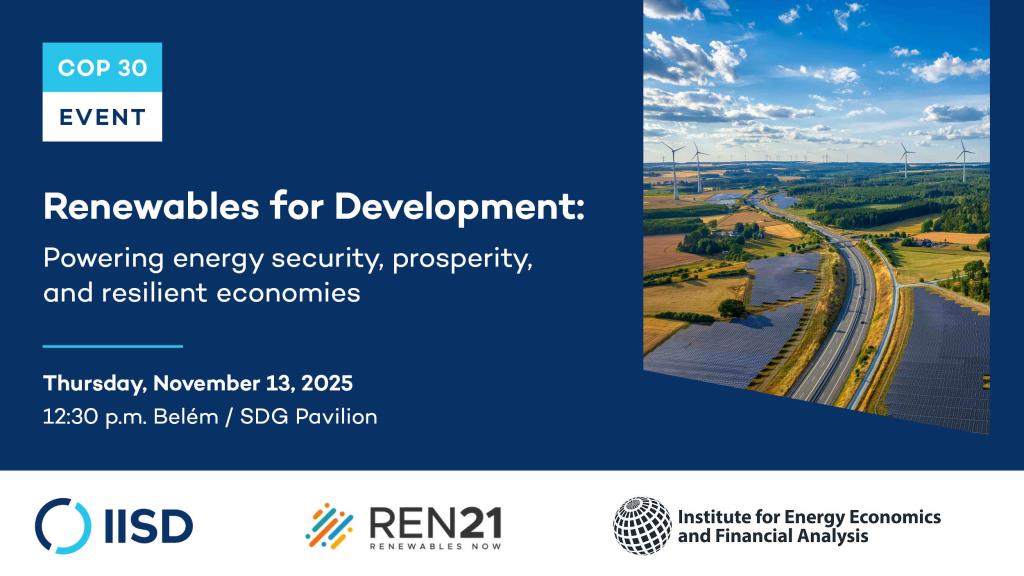
COP 30 Side Event | Renewables for Development: Powering energy security, prosperity, and resilient economies

November 13, 2025 12:30 pm - 1:30 pm BRT

SDG Pavilion

(Open with a conference pass)

COP 30 event card, renewables for development

Amid geopolitical instability, climate risks, and persistent inequality, renewable energy offers a pathway to build fair and resilient economies. Global electricity demand is projected to grow by around 4% between 2025 and 2027, with developing economies accounting for 85% of this additional demand. At the same time, 700 million people worldwide still lack access to electricity and over 2 billion to clean cooking. The rapidly falling costs of renewable energy and battery storage present a historic opportunity to meet rising demand for clean energy. New policy approaches can improve reliability and affordability, while also advancing energy security and enabling inclusive economic development.

This COP 30 side event will build on global insights into renewables-based economies, anchored in the perspective that integrated, renewables-based energy systems are essential for energy security and sustainable development.

The panel discussion will explore how renewable energy can serve as the backbone of energy security. For developing countries, renewables offer a pathway that is less resource dependent, more adaptable to external shocks, and aligned with economic and social goals.

Speakers will examine the enabling conditions needed for renewables to deliver energy security, resilient development, and stable economic benefits. Key themes will include finance and investment, system integration, job creation, and integrated planning for reliable renewables-based development.

The session will highlight concrete solutions, including demand-driven renewable energy approaches, such as India’s Firm and Dispatchable Renewable Energy model, to demonstrate how renewables can strengthen energy supply and advance prosperity for people and communities.

Agenda

Opening Remarks

Rana Adib, Executive Director, REN21

Panel Discussion
  • Jonas Kuehl, Senior Policy Advisor, International Institute for Sustainable Development
  • Ramon Mendez Galain, Former Energy Ministry, Uruguay
  • Lauren Hermanus, Founding Director,  Southern Transitions
  • Shantanu Srivastava, Research Lead, Sustainable Finance & Climate Risk, South Asia, Institute for Energy Economics and Financial Analysis
  • Clovis Zapata, Country Representative for Brazil, United Nations Industrial Development Organization
Q&A
Closing Remarks
Conference

COP 30 Side Event | From Policy to Practice: Scalable clean cooking solutions for the SDGs

November 18, 2025 10:30 am - 11:30 am BRT

SDG Pavilion

(Open with a conference pass)

Universal access to clean cooking is pivotal for achieving the Sustainable Development Goals (SDGs)—it protects health (SDG 3), empowers women and girls (SDG 5), advances affordable and clean energy (SDG 7), reduces inequalities (SDG 10), and supports climate action (SDG 13). Yet, billions of households still rely on polluting fuels.

Many countries have expanded clean cooking access through subsidized liquefied petroleum gas (LPG), but these subsidies often benefit wealthier households more than the poor and rarely reach those most in need—especially in rural and low-income urban areas outside formal LPG distribution networks. At the same time, LPG subsidies strain public budgets and expose governments to volatile markets and import dependence.

Clean cooking solutions, such as electric cooking powered by renewable energy and biogas, offer transformative alternatives. They reduce household air pollution, lower long-term energy costs, strengthen energy security, and accelerate progress across the SDGs.

This side event, co-hosted by the International Institute for Sustainable Development, National Research and Innovation Agency Indonesia, and Solar Cookers International, will showcase real-world, evidence-based, and inclusive clean cooking initiatives from India, Indonesia, and the Central African Republic. The discussion will highlight policies and partnerships needed to align national energy transitions with the SDG agenda—and to deliver universal, sustainable clean cooking for all.

Agenda

Opening Remarks

Anne Hammill, Vice President, International Institute for Sustainable Development

Panel Discussion

Polycarpe Mandayen, Central African Republic Ministry of Environment, Climate Technology Centre and Network Focal Point  

Shruti Sharma, Lead, India Program and Affordable Energy, International Institute for Sustainable Development

Caitlyn Hughes, Executive Director, Solar Cookers International

Maxensius Tri Sambodo, Senior Researcher, National Research and Innovation Agency, Indonesia

Mariam Amoudou Sidi, Central African Republic Civil Service Gender and Climate Change Focal Point

Q&A
 

Conference details

Conference

COP 30 Side Event | Redirecting Subsidies and Investments to Enable Regenerative and Inclusive Food Systems

November 14, 2025 5:00 pm - 6:00 pm BRT

(Open with a conference pass)

Agricultural subsidies and incentives are the largest source of public investment in food systems, yet they often favour large-scale, unsustainable production that drives deforestation, biodiversity loss, and inequality. Meanwhile, smallholders—vital to food security—face declining productivity from climate shocks and soil degradation.

This session, organized in partnership with the Rockefeller Foundation, Porticus and the Institute for Climate and Society, was held at the COP 30 Food Systems Pavilion. 

Discussions centered on how innovative finance and governance mechanisms can realign subsidies and incentives to advance regenerative, inclusive food systems. It convened governments, researchers, investors, and philanthropies to discuss how reformed incentives can boost productivity, resilience, and equity for smallholder farmers amid growing climate and market pressures.

Key takeaways

  • Agricultural subsidies need reform because many currently support practices that harm soil, biodiversity, and the climate.
  • Redirecting subsidies toward regenerative and inclusive farming can strengthen food systems and support climate and equity goals.
  • Smallholder and family farmers struggle to access existing subsidies due to bureaucracy, low awareness, and limited technical assistance.
  • Brazil’s experience shows both the challenges and opportunities in aligning subsidy programs with sustainability objectives.
  • Collaboration across government, philanthropy, civil society, and the banking sector is essential—especially in Brazil, where the Bank of Brazil delivers subsidized credit.
  • Better communication and outreach are needed to help farmers understand and use available programs.
  • The goal isn’t to reduce public spending, but to invest it more strategically in practices like agroforestry and soil restoration.

Conference details

Conference

IISD at IUCN World Conservation Congress

October 9, 2025 8:00 am - October 15, 2025 8:00 pm GST (GMT +4)

Abu Dhabi, United Arab Emirates
Abu Dhabi National Exhibition Centre

(Open to public)

The forthcoming International Union for Conservation of Nature (IUCN) World Conservation Congress (WCC) will take place in Abu Dhabi, United Arab Emirates (UAE), from October 9 to 15, 2025. Held every 4 years since 1948, the Congress brings together world leaders and decision-makers from government, civil society, Indigenous communities, business, and academia to advance solutions that protect and restore the environment, as well as harness the power of nature to address global challenges. 

This year’s Congress comes at a pivotal moment: only 5 years remain to achieve the 2030 targets of the Paris Agreement and the Sustainable Development Goals. With urgency and ambition, WCC 2025 will focus on accelerating action and scaling up collaboration to ensure that sustainability efforts are effective, equitable, and just. Discussions will centre on five priority themes:

  • scaling up resilient conservation action
  • reducing climate overshoot risks
  • delivering on equity
  • transitioning to nature-positive economies and societies
  • disruptive innovation and leadership for conservation 

The International Institute for Sustainable Development (IISD) will contribute to these conversations by sharing expertise and insights from its work to halt biodiversity loss, strengthen environmental protection, and scale up nature-based solutions (NbS) where they are most urgently needed. Our experts will participate in events and discussions, highlighting activities and achievements of IISD’s NbS projects, particularly the Scaling Nature-based Solutions for Climate Adaptation in Sub-Saharan Africa (SUNCASA) and Climate Adaptation and Protected Areas (CAPA) initiatives

Both projects will be featured during the session “From cities to parks: Nature-based solutions for climate resilience,” which will present preliminary findings from the integrated cost-benefit analysis conducted by the Nature-Based Infrastructure Global Resource Centre in SUNCASA cities: Dire Dawa, Ethiopia; Kigali, Rwanda; and Johannesburg, South Africa. In addition, the CAPA Initiative will launch a new infographic on conflict-sensitive NbS for climate adaptation.  

Do you want to learn how to analyze the economic performance and co-benefits of nature-based infrastructure? Don't miss the NBI Centre's free 5-week live program!

See below for the full list of IISD’s participating events at the IUCN World Conservation Congress 2025.

Follow IISD Earth Negotiations Bulletin coverage of the Congress.


Building the Future: Approaches to Nature-Positive Infrastructure Development

Date: Friday, October 10, 2025

Time: 4–5:30 p.m. (GMT +4)

Location: Virtual Channel 1

Mainstreaming biodiversity is key to ensuring a prosperous future for people and the planet. But is it feasible? This virtual session will explore challenges, share insights, and discuss opportunities to integrate nature into infrastructure development.

Speakers

  • Rodney van der Ree, WSP Australia and The University of Melbourne
  • Anna Ackermann,  International Institute for Sustainable Development (IISD)
  • Marina Kosmus, Competence Centre Biodiversity, Forests and Agriculture, GIZ
  • Savina Carluccio, International Coalition for Sustainable Infrastructure
  • Johan Robinson, GEF Biodiversity and Land Degradation Unit, UNEP
  • Umang Bhattarai, Asian Development Bank
  • Evan Freund, WWF


From cities to parks: Nature-based Solutions for climate resilience

Date: Saturday, October 11, 2025

Time: 2–3:30 p.m. (GMT +4)

Location: Canada Pavilion

This 90-minute session, co-organized by IISD and Parks Canada, will highlight challenges, achievements, and lessons learned from implementing the SUNCASA and CAPA projects in protected and urban areas across sub-Saharan Africa, the Caribbean, and Oceania. 

The session will feature presentations from local implementing partners in Belize, Rwanda and Zambia, offering insights into on-the-ground experiences. Attendees will also participate in an interactive world café activity, rotating through three stations to discuss the following:

  • promising practices and opportunities for scaling up NbS in urban and protected area contexts
  • key barriers and challenges to implementation
  • strategies for integrating gender-responsive and socially inclusive considerations

The session will conclude with a plenary discussion, where participants will share key takeaways and reflections from the conversations, fostering actionable insights for advancing NbS globally.

Speakers


Environmental Change and Migration

Date: Thursday, October 9, 2025

Time: 3–3:45 p.m. (GMT +4)

Location:  IUCN Commissions Knowledge Hub

Migration of people and species shapes the future of conservation. By understanding movement patterns driven by environmental change and conflict, we can better anticipate pressures on ecosystems. This session will look at strategies for addressing the intersections of climate change, migration, and conservation, including innovative policies and cross-sector collaboration. Participants will leave the event equipped to adapt conservation planning and management to dynamic, complex migration challenges.


Conflict-sensitive conservation in practice: Learning from peers

Date: Friday, October 10, 2025

Time: 2–2:40 p.m. (GMT +4)

Location: Conference Hall B: Session Room 8

Many biodiversity hotspots are located in regions affected by conflict, instability, or weak governance, making conservation goals harder to achieve. This session will showcase lessons from conservation practitioners on conflict-sensitive conservation and introduce a new free, online conflict-sensitive conservation course, hosted by the IUCN Academy.

The session is a collaborative effort between IISD, PeaceNexus Foundation, Africa Wildlife Foundation, Conservation International, Environmental Peacebuilding Association/Environmental Law Institute, Global Youth Biodiversity Network, IUCN (CEESP and Academy), and WWF. 

Discussions will explore these topics:

  • integrating conflict sensitivity and rights-based approaches
  • ensuring inclusivity and a gender-responsive approach
  • particular challenges and opportunities for young conservation activists
  • monitoring, evaluation, and learning in conflict-sensitive conservation


How can we empower community ownership of ecosystem-based adaptation at scale?

Date: Monday, October 13, 2025

Time: 2–3 p.m. (GMT +4)

Location: IUCN Programme 2026-2029 Pavilion - R2

This interactive session will explore how community-led ecosystem-based adaptation can drive scalable, inclusive climate resilience. Drawing on lessons from the CBAScale+ project in southern Africa, participants will learn about participatory processes, gender-responsive approaches, and policy integration in community-based adaptation. Voices from government, technical teams, and development partners will share insights on responding to climate risks through participatory approaches, fostering both resilient communities and ecosystems.