Government support is more important than ever for the energy transition in the wake of COVID-19. Shifting government support from fossil to clean energy can ensure that every rupee of public money helps in achieving the goals of access, energy security, and the shift to a low-carbon economy.
The session, hosted by IISD and the Council on Energy, Environment and Water (CEEW), features insights on how the Government of India has used subsidies to support different types of energy from FY 2014 until FY 2020, and describes major shifts since the onset of COVID-19. Further, we explore how subsidy policy can best promote solar photovoltaic (PV) manufacturing, and how investments by Public Sector Undertakings (PSUs) are supporting the clean energy transition.
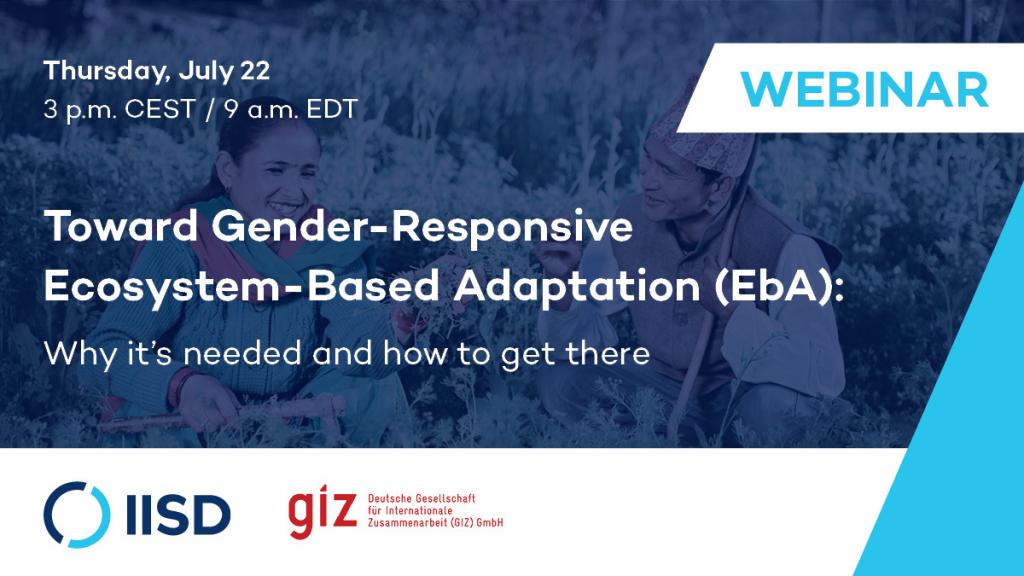
Toward Gender-Responsive Ecosystem-Based Adaptation (EbA): Why it’s needed and how to get there
The International Institute for Sustainable Development (IISD), in partnership with the Global Project Mainstreaming EbA, have co-organized the upcoming online session on how to ensure a gender-responsive approach to Ecosystem-based Adaptation (EbA).
As a type of nature-based solution, Ecosystem-based Adaptation (EbA) uses natural systems to build resilience to climate change while generating social and economic returns and providing multiple benefits, including improved health, biodiversity protection, food security, and alternative livelihood opportunities.
Following this, participants will have the opportunity to learn from an on-the-ground case of gender-responsive EbA in Nepal. Interactive components will allow for the sharing of participants' own experiences with the topic.
Speakers:
Angie Dazé, Senior Policy Advisor and Lead, Gender Equality, IISD
Gender-responsive EbA – insights from a new publication
Manorama Sunuwar, Gender Equality and Social Inclusion Coordinator, CARE Nepal
Putting a gender-responsive approach to EbA into practice - an example from Nepal
Building Post-COVID Recovery Around Wealth Rather than GDP
How can measures of wealth that go beyond GDP be used to prioritize post-COVID recovery actions and contribute to SDGs? Find answers at this HLPF side event.
Expanded measures of wealth (“comprehensive” or “inclusive” measures) that complement GDP are under development by UNEP, the World Bank, the Bennett Institute at Cambridge University and the International Institute for Sustainable Development, among other prominent organizations. They are critical to helping governments deploy policies to improve well-being without depreciating natural capital, as the recent Dasgupta Review highlighted. This side event will introduce examples of expanded wealth measures and demonstrate how they can be used to prioritize post-COVID recovery investments while promoting and contributing to SDGs 8, 13, and 17.
The potential for decision-makers to increase national wealth and well-being by basing decisions on expanded wealth measurements is significant during the unprecedented post-COVID recovery period. The pandemic has highlighted the need for broader measures of wealth to understand socio-economic resilience under stress. As one example, tracking financial assets as part of a country’s wealth portfolio can demonstrate the under-recognized need for financial resilience. Financial assets are important elements of a wealth portfolio, along with produced, human, natural and social capital, to see a country (or a family) through difficult times.
The side event will draw on an ongoing initiative on “Measuring Comprehensive Wealth to Promote Inclusive and Sustainable Development” implemented by the International Institute for Sustainable Development and supported by Canada’s International Development Research Center (IDRC). The event will bring together leading experts in the area and provide insights on:
What types of investments and policy measures would be the most relevant to expand countries’ wealth and address post-COVID needs?
How can we strengthen resilience by better measuring wealth?
What are the capacity needs at the country level to advance the integration of wealth measures to address post-COVID needs and build resilience?
Moderator: Dominque Charron, Vice-President, Programs and Partnerships (International Development Research Centre, IDRC)
Presenters:
Rob Smith, Principal, Midsummer Analytics, and Senior Associate, International Institute for Sustainable Development (IISD)
Pushpam Kumar, Chief Environmental Economist, United Nations Environment Programme (UNEP)
Matthew Agarwala, Project Leader, Bennett Institute for Public Policy, University of Cambridge
Alin Halimatussadiah, Assistant Professor, Faculty of Economics and Business, Universitas Indonesia
One year ago, the United Nations High-level Political Forum on Sustainable Development (HLPF) was the first major global gathering to keep its full schedule when it pivoted to a virtual setting. The pandemic had only been declared four months previously. Disastrous waves of infections had yet to strike. Privileged governments were still in the early days of deploying massive stimulus packages.
As the 2021 HLPF approaches, there’s cause for hope and concern. Approved vaccines are blunting COVID case numbers in some parts of the world; in others, shots are a rare or non-existent treasure. Economic relief has flowed to some people and environmentally sustainable sectors, but dollars have also gone to high-polluting industries while missing marginalized groups.
With a world reeling from the health and economic impacts of COVID-19, how will the HLPF build momentum for the 2030 Agenda and bolster commitments to Leave No One Behind?
The International Institute for Sustainable Development invites you to a panel discussion and Q&A session the day after the Forum closes, answering:
How did the second virtual HLPF go?
What challenges were identified and what themes emerged for moving forward with SDG implementation as we “recover” from the global pandemic?
Where does the 2030 Agenda go from here?
IISD’s team of experts will provide a brief snapshot of the HLPF’s proceedings and challenges in the coming year.
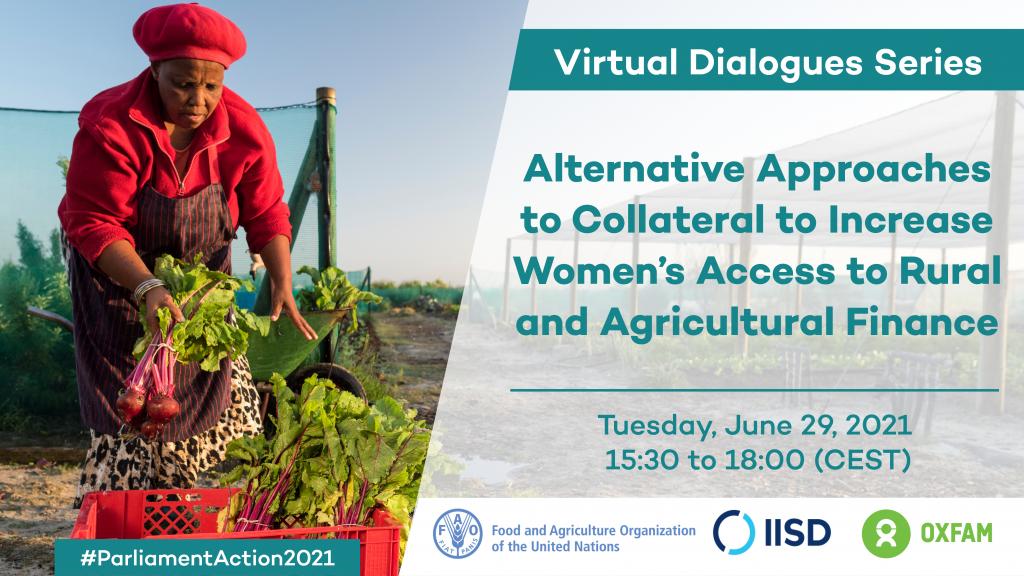
Parliamentarian Action #5 | Alternative Approaches to Collateral to Increase Women’s Access to Rural and Agricultural Finance
June 29, 2021 3:30 pm - 6:00 pm CEST
(Open to public)
Agricultural lending is considered "high risk" by formal financial institutions, as farmers are more vulnerable to changes in weather, rainfall levels, pests, and infestations, as well as price fluctuations. As a result of these perceived and actual risks, loans for smallholder farmers require high rates of collateral. This situation is exacerbated for rural women, who often do not inherit and possess assets or properties that can be accepted by formal financial institutions as conventional forms of collateral.
This virtual dialogue of the Parliamentarians Actions for Gender Equality and Resilient Food Systems in Response to Covid-19 series brought together parliamentarians, financial institutions, and other main stakeholders to discuss the importance of developing alternative approaches for risk sharing and management that can increase women’s access to finance through alternative collateral requirements.
This dialogue sought to:
1) Raise awareness on the specific constraints and challenges faced by rural women in accessing finance along with their interlinkages with rural poverty and food insecurity, as well as potential opportunities to ensure women’s financial inclusion.
2) Share existing public policies and strategies in the African region to develop nonconventional collateral approaches targeting rural areas, in order to enhance the capacity of parliamentarians to engage with financial institutions and other stakeholders to strengthen national financial markets through the promotion and adoption of regulatory and legislative frameworks.
3) Promote an exchange of knowledge, experiences, and good practices among parliamentarians, international organizations, financial institutions, women's organizations and other relevant stakeholders on specific measures and approaches to promote rural women’s access to finance.
This was the fifth virtual dialogue in the Parliamentarians' Actions for Gender Equality and Resilient Food Systems in Response to COVID-19 series. It was held on June 29, 2021, from 15.30 to 18.00 CEST.
It was part of a series of dialogues organized by the Food and Agriculture Organization of the United Nations (FAO), International Institute for Sustainable Development (IISD), Women in Law & Development in Africa (WiLDAF) and Oxfam as part of their policy support to the Economic Community of West African States (ECOWAS) Network of Parliamentarians on Gender Equality and Investments in Agriculture and Food Security. The objective of the series is to enhance the role of African parliamentarians in mitigating the gender-differentiated impacts of COVID-19 on food systems.
Watch the virtual dialogue's full recording
Assista à íntegra do diálogo virtual em língua portuguesa
While investments and policies are moving away from coal, the key debate is now about ending international support to other fossil fuels, in particular natural gas, in order to respect the Paris Agreement’s goals. As the gas industry advocates for the Global South to expand gas consumption and production, there is an urgent need to avoid locking in a high-carbon future. Instead, there is a huge untapped potential to deploy clean alternatives at scale in the Global South and meet energy access and development needs.
At the G7 Leaders summit in June, countries committed to “phase out new direct government support for international carbon-intensive fossil fuel energy as soon as possible, with limited exceptions consistent with an ambitious climate neutrality pathway, the Paris Agreement, 1.5°C goal and best available science.” But in order to realize this commitment, more public finance institutions and governments must join progressive players in ending public support for oil and gas.
Building on previous announcements and latest research, this event outlined the decisive role that international public finance plays in accelerating the transition from fossil fuels to clean energy in the Global South, noting opportunities and challenges in doing so.
Speakers from civil society, governments, and public finance institutions discussed the conclusions of the Step Off the Gas report and highlighted best practices to move away from fossil fuel finance—including gas—and scale up investments in clean alternatives. They identified necessary steps ahead of COP26 to accelerate progress on this agenda.
After opening words and presentations from the German Federal Ministry for the Environment, Nature Conservation and Nuclear Safety (BMU) and IISD, speakers engaged in a panel discussion on perspectives and opportunities to shift international public finance from fossil fuels to clean energy.
This webinar is hosted by the International Institute for Sustainable Development (IISD) and the Deutsche Gesellschaft für Internationale Zusammenarbeit (GIZ).
Agenda
Opening Remarks
Moderator: Dr. Mike Enskat, Head of Energy, Water, Mobility, Deutsche Gesellschaft für Internationale Zusammenarbeit (GIZ)
Norbert Gorißen, Deputy Director General for International Policy, German Federal Ministry for the Environment, Nature Conservation and Nuclear Safety (BMU)
Presentation of Report Findings
Greg Muttitt, Senior Policy Advisor, International Institute for Sustainable Development
Discussion
Sandra Guzmán, General Coordinator, Climate Finance Group for Latin America and the Caribbean (GFLAC) John Murton, COP26 Envoy, Government of the United Kingdom Tomas Anker Christensen, Climate Ambassador, Government of Denmark
Webinar | Approaches to Progress Reporting on National Adaptation Plan (NAP) Implementation
How can a country report on the progress and results of their adaptation actions? On June 24, the NAP Global Network will host a webinar to present our review of available NAP progress reports, ask country partners about their experiences, and derive lessons to guide national governments through this process.
A progress report for a National Adaptation Plan (NAP) can serve to inform government workers, the general public, and the international community about what is working to build resilience to climate change and what is not, in which contexts, and why. This is essential for accountability purposes, as well as for learning and improving the next version of the NAP.
Over ten countries have reported progress on their NAP so far—a handful have even reported more than once—while others are currently going through the exercise for the first time. As more and more countries start implementing NAP processes and develop monitoring, evaluation, and learning (MEL) systems, the question of how to report on the progress and results of adaptation actions to different stakeholders, from local to international levels, becomes more urgent.
In May 2021, the NAP Global Network conducted a review of the available NAP progress reports. The results indicate that these reports use different objectives, approaches to evaluating progress, and ways in which the results are presented and communicated. The process of developing a progress report seems to present as many challenges as it does opportunities to strengthen NAP processes.
Join this event to look at what has already been done in terms of NAP progress reporting and derive lessons that could guide countries through the reporting process.
As governments and stakeholders work to develop policies that can promote the massive economic transformation that sustainability requires, there is increasing interest in the role that trade and trade policy can play. This effort has become even more urgent in response to the COVID-19 pandemic and calls to “build back better” through stimulus and recovery packages.
The United Nations Sustainable Development Goals (SDGs) highlight trade as a key means of implementation, and many SDGs have trade dimensions. Progress on achieving the SDGs and their underlying targets has been slow, however, despite public pressure for increased action by governments to respond to urgent global crises in biodiversity, climate, and pollution, and to take action to “green” the global economy and trade.
The World Trade Organization’s (WTO's) “Aid for Trade Initiative” is one area where this discussion is developing quickly. As WTO Members review progress to date and prepare the Aid for Trade work program from 2022 onward, ensuring that these efforts incorporate sustainability considerations will be critical to ensuring a robust, green, and inclusive recovery.
This webinar examined the above-mentioned considerations and was held on June 24, 2021, at 3:30 p.m. CEST. The event was co-hosted by the International Institute for Sustainable Development (IISD) and the Forum on Trade, Environment and the SDGs (TESS).
The event featured an introduction to a new joint publication (forthcoming) by IISD and TESS on Greening Aid for Trade.
The webinar addressed the following topics:
Priorities from the perspective of beneficiary countries and developing country stakeholders
Trade-related aspects of environmental challenges facing developing countries in the context of the SDGs, combining social, economic, and environmental aspects
How Aid for Trade can support opportunities for green trade and economic diversification and bolster climate-resilience and readiness
Opportunities for synergies with other sources of environment, development and trade finance focused on green economy goals
Research and data needs, and options for further discussion
Nathalie Bernasconi-Osterwalder, Executive Director, IISD Europe
Carolyn Deere Birkbeck, Director, Forum on Trade, Environment & the SDGs
Michael Roberts, Aid for Trade Coordinator, Development Division, WTO
Olivier Cattaneo, Head, Policy Analysis and Strategy Unit, Development Co-operation Directorate, Organisation for Economic Co-operation and Development (OECD)
Discussants:
H.E. Dr. Muhammad Mujtaba Piracha, Ambassador/Permanent Representative to the World Trade Organization, Pakistan
Annegret Brauss, Coordinator, “GreenToCompete” Initiative, International Trade Centre (ITC)
Webinar | The End of Tax Incentives: What will a global minimum tax mean for developing countries?
This webinar will connect policy makers, academics, and activists working on trade, investment and tax to discuss the global minimum tax proposal and how it could affect developing countries and the use of tax incentives.
In early June, the G7 reached a “historic” deal to make multinational companies pay more tax. They agreed to introduce a global minimum corporate tax rate of at least 15% to try to stop tax competition. Pressure is on other countries to follow suit, including at a meeting of the G20 at the end of the month, and the OECD/G20 Inclusive Framework in early July.
However, tax justice campaigners argue that 15% is too low and will be inadequate to stop the “race to the bottom”. They also say that a rate of 15% will see 60% of the additional revenues flow to the G7 countries, leaving very little for developing countries most in need of funds especially amid the COVID-19 pandemic.
On June 23, the International Institute for Sustainable Development (IISD) hosted a webinar convening policy makers, academics, and activists working on trade, investment, and tax to discuss the contents of the reforms, where and how the rate should be set, how a global minimum tax may affect the use of tax incentives in developing countries, the impact of fiscal stabilization in investment agreements, and dispute resolution.
Panelists included experts that helped produce work by IISD (through IGF) and the African Tax Administration Forum, on the implications of the reforms for resource-rich developing countries in particular.
The Why and How of Investment Dispute Prevention and Management Agencies – Sharing country experiences
June 25, 2021 3:00 pm - 4:30 pm CEST
(Open to public)
Due to the growing controversies around investor–state dispute settlement (ISDS), increasing attention is being given to alternatives, either as complements or replacements for existing ISDS mechanisms. One such alternative comes in the form of investment dispute prevention and management agencies (DPMAs). These are specialized agencies or functions with the responsibility of coordinating stakeholders involved in potential investment disputes. The aim is to deescalate tensions among stakeholders and to address potential disputes before they arise.
Some countries have put the concept into practice, each with different designs and ways of operating. How do these DPMAs operate and what are their effects in practice? Have they proven to be an effective alternative to address investment-related disputes? Will they introduce new risks? What are some criteria governments may want to consider in designing and establishing effective DPMAs? What roles can international institutions have in this process?
This webinar built on the research findings of a forthcoming IISD publication by Jonathan Bonnitcha and Zoe Phillips Williams, and aimed to start a discussion on these questions so policy-makers can make informed decisions on this topic.