Webinar

Financing a Just Energy Transition Through Fossil Fuel Subsidy Reform

June 20, 2023 4:30 pm - 6:00 pm IST

via Zoom

(Open to public)

Developing countries require financial resources to address climate change, reduce greenhouse gas emissions, and promote adaptation, but they often lack funding. Developed countries have pledged to provide climate finance to developing countries, but support is slow to arrive. Fossil fuel subsidy reform could help developing countries unlock a large amount of funding to support climate mitigation and adaptation, but this will require shifting financing away from fossil fuels and toward a just energy transition.

In 2009, G20 members committed to phasing out and rationalizing fossil fuel subsidies in the medium term. As of 2022, fossil fuel subsidies have not been phased out; instead, they exceeded USD 1 trillion globally for the first time—largely due to governments’ increased subsidies to cushion consumers from rising energy prices.

This official Civil 20 (C20) side event discusses the challenges and opportunities of reforming fossil fuel subsidies for different G20 members. It looks at options for generating new and additional sources of climate finance and for ensuring social and climate justice. The webinar includes input from speakers from Argentina, Brazil, India, Japan, and South Africa.

Agenda

Welcome

Opening Remarks

Vinod Menon, C20 Working Group Coordinator for Sustainable and Resilient Communities, C20

Presentation: Unlocking Finance with Fossil Fuel Subsidy Reform

Shruti Sharma, Senior Policy Advisor, IISD

Interventions from G20 Member Countries

Argentina | Guillermina French, Research Assistant, FARN

Brazil | Livi Gerbase, Policy Advisor, INESC

South Africa | Richard Bridle, Senior Policy Advisor, IISD

Japan | Kimiko Hirata, Executive Director, Climate Integrate

Panel Discussion

Christopher Beaton, Lead Sustainable Energy Consumption, IISD
Sanjay Vashist, Director, Climate Action Network South Asia
Chandra Bhushan, Founder and CEO, iForest
Kimiko Hirata, Executive Director, Climate Integrate
Q&A

Closing Remarks

Webinar

Border Carbon Adjustment Measures: Informal Technical Dialogue for Capital-Based Officials of Concerned Trade Partners

June 7, 2023 5:00 am - 6:30 am CEST

(By invitation)

BACKGROUND

As countries consider more ambitious climate mitigation policies to accelerate reductions of emissions and meet the Paris Agreement goal of limiting global warming to 1.5 degrees by 2030, “border carbon adjustment” (BCA) schemes have been increasingly considered as a potential trade policy tool. The European Union has already taken the first step and adopted a “Carbon Border Adjustment Mechanism” (CBAM) which entered into force on 17 May 2023. BCAs are also being considered in other jurisdictions, such as Canada and the United Kingdom.

The debate on BCA has gained momentum, including in the context of the multilateral trading system where cooperative approaches to BCAs have begun to be called for to ensure the inclusion of concerns of all trading partners. To proponents, BCA is key to preventing carbon leakage, that is, the increase of emissions abroad in response to strong domestic climate policies. They consider it also a potential for incentivising carbon pricing and carbon footprint reductions in partner countries. On the other side, BCA will have direct impacts on trading partners that export goods in the concerned sectors. Developing countries have been particularly vocal on their concerns towards BCAs, including their potential to disguise protectionism and create trade distortions and their non-consideration of the principle of Common but Differentiated Responsibilities and Respective Capacities (CBDR-RC) that is at the heart of multilateral climate action. Many also question the effectiveness of BCAs in incentivising carbon emission reductions.

ABOUT THE EVENT

IISD, in collaboration with CUTS International Geneva, organized a technical webinar for the capital-based officials of concerned WTO Members who are likely to be affected by BCAs. The event offered participants an opportunity to learn about the latest developments regarding BCAs, share their concerns regarding BCA proposals, and exchange views on options to address concerns and integrate development dimensions in BCA designs, as well as review the possibilities for stronger international cooperation while developing such instruments. This event follows on from an informal dialogue organised for Geneva-based delegates of these same WTO Members earlier this year, and was designed to provide capital-based officials with the opportunity to hear and discuss the material presented at the previous event, with updates to reflect developments.

AGENDA

11:00 – 11:10 Welcome Remarks

11:10 – 11:25 Scene-setting: State of Play of BCA discussions and Key Policy Questions

11:25– 11:40 Potential Implications for Developing Countries

11:40– 12:20 Open discussion
12:20 – 12:30 Closing Remarks

Webinar

Something Old, Something New: Help us launch IISD-ELA’s 55th research season

For over 50 years the world’s freshwater laboratory has been at the forefront of scientific innovation in Canada.

June 29, 2023 12:00 pm - 1:00 pm CDT

(Open to public)

Even our approach to exploring threats to freshwater lakes by researching on and manipulating them directly over the long term was—and still is—unique in the world.

As we at IISD Experimental Lakes Area hit our 55th year, we’re not letting up on innovating any time soon, from tracking the health of our lakes from the comfort of our desks to scraping mucus—yes, mucus—off a fish to learn more about its health.

(And while those new approaches to science are critical, there are some more traditional ways of researching our fresh water—like donning a pair of waders—that we can’t see abandoning any time soon.)

On Thursday, June 29, 2023, at 12:00 p.m. (CDT), join us for an hour-long virtual launch of our new research season, where we will celebrate our traditional and innovative approaches to what we do, as well as explain what we are setting out to discover this summer.

SPOILER ALERT: This includes 33 billion particles of plastics and some used car tires …

Register HERE.

Webinar

High-Level Political Forum 2023 Debrief

Experts provided a brief snapshot of the proceedings at the 2023 High-Level Political Forum on Sustainable Development, and their linkages to the SDG Summit and 2024 Summit of the Future

July 25, 2023 9:00 am - 10:00 am EST

(Open to public)

The SDG Lab, Cepei, and IISD held a panel discussion and Q&A session after the 2023 High-Level Political Forum on Sustainable Development (HLPF) closed.

Experts provided a brief snapshot of the proceedings at the 2023 HLPF, and their linkages to September’s SDG Summit and 2024 Summit of the Future, answering:

  • How did the HLPF go?
  • What challenges were identified and what themes emerged for moving forward with the implementation of the Sustainable Development Goals (SDGs)
  • Where does the 2030 Agenda go from here?
Webinar

What to expect at the HLPF: Building momentum towards the SDG Summit and beyond

The SDG Lab, Cepei, and IISD hosted a virtual briefing and question/answer session on the 2023 High-Level Political Forum on Sustainable Development (HLPF). What should you expect as the 2023 HLPF approaches, and how is this year’s forum connected to the SDG Summit and setting the scene for the 2024 Summit of the Future?

July 6, 2023 9:00 am - 10:30 am EST

(Open to public)

Each year, countries gather at the United Nations at the High-level Political Forum on Sustainable Development (HLPF) to report their successes and challenges in bringing the 2030 Agenda and its Sustainable Development Goals (SDGs) to life.

Hosted by CEPEI, the SDG Lab, and the International Institute for Sustainable Development, this webinar unpacked the main expectations at this year’s HLPF, including reviewing the main findings from two reports which will inform the SDG Summit: the Global Sustainable Development Report 2023, and the report by the High-Level Advisory Board on Effective and Inclusive Global Governance. At the same time, this webinar explored linkages with the 2023 SDG Summit and the 2024 Summit of the Future. 

Agenda

  • Welcome by moderator | Philipp Schönrock, Cepei Director
  • HLPF 2023 in focus | Friedrich Soltau, Senior Sustainable Development Officer, UNDESA
  • GSDR Main findings | Norichika Kanie, Professor, Graduate School of Media and Governance, Keio University, Japan
  • Connecting HLPF to SDG Summit & Summit of the Future | Oezge Aydogan, Director, SDG Lab at UN Geneva, and Stefan Jungcurt, Lead II, SDG Indicators and Data, IISD
  • Wrap Up and Staying Connected During HLPF | Philipp Schönrock, Cepei Director
  • Q&A Expectations from Participants | Audience and Panel
Webinar

Media Briefing on Carbon Border Adjustment Mechanism

May 26, 2023 4:00 am - 5:00 am CEST

(By invitation)

BACKGROUND

The EU's pioneering Carbon Border Adjustment Mechanism (CBAM) is the beginning of new policies to come. Several other countries are considering similar measures to tackle emissions-intensive heavily traded sectors and as more jurisdictions implement carbon pricing, they will have to grapple with how to cover these sectors without chasing emissions and jobs to other jurisdictions with lower carbon costs. Border Carbon Adjustments (BCAs) are seen as a policy response addressing these challenges, but they also pose significant risks for developing countries.  Among them, the lack of harmonization in reporting and certification requirements, not considering the circumstances of developing country exporters concerning access to low-carbon capital investments, GHG accounting, low-carbon transition, and the potential rise of protectionist measures that could be associated to BCAs.  

ABOUT THE EVENT

This media briefing organized by IISD aims to provide journalists with an accurate, impartial, and evidence-based analysis of the key choices governments make in designing border carbon adjustment policies and the implications these choices have for trading partners. 

Alice Tipping, Director of Trade and Sustainable Development at IISD, will give a concise state of play on the political landscape for CBAM. Aaron Cosbey, Senior Associate at IISD and a global expert on border carbon adjustment policies, will walk participants through key choices in CBAM design, and the tensions governments are grappling with. Bryce Baschuk, Reporter at Bloomberg News, will open the discussion. Participants will then have the opportunity to ask Mr. Cosbey their own questions about both the present and the future of border carbon adjustments, as well as what this could mean for specific sectors and regions.

Some of the key questions that we hope to answer:

  • What are Border Carbon Adjustments (BCAs) and why are they part of policy response to climate change?
  • What is the current political landscape regarding BCAs, and which countries might follow the EU in setting up their own instruments?
  • What are the potential impacts of BCAs on global trade, particularly for developing countries? What are the main sectors concerned? 
  • How do BCAs work in practice, and what key elements make a difference in how they work?
  • What tensions are governments grappling with as they think about BCAs?


Webinar details

Topic
Trade
Impact area
Sustainable Economies
Webinar

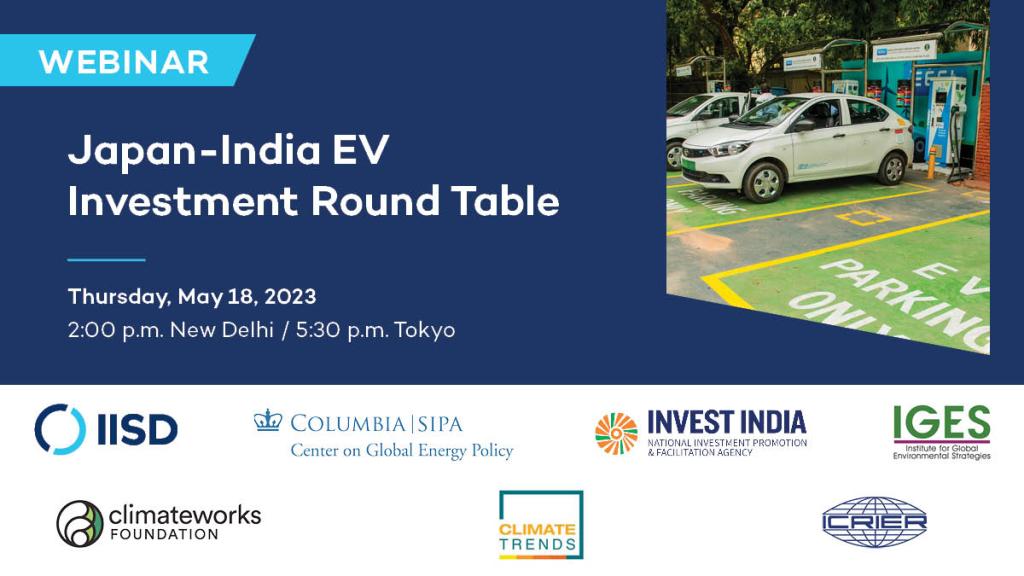
Japan-India EV Investment Round Table

May 18, 2023 2:00 pm - 3:30 pm IST

via Zoom

(Open to public)

Webinar card for "Japan-India EV Investment Round Table" with photo of electric vehicle.

With electric vehicle (EV) sales on the rise and climate action accelerating, decarbonization of the transport sector is set to be a central issue on the 2023 global climate change agenda. As India assumes the G20 presidency and ahead of the upcoming G7 Summit in Japan, this webinar will explore areas of cooperation on EVs and how investment can support climate and economic goals.  

The Government of India has already pledged to have 30% of all new vehicle sales in the country to be EVs by 2030. To reach this target, India will need an investment of USD 266 billion between 2020 and 2030. While transport electrification will bring many advantages, including reducing CO2 emissions and enhancing India’s energy security, a newly launched report estimates that significant foreign direct investment will be needed to increase EV component and battery manufacturing. 

This round table, organized by the International Institute for Sustainable Development (IISD), Columbia University, and the Institute for Global Environmental Strategies (IGES), will highlight areas of cooperation for Japan and India within the EV ecosystem. Held in a virtual format, the round table will cover recent EV developments in India and explore collaboration with Japanese automakers (OEMs), component manufacturers, and institutional investors.

Building on the independent report Investor Perspectives on Accelerating Growth in the Indian EV Ecosystem this round table will provide recommendations for how policy-makers in India can support EV investment.

Agenda

Moderator: Pramoda Gode, Lead, Moving India, World Economic Forum

Introduction
Swasti Raizada, Policy Advisor, International Institute for Sustainable Development

Presentation on Investor Feedback on India’s EV Ecosystem
Abhishek Bansal, Senior Investment Specialist, Invest India
Siddharth Goel, Senior Policy Advisor, IISD

Presentation on Critical Mineral Supply Chain Cooperation
Nanda Kumar Janardhanan, Research Manager, Climate and Energy and Regional Coordinator, South Asia, IGES

Remarks on Government of India Policies and Priorities
Sudhendu Sinha, Adviser, Infrastructure Connectivity, Transport and Electric Mobility, NITI Aayog

Presentation on Challenges and Opportunities for xEV Automotive Usage
Masaru Akaishi, Managing Director, Maruti Suzuki Toyota

Remarks on Evolving Auto Business and EV Manufacturing in India
Inderveer Singh, Founder and CEO, EVage

Round Table Discussion and Q&A

Webinar details

Webinar

The Just Transition Toolbox for Coal Regions — Knowledge needs in the South-East-Asian context

May 10, 2023 9:00 am - 10:30 am CEST

via Zoom

(Open to public)

The global energy transition from coal to renewable energy will have economic and social effects in coal regions in developing and emerging countries, threating local livelihoods, economic activities, and jobs, but also holding opportunities for sustainable, low-carbon development. Regional decision-makers play an important role in steering the transition and developing locally adapted solutions, but often lack capacity and knowledge of how to best support the transition process.

Against this background, the Wuppertal Institute has developed the Just Transition Toolbox for coal regions, a comprehensive compendium of experiences and good practices with references and links to existing handbooks, tools, and guidelines. It builds on the previous work of the Secretariat of the EU Initiative for Coal Regions in Transition (CRIT) and vast knowledge from a diverse range of stakeholders across the globe. 

As an introduction into the expert exchange, the toolbox is presented to give practitioners an overview of the guidance material which is already available. Practitioners from coal regions globally then present examples of their regions and discuss the challenges, which they are still facing in the future.

Agenda

Welcome

Timon Wehnert, Head Berlin Office and Co-Head of Research Unit International Energy Transitions, Wuppertal Institute

Introduction of IKI JET Project

Joscha Rosenbusch, Manager, GIZ

Toolbox for Just Transition in Coal Regions

Jannis Beutel, Junior Researcher, Wuppertal Institute

Audience Q&A

Regional Examples

Coal Regions in Indonesia
Marlistya Citraningrum, Program Manager, Sustainable Energy Access, IESR

Coal Region(s) in Thailand
Chalie Charoenlarpnopparut, Associate Professor, Sirindhorn International Institute of Technology, Thammasat University

Coal Region(s) in India
Srestha Banerjee, Director, Just Transition, iForest

Discussion

Closing Remarks

About the Project

The Just Energy Transition in Coal Regions - Interregional Platform (JET-CR Platform) forms part of the project Innovation Regions for a Just Energy Transition (IKI JET). The JET-CR Platform is a joint German-EU Project (Joint Action) implemented in eight countries.

This project aims to make a substantial contribution to accelerating the transition away from a coal based, unsustainable energy system, and towards a net-zero emission and climate resilient energy system, reducing greenhouse gas emissions from coal use, while ensuring environmental protection, inclusive and sustainable economic development with decent employment opportunities, along with social protection in selected coal regions in Asia, Africa, and Latin America.

Webinar

Beneath the Surface: Women and the Mine of the Future Global Report

Exploring research findings and discussing global trends, implications, and policy recommendations from the Women and the Mine of the Future Global Report.

May 24, 2023 9:00 am - 10:30 am EDT

(Open to public)

The lack of granular employment data leaves decision-makers ill-equipped to effectively support a more equal and inclusive mining workforce. To help address the data gap the Women and the Mine of the Future Global Report looks at 12 countries to uncover the gender-disaggregated employment profile for large-scale mining, focusing on women and their occupations in the sector. This webinar will explore research findings and discuss global trends, implications, and policy recommendations for decision-makers.

Webinar

Standards and the Sustainable Development Goals: Leveraging sustainability standards for reporting on SDG progress

This online event launched a new IISD State of Sustainability Initiatives (SSI) Review that examines how governments can work with sustainability standards to advance the Sustainable Development Goals (SDGs) and better track and report on their progress toward achieving them.

May 9, 2023 9:30 am - 10:45 am EDT

(Open to public)

The 2030 Agenda for Sustainable Development outlines an ambitious vision for people and the planet. It sets out 17 goals and 169 targets for the global community to work together to achieve by 2030—ranging from boosting climate action and eradicating poverty to ensuring gender equality, halting biodiversity loss, and conserving natural resources. 

However, progress toward achieving this vision has stalled following setbacks caused by unexpected events, such as the COVID-19 pandemic, conflicts, and the food and energy crises. How can voluntary sustainability standards (VSSs) help governments to stay on track in their pursuit of the 2030 Agenda?

This event shared the findings of a new IISD SSI Review: Standards and the Sustainable Development Goals: Leveraging sustainability standards for reporting on SDG progress. It explored how governments can work with VSSs to advance the SDGs and better track and report progress toward achieving them.

The report includes three case studies from India, Tanzania, and Uganda to demonstrate how VSSs can help governments prepare voluntary national reviews for the High-Level Political Forum on Sustainable Development, which outline their progress on advancing the SDGs in their jurisdictions. 

Moderator

  • Cristina Larrea, Lead II, Sustainability Standards, IISD 

Keynote speaker

  • Sakiko Fukuda-Parr, Chair, UN Committee for Development Policy

Confirmed speakers and panelists

  • Elena Kosolapova, Senior Policy Advisor, SDG Knowledge Hub Content Editor, IISD
  • Alex Lwakuba, Commissioner for Crop Production, Ministry of Agriculture, Animal Industry, and Fisheries of Uganda
  • Chariton Namuwoza,  Chief Executive Officer, National Organic Agricultural Movement of Uganda
  • Rijit Sengupta, Chief Executive Officer, Center for Responsible Business, India
  • Lynn Wagner, Senior Director, Tracking Progress Program, IISD
  • Uchita de Zoysa, Chairman, Global Sustainability Solutions, Former Chief Negotiator for the UN SDGs and Advisor to the Minister of Sustainable Development and Wildlife, Sri Lanka

This webinar included interpretation in English, French, and Spanish.