Experts Call on G7 to Get Serious on Fossil Fuel Subsidy Reform
Rich countries are wasting billions of dollars on coal, oil, and gas industries, as G7 deadline looms.
April 16, 2024 — At a press conference in Rome on Tuesday, Italian Minister of the Environment and Energy Security Gilberto Pichetto Fratin set out the agenda for G7 climate, energy, and environment ministerial meetings April 28-30.
"In continuity with the commitments undertaken in the G7 and G20 spheres, the Italian Presidency will be consolidating the initiatives already underway and focusing on targeted, joint actions geared to concreteness," said Minister Pichetto Fratin. "We want to give a strong push to the development of renewables and broaden our horizons to all sources that, with scientific support, can guarantee us energy security, contributing to the achievement of environmental objectives."
This must include action to tackle persistent public financial support to coal, oil, and gas, say experts at the International Institute for Sustainable Development. G7 countries have committed every year since 2009 to eliminate “inefficient” fossil fuel subsidies. In 2016, they added a deadline: by 2025. Yet, without a serious focus on fossil fuel subsidy reform at G7 ministerial meetings on April 28–30, the bloc will miss this target. For the latest year full data are available, 2022, fossil fuel subsidies across G7 countries hit an all-time high of USD 199.1 billion. This followed a global trend, as oil and gas prices spiked after Russia invaded Ukraine, and governments moved to shield consumers from bill hikes.
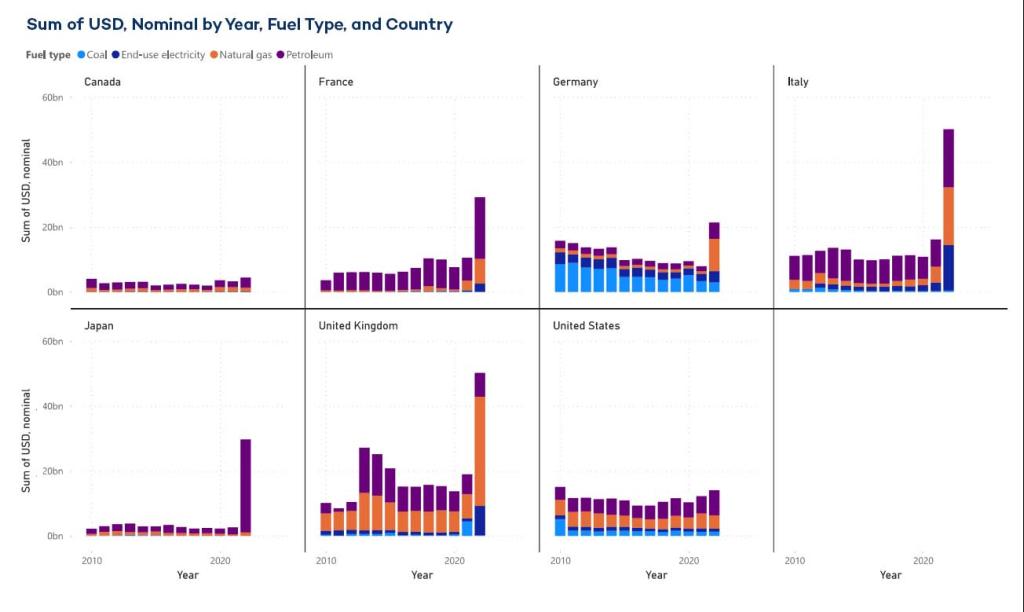
Support for clean energy must, therefore, be coupled with moving away from coal, oil, and gas, IISD experts say. Countries agreed at COP 28 in Dubai in December to transition away from fossil fuels. Scenario analysis shows there is no room for new coal, oil, or gas under a 1.5°C global warming limit.
“The surest path to energy security is to reduce exposure to volatile fossil fuel markets,” says Farooq Ullah, senior policy advisor at IISD. “G7 governments need to stop throwing money at climate-polluting sectors and mobilize investment to scale up clean energy systems.”
G7 communiques to date include the caveat that governments need only eliminate “inefficient” fossil fuel subsidies. This has never been defined. The ambiguity allows governments to claim they are complying with the commitment while continuing to put money into the pockets of the coal, oil, and gas industries. IISD is calling on the G7 to tighten up the language and change the defaults.
“At this month’s G7 meetings, ministers need to close the loopholes and show they are serious about tackling fossil fuel subsidies,” says Jonas Kuehl, policy analyst at IISD. “Any exceptions to the rule need to be clearly justified and temporary while alternative non-fossil subsidy solutions are developed.”
Notes to editors:
- Webcast of press conference
- Burning Billions: Record public money for fossil fuels impeding climate action
- Navigating Energy Transitions
Media Contact
Megan Darby, senior communications officer, IISD: [email protected]
About IISD
The International Institute for Sustainable Development (IISD) is a globally recognized think tank with 3 decades of experience working to solve the world’s most pressing sustainable development challenges. We combine deep expertise in a wide range of issues with a collaborative approach to research, policy advice, and hands-on support to ensure these solutions are brought to life. Headquartered in Winnipeg, Manitoba, we are a diverse team of over 300 professionals working from offices in Canada, Switzerland, and other locations around the world.
You might also be interested in
How the G7 Can Advance Action on Fossil Fuel Subsidies in 2025
G7 countries are off track to phase out fossil fuel subsidies by 2025. Despite a challenging geopolitical outlook, fossil fuel subsidy reform is a timely way for cash-strapped governments to fund their spending priorities.
Removing a Fossil Fuel Subsidy Is a Means, Not an End—The transition is the point
COFFIS is an international coalition working to phase out fossil fuel subsidies. Kim Solberg, part of the team that founded COFFIS, sits down to explain what made it possible—and why, in her view, a subsidy can only be removed as part of the wider transition it's meant to serve.
The G7 at a Crossroads: Advancing multilateralism, climate, environment, and energy action in an uncertain world
Canada’s G7 Presidency offers a critical chance to reaffirm the group’s leadership on climate action, resilience, biodiversity, and clean energy. Our experts break down what needs to happen to seize this moment.
What the G7 Ministerial Could Have Delivered on Fossil Fuel Subsidies Reform
The G7 climate, energy, and environment ministers’ meeting in Turin fell short when it came to breaking the 15 years of gridlock on fossil fuel subsidies. Here are three ways the G7 can use their next meetings to demonstrate measurable progress.