Webinar

Strengthening Natural Infrastructure Through Public Policy

December 5, 2023 11:00 am - 12:00 pm CT

(Open to public)

The need for strong public policy to strengthen the use of nature in meeting our water (and other) needs is increasingly clear. However, exactly how and what public policy can help in this space is perhaps less understood.

This webinar brings together experts to highlight some efforts in the public policy arena. We hear about the U.S. Nature-Based Solutions Roadmap developed by the United States Presidency to “unleash nature’s full potential,” as well as leading efforts and opportunities in this space from a Canadian perspective.

Some key takeaways from this webinar were:

  • There seems to some general consensus on natural infrastructure related terminology across the board—we're now using nature based solutions, natural infrastructure and related terms in more specific ways to enable governments and other stakeholders.
  • The US roadmap on NBS is an exciting and inspiring enabling policy that gives us great examples of not only what is needed in Canada, but also how it might be achieved through coordination between multiple agencies, including for provincial governments in Canada.
  • The National Adaptation Strategy is an exciting policy enabler for natural area management and natural infrastructure in Canada and incorporates some much-needed regional resource centres and tools for capacity building for these efforts.
  • Upcoming Green Municipal Funds will include funding for adaptation actions and will target smaller communities, incorporating capacity building and project design elements- clearly in response to some of the critical gaps we've seen in relation to NI.
  • Funding is key—both in the U.S. and in Canada there are big dollars being put towards efforts, and more and more these are directed not just to the easy wins, but to the long-term systems that are needed to scale up efforts in this space.

This webinar took place on December 5, 2023. Watch the full recording below or on YouTube.


This webinar is the third in a series of three fall webinars by IISD's Natural Infrastructure for Water Solutions (NIWS). Learn about Overcoming Capacity Limitations for Rural and Small Municipalities Across the Prairies from our first webinar and watch our second webinar, Pathways to Financing Natural Infrastructure in Canada.


Our Speakers

Dr. Lydia Olander

Dr. Lydia Olander is the Director of Nature-Based Resilience at the White House Council on Environmental Quality, where she leads work on nature-based solutions, coastal resilience, and community-driven relocation. 

She also works on compensatory mitigation, climate resilience for natural systems, natural capital accounting, and incorporating ecosystem services into benefit-cost analysis. She has worked at the intersection of science and policy for two decades, supporting decision-makers in addressing environmental challenges.

Guy Greenaway

Guy Greenaway is the Executive Director, Corvus Centre for Conservation Policy. 

Guy’s 25-year career has involved research, facilitation, and communication in several areas of nature conservation in Canada, primarily through non-government organizations but also through private consulting and volunteering.

Guy’s work has focused on natural infrastructure, private land conservation, market-based instruments, sustainable land use, strategic planning, ecosystem services valuation, agricultural land conservation, conservation policy development, community visioning, and municipal conservation planning.

Laniel Bateman

Laniel Bateman is the Director for Climate Change Adaptation and Resilience Policy at Environment and Climate Change Canada. She joined Environment Canada in 2003 and has worked on a broad range of files, primarily related to climate change and nature.

Prior to joining the Government of Canada, she worked for an environmental non-government organization and in the private sector in wetland remediation. Laniel holds an Environmental Science degree from the University of Guelph.


Resources:


Resources shared by Environment and Climate Change Canada:

National Adaptation Strategy:
Funding Programs:
Looking Forward:
Awareness and Capacity:


Thanks to our funder and to our webinar series partner:

NAI logo
IISD in the news

Interest in offshore oil exploration fizzles off Canada's most eastern coast

No companies wanted to pay to search for fossil fuels off Newfoundland and Labrador's coast this year. Each year, companies are invited to offer money to explore areas in the Atlantic Ocean for oil and gas deposits. But last week, the Canada-Newfoundland and Labrador Offshore Petroleum Board announced there were no new bids to explore the region in 2023. The lack of interest contrasts sharply with 2022 when over $238 million worth of exploration licences were awarded by the provincial-federal regulator.

November 8, 2023

IISD in the news details

Topic
Energy
Region
Canada
Impact area
Nature
IISD in the news

Natural gas is a dying commodity, and Canada needs to stop supporting it

If governments around the world maintain the status quo in terms of energy policies, we’ll see peak global demand for coal, oil and gas before 2030 – and clean technologies will play a much stronger role. That's according to the latest analysis from the International Energy Agency, which recently released its annual World Energy Outlook, or WEO, report. For Canada, the IEA research confirms it's time for governments to heed the signals and end public support to the fossil fuel industry. This includes eliminating subsidies for liquefied natural gas expansion across the country.

November 7, 2023

IISD in the news details

Topic
Energy
Region
Canada
Impact area
Nature
IISD in the news

Small lakes, big studies: what Ontario's experimental lakes area teaches the world about water

Deep in northwestern Ontario is a collection of 58 small, pristine lakes where, for the past half century, scientists worried about water have gathered to take their laboratory outside. This is the world's largest outdoor experimental freshwater research facility, allowing scientists to develop invaluable long-term data about the effects of pollutants, clean-up processes and climate change on a finite resource.

November 7, 2023

IISD in the news details

Topic
Water
Region
Canada
Insight

Why Canada Needs to Transform Its Approach to Funding for Climate Disaster Recovery

October 31, 2023

This summer, Canada endured its worst wildfire season on record. The ecological, health, and livelihood losses due to these fires are immense—as will be the costs of rebuilding and recovery. These events come on the heels of Hurricane Fiona and the windstorms in Ontario and Quebec in 2022, which alone caused over CAD 800 million and CAD 1 billion, respectively, in insured damages.

When large-scale disasters such as these occur, provincial and territorial governments can turn to the federal government to help fund a portion of their response and recovery costs through the Disaster Financial Assistance Arrangements (DFAA) program. With the number of climate-related disasters increasing, the federal government is now spending billions of dollars annually through the DFAA program to support post-disaster recovery.

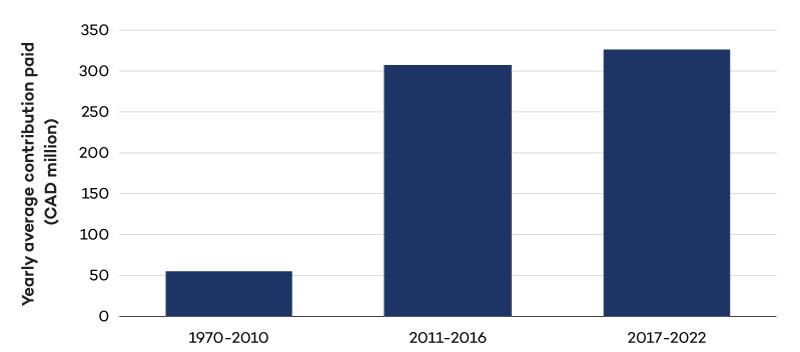
Of the CAD 7.9 billion in assistance paid by Ottawa since the start of the DFAA program, approximately three quarters was distributed in the past 10 years. The 2021 wildfires and flooding in British Columbia alone required CAD 1.5 billion in DFAA payments, and recovery costs for Hurricane Fiona in 2022 may exceed CAD 1 billion. Reflecting these rising costs, the annual budget for DFAA payments jumped from CAD 100 million in 2022/2023 to CAD 1,724.9 million in 2023/2024.

A graph showing an increase in DFAA funding between 1970 and 2022.
Increase in DFAA funding over the years. Data sourced from Public Safety Canada.

In its 2023 budget, the Government of Canada committed funding for a modernized DFAA program to support the mitigation of disaster risks. As outlined in the November 2022 report of a federally commissioned advisory panel, modernizing the DFAA provides an opportunity to increase the climate resilience of Canadian communities and avoid future costs. By pivoting the program from being solely focused on disaster response and recovery to including disaster prevention and resilience, the DFAA program could become an important tool used to fund adaptation projects across Canada.

What is the DFAA program?

Established in 1970 and administered by Public Safety Canada, the federally funded DFAA program provides financial assistance to the provinces and territories in the event of a large-scale natural disaster. As of January 2023, provincial and territorial governments can request access to these arrangements when their recovery costs exceed CAD 3.61 per capita of their population. As the cost of disasters increases, so too does the share covered by the federal government. The federal government pays an average of 82% of eligible disaster costs: these include emergency shelters, repairs to public infrastructure, and restoration of businesses or homes.

Why does the DFAA program need to be modernized?

For years, the DFAA program has been critiqued for being inefficient and lacking the flexibility to respond to changing circumstances and the unique needs of different communities across the country.

A major criticism of the program, though, is that it is primarily financing disaster response and recovery—as opposed to disaster prevention. Moreover, its requirements make it impossible for provincial and territorial governments to invest in initiatives that build resilience, such as relocating buildings away from high-risk flood zones or requiring homes to be built to better withstand wildfires. This situation is at odds with Canada's current emergency management strategy and commitments under the Sendai Framework for Disaster Risk Reduction, both of which emphasize preventing and reducing the negative impacts of disasters.

This means that, over the past 50 years, nearly CAD 8 billion has been spent reacting to disasters across Canada with limited mechanisms to ensure any of this funding actively prevents these disasters from occurring—even in areas where disasters are preventable and predictable.

How can the DFAA program be improved?

With the cost of disasters increasing every year, in 2022, Public Safety Canada established an expert advisory panel to "review and make recommendations on how to improve the sustainability and long-term viability of the program." In their November 2022 report, Building Forward Together, the panel members called for the DFAA program to play a much larger role in incentivizing disaster risk reduction and building long-term climate resilience. In its 10 recommendations, the panel called for

  • establishing an integrated disaster-resilience standard and associated national resilience rating system, which would help Public Safety Canada target funding measures to reduce the impacts of climate-related disasters and support climate change adaptation;
  • ensuring that federal finance strategically targets vulnerable populations, as informed by the national resilience rating system;
  • improving the coordination and alignment of federal programs for disaster risk reduction and climate change adaptation to ensure measures are implemented meaningfully;
  • ensuring stakeholders have access to the information, tools, and capacity they need to be aware of their risk levels and make informed decisions; and
  • increasing the program’s efficiency by digitizing and streamlining the application process, providing better access to guidance, and improving responsiveness, as well as making the program more flexible to differing needs between and within regions.

Implementing these recommendations would fundamentally change the focus of the DFAA program from responding to climate-related disasters as they happen to taking steps needed to anticipate, prevent, and reduce these events—consistent with ongoing efforts to adapt to climate change.

How does this relate to Canada’s National Adaptation Strategy?

In June 2023, Canada's first National Adaptation Strategy (NAS) was released. Disaster resilience is one of the five key systems around which the strategy is organized. Consistent with the commitment made in Canada’s 2023 budget, the NAS includes a target of modernizing the DFAA program by 2025 "to incentivize disaster risk reduction and improve recovery outcomes from large-scale disasters." However, meeting the NAS target will require a significant amount of work in a relatively short amount of time; ensuring that these modernization efforts truly allow Canada to better prepare for and recover from climate-related disasters will likely be challenging. The federal government will also need to reach agreements with provincial and territorial governments.

Building resilience to climate change and extreme weather events is not just a Canadian endeavour. Countries throughout the world have struggled to better align and integrate their climate change adaptation and disaster management efforts. In August 2023, the United States Federal Emergency Management Agency announced nearly USD 3 billion in funding for various adaptation projects. This follows an observed trend of greater understanding among national governments of the need for a more integrated approach to climate change adaptation and disaster risk reduction efforts to achieve their sustainable development goals.

What’s next?

The frequency and cost of climate-related disasters are increasing across Canada. Federal financial assistance arrangements must change to meet this growing challenge. They should focus on reducing and preventing the damage caused by floods, fires, and hurricanes rather than simply providing more funding for disaster response and recovery. Federal funding can include provisions that lead provincial and territorial governments to incorporate adaptation measures into pre-disaster planning and post-disaster rebuilding. Crucially, we need meaningful governance systems to integrate climate adaptation and disaster prevention measures across federal departments and between federal and provincial agencies.

Without a greater focus on disaster prevention that accounts for climate change, Canada will only see a rising bill tied to increasingly devastating natural disasters. The DFAA program is a critical tool to help people across the country withstand these events now and into the future, but it is in desperate need of sharpening to support long-term resilience.

Insight details

IISD in the news

Freedom from fossil fuels? Canada's energy-security future hinges on continued growth of renewables

It's often stated that Canada's abundant oil and gas reserves provide energy security. Yet recent geopolitical turmoil–such as Russia's invasion of Ukraine–has tested this notion, causing oil and gas prices to surge, fuelling inflation and making Canadians' lives more costly. Increasingly, especially given climate change's existential threat, it's apparent Canada's energy-security future involves moving beyond oil and gas.

October 30, 2023

IISD in the news details

Topic
Energy
Region
Canada
Impact area
Sustainable Economies
Nature
Insight

The Climate Crisis Is Outpacing B.C.'s Ability to Adapt

October 26, 2023

British Columbia has become Canada's epicentre of climate change-induced disasters. After historic wildfire seasons in 2021 and 2022, 2023 is now officially the province's most expensive and most destructive wildfire season on record. One of the worst fires, the McDougall Creek fire, forced more than 10,000 people to flee and has damaged or destroyed at least 181 properties in West Kelowna alone. Just a couple of years ago, 619 people died during a week-long heatwave, almost all of them perishing indoors without adequate cooling systems.

Heat waves, wildfires, and floods are costing B.C. up to CAD 17 billion per year—and the actual number is often higher when accounting for disruptions in shipping and supply chains that affect other provinces and territories or the indirect impacts on B.C.'s tourism industry. There are also costs associated with loss of life or deteriorating health, lost income and livelihoods, or the impacts on mental health and cultural heritage that often cannot be quantified in economic terms.

Last week, the province's Ombudsperson released a report highlighting how outdated, under-resourced, and inaccessible B.C.'s disaster and emergency support programs are—particularly for vulnerable people. Simply put, these measures are insufficient to address the impacts of today’s climate crisis.

What needs to change? We must acknowledge the limits of adaptation efforts

The ecological, health, and livelihood losses due to fires and floods are immense—as will be the costs of rebuilding and recovery. The uncomfortable reality is two-fold: 1) we cannot continuously finance disaster recovery, and 2) there are limits to adaptation. Even with sufficient investments into infrastructure upgrades, we will reach a degree of change too large to manage unless we collectively stop emitting greenhouse gases into the atmosphere and the climate stabilizes. The number, intensity, and frequency of extreme weather events will reach a point at which typical adaptation measures like building seawalls and expanding reservoirs simply won’t be enough, causing what the international climate community refers to as "loss and damage."

Loss refers to the complete loss of something, such as a human life or an ecosystem that can’t be brought back. Damage usually refers to infrastructure, for example, a bridge that collapses in a flood despite the fact it was built to more resilient standards. Loss and damage can be profound in both economic and non-economic ways that are beyond what countries, communities, and ecosystems can adapt to. While many might picture hurricane-ravaged island nations or monsoon-drenched shantytowns, the inescapable reality is that loss and damage also looks like what is happening right here, right now, in B.C.

As we reflect on the staggering fiscal and human impacts of climate change, it becomes abundantly clear that we need urgent, transformational change in how we approach climate risks and how we respond to ongoing and future loss and damage.

The federal, provincial, and municipal levels of government have finally started to get serious about climate adaptation—but there's a huge gap in tangible adaptation measures needed right now, let alone acknowledgement of the irreversible effects of loss and damage in B.C.'s current Climate Preparedness and Adaptation Strategy for 2022–2025.

The good news is that this particular strategy is due for an update by 2025. This means we have a window of opportunity to weigh in and ensure our government goes beyond the status quo when it comes to climate adaptation planning.

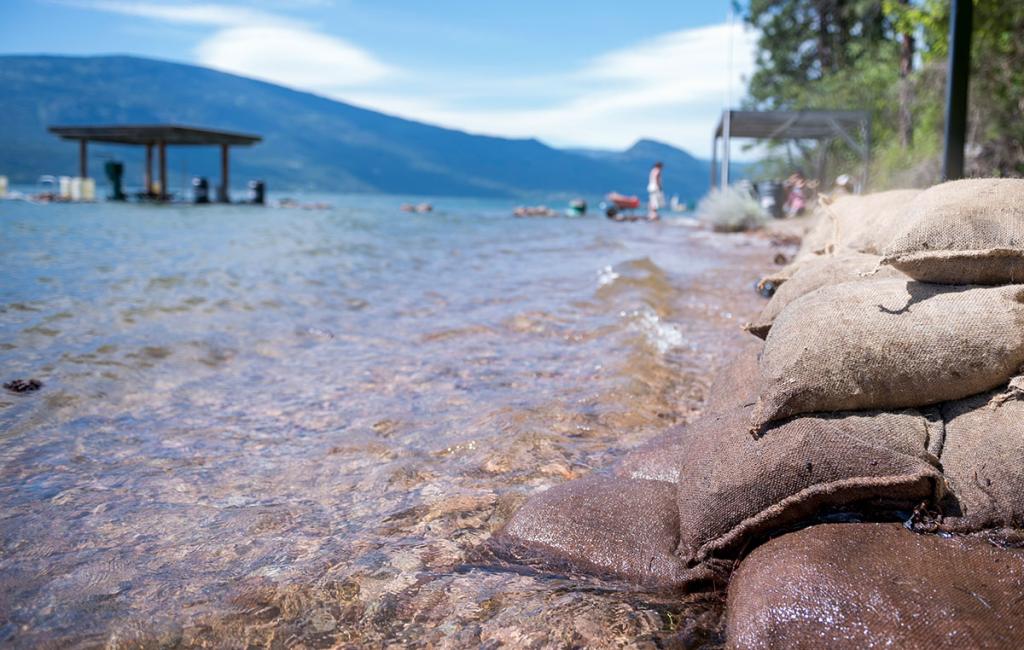
Sandbags are stacked along the shoreline of Okanagan Lake during Spring flooding on May 23, 2017 in Lake Country, British Columbia, Canada.

Coming to terms with the irreversible impacts of climate change: It's time to link climate adaptation and emergency management

One critical piece of the puzzle is better integration of climate change adaptation into emergency preparedness planning, timely and effective humanitarian response, and post-disaster recovery efforts. There is also a need to rapidly address the growing risk of destroyed homes and infrastructure that are not covered by private insurance. This means relocating buildings away from high-risk flood zones, building the capacity of communities, and improving coordination and cooperation around emergency preparedness and management at the regional level.

Local communities and municipalities must receive the tailored support they need to understand the climate risks anticipated for their area and be able to plan accordingly for more intense floods, fires, and heat-related emergencies. However, information alone will not solve the problem: many resource-constrained municipalities will need predictable provincial and federal funding and assistance to help pay for emergency preparedness, disaster response, and required infrastructure upgrades.

Preparing for climate change is complex, and the solutions aren’t always straightforward. But we cannot act with anything less than urgency right now. B.C. is often referred to as a leader on climate change, nationally and globally, and it’s time for the whole government at every level to step up and collectively rise to this challenge.

Insight details

Webinar

Pathways to Financing Natural Infrastructure in Canada

November 21, 2023 11:00 am - 12:00 pm CT

(Open to public)

Natural infrastructure is a cost-effective way to meet our water infrastructure needs. However, if we want to meaningfully advance this solution, we need both the recognition of its benefits and access to capital.

While the public sector continues to be the key source of funding for natural infrastructure projects, we need to find ways to mobilize capital from the private sector and capital markets.

Some key takeaways from this webinar were:

  • Investors perceive natural infrastructure financing as less risky than it used to be, owing in part to successful financing examples in the United States and other regions.

  • Outcome-based financing is a promising mechanism to help address the natural infrastructure financing gap. It needs to be designed collaboratively and uphold the rights of Indigenous Nations.

  • The key to make nature investable is standardizing the measurement and monitoring of natural infrastructure outcomes. Existing studies, measurement frameworks, and resources are available, with capacity and collective momentum being challenges.

  • Money is not the only solution for protecting and restoring nature. We need to be more radical and reinvent the way we relate to nature and use this to guide our decisions of capital allocation and evaluation.


The webinar was moderated by Kim Neale, Project Manager and Indigenous Affairs Associate at the Natural Assets Initiative.

This webinar took place on November 21, 2023. Watch the full recording below or on YouTube.


This webinar is the second in a series of three fall webinars by IISD's Natural Infrastructure for Water Solutions (NIWS). Watch the other two webinars: Strengthening Natural Infrastructure Through Public Policy and Overcoming Capacity Limitations for Rural and Small Municipalities Across the Prairies.


Our Speakers

Diane-Laure Arjaliès

Diane-Laure Arjaliès is an Associate Professor at the Ivey Business School, Western University (Canada). She ambitions to push the boundaries of knowledge and practice by investigating how fashioning new devices, and collective actions can help transform financial markets towards sustainability. Over the years, she has studied the emergence of responsible investing, ESG integration, impact assessment, integrated reporting, and cryptocurrencies. Her work in this area has won her several academic, teaching, and professional prizes.

She founded and has led the Sustainable Finance Lab, an impact lab from the Centre for Building Sustainable Value. She is currently conducting an extensive research program on conservation finance, aiming to channel capital toward protecting ecosystems, notably through conservation impact bonds. As an ethnographer, she enjoys doing field research and sharing her experience with students and practitioners. She published her work at the Oxford University Press, Chains of Finance: How Investment Management is Shaped, and in major academic journals across various disciplines.

Robert Wilson

Robert Wilson is the Director of Conservation Finance at The Nature Conservancy of Canada (NCC) and a senior member of NCC’s Nature + Climate Accelerator group. He is responsible for advising on conservation finance-related programs that support NCC’s nature-based, natural climate solutions work, with a particular focus on carbon finance.

Rob is currently a member of the Technical Expert Group designing a federal Improved Forest Management carbon protocol, a member of the federal Conservation Exchange Working Group and has been an active member of two previous provincial Forest Carbon Policy working groups designing provincial offset programs. He graduated from the University of Toronto with an undergraduate degree in political science, a Resource Management Diploma from its Faculty of Forestry and an M.B.A. from the Rotman School of Management.

Rob is involved in a number of large-scale, land conservation projects in his work at NCC, with a focus on designing impact-based approaches and investment opportunities by which to attract more sources of private capital into nature-based solutions projects across the country – in short, Making Nature Investable.

Marina Puzyreva

Marina Puzyreva is a senior policy advisor with the International Institute of Sustainable Development (IISD)’s Water Program. With an extensive background in economics, finance, and public policy, she is investigating a business case for nature-based solutions for improved water outcomes and their co-benefits.

Marina is the lead author of IISD’s upcoming report examining viable financing mechanisms for natural infrastructure and their application to the Canadian Prairies, with a focus on attracting private capital. Marina also collaborates with Indigenous partners in Canada to broaden the understanding of value in policymaking and to develop cooperative approaches to managing and protecting our waters. She has also engaged with municipal partners in Canada, focusing on natural infrastructure, including analyzing municipal decision-making and establishing criteria and metrics to prioritize natural infrastructure over conventional solutions.


Resources:


Thanks to our funder and to our webinar series partner:
 

NAI logo

Webinar details

Success story

Fueling Change: The journey to end fossil fuel subsidies in Canada

How Canada became the first country in the world to introduce a framework for ending government subsidies to domestic oil and gas companies.

October 13, 2023

It may have taken 14 years but what a feeling it was to finally hear the words: “We're eliminating subsidies to produce fossil fuels in Canada.” 

Delivered at a press conference in Ottawa, Canada, by Canadian Federal Environmental Minister Steven Guilbeault, that sentence was the culmination of more than a decade of behind-the-scenes work by Canadian climate organizations to end subsidies supporting domestic oil and gas production. This was an important step forward and a long-awaited landmark towards eliminating support for fossil fuels. 

In front of a group of reporters and government officials, Guilbeault took a moment to acknowledge the efforts of those who worked so hard for this achievement, including IISD and Environmental Defence. 

The Government of Canada’s guidelines on inefficient fossil fuel subsidies are the first transparently published conditions that will be used to prevent any new measures that would constitute inefficient fossil fuel subsidies. A subsidy is a financial benefit that the government gives, usually to a specific business, group or industry. This new policy builds on Canada’s commitment in 2022 to end new direct public support for the international unabated fossil fuel energy sector under the Glasgow Statement.  

Where it started... 

The journey to this seminal decision began in 2010—at least for the organizations determined to tackle the relatively unexplored, but at the time very controversial, topic of government fossil fuel subsidies. It was at this time that IISD launched a ground-breaking report: Untold Billions: Fossil-fuel subsidies, their impact and the path to reform. 

“Our argument was that continuing to have fossil fuel subsidies while introducing policies like carbon pricing was like bailing water out of a leaking boat, without fixing the leak itself. You never really get to the root of the problem”.

Philip Gass, Interim Co-Director, Energy & Lead, Energy Transitions

The report examined the extent of fossil-fuel subsidies, their impact on climate change, and the challenges to reforming them in Canada. It was a critical component of a much broader effort at IISD to map the scope and role of fossil-fuel subsidies in the world economy.  

“It was the first major piece of research to focus on fossil fuel subsidies in Canada,” says Philip Gass, Interim Co-Director, Energy and Lead, Energy Transitions for IISD, “and it was quite contentious at the time. We were criticized for it and were told that we didn’t understand the impact that ending subsidies would have on jobs. We were even getting angry phone calls.” 

But the issue was becoming increasingly important to Canadians, so Gass and his team persisted.  

In 2015, IISD launched a series of initiatives revolving around fossil fuel subsidies with a specific focus on Canada. Experts compiled regular inventories of fossil fuel subsidies at the provincial and federal level and combined these with webinars and public engagement focused on increasing awareness of the economic and climate change-related impacts of subsidies, along with technical advice on how Canada could meet its G7 and G20 commitments on fossil fuel subsidy reform. These endeavours also aimed to convince the government that continuing to provide subsidies would undermine any climate measures it was considering. 

“Our argument was that continuing to have fossil fuel subsidies while introducing policies like carbon pricing was like bailing water out of a leaking boat, without fixing the leak itself.  You never really get to the root of the problem” said Gass. “Fossil fuel subsidies prevent carbon pricing from being fully effective.” 

After eight more years of work on the topic, the team at IISD was happy to see the new policy this summer. It’s a significant advancement, but there’s still more work to be done.  

Where should Canada go from here? 

The focus now, says Laura Cameron, Policy Advisor with IISD, will be on understanding how the framework gets interpreted and implemented. In creating the framework, the government identified 129 subsidy measures, but these haven't yet been made public. How the guidelines in the policy are applied will determine how effective it is in ensuring no further subsidies are introduced. 

Cameron is also hoping to see a mechanism for accountability. It’s not clear who is going to make sure the rules are being followed across government departments. 

And there remains a big gap in current policies: domestic public financing for fossil fuels. Along with the subsidies framework, the government announced they would introduce a plan to end domestic public financing for fossil fuels by fall 2024. This is an essential next step because the majority of Canada’s financial support for fossil fuels is through public financing. IISD is pushing to have that plan released this year. Environmental Defence estimates about CAD 19 billion in financing for fossil fuels has come from the Federal Government in 2022

IISD applauded the framework in a public statement, pointing out that one of its key strengths is the adoption of the World Trade Organization's definition of fossil fuel subsidies. Canada's notable contribution lies in its establishment of a comprehensive definition of inefficiency, thereby bringing some transparency to a term that has clouded the subsidies conversation for over a decade. This clarity plays a crucial role in guiding the classification and eventual elimination of subsidies, encompassing direct transfers, foregone revenue, transfer of risk, and provision of goods and services. 
 
However, the definition of inefficiency still allows for support of “abated” fossil fuel production for projects that include emissions reduction measures, such as carbon capture and storage in the oil and gas sector and fossil-derived hydrogen. A recent report by IISD, Persistent High Costs of CCS: Implications for Canada's Oil and Gas Sector, provides new analysis that shows it is unlikely the costs of CCS will decline significantly over time: the technology is too complex, it demands too much customization with each application, and it is improbable that it will capture the benefits of mass manufacturing in the way technologies such as solar PV have.  

The fossil fuel subsidy framework allows for exemptions in six categories: enabling significant carbon emissions reductions, supporting clean energy, providing essential energy to a remote community or short-term support for an emergency response, supporting Indigenous participation in fossil fuel activities or are projects that have a credible plan to reach net-zero by 2030. 

Solar panels and wind turbines against a cloudy sky

IISD will actively monitor and advocate for the government to reform these exemptions, while ensuring that conditions are implemented in a transparent manner aligned with Canada's climate commitments. The ultimate goal, simply put, is to completely phase out all fossil fuel subsidies and redirect support towards renewable energy. 

Responses by other organizations for the framework also pointed out its shortcomings. Julia Levin, associate director of Environmental Defence, issued a statement saying that the framework marks an important step forward but there are still loopholes in the guidelines to be addressed. Political opponents in the Canadian government said the framework did not go far enough and did not meet the urgency of the moment regarding climate disasters.  

But despite some criticisms, the framework represents meaningful progress. 

“This is a significant step forward and sets a strong example for Canada’s G20 peers,” says Cameron. “But gaps in the framework mean public money could continue to flow toward oil and gas production at a time when the country must swiftly move to renewable energy. With these gaps closed, Canada can ensure public funds are truly advancing climate solutions.”  

Success story details

IISD in the news

Consider more than just the environment when examining climate-resilient infrastructure, say experts

Ensuring Canada's infrastructure is more resilient in the face of increasing climate disasters will require reframing the issue beyond the readily apparent environmental impacts, according to an expert at a national climate adaptation research centre.

October 4, 2023

IISD in the news details