Insight

The Critical Next Step: What you need to know about Canada’s 2030 climate target

January 22, 2024

At the close of 2023, Environment and Climate Change Canada released the first official Progress Report on its 2022 Emissions Reduction Plan. The report details progress toward the government’s 2030 climate goals as mandated by the Net Zero Accountability Act, forecasting that, if all modelled policies are fully implemented, national emissions will fall to 36% below 2005 levels in 2030. A parallel, independent assessment by the Canadian Climate Institute (CCI) mirrors these findings, forecasting a 34%–36% reduction. While these reports confirm that progress has been made in recent years to reduce Canada’s emissions, they also show that current measures are insufficient to reach the government’s 40%–45% reduction target. To close this gap and help avoid the worst impacts of climate change, it is essential that the federal government implements stronger policies alongside a clearer communications strategy.

What are Canada’s climate targets?

Federally, Canada has two complementary climate targets. The first is achieving “net-zero by 2050,” meaning that any new greenhouse gas emissions from 2050 onwards are offset by verifiable and permanent removals. To prevent the most dangerous effects of climate change, this is a necessary target for all countries, not just Canada. The federal government’s second climate target is to reduce national greenhouse gas emissions by 40% to 45% relative to 2005 levels by 2030.

Provincially, most governments echo the federal goal of “net-zero by 2050,” but 2030 targets are still rare. According to CCI, “three quarters of Canada’s emissions come from provinces and territories without their own legislated emissions reduction targets for 2030.” This discrepancy reflects a tension between the two levels of government regarding the pace of the energy transition, as articulated in the recent statements of Alberta’s premier about the forthcoming Federal Clean Electricity Regulations. That is, Premier Smith notes Alberta already has a target of reaching net-zero by 2050, so why bother with stringent 2030 regulations?

Why Canada’s 2030 target is critical for keeping global temperature rise to 1.5°C

Canada’s 2030 target is essential for maintaining a stable climate for two main reasons. The first is scientific. When the International Panel on Climate Change recommended the world reach net-zero by 2050, it simultaneously called for emissions to fall by 45% (relative to 2010) by 2030. What matters for the climate is not the specific year the world stops emitting greenhouse gases but rather the amount of greenhouse gases in the atmosphere. Figure 1, where total emissions are represented by the area under the line, makes this clear. Even if the world achieves net-zero by 2050, without strong emissions reductions by 2030 it becomes very difficult to prevent more than 1.5°C of global warming. In other words, reaching net-zero by 2050 without taking 2030 targets seriously risks missing the 1.5°C temperature target with disastrous consequences worldwide—including billions of dollars in damage to the Canadian economy.
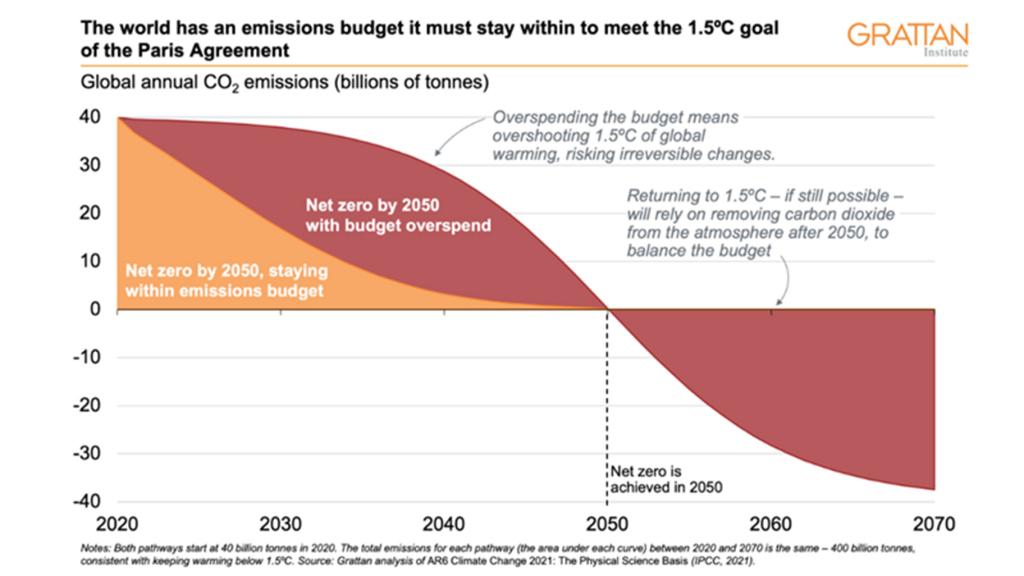
This figure compares net-zero by 2050 trajectories.
Figure 1. Comparing net-zero by 2050 trajectories. Source: Ha, 2021.

The second reason for a strong 2030 emissions target is political. By establishing a specific and measurable goal, it becomes easier to assess the government’s progress in addressing climate change. This creates an incentive for politicians to fulfill their commitments to the public. The risk with a “net-zero by 2050” target on its own, however, is that political tenures and election cycles are short. Multi-decadal targets like this offer a convenient delay tactic for politicians who are otherwise unmotivated to address climate change. A 2030 target is essential to keep governments on track for net-zero by 2050, and ultimately that 1.5°C temperature target, by holding our representatives accountable along the way.

What more can be done to meet Canada’s targets?

The government’s progress report shows that despite significant advances in climate policy, more must be done to meet Canada’s critical 2030 targets (Figure 2). To start, announced but unimplemented policies must be designed as stringently as possible. A key example here is the proposed emissions cap for the oil and gas sector, Canada’s most polluting industry. To reach a 40%–45% reduction in emissions by 2030, the government must begin by closing the policy’s proposed loopholes, thereby increasing certainty in the emissions reduction outcomes that the government claims the policy will have. Other policies, such as the clean electricity regulations, must also be implemented as soon as possible. Even then, however, new, innovative policies will still be needed. There are only 6 years to 2030, and there is a lot of work left to do.
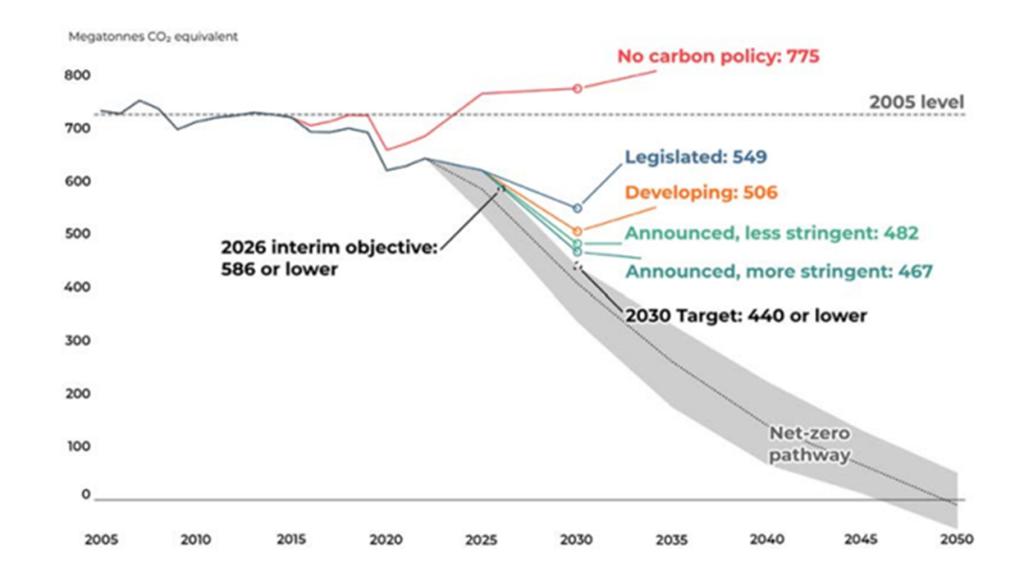
This figure shows Canada’s emissions pathways, according to the institute’s independent modelling of the 2023 progress report.
Figure 2. Canada’s emissions pathways, according to the institute’s independent modelling of the 2023 progress report. Source: Sawyer et al., 2023, p. 21.

Beyond policy development, there is a broader communications challenge facing the federal government. Opponents of climate policy have often tried to link specific measures to the cost-of-living challenges currently facing Canadians, particularly criticizing the carbon tax. This is in spite of the fact that most households benefit from the tax and rebate system. Some provincial governments, meanwhile, show no intention of setting or meeting 2030 targets, while also disputing the federal government’s authority to intervene in response to their inaction. While it is correct that provinces have jurisdiction over natural resources, the federal government can regulate matters of national concern—such as greenhouse gas emissions—in a way that incidentally affects provincial matters. Opposing legal challenges are thus overstated, but they nonetheless carry weight in public discourse. To build the public support necessary to accelerate Canada’s climate agenda, the government will have to do more to address these rhetorical and legal challenges head-on—confidently and publicly.

Insight

Ending Canada’s Support for Fossil Fuels: Tracking Progress and Charting Next Steps

Canada has committed to ending subsidies and public financing for fossil fuels at home and abroad and has taken some important steps along the path. Our experts set out the journey so far, and how it can improve.

January 15, 2024

One crucial step to speed up the worldwide energy transition is reallocating public financial support from fossil fuels to renewable energy sources. The Intergovernmental Panel on Climate Change warned that government support for the fossil fuel industry financially is “severely misaligned” with the goals of the Paris Agreement. Canada has made promises to stop putting public funds into fossil fuels, but what progress has been made? And how can it improve? 

Funding Fossil Fuels: How far has Canada come? 

Canada has committed to ending subsidies and public financing for fossil fuels at home and abroad and has taken some important steps along the path. In 2021, it signed on to the Clean Energy Transition Partnership, which commits countries to ceasing to provide new direct public support for the international unabated fossil fuel energy sector by the end of 2022 and prioritizing support for clean energy. In 2022, Canada became one of the first countries to make good on this commitment by publishing a policy to stop providing public finance for fossil fuel projects abroad. More recently, the country committed to ending domestic public finance for fossil fuels, pledging to publish a plan by fall 2024. And in July 2023, 14 years after its original commitment, Canada published its long-awaited assessment framework for inefficient fossil fuel subsidies.  

These are all essential steps to moving money away from fossil fuels. But the details of these policies, how they are implemented, and how they are enforced will make or break Canada’s commitments. Let’s take a closer look. 

Plugging the Holes in the Frameworks 

Canada’s policies on international public finance and fossil fuel subsidies have some notable strengths. The subsidies policy includes a strong definition aligned with the World Trade Organization’s. Moreover, the policy requires fossil fuel projects that would receive support to prove a lack of renewable energy alternatives and include an assessment of the risk of stranded assets. 

But the policies also include loopholes that could jeopardize their effectiveness—and Canada’s reputation as a climate leader. These loopholes include the following: 

  • Natural gas. The international public finance policy allows support for the production of natural gas-fired power in some circumstances, which is incompatible with Paris Agreement targets. Any support allowed in an emergency should be clearly defined and time-bound, ensuring no future lock-in of fossil fuel infrastructure.  

  • Carbon capture, utilization, and storage (CCUS). The policies allow support for CCUS technologies in the fossil fuel and power generation sectors. CCUS is expensive, energy intensive, slow to implement, and unproven at scale, making it an inefficient use of public funds. Funding CCUS in the fossil fuel sector violates the polluter-pays principle: those responsible should be financially liable for cleaning up their pollution. 

  • Lack of accountability. The policies lack details on implementation and enforcement, as well as sufficient transparency to be held accountable. It is essential to have guidelines for how the policies will be put in place across departments and who will keep the government accountable for its promises. For example, Canada has not yet published a list of tax and non-tax subsidies identified in its self-review—and publicly disclosing subsidies is a critical first step to ensuring accountability.

To fulfill its own commitment, Canada needs to publish a policy to end domestic public finance for fossil fuels immediately. 

The biggest hole in Canada’s current policies is domestic public finance for fossil fuels. Most of Canada’s financing for fossil fuels comes from within its own borders: Export Development Canada, the national export credit agency, has provided over CAD 88 billion to the oil and gas sector since 2016, including CAD 19 billion in 2022.

Ending Fossil Fuel Financing at Home 

What does the roadmap to ending domestic public financing for fossil fuels in Canada look like? We have three recommendations. 

First, it should close the loopholes in existing policies. Any policy framework should ensure that the government does not enable financing for infrastructure that would lock in fossil fuel use far into the future. Investments in natural gas and unproven, expensive technologies such as CCUS only entrench carbon-intensive infrastructure. 

Second, it should reproduce the strengths of international public financing policy. Canada’s policy for international public financing of fossil fuels is already robust in its scope and requirements for due diligence. A policy for ending domestic public finance of fossil fuels should:  

  • align with the goal of the Paris Agreement to hold the increase in global average temperature to 1.5°C above pre-industrial levels, 

  • exclude the financing of “abated” fossil fuel production, 

  • rigorously assess and manage risks of stranded assets and carbon lock-in, and 

  • require proof that support for fossil fuels will not hinder the transition to renewables where developing renewables would be possible. 

Most importantly, the policy should outline how recovered funding will be redirected to clean energy. Canada’s policies should not only include robust conditions for phasing out financing for fossil fuels. They should also provide details on how the money will be redirected toward renewable energy projects.

Experts estimate that Canada’s public clean electricity support needs to be scaled up nearly tenfold from its current level to be on track with a 1.5°C-aligned scenario.

Canada is already a first mover internationally in ending the financing of fossil fuels, but fully aligning financial incentives with climate policy requires closing the gap in domestic public finance and eliminating loopholes in its existing policies.  

Insight details

Topic
Energy
Region
Canada
IISD in the news

Ottawa supports Big Oil over the climate

One can only imagine the positive buzz these days inside the boardrooms of Canada's oil companies, as they rake in record profits and plan major expansions of their oil production. Amid all the good cheer, one could easily lose sight of the fact that those plans will push the world dangerously closer to the brink of irreversible climate chaos. Even as the world finally signed a commitment at UN climate talks last month to begin transitioning away from fossil fuels, Canada's major oil companies are poised to do exactly the opposite — to greatly expand their fossil fuel production.

January 12, 2024
Statement

Canada’s Oil and Gas Emissions Cap Framework is a Welcome Step Forward, but Not Enough to Meet Climate Goals

December 7, 2023

Today, the Government of Canada announced a groundbreaking policy framework for a regulatory cap on oil and gas sector emissions. This is a welcome step forward that lays the foundation for a sector-specific cap-and-trade system to tackle emissions from Canada’s most polluting industry. 

At the same time, the Government also released the first official progress report on its 2022 Emissions Reduction Plan confirming that current policies are insufficient to meet Canada’s 2030 targets. An ambitious emissions cap has significant potential to get Canada’s climate agenda back on track, but only if certain areas of concern in today’s framework are addressed.  

Today’s announcement—in conjunction with methane regulations announced earlier this week—lays the groundwork for regulating upstream oil and gas sector emissions in Canada. The proposed cap-and-trade system will mandate emissions reductions by 2030, while progressively lowering the cap over time in line with a yet-to-be-determined trajectory for net-zero by 2050. This sends a clear signal to the industry that emissions must decline, and private investment ought to reflect that reality. When implemented, this policy would also ensure that the sector’s current projected emissions increase will halt by 2030—a huge step toward meeting Canada’s climate goals.  

That said, there remain some areas of concern in the proposed framework. The proposed emissions reduction target of 16-20% relative to 2005 levels (35-38% relative to 2019) is far below the economy-wide goal of 40-45% reduction by 2030, and even weaker than the 31% reduction in the Emissions Reduction Plan. While this framework should be applauded for suggesting that emissions will be mandated as net-zero by 2050, the relatively lenient 2030 target puts Canada’s climate goals at risk while shifting responsibility to other sectors. 

The framework also lays out additional compliance flexibilities for firms that exceed these reduction targets, including carbon offsets and payments into a decarbonization fund. Carbon offsets however—where companies pay for emissions reductions in other sectors or abroad—are often ineffective for reducing overall emissions. Payments to a decarbonization fund, moreover, do not equate to emissions reductions at all as any future emissions reductions from clean technology would already be accounted for under the cap. 

“We need this cap to tame the beast,” says Aaron Cosbey, Senior Associate at IISD. “The oil and gas sector is the single largest emitter of greenhouse gases in Canada, and it’s still growing in spite of all our current policies. But to rise to that challenge, the version of the cap we actually pass into law will have to be a lot stronger.” 

To ensure that Canada’s 2030 climate targets are met, and that industry does its fair share in meeting those targets, we encourage the federal government to review and incorporate feedback including: 

  • Strengthening the emissions reduction target for 2030—as close to 40% below 2005 levels as possible—to ensure that Canada’s most polluting sector does its fair share in reducing national emissions. 

  • Minimizing the role of offsets and investments in a decarbonization fund to enable industry to meet its 2030 targets.  

It is imperative that the Government of Canada keep up the momentum by publishing draft regulations as soon as possible. This will give industry more time to meet its 2030 targets. 

With an ambitious emissions cap, Canada has the opportunity to implement a world-leading policy for regulating the oil and gas industry while getting back on track with its Emissions Reduction Plan. Doing so is both economically feasible and widely popular among Canadians across Provinces and Territories. 

Statement details

IISD in the news

Feds and province veto offshore oil exploration in Nova Scotia

A licence to explore the offshore of Nova Scotia for oil and gas and restart fossil fuel activity there after years of dormancy was rejected Monday by the federal and provincial governments. The decision to reject the licence considers broader policy focused on "shared commitments to advance clean energy and pursue economic opportunities in the clean energy sector, which are beyond the scope of the board's regulatory purview," a joint statement said.

December 5, 2023

IISD in the news details

Conference

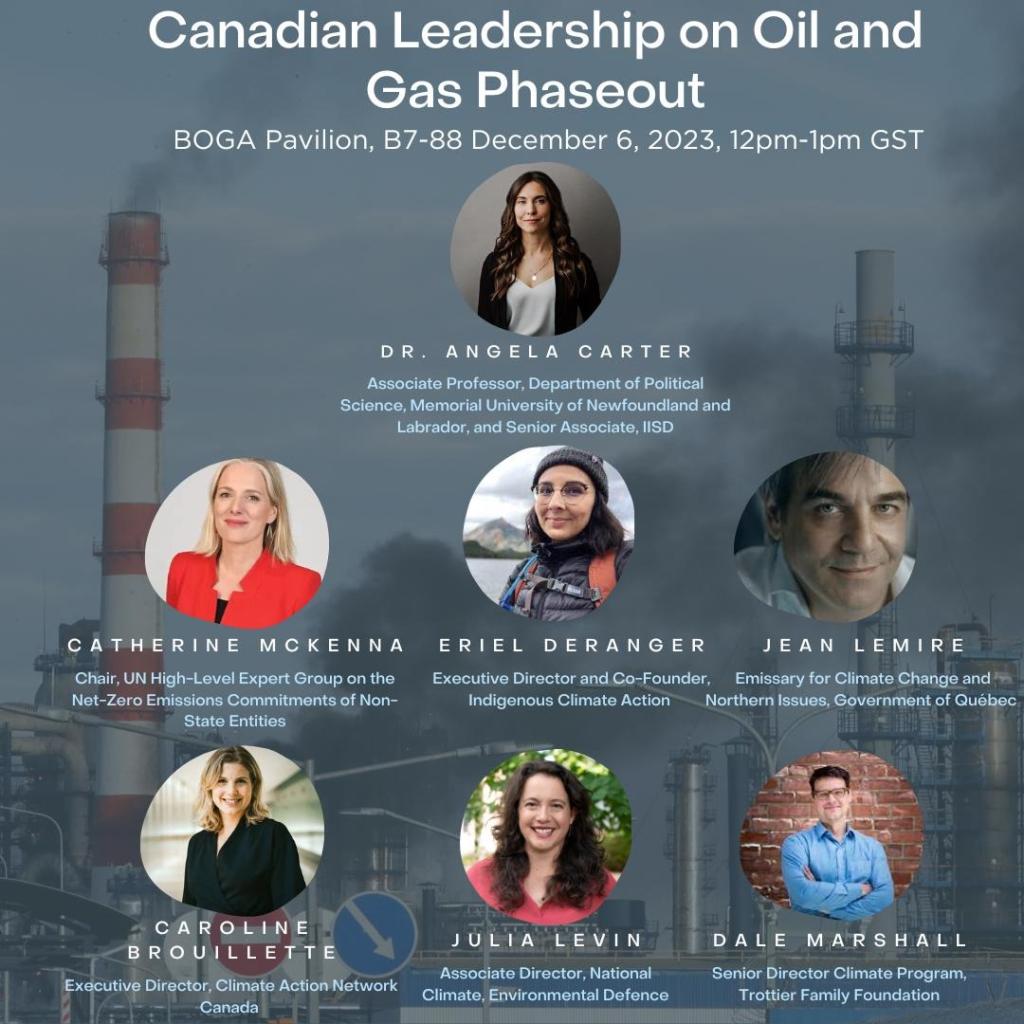
COP 28 Side Event | Canadian Leadership on Oil and Gas Phase-Out

December 6, 2023 12:00 pm - 1:00 pm GST

In-person at the BOGA Pavilion

(Open to public)

Canadian Leadership on Oil and Gas Phase-Out event with photos of speakers

This COP 28 side event showcases progress to date on phasing out oil and gas production in Canada. Panellists from a diverse range of backgrounds will discuss opportunities to amplify the phase-out across the country, highlighting the role of Indigenous leadership, civil society advocacy, provincial policy, and international governance frameworks.

Agenda

Welcome and Introductions

Angela Carter, Associate Professor, Department of Political Science, Memorial University of Newfoundland and Labrador, and Senior Associate, IISD

Panel Discussion

Catherine McKenna, Chair, UN High-Level Expert Group on the Net-Zero Emissions Commitments of Non-State Entities

Eriel Deranger, Executive Director, Indigenous Climate Action

Jean Lemire, Emissary for Climate Change and Northern Issues, Government of Quebec 

Caroline Brouillette, Executive Director, Climate Action Network Canada

Julia Levin, Associate Director, National Climate, Environmental Defence

Q&A

Closing Remarks

Dale Marshall, Senior Director Climate Program, Trottier Family Foundation

Conference details

IISD in the news

Canada won't get to net zero without an emissions cap on oil and gas, researchers say

The oil and gas sector is being increasingly scrutinized for its contribution to the climate crisis, as it is estimated that this particular industry is responsible for more than 75 per cent of global greenhouse gas emissions and nearly 90 per cent of all carbon dioxide emissions, according to the United Nations. While many producers have said they are committed to the global goal of net-zero emissions by 2050, with production of oil and gas expected to continue to ramp up for the foreseeable future, it’s difficult to see how this will be achieved.

November 22, 2023

IISD in the news details

Topic
Climate Change Mitigation
Region
Canada
Impact area
Climate
Conference

COP 28 Side Event | Tackling Climate Change in Africa's Protected Areas

December 2, 2023 5:00 pm - 6:00 pm GST (GMT+4)

WWF Pavillion

(Open to public)

Card announcing CAPA Event at COP 28

Taking place on Africa Day, this event, hosted jointly by WWF’s Regional Office for Africa and IISD, will focus on climate change challenges in protected areas, showcasing the Climate Adaptation and Protected Areas (CAPA) Initiative, funded by Canada’s Partnering for Climate Initiative. It will provide a space to unpack the complexity of climate change impacts and potential interventions, including through nature-based solutions. This event will also highlight the benefits of transboundary protected areas to enhance adaptation, biodiversity conservation, and development cooperation among neighbouring countries.

Speakers:

Evelyn Namubiru-Mwaura, Director, Program Quality and Resource Acquisition, WWF International

Andrew Hurst, Executive Director, Climate Finance, Global Affairs Canada

Alec Crawford, Director, Nature for Resilience, IISD

Harisoa Hasina Rakotondrazafy, WWF Madagascar and West Indian Ocean Programme Office

Her Worship Gladys Kamasanyu, Chief Magistrate, Uganda Wildlife Court

Conference

COP 28 Side Event | Partnering for Climate: Supporting Nature-based Climate Solutions for Adaptation

December 2, 2023 3:30 pm - 4:30 pm GST (GMT+4)

Canadian Pavilion

(Open to public)

Card announcing Partnering for Climate Event at COP 28

This event, hosted jointly by Global Affairs Canada and IISD, will highlight Canada’s leadership on climate finance through the Partnering for Climate initiative and include interactive exchanges between Partnering for Climate project hosts and an international audience. It will feature IISD-led projects, such as the Climate Adaptation and Protected Areas (CAPA) Initiative and the Scaling Urban Nature-Based Solutions for Climate Adaptation in sub-Saharan Africa (SUNCASA) initiative, as well as Plan International Canada’s project: Conservation and Sustainable Management of Coastal and Marine Ecosystems (COSME) in Kenya. This event seeks to demonstrate the implementation potential and stories of nature-based solutions for adaptation in Canada, sub-Saharan Africa, and Small Island Developing States, as well as Canada’s role in accelerating global climate action.

Speakers:

  • Andrew Hurst, Executive Director, Climate Finance, Global Affairs Canada
  • Alec Crawford, Director, Nature for Resilience, IISD
  • Evelyn Namubiru-Mwaura, Director, Program Quality and Resource Acquisition, WWF International
  • Jeffrey Qi, Policy Advisor, Resilience, IISD
  • Kristen Ostling, Senior Advisor, Policy and Advocacy, Plan International Canada

To learn more, visit the Canadian Pavilion event page here[Please note that the official page is being updated to reflect changes from Parks Canada to Plan International Canada]

IISD in the news

Environmentalists release recommendations for next year's budget

Canadian Finance Minister Chrystia Freeland is set to unveil the government's Fall Economic Statement Nov. 21, but some environmentalists are already looking forward to next year's federal budget. On Thursday, the Green Budget Coalition (GBC), comprised of several environmentally-focused non-profit organizations, released its set of five recommendations for the next budget. According to Laura Cameron, a policy advisor at the International Institute for Sustainable Development who wrote the GBC's sustainable jobs recommendation, the feds need to provide financing to support Bill C-50, the government's proposed sustainable jobs legislation, which is currently making its way through the House.

November 9, 2023

IISD in the news details

Region
Canada
Impact area
Sustainable Economies