The COVID-19 crisis, while difficult and tragic, also provides a critical opportunity to align efforts to meet Canada’s climate goals with the challenge of economic reconstruction post-pandemic.
The COVID-19 crisis, while difficult and tragic, also provides a critical opportunity to align efforts to meet Canada’s climate goals with the challenge of economic reconstruction post-pandemic.
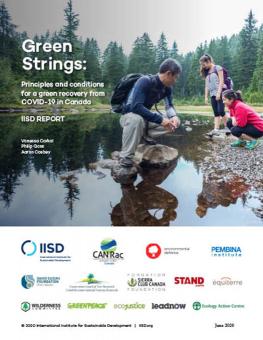
IISD has developed seven "green strings" recommendations: key principles, criteria, and conditionalities that should be applied to government measures for economic recovery from COVID-19 to ensure a green recovery.
Canada’s leading environmental groups, representing close to two million people, have signed on to the recommendations, including the Pembina Institute, Climate Action Network Canada, David Suzuki Foundation, Environmental Defence, Greenpeace Canada, Équiterre, Ecojustice, Ecology Action Centre, Conservation Council of New Brunswick, Stand.earth, Leadnow, Sierra Club Canada Foundation, and Wilderness Committee.
The reasons to set and apply "green strings" are clear:
Conditions in the public interest are the government’s right and duty.
The benefits of green stimulus and recovery measures are backed by evidence.
We need a new economic model for the workers of today and tomorrow.
Urgent action is needed to address the climate crisis.
Health and climate change imperatives go hand in hand.
There is strong public support for ensuring a green recovery.
The following seven “green strings” should be attached to COVID-19 recovery measures announced by Canada’s government:
Support only companies that agree to plan for net-zero emissions by 2050.
Make sure funds go towards jobs and stability, not executives and shareholders.
Support a just transition that prepares workers for green jobs.
Build up the sectors and infrastructure of tomorrow.
Strengthen and protect environmental policies during recovery.
Be transparent and accountable to Canadians.
Put people first and leave no one behind.
We can no longer continue with the status quo, worsening the climate and biodiversity crises and locking our country and the global community in to stark health, environmental, and economic outcomes. We must seize this difficult moment to transform our economy and our institutions to serve vital public policy goals from environment to equity. The stakes are high.
Down to Earth: How to Protect Fresh Water from Oil Spills
This episode looks at what freshwater scientists are trying to accomplish by spilling oil into a remote lake, and the unusual solution they've found to help clean up future oil spills.
Pipelines run all across North America. You probably live closer to one than you think. Although spills from pipelines don't occur frequently, we need to better understand what impact they have on nearby freshwater environments.
That's why a team of scientists at IISD Experimental Lakes Area in a very remote pocket of Canada are involved in a new project that seeks to better understand the risks of transporting oil, how to prepare for spills, and how to respond to them effectively.
In this episode of Down to Earth, take a trip with host Sumeep Bath to one of the ELA's 58 protected lakes in northwestern Ontario (the nearest town is a two-hour drive through the woods on a gravel road), meet the personalities behind the project, and get a feel for what's truly involved in solutions-based freshwater research (hint: it involves getting wet).
Share this page:
Insight
We May Be in Uncharted Waters, But We Aren’t Lost at Sea
When the financial crisis of 2008 hit, governments around the world began structuring stimulus plans. We can learn a lot by looking back at how effective these turned out to be.
June 8, 2020
As Canada navigates the COVID-19 pandemic from immediate response to short-term relief and, finally, long-term recovery, its leaders will face increasing scrutiny as to how much stimulus money is going where, and to what extent it will help us build back better.
If this all feels vaguely familiar, it’s because we’ve seen it before. When the global financial crisis of 2008 hit, governments around the world began structuring similar stimulus plans. We can learn a lot by looking back at how effective these turned out to be, both in terms of revitalizing economies and forging a path toward a low-carbon, sustainable future.
In the aftermath of the 2008 crisis, many countries implemented two kinds of policies: those that met urgent needs to support vulnerable sectors and people, saving industries and creating jobs; and those that aimed at longer-term recovery.
Taking the long road to recovery
In the latter category, countries such as the U.S. came out of the financial crisis with policies aimed at transitioning the energy system toward renewables, rolling out mass broadband, revolutionizing education and health care, investing in research and development, and renewing infrastructure.
While these kinds of long-term policies don’t fill the immediate need for jobs, they build a foundation for future growth and prosperity (the central tenet of building back better) by deliberately reshaping the economy.
While long-term policies don’t fill the immediate need for jobs, they build a foundation for future growth and prosperity (the central tenet of building back better) by reshaping the economy.
To do this, you need to have some idea of what you’re driving toward. Post-2008, countries including the U.S., Korea, Australia, Japan, and China used stimulus to support and nurture sectors that were poised to drive green recovery, which meant that economic rebuilding went hand in hand with immediate and lasting environmental improvements.
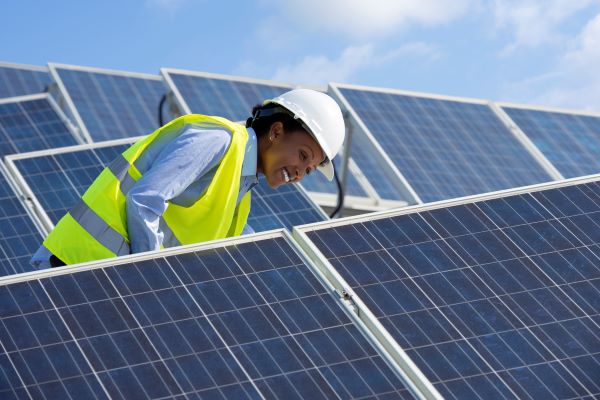
Investing in solar energy may be the right move for some countries / iStock
They put people to work retrofitting buildings to high energy-efficiency standards. China launched into its drive for global leadership on wind and solar power manufacturing. The U.S. forced its troubled auto manufacturing sector to reorient and start building fuel-efficient cars that would serve future markets.
It became clear that, in recovering from crisis, a nation could actively reshape its future to become at once greener and more prosperous.
The global financial crisis also taught us that bailouts of companies should be avoided, but if they are necessary taxpayers should be made whole at the end of the day, and conditions of bailouts should be onerous and tied to policy directives.
It became clear that, in recovering from crisis, a nation could actively reshape its future to become at once greener and more prosperous.
Because the auto bailouts in the U.S. were tied to improvements in vehicle efficiency, a lower emitting vehicle fleet was able to thrive, despite decades of resistance by the sector itself. The Canadian auto bailout came with daunting conditions; it forced restructuring and accelerated bankruptcy that wiped out shareholders, replaced senior management and took equity stakes. In the same vein, the present-day bailout of KLM-Air France was conditioned on limiting the airline’s ability to compete with France’s more environmentally friendly domestic rail services in cases where the journey by rail would be less than 2.5 hours.
Shovel-ready versus shovel-worthy
Investment in simple, ‘shovel-ready’ projects where finance was constrained also performed well after the 2008 crash, such as energy-efficiency funding for residential and municipal sectors. Areas where there was potential for a high number of standardized small projects, such as efficiency retrofitting, also performed better, and showed lower risk than large, complex infrastructure projects.
But governments must consider what’s shovel-worthy, too, applying the principles of smart industrial policy and targeting far-sighted support in areas where latent comparative advantage may take years to emerge. Many countries, notably Europe, made large investments in wind and solar power part of their post-2008 spending. For Europe, this led to a large wind-energy cluster, where countries like Germany held a mechanical engineering advantage.
The inevitable price of this kind of success is risk; the EU investments in solar energy did not create a similar cluster, in part because China already had an advantage in semiconductor electronics.
This is our chance to set Canada on a path of resilience and ensure we can compete in the low-carbon markets of the future.
Policy design is also crucial to avoid unintended consequences and rebound effects. In Australia, a home-insultation program was rapidly instituted, but failed because of a lack of consultation and poor design choices that traded safety, accountability, and effectiveness for speed of implementation. In Japan, subsidies to drive a massive shift toward more efficient, lower-emitting vehicles were a great success, but the decrease in greenhouse gases was largely offset by reductions in road tolls designed to boost tourism, which led people to drive more.
These kinds of pitfalls can be avoided by working across ministries, consulting with stakeholders, and carefully considering policy impacts (both intended and unintended).
We have an opportunity right now for a green transition, with an unprecedented global investment of public funds that will have decades-long repercussions. It’s our chance to set Canada on a path of resilience and ensure we can compete in the low-carbon markets of the future.
But in our rush to create policy solutions in these uncharted waters, let’s not forget that we can draw on rich experience to help us navigate toward this goal.
This op-ed originally appeared in the Hill Times on June 8, 2020. It has been republished with permission.
COVID-19 Has Changed our Freshwater Use. We Need To Be Careful
In an op-ed for the Ottawa Citizen, Matt McCandless argues we often take fresh water for granted, but we must protect it as usage patterns change.
June 4, 2020
In an opinion piece for the Ottawa Citizen, Executive Director of IISD Experimental Lakes Area Matt McCandless argues that, in Canada, we often take fresh water for granted but that, as responsible citizens, there are critical steps we need to take to safeguard its health as water usage patterns change.
"Buoyed by an increased prevalence of lockdown-related good-news stories, such as tales of clearer Vancouver skies and Venetian canals, our general assumption is that the current limitations on human movement will ultimately result in a significant net positive effect for our environment.
Well, that’s only part of the story. Notably absent from much of this discussion, perhaps because of its perceived perennial ubiquity, especially in Canada, is our supply of fresh water..."
Recent polling data shows Canadians agree; a majority believe we must keep up efforts to combat climate change regardless of the health and economic impacts of COVID.
Extreme weather events have not stopped while the world is on lockdown: just last week, the most powerful cyclone in 20 years hit eastern India and Bangladesh, with India now bracing for another; two dams in Michigan were breached in what is being called a “500-year flooding event”; and scientists warned of a grim outlook for Atlantic hurricane season.
The Task Force for a Resilient Recovery, of which IISD is a member, is currently formulating recommendations for how Canada can ensure our economic recovery supports the jobs, infrastructure, and growth needed to keep us competitive in a changing climate.
Our recovery efforts have started on the right foot, but we must do more
Canada has already made steps in the right direction by announcing the conditionality of COVID-19 loans to large businesses based on the disclosure of climate impacts and risks, a first-of-its-kind approach that has garnered international interest. Another welcome move was the federal government’s decision to put CAD 1.7 billion into helping clean up orphaned and abandoned oil and gas wells.
But Canada can and must do more or risk getting left behind while the rest of the world moves on. IISD’s research into stimulus packages in Europe and Asia, which will feed into the Task Force’s recommendations, shows four areas of opportunity:
Buildings:Australia, New Zealand, South Korea, and the European Union (EU) through its Green Deal, are rolling out energy efficiency retrofits for low-income homeowners and for publicly owned buildings. Public investments vary between USD 7 and USD 750 per capita (in Denmark), with the aim of saving much more on energy bills and creating thousands of local jobs. The same rationale holds true for energy efficiency retrofits in Canada, where buildings are the third largest source of greenhouse gas (GHG) emissions (13% of the total in 2018).
Mobility: France has committed EUR 8 billion (around USD 130 per capita) to “cash for clunkers” programs and subsidies for the purchase of electric vehicles (EVs). Iceland and China are investing in EV charging infrastructure, while the EU is considering a VAT exemption for “zero-emission” cars. In addition, the United Kingdom and many European cities have announced large investments in cycling and walking infrastructure, while China is planning more funding for high-speed rail. Mobility is the sector hardest hit by the COVID-19 crisis and the second largest source of Canada's GHG emissions (25% of the total in 2018). Using stimulus to green and electrify the Canadian mobility sector appears a viable solution, with the added benefit of preparing Canadian manufacturers to compete in export markets.
Nature restoration: The EU, through its Biodiversity 2030 Strategy, has committed around USD 500 per capita to nature restoration; New Zealand has committed USD 140 per capita. Similar efforts are underway in Iceland and Pakistan, with locals employed to plant trees, improve waterways, promote organic agriculture, and restore wildlife habitats. Canada is world-famous for its vast outdoors, but those spaces also suffer from industrial and agricultural pollution requiring investments in natural infrastructure.
Clean energy: Many countries have come up with investment plans for clean energy. Australia, Norway, and Portugal are backing hydrogen, while Denmark and Germany are building out additional wind investments. The EU has also pledged EUR 40 billion in a Just Transition Fund to support coal phase-outs, retrain workers, and decarbonize businesses. Energy is the largest source of Canada's GHG emissions—26% of the total came from oil and gas in 2018.
None of this is to suggest Canada should abandon its current climate efforts. Its existing commitment to phasing out coal, for example, is vital and needs to be complemented by investments in renewable energy, grids, and storage. Similarly, a federal carbon tax is necessary, but insufficient on its own. To meet the international commitments we have made to limit global warming by 2030, we need to use all the tools in the toolbox.
A federal carbon tax is necessary, but insufficient on its own. To meet the international commitments we have made to limit global warming by 2030, we need to use all the tools in the toolbox.
In fact, Canada was late in introducing carbon pricing and should learn from those who got there first. Europe, which has had carbon pricing for a long time, has also experienced problems with its implementation. As the above examples demonstrate, many countries in Europe have recognized carbon pricing alone is not enough and are rolling out sizable green stimulus plans now.
And, while some commentators have suggested there are risks in allowing governments to pick winners and losers in the marketplace, the history of innovation—from the Internet to the iPhone—demonstrates the critical role of direct government support in developing new technologies. Risks can and must be managed, including through private sector participation.
As we face a once-in-a-generation opportunity to shape our future, Canada also has an opening to not just keep up with international peers but show true leadership in the face of unprecedented adversity. To do any less would be a betrayal—of ourselves and future generations.
The decisions we make coming out of COVID will shape our country for years to come. We encourage governments—and all Canadians—to envision and work towards the future we truly want. The Task Force offers these recommendations as a bridge to a better Canada—one that is clean, prosperous, and climate resilient.
The COVID-19 pandemic is a global health and economic crisis. Since it began, governments around the world have focused on the need for health care support and immediate economic relief for those directly affected.
Countries are now setting their sights on the longer-term horizon and determining how to drive an economic recovery. A number of historic green stimulus announcements, particularly in Europe and Asia, show positive signs that the recovery will support urgent climate goals and the growth of a low-carbon economy.
What will be Canada’s response? How can we foster a recovery that gets Canadians back to work while ensuring our country is competitive, prosperous, and climate-resilient in the clean economy of the 21st century? This is the urgent question that inspired the work of the Task Force for a Resilient Recovery.
The Task Force came together in May 2020 to provide independent and urgent advice on how government can build this kind of recovery through actions and investments over the next five years.
In developing this advice, the Task Force drew on leading international efforts while also assessing dozens of Canadian recovery proposals for economic, equity, and climate benefits.
The result is five overarching bold moves, supported by 22 recommendations, and calling for CAD 55.4 billion in government investment over the next five years.
The decisions we make coming out of COVID will shape our country for years to come. We encourage governments—and all Canadians—to envision and work towards the future we truly want. The Task Force offers these recommendations as a bridge to a better Canada—one that is clean, prosperous, and climate resilient.
Remembering Sylvia Ostry, a Pioneering Winnipegger
The proud Canadian saw in IISD an organization prepared to take risks in pursuit of its mission, defy the status quo, and challenge accepted wisdom.
May 13, 2020
Sylvia Ostry, who passed away on May 7, 2020, at the age of 92, was surely one of the great international Canadians of her generation.
A leading economist and public servant, she was the Chief Statistician at Statistics Canada from 1972 to 1975, then became Deputy Minister of Consumer and Corporate Affairs (the first female deputy minister at the federal level). Prominent roles followed at the Economic Council of Canada and the Organisation for Economic Co-operation and Development. More recently, she served as Chancellor of the University of Waterloo, followed by a stint as Chair of the University of Toronto's Centre for International Studies.
On top of her professional accomplishments, Sylvia was awarded 18 honorary doctorates from universities around the world. The UN High Commissioner for Refugees launched a lecture series in her honour.
Less well known is that Sylvia had a particular affection for IISD. Born in Winnipeg, MB, she was proud that such an eminent worldwide institution should be based in her home province of Manitoba but, more importantly, she saw in IISD an organization prepared to take risks in pursuit of its mission, defy the status quo, and challenge accepted wisdom.
Sylvia saw in IISD an organization prepared to take risks in pursuit of its mission, defy the status quo, and challenge accepted wisdom.
Sylvia was delighted when IISD challenged the World Trade Organization (WTO) to live up to its commitment to ensuring that trade serves sustainable development. She was intolerant of ill-considered policy with no convincing economic or social purpose that only rewarded individual politicians.
Early on, IISD decided to examine the impact of subsidies on sustainable development. Initial findings were alarming: many subsidies are clumsy economic policy tools that too often undermine rather than advance sustainable development. We resolved to test the waters with a first phase of work on biofuel subsidies, then launch an initiative on fossil fuel subsidy reform. Early efforts to gather support were discouraging, and we considered throwing in the towel.
During a long walk around the grounds of the WTO, after listening to IISD President David Runnalls and myself bleakly conclude that we couldn’t make it work, Sylvia stopped and asked point-blank: “How can an institute dedicated to sustainable development not address subsidies?”
She was right, and the result was IISD’s flagship Global Subsidies Initiative, for which Sylvia later chaired the Senior Advisory Council. Her impish humour and her maverick’s healthy disrespect for established power set the tone for the initiative, guiding it through the first shoals and out into open water.
She also pounded home the importance of unimpeachable data and robust analysis. Challenging subsidies would make IISD many enemies and opponents’ first line of attack would be to discredit us by suggesting our analyses were incomplete or out of date and that our data were flawed. Any thread left hanging would be used to unravel the entire fabric, Sylvia cautioned. This advice served IISD well, not only in its controversial work on biofuel subsidies but more generally in all our work on sustainable development. After all, in the end, sustainable development is a challenge to the status quo and no thanks are to be expected from those who benefit from unsustainable behaviour.
She taught us that, if there is no precedent for doing something or approaching things in a particular way, the best thing to do is set that precedent.
IISD owes a debt of gratitude to this great child of Manitoba. She represented the spirit IISD tries to bring to its work. She taught us that no idea is stronger than the analytic base on which it rests. She taught us that, if there is no precedent for doing something or approaching things in a particular way, the best thing to do is set that precedent.
And, perhaps most importantly, she taught us not to take ourselves too seriously. Humour, disruption, questioning of authority, innovation, and creativity are all part of the magic mix that makes for a successful professional and institutional life, all of which she so fully embodied.
Together | Ensemble is Canada’s national conference devoted to tracking progress on the United Nations Sustainable Development Goals (SDGs).
The free online conference will run May 20–22, 2020. It represents an all-of-society approach to addressing Canada’s toughest sustainable development challenges, bringing together the private sector, academia, government, and civil society. It will promote:
Work that is happening across the country
New opportunities for collective impact
Mobilization of good practices, effective research, and policy work
New partnerships, innovations, and pathways for progress on the SDGs.
On Thursday, May 21, 2020, IISD's Stefan Jungcurt moderates an exceptional panel discussion on cities and municipalities embracing the SDGs.
Localizing the SDGs in Your Community
Municipalities across Canada are aligning community indicator systems, strategic planning, and reporting frameworks with the Sustainable Development Goals to develop robust, holistic measures of sustainability and to promote interdepartmental collaboration. This session features strategies and tools from leaders who have initiated the process of localizing the SDGs in their communities.
Confirmed Speakers:
Stefan Jungcurt (moderator), International Institute for Sustainable Development (IISD)
S. S. Ahmad, Green Beacon Consulting
Anna Marie Cipriani, City of Waterloo
Luis Patricio, London Poverty Research Centre
Thursday May 21, 2020 from 12:00–12:45 pm EDT Register online
Building Back Better Is the Right Thing to Do. It Also Makes Good Economic Sense.
Canada must focus on building back better in order to set us on a path toward net-zero emissions and even greater economic growth.
May 4, 2020
Like its G20 peers, the Government of Canada has swiftly implemented significant relief measures in response to the COVID-19 pandemic. The initial wave of rescue spending has, as it rightly should, focused on keeping businesses and people alive.
Decision-makers in Ottawa have made smart decisions already, choosing to invest in environmental clean-up and emission reduction projects that put people to work while having a positive impact on the environment.
But what happens next, in the recovery phase of stimulus spending, could either lock us into a system from which there is no escape or set us on a path toward net-zero emissions and even greater economic growth, a finding reinforced by a new report released today.
A new study finds that "recovery packages that seek synergies between climate and economic goals have better prospects for increasing national wealth."
The study, released by leading economists including Nobel Prize winner Joseph Stiglitz and acclaimed climate economist Nicholas Stern, finds that “recovery packages that seek synergies between climate and economic goals have better prospects for increasing national wealth.”
Building back better makes economic sense
The researchers catalogued over 700 stimulus policies into groups and completed a survey of 231 experts from more than 50 countries, including senior officials from finance ministries and central banks. Based on the survey results as well as lessons from the 2008 financial crisis, the economists found that “green projects create more jobs, deliver higher short-term returns per dollar spend and lead to increased long-term cost savings, by comparison with traditional fiscal stimulus.”
The report zeroes in on five policies that can have a large return on investment, be enacted quickly, and have a strongly positive impact on climate. These are:
Investment in renewable energy production, such as wind or solar
Building efficiency retrofit spending
Clean research and development spending
Natural capital investment for ecosystem resilience and regeneration
Investment in education and training to address immediate unemployment from COVID-19 alongside unemployment from decarbonization.
For Canada, these findings are especially relevant, given the collapse in oil prices and the pressure from industry groups to loosen requirements on federal infrastructure spending. But as today’s report shows, a smarter economic recovery is one that delivers both immediate and long-term economic and environmental benefits.
Today’s report underscores the fact that governments can tackle the global economic shock of COVID-19 while simultaneously addressing climate change.
In addition to the substantially higher job-creation effects of investing in green infrastructure and renewable energy, the report notes that green economic recovery investments have stronger longer-term economic multiplier effects, notably in investing in high-productivity economies of the future.
Today’s report underscores the fact that governments can tackle the global economic shock of COVID-19 while simultaneously addressing climate change. It reinforces the recent economic advice of the International Monetary Fund that all governments should embrace a green economic recovery, as well as yesterday's statement by financial institutions about keeping a razor-sharp focus on scaling up investments in low- and zero-carbon pathways.
The choices we make now can set the course for a more prosperous and sustainable future. That choice is ours, Canada.