Farmers for Climate Solutions Task Force

COVID-19 has been fundamentally destabilizing to much of Canadian life, and the agriculture sector is no exception. Farm debt is at a record high, business margins are narrowing; farmers are aging and retiring without farm succession plans; climate impacts are worsening and sector emissions are currently on track to increase through 2030.

Experts working with farmers to recommend climate policy solutions

In its promise to build back better, the Canadian government has made an unprecedented commitment to farmers and ranchers in the 2020 Speech from the Throne to, "recognize ... farmers, foresters, and ranchers as key partners in the fight against climate change, supporting their efforts to reduce emissions and build resilience."

To deliver on this commitment, the Canadian government must prioritize: 

  • Farmer-led policy solutions that are backed by evidence

  • Policy solutions that simultaneously enhance climate action, farmer and rancher livelihoods, and a more inclusive and equitable sector

Spreading low emission, highly resilient agriculture will improve farmer livelihoods and help rural communities thrive. All Canadians will benefit through the enhancement of clean air, water, biodiversity, food security, rural well-being and beautiful country landscapes.

What does it mean to build back better in agriculture?

Long before the pandemic, the agriculture sector has been resting on unstable foundations. Farm debt is at a record high, business margins are narrowing; farmers are aging and retiring without farm succession plans; climate impacts are worsening and sector emissions are currently on track to increase through 2030. 

Farmers for Climate Solutions recently recruited a farmer-led task force of experts to propose short-term actions that will deliver long-term lasting benefits in emissions reduction, economic well-being, and equity. 

The task force advised Farmers for Climate Solutions on a short list of recommendations to be advanced for Budget 2021 and to inform the next Agricultural Policy Framework.

Meet the experts here.

Project details

Report

International Best Practices: Estimating tax subsidies for fossil fuels in Canada

This report outlines international best practices in defining and estimating tax subsidies and other types of foregone government revenue. It also counters common misconceptions about subsidy definitions and quantification methods.

December 14, 2020
  • Tax expenditures and other types of fossil fuel subsidies must be measured and reported transparently by Canadian governments.

  • Of the 128 revenue foregone policies we identified in the fossil fuel sector in Canada, only 50% were quantifiable.

  • Quantifiable revenue foregone policies in the fossil fuel sector in Canada account for around CAD 3.2 billion in fossil fuel subsidies.

Canadian governments provide financial support for fossil fuels through a variety of measures, including direct transfers to fossil fuel producers. Much of this support is provided through the tax system. Tax expenditures reduce government revenue and create incentives for the production and consumption of fossil fuels. A clear understanding of the extent of tax subsidies is necessary to assess their impacts on government budgets—particularly important in the context of the COVID-19 economic recovery—as well as on air pollution and climate change. But the transparency of the cost of Canada’s tax subsidies for fossil fuels is poor. We recommend that all tax expenditures and other types of foregone revenue be measured and reported in line with international guidelines and best practices.

Report details

Topic
Climate Change Mitigation
Energy
Subsidies
Region
Canada
Project
IISD Global Subsidies Initiative
Impact area
Climate
Publisher
IISD
Copyright
IISD, 2020
IISD in the news

Report shows Winnipeg’s weak points magnified through COVID pandemic

A community indicator report released last week setting benchmarks for Winnipeg’s communal well-being pre-pandemic showed that while many of Winnipeg’s sectors seem to be improving, inequalities that were present before the pandemic began in March have since worsened.

December 6, 2020

IISD in the news details

Report

2020 Our City: A Peg Report on COVID-19 and Well-Being Indicators to Watch

In a year of unprecedented change, the Peg report shifts to look at emerging trends on how COVID-19 is affecting Winnipeg.

December 2, 2020

While the report shares some immediate impacts of COVID-19—shown in this report with recent point-in-time statistics—many effects will be felt in our community for years to come. In this report, we focus on 14 Peg indicators we think will eventually reflect those longer-term impacts. Collectively, these indicators provide a baseline measure of Winnipeg’s well-being when we entered the pandemic. We hope by highlighting potential long-term impacts, we will inspire people to act to lessen the severity of these effects.

Our reports only give a snapshot of the information available on the Peg website (mypeg.ca).

Report details

Topic
Sustainable Development Goals
COVID-19 and Resilient Recovery
Region
Canada
Project
Peg
Impact area
International Governance
Publisher
IISD
Copyright
IISD, 2021
Webinar

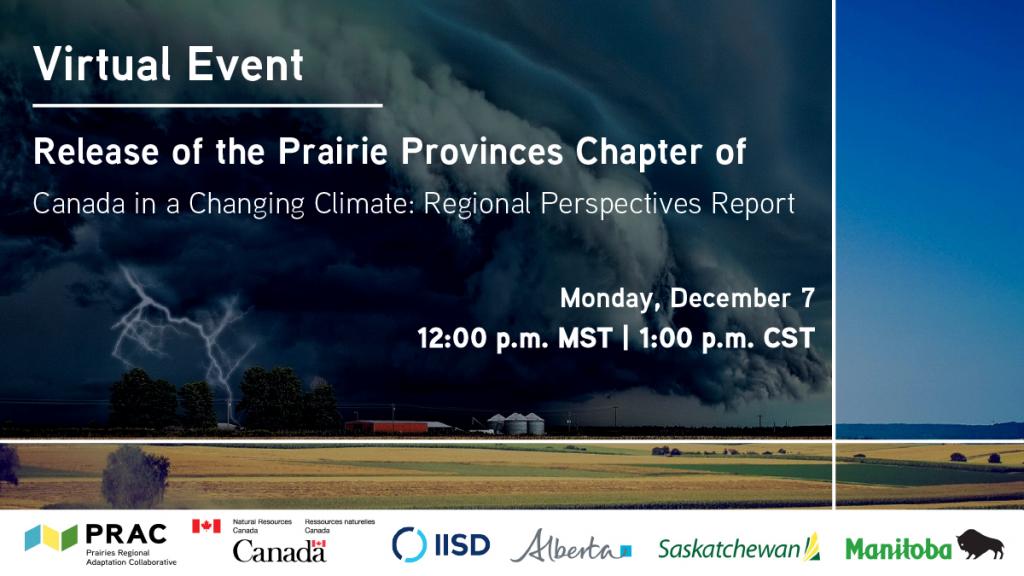
Release of the Prairie Provinces chapter of Canada in a Changing Climate: Regional Perspectives Report

December 7, 2020 1:00 pm - 2:30 pm CST

(Open to public)

webinar-prac-prairie-chapter-release-december-7

Natural Resources Canada (NRCan) leads the national knowledge assessment process, Canada in a Changing Climate: Advancing our Knowledge for Action. The first product of the current assessment process, Canada’s Changing Climate Report, was released in April 2019. The Prairie Provinces chapter is the first chapter of the Regional Perspectives Report to be released, which will be followed in 2021 by the National Issues Report, other Regional Perspectives chapters and the Health of Canadians in a Changing Climate Report.

The PRAC is pleased to host representatives from NRCan and the author team of the Prairie Provinces chapter to share an overview of the national assessment process and to discuss the key messages from the chapter, which focus on shifting ecosystems, extreme weather events, water management, agriculture, social considerations and adaptation planning.

Webinar details

Topic
Climate Change Adaptation
Region
Canada
Impact area
Climate
Guide

Mobilizing Capital for Natural Infrastructure in Canada

A guide for project champions and funders

Natural infrastructure is an area or system that is either naturally occurring or naturalized and then intentionally managed to provide multiple benefits for the environment and human well-being. These range from managed wetlands and grasslands to floodplains and forests, and can generate significant economic, social, and environmental benefits for surrounding communities and regions.

December 1, 2020
  • Natural infrastructure is an area or system that is either naturally occurring or naturalized and then intentionally managed to provide multiple benefits for the environment and human well-being. They range from wetlands and grasslands to floodplains and forests.

  • Natural infrastructure systems differ from just "plain old nature" in that they are specifically designed and optimized to generate greater benefits than they would otherwise if just left unmanaged.

  • Potential sources of capital for natural infrastructure projects include private, public and philanthropic funding and public financing. Projects are most likely to be funded via a combination of early philanthropic catalyst grants and larger, long-term sources of public funds.

Despite increasingly compelling evidence in support of natural infrastructure projects, large-scale investment is still lagging.

In this report, we provide a template and guidance for project champions and funders specifically to fund natural infrastructure projects.

Rather than starting with general categories of nature-based projects and their overall benefits, this report outlines a path to investment based on identifying specific drivers and project champions for nature-based solutions and then aligning the design of natural infrastructure projects with available financing tools.

Research highlights the value of natural infrastructure projects by focusing on their broad benefits. This report focuses on providing guidance to project champions and funders to bridge the gap between early-stage valuation and feasibility studies and project finance.

The research highlights that natural infrastructure champions are most likely to succeed in developing innovative and pragmatic finance solutions when they focus on identifying a driver, identifying a lead beneficiary or project implementer, developing a pitch, establishing a partnership, and securing catalyst/predevelopment funding.

Recommendations for funders and investors in natural infrastructure include funding targeted research to fill data gaps and develop performance metrics, convening and aligning potential natural infrastructure beneficiaries, supporting efforts to achieve scale, and providing dedicated pre-development support.

Guide details

Topic
Infrastructure
Water
Climate Change Adaptation
Region
Canada
Impact area
Nature
Initiatives
Natural Infrastructure for Water Solutions (NIWS)
Publisher
IISD
Copyright
IISD, 2020
Webinar

Stepping up to the Plate: How Canada can meet ambition on phasing out fossil fuel support

December 15, 2020 12:00 pm - 1:30 pm EST

via Zoom

(Open to public)

Under the Paris Agreement on climate change, Canada committed to reduce its annual greenhouse gas emissions to 30 per cent below 2005 levels by 2030. Yet the country is set to miss this target, in part due to ongoing support for fossil fuels. In fact, a recent scorecard ranked Canada last among G20 OECD countries for progress in ending fossil fuel support, even as the federal government committed to net-zero by 2050.

This webinar will present Canada’s current state of fossil fuel support and identify where the problem spots are, comparing to other G20 countries. We’ll examine how Canada’s planned policies and actions will expand fossil fuel production, widening the gap from what’s needed for 1.5°C and 2°C pathways and creating other risks in the process. Special attention will be placed on what the US election means for climate action post-2021, helping to shed light on what can be expected from the new Biden administration and how it could affect Canada.

Webinar

Tackling Fossil Fuel Subsidies in British Columbia

December 8, 2020 3:00 pm - 4:30 pm

via Zoom

(Open to public)

British Columbia is on the heels of an election, with the government focusing on climate change action through its flagship CleanBC plan. Yet BC has the second-highest level of fossil fuel subsidies of Canadian provinces. This webinar will delve into the province’s fossil fuel subsidies, examining their impacts but also potential to phase them out to support climate action.

In 2017–18, BC’s fossil fuel subsidies totaled at least CAD 830 million. We’ll go through the different types of subsidies in the province and explain their role in the expansion of liquefied natural gas (LNG), including what this means for competing clean energy. We’ll discuss the BC NDP election promise to review the oil and gas royalty framework, and how this could be used as a starting point for subsidy reform. We’ll see how fossil fuel subsidies and climate change impact communities directly, including First Nations, but also highlight the potential to kickstart clean solutions if government money is reinvested wisely.