Statement

Canada's Sustainable Jobs Legislation: A milestone for workers and communities on the path to net-zero

The Canadian Sustainable Jobs Act, Bill C-50, was officially passed into law today. IISD celebrates this significant milestone to engage and support workers and communities as Canada moves to a low-carbon economy. 

June 19, 2024

The global energy transition is already underway, bringing incredible opportunities for green job creation and labour shifts in high-emitting sectors. The Sustainable Jobs Act puts in place the necessary processes and principles to ensure that Canada's transition is charted in collaboration with workers, Indigenous Peoples, and affected communities.  

The act requires the creation of key governance mechanisms to coordinate and direct transition programs, including the Sustainable Jobs Partnership Council, Secretariat, and Action Plans. The Partnership Council will ensure that the government’s work is guided by labour, Indigenous Peoples, industry, civil society, and transition experts. The act outlines principles of a “people-centred sustainable jobs approach,” including social dialogue between workers, governments, and employers, as well as decent work in the green economy—meaning good-paying, high-quality jobs with union representation, job security, and social protection. 

IISD provided recommendations for the legislation and amendments based on best practices in just transition legislation in other jurisdictions and guidance from Canadian and international labour leaders. As a result of civil society input, the legislation was improved to include stronger links between sustainable jobs and climate policies under the Net-zero Emissions Accountability Act, stronger links between the guiding principles and action plans, and more inclusive governance processes. 

“This new legislation lays the foundation for a shift that prioritizes workers and communities. Scaling up renewable energy and low-carbon infrastructure presents exciting opportunities for employment and green industrial growth. But this work will only be successful through true collaboration with Indigenous communities and impacted workers.” 

Laura Cameron, IISD Policy Advisor

The success of the legislation hinges on the engagement, policies, programs, and investments that follow. The government must implement the guiding principles across all sustainable employment initiatives—promoting fair labour practices and adopting an inclusive approach to tackle inequalities in the job market, all while advancing Canada’s climate commitments. Given the regional nature of the energy transition in Canada, supporting social dialogue at the local and regional scales will be essential. This work should be supported by strategic foundational investments in sustainable jobs programs in Budget 2025. 

“Bill C-50 establishes a robust framework for prioritizing workers in the shift towards sustainable energy. Moving forward, it is imperative for the federal government to leverage this achievement to advance global progress on energy transition during its upcoming G7 presidency.” 

Philip Gass, Director, Energy Program, Just Transitions and Canada

With this legislation and subsequent actions, Canada can join peers such as Germany, New Zealand, and Scotland as an international leader in supporting workers and communities through the transition.  

Statement details

Deep Dive

How Can We Work With Nature to Tackle Drought and Desertification?

Drought is one of the most devastating and pervasive challenges exacerbated by climate change. However, we can work to reduce its effects through nature-based solutions for land restoration and climate-smart agriculture. 

June 14, 2024

Drought and Desertification

Drought has affected more people than any other natural disaster over the last 40 years, by drastically reducing both water quality and quantity, increasing the risk of disease and illness, and severely impacting livelihoods and nutrition through land degradation and food scarcity.

Extreme weather patterns, exacerbated by climate change, have resulted in some areas receiving a whole season’s rainfall in a single day, followed by an entire season with no rainfall at all. This variability is disastrous for communities, as it impacts soil health, agriculture, biodiversity, and hydropower, and often damages vital infrastructure. Such extremes leave land damaged through desertification: a form of land degradation in which drylands lose moisture and nutrients, becoming arid. This process can also be sparked through human activities, including agricultural factors like overgrazing and tilling, urban expansion and deforestation. Globally, more than 2 billion hectares of previously productive land has been degraded through desertification. That is an area twice the size of the United States!

Drought affects 1.84 billion people globally—that’s one in eight people

Currently, drought affects 1.84 billion people globally—that’s one in eight people. And it is set to get worse. The duration and frequency of droughts have increased by 29% since 2000, compared with the previous two decades. With further global warming, the latest Intergovernmental Panel on Climate Change (IPCC) report found that every region is projected to experience more frequent heatwaves and droughts. By 2040, one in four children will be living in areas with extreme water shortages, with far-reaching impacts for future generations.

Drought is one of the most devastating and pervasive challenges exacerbated by climate change. However, we can work to reduce its effects by learning from nature.

Mongolian nomad woman milking a cow

As intense weather worsens, droughts increase in intensity and frequency and the Earth heats up, there will be devastating impacts on communities, people's livelihoods, food security, and global economies.

Drought: A global problem

Drought is a global concern. The greatest impact is on low- and middle-income countries, where 85% of people affected by drought reside, according to the World Bank. Agriculture is at the heart of these economies and is the sector most affected by drought, absorbing up to 80% of all direct impacts. Nearly 1.3 billion people rely on agriculture as their main source of income. As intense weather worsens, droughts increase in intensity and frequency and the Earth heats up, there will be devastating impacts on communities, people's livelihoods, food security, and global economies.

An average of 70 countries are affected by drought each year. The World Bank mapped recent drought and desertification hotspots from 2019 to 2022, demonstrating that this phenomenon is intensifying in five out of seven continents. These hotspots are illustrated in the below map, which will name the country when you hover over it.


Even the areas currently not affected by water scarcity will soon feel its effects due to climate-related migration. By 2030, an estimated 700 million people will be at risk of displacement from drought alone. More people will lose their livelihoods. They will be forced to flee their homes. Food will become harder to come by, as millions of hectares of land dries up and becomes uninhabitable. Drought has the potential to be a silent tsunami, sweeping across great swathes of our landscape over the next decade, with developing and least developed countries set to be the worst affected.

By 2030, an estimated 700 million people will be at risk of displacement by drought alone

Nature-based solutions—an antidote to drought

Nature is a resilient teacher. By employing nature’s own checks and balances for environmental extremes like drought and desertification, we can adapt the landscape to absorb some of the impacts of climate change.

Lessons found in nature are implemented through nature-based solutions (NbS) that help protect, restore, and sustainably use ecosystems while simultaneously providing human well-being, resilience, and biodiversity benefits. Examples of NbS include planting trees to improve air and soil quality, retain water, and provide wildlife habitats, or restoring wetlands to create buffer zones for flooding and to support erosion protection. This green approach to infrastructure services can complementand sometimes replacetraditional grey infrastructure, such as concrete drains, seawalls, or breakwaters. Known as nature-based or natural infrastructure, this type of NbS can be employed to reduce the impacts of drought and desertification.

River in Namibia

By 2040, one in four children will be living in areas with extreme water shortages, with far-reaching impacts for future generations.

Combatting extreme droughts in Burkina Faso

In West Africa, Burkina Faso is experiencing severe impacts of climate change in the form of increasingly extreme rainfall and flooding events coupled with prolonged droughts. As a result, 46% of the country's arable land is now degraded. 80% of the population relies on agriculture for income, so drought and heat stress have detrimentally affected livelihoods and resulted in food scarcity.

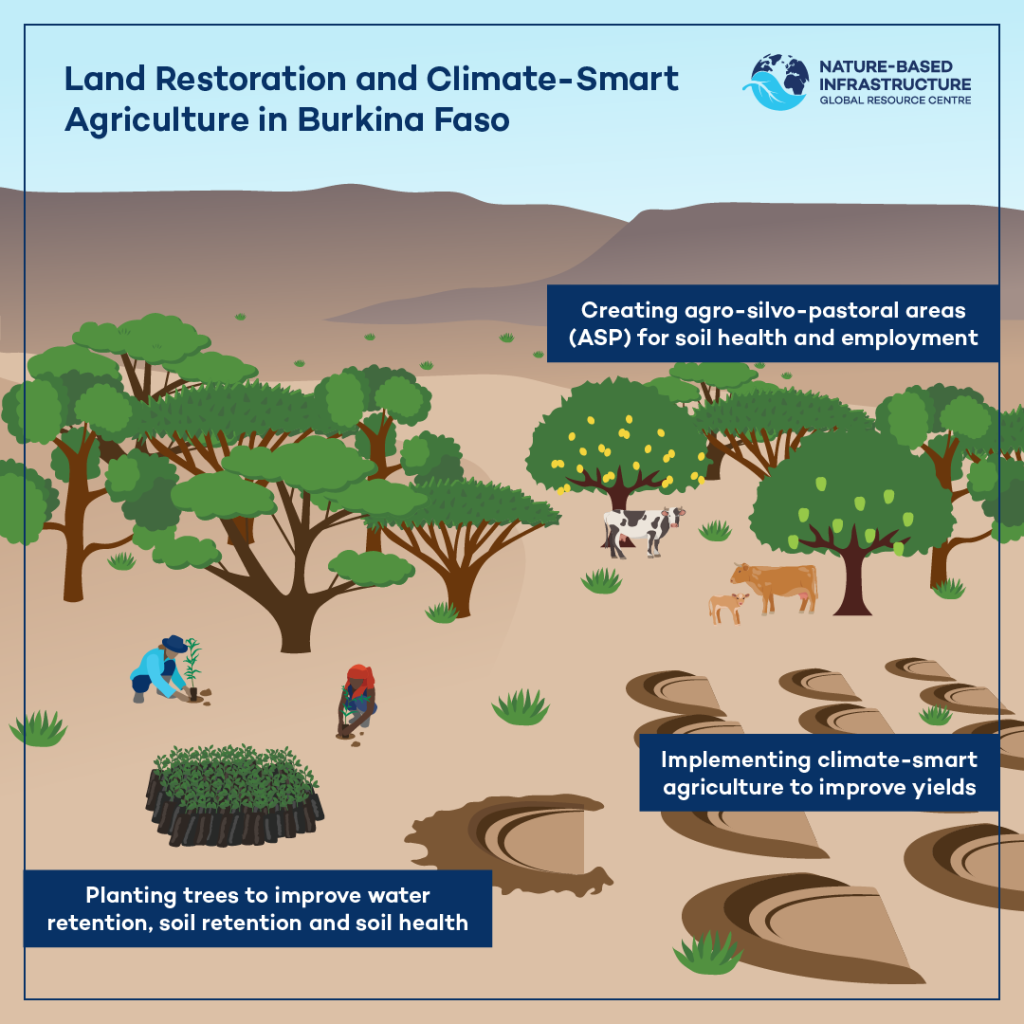
To combat this, the government has proposed a new land restoration project that aims to regenerate over a third of the country’s total land cover. Through the Nature-Based Infrastructure (NBI) Global Resource Centre, an initiative aiming to demonstrate the investment case for nature-based approaches to climate change adaptation, IISD assessed three potential methods for land restoration: nature-based, hybrid and traditional grey infrastructure. Working with Burkina Faso’s Ministries of Finance and Agriculture, and supported by the NDC Partnership, the NBI Global Resource Centre developed financial and economic models, calculating that the nature-based approach performed better than traditional grey infrastructure, to the tune of USD 1.7 billion in added benefits to the community over 30 years.

Burkina Faso NBI for Land Restoration

Consisting of tree planting, climate-smart agriculture, regenerative agriculture practices, and the establishment of agro-silvo-pastoral areas (which integrate agriculture, grasslands, fruit crops, and livestock farming), the combined methods reduce land erosion, enhance water retention, and improve soil quality, thereby helping to restore the degraded land and boost agricultural productivity. This modelling demonstrates the remarkable potential of nature in restoring land and reversing desertification while creating a wealth of environmental, social, and economic benefits for rural communities.

At least 100 million hectares of healthy land, an area the size of Egypt, is lost every year.

Nature-based solutions are like a Swiss Army knife. They can help us tackle many problems in a single project: drought, flooding, climate-related migration, food scarcity, nutrition, public health, rural livelihoods and the economy, CO2 emissions, heat stress, biodiversity protectionand even social inequality. Because of its inherent resilience, working with naturerather than against iteffectively reduces the impacts of drought and stops desertification in its tracks. But we need to deploy nature urgently; at least 100 million hectares of healthy land, an area the size of Egypt, is lost every year.

Deserted homes in Kolmanskop ghost town near Luderitz in Namibia, the site of an abandoned diamond mine

By 2030, an estimated 700 million people will be at risk of displacement from drought alone.

Three ways to include nature in climate adaptation

Increase awareness to demonstrate the diverse returns on investment

The first critical step for the successful implementation of NbS is to increase awareness of how nature can deliver these benefits by engaging with local communities, farmers, policymakers, and investors.

IISD has worked on a variety of projects doing just that all over the world. The Nature for Climate Adaptation Initiative developed an online course to raise awareness of the benefits of ecosystem-based adaptation and equip learners with transferable and replicable skills in designing and implementing these initiatives. Furthermore, in Manitoba, Canada, our Natural Infrastructure for Water Solutions team worked with the Seine Rat Roseau Watershed District to demonstrate the financial and economic benefits of their Water Retention program to local farmers and communities. The program helps protect farms from floods and drought, conserves habitats, and improves water quality downstream. David Wiens, a dairy producer in the district, said of the program: “My initial concern was about having the pastures flooded for a period of time. But when I understood the design, it became clear that it would actually be winwin.”

We can also tackle social inequalities by empowering underrepresented groups to pave the way for nature-based approaches. For example, a project that aimed to improve women’s land ownership in Rwanda also increased investments in soil conservation. In the Amazon, securing land rights for Indigenous People helped reduce deforestation. The impacts of the climate and biodiversity crises interact with social and gender inequalities, disproportionately affecting marginalized populations, and NbS initiatives must take this into account to boost societal benefits.

Collaboration is keyconsider drought as part of a wider problem

Drought and degraded land are not isolated issues. They have far-reaching impacts and implications for all areas of society, including public health, agriculture, the economy, and migration. An intersectional, unified approach between local communities, farmers, and policy-makers is crucial to gaining investment. Government ministries must come together to find solutions for climate change adaptation and mitigation. Local governments need to work with farmers and communities to support projects on the ground. Non-governmental organizations and governments can align with private investors to encourage financial flows to land restoration projects that sequester carbon and improve agricultural yields. Overall, stakeholders must break out of their silos and work together with an intersectional and coordinated approach to the problem.

Encourage and implement climate-smart and regenerative agricultural practices

In areas worst affected by drought, raising awareness, and funds and providing training for agricultural communities on implementing climate-smart and regenerative agricultural practices is crucial to maintaining land-restoration progress. Depending on the location, these practices can include reduced- and no-tilling techniques, “half-moons” or “earth smiles” (a traditional method of rainwater collection and soil restoration in the Sahel), keeping soil covered to prevent erosion, increasing crop diversity to boost soil health, nature-based water retention methods like channel rehabilitation, planting agroforests, creating agro-silvo-pastoral areas, and many more. These strategies are necessary to both recover already degraded land and prevent further desertification as droughts worsen with climate change.

Drought has been a concern for agriculture around the globe. Even in areas that are not directly affected to the extreme levels seen in low- or middle-income countries, action needs to be taken. By implementing NbS and making changes now to agricultural practices, farmers, communities, and policymakers can do their part to lessen future impacts of the climate crisis.


Learning more about how nature can help

With drought intensifying in five of seven continents, as well as the other climate crisis effects we are facing globally, it can feel a bit hopeless.  However, if we collaborate on solutions, using nature as our example, we can improve our climate adaptation strategies locally and globally.

Here at IISD, we have a number of ways for you to explore solutions, learn from case studies, and discover more about working with nature for climate adaptation.

Deep Dive

Why Liquefied Natural Gas Expansion in Canada Is Not Worth the Risk

The Bottom Line: Unpacking the future of Canada's oil & gas

Re-Energizing Canada is a multi-year IISD research project envisioning Canada's future beyond oil and gas. This policy brief is a part of the The Bottom Line series, which digs into the complex questions that will shape Canada's place in future energy markets. (Download PDF)

June 4, 2024

Summary 

  • New liquefied natural gas (LNG) facilities will undermine Canada’s domestic and international climate commitments through increased upstream and midstream emissions and—more critically—by diverting scarce financial and clean energy resources toward fossil fuel production and away from more cost-efficient decarbonization efforts. 
  • The possibility of coal-to-LNG switching abroad should not be used to justify the inevitable increase in domestic emissions associated with expanding LNG production. While proponents argue that LNG exports will decrease global emissions by replacing coal consumption overseas, this climate benefit is uncertain and often overstated, in part because of LNG’s potential to crowd out investment in renewable energy. 
  • The economics for new LNG production are weakening, as demand is estimated to have already peaked in advanced economies such as Europe and South Korea; LNG demand growth in emerging Asian markets is also projected to slow. 
  • By the time Canadian LNG from most new facilities reaches markets near the end of the decade, global LNG supply is expected to have already outpaced demand, deflating global prices. As a result, Canadian LNG projects may struggle to compete with cheaper and incumbent producers—such as Qatar and the United States—without substantial public subsidies. 
  • To limit the risks to taxpayers, the economy, and the climate, Canadian governments should avoid issuing project approvals and export licences to new LNG projects while phasing out subsidies and other forms of public support for approved projects. 

Introduction  

Canada produces more natural gas than is necessary for domestic demand, with over 40% of production exported between January 2020 and July 2023. To support the expansion of export markets beyond the United States, there are several active projects and proposals to construct liquefaction facilities in Canada that would convert feedstock gas into liquefied natural gas (LNG) to be exported overseas. While some of Canada’s gas has recently been sold to operators of liquefaction terminals in the United States—indirectly expanding Canadian export markets—the proposed domestic terminals are intended to enable Canadian gas to be exported overseas directly.  

Following an analysis of the most recent evidence, however, this brief concludes that plans to produce LNG in Canada carry excessive economic and environmental risks. Most prominently, Canadian LNG from most new facilities is at risk of entering the market during a global glut in supply, hampering the potential for export investments to be profitable and ultimately leaving investors at risk of losses from stranded assets. Meanwhile, excess LNG on the global market threatens to drive down prices and undercut the expansion of renewables abroad. Moreover, a Canadian LNG industry will come at the cost of increased domestic emissions that threaten to undermine Canada’s climate obligations. Accordingly, Canadian governments should limit exposure to such risks by refraining from issuing new construction and export permits while phasing out subsidies and other forms of financial support currently allocated to LNG projects. 

Other countries are also beginning to acknowledge the risks of LNG expansion. Earlier this year, the Biden administration announced a pause on granting new LNG export licences to non-free trade agreement countries. The rationale was the need to better integrate economic and environmental risks into the approval process, following "an evolving understanding of the market need for LNG, the long-term supply of LNG, and the perilous impacts of methane on our planet." While this policy development in the United States will not directly affect Canadian producers, it does acknowledge the need to examine the overall costs and benefits of LNG expansion in a rapidly changing global market.

Reconsidering Canadian LNG Projects 

Canada currently does not have any major LNG export facilities. However, eight projects are in various stages of consideration or construction, according to the federal government. Most of these are in British Columbia (BC), with one under consideration in Newfoundland and Labrador (see Table 1). West Coast LNG projects generally aim to supply Asian markets while the Newfoundland LNG projects would target sales to Europe. The largest and most advanced project is LNG Canada’s Phase 1, which is scheduled for completion in 2025. Woodfibre LNG, the only other project in Canada that has begun construction, is expected to be complete in 2027. Most other projects are scheduled for completion by or around 2030, though all are awaiting final investment decisions, environmental impact assessments, and/or export licences (Table 1). If approved, these pending LNG projects could have projected lifespans ranging from 20 to 60 years, depending on the project. As such, decisions on LNG expansion must be taken with a balanced view of their associated economic and environmental risks in the long term. 

Table 1. LNG export projects proposed or under construction in Canada
Project (location)  Export capacity (MTPA3) Export licence Government approvals  Final investment decision Construction status 
LNG Canada Phase 1 (Kitimat, BC)  14  40 years  Approved Approved Begun; to be completed in 2025 
LNG Canada Phase 2 (Kitimat, BC)  14  40 years Approved Pending  Not started 
Woodfibre LNG (Squamish, BC)  2.1 40 years  Approved Approved Begun; to be completed in 2027 
Ksi Lisims LNG (Gingolx, BC)  12  40 years Pending  Pending Not started
Tilbury LNG Phase 2 (Delta, BC)  2.5 25 years Pending  Pending  Not started
Cedar LNG (Kitimat, BC) 3 25 years Pending Pending  Not started
Port Edward LNG (Port Edward, BC)  0.3  Short term Pending Pending Not started 
Grassy Point LNG (Placentia Bay, NL) 2.5  Yet to apply  Pending Pending Not started

Sources: Authors, based on data from BC Environmental Assessment Office, 2024; Cedar LNG, 2024; Natural Resources Canada, 2023; Nickel, 2024; Woodfibre LNG, 2024

Environmental Risks of LNG Expansion 

LNG Production Would Threaten Canadian Climate Goals 

LNG production emits greenhouse gases (GHGs) at all stages of the value chain (Figure 1), posing an inherent challenge to aligning Canada’s plans for LNG expansion with domestic climate goals. Indeed, Clean Energy Canada calculates that just the six most advanced LNG projects in BC could add 13 Mt of carbon dioxide equivalent (CO2e) annually to Canada’s emissions by 2030. The Pembina Institute estimates that these upstream and midstream emissions would result in BC's oil and gas sector emitting a total of 30 Mt CO2e in 2030. This is more emissions than every gas-powered passenger car in Canada emitted in 2021 (25 Mt CO2e) and would breach BC’s sector-specific emissions target by 200%. This long-term fossil fuel infrastructure risks becoming stranded before the end of its economic life cycle if Canada reaches net-zero emissions by 2050. New LNG infrastructure may also create a fossil fuel lock-in effect by increasing the economic and political costs of meeting Canada’s climate commitments relative to a scenario where excess fossil fuel infrastructure is not developed. 

Figure 1. Illustrative life-cycle emissions of LNG5 

Source: Authors’ graphic based on data from Nie et al., 2020

Recognizing the emissions entailed by LNG expansion, both LNG proponents and the BC government have often suggested that LNG production in new facilities could be net-zero by 2030. However, significant resource constraints will make it difficult to fully decarbonize all planned LNG facilities. Indeed, for most LNG facilities, decarbonization would entail a massive demand for clean electricity that is proposed to come primarily from hydroelectric power sources, such as BC Hydro’s Site C dam, which is currently under construction at an estimated cost of CAD 16 billion. This new dam, however, will be far from sufficient to decarbonize BC’s planned LNG projects, as 2.5 times the hydroelectricity output of Site C would be required just to align LNG Canada Phase 1 and Woodfibre LNG with BC’s oil and gas sector emissions target. It is unclear how BC would produce enough clean electricity by 2030 to align all new LNG facilities in the province with 2030 climate targets.  

Even if new LNG facilities could be fully decarbonized, doing so would indirectly undermine Canada’s domestic climate targets by drawing excessively from clean energy supplies. That is, the massive amount of clean electricity required for LNG facilities could otherwise be used to decarbonize existing industries, such as the transport sector, or facilitate alternative growth strategies in low-carbon industries, such as renewable power generation. LNG expansion would therefore commit Canadian governments to the opportunity cost of using clean electricity to reduce future emissions associated with highly energy-intensive LNG facilities instead of reducing current emissions in other sectors. To put this opportunity cost in perspective, Clean Energy Canada estimates that importing the equivalent electricity produced by just one Site C dam would cost approximately CAD 600 million annually.

LNG expansion would therefore commit Canadian governments to the opportunity cost of using clean electricity to reduce future emissions associated with highly energy-intensive LNG facilities instead of reducing current emissions in other sectors.

New LNG Is a Risk to Global Emissions Reductions 

Acknowledging the reality of increased domestic emissions driven by LNG expansion, proponents argue that Canadian LNG exports would reduce emissions abroad, thereby generating a net benefit for the climate globally. This is suggested to occur because of coal-to-LNG fuel switching, as Canadian LNG displaces coal use for power generation in target export markets. However, recent studies suggest that this relationship between coal-to-LNG fuel switching and aggregate emissions reductions is more complicated than previously assumed and thus should not be relied on to justify the inevitable increase in domestic emissions associated with domestic LNG production.

Part of this complicated picture is that rates of fugitive methane emissions—those that are unintended and typically unmeasured—are much higher throughout the natural gas supply chain than previously believed. For example, methane emissions from oil and gas production in Canada have been consistently underestimated, with two recent studies estimating methane emissions to be 50% and 90% above official reported figures, respectively, at sites under evaluation. While the exact magnitude of methane emissions will differ by project, and the forthcoming federal methane regulations would reduce emissions in Canada, it is unlikely that methane emissions will be eliminated entirely from LNG value chains—especially in parts of the value chain that operate beyond Canada’s jurisdiction. When accurately accounted for in life-cycle emissions comparisons, these higher-than-assumed methane emissions can weaken or even reverse the assumed climate advantage of coal-to-LNG fuel switching.

Moreover, multi-decade LNG expansion projects may create international energy market conditions that undermine the transition from fossil fuels to zero-emission power sources. That is, infrastructure lock-in and deflated natural gas prices caused by excess supply would create long-term incentives for more natural gas consumption than would otherwise occur. While proponents argue that this increase in supply may displace coal as an energy source, others highlight that lower gas prices may also disincentivize investments in renewable power generation and thus slow the clean energy transition in emerging economies. Indeed, increased LNG supply in the international market will make it more competitive relative to alternatives generally. That includes both coal and renewables. The extent to which switching occurs between LNG and either of these alternatives will ultimately depend on contextual factors—such as policy support—that will differ across importing countries. Accordingly, new long-term LNG projects will incentivize higher global LNG consumption, which may, in turn, displace coal, renewables, or both depending on economic and policy contexts across importing countries. Proponents, therefore, cannot argue with certainty that new LNG exports will reduce global emissions by displacing coal use abroad. Rather, the risk of displacing renewables instead must be fully acknowledged in decisions to support LNG going forward.

Canadian LNG Is a Risk to Global Climate Goals 

Given these direct and indirect impacts on global emissions, new LNG production is widely recognized as incompatible with science-aligned emissions trajectories for keeping the average global temperature rise to 1.5°C. The International Energy Agency, United Nations Environment Programme, Intergovernmental Panel on Climate Change, and others have all concluded that there can be no new long-term oil and gas projects—including Canada’s planned LNG expansion—if the 1.5°C temperature target is to be achieved. This conclusion remains true even if LNG is assumed to be less emissions intensive than coal. Moreover, the IEA’s modelling suggests that emissions from oil and gas sector operations must decline by 60% (relative to 2022) by 2030. This modelling does not leave room for the rising emissions expected from LNG expansion projects, as outlined above in the case of BC, for example. New LNG projects, therefore, pose a substantial long-term risk to global climate goals. 

Canadian LNG expansion could also have a more immediate chilling effect on global climate ambition. Prioritizing industrial expansion over internationally recognized climate commitments would suggest that Canada is not committed to transitioning away from fossil fuels in line with the Paris Agreement, thereby sending a non-cooperative signal to other countries that may be facing a similar dilemma over fossil fuel expansion. This move is especially risky given Canada’s outsized historical contribution to climate change and the implications that this has for international discussions regarding a just distribution of the remaining global carbon budget. In a time where global cooperation on climate change is critical to implementing the Paris Agreement, the non-cooperative signal that would be sent by Canada prioritizing LNG expansion over its own climate commitments should not be overlooked.

Economic Risks of LNG Expansion 

Market Fundamentals Are Increasingly Unfavourable for New LNG Exports 

The economics of LNG development are weakening. Even with an optimistic 3–5-year time frame for construction, most Canadian projects would not begin exporting until the end of the decade. By this time, forecasted supply from incumbent producers is already expected to outpace demand. The United States, for example, already the world’s largest LNG exporter, is expected to double its current export capacity, with 102 billion cubic metres (bcm) of new capacity currently under construction. Russia and Qatar also have significant projects underway. Altogether, the IEA estimates that LNG projects under construction and those that have been awarded a positive final investment decision will add 250 bcm per year of liquefaction capacity by 2030—the equivalent of half of today’s global LNG supply. More than half (60%) of this increase is expected to come from the United States and Qatar.

At the same time, medium- and long-term natural gas demand forecasts are being consistently revised downward (Figure 2). Renewable energy capacity has expanded far more quickly than expected—despite growing fossil fuel subsidies—due to falling technology costs and increased climate ambition. Meanwhile, energy demand growth in key markets such as China is expected to slow relative to previous forecasts. LNG imports in Japan also fell by 8% in 2023—to their lowest level since 2009—following the restart of several nuclear power stations and growing renewable power generation. South Korean LNG imports similarly fell almost 5% in 2023, with demand expected to fall through the mid-2030s as new renewables and nuclear power plants come online. In the European Union, natural gas demand is in “structural decline” following a rapid expansion of renewables. Indeed, despite a short-term increase in European LNG demand following Russia’s invasion of Ukraine, the European Union Agency for the Cooperation of Energy Regulators recently confirmed that Europe’s LNG demand is expected to peak in 2024. Finally, volatile LNG prices and delays to import infrastructure projects in emerging markets in South and Southeast Asia are expected to continue dampening future demand.  

Figure 2. IEA forecasts for global natural gas demand by year based on current climate policies 

IEA forecasts for global natural gas demand
Source: IEA. CC BY 4.0

This slowing demand and growing supply will likely lead to an LNG market glut by the time most Canadian export capacity would come online toward the end of this decade. This expectation of a near-term supply glut for LNG is supported by recent market analyses from Morgan Stanley, S&P Global, and the Oxford Institute for Energy Studies. In the medium to long term, moreover, data from the IEA’s most recent modelling suggests that with current climate policies, there is sufficient LNG capacity in operation and under construction globally to meet projected natural gas demand all the way to 2040 (Figure 3). When announced climate policies are modelled, LNG projects under construction today are expected to result in more than twice the necessary capacity required to meet forecasted demand in 2050 (Figure 3). 

As a result, the IEA warns that LNG’s market fundamentals are shifting, "[raising] questions about the long-term profitability of projects." The most recent market analysis from the Institute for Energy Economics and Financial Analysis reaches the same conclusion, even when the United States’ recent pause on LNG export licences is accounted for. Indeed, it is precisely this concern for an imminent oversupply of LNG that informed the U.S. government’s decision to pause future LNG export licensing. In the longer term, demand is harder to predict due to a range of uncertainties, including policies across importing and exporting countries. As such, long-term forecasts of LNG demand vary wildly. What is highly likely, however, is that LNG demand in certain advanced, high-consuming economies like Europe and South Korea has peaked. It is clear that high-demand projections in the long term are less compatible with global climate goals, and as such, investment decisions today that bet on the former are likely to materially undermine the latter. The business case for new LNG capacity is therefore already weak for the near and medium terms, and this trend will likely continue into the longer term as global climate ambition increasingly aligns with the Paris Agreement.  

Figure 3. Global LNG capacity versus demand under three IEA scenarios

Global LNG capacity versus demand
Note: Scenarios are based on current climate policies (Stated Policy Scenario), announced climate policies (Announced Pledges Scenario), and a trajectory consistent with the Paris Agreement’s 1.5°C global warming target (net-zero emissions).  
Source: IEA. CC BY 4.0

Canadian LNG May Struggle to Compete in a Crowded Global Market 

The economic viability of Canadian LNG, specifically, will be directly affected by these worsening market fundamentals. Low demand and high supply will deflate global market prices, leaving marginal producers and new projects that have yet to repay their capital investments at risk of being priced out of the market. Canada’s intended importers in emerging Asian markets are price-sensitive and can therefore be expected to choose low-cost producers over more expensive ones—regardless of green credentials. Canadian LNG’s competitiveness and economic viability, therefore, will depend mostly on its production, transportation, and liquefaction costs relative to alternatives—notably from Qatar and the United States.  

It will be difficult for Canadian producers to compete on cost against these two alternative exporters. Qatar is by far the world’s lowest-cost LNG producer, which is unlikely to change. Qatar can produce LNG for as little as USD 0.03 per million British thermal units (mmBtu)—compared to the global average of USD 3–5/mmBtu—due to its abundant and easily accessible feedstock natural gas reserves, efficient co-production with natural gas liquids, and low labour costs. When directly compared to U.S. LNG exporters on the Gulf Coast, LNG Canada is estimated to have double the production costs per unit of capacity.  

LNG Canada’s comparatively high costs are mostly driven by high capital costs for infrastructure development, as well as transport of natural gas feedstock—and these costs have only increased over time. The result is an LNG project with "razor-thin" margins, ultimately dependent on extremely cheap feedstock gas and a relatively high LNG market price. As discussed above, however, such an economic forecast is unlikely in the near-to-medium term due to the expected oversupply of natural gas globally. Similar cost increases and economic feasibility concerns have also been raised regarding Woodfibre LNG. Meanwhile, all other Canadian LNG projects are awaiting final investment decisions (Table 1). The case for Canadian LNG’s economic competitiveness in a crowded global market therefore remains unconvincing. 

Canadian LNG Assets May Become Stranded—With Taxpayers Carrying Much of the Risk 

To navigate this challenging economic landscape for new LNG exports, Canadian LNG projects rely heavily on subsidies and public funding. The LNG Canada project, for example, has already received at least CAD 275 million in direct investments from the federal government, alongside approximately CAD 1 billion in steel tariff exemptions. Provincial data also show that the BC government has provided LNG Canada with at least CAD 5.4 billion in various forms of financial incentives. In addition, provincial and federal governments have funded specialized infrastructure projects such as the CAD 16 billion Site C dam and the Coastal Gaslink pipeline that will be used to transfer feedstock gas to LNG facilities, including LNG Canada. Similar subsidies—including steel tariff exemptions and reduced rates for electricity consumption—are also expected to apply to Woodfibre LNG. 

The precarious business case for Canadian LNG, in turn, generates economic risk for private investors, public taxpayers (who are contributing through subsidies), participating Indigenous partners, and the local economies in which these projects are being developed. Indeed, the unfavourable market conditions forecast above could result in significant losses for Canadian LNG projects, creating a risk of assets being closed prematurely—thereby becoming stranded. The result would not only be losses for public and private investors but also major economic shocks for the workers and communities that become economically dependent on these projects. In addition, the physical assets themselves would require decommissioning to avoid local environmental damage—the costs of which may ultimately fall on the taxpayer. The Canadian economy is already at significant risk of widespread asset stranding in the oil and gas sector; new LNG projects will add further risk to that portfolio, with much of it carried by taxpayers.  

The financial exposure of taxpayers, moreover, may increase over time. If market conditions develop as expected and Canadian LNG projects become at risk of being stranded, then governments may be incentivized to expand subsidies in an attempt to delay the economic and political costs of asset stranding described above. In a competitive international market, LNG producers are likely to rely on substantial government subsidies and public investment to align their production activities with domestic climate targets. The Site C hydroelectric project, for example—electricity from which is essential for decarbonizing LNG Canada—has an estimated project cost of CAD 16 billion that is funded primarily by the Government of British Columbia and increased prices for both residential and industrial BC Hydro consumers. Meanwhile, LNG Canada’s proponents have already suggested that even more government support will be required to fully electrify Phase 2 of the project while maintaining its economic viability.  

Implications for Canadian Decision-Makers 

Given market uncertainties and known climate constraints, the risks of LNG expansion far outweigh the suggested benefits. Environmentally, Canadian LNG is at odds with domestic climate obligations. Even in a less ambitious climate scenario, there are significant risks that LNG exports will not drive the net reduction in GHG emissions that its proponents claim. Rather, LNG risks either locking in decades more fossil fuel extraction and consumption (displacing investment from renewables in the process) or leaving multi-billion-dollar assets stranded. Economically, the business case for LNG expansion in Canada is tenuous. Consistent downward revisions of LNG demand forecasts in key Asian and European markets, alongside a supply of cheaper exports from Qatar and the United States, suggest that Canadian LNG may be priced out of the market soon after exports begin. The result would be major economic losses for investors, taxpayers, and local communities alike. Considering these risks, public and private investment should instead be driven toward green industries such as renewable power generation and decarbonized transport systems.  

Importantly, there is still time for Canadian governments to correct course. Large-scale LNG production in Canada has not yet begun, and construction has only advanced significantly for LNG Canada’s Phase 1. The Woodfibre LNG project has begun site preparation activities, but construction is not expected to begin in earnest until later in 2024. All other LNG export facilities are still awaiting various approvals—whether from provincial and federal governments or private investors. This delay allows Canadian governments to re-evaluate the economic and environmental risks of LNG expansion based on the most recent evidence. Beyond approvals, provincial and federal governments also have decisions to make regarding the financial support that they may offer these projects—including those already under construction. Governments and investors should reconsider whether spending billions on projects that jeopardize Canada’s economic and environmental security is an efficient use of public funds. The substantial risks associated with new LNG facilities suggest that LNG expansion in Canada is simply not viable from a long-term perspective.

A full list of references can be found here.

Re-Energizing Canada is a multi-year IISD research project envisioning Canada's future beyond oil and gas. This publication is a part of The Bottom Line policy brief series, which digs into the complex questions that will shape Canada's place in future energy markets.

Press release

New Report Highlights Economic and Environmental Costs of Canada’s LNG Expansion

LNG expansion will not only hamper Canada’s progress toward its climate goals but also create challenges for the economy in the long term.

June 4, 2024

June 4, 2024, Ottawa—A new report from the International Institute for Sustainable Development (IISD) says liquefied natural gas (LNG) projects in Canada will not only undermine the country’s progress toward its climate goals but are likely to enter an oversupplied market dominated by cheaper producers, notably the United States and Qatar, making it a perilous economic venture. The report calls upon federal and provincial governments to refrain from granting approvals and export licences for new LNG ventures, and to phase out subsidies and other public support for existing projects.  

Other findings include the following: 

  • New LNG facilities will undermine Canada’s domestic and international climate commitments through increased upstream and midstream emissions and, more critically, by diverting scarce financial and clean energy resources toward fossil fuel production and away from more cost-efficient decarbonization efforts. 

  • Canadian LNG projects, most of which are not expected to export until the end of the decade, risk entering an oversupplied market.  

  • LNG demand in advanced economies such as Europe and South Korea will soon peak (or has already peaked), with slowing growth in emerging Asian markets. 

  • The projected lifespans for pending LNG projects range from 20 to 60 years, requiring long-term investments that risk handcuffing Canada to LNG long after it is no longer economically viable. 

"With 60% of new LNG projects under construction in the U.S. and Qatar, expensive Canadian LNG will face stiff competition from these cheaper, incumbent producers," says Nichole Dusyk, senior policy advisor at IISD and co-author of the report. "Expanding LNG projects in Canada amidst weakening market demand risks creating obsolete infrastructure and inevitable losses in a fiercely competitive market—with taxpayers carrying significant risk." 

The United Nations International Panel on Climate Change and the International Energy Agency have concluded that there can be no new long-term oil and gas projects—including Canada’s planned LNG expansion—if the 1.5°C temperature target to avoid the worst climate impacts is to be achieved.  

“Canadian LNG production emits greenhouse gases at all stages of the value chain, putting it at odds with domestic climate obligations,” said Steven Haig, policy analyst and co-author of the brief. “Public and private investment should be directed toward green industries, such as renewable power generation and decarbonizing transportation.”  

The report urges Canadian governments to protect the economy, environment, and taxpayers by mitigating the risks associated with LNG expansion. This can be achieved by refraining from granting approvals and export licences for new LNG ventures and phasing out subsidies and other public support for existing projects.  

Media contact: 

For more information or to interview one of the report authors, please contact Trish Tervit, communications lead, Energy Team: [email protected] 

Press release details

Exhibition

Why We Need to Pollute the Environment More, to Pollute it Less - TedX Winnipeg

Our very own Pauline Gerrard is taking to the TedX Winnipeg stage on June 6 to explain why we need to pollute the environment more, in order to pollute it less. 

June 6, 2024 9:00 am - 4:00 pm Central Daylight Saving Time

(Open to public)

Pauline Gerrard, interim executive director of IISD Experimental Lakes Area, will take to the stage on June 6, 2024 as part of TedX Winnipeg.

She will be explaining why we need to pollute the environment more, in order to pollute it less.

To support her intentionally provocative statement, she will showcase the world's freshwater laboratory as a shining example of that 'whole-ecosystem experimentation' model, explore links to traditional knowledge, and set out a path forward.

If you're in Winnipeg, you can buy tickets to attend online. If not, you can livestream the event on the day.

Click here to do both.

Press release

Canadian Youth Head to Bali for World's Largest Water Forum

May 9, 2024

Government officials, heads of state, scholars, and international organizations are gathering in Bali this month for the 10th annual World Water Forum—and will be joined by two Canadian youths.

These young academics will convene with global water experts to share ideas and research on how water resources can be made available to everyone.

Emily Kroft is an award-winning Youth Engagement and Water Policy Officer. She runs the IISD Next program, which includes a campus workshop series on sustainability that is attended virtually by hundreds of students all over the world. Emily will share research from the IISD Experimental Lakes Area in two separate presentations at the event.

“Water sustainability and freshwater policy are pressing global issues right now,” says Emily. “With the impacts of climate change, water policy work and research are more important than ever. We need to think both regionally and internationally when it comes to solutions.”

One of the IISD Next students, Alyssa D’Addio, is joining Emily at the World Water Forum, where she will be attending the World Youth Parliament for Water General Assembly. Travelling this weekend to Bali from Mississauga, she's excited to join other youth from around the world to discuss water policy and protecting freshwater resources.

“I’m hoping to learn more about community-driven solutions being mobilized to address issues like water scarcity, pollution, and conservation,” says Alyssa. “I’m especially eager to deepen my understanding of complex issues prevalent in different socio-political contexts, such as how water challenges give rise to and intensify conflicts and insecurity.”

Alyssa credits the IISD Next workshop series for helping her learn more about global issues surrounding water and how science can form a basis for policy-level decision making about freshwater resources. IISD Next is made possible in part thanks to Wawanesa Insurance, who is also sponsoring this student’s attendance at the forum.

Media Contact

Brittney Le Blanc, Communications Officer, Water, IISD: [email protected]

More about IISD Next

IISD Next is an initiative that works with hundreds of students and youth advocates all over the world to ensure the next generation of leaders has an in-depth understanding of policy topics related to sustainable development, along with the tools they need to engage with various levels of governance. The workshop series provides training and insight into how youth can more effectively engage with government policy and work toward concrete change, as well as deep dives into the United Nations 2030 Agenda for Sustainable Development and its 17 Sustainable Development Goals, among other crucial climate issues.

Press release details

Topic
Water
Region
Canada
Press release

Innovative Approaches to Canadian Municipal Infrastructure Celebrated by International Think Tank

May 8, 2024

Three municipalities within Canada are being recognized as leaders when it comes to innovative approaches to natural infrastructure benefiting the municipality, the environment, and providing many economic advantages.

A new report released by the International Institute for Sustainable Development (IISD), a think tank headquartered in Winnipeg, MB, recognizes that the City of Nelson, British Columbia; the Halifax Regional Municipality, and EPCOR in the City of Edmonton, are taking the lead on working with nature to help meet infrastructure needs. The three are highlighted in the report as models for other cities, showcasing effective policy changes in different administrative, jurisdictional, and geographic settings.

Climate change will strain existing municipal infrastructure that provides the services we all need—flood and drought protection, drinking water, and wastewater treatment. Typically, these services rely on grey infrastructure such as dams, pipes, and treatment facilities. However, some municipalities are leading the way forward by complementing the above with natural infrastructure such as wetlands, trees, grasslands, and rain gardens to enhance service delivery.

When compared to large urban centres that tend to have greater staff capacity, the City of Nelson is successfully implementing natural infrastructure, regardless of limitations. With strategic bylaws, such as The Subdivision and Development Servicing Bylaw, the city is promoting the use of natural infrastructure approaches—including rain gardens, bioretention swales, and constructed wetlands—for improved stormwater management.

The Halifax Regional Municipality embeds natural infrastructure across its suite of policy and planning mechanisms, trickling into lower-level plans like HalifACT. This climate change plan specifies the need to “protect, restore, maintain, and expand natural areas and green infrastructure assets.”

Guided by HalifACT and with funding for the Natural Infrastructure Fund, 555 metres of cobble beach will be restored with native vegetation, a breakwater, and a raised permeable waterfront trail along Shore Road. With the use of natural infrastructure, the area will be more resilient to extreme weather, reducing severe erosion, road washouts, and closures.

EPCOR, based in the City of Edmonton, takes an integrated approach to stormwater management, with approximately 59% of a CAD 1.6 billion investment going toward natural infrastructure over 30 years. That’s a huge savings for the City of Edmonton when compared to exclusively using grey infrastructure. The previous plan, which relied on grey infrastructure, was estimated to cost between CAD 2.2 billion and CAD 4.6 billion over 80 years and was less effective at reducing flood risk.

By partnering with the City of Edmonton to share the cost, operation, and maintenance of natural infrastructure, EPCOR is leading the way in normalizing natural infrastructure by increasing knowledge, on-the-ground projects, and skilled professionals.

Natural infrastructure can help provide essential water infrastructure services at a fraction of the cost of grey infrastructure, helping municipalities meet important water-related needs while working alongside nature.

“The featured jurisdictions in our report show that regardless of size, municipalities can develop solutions and successfully work with nature to meet infrastructure needs,” says Ashley Rawluk, co-author of the report and policy advisor with IISD’s Water Program and Natural Infrastructure for Water Solutions (NIWS) initiative. “These solutions infrastructure benefits, but also can benefit communities in other social, economic, and environmental ways. These are three bright spots in Canada which we hope will inspire others.”

The full report, as well as a summary, can be found here.

More on the Natural Infrastructure for Water Solutions Initiative

IISD has launched the NIWS initiative to better support the implementation of natural infrastructure on Canada’s Prairies—for cleaner water and more resilient communities. Natural infrastructure allows us to plan and work with nature to help meet infrastructure needs. NIWS hopes to take the idea of natural infrastructure from novel to normal, championing water infrastructure solutions in rural communities, cities, and government planning processes.

Press release details

IISD in the news

'One shot': Parks Canada needs to eradicate zebra mussels in Clear Lake, says expert

An attempt to eradicate zebra mussels from Clear Lake could come with short-term pain for some, but doing nothing and allowing the mussels to spread poses a far greater risk, according to one expert.

May 2, 2024

IISD in the news details

Topic
Water
Region
Canada
IISD in the news

Canada's greenhouse gas emissions climbed in 2022, after pandemic slowdown

Canada's greenhouse gas emissions rose in 2022, as the economy rebounded from the pandemic slowdown, according to new figures released by the federal government. The new National Inventory Report data shows emissions reached 708 megatonnes in that year, compared with 698 megatonnes in 2021. But Environment Minister Steven Guilbeault said the 2022 numbers are a sign his government's climate policies are working, with emissions totals the lowest in 25 years aside from the pandemic years.

May 2, 2024

IISD in the news details

Topic
Climate Change Mitigation
Energy
Region
Canada
Impact area
Climate
IISD in the news

Greenhouse-gas emissions falling, but oil-sands emissions continue to climb, federal report says

Federal climate policies have begun to make a dent in overall greenhouse-gas emissions, but oil-sands emissions continue to climb, raising questions about how the country can meet its overall targets as producers ramp up production to feed the Trans Mountain expansion system.

May 2, 2024

IISD in the news details

Topic
Climate Change Mitigation
Energy
Region
Canada
Impact area
Climate