IISD in the news

A decade of failing Lake Winnipeg

Meeting phosphorus license limits at Winnipeg’s North End sewage treatment plant? Neither difficult nor complicated. Just a simple problem that has become so mired in competing agendas and so obscured by decades of political showmanship that it’s now hard to sort out evidence from ideology.

June 30, 2021

IISD in the news details

Topic
Water
Region
Canada
Project
IISD Experimental Lakes Area
Impact area
Nature
IISD in the news

Natural Resources report spells danger ahead if we don’t get ready for climate catastrophe

Crumbling infrastructure, billions of dollars of annual costs, and frequent extreme weather events are just a handful of the disasters spelled out for the country’s future in a landmark report from Natural Resources Canada that says the time has come to brace for impact.

June 29, 2021

IISD in the news details

Topic
Climate Change Adaptation
Region
Canada
Impact area
Climate
Nature
Press release

Kick-Starting Canada’s National Adaptation Strategy: Key takeaways from global peers

WINNIPEG—Compared to many other countries, Canada is lagging on climate adaptation. The impacts of climate change are already being felt from coast to coast, and the situation will only worsen unless greater steps are taken to prepare for what lies ahead.

June 16, 2021

A new report from the International Institute for Sustainable Development (IISD), prepared with support from the Insurance Bureau of Canada (IBC), indicates that while Canada has a lot of catching up to do, it won’t be starting from scratch—there's even an opportunity for the nation to be a leader in adaptation.

Launching today at a high-level Public Policy Forum event attended by Canadian government officials, representatives from the private sector, and environmental leaders, Toward a National Adaptation Strategy for Canada: Key Insights From Global Peers provides recommendations for the development of Canada's national adaptation strategy (NAS) based on experiences in other countries, as well as what is currently being accomplished at subnational levels.

It offers 13 recommendations for Canada as it develops its strategy, based on an analysis of a dozen policy instruments from 11 different countries, each of which plays a critical role in creating more resilient economies, ecosystems, and communities. This provides a starting point and clear direction that can help the federal government kick-start its NAS.

Among the key recommendations:

  • Develop a unified approach to climate risk assessment at the national level
  • Put gender equality and social inclusion at the heart of Canada’s approach to adaptation
  • Leverage the NAS process to advance reconciliation with the Indigenous Peoples of Canada
  • Specify clear institutional arrangements for the NAS
  • Design a clear framework and system for tracking progress in adaptation

"Though Canada has some catching up to do on national adaptation planning," says the report’s lead author, Anne Hammill, "the federal government can draw on what has worked internationally to develop an ambitious and inclusive adaptation strategy. Canada has all the pieces we need to become a global leader on building the climate resilience of our communities and ecosystems."

Says Craig Stewart, Vice-President Federal Affairs, IBC: "Canada currently has a national strategy with ambitious, measurable targets for emissions reduction and biodiversity protection. It's time we had a national strategy and targets for protecting Canadians from floods, fires and storms."

Key facts:

All EU Member States now have a national adaptation strategy or plan; adaptation has been mainstreamed into the EU's policies and long-term budget. Canada is still talking about its strategy.

Severe weather events in 2020—one of the warmest years on record—caused CAD 2.4 billion in insured damage in Canada, the fourth highest annual damage on record (IBC, 2021).

As the second biggest country in the world, with 15 eco-zones and 38 million inhabitants distributed very unevenly in urban and rural settings, climate change impacts Canadians in a wide range of ways.
 

Media contacts:

Vanessa Farquharson
Director, Communications
International Institute for Sustainable Development (IISD)
[email protected]

Vanessa Barrasa
Manager Media Relations
Insurance Bureau of Canada
[email protected]
Press release details

Explainer

Canada's National Adaptation Strategy: A roadmap

Most Canadians believe climate change is an urgent crisis and are feeling its impacts already. The federal government will soon develop Canada’s first-ever national adaptation strategy and our experts have ideas to make it effective.

June 16, 2021

Explainer details

Topic
Climate Change Adaptation
Region
Canada
Impact area
Climate
Nature
Report

Toward a National Adaptation Strategy for Canada: Key insights from global peers

In December 2020, Canada's federal government announced its commitment to developing Canada's first-ever national adaptation strategy (NAS). In doing so, it joined the ranks of numerous countries that have initiated, developed, reviewed, and updated national strategies and plans to reduce the vulnerability of their countries to the impacts of climate change. While recognizing that Canada's NAS will need to be tailored to its unique governance structure and adaptation needs, the federal government can learn from global good practice to design a process that will produce an ambitious and inclusive adaptation strategy-one that protects and prepares Canadians for a changing and increasingly uncertain climate.

June 15, 2021
  • Severe weather events in 2020-one of the warmest years on record-caused CAD 2.4 billion in insured damage in Canada, the fourth highest annual damage on record (Insurance Bureau of Canada, 2021).

  • Countries around the world have taken steps to embed adaptation in policies and decision-making, with 72% of countries having adopted at least one national-level adaptation planning instrument-such as a plan, strategy, policy, or law-while another 9% are in the process of developing one.

  • Defining institutional arrangements is essential to adaptation action. Clearly establishing roles and responsibilities ensures coordinated action horizontally at the national level as well vertically with sub-national actors.

This report, Toward a National Adaptation Strategy for Canada: Key insights from global peers, outlines some key issues and considerations that can help the federal government kick-start the development of Canada’s NAS.

The aim is to provide context and direction for the process so that the federal government can quickly get started. It reviews the global trends in adaptation planning, summarizes federal adaptation efforts to date, and builds on both to lay out some of key considerations for Canada’s NAS. International experience and good practices identified were drawn from an examination of 12 adaptation policy instruments from 11 countries, in combination with key informant interviews. The policy instruments were assessed in terms of the emphasis on scientific assessments of climate vulnerability and risks, the use of detailed frameworks for prioritizing risks and adaptation solutions, the number of defined adaptation actions, the inclusion of adaptation targets and indicators, references to progress reporting, and the degree to which they addressed social inclusion. The country review revealed that:

  • Legislative backing for adaptation action at the national level is on the rise, with more countries adopting laws in recent years.
  • Iterative adaptation planning is taking place, with more than half of the policy instruments examined having recently been updated or are about to be updated.
  • Most countries reviewed have codified who is responsible for coordinating adaptation action at the national level and between jurisdictions.
  • Many countries have defined cycles of climate risk assessment, planning, implementation, and review, and most countries articulate a clear process and timeframe for progress reporting.
  • Almost all policy instruments reference social inclusion issues, but very few emphasize matters such as gender equality regularly and throughout.

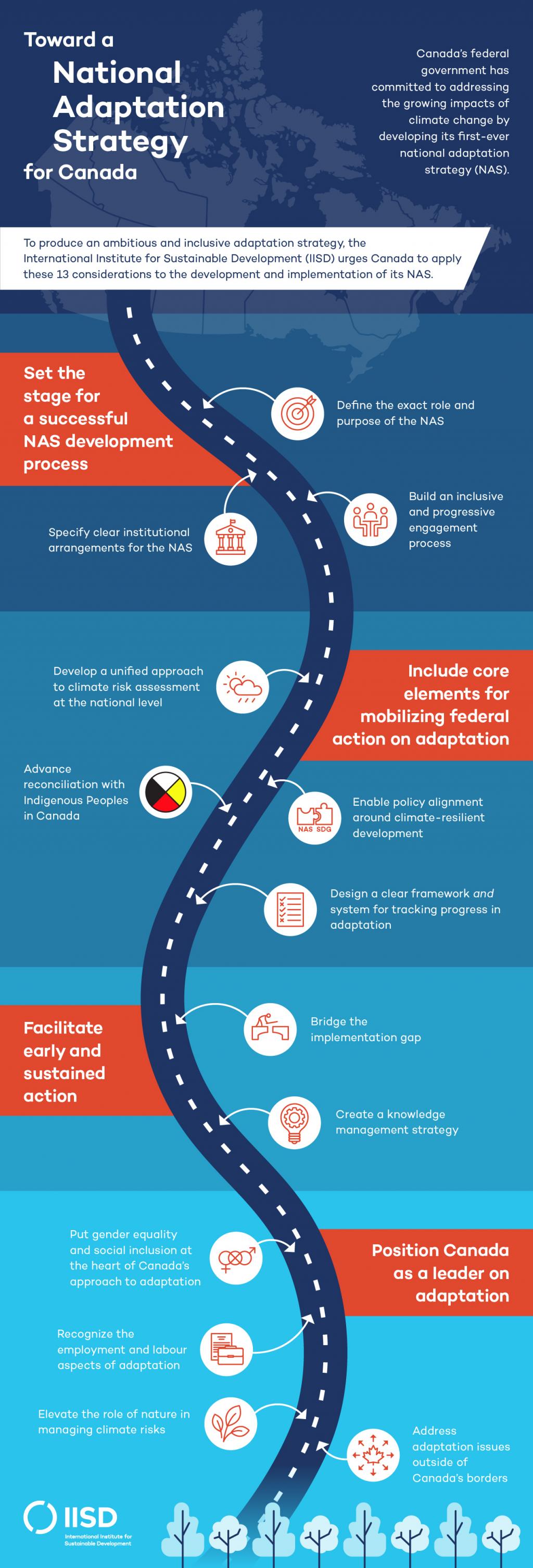
Reflecting on the current state of adaptation policies, institutions, and knowledge resources in Canada, along with findings of the international review, the report offers 13 mutually reinforcing considerations divided into four main aspects for Canada as it develops its strategy. These are:

1. Set the stage for a successful NAS development process

  • Define the exact role and purpose of the NAS
  • Specify clear institutional arrangements for the NAS
  • Build an inclusive and progressive engagement process

2. Include core elements for mobilizing federal action on adaptation

  • Develop a unified approach to climate risk assessment at the national level
  • Enable policy alignment around climate-resilient development
  • Leverage the NAS to advance reconciliation with Indigenous Peoples in Canada
  • Design a clear framework and system for tracking progress in adaptation

3. Facilitate early and sustained action

  • Bridge the implementation gap
  • Create a knowledge management strategy

4. Position Canada as a leader on adaptation

  • Put gender equality and social inclusion at the heart of Canada’s approach to adaptation
  • Recognize the employment and labour aspects of adaptation
  • Elevate the role of nature in managing climate risks
  • Address adaptation issues outside of Canada’s borders

With these considerations in mind, the federal government can work with other governments and key stakeholders throughout Canada to develop a unified vision and approach to preparing and protecting Canadians against the accelerating impacts of climate change.

Report details

Topic
Climate Change Adaptation
Governance and Multilateral Agreements
Region
Canada
Impact area
Climate
Publisher
IISD
Copyright
IISD, 2021
IISD in the news

Experimental Lakes Area to partner with African researchers in 2022

A new program in northwestern Ontario could bring up to a dozen young, female scientists, who usually conduct their research on the other side of the globe, to the Experimental Lakes Area (ELA).

June 10, 2021

IISD in the news details

Topic
Water
Region
Canada
Africa
Project
IISD Experimental Lakes Area
Impact area
Nature
IISD in the news

The dirt under the hood of clean electric vehicles

The global environmental movement has finally been heard on Wall Street, but is science keeping pace?

With the utopian rhetoric of "green" and "sustainable" energy now driving investment out of oil and gas, the reality of full-cycle economics is being left in the rear-view mirror.

June 8, 2021

IISD in the news details

IISD in the news

Canada has to become much more active in building a battery ecosystem

TORONTO—In the transition to a net-zero world, a key role will be played by electric vehicles powered by batteries. This is one of the most achievable ways to reduce greenhouse gas emissions and make progress on our climate goals.

June 7, 2021

IISD in the news details