Explainer

Climate Change Risks and Resilience Options for Canada’s Built Infrastructure

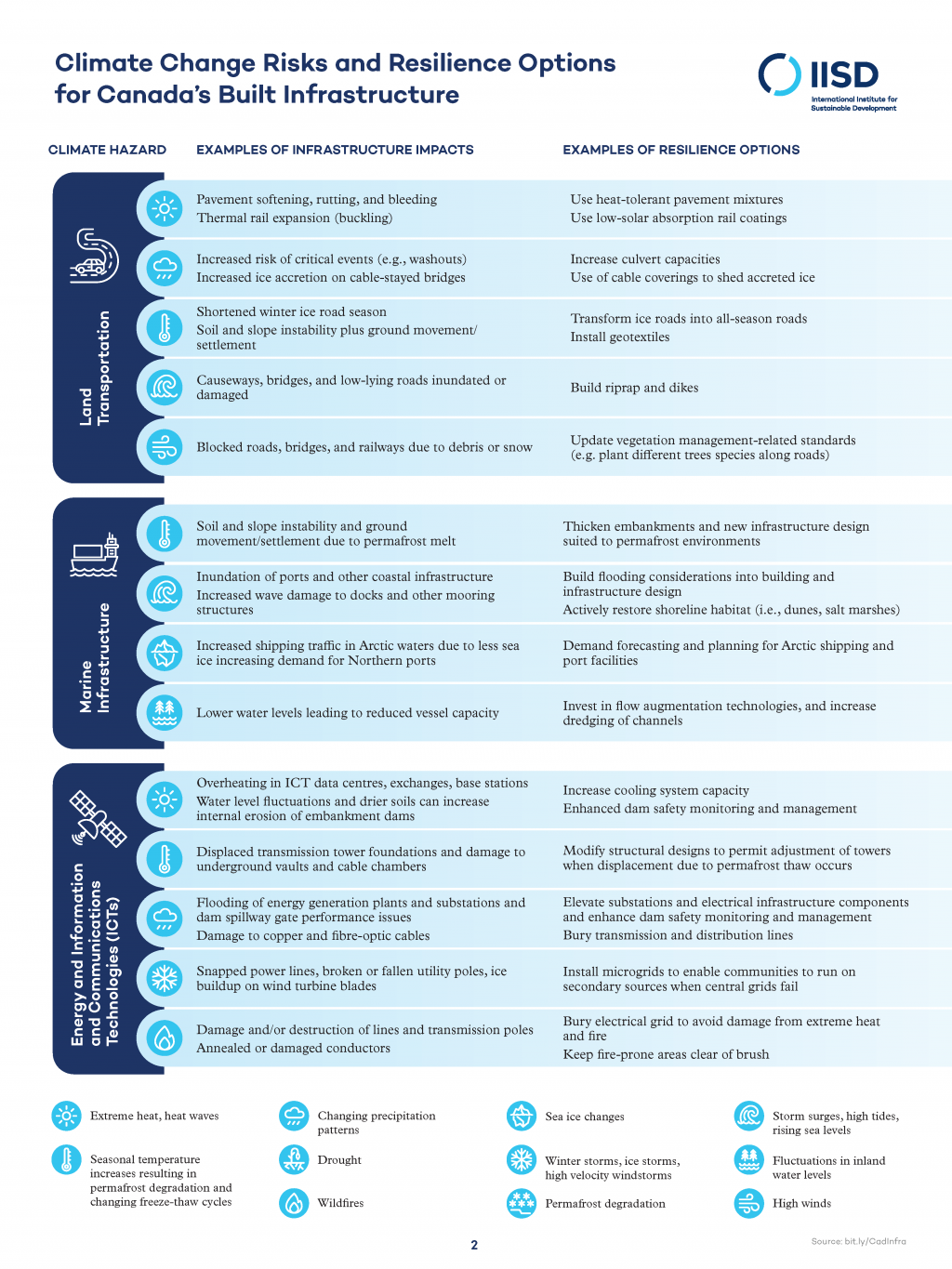
Canada’s climate is changing, bringing new risks and challenges for the nation’s infrastructure. A new IISD report, prepared with support from Infrastructure Canada, reviews current literature on climate change hazards, impacts, and adaptation options for six types of built infrastructure across Canada.

July 9, 2021

Explainer details

Topic
Climate Change Adaptation
Region
Canada
Impact area
Climate
Nature
Press release

Canada Must Climate-Proof its Infrastructure Investments

WINNIPEG–The climate crisis is here and its impacts, such as record-breaking high temperatures in Western Canada, are bringing new risks and challenges for the nation’s infrastructure.

July 9, 2021

A new report from the International Institute for Sustainable Development (IISD), prepared with support from Infrastructure Canada, makes one thing clear: how we create and maintain our built environment must change.

“These last few weeks have shown us first-hand how climate change can damage the infrastructure in Canada, risking lives and costing billions in repairs,” says Anne Hammill, Senior Director of IISD’s Resilience Program. “We need our municipalities and governments to better incorporate climate change risks into the design, operation, and rehabilitation of our built infrastructure, while also looking more seriously at the benefits of using nature-based solutions.”

Advancing the Climate Resilience of Canadian Infrastructure: A review of literature to inform the way forward profiles the ways in which action is already being taken nationally and internationally through policies, tools, and financing to enable more resilient infrastructure. But greater effort and investments are needed to keep up with the accelerating pace of climate change.

The authors also look at the role of natural infrastructure (a nature-based solution), such as wetlands and living shorelines, in providing a cost-effective way to increase resilience while providing other benefits such as carbon sequestration, species habitat, and recreational spaces.

Among the key messages and areas for action identified:  

  • One third of core public infrastructure is in poor condition.
  • The estimated infrastructure deficit in Canada is between CAD 150 billion and CAD 1 trillion.
  • Greater incentives and professional support are needed to integrate climate change considerations into infrastructure design, construction, and maintenance.
  • There must be greater awareness of the economic, social, ecological, and protective benefits of hybrid built and natural infrastructure solutions.

The Honourable Catherine McKenna, Minister of Infrastructure and Communities, says, “As the devastation caused by the wildfire that destroyed the town of Lytton showed, climate change is already impacting communities across Canada. We need to adapt to a changing climate that is resulting in more frequent flooding, forest fires, droughts, erosion, and thawing permafrost in the North. The federal government is working with Canadians to adapt to a changing climate and to build more resilient communities through investments in climate resilient infrastructure and by using the best available data and best practices in infrastructure adaptation, mitigation, and planning.”
 

Media contact:

Catherine Burge
Communications Officer, Resilience
International Institute for Sustainable Development (IISD)
[email protected]
 

Press release details

Topic
Climate Change Adaptation
Region
Canada
Impact area
Climate
Nature
Press release

New Report: Canadian governments provided at least CAD 23 billion in support for oil & gas pipelines since 2018

Heavily redacted documents point to lack of government transparency and reluctance to reveal the full picture to Canadians

July 8, 2021

July 6, 2021, Ottawa—Over the past three years, oil and gas pipelines received more than CAD 23 billion in support from Canadian federal and provincial governments, including CAD 10 billion since the COVID-19 pandemic started, reveals a new study released today by the International Institute for Sustainable Development (IISD), titled Pipelines or Progress: Government support for oil and gas pipelines in Canada.

This analysis marks the first time government financial support for Canadian pipelines has been quantified; it’s the highest amount reported to date of government fossil fuel support in Canada. 

Breaking down the CAD 23 billion total, the report finds the federal government provided nearly CAD 16 billion in support for the Trans Mountain Pipeline and Coastal Gaslink projects, while the Government of Alberta committed CAD 7.5 billion to Keystone XL. 

The CAD 23 billion is likely an underestimate. Nearly two years after filing 13 related Access to Information and Privacy requests, thousands of pages of federal government documents related to financial support for the Trans Mountain project were either withheld from researchers or heavily redacted. 

“It is extremely concerning that governments are hiding the full picture of their support from Canadians when taxpayer dollars are on the line,” says Vanessa Corkal, lead author of the report. “Looking at Canada’s climate ambition and the global race to net-zero emissions, we can’t afford to keep expanding fossil fuel supply—and that’s exactly what governments are enabling by financing oil and gas pipelines.” 

Due to low private sector interest, oil and gas companies are increasingly turning to government sources to finance export infrastructure, IISD experts report. This means that government support for pipelines extends and expands fossil fuel production that would be otherwise uneconomic, leading to large increases in emissions that last for decades, the study concludes.

In addition, the report suggests governments’ assumptions that these projects will provide economic benefits to Canadians may be unwarranted. The study notes that the financial future of these pipelines is uncertain as projects may not recoup costs, putting public investments at significant risk—as illustrated by the recent cancellation of Keystone XL. 

“Rather than risking public money on high-carbon pipelines, Canada must focus on diversifying the economy and supporting workers and communities in the low-carbon transition,” says Corkal. “It’s not too late to rethink these projects, particularly Trans Mountain. Governments need to shift funds to growing clean energy industries and work with Canadians to secure strategic economic opportunities. We also need to end public finance for fossil fuels—Export Development Canada extends at least CAD 13 billion to the oil and gas industry every year.”

These issues should be top of mind for Canadian leaders, Corkal suggests, as they convene with the rest of the G20 to address climate change and a resilient COVID-19 recovery, including at this month’s Climate and Energy Ministers meetings.
 

Press release details

Region
Canada
IISD in the news

Canada needs to cap its pipeline of fossil fuel supports

Rather than attempting to revive yesterday’s energy and economic systems, the federal government has an opportunity to 'build back better' by supporting the transition to renewable energy and a more equitable economy.

July 7, 2021

IISD in the news details

IISD in the news

Canadian governments have spent $23 billion supporting three pipelines since 2018: report

A new report finds Canadian governments have provided billions to support pipelines — none of which have been completed to date — even as experts worry pipelines themselves undermine progress on climate goals.

July 6, 2021

IISD in the news details

IISD in the news

At least $23 billion spent supporting pipelines since 2018

Since 2018, governments in Canada have pumped at least $23 billion worth of support into three megaproject pipelines designed to move giant amounts of oil and gas to international markets, undermining Ottawa’s commitment to lower greenhouse gas emissions, says a new report from the International Institute for Sustainable Development (IISD).

July 6, 2021

IISD in the news details

Report

Pipelines or Progress: Government support for oil and gas pipelines in Canada

Oil and gas pipelines in Canada received over CAD 23 billion in Canadian government support over the past 3 years—including CAD 10 billion since COVID-19 began. CAD 23 billion is likely an underestimate because calculating full levels of subsidies and other government support is impossible due to a lack of government transparency.

July 5, 2021
  • Canadian governments provided CAD 23 billion to oil and gas pipelines in the last 3 years. The economic benefits to Canadians are as uncertain as these projects' futures.

  • Governments have begun to heed calls for a green recovery in Canada. Yet public financial support for pipelines can increase carbon emissions for decades, undermining Canada's positive actions.

  • Rather than risking public money supporting pipelines, Canadian governments should diversify the economy, support workers and communities, and shift funds to growing clean energy industries.

We examined support by provincial and federal governments in Canada to three major pipeline projects, none of which has been completed to date. We found at least eight different types of financial support measures provided for Trans Mountain, two for Keystone XL, and two for Coastal GasLink. Cumulatively, Canadian governments have provided over CAD 23 billion in government support since 2018. Of this, over CAD 11 billion is in loans, and at least CAD 10 billion is loan guarantees or liabilities. Over CAD 10 billion in government support to pipelines was provided after the COVID-19 pandemic hit.

Government support for pipelines has been made at least partly on the assumption that the projects will provide economic benefits to Canadians, even as the oil and gas sector faces challenges due to shifting investments and as the International Energy Agency has illustrated that new government investments in fossil fuel production are incompatible with a net-zero economy. Yet project finance is increasingly being provided by the government, even at a time of increased international calls for phasing out public finance for fossil fuels. Government support to pipelines places public money at financial risk for current and future generations. Support for oil and gas export infrastructure, such as pipelines, undermines Canada’s commitments under the G7 and G20 to phase out inefficient fossil fuel subsidies.

Report details

Topic
Climate Change Mitigation
Energy
Subsidies
Region
Canada
Project
IISD Global Subsidies Initiative
Impact area
Climate
Nature
Publisher
IISD
Copyright
IISD, 2021
IISD in the news

Study finds $23-billion in federal, provincial pipeline support

Taxpayer dollars are heavily distorting Canada’s financial marketplace in favour of fossil fuel pipelines, new research suggests.

July 5, 2021

IISD in the news details

IISD in the news

A hotter future is already here — and Canada is not ready

Like the pandemic, climate change causes the poor and the frail to suffer most. We need to prepare.

July 3, 2021

IISD in the news details

Topic
Climate Change Adaptation
Region
Canada
Impact area
Climate