Statement

Canada’s New Nationally Determined Contribution Shows Progress but Misses Key Opportunities

July 13, 2021

Winnipeg—Canada has released a long-awaited update to its Nationally Determined Contribution (NDC), demonstrating greater climate ambition and representing an important step forward as the nation seeks to meet targets outlined in the Paris Agreement.

The International Institute for Sustainable Development (IISD) welcomes the commitment in the NDC to advancing gender equality, social inclusion, and Indigenous reconciliation through climate action in Canada and abroad. The application of comprehensive, participatory Gender-Based Analysis Plus (GBA+) through the design, implementation, monitoring, and evaluation of all climate policies and programs is essential. This provides a foundation for ensuring equitable benefits from investments in climate action for people of all genders and social groups, including Indigenous Peoples, racialized Canadians, youth, and 2SLGBTQQIA+ people.

Alongside an updated NDC, Canada also submitted its first Adaptation Communication yesterday, which affirms Canada’s commitment to developing a National Adaptation Strategy and emphasizes the growing value of nature-based solutions. This is noteworthy progress that should not be overlooked, especially as people across the country are already suffering from the impacts of climate change.

When it comes to what Canada will do to mitigate global warming, however, its new NDC falls short:

  • The document reiterates previous commitments, including the target of a 40%–45% reduction in emissions below 2005 levels by 2030 and sectoral policies from the recently updated climate plan. This target is not in line with the ambition necessary to incent rapid decarbonization and a climate-safe future. Canada still lacks clear sectoral pathways and carbon budgets for high-emitting sectors—this is particularly concerning for oil and gas, whose emissions are the largest of all economic sectors in Canada and are on the rise.
     
  • The NDC also fails to address fossil fuel subsidy reform and the phase-out of public finance for fossil fuels. The International Energy Agency’s recent report emphasizes that governments must end all new funding to oil and gas to reach net-zero by 2050.
     
  • While it is encouraging to see mention of just transition in the updated NDC, there is little reference to how government will collaborate with workers and labour groups to ensure their needs are fully addressed.

As the 26th Conference of the Parties (COP 26) approaches, pressure is quickly escalating for developed countries to ramp up their ambitions on climate—not with broad brushstrokes but with detailed plans, aggressive timelines, and scaled-up financing on all fronts. Canada cannot afford to fall behind. Its updated NDC is promising, but greater commitments must be forthcoming in the months ahead.

 

Press release

Urgent Need for Canada to Reconcile Climate Action and International Trade: New report

July 13, 2021

Toronto/Winnipeg—With the European Commission set to announce a new border carbon adjustment (BCA) regime for the European Union (EU) tomorrow, now is the time for Canada to figure out how to reconcile its climate ambition with the need to protect the competitiveness of domestic industry and prevent carbon leakage.

That’s one of the urgent messages in Enabling Climate Ambition: Border Carbon Adjustment in Canada and Abroad, released today by the International Institute for Sustainable Development (IISD) and Clean Prosperity.

The new report is the first to examine in detail the kinds of questions that Canada will have to answer as it designs a BCA regime. In particular, it looks at how Canada might harmonize its border carbon charges with top trading partners that are also ambitious about tackling climate change, such as the United States and the EU.

BCAs are charges applied to the embedded carbon emissions in imported goods, especially imports from countries with less stringent climate policies. 

"Canada will not achieve its climate ambition if our policies just end up shifting emissions from domestic firms to their foreign competitors," says Aaron Cosbey, co-author of the report and Senior Associate with IISD. "There’s no way around it: BCAs are challenging to get right, and they're no silver bullet. But it's hard to see how we can successfully decarbonize without them."

"The problem we need to confront is that not every country is as ambitious as Canada when it comes to climate action," says Clean Prosperity Executive Director and report co-author Michael Bernstein. "BCAs are one solution to that problem. They complement strong Canadian climate policy by keeping industry on a level playing field with foreign competitors while continuing to incentivize decarbonization."

Read the full report to learn more.

For more information: [email protected]

IISD in the news

Vancouver could get up to $20M to capture and clean its rain

The federal government is inviting the City of Vancouver to apply for up to $20 million in funding for natural infrastructure projects to support the city’s strategy to capture and clean rainfall with natural solutions.

July 13, 2021

IISD in the news details

Report

Enabling Climate Ambition: Border carbon adjustment in Canada and abroad

Canada’s ambitious climate policies are necessary to get us to net-zero by 2050, but if other countries don’t take similar actions, it will mean trouble for Canadian sectors such as steel, cement, fertilizers, and chemicals, whose emissions might simply be transferred to unregulated foreign competitors. Like other countries that are now working to implement protections, Canada needs to think about tools like border carbon adjustment (BCA) that aim to impose a carbon price on imports. 

July 12, 2021
  • With Canada’s carbon price legislated to rise to CAD 170/tonne by 2030, we urgently need to design protections to ensure that our energy-intensive trade-exposed sectors achieve real emissions reductions, as opposed to seeing emissions simply transferred to unregulated foreign competitors.

  • Border carbon adjustment (BCA) will be a reality in the European Union (where it’s known as CBAM) by 2023, and the United States and United Kingdom intend to adopt similar systems. Any country with climate ambition will need to seriously consider following suit.

  • But BCA is devilishly complex, politically explosive, potentially illegal under trade rules, and would have to be adapted to Canada’s unique climate pricing regime. It’s imperative to start thinking in depth about how to get it right.

As climate ambition ramps up in Canada and around the world, one of the key challenges governments face is how to impose meaningful carbon prices on domestic industries when not all trading partners are similarly ambitious. In countries that are pursuing ambitious climate policies, there has been increasing interest in an instrument that could help enable that ambition: border carbon adjustment (BCA). BCA aims to ensure that imports face the same carbon price faced by domestic producers.

But BCA is devilishly complex, politically explosive, potentially illegal under trade rules, and would have to be adapted to Canada’s unique climate pricing regime. So Canadian policy-makers need to start thinking now about what such a regime might look like here.

This report surveys eight design elements and makes specific recommendations for the shape of a Canadian BCA. The report also explores how Canada should react to emerging BCA schemes in major trading partners such as the EU and United States, and how its own scheme might accommodate climate policies in those countries.

Participating experts

Report details

Topic
Climate Change Mitigation
Trade
Energy
Region
Canada
Project
Trade and Climate Change
Impact area
Climate
Sustainable Economies
Publisher
IISD
Copyright
IISD and Clean Prosperity, 2021

Lower Winnipeg River Basin: An opportunity to improve the health of our waters

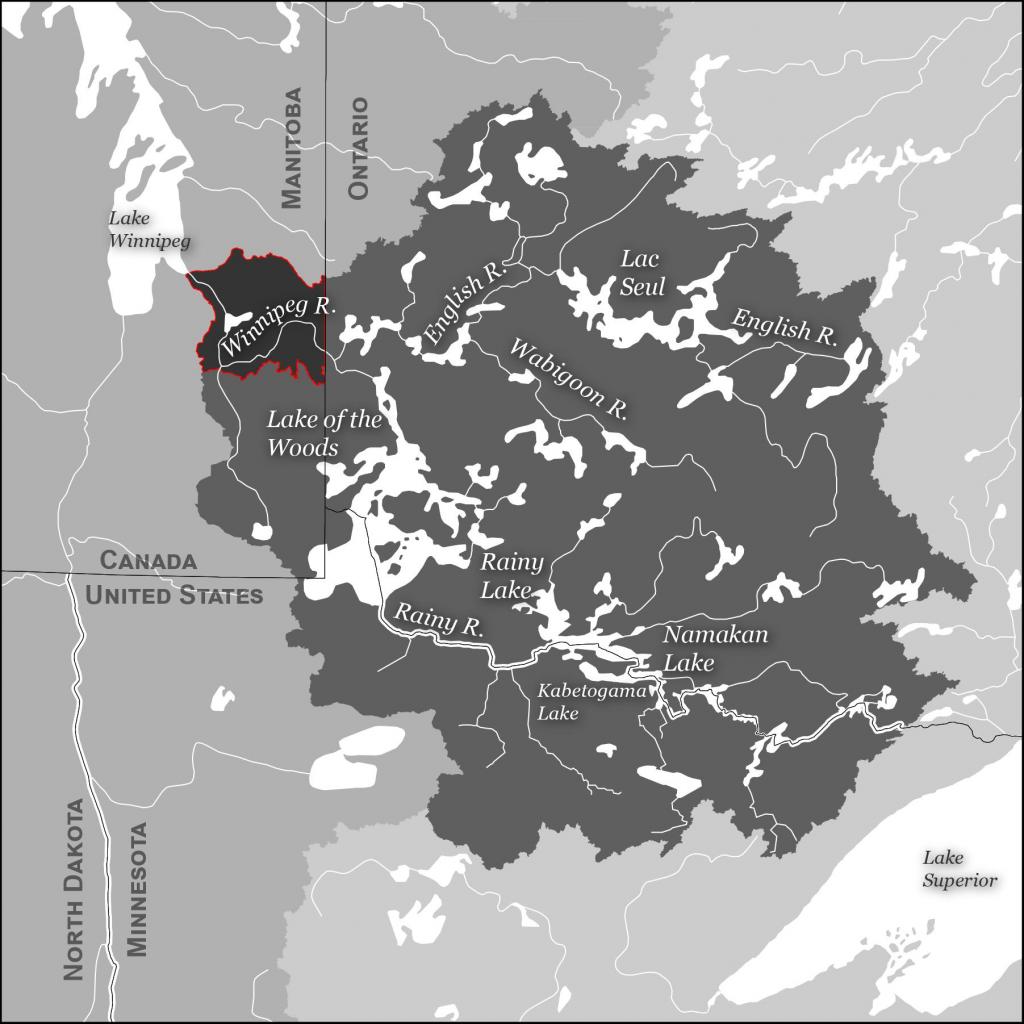
The Lower Winnipeg River Basin (LWRB) is where the Canadian Prairies meet the Boreal Forest.

Carrying 50% of the annual flow to Lake Winnipeg, the Winnipeg River snakes through northwestern Ontario, draining Lake of the Woods before reaching Manitoba’s oldest hydroelectric dams, a decommissioned nuclear facility, and thousands of vacation properties. A history of forestry, transportation, mining, and recreation has left a mark on the land and water in this basin.

Grayscale map of the Lower Winnipeg River Basin

Did you know that:

  • The Winnipeg River reach between Pointe du Bois and Pine Falls contributes approximately 3% of the entire total phosphorus load to Lake Winnipeg?
  • The LWRB spans multiple towns and settlements, Whiteshell Provincial Park and supports six hydro generating stations, active mining, and tourism industries?
  • There is currently no watershed district established to manage the LWRB and no management plan for the basin?

This presents a unique opportunity to pilot more effective management practices and approaches. IISD has compiled data and information on this section of the basin and is exploring how innovative technologies and Traditional Knowledge can work together to preserve and enhance the health of the water—and the prosperity of the communities on the shorelines.

IISD in the news

Natural landscapes key to Canadian cities, rural areas for building climate resilience, experts say

Investing in natural infrastructure like the Park Rill Floodplain will be key to building climate resilience in Canada, according to a new report by the International Institute for Sustainable Development (IISD) released Monday.  

July 12, 2021

IISD in the news details

IISD in the news

Canada needs infrastructure that can handle climate change, report says

Canada should act fast to protect critical infrastructure from climate breakdown by building resilience into ports, power grids, bridges, and more, the International Institute for Sustainable Development (IISD) says.

July 12, 2021

IISD in the news details

Report

Advancing the Climate Resilience of Canadian Infrastructure

A review of literature to inform the way forward

Canada's climate is changing, bringing new risks for its roads, buildings, water pipes, ports, and transmission lines. As past climate parameters can no longer be relied on when making decisions related to the design, construction, and maintenance of new and existing infrastructure, new approaches are needed. An integrated, whole-of-society approach—bringing together all orders of government, sectors, and civil society—is required to increase the climate resilience of the infrastructure supporting Canadian communities.

July 11, 2021
  • Greater effort and investment are needed if Canada's ageing infrastructure is to keep up with accelerating climate change and close an infrastructure deficit already estimated to be between CAD 150 billion and CAD 1 trillion.

  • Natural infrastructure is becoming a mainstream, cost-effective option for enhancing the resilience of Canada's built infrastructure while also providing communities with other important benefits.

  • A diverse range of strategies, policies, guides, standards, codes, and financing programs have emerged in Canada and internationally to help inform efforts to increase the climate resilience of built infrastructure.

The report Advancing the Climate Resilience of Canadian Infrastructure: A review of literature to inform the way forward is intended to inform and create awareness of an integrated, whole-of-society approach to making infrastructure across Canada resilient to a changing climate. Written for infrastructure owners, designers, builders, operators, investors, policy-makers, and stakeholders, it provides a snapshot of the range of action taking place in Canada and internationally to increase the climate resilience of infrastructure.

The report compiles available information on the impacts and risks of climate change for Canada’s infrastructure from a regional perspective and for six types of built infrastructure. Illustrative examples of current technical solutions to addressing these risks are presented. In addition, it summarizes the range of natural infrastructure solutions that are available to enhance the resilience of communities to climate change. To better understand actions being taken to improve the climate resilience of Canadian infrastructure, the report synthesizes a range of current policies, guidelines, and financing being implemented federally and internationally to inform and incentivize climate-resilient infrastructure.

Participating experts

Report details

Topic
Climate Change Adaptation
Infrastructure
Nature-Based Solutions
Region
Canada
Impact area
Climate
Publisher
IISD
Copyright
IISD, 2021
Explainer

Natural Infrastructure Solutions for Climate Resilience

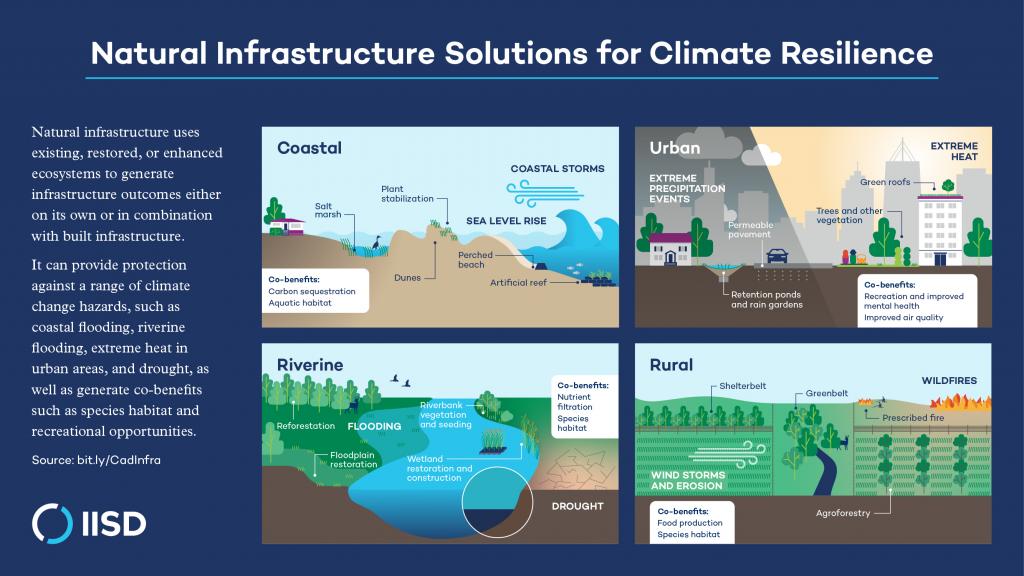
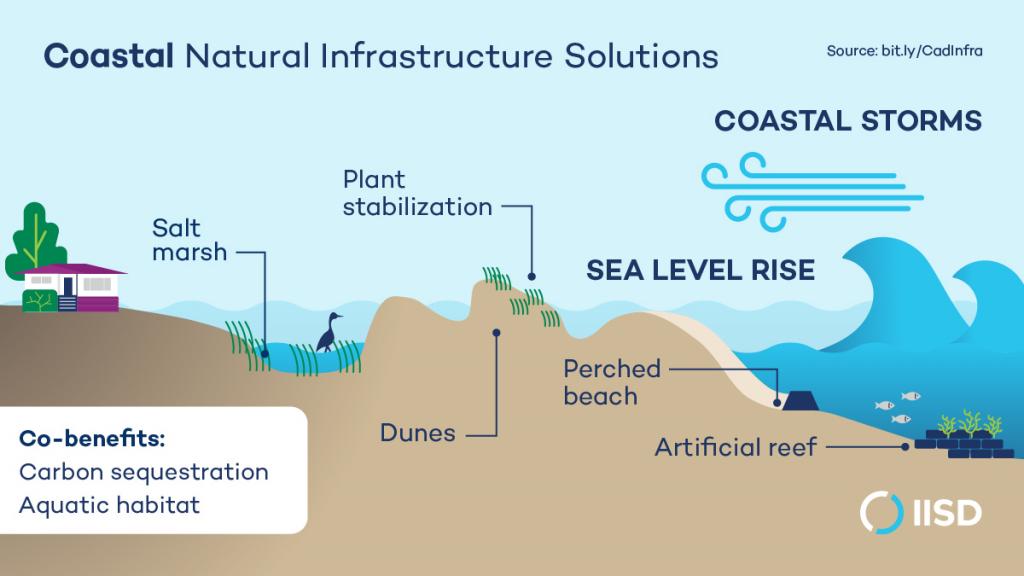
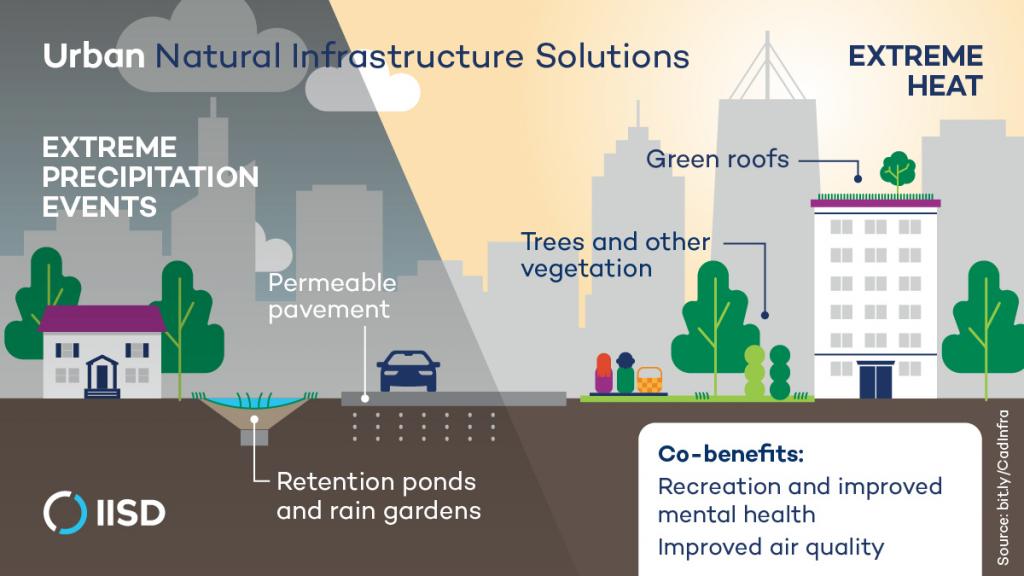
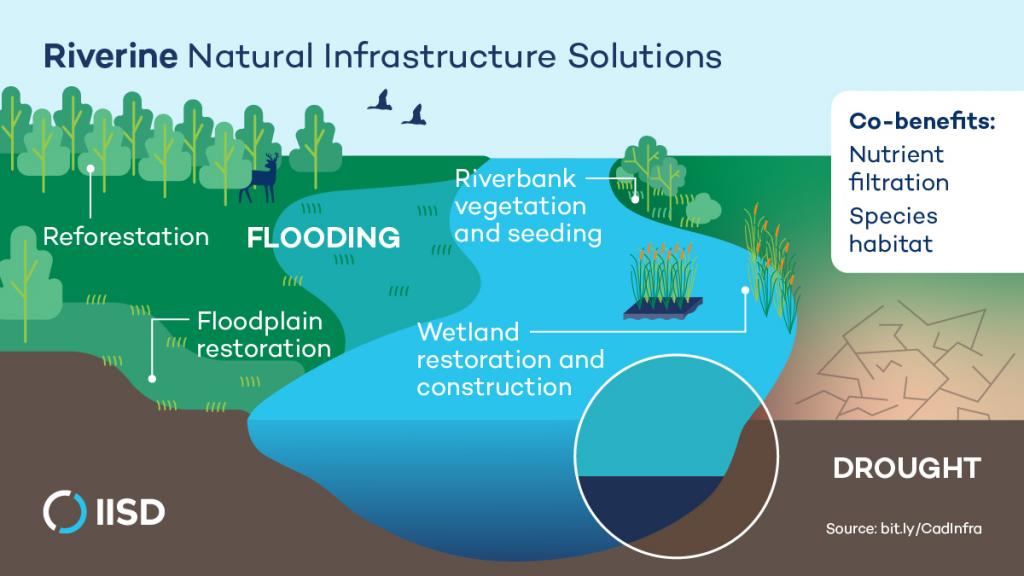
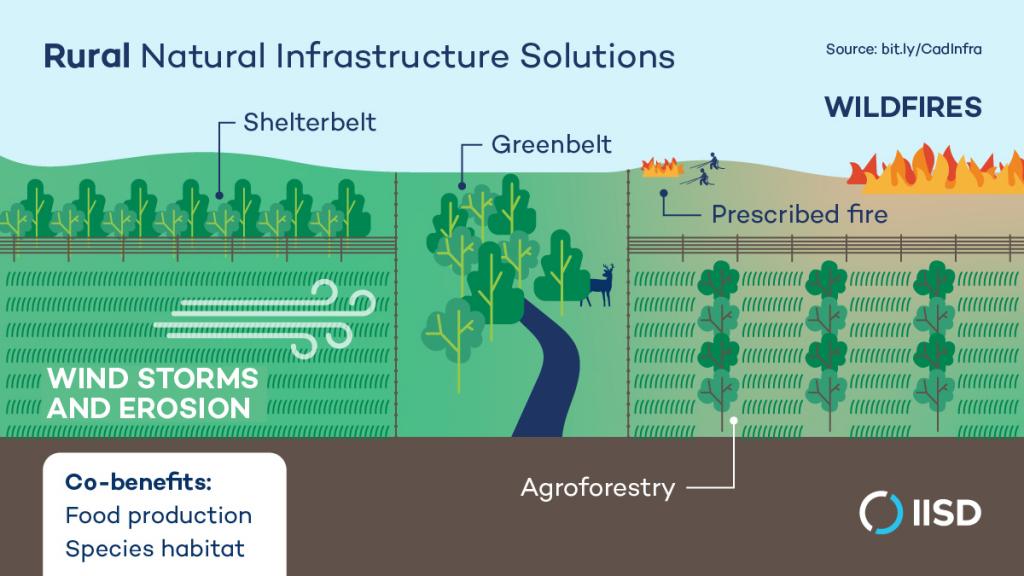
Natural infrastructure can provide protection against a range of climate change hazards, such as coastal flooding, riverine flooding, extreme heat in urban areas, and drought, as well as generate co-benefits such as species habitat and recreational opportunities.

July 9, 2021

Explainer details

Topic
Climate Change Adaptation
Region
Canada
Impact area
Climate
Nature