Here's one powerful way to protect our Great Lakes: open data
The COVID-19 pandemic has shown that timely, online access to data can be transformational. Amid a global pandemic, information sharing among scientists and nations helped us develop and roll out a vaccine in record time. Meanwhile, publishing daily case counts enabled people to understand risks and behave accordingly. Free and open access to data on other critical public issues — including climate change and freshwater health — is just as essential.
Statement on the Release of the Alberta Public Inquiry Into Anti-Alberta Energy Campaigns
October 22, 2021
IISD is Canada’s largest sustainable development think tank. For 30 years, we have been working collaboratively with different stakeholders around the world to advance evidence-based solutions to the climate crisis. In all those years, this is the first time we’ve been the subject of a public inquiry.
Freedom of expression is a cornerstone of our democracy. The right to express opinions on matters of public policy should be protected by every level of government in Canada. We welcome Commissioner Allan’s finding that "I have not found any suggestions of wrongdoing on the part of any individual or organization. No individual or organization, in my view, has done anything illegal. Indeed, they have exercised their rights of free speech."
We will continue to urge governments around the world to phase out inefficient fossil fuel subsidies and invest in a clean energy transition to prevent catastrophic climate change. This transition is already underway; countries with targets to reduce their greenhouse gas emissions to net-zero by 2050—including Canada—represent 68% of global GDP. And every scenario in the International Energy Agency’s latest global energy forecast now projects a decline in oil demand in the coming decade.
Alberta’s future prosperity would be better served by governments investing public money in diversifying the economy, building on the real strengths that have always powered the province: a skilled workforce, an entrepreneurial spirit, and abundant resources.
Three steps Canada can take to reduce health impacts of climate change
The health impacts of climate change are rising globally, according to a new study, but a Canada-specific policy brief lays out three key areas that could be game-changers when it comes to the way climate change affects human health in the country.
Show us your plan for net zero, experts tell energy regulator
On the heels of a report that predicts a world in which demand for fossil fuel falls, experts and advocates want the Canadian Energy Regulator to model what a net-zero economy would look like in Canada.
Governments must do more to incorporate climate change risks and infrastructure
Greater effort and investment is needed if Canada’s aging infrastructure is to keep pace with accelerating climate change, a new report by the International Institute for Sustainable Development (IISD) concludes.
Report shows fossil fuel production out of step with government climate commitments
Governments around the world expect to produce twice as much fossil fuels as their climate commitments would allow, a new international report has found.
The world is aiming for net-zero emissions by 2050. Here's what that means
Canada has committed to reaching net-zero emissions by 2050 to fight climate change. At the upcoming COP26 climate summit, hitting net zero globally by 2050 is a key goal.
The Air That Trees Breathe: Translating climate science into Ojibwe
Over the past three years, our freshwater scientists at the IISD Experimental Lakes Area, located on Treaty 3 Land, have been working with a group of Elders, language experts, and youth to translate research on mercury contamination and climate change into Ojibwe.
September 28, 2021
Anishinaabemowin—also known as Ojibwe—is the language spoken by the Anishinaabe people.
Over the past 3 years, here at IISD Experimental Lakes Area, we have been working with a group of Elders, language experts, and youth to translate two animated videos explaining our research on mercury contamination and climate change into Ojibwe.
We now not only have the Ojibwe versions of these videos, but we also put together two supplementary lesson plans—each consisting of a full transcript, sentence breakdown, list of new words, and root word collections.
We hope that all-level language learners can benefit from these visual, audio, and grammatical resources and, at the same time, learn about some interesting scientific concepts. Language teachers can also include them in their teaching activities, as suggested in the lesson plans.
Speaking personally, I am a massive language enthusiast and have greatly enjoyed this process.
Given that, and the fact that the number 4 is sacred in Anishinaabe culture (and many other Indigenous cultures), I wanted to share four interesting aspects about Anishinaabemowin that I have learned.
The Creational
The Ojibwe language energizes and replenishes itself and does not borrow foreign vocabulary. For instance, many popular languages around the world derive the word for the element “carbon” from its Latin root carbo, meaning “coal,” including carbone in French, carbono in Spanish, Karbon in Turkish, كربون (Karbun) in Arabic … you get the gist! This “borrowing” phenomenon is very common in many scientific terminologies.
However, the Ojibwe language does not follow the same rule. Instead, the Ojibwe translation of some of the terminologies we encountered was based on the function, the action, and the observer’s understanding associated with these terms.
For example, carbon dioxide in Ojibwe is mitigoo-inanaamowin, meaning “(the air that) the trees breathe.” You will find many more such neologisms created in the lesson plans.
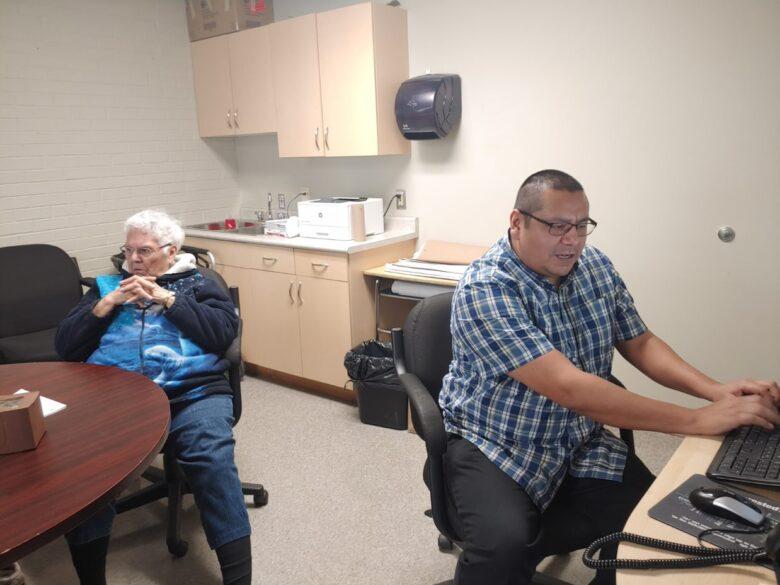
Nancy and Jason Jones (who led the translation exercise), hard at work.
The Cultural and Spiritual
Jason Jones, an Ojibwe language teacher and a member of our translation team, explained that there are three forms of translation: literal, implied, and cultural.
All three methods were implemented in our translation exercise.
For example, in the climate lesson plan, you will notice that some parts of the translation do not follow the order of the English texts. In other words, literal (word-by-word or sentence-by-sentence) translation was replaced by implied translation, where translators interpreted the overall meaning in a way that they observed or understood.
The term for the “United States” is “gichi-mookomaanakiing” in Ojibwe, meaning “the land of the big knives.” This is, according to Jason, an example of a cultural interpretation: long ago, Anishinaabe people would bring their sacred items into battles and carry them on their sides. They saw early Europeans carrying their swords—big knives—by their sides all the time and thought these big knives were their sacred items.
Jason also explained that there are Elders who speak spiritual Ojibwe—a form of the language that he insightfully described as “being loaded with culture” and “untouched by the residential schools.”
For instance, “gookomisinaan” (literally “our grandmother”) represents “the moon” in spiritual Ojibwe. In one of the Anishinaabe stories, the hero Nenaboozhoo’s grandmother turns herself into the moon. That concept, therefore, is forever connected to water and women. This type of spiritual Ojibwe language has been lost over the years, and “language helpers” are trying to get it back.
The Action-Based
Many languages, including English, are noun-based, meaning that the majority of the words in the language domain are nouns, as opposed to verbs. But the Ojibwe language is quite the opposite in that the majority of its vocabulary consists of verbs (actions) as opposed to nouns (objects).
For instance, the noun mercury in Ojibwe is biiwaabikowaabo gaa-waawaakeshkaag, meaning “the liquid metal that is (very) shiny” or “the liquid metal that shines brightly.” That term was created and eventually transformed into a noun form, however, with an action (“shines”) built into it.
The action-based aspect of the language, in a way, reflects the teaching of the Anishinaabe Elders in terms of taking responsibility and action to protect the land and the water.
The lesson plans include the breakdown of each sentence into its root words. Go ahead and see if you can find the actions associated with the words.
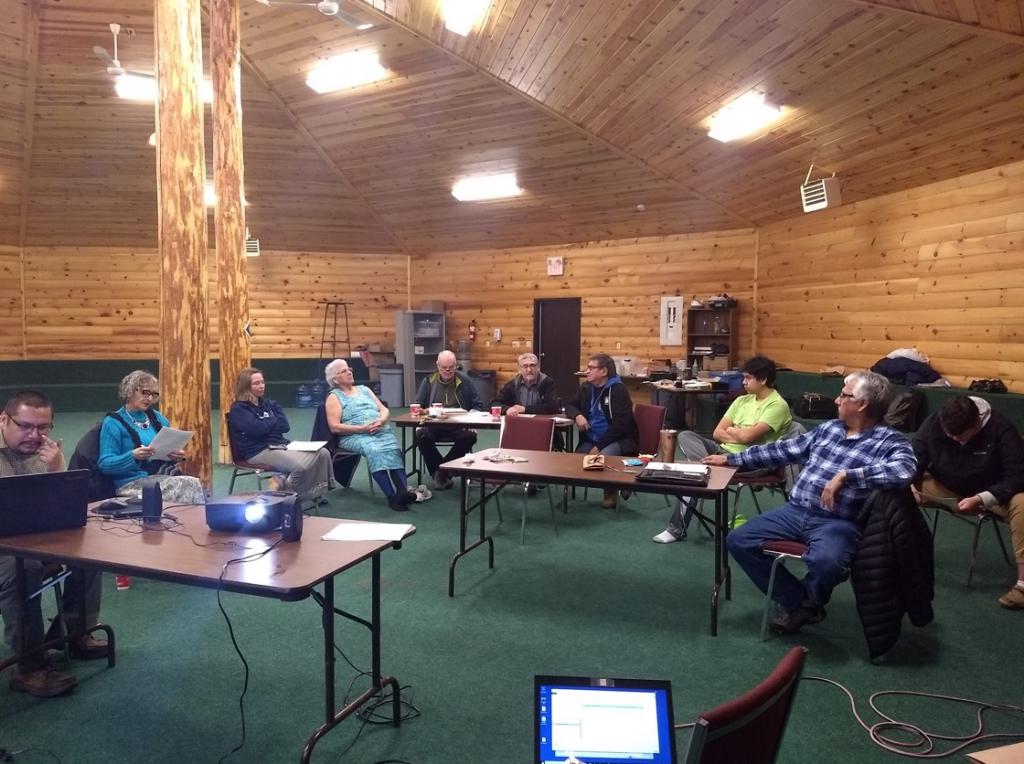
This translation project depended on high levels of collaboration with Elders and language helpers.
Animate or Inanimate?
Many Ojibwe words are categorized as animate or inanimate, meaning the object is either living or non-living, spirited or non-spirited.
In Western science, we often describe a compound as being organic or inorganic, a concept that could potentially help us understand this dualism. However, here’s a story that I love sharing when I speak about this fourth aspect of the Ojibwe language.
Elder Nancy Jones asked us, during one of our translation sessions, “Where is mercury from?” We answered: “Mercury is a naturally-occurring element found in rocks.” She followed with another question: “Then why is it considered non-living (inorganic)? Because in Anishinaabemowin, a rock is animate, living, and has a spirit.”
Elder Nancy’s simple question profoundly changed my way of looking at nature and all the elements we find there.
While Western science helps us objectively observe the environment, which is defined by a separation between the observer and the observed, Indigenous traditional wisdom unites the observer and the observed. Nature as a whole is a giant living being, and we are a part of it!
The language we speak shapes our worldview. Many Indigenous languages are at risk of disappearing. Understanding the importance of a language and helping to find creative ways to preserve and revitalize it can reverse this trend.
I would like to thank the Elders and language helpers for their teachings and for giving me the permission to share those stories in this blog article.