Report

Training Workshop for UEMOA Members' State Officials on Mining Economics, Bamako, Mali, July 2017

July 11, 2017

The Intergovernmental Forum on Mining, Minerals, Metals and Sustainable Development (IGF) held a training workshop on the subject of mining economics for government agency officials from the member states of the West African Economic and Monetary Union (UEMOA) in Bamako, Mali, in July 2017. 

The workshop was attended by 32 officials from UEMOA member states’ government agencies in charge of mining, economy and finances. The training workshop was organized by the IGF in partnership with the UEMOA Commission, in the context of implementing the Memorandum of Understanding between the UEMOA Commission and the International Institute for Sustainable Development (IISD).

Report details

Topic
Mining
Region
Mali
Impact area
Sustainable Economies
Publisher
IISD
Copyright
IISD, 2017
Report

Investment-Related Dispute Settlement: Lessons from international accountability mechanisms

Working toward elements of a new mechanism for investment-related disputes, the expert meeting held in Washington, D.C., United States, on April 11, 2017 focused on ways forward on a compliance structure to hold companies accountable.

July 9, 2017

In 2014 IISD initiated a process with experts to discuss the simple question: “If investment-related dispute settlement mechanisms at the international level were to be built anew, what should they look like?”

Bulding on the results of the 2014 meeting and of a second expert meeting held in May 2016, as well as recent developments in international practice regarding investment-related dispute settlement, a third meeting was held in April 2017. IISD and the American University Washington College of Law's Program on International and Comparative Environmental Law hosted the expert meeting “Developing a New Accountability and Dispute Settlement Mechanism on Investment: Lessons from international accountability mechanisms (IAMs).”

Given the extensive expertise of the Washington-based community, the April 2017 expert meeting focused on ways forward on a compliance and dispute settlement mechanism on investment. Drawing lessons from their experience with IAMs, the experts discussed the design of a new international mechanism for resolving investment-related conflicts and ensuring compliance with applicable principles and rules.

Report details

Report

At the Crossroads: Balancing the financial and social costs of coal transition in China

The global decline of the coal industry has led to job losses and mine closures. As Shanxi in China considers how to create new employment in a coal dependent region we review international experience of the tranistion away from coal. 

July 5, 2017

The boom and eventual bust of resource-dependent regions has played out across the world many times over the last 50 years.

As extractive industries decline demands are made for subsidies to protect the industry while policy-makers search for new industries to replace lost jobs and maintain economic development.

This report examines the current status of the coal transition in Shanxi and proposes recommendations for how reform can be managed to ensure that economic, social and environmental factors are built into the process. These recommendations draw on international experience, in particular, the experience summarized in case studies from South Wales in the United Kingdom, Appalachian Kentucky in the United States and Asturias in Spain.

Report details

Topic
Sustainable Finance
Subsidies
Energy
Region
China
Impact area
Climate
Publisher
IISD
Copyright
IISD, 2017
Report

Standards and Biodiversity

The Standards and Biodiversity Report analyzes the criteria and market coverage of 15 major agricultural voluntary sustainability standards against key biodiversity parameters.

June 26, 2017

The Standards and Biodiversity Report analyzes the relationship between biodiversity and 15 voluntary sustainability standards.

The report is the first to apply the Biodiversity Impact Indicators for Commodity Production (BIICP) developed under the guidance of the Convention on Biological Diversity, analyzing criteria coverage across the BIICP and distribution of compliance across key markets and biodiversity parameters.

Report details

Topic
Standards and Value Chains
Trade
Impact area
Sustainable Economies
Publisher
IISD
Copyright
IISD, 2017
Report

2016 IGF Annual Report

The achievements and objectives of the Intergovernmental Forum on Mining, Minerals, Metals and Sustainable Development (IGF) are detailed in its first annual report.

June 21, 2017

The achievements and objectives of the Intergovernmental Forum on Mining, Minerals, Metals and Sustainable Development (IGF) are detailed in its first annual report.

The IGF supports nearly 60 nations committed to leveraging mining for sustainable development to ensure that negative impacts are limited and financial benefits are shared. It is devoted to optimizing the benefits of mining to achieve poverty reduction, inclusive growth, social development and environmental stewardship. IISD manages Secretariat duties for the IGF.

Report details

Topic
Mining
Impact area
Sustainable Economies
Publisher
IISD
Copyright
IISD, 2017
Report

IGF Mining Policy Framework Assessment: Mongolia

An assessment of Mongolia’s readiness and capacity to implement the Mining Policy Framework (MPF) of the Intergovernmental Forum on Mining, Minerals, Metals and Sustainable Development (IGF).

June 14, 2017

Mongolia began large-scale exploitation of its abundant mineral resources in the 1990s, leading to a mining boom and enabling one of the highest economic growth rates in the world.

The country is particularly rich in copper and coal reserves, the exploitation of which is primarily responsible for tripling Mongolia’s economic growth since 2009. The country is now heavily reliant on its minerals sector, which represents approximately 30 per cent of government revenues, 18.6 per cent of gross domestic product (GDP), 80 per cent of export earnings, and 70 per cent of new foreign direct investment into Mongolia.

This report presents the findings of the Mining Policy Framework assessment process conducted in Mongolia between August 2016 and January 2017.

It is structured as follows:

Section 2 briefly describes the methodology used to conduct the assessment;

Section 3 gives an overview of the mining sector in Mongolia and the policy context;

Section 4 presents the main results of the assessment along the six dimensions of the MPF;

Section 5 discusses these results and identifies key strengths and gaps;

and Section 6 presents some initial recommendations regarding implementation gaps that require particular attention from the host country government.

Report details

Topic
Mining
Impact area
Sustainable Economies
Publisher
IISD
Copyright
IISD, 2017
Report

The Vulnerability of Pakistan's Water Sector to the Impacts of Climate Change: Identification of gaps and recommendations for action

This report explores the vulnerability of Pakistan’s water supply to climate change, noting potential changes in water availability, water demand, implications for key sectors, and strategies for addressing knowledge and capacity gaps.

June 11, 2017

This report presents the findings of a research project that identified potential climate change impacts on the future availability of water resources in the Indus Basin in Pakistan.

The project also identified implications for agriculture and health, projected changes in water demand and possible actions that could be taken to enhance Pakistan’s capacity to respond to these projected changes.

This project was led by the Ministry of Climate Change and the United Nations Development Program, in partnership with the Centre for Climate Research and Development at the COMSATS Institute of Information Technology in Islamabad, Pakistan, and the International Institute for Sustainable Development in Winnipeg, Canada.

This research project’s five main components included water supply analysis, water demand analysis, policy analysis, and outreach and communication to better understand existing capacity and identify gaps in research, data and water management practices.

The report concludes with recommendations related to research, policy implementation, infrastructure, and climate change adaptation to address uncertainty related to climate change and to increase social and economic capacity.

KEY FINDINGS

Climate change will have a limited impact on the total volume of water flowing in the Indus River Basin in the near and medium terms. Prior to the 2050s, climate change is more likely to change the timing of peak flow and increase the variability of flow volume in the Indus River, primarily due to less predictable precipitation (monsoon) patterns rather than changes in overall flow volume from glacial and nival (snow melt) sources.

There is a lack of existing knowledge regarding the complex hydrological regime of the Upper Indus Basin, limiting current capacity to estimate future water availability.

A projected increase in water demand means that water scarcity on a per capita basis will increase in Pakistan in the coming decades, even in the absence of climate change. Strong action is needed to better understand current and projected water demand patterns, and to improve water management practices, particularly in the agricultural sector.

Priorities for action to address these gaps include accelerating uptake of sustainable irrigation practices by smallholder farmers, strengthening post-secondary education in the area of climate change, establishing a repository of water data and analysis, and modernizing Pakistan’s streamflow monitoring network.
Report

Costs of Pollution in Canada: Measuring the impacts on families, businesses and governments

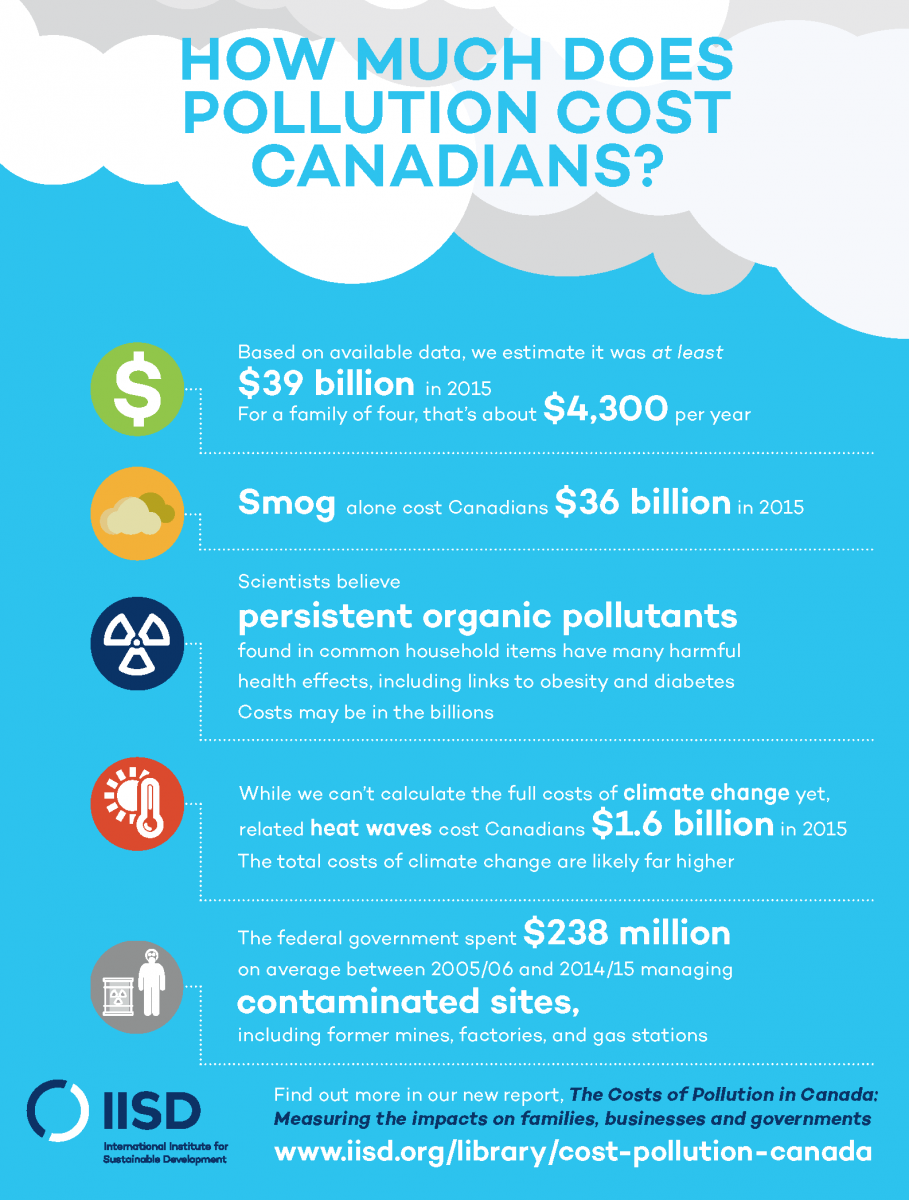
Pollution costs Canadian families, businesses and governments a startling amount every year. These costs add up to tens of billions of dollars at least. These are our findings from a new report on the cost of pollution in Canada.

June 1, 2017

Pollution costs Canadian families, businesses and governments a startling amount every year. These costs add up to tens of billions of dollars at least. These are our findings from a new report on the cost of Pollution in Canada.

Pollution harms human health, damages forests and crops and degrades the quality of land and water—to name just some of its impacts. The result is higher costs for many things: medical care, raw materials, food and public services. In these and numerous other ways, pollution threatens not only Canadians’ current well-being but also the prospects for sustaining that well-being into the future.

Despite pollution’s widespread costs, Canadians are not adequately informed about them. Various studies have assessed the costs of specific pollutants (for example, additional hospital stays due to urban smog), but no single study covers them all. For many pollutants, no cost information is available at all. The result is an incomplete and complicated array of information that an average citizen would be hard-pressed to sort through. 

With financial support from the Ivey Foundation, the International Institute for Sustainable Development reviewed and synthesized existing studies on the costs of pollution in an effort to improve the data available to Canadians. Our findings, which represent the most comprehensive assessment of pollution and its costs undertaken in Canada, are summarized here and outlined in detail in the main report. The methods used in compiling the report were scrutinized and approved by the Conference Board of Canada. 

Our hope is that the report better equips Canadians, policy-makers and industry leaders to understand and make decisions about pollution. The challenge is to balance the trade-off between pollution’s costs on the one hand and the benefits of the activities that lead to its creation on the other. The report shows that the costs involved are very significant. Allowing the costs to be obscured by poor data serves no one well.  


Report details

Report

Financial Supports for Coal and Renewables in Indonesia

This report shows that the “true cost” of coal, including subsidies and externalities such as GHG emissions and air pollution, is considerably greater than the cost of renewable energy in Indonesia.

May 31, 2017

Electricity generation remains a key issue for Indonesian policy-makers. Millions of households are still without access to electricity, and large investments are needed to supply reliable power for households and industries across the country.

Coal has become an increasingly central part of Indonesia’s power plans and is expected by the government to continue to play a significant role in the decades to come. In 2014, coal accounted for 31 per cent of Indonesia’s primary energy mix, up from 17 per cent in 2004. In 2025, the government expects coal to meet around 30 per cent of Indonesia’s primary energy demand. In 2050, projections estimate coal to account for 25 per cent of Indonesia’s primary energy mix.

While this would see the total share of coal in the energy mix decline slightly, the projected growth in total energy consumption implies a large expansion in coal power production. This is also reflected in the government’s near-term plans to rapidly expand power production by 35 gigawatts (GW), with more than 20 GW of this amount to come from coal.

Nevertheless, concerns over the environmental impact of coal use and a desire to expand access to energy as quickly and cost-effectively as possible have created pressure to adopt cleaner forms of energy production.

Despite its negative impact, Indonesia’s coal industry and electricity sector have access to subsidies that can lock in coal use for the coming decades. By contrast, renewable energy is often perceived as too expensive to build on a large scale. However, such opinions are usually not based on an assessment of the true costs of generating electricity from renewables, which can be competitive with or even lower than coal. This is especially true when taking account of negative externalities such as air pollution and greenhouse gas emissions.

This report provides an estimate of subsidies to coal and renewables in Indonesia. It also considers the cost of externalities in order to make a comparison of the true costs associated with electricity generation from coal and renewable energy respectively.

Report details

Topic
Subsidies
Region
Indonesia
Impact area
Climate
Publisher
IISD
Copyright
IISD, 2017
Report

IGF Mining Policy Framework Assessment: Suriname

An assessment of Suriname’s readiness and capacity to implement the Mining Policy Framework (MPF) of the Intergovernmental Forum on Mining, Minerals, Metals and Sustainable Development (IGF).

May 23, 2017

Mining has historically played a central role in Suriname’s economy.

Mineral exploitation—first of bauxite, then gold—has underpinned the economy since its independence. And yet despite its central role in the economy, progress on updating national mining policies and legislation has been slow to date. 

This report presents an assessment of Suriname’s readiness and capacity to implement the Mining Policy Framework (MPF) of the Intergovernmental Forum on Mining, Minerals, Metals and Sustainable Development (IGF). At the request of the Surinamese government, staff from the IGF Secretariat conducted the assessment between August and November 2016; the process involved an extensive desk-based review of key domestic and international laws and policies, as well as a 5-day field visit to the country, during which the project team met with a broad array of stakeholders from government, civil society, international organizations and the private sector.

Using the IGF’s Mining Policy Framework (MPF) as a guide, this assessment report first presents the national development, mining and legal contexts, and then highlights the key strengths, weaknesses and gaps in Suriname’s mining policies and laws, across all six of the MPF’s thematic areas. The assessment was carried out with the support of the Government of Canada. 

Report details

Topic
Mining
Region
Suriname
Impact area
Sustainable Economies
Publisher
IISD
Copyright
IISD, 2017