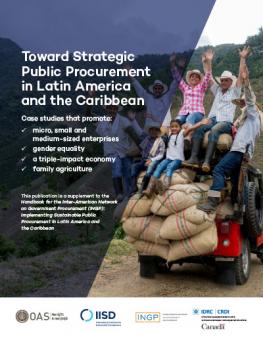
Toward Strategic Public Procurement in Latin America and the Caribbean
This paper presents four best practice case studies and key ingredients of procurement reform to enable the shift toward strategic public procurement for sustainable development.
For public procurement to become a strategic lever for sustainable development, the entire procurement process and function of the public procurer must be redesigned. Latin American and Caribbean countries have been working together with IISD through the Inter-American Network on Government Procurement (INGP) on the transformation of public procurement from an administrative to a strategic function.
This paper presents four best practices from the region on how that transformation is taking place. It discusses how procurement has been used to contract with micro, small and medium-sized enterprises in the Dominican Republic, to support family agriculture in Paraguay, to promote the triple-impact economy in Argentina, and to advance gender equality in Chile.
The paper concludes with 10 key ingredients for strategic public procurement for sustainable development in the region.
This publication builds on the Handbook for the Inter-American Network on Government Procurement (INGP): Implementing Sustainable Public Procurement in Latin America and the Caribbean (Casier et al., 2015). It aims to provide guidance to the INGP network for taking the next step on Sustainable Public Procurement.
The 10 key ingredients for strategic public procurement reform are:
The definition of public policy priorities as a precursor to public procurement reform
Evidence-based assessments to identify barriers, challenges, and interventions for reform
Capacity building of both procurement agencies as well as suppliers
The use of technology and digitization to eliminate access barriers
The existence of an enabling legal framework
Leadership by procurement agencies beyond their traditional scope of authority
Interagency collaboration and a multistakeholder approach
Understanding reform as a continuous learning process that needs to be monitored and redirected based on feedback
Knowledge about suppliers and their product and service offering
A solid internal and external communication strategy
IISD and Organization of American States (OAS), 2020
Report
IGF Guidance for Governments: Improving legal frameworks for environmental and social impact assessment and management
This IGF guidance document offers governments a summary of international best practices in legal frameworks for environmental and social impact assessment and related management plans for large-scale mines.
The IGF Secretariat’s Guidance for Governments: Improving legal frameworks for environmental and social impact assessment and management offers IGF member states a summary of international best practices in legal frameworks for environmental and social impact assessment (ESIA) and related management plans for large-scale mines.
It includes examples, strategies, and tools to aid in evaluating and improving legal frameworks and environmental and social aspects of resource governance.
When improperly regulated, mining activities have the potential to harm the environment and disrupt social and economic structures within a community instead of capturing the many benefits that can flow from the sector. ESIAs and related tools, such as environmental and social management plans, are thus critical components in legal frameworks for mining activities, both to minimize the negative impacts and to optimize the positive contributions of the mining sector.
With mining activities taking place in jurisdictions with varying levels of social and environmental protection, a survey of best practices for the governance of environmental and social impacts and the benefits of mining through all phases of the life cycle of the mine, from exploration through the postmining transition, is fundamental. When the legal framework adequately addresses the timing, scope, implementation, monitoring, and enforcement processes of ESIA and related management frameworks, governments and other stakeholders have a roadmap for managing impacts and optimizing social and economic benefits from the mining sector.
This report provides the results and technical background of the Sustainable Asset Valuation (SAVi) assessment of the Saloum Delta in Senegal. It finds that the value of the ecosystem services provided by the Delta is degrading over time and, without conservation or restoration interventions, will continue doing so.
The assessment provides an economic valuation of the contribution of the Delta to local livelihoods and regional development. It assesses a range of scenarios and simulates how these scenarios affect the economic contribution of the Saloum Delta.
Different stakeholders are using this study to identify and implement strategies that both protect the Saloum Delta ecosystem and increase revenues from the ecosystem services. The more revenues the ecosystem services can provide, the higher the incentive will be for stakeholders to prioritize its continued maintenance and upgrading.
Determining the Status of Fish Stocks in Data-Poor Environments and Multispecies Fisheries
Some of the possible new World Trade Organization rules on fisheries subsidies could apply only when fish stocks are overfished or fishing is unsustainable. How can this be assessed in the context of data-poor and multispecies fisheries?
More than 80% of global catches occur in fisheries that lack the necessary data, resources, and infrastructure to conduct quantitative model-based stock assessments.
Developing countries with multi-gear, multi-species, and data-limited fisheries can face particular challenges in using the most common methods to assess fish stocks, which are often based on the concept of maximum sustainable yield.
A variety of methods can be used to assess the health of fish stocks. While some of these methods require quantitative data and modelling, others do not, relying instead on the use of expert judgment applied to relatively simple information gathered.
In implementing possible new World Trade Organization (WTO) rules on fisheries subsidies, WTO members could use a wide range of “alternative reference points” to establish when a stock is overfished or when overfishing is occurring. These include reference points and corresponding indicators that are more suitable to data-poor and multispecies fisheries.
World Trade Organization (WTO) negotiations on fisheries subsidies aim to discipline the financial support provided by governments to their fishing sector to ensure that it does not have harmful impacts on marine resources and those who depend on them for food and income. The application of some of the possible rules currently discussed by WTO members would depend on whether fish stocks are in an overfished condition or whether overfishing is occurring.
Methods commonly used to assess the health of fish stocks and the sustainability of fishing effort, however, can have substantial data requirements. A key concern in the negotiations is thus how these subsidy disciplines could be applied by governments with little access to data about the state of their stocks. This brief provides an overview of methods for assessing fish stock status in data-poor and multispecies fisheries and highlights some key implications for WTO negotiations on fisheries subsidies.
An Application of the Sustainable Asset Valuation (SAVi) Methodology: Assessing the economic value of restoring the wetlands of S'Ena Arrubia and Corru S'Ittiri-Marceddì-San Giovanni in the Gulf of Oristano in Sardinia, Italy
An application of the Sustainable Asset Valuation (SAVi) methodology
This assessment uses the Sustainable Asset Valuation (SAVi) to calculate the economic and societal value generated by the S’Ena Arrubia and Corru S’Ittiri-Marceddì-San Giovanni wetlands in the Gulf of Oristano in Sardinia, Italy.
S’Ena Arrubia and Corru S’Ittiri-Marceddì-San Giovanni lagoons in Sardinia will generate cumulative ecosystem services worth EUR 306 million between 2020 and 2060. If there is no degradation in wetland quality, an additional value of EUR 171 million could be captured over 40 years.
After adjusting for the cost of production facilities, the circular business scenario of reusing livestock manure generates a net benefit of EUR 81.3 million in S’Ena Arrubia and EUR 124.2 million in Corru S’Ittiri-Marceddì-San Giovanni.
This assessment uses the Sustainable Asset Valuation (SAVi) to calculate the economic and societal value generated by the S’Ena Arrubia and Corru S’Ittiri-Marceddì-San Giovanni wetlands in the Gulf of Oristano in Sardinia, Italy. They are protected by the Ramsar Convention, an international treaty for the conservation and sustainable use of wetlands. The two sites are important biodiversity reservoirs due to the presence of numerous plant and animal species, and they provide essential ecosystem services. They enable a range of local industries, including agriculture, tourism, fisheries, and aquaculture.
This SAVi assessment covers the following topics:
The dollar value of the ecosystem services provided by the S’Ena Arrubia and Corru S’Ittiri-Marceddì-San Giovanni wetlands.
The dollar value of the labour income generated by tourism, fisheries, and agriculture that is enabled and enhanced by the wetland sites.
Capital and operating costs of built infrastructure that will provide the same output of services. This is important to enable stakeholders to compare and contrast natural capital with built assets.
The financial feasibility of circular economy solutions in the reuse of agricultural waste.
The possibility of re-targeting direct income support in the agriculture sector toward better environmental performance.
This report first presents Jamaica’s development, mining, and legal contexts. It then highlights the key strengths and gaps in Jamaica’s mining policies and laws across six thematic areas before making recommendations for further capacity building and reform.
Jamaica has a range of commercially exploitable minerals, including metallic minerals (including bauxite and gold), non-metallic minerals, (clay, dolomite, gypsum, limestone, marble, sand and gravel, silica sand, volcanic rocks, and shale) and semi-precious minerals.
With the exception of the bauxite/alumina sector, most of Jamaica’s minerals are in the early stages of development. The sector accounts for approximately 2.2% of Jamaica’s GDP and employs around 6,000 workers, mostly Jamaicans.
For the mining sector to be a central pillar of Jamaica’s continued development as envisaged in its national development plan, Vision 2030, a strong legal and policy framework is required, one that maximizes the benefits accrued to the nation and to communities from the mining sector. This framework should promote investment while upholding strong environmental and social standards.
Mining can play a significant role in Jamaica’s long-term social and economic development: it can generate revenues for the government; create employment, skills development, and business opportunities for local
communities; provide the material inputs for infrastructure; and support investments in education, health, and clean technology.
At the request of the Government of Jamaica, and in collaboration with the Ministry of Transport and Mining, the Intergovernmental Forum on Mining, Minerals, Metals and Sustainable Development (IGF) is working to advance such policies and good governance practices in Jamaica through the use of its Mining Policy Framework (MPF).
This assessment report first presents Jamaica’s development, mining, and legal contexts. It then highlights the key strengths and gaps in Jamaica’s mining policies and laws across six thematic areas: Legal and Policy Environment, Financial Benefit Optimization, Socioeconomic Benefit Optimization, Environmental Management, the Post-Mining Transition, and Artisanal and Small-scale Mining, before making recommendations for further capacity building and reform.
Rethinking Eskom: Lessons from electricity sector reform in India and Mexico
As South Africa debates how to reform its struggling electricity sector, this publication reviews how international experience from India and Mexico could inform the debate.
Reforms should reflect the South African context and impacts beyond economic efficiency. Electricity sector reforms in India and Mexico cannot be said to follow the "standard model" of reform. They are nationally specific.
Unbundling and privatization in isolation will not fundamentally improve the economics of the electricity sector.
Power auctions and opening up to private generators have driven growth in renewables, but this may not be acceptable in the South African context.
South Africa is debating the reform of its heavily indebted state-owned electricity utility Eskom. This paper explores two international examples of electricity sector reform in emerging economies with comparable characteristics—India and Mexico. It finds that the "standard model" of electricity sector reform does not adequately address the challenges facing the sector. In addition, reforms should consider the South African context and impacts beyond economic efficiency and consider the need to keep prices affordable for the poor, vulnerable, and small, medium, and micro enterprises (SMMEs), provide decent jobs, reduce coal dependence, and acknowledge calls to retain forms of public and community ownership.
North America and Europe are driving demand for sustainably produced bananas, which have captured a 10% share of some markets.
From 2008 to 2016, voluntary sustainability standard-compliant bananas grew to account for at least 7% of the sector (36% of exports).
Asia is the largest producing region, but 80% of exported bananas come from Latin America and the Caribbean.
Bananas (including plantains) are the world’s fourth most important staple crop (after wheat, maize, and rice). The sector faces a variety of sustainability issues, including crop disease, climate change impacts, excessive pesticide use, and poor labour practices. Banana producers are increasingly using voluntary sustainability standards (VSSs) to tackle the sector’s sustainability challenges.
This report is the sixth in IISD’s Sustainable Commodities Marketplace Series, which presents market information and analysis on agricultural commodities to foster transparency, knowledge, and strategic decision making for sustainable development.
The National Adaptation Plan (NAP) process provides an unprecedented opportunity to reduce vulnerability to climate change, while also redressing social and gender inequalities. To realize this potential, a gender-responsive approach to the NAP process is needed.
Our first synthesis report, Towards Gender-Responsive NAP Processes: Progress and Recommendations for the Way Forward, highlighted the challenges and opportunities that countries face in taking a gender-responsive approach to their NAP processes and made recommendations for taking this forward. This second synthesis report provides an overview of the areas that have made significant progress in the last two years, as well as the additional efforts that will be required in the coming years.
This report aims to help countries engaged in NAP processes use a gender-responsive approach, regardless of where they are in the process. This may also be of interest to development partners who are providing capacity development and technical support to adaptation actors involved in NAP processes.
Joint Statement on Micro, Small, and Medium-Sized Enterprises: History and latest developments in the Informal Working Group
This brief outlines the history and developments of MSME-related discussions in the World Trade Organization (WTO) context, looking specifically at MSME-related issues at the WTO as well as in other forums and contexts.
This brief was prepared for the virtual seminar on the Joint Statement Initiative (JSI) devoted to micro, small, and medium-sized enterprises (MSMEs), held on May 8, 2020.
The brief outlines the history and developments of MSME-related discussions in the World Trade Organization (WTO) context, looking specifically at MSME-related issues at the WTO as well as in other forums.
This material has been produced with funding by U.K. aid from the U.K. Government. It was produced as part of the TAF2+ Umbrella Grant Project on New WTO Issues, which covers the areas of investment facilitation, electronic commerce, and MSMEs.
The Umbrella Grant is a project of the Trade and Investment Advocacy Fund (TAF2+) and is implemented by the International Institute for Sustainable Development, in consortium with CUTS International, Geneva; BKP Economic Advisors; and InterAnalysis. The papers for our Geneva Seminars and virtual seminars benefited from the review of our editorial oversight committee, including Nathalie Bernasconi-Osterwalder, Rashid Kaukab, Julien Grollier, Rashmi Jose, Susan Joekes, and Julian Mukiibi. Views expressed in the publication are the authors' own and do not necessarily reflect HM Government’s official positions or those of TAF2+.