Report

Advancing Gender-Responsive and Socially Inclusive Practices in Nature-Based Solutions for Adaptation

By sharing promising practices and lessons learned, these case studies seek to inform and inspire adaptation practitioners and planners to help ensure that gender-responsive and socially inclusive practices are integrated throughout the lifetime of a project.

February 17, 2025

Key Findings

  • Including diverse voices (women, youth, Elders, and so on) in project activities and providing safe, inclusive spaces for sharing can help enhance operations and improve the effectiveness of nature-based solutions for adaptation projects.

  • For nature-based solutions programming to be effective, it is important to build trust with community members and establish local partnerships and relationships with trusted liaisons and facilitators—particularly those from equity-deserving groups.

  • Investing in citizen science and community-led, gender-responsive, and socially inclusive monitoring, evaluation, and learning processes is key to better understand the varied impacts of climate change and biodiversity loss on local communities.

While there is an increased push for nature-based solutions (NbS) projects around the globe, a gap in evidence exists on projects that promote gender equality and social inclusion (GESI) outcomes. Designing NbS for adaptation projects to be responsive to differences in intersecting identity factors, such as gender, age, sexuality, socio-economic status, Indigeneity, and ability, is important. Considering these factors can help build the adaptive capacity of equity-deserving groups to climate change, enable these groups to participate in adaptation planning and decision making, and strengthen the resilience of their local ecosystems.

To address this gap in evidence, these two case studies have been developed as a supplement to the Nature for Climate Adaptation Initiative report, Mainstreaming Gender Equality and Social Inclusion in Nature-based Solutions for Climate Change Adaptation. They provide practical examples of integrating GESI considerations at various stages of implementing NbS for adaptation.

The first case study showcases a gender-responsive and socially inclusive approach to climate resilience planning for small-scale cooperatives in Zanzibar. The case study demonstrates how understanding the gendered context of operations and governance structures, assessing climate risks using a GESI lens, and identifying and selecting options with inclusivity in mind can enhance the efficacy and sustainability of NbS for adaptation.

The second case study provides a practical example of socially inclusive implementation and monitoring, evaluation, and learning as part of an Indigenous Guardians program that seeks to incorporate Traditional Knowledge and practices into land and wildlife management to better adapt to a changing climate in Canada.

Each case study includes an overview of the local context and climate risks, how the project considered the need for climate change adaptation and integrated gender-responsive and socially inclusive practices, and lessons learned. The case studies were developed through interviews with project implementers and by reviewing relevant reports and documents.

The report is part of a compendium of resources developed by the Nature for Climate Adaptation Initiative (NCAI), which is supported by Global Affairs Canada.
Brief

IGF Case Study: Inclusive Closure and Post-Mining Transition at the Golden Pride Mine, Tanzania

This IGF case study of an open-pit gold mine in Tanzania provides good examples of how closure and post-mining transition can be done effectively and inclusively.

November 29, 2022

Successful mine closure is a vital part of the full life cycle of a mining operation. Preparing for closure starts early and continues throughout the mine life until all closure activities have been completed according to the agreed-upon closure criteria. Mine closure is a multifaceted activity that includes engaging with communities and stakeholders, reclaiming, and stabilizing a mine site such that it is environmentally sound and productive into the future, as well as supporting the post-mining resilience of communities. Every mining operation is unique, and the approaches to closure must be tailored to the environmental, social, economic, and regulatory context of each mine.

This case study of the Golden Pride open-pit gold mine in Tanzania provides good examples of how closure and post-mining transition can be done effectively and inclusively. It outlines the steps that were taken by the mine, the Government of Tanzania, and local communities to define and implement the closure plan for the operation. It provides a summary of the steps taken to define post-mining land use, implement closure activities, and support opportunities for the post-mining resilience of communities. It concludes with an outline of lessons learned and policy implications for governments, including the importance of early engagement with communities, the need for adaptable post-mining land use plans, the benefits of progressive reclamation, the importance of addressing post-closure site safety and security, and the value of applying international best practices to mine closure.

Brief details

Podcast

Down to Earth: How to Protect Africa's Great Lakes

There are great lakes all over the world.

But you may have only heard of the Laurentian—or North American—Great Lakes.

July 15, 2021

In this episode of Down to Earth, we want to introduce you to the African Great Lakes and explain why they matter to so many people—and why they may be more familiar than you think.

We also hear from two researchers, from very different backgrounds, who explore a new partnership between the International Institute for Sustainable Development and the African Center for Aquatic Research and Education that brings researchers across two continents together to work to protect the African Great Lakes.

Report

A Sustainable Asset Valuation of the Kakono Hydropower Plant in Tanzania

Assessing Climate Risks and Externalities of Hydropower and Energy Generation Alternatives

July 6, 2021

In this SAVi assessment, an asset performance of the Kakono HPP is evaluated by (1) integrating environmental and socio-economic costs and co-benefits (externalities) into the assessment, (2) evaluating the performance impacts of different climate scenarios, and (3) comparing it to the performance of two hypothetical energy generation alternatives.

Report details

Topic
Climate Change Adaptation
Infrastructure
Region
Tanzania
Impact area
Climate
Nature
Sustainable Economies
Publisher
IISD
Copyright
ECMWF, 2021
Webinar

Virtual Fireside Chat: How Two Continents Are Working Together to Improve The Health Of The African Great Lakes

Did you know that scientists across North America and Africa are putting their heads—and expertise—together on issues including algal blooms, climate change, invasive species, fragile fisheries, to name but a few, to improve the health of the African Great Lakes?

October 28, 2020 9:00 am - 10:00 am Central

(Open to public)

And this matters because the seven African Great Lakes contain around 25% of the world's fresh water and underpin the welfare and livelihoods of over 50 million people across 10 countries.

To hear their stories, and to learn more, we invite you to a virtual fireside chat on Wednesday, October 28, 2020, at 9:00 a.m. (CDT); 10:00 a.m. (EDT); 3:00 p.m. (CET); 4:00 p.m. (CAT); 5:00 p.m. (EAT).

You will discover:

  • Exactly what the African Great Lakes are, and why we need to collaborate in order to protect them
    • from Dr. Kevin Obiero, Chair, ACARE & Centre Director, Kenya Marine and Fisheries Research Institute
  • The critical role that women are playing
    • from Stephanie Smith, Strategic Advisor, IISD-ACARE
  • A case study of work already underway to protect the African Great Lakes
    • from Ms. Cecilia M. Githukia; Research Scientist; Kenya Marine and Fisheries Research Institute, Aquaculture Division


REGISTER HERE

Press release

Scientists from Two Continents to Work Together to Improve the Health of the African Great Lakes

The International Institute for Sustainable Development and the African Center for Aquatic Research and Education join forces to strengthen the global large-lakes scientific community.

September 15, 2020

ANN ARBOR, MI—World-class scientists and researchers from across North America and Africa will soon be putting their heads (and expertise) together to tackle some of the most pressing issues—algal blooms, climate change, invasive species, fragile fisheries, to name but a few—facing the African Great Lakes (AGL).

The AGL are highly valuable natural resources, renowned for their rich fisheries and "biodiversity hotspots." Consequently, they, and the ecosystem services they provide, underpin the welfare and livelihoods of over 50 million people across 10 countries.

This is all thanks to a new major partnership announced today between the International Institute for Sustainable Development (IISD) and the African Center for Aquatic Research and Education (ACARE). The IISD-ACARE collaboration will provide an opportunity for the world’s freshwater laboratory and networks on the African Great Lakes to come together and strengthen science on large freshwater resources and the countries in which they reside.

Despite the recognized importance of the AGL, these vital ecosystems and their livelihood support systems are threatened by the impact of human activity, such as overfishing and pollution at local, regional, and global scales.

To address some of the challenges on the African Great Lakes, IISD-ACARE, will combine the legal and policy expertise of IISD’s vast expert staff with ACARE’s African network of large-lakes experts in Burundi, the Democratic Republic of the Congo, Ethiopia, Kenya, Malawi, Mozambique, Rwanda, Tanzania, Uganda, and Zambia.

“We have recognized that no one organization, institution, or even country, can address the challenges that our global freshwater resources face. It is essential, therefore, to strengthen collaborations for leveraging the combined skills, assets, technologies and resources of public, private, and non-profit entities to deliver sustainable instruction, guidance, and research to protect these resources,” said Dr. Kevin Obiero, Chair, ACARE’s Board of Directors.

“Partnering with the International Institute for Sustainable Development will enhance our ability to strengthen science and positively affect policy and management on these critical resources and provide the experience of working with the global scientific community.”

Strengthening the IISD-ACARE approach is IISD’s Experimental Lakes Area (IISD-ELA)—the only place in the world where scientists can manipulate real lakes to understand what human activity does to fresh water. A series of 58 lakes and their watersheds in northwestern Ontario, Canada, IISD-ELA brings over 50 years of freshwater research like no other and policy analysis to inform decision making.

“ACARE has created a world-class, highly collaborative network of experts on each of the African Great Lakes,” said Dr. Matthew McCandless, Executive Director, IISD-ELA. “Resources from IISD and ACARE’s combined networks will allow us to accomplish three long-term goals: strengthening global and regional research partnerships; facilitating existing, and boosting new, transboundary and inter-jurisdictional lake advisory groups; and, strengthening the capacity of freshwater scientists through experiential education and public engagement.”

During its first year, the new partnership will boost the activities of six Advisory Groups that were created to address issues on each of the African Great Lakes (considered to be lakes Albert, Edward, Kivu, Malawi/Nyasa/Niassa, Tanganyika, Turkana, and Victoria). Members of each group are harmonizing priorities on the lakes to advance work on scientific inquiry, monitoring, climate change, and education and training, among other issues.


To learn more about the partnership and programs, click here.

For more information, or to arrange an interview, please contact:

Ted Lawrence, Executive Director, African Center for Aquatic Research and Education, [email protected]

Sumeep Bath, Communications Manager, IISD Experimental Lakes Area, [email protected]


About ACARE

The African Center for Aquatic Research and Education (ACARE) was established to help strengthen and harmonize science and information exchange through a highly collaborative network of freshwater experts.

Scientists from Two Continents Working Together to Improve the Health of the African Great Lakes

World-class scientists and researchers from across North America and Africa are putting their heads, and expertise, together to tackle some of the most pressing issues—algal blooms, climate change, invasive species, fragile fisheries, to name but a few—facing the African Great Lakes (AGL) today.

What are the African Great Lakes?

The AGL are highly valuable natural resources, renowned for their rich fisheries and "biodiversity hotspots." Consequently, they, and the ecosystem services they provide, underpin the welfare and livelihoods of over 50 million people across 10 countries. Despite the recognized importance of the AGL, these vital ecosystems and their livelihood support systems are threatened by the impact of human activity by numerous anthropogenic stressors at local, regional, and global scales.

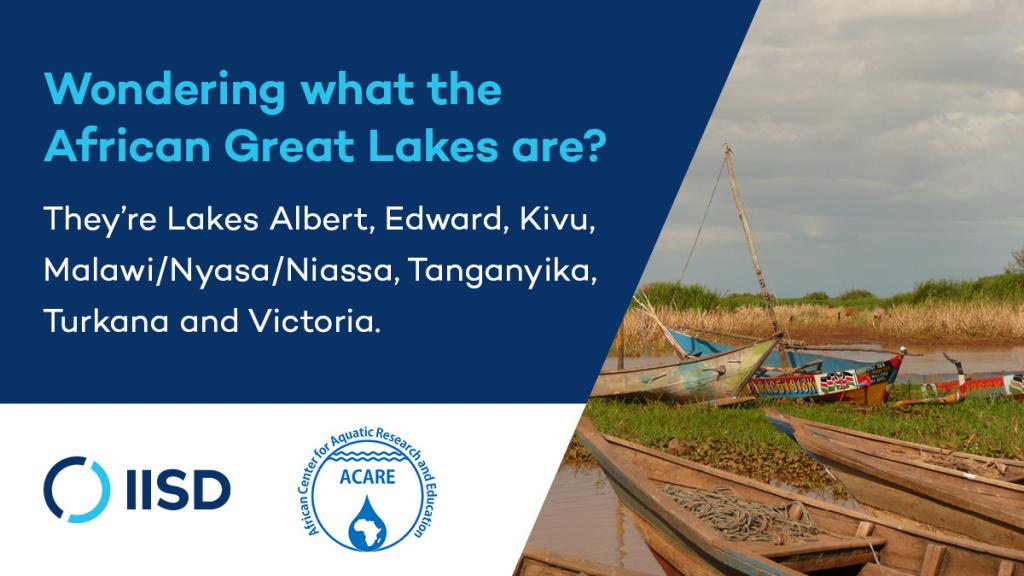
The African Great Lakes are lakes Albert, Edward, Kivu, Malawi/Nyasa/Niassa, Tanganyika, Turkana, and Victoria. You can learn more about the African Great Lakes here.

List of the African Great Lakes


How does this project work?

The partnership between the International Institute for Sustainable Development (IISD) and the African Center for Aquatic Research and Education (ACARE) provides an opportunity for the world’s freshwater laboratory and networks on the African Great Lakes to come together and strengthen science on large freshwater resources and the countries in which they reside.

IISD-ACARE combines the legal and policy expertise of IISD’s vast expert staff with ACARE’s newly created African network of large-lakes experts and scientists in Burundi, the Democratic Republic of the Congo, Ethiopia, Kenya, Malawi, Mozambique, Rwanda, Tanzania, Uganda, and Zambia.


What are we working on?

The partnership works to boost the activities of six advisory groups that were created to address specific issues on each of the African Great Lakes. Members of each group are harmonizing priorities on the lakes to advance work on scientific inquiry, monitoring, climate change, and education and training, among other issues.

An exciting flagship project of the initiative—the African Women in Science program—is a 10-month program designed by women, for women, to support the interests, needs, and goals of early-career scientists working on Africa’s freshwater issues. Dozens of women in science have now benefited from the program, including those who share their stories, and how the program has benefited their career, in the video below.


How can I learn more?

To learn more about the project, or to discuss research and collaboration opportunities, you can visit the ACARE website, or contact us directly.

Podcast

Down to Earth: How Farmers in Zanzibar Are Tackling Climate Change From the Ground Up

How are farmers on a small island off the coast of Tanzania adapting to climate change, restoring the local ecosystem, and protecting their livelihoods? It all starts with a spice forest.

July 13, 2020

In this episode, join IISD's Director of Communications, Zahra Sethna, as she travels to a small island off the coast of Zanzibar, which is very hilly, very green, and very much affected by climate change. 

"It's a big disaster," says Mbarouk Mussa Omar, the Executive Director of Community Forests Pemba, during a heat wave in the middle of February. "It's threatening our livelihood, our food security." 

Much of Pemba's Indigenous forests were cut down in the 19th century to open up land for growing cloves; since then, even more deforestation has occurred for construction, firewood, and other crops. But local farmers have come up with a creative solution to bring back the trees, regenerate the land, and become more resilient, all without sacrificing their income.

It starts with a spice forest. Press play to hear the full story.

Report

The Sustainable Asset Valuation of the Southern Agricultural Growth Corridor in Tanzania (SAGCOT) Initiative: A focus on irrigation

This report discusses the results of the application of the Sustainable Asset Valuation (SAVi) tool to irrigation infrastructure in the Southern Agricultural Growth Corridor in Tanzania.

December 27, 2018

The Southern Agricultural Growth Corridor of Tanzania (SAGCOT) is an initiative that aims to strengthen Tanzania’s agriculture sector.

IISD has carried out an economic and financial assessment of different irrigation options to deliver the outcomes of the SAGCOT initiative. IISD used the Sustainable Asset Valuation (SAVi) tool for this assessment.

SAVi is a simulation service that helps governments and investors value the many risks and externalities that affect the performance of infrastructure projects.

The distinctive features of SAVi are:

  • Valuation: SAVi values, in financial terms, the material environmental, social and economic risks and externalities of infrastructure projects. These variables are ignored in traditional financial analyses.
  • Simulation: SAVi combines the results of systems thinking and system dynamics simulation with project finance modelling. We engage with asset owners to identify the risks material to their infrastructure projects and then design appropriate simulation scenarios.
  • Customization: SAVi is customized to individual infrastructure projects.

Report details

Topic
Public Procurement
Food and Agriculture
Region
Tanzania
Project
The Sustainable Asset Valuation (SAVi)
Impact area
Sustainable Economies
Publisher
IISD
Copyright
IISD, 2018
Policy Analysis

Big Data for Resilience

Summary of a recent event looking at the links between Big Data, resilience and achieving long-term development goals, and the implications for practitioners, policy-makers and researchers.

June 27, 2018

Experiences around the world suggest that Big Data is enabling larger, creative and often socially driven changes involving highly diverse stakeholders.

But there is still a lot to learn about the links that exist between Big Data, resilience and the achievement of long-term development goals, and the implications for practitioners, policy-makers and researchers.

Seeking to address this gap, the International Institute for Sustainable Development (IISD) led the development of The Big Data for Resilience (BD4R) Storybook. The publication examines the experiences of six international organizations that are actively using Big Data to strengthen the resilience of vulnerable communities and ecosystems to a variety of shocks and stressors.

The BD4R Storybook was launched at an event hosted by the Wilson Center in Washington, D.C. This article summarizes some of the highlights from these discussions.

Policy Analysis details